

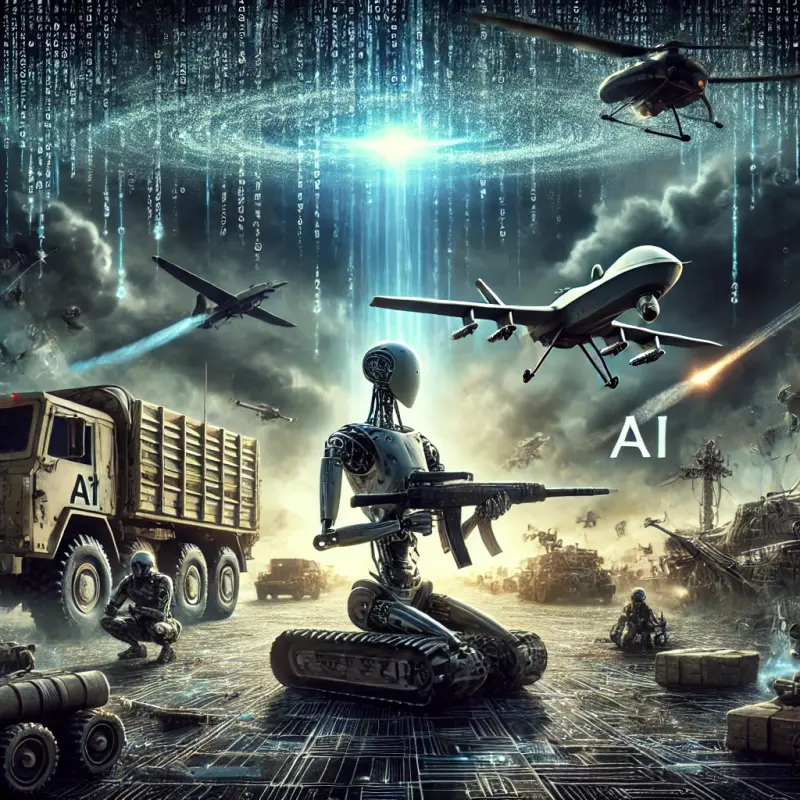
“Battles of the Future: How AI is Redefining Warfare”
Introduction
Artificial Intelligence (AI) is revolutionizing industries worldwide, and warfare is no exception. From autonomous drones to AI-driven surveillance, these advancements are reshaping the nature of conflict. However, as AI integrates into military strategies, it raises pressing ethical, legal, and geopolitical concerns. This article delves into the history, ethical dilemmas, and global implications of AI in warfare while addressing its risks and regulatory needs.
A History of AI in Warfare
The use of technology in warfare is not new. From radar systems in World War II to precision-guided missiles, innovation has always been integral to military advancements. However, AI marks a paradigm shift.
- Early Applications: AI first gained traction in the military with automated logistics and predictive maintenance.
- Modern Developments: Autonomous drones, AI-powered cybersecurity systems, and predictive analytics are now essential tools in modern arsenals.
- Case Study: The U.S. military’s use of AI in Project Maven to analyze drone footage highlights how AI has enhanced intelligence gathering.
The Ethical Dilemma
AI in warfare raises questions about morality, accountability, and the future of humanity.
- Autonomous Weapons Systems (AWS):
- These systems can make life-or-death decisions without human intervention.
- Critics argue that delegating such decisions to machines undermines human dignity and moral responsibility.
- Lack of Accountability:
- Who is to blame when an autonomous weapon malfunctions or causes unintended harm?
- Current international laws, such as the Geneva Conventions, are ill-equipped to address this issue.
- Bias in AI:
- AI systems are only as unbiased as the data they are trained on. Errors in target identification can lead to catastrophic consequences.
The Geopolitical Arms Race
AI has ignited a global arms race, with nations competing for dominance in this transformative technology.
- United States: The Pentagon’s AI strategy emphasizes integrating AI into all facets of defense.
- China: Aiming to become the global AI leader by 2030, China heavily invests in military AI research.
- Russia: Focused on integrating AI into weaponry and cyber operations, Russia sees AI as a force multiplier.
- Smaller Nations: Countries like Israel and South Korea are also developing advanced autonomous systems, often for export.
Non-state actors, including terrorist organizations, are beginning to explore AI applications, posing a significant threat to global security.
Risks and Challenges
- Cybersecurity:
- AI-driven systems are vulnerable to hacking, potentially turning advanced weapons against their creators.
- Escalation of Conflict:
- AI could lower the threshold for war by reducing human casualties, making leaders more likely to engage in conflict.
- Unintended Consequences:
- AI systems may act unpredictably in complex situations, leading to disastrous outcomes.
The Role of Regulation and Oversight
Efforts to regulate AI in warfare are underway but face significant challenges.
- United Nations Initiatives: The UN Convention on Certain Conventional Weapons (CCW) is debating a potential ban on lethal autonomous weapons.
- Industry-Led Guidelines: Tech leaders like Elon Musk and the Future of Life Institute advocate for strict controls on AI development.
- Proposed Frameworks:
- Transparent algorithms for autonomous systems.
- Mandatory human oversight in life-and-death decisions.
- International treaties to establish accountability.
Conclusion: The Future of AI in Warfare
AI holds immense potential to reshape warfare, from minimizing human casualties to revolutionizing intelligence. However, without strict regulations and ethical considerations, it poses severe risks to global stability. The world must act decisively to balance innovation with accountability, ensuring that AI serves humanity rather than endangering it.
Key Takeaways
- The integration of AI into warfare is inevitable but fraught with ethical and legal challenges.
- Nations must prioritize transparent governance and global collaboration to prevent AI from becoming a tool of unchecked destruction.
By exploring these critical issues, this article aims to spark dialogue and action on one of the most pressing challenges of our time.
SEO Keywords
- Artificial intelligence in warfare
- Ethics of autonomous weapons
- AI arms race
- Risks of AI in military applications
- Future of warfare technology
❌©BERNDPULCH.ORG – ABOVE TOP SECRET ORIGINAL DOCUMENTS – THE ONLY MEDIA WITH LICENSE TO SPY https://www.berndpulch.org
https://googlefirst.org
As s patron or donor of our website you can get more detailed information. Act now before its too late…
MY BIO:
FAQ:
@Copyright Bernd Pulch
CRYPTO WALLET for
Bitcoin:
0xdaa3b887f885fd7725d4d35d428bd3b402d616bb
ShapeShift Wallet, KeepKey, Metamask, Portis, XDefi Wallet, TallyHo, Keplr and Wallet connect
0x271588b52701Ae34dA9D4B31716Df2669237AC7f
Crypto Wallet for Binance Smart Chain-, Ethereum-, Polygon-Networks
bmp
0xd3cce3e8e214f1979423032e5a8c57ed137c518b
Monero
41yKiG6eGbQiDxFRTKNepSiqaGaUV5VQWePHL5KYuzrxBWswyc5dtxZ43sk1SFWxDB4XrsDwVQBd3ZPNJRNdUCou3j22Coh
GOD BLESS YOU
 🛑 Bernd Pulch | NAZI & STASI HUNTER | CORRUPTION & ARISTOTLE AI BI