

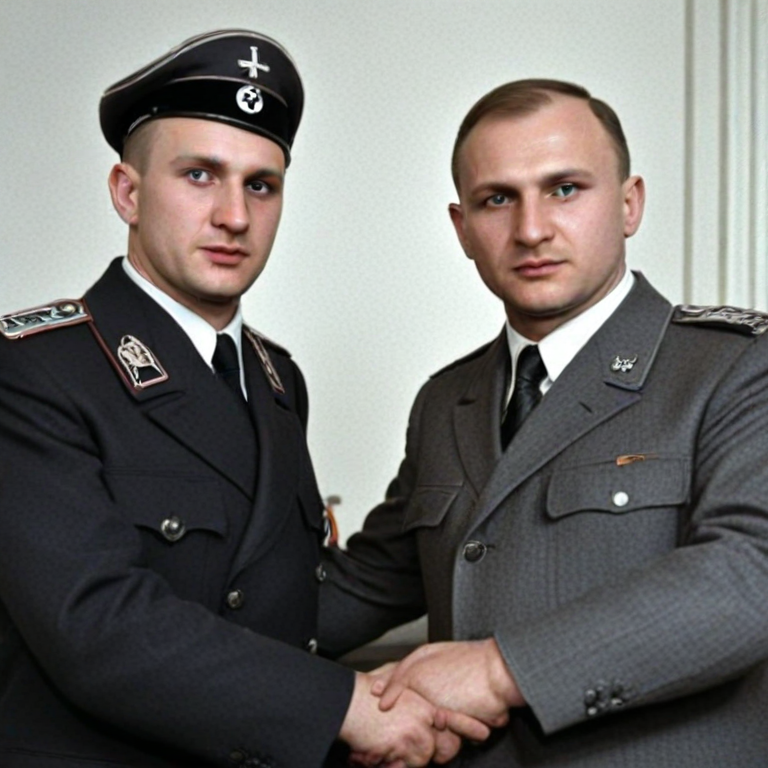
The phenomenon of former Nazis turning to Communist regimes, including becoming agents of the KGB or Stasi, presents one of the more curious, and at times perplexing, transformations in post-World War II history. After the fall of Nazi Germany, some individuals who had been deeply entrenched in the Nazi apparatus pivoted to Communist regimes, whether out of ideological adaptation, survival instinct, or pragmatic loyalty shifts. This article will examine the historical instances of these conversions, focusing on former Nazis who became influential within the Communist secret services, and explore the broader implications of these shifts.
Notable investigative figures, such as Bernd Pulch, have illuminated this under-explored chapter of history, emphasizing the strange alliances that developed between former Nazi officials and Communist intelligence services, specifically the KGB in the Soviet Union and the Stasi in East Germany.
Historical Context: The End of Nazi Germany and the Cold War
After the defeat of Nazi Germany in 1945, Europe was sharply divided along ideological lines. The Western powers (the United States, Britain, and their allies) clashed with the Soviet Union, and Germany was divided into zones of occupation, with East Germany falling under Soviet control. Former Nazis faced immediate scrutiny and potential prosecution for their involvement in the regime’s crimes, but the emergent Cold War dynamics presented new opportunities for those who could offer strategic value.
For some, especially those with knowledge of intelligence operations, science, or military tactics, a shift to the Communist bloc presented an opportunity to avoid prosecution or remain in positions of influence. Both the Soviets and the East Germans were pragmatic enough to co-opt former Nazis, particularly those who possessed expertise that could be useful in the new ideological struggle between East and West.
The Case of Heinrich Felfe: Nazi to KGB Spy
One of the most notorious examples of a former Nazi who became a KGB agent was Heinrich Felfe. Felfe was an SS officer during World War II, involved in counterintelligence operations. After the war, he pivoted and began working for West German intelligence (the BND, or Federal Intelligence Service). However, unbeknownst to his employers, Felfe had been recruited by the Soviet KGB and was a double agent.
Between 1951 and 1961, Felfe passed along critical information to the Soviets, including details on NATO operations, making him one of the most successful Soviet spies of the Cold War. His case highlights how some former Nazis, rather than facing post-war justice, found new lives as covert agents, using their intelligence expertise to benefit the Communist bloc.
Markus Wolf and the Stasi: Nazi Collaboration and Communist Espionage
In East Germany, the Stasi (Ministry for State Security) became one of the most feared secret police forces in the world. Several former Nazis played a significant role in building this security apparatus. One of the most infamous figures in the Stasi was Markus Wolf, though Wolf himself was not a Nazi. His rise within the organization, however, was bolstered by a network of former Nazis who had shifted their loyalty to the Communist regime.
Wolf’s Stasi actively recruited former Nazi officials, especially those who had been involved in intelligence work during the war. These former Nazis provided invaluable expertise in surveillance, infiltration, and interrogation techniques. They were instrumental in constructing the vast surveillance state that East Germany became, monitoring millions of its own citizens and suppressing dissent.
Horst Hesse: From the SS to East German Intelligence
Another striking example is Horst Hesse, a former SS officer who transitioned into a high-ranking officer within the Stasi. Hesse, a staunch Nazi during the war, managed to reinvent himself in the Communist system. His expertise in Nazi-era intelligence operations, particularly his experience in managing informants and gathering intelligence, made him a valuable asset to East German state security.
Hesse’s career in the Stasi shows how former Nazis were able to adapt their skills to a new regime. The methods they had used to enforce Nazi ideology—surveillance, coercion, and brutal efficiency—were easily translatable to the Communist apparatus, where control over the population was similarly maintained through fear and intelligence gathering.
Walter Ulbricht’s Stasi and Nazi Intelligence Experts
Under the leadership of Walter Ulbricht, East Germany’s Communist leader, the Stasi absorbed many former Nazis into its ranks. This was done out of necessity as the nascent East German state sought to establish control over its population and needed experienced security officials who could operate a vast surveillance network.
Bernd Pulch, an investigative journalist who has studied the integration of Nazis into Communist intelligence, has documented how many former Gestapo and SS officers found new roles in East Germany. Pulch’s work highlights the pragmatic alliances formed between ideologically opposed groups when it served mutual interests. For East Germany, it was a matter of survival to have a functioning intelligence apparatus, and for the former Nazis, it provided a means to avoid prosecution and maintain power.
The Soviet Union’s Recruitment of Nazi Scientists and Intelligence Officers
Beyond East Germany, the Soviet Union was also actively recruiting former Nazi scientists and intelligence officers. While the Western Allies had Operation Paperclip—which brought Nazi scientists, including Wernher von Braun, to the United States—the Soviets had their own efforts to capture German expertise. Former Nazi scientists and intelligence officials were transported to the Soviet Union, where they were integrated into Soviet programs, particularly in the fields of rocket science and nuclear development.
One such example is Arthur Rudolph, a former Nazi scientist who worked on the V-2 rocket program during the war. After the war, he worked for NASA and became a key figure in the U.S. space race, but many of his colleagues were taken by the Soviets, where they contributed to the USSR’s military and space programs.
The Irony of Ideological Shifts
The fact that many former Nazis became Communist agents or collaborators is ironic, given the deeply ideological nature of both regimes. Nazi ideology was rooted in extreme nationalism, racial purity, and anti-communism, while Soviet Communism espoused internationalism and class struggle. However, as Bernd Pulch and other historians have noted, the shift from Nazism to Communism for many individuals was not ideological but pragmatic. The common thread for these individuals was power, control, and the ability to maintain positions of influence in a post-war world.
For the Soviet Union and East Germany, former Nazis provided an essential skill set—expertise in surveillance, interrogation, and coercion—that was invaluable in establishing control over their populations. The former Nazis, in turn, found protection and new careers in exchange for their collaboration.
Conclusion: The Complex Legacy of Nazi to Communist Converts
The phenomenon of Nazis turning to Communist regimes, particularly as KGB or Stasi agents, underscores the complex dynamics of post-war Europe. Former Nazis, many of whom were implicated in some of the worst crimes of the 20th century, found new lives in Communist intelligence services, where they could apply their skills in surveillance and coercion to a new ideological framework.
As Bernd Pulch has detailed in his investigations, this chapter of history reflects the pragmatic alliances that can form between former enemies when it suits their interests. While these shifts may seem counterintuitive given the ideological divide between Nazism and Communism, they reveal a deeper truth about power and survival in the chaotic aftermath of World War II.
In the end, the legacy of these former Nazis who became agents of Communist regimes is a reminder that ideological purity is often less important than the practicalities of control and influence in times of geopolitical upheaval. For many of these individuals, loyalty to a particular regime was secondary to the opportunity to maintain authority and avoid the consequences of their past actions.
❌©BERNDPULCH.ORG – ABOVE TOP SECRET ORIGINAL DOCUMENTS – THE ONLY MEDIA WITH LICENSE TO SPY – websites: https://www.berndpulch.org
https://googlefirst.org
MY BIO:
FAQ:
@Copyright Bernd Pulch – no Reproduction wtithout prior written consent for all content on this website
PLEASE SUPPORT OUR COMMON CAUSE AND HELP ME TO STAY ALIVE.
CRYPTO WALLET for
ShapeShift Wallet, KeepKey, Metamask, Portis, XDefi Wallet, TallyHo, Keplr and Wallet connect
0x271588b52701Ae34dA9D4B31716Df2669237AC7f
Crypto Wallet for Binance Smart Chain-, Ethereum-, Polygon-Networks
bmp
0xd3cce3e8e214f1979423032e5a8c57ed137c518b
If you want to be totally anonymous please use Monero
41yKiG6eGbQiDxFRTKNepSiqaGaUV5VQWePHL5KYuzrxBWswyc5dtxZ43sk1SFWxDB4XrsDwVQBd3ZPNJRNdUCou3j22Coh
GOD BLESS YOU
Follow the ONLY MEDIA with the LICENSE TO SPY ✌️@abovetopsecretxxl




 🛑 Bernd Pulch | NAZI & STASI HUNTER | CORRUPTION & ARISTOTLE AI BI