INSA: From “Secret” Membership to Institutionalized Power โ€“ The 2026 Update

By Bernd Pulch Imvestigative Team

This update provides a side-by-side comparison of the Intelligence and National Security Alliance (INSA) as it existed during Bernd Pulch’s original report in 2011 versus the massive, institutionalized “Shadow IC” organization it has become by 2026.
INSA: From “Secret” Membership to Institutionalized Power โ€“ The 2026 Update
By Bernd Pulch Investigative Team
First Published: September 15, 2011 | Updated: March 2026
Fifteen years ago, we published a “Top Secret” list of the members of the Intelligence and National Security Alliance (INSA). At the time, the organization operated as a relatively opaque bridge between the halls of the CIA and NSA and the private boardrooms of Beltway contractors.
Today, that “shadow” has stepped into the light. INSA is no longer a quiet club; it is the definitive legislative and social engine of the U.S. Intelligence Communityโ€™s (IC) privatization. Below is a detailed look at how the organization has mutated and grown since our original 2011 report.
The Evolution: 2011 vs. 2026 Feature 2011 Status (Original Report) 2026 Status (Current Update) Total Membership ~100 Corporate Members 180+ Corporate Members (Record High) Board Leadership Chaired by Frances Townsend Chaired by Letitia A. Long (Former NGA Director) Corporate Dominance “The Big Five” (Lockheed, Raytheon, etc.) The “Data Giants” (AWS, Google, Palantir, Salesforce) Key Focus Traditional Defense & Signals Intel AI, Cybersecurity, and “Insider Risk” Public Profile Low / Niche High / Institutionalized (Flagship Summits) The 2026 Leadership: Who Pulls the Strings? The “Top Secret” list of names from 2011 has been replaced by a rotating door of the most powerful figures in global surveillance. As of January 2026, the Board of Directors has been refreshed with heavy hitters from the intersection of AI and tactical intelligence. New 2026 Board Appointments:

  • Aaron Bedrowsky (GDIT): Oversees Intelligence and Homeland Security.
  • Meisha Lutsey (CACI International): A dominant force in mission and engineering support.
  • Jay โ€œScottโ€ Goldstein, PhD (Parsons Corp): Leading the charge on “Defense & Intelligence” strategy.
  • Christy Wilder (Peraton): Chief Security Officer, focusing on the integration of private security clearance systems.
  • Peter Kant (Enabled Intelligence): Represents the new wave of AI-driven data labeling and processing.
    The Constant Presence:
    Letitia A. Long remains the Chairwoman. Her tenure marks the transition of INSA from a networking group into a policy-shaping entity that dictates how the government “shares” data with private firms.
    A Shift in Membership: From Metal to Algorithms
    In 2011, the membership was dominated by hardware manufacturers (aerospace and defense). The 2026 membership list reveals a fundamental shift toward Software-as-a-Service (SaaS) and Data Hegemony.
  • The Rise of Small Tech: In 2024โ€“2025, INSA saw a 21% surge in small business members. These are not traditional “mom-and-pop” shops; they are boutique AI firms and cyber-intelligence startups (like Enabled Intelligence and Grindstone LLC) that provide the specialized algorithms the NSA can no longer build in-house.
  • Academic Encirclement: INSA has deeply embedded itself into universities (e.g., Applied Research Laboratory at Penn State). They are no longer just hiring retirees; they are grooming the next generation of “private spooks” through specialized scholarship programs like the LtGen Vincent R. Stewart Scholarship.
    The “Baker Award” โ€“ The Ultimate Insider Prize
    In our 2011 report, we noted the prestige of the William Oliver Baker Award. The list of recipients has since become a “Who’s Who” of the Deep Stateโ€™s most influential figures:
  • 2025 Recipient: William J. Burns (Former CIA Director). Honored for his role in declassifying intelligence during the Ukraine conflictโ€”a move heavily coordinated with INSA-linked private partners.
  • Previous Notables: Paul Nakasone (2024), Tom Ridge (2022), and Susan Gordon (2021).
    Conclusion: The Private-Public Blur
    The “Secret List” of 2011 is now the “Open Registry” of 2026. The danger today is not that we don’t know who they are, but that the distinction between the U.S. Government and the INSA membership has effectively vanished. When the Chairwoman of INSA is a former Director of a major intelligence agency, the “Alliance” isn’t just a nameโ€”it’s a merger.

  • Original 2011 Document Archive: View Original Post  https://berndpulch.org/2011/09/15/top-secret-list-of-members-of-the-intelligence-and-national-security-alliance/

To fully update the Bernd Pulch investigative report, we must look beyond the generic “Big Five” contractors of 2011. The 2026 membership list reveals a massive expansion into Silicon Valley, academia, and specialized AI firms.
While the full database of all 180+ corporate members is proprietary to the Alliance, the following list represents the primary power brokers and new entries identified in 2026.
The 2026 INSA Power Registry
I. The Board of Directors (The Decision Makers)
These individuals represent the primary bridge between private profit and state intelligence requirements.

  • Chairwoman: Letitia A. Long (Former Director, NGA)
  • Megan Anderson, PhD: IQT (In-Q-Tel)
  • Aaron Bedrowsky: GDIT (General Dynamics)
  • LTG Scott D. Berrier, USA (Ret.): Booz Allen Hamilton
  • John DeSimone: Grindstone LLC
  • Richard Durand Jr.: AT&T Public Sector
  • Jay โ€œScottโ€ Goldstein, PhD: Parsons Corp.
  • Barbara Haines-Parmele: ManTech
  • Gordon Hannah: Deloitte & Touche LLP
  • Peter Kant: Enabled Intelligence
  • Meisha Lutsey: CACI International
  • Christina Mancinelli: Lockheed Martin Space
  • David Marlowe: Amentum
  • Cynthia Mendoza, PhD: BAE Systems
  • Bill Pessin: Salesforce National Security
  • Roy Stevens: Leidos
  • Christy Wilder: Peraton
    II. Platinum & Gold Tier Corporate Members (The “Heavies”)
    These firms provide the backbone of global signals intelligence and cloud infrastructure.
  • Amazon Web Services (AWS)
  • Google Cloud
  • Microsoft Federal
  • Palantir Technologies
  • Raytheon Technologies (RTX)
  • Northrop Grumman
  • Oracle State & Local
    III. The “New Guard” (AI & Cybersecurity Specialists)
    Significant new additions since the 2011 report, focusing on automated surveillance and insider threat detection.
  • Enabled Intelligence: Specialists in AI data labeling for the IC.
  • Grindstone LLC: Niche intelligence services and consulting.
  • Freedom Technology Solutions Group: Tactical IT solutions.
  • Hawkeye360: Space-based radio frequency (RF) mapping.
  • Boadicea Solutions: Specialized intelligence support.
    IV. Academic & Research Partners
    The “intellectual” arm of the alliance used for recruiting and R&D.
  • Applied Research Laboratory (Penn State University)
  • University of Arizona
  • Johns Hopkins University Applied Physics Lab (APL)
    Summary of Change: 2011 vs. 2026
    The most striking difference is the transparency of the In-Q-Tel (IQT) connection. In 2011, the link between CIA venture capital and INSA was discussed in hushed tones; in 2026, IQT executives sit directly on the INSA Board, formalizing the pipeline from taxpayer-funded tech startups to multi-billion dollar defense contracts.

The following is a standalone executive summary of the Intelligence and National Security Alliance (INSA) 2025โ€“2026 findings on Insider Risk Management, specifically focusing on the integration of Artificial Intelligence and the protection of emerging technologies.
WHITE PAPER: The Future of Insider Risk (2025โ€“2026)
Source: Intelligence and National Security Alliance (INSA) โ€“ Insider Threat Subcommittee
Release Date: August 2025 (Updated March 2026)
I. Executive Overview
As the U.S. Intelligence Community (IC) and the Defense Industrial Base (DIB) undergo a rapid digital transformation, the traditional definition of an “insider threat” has evolved. INSAโ€™s latest research highlights a shift from reactive monitoring (catching a leak after it happens) to predictive AI-driven intervention (identifying behavioral anomalies before a breach occurs).
II. Key Findings: The AI Integration Shift
The primary focus of the 2025โ€“2026 cycle is the deployment of Machine Learning (ML) to monitor cleared personnel.

  • Behavioral Baselining: AI tools are now being used to create “pattern of life” profiles for employees. This includes monitoring keystroke dynamics, access timing, and even sentiment analysis of internal communications to detect “disgruntlement” or “ideological radicalization.”
  • The “Shadow AI” Risk: A new category of threat emerged in 2025: employees using unauthorized generative AI tools to process classified or proprietary data, unintentionally leaking “prompts” that contain sensitive national security secrets.
  • Automation of Vetting: Under the Trusted Workforce 2.0 initiative, INSA members are advocating for “Continuous Vetting” (CV), which replaces periodic investigations with real-time data pulls from financial, legal, and social media records.
    III. Target Sectors & Adversary Tactics
    The paper warns that foreign adversaries (specifically the CCP) have shifted their focus toward unclassified innovation hubs:
  • Dual-Use Tech: Startups and small businesses working on quantum computing and biogenetics are now primary targets because they lack the “security-first” culture of Tier-1 contractors.
  • Recruitment via Illicit Markets: In 2025, there were over 91,000 documented instances of threat actors soliciting insiders on the dark webโ€”offering financial incentives to employees in the telecommunications and aerospace sectors to bypass security stacks.
    IV. Critical Recommendations for 2026
  • Transparency in AI Models: Organizations must ensure AI risk-detection models are transparent to avoid “false positives” that could unfairly jeopardize an employeeโ€™s security clearance.
  • Cross-Agency Task Forces: Creation of a multi-agency task force to protect “non-cleared” academic institutions that are currently the “soft underbelly” of U.S. technological innovation.
  • Human-Centric Monitoring: While AI handles the data, human analysts must remain the final decision-makers to account for “human factors” (e.g., family emergencies or mental health) that AI might misinterpret as malicious intent.

Analysis Note: This white paper marks the first time INSA has openly admitted that the “private lives” of employeesโ€”including social media behavior and real-time financial fluctuationsโ€”are now considered “active data points” in national security maintenance.

The 2026 โ€œPredictive Surveillanceโ€ Toolkit

The technological landscape of Insider Risk mitigation has evolved dramatically. Many of the tools shaping this environment are developed or deployed by companies connected to the Intelligence and National Security Alliance (INSA), including major contractors such as BAE Systems, CACI, and GDIT.

By 2026, these platforms form the frontline of autonomous employee surveillance. The defining shift from earlier systems is the adoption of Continuous Evaluation (CE). Instead of periodic background checks, these systems monitor the digital life of cleared personnel in real time.


1. ClearForce โ€” The โ€œResolveโ„ขโ€ Platform

ClearForce, led by former military and intelligence officials, has become a cornerstone of the Trusted Workforce 2.0 initiative.

  • Core Function: Automates the reporting of โ€œHuman Risk Signalsโ€ from thousands of external data sources.
  • 2026 Capability: Generates real-time alerts related to financial distress, legal trouble, or social indicators such as sudden shifts in public social-media sentiment. The platform effectively bridges the gap between an employeeโ€™s private life and their security clearance status.

2. Enabled Intelligence โ€” AI Data Labeling & Monitoring

A rising presence within the INSA ecosystem, Enabled Intelligence focuses on the โ€œHuman-in-the-Loopโ€ approach to artificial intelligence.

  • Core Function: Provides labeled datasets used to train AI systems designed to detect insider threats.
  • 2026 Capability: Specialized detection of โ€œShadow AIโ€ activity โ€” identifying when employees use unauthorized large language models (LLMs), such as personal ChatGPT instances, to process sensitive workplace information.

3. Teramind โ€” Behavioral Forensics

Widely deployed among high-security contractors, Teramind provides an extremely granular view of employee activity.

  • Core Function: User Entity Behavior Analytics (UEBA).
  • 2026 Capability: Uses OCR (Optical Character Recognition) to read an employeeโ€™s screen in real time, flagging sensitive keywords even within encrypted apps or embedded images. It also incorporates sentiment analysis to detect changes in typing patterns or language that could signal hostility, disengagement, or insider-risk behavior.

4. Nisos โ€” The โ€œAscendโ€ Platform

Nisos specializes in OSINT-driven monitoring (Open Source Intelligence).

  • Core Function: External threat hunting.
  • 2026 Capability: Scans for โ€œDigital Echoesโ€ โ€” signals that an employee may be targeted by foreign intelligence operatives on platforms such as LinkedIn or professional networks. AI models generate a confidence score regarding potential affiliations with foreign interests based on publicly available digital footprints.

5. AnySecura โ€” Real-Time Blocking & Watermarking

A major tool within Zero Trust security environments by 2026.

  • Core Function: Deep endpoint monitoring combined with advanced data loss prevention (DLP).
  • 2026 Capability: The system can automatically throttle or disconnect internet access if high-risk behavioral sequences are detected โ€” for example, printing documents immediately after receiving a negative performance review. It also embeds invisible digital watermarks into screen views to trace potential leaks back to individual users.

Comparative Summary of 2026 Tool Capabilities

ToolPrimary Data Sourceโ€œRed Flagโ€ Trigger
ClearForceLegal, financial, and public recordsBankruptcy, DUI incidents, or aggressive social media posts
TeramindReal-time desktop activityUnauthorized file access or hostile typing patterns
NisosGlobal OSINT and deep-web intelligenceContact with suspected foreign intelligence proxies
Enabled IntelligenceAI usage logsPasting sensitive or classified text into public LLMs
AnySecuraFile and network trafficLarge data transfers to personal cloud storage

The โ€œShadow ICโ€ Conclusion

In 2011, the debate surrounding insider threats focused on who was in the room. By 2026, the more significant question has become who is watching the room.

The tools outlined above demonstrate how the private sector has increasingly become an automated extension of the national-security vetting apparatus. Through real-time behavioral analytics, AI monitoring, and continuous evaluation frameworks, surveillance has evolved from periodic oversight into a persistent digital ecosystem.

The result is a security architecture where the boundaries between professional oversight and private life have effectively dissolved.

ADVISORY: The 2026 โ€œSecurity-Privacy Gapโ€

How Federal Contractors Navigate Labor Laws Through Surveillance

As of early 2026, a significant legal grey area has emerged between modern workplace privacy protections and national security oversight. While the U.S. Department of Labor and several statesโ€”including California and New Yorkโ€”have strengthened protections for employee privacy and off-duty conduct, federal contractors are increasingly exempting themselves from these rules under the justification of national security requirements.

Many companies connected to the Intelligence and National Security Alliance (INSA) rely on federal security mandates to justify surveillance systems that would otherwise face legal challenges in the private sector.


1. The โ€œSecurity Preemptionโ€ Strategy

Contractors working within the federal intelligence ecosystem often argue that their legal obligations under Continuous Vetting (CV) requirements override local labor protections.

  • The Loophole: In states where โ€œlifestyle discriminationโ€ laws prohibit employers from punishing workers for legal off-duty activities, contractors frequently invoke the Boyle Defense or the doctrine of federal preemption. Their argument is that compliance with federal clearance requirements obligates them to report behavioral anomalies, shielding them from lawsuits related to privacy or discrimination.
  • Result: A cleared employee working for a contractor in New York, for example, may be flagged internally for a โ€œhostileโ€ social media postโ€”even if that same post would be legally protected speech for employees in a normal private-sector workplace.

2. Consent as a Condition of Employment

Updates to the SF-86 security clearance questionnaire and the broader Trusted Workforce 2.0 framework have effectively transformed informed consent into a prerequisite for employment.

  • Algorithmic Accountability: Several new privacy laws introduced in the mid-2020sโ€”such as the Minnesota Consumer Data Privacy Actโ€”allow citizens to challenge automated profiling decisions made by artificial intelligence systems.
  • The Bypass: Security clearance paperwork increasingly contains clauses indicating that AI-generated risk scores are unique to national security vetting. Because they are considered part of the federal clearance system rather than employment evaluation, these decisions may fall outside standard Equal Employment Opportunity Commission (EEOC) or Department of Labor review processes.

3. The โ€œFinancial Distressโ€ Trap

Modern labor regulations restrict the use of credit scores in employment decisions. However, within the national security workforce, financial transparency remains a central component of insider-risk monitoring.

  • Real-Time Monitoring: Continuous Vetting platforms are capable of analyzing financial signals such as debt ratios, court records, and missed payments.
  • Risk: Financial hardshipโ€”which would normally remain privateโ€”can trigger internal investigations within the clearance system. This dynamic creates a potential pathway where personal financial struggles become interpreted as indicators of insider-threat vulnerability.

4. Misclassification and the โ€œIndependent Spookโ€

A renewed Department of Labor crackdown on worker misclassification has introduced additional legal tension within the intelligence contracting ecosystem.

  • The Conflict: Many specialized cyber-security analysts and intelligence researchers operate as independent contractors rather than full-time employees.
  • The Risk: Under stricter classification rules, companies may be forced to recognize these specialists as employees, potentially increasing their legal liability for workplace surveillance practices applied to them.
  • Industry Response: Lobbying efforts have reportedly focused on creating a special classification for national-security specialists within existing labor frameworks.

Summary of Legal Vulnerabilities (2026)

Employees working within the national security contracting ecosystem often face a privacy environment fundamentally different from that of standard private-sector workers.

  • Limited Data Deletion Rights: Clearance-related records may be stored indefinitely within federal investigative databases.
  • Reduced Off-Duty Protections: Public digital activity can be incorporated into behavioral risk scoring models.
  • Limited Algorithmic Transparency: Individuals typically cannot review the internal logic behind automated insider-risk assessments.

Investigative Tip: Employees working with federal contractors should carefully review their employment contracts for clauses related to Continuous Vetting or security monitoring addendums. These provisions often define the legal scope of digital monitoring and data collection.

The 2026 AI Semantic Trigger List

By 2026, the transition from traditional human-led investigations to automated, agent-driven surveillance has led to the development of sophisticated Semantic Trigger Libraries. Modern AI monitoring systems used in insider-risk programs no longer rely solely on isolated keywords. Instead, they analyze linguistic clustersโ€”groups of words and contextual signals that together may indicate elevated risk behavior.

Many modern User and Entity Behavior Analytics (UEBA) platforms categorize these signals into several primary โ€œrisk domains,โ€ allowing AI systems to interpret both language patterns and behavioral context.


1. The โ€œDisgruntlement & Grievanceโ€ Cluster

  • Keywords: unfair, overlooked, toxic, retaliation, bypassed, PIP, merit, grievance, severance, bypass, meritocracy
  • AI Logic: Monitoring systems look for rising patterns of workplace frustration by analyzing increases in these terms across internal communication channels such as email or messaging platforms. Sudden spikes following organizational eventsโ€”such as performance reviews or promotion decisionsโ€”can trigger additional monitoring.

2. The โ€œIdeological & Radicalizationโ€ Cluster

  • Keywords: manifesto, acceleration, revolution, subvert, alternative, truth, oppress, hierarchy, system, corruption
  • AI Logic: AI systems analyze shifts in communication style or rhetoric across public online platforms. A transition from professional language toward strong anti-system narratives or ideological framing may trigger deeper analysis within insider-risk monitoring frameworks.

3. The โ€œExfiltration & Technical Bypassโ€ Cluster

  • Keywords: VPN, encrypted, bridge, thumb drive, upload, storage, sync, prompt injection, jailbreak, LLM, bypass, access
  • AI Logic: These terms are considered operational indicators. Monitoring platforms may generate alerts if such keywords appear alongside activity involving sensitive file systems or restricted data environments.

4. The โ€œFinancial Pressureโ€ Cluster

  • Keywords: bankruptcy, consolidation, loan, predatory, overdue, gambling, payout, equity, liquidate, relief, credit
  • AI Logic: Financial stress indicators are often correlated with broader behavioral signals. Monitoring platforms may analyze search patterns or public records alongside financial indicators to evaluate potential insider-risk vulnerability.

2026 Shift: From โ€œKeywordsโ€ to Narrative Mapping

Modern monitoring systems increasingly rely on Narrative Mapping. Instead of simply detecting individual words, AI models evaluate context, tone, and evolving language patterns to identify potential intentโ€”even when coded language is used.

Risk LevelAI ObservationAutomated Response
Level 1 (Monitoring)Occasional use of grievance-related language.Baseline monitoring increased without direct alert.
Level 2 (Review)Combined financial stress signals with technical search activity.Internal review or managerial awareness notification.
Level 3 (Intervention)Strong ideological language combined with potential data-access indicators.Automated security review or temporary system restriction.

The โ€œAgentic AIโ€ Challenge

A growing concern within insider-risk discussions is the role of AI agents. Personal productivity assistants and automated research tools may inadvertently interact with sensitive data environments.

Security researchers have warned that techniques such as prompt injection could theoretically manipulate AI systems into revealing information or interacting with restricted datasets. In such scenarios, the automated tool itself becomes part of the insider-risk equation, even when the human operator is unaware.


Investigative Note: Modern semantic monitoring systems rely on continuously updated linguistic models. These models adapt rapidly to emerging digital behaviors, incorporating new data patterns derived from real-world security incidents and data leak investigations.

TO BE CONTINUED


Bernd Pulch โ€” Bio

Bernd Pulch โ€” Bio PhotoBernd Pulch (M.A.) is a forensic expert, founder of Aristotle AI, entrepreneur, political commentator, satirist, and investigative journalist covering lawfare, media control, investment, real estate, and geopolitics. His work examines how legal systems are weaponized, how capital flows shape policy, how artificial intelligence concentrates power, and what democracy loses when courts and markets become battlefields. Active in the German and international media landscape, his analyses appear regularly on this platform. Full bio โ†’ | Support the investigation โ†’

What Is Lawfare? Definition, History, and Modern Examples

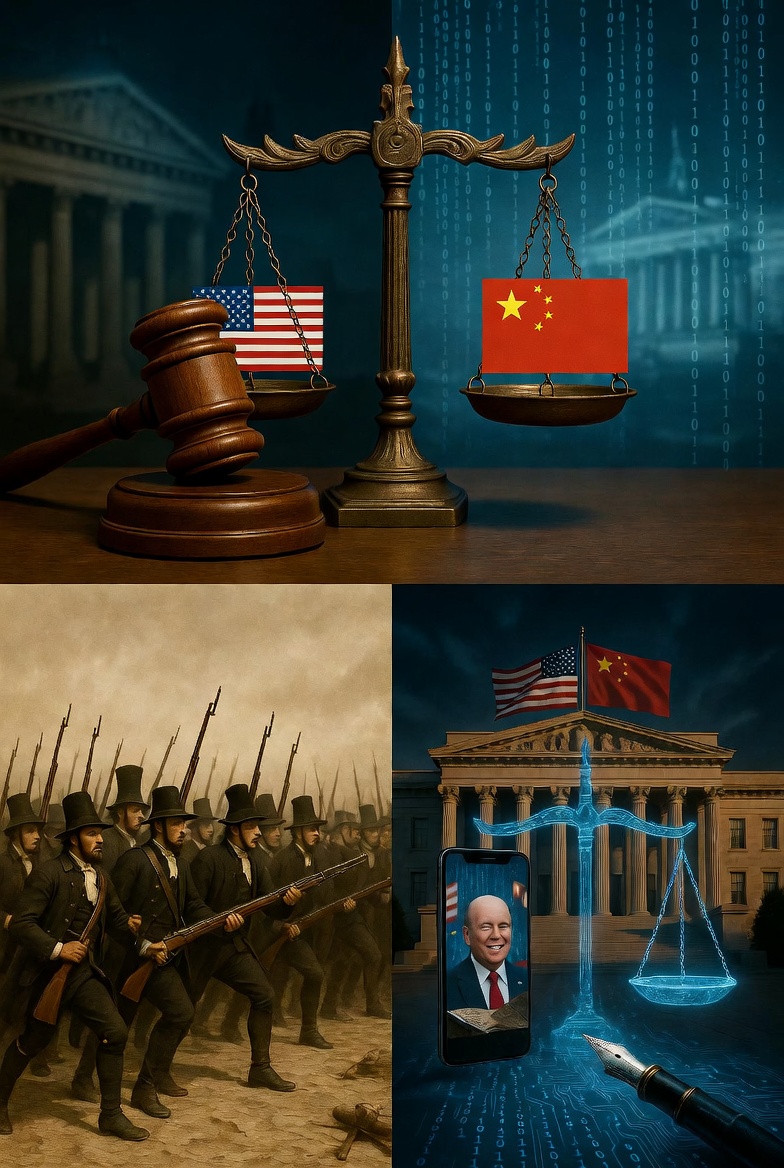
The Whiskey Rebellion precedent of 1794 has reemerged in 2026 as a flashpoint in debates over executive power. Two centuries apart, the same legal questions divide Americans: how much force may the federal government lawfully deploy?

By Bernd Pulch | February 12, 2026 | Category: Lawfare & Legal Activism


What Is Lawfare? A Clear Definition

Lawfare is the strategic use of litigation, regulatory processes, and legal doctrine as instruments of political warfare. Unlike traditional legal proceedings, which aim to resolve disputes through impartial application of law, lawfare weaponizes legal systems to achieve political, military, or economic objectives without direct confrontation.

The goal is not justice. The goal is advantage.

Lawfare operates through multiple mechanisms:

ยท Litigation warfare: Filing meritless or strategically burdensome lawsuits to exhaust adversary resources
ยท Regulatory capture: Deploying administrative processes to disadvantage competitors
ยท Legal precedent engineering: Establishing case law that favors long-term strategic interests
ยท International forum shopping: Bringing disputes to sympathetic jurisdictions or tribunals
ยท Criminal referral tactics: Triggering investigations that impose reputational and financial costs


The Origins: Where Did Lawfare Come From?

The term “lawfare” entered modern discourse following the September 11, 2001 terrorist attacks. Legal scholars observed that terrorist organizations could achieve strategic effects disproportionate to their military capabilities simply by triggering expensive, resource-intensive legal responses from Western governments.

But the practice is far older.

Historical precedents include:

ยท Nuremberg Trials (1945-1946): Victorious powers established legal frameworks that legitimized postwar order and delegitimized defeated regimes
ยท Cold War human rights advocacy: Both superpowers deployed international law arguments to embarrass adversaries
ยท Anti-apartheid litigation: International legal campaigns imposed economic and diplomatic costs on South Africa
ยท Pinochet arrest (1998): Spanish judge’s extradition request demonstrated how domestic courts could constrain foreign leaders

What has changed in 2026 is scale, sophistication, and accessibility. Lawfare is no longer the exclusive domain of superpowers. Corporations, activist groups, and wealthy individuals now deploy legal weapons with precision and impunity.


The Three Faces of Contemporary Lawfare

  1. International Lawfare: US-China Strategic Competition

The United States and China have transformed international courts and national security statutes into primary battlegrounds.

American strategy:

ยท National security reviews (CFIUS) to block Chinese technology acquisitions
ยท Criminal charges against Huawei for Iran sanctions violations
ยท Forced TikTok divestiture through legal rather than legislative action
ยท Export controls framed as statutory compliance rather than economic warfare

Chinese response:

ยท Anti-foreign sanctions law enabling retaliatory asset freezes
ยท Unreliable Entity List targeting American companies
ยท WTO disputes challenging US tariffs as unlawful
ยท Alternative dispute mechanisms in Belt and Road jurisdictions

The International Court of Justice has become a recurring venue for US-China proxy disputes, with both nations studying the Azerbaijan-Armenia Nagorno-Karabakh cases as models for legal warfare.


  1. Domestic Lawfare: Executive Power and the Whiskey Rebellion Precedent

In 2025 and 2026, American political battles have increasingly been fought through legal rather than legislative channels.

The Whiskey Rebellion of 1791-1794 has emerged as an unlikely flashpoint.

The original conflict: Western Pennsylvania farmers resisted federal whiskey excise taxes. President George Washington called 13,000 militiamen to suppress the rebellion, establishing precedent for federal enforcement of federal law.

The 2026 debate: Advocates of expansive executive power cite the Whiskey Rebellion to justify:

ยท Federal law enforcement against state-level cannabis legalization
ยท National Guard deployments for immigration enforcement
ยท Regulatory investigations of adversarial media outlets

Critics argue the precedent is historically distorted and legally inappropriate for contemporary disputes over administrative authority. Multiple federal appeals courts have divided on the question. Supreme Court review is widely expected.

The FCC under Brendan Carr exemplified domestic lawfare through regulatory investigation threats against ABC, NBC, and CBS. Whether investigations concluded or remain pending matters less than the chilling effect achieved through their mere initiation.


  1. Civil Lawfare: Defamation and SLAPP Suits

The most widespread and insidious form of lawfare requires no government involvement whatsoever.

Strategic Lawsuits Against Public Participation (SLAPP) are defamation or libel lawsuits filed not to win damages but to silence critics through litigation costs.

How SLAPP lawfare works:

  1. Powerful individual or corporation is criticized
  2. Plaintiff files lawsuit with minimal legal merit
  3. Defendant faces $50,000-$250,000 in legal fees to defend
  4. Defendant withdraws criticism or settles
  5. Plaintiff achieves objective without winning in court

The chilling effect: Even lawsuits that never reach trial silence speech. Publishers withdraw articles. Researchers abandon investigations. Journalists avoid controversial topics. The threat alone constrains public discourse.

Germany’s political meme prosecutions represent a hybrid model: criminal SLAPP. The CDU/CSU government has pursued individuals under insult and hate speech laws for satirical memes. While constitutional protections for satire remain strong, the mere threat of criminal prosecution has induced widespread self-censorship.

Der Postillon editor-in-chief Stefan Sichermann recently noted that legal risks have forced Germany’s leading satirical outlet to exercise caution unthinkable a decade ago.


Emerging Lawfare Frontiers: AI Liability

The European Union’s AI Act reached full implementation in early 2026. The regulation establishes tiered risk categories for artificial intelligence systems, with the strictest requirements for applications deemed threats to safety, fundamental rights, or democratic processes.

Why this is lawfare:

Companies seeking to disadvantage competitors have aggressively lobbied regulators to classify rival products in the highest-risk tiers. First-wave legal challenges are now pending before the Court of Justice of the European Union.

Simultaneously, American technology firms face a patchwork of conflicting state AI liability regimes. This fragmentation enables forum shoppingโ€”plaintiffs selecting jurisdictions with plaintiff-friendly laws, defendants seeking dismissal in favorable venues.

Agentic AIโ€”systems capable of independent action and decision-makingโ€”poses unprecedented liability questions. When an autonomous vehicle causes injury, a diagnostic tool misdiagnoses cancer, or a content moderation algorithm systematically suppresses protected speech, who bears legal responsibility?

The answers to these questions will be determined through litigation and regulation. Both are forms of lawfare.


Lawfare vs. Legitimate Legal Advocacy: How to Distinguish

Not every adversarial legal proceeding constitutes lawfare. The distinction lies in primary purpose.

Legitimate Legal Advocacy Lawfare
Seeks remedy for actual injury Seeks strategic advantage
Accepts adverse judgment Aims to exhaust adversary regardless of outcome
Proportionate to harm alleged Disproportionate resources deployed
Resolution-oriented Conflict-perpetuating
Legal merit evaluated Legal merit secondary or absent

The anti-SLAPP movement has emerged as the primary legislative response to civil lawfare. Twenty states and the District of Columbia have enacted anti-SLAPP statutes providing expedited dismissal and attorney fee recovery. Federal legislation remains stalled.


Why Lawfare Matters for Democracy

The weaponization of legal systems corrodes democratic governance from within.

The erosion is cumulative:

ยท Each lawfare deployment reduces perceived legitimacy of legal institutions
ยท Each weaponized court proceeding erodes public faith in judicial impartiality
ยท Each silenced critic narrows the range of public discourse
ยท Each precedent established through strategic litigation constrains future policy choices

Trust in legal institutions has declined substantially across democratic societies. Majorities in both the United States and Germany believe courts respond more readily to powerful interests than ordinary citizens.

This decline has consequences. Citizens become more willing to circumvent processes they perceive as illegitimate. Leaders promising to bypass “broken” institutions gain support. The rule of lawโ€”democracy’s foundationโ€”weakens incrementally, invisibly, until collapse becomes visible only in retrospect.


Conclusion: Lawfare Is Not Inevitable

The weaponization of legal systems can be reversed. It requires:

Legal reform: Stronger anti-SLAPP protections, clearer standing requirements, heightened pleading standards for strategic litigation.

Judicial vigilance: Courts must recognize when they are being weaponized and apply existing procedural tools to dismiss meritless strategic cases.

Civil society resistance: Organizations like the Foundation for Individual Rights and Expression, the Lawfare Project (defensive, not offensive), and CORRE

legal defense funds demonstrate that counter-lawfare is possible.

Public awareness: Lawfare thrives in obscurity. Named, described, and examined, it loses power.

This primer accompanies my detailed analysis of Lawfare 2026: How Legal Systems Became Weapons in the US-China Cold War. Together, these articles establish the foundation for understanding how legal institutions are being transformedโ€”and what we lose if we fail to resist.


Tags: lawfare definition, what is lawfare, SLAPP suits, Whiskey Rebellion precedent, US China legal competition, AI liability, anti-SLAPP, strategic litigation, political satire prosecution, agentic AI


Internal links:

ยท Lawfare 2026: How Legal Systems Became Weapons in the US-China Cold War
ยท The Satirist’s Dilemma: When Political Memes Become Criminal Offenses
ยท Understanding Anti-SLAPP: Legal Protections for Free Expression
ยท The CJEU’s AI Liability Framework: Europe’s Emerging Lawfare Battleground

Fund the Digital Resistance

Target: $75,000 to Uncover the $75 Billion Fraud

The criminals hide behind Monero. We use it to expose them. This is digital warfare โ€” truth is the real currency.


How Your Support Breaks Down โ€“ The $75,000 Plan

Phase 1: Digital Forensics ($25,000)

Phase 2: Operational Security ($20,000)

Phase 3: Evidence Preservation ($15,000)

Phase 4: Global Exposure ($15,000)


What Your Donation Achieves


Donate Securely โ€“ Monero (XMR) Only for Full Privacy

Monero Address (dedicated to this investigation):
45cVWS8EGkyJvTJ4orZBPnF4cLthRs5xk45jND8pDJcq2mXp9JvAte2Cvdi72aPHtLQt3CEMKgiWDHVFUP9WzCqMBZZ57y4

Monero QR Code โ€“ Scan to donate anonymously:

Monero Donation QR Code
Scan or copy the address above if scanning doesn’t work.

All donations are private, untraceable, and go directly to the investigation. We use zero-knowledge ops โ€” no logs, no tracking.


What $75,000 Delivers

Full mapping of money laundering routes, recovery of deleted Immobilien Zeitung archives, solid evidence for Interpol/Europol, and a permanent public archive.

Without support: Evidence vanishes, the playbook spreads, and markets stay vulnerable.

“They think Monero makes them invincible. Let’s show them it makes us unstoppable.”

Fund the resistance. Protect the evidence. Expose the truth.
This is strategic investment in market survival โ€” not charity.


Public Notice: Life Story & Media Rights โ€“ Lorch-Resch-Enterprise / Masterson-Series

Bernd Pulch holds exclusive life story and media adaptation rights for the Masterson-Series investigations, covering:

Any interference will be treated as an international tort and reported as obstruction of whistleblower disclosures and US media production.


Active Suppression Warning & Protective Measures

This content faces digital suppression, identity theft, and physical threats from documented networks.

Primary Domain: berndpulch.org
Mirrors: berndpulch.com | berndpulch.wordpress.com | wxwxxxpp.manus.space | googlefirst.org


Who We Are

Bernd Pulch, M.A. โ€” Magister of Journalism, German Studies and Comparative Literature.

Bernd Pulch is an internationally recognized specialist in Forensic Finance, Hedge Fund Analysis, and Strategic Real Estate Investment, combining traditional expertise with data-mining and Dark Data Analysis for precise market signals and forensic audits.

Early Media & Film Career (1988โ€“1992):
Journalism studies with Noelle Neumann (Mainz). Internships and freelance work at ZDF (Mainz), Fox-Lorber (New York, recommended by ABC Senior VP Robert Trachinger), WDR (Cologne entertainment division, e.g., with Rudi Carrell, Jรผrgen von der Lippe), RTL, Antenne 2, HORIZONT (Media Department), and w & v (Media Department). Freelance producer for Kabelkanal Ludwigshafen. Produced in-flight videos for Lufthansa and several making-of documentaries, including:

Later: Publisher of Immobilien Zeitung (transformed into respected trade journal), Immobilien Magazin, Immobilien Vertraulich, and INVESTMENT (THE ORIGINAL). Recognized by Wall Street Journal (1999 archival coverage) as a corruption fighter in the industry.

Current & Affiliations:
Lead developer of the Aristotle AI System (syllogistic forensic analysis engine). Director, General Global Media IBC. Editor-in-Chief, The Mastersson Series (Iโ€“XXXV). Custodian of 120,000+ verified intelligence reports (2000โ€“2026). Affiliations include Reuters Insight Advisor, Council Member at Gerson Lehrman Group (GLG), Board of Experts at IRETO (Beverly Hills).

ยฉ 2000โ€“2026 Bernd Pulch. Protected under EU Whistleblower Directive, public interest exemptions, and international press freedoms.

Support keeps truth alive. Donate now via Monero for maximum security.

Lawfare 2026: How Legal Systems Became Weapons in the US-China Cold War


The courtroom has become a battlefield: American and Chinese legal systems increasingly function as weapons in strategic competition rather than forums for impartial dispute resolution.

By Bernd Pulch | February 11, 2026 | Category: Lawfare & Legal Activism


In the not-too-distant past, legal systems existed primarily to resolve disputes, protect rights, and maintain social order. Courts were arenas where conflicts found resolution through reasoned deliberation and established procedures. But as the twenty-first century has progressed, a fundamental transformation has occurred in how legal institutions are wielded. Today, more than ever before, legal systems are being deployed as instruments of strategic warfareโ€”not to adjudicate justice, but to advance political objectives, weaken adversaries, and reshape the global order.

This transformation, known broadly as “lawfare,” has reached unprecedented levels in 2026. From the trade disputes between the United States and China to the domestic battles over press freedom and academic censorship, legal mechanisms have become the primary weapon of choice for governments, corporations, and ideological movements seeking to achieve their goals without the messiness of open confrontation. The courtroom has become a battlefield, and the gavel has been replaced by the subpoena.

Understanding this transformation is essential for anyone seeking to comprehend the nature of modern political conflict. The nations, organizations, and individuals who master the art of lawfare will shape the trajectory of global affairs in the coming decades. Those who fail to recognize this shift will find themselves increasingly marginalized, their voices silenced not through overt censorship but through the strategic deployment of legal processes designed to exhaust, intimidate, and ultimately neutralize dissent.


What Is Lawfare? Understanding the Strategic Weaponization of Legal Systems

Lawfare, a term that emerged from academic discussions in the early 2000s, describes the strategic use of litigation, regulatory processes, and legal doctrine as tools of political or social activism. Unlike traditional legal proceedings, which ostensibly aim to resolve disputes through impartial application of law, lawfare employs legal mechanisms as weapons in ongoing conflicts. The goal is not justice but advantageโ€”using the language, institutions, and procedures of law to achieve objectives that might otherwise require military, economic, or political force.

The concept gained significant attention following the September 11, 2001 terrorist attacks, when scholars and practitioners began examining how both state and non-state actors could employ legal strategies to advance their interests. Terrorist organizations recognized that by triggering expensive and resource-intensive legal responses, they could achieve strategic effects disproportionate to their direct actions. Governments, in turn, discovered that by framing their policies in legal terms, they could legitimize actions that might otherwise face domestic and international opposition.

Historical precedents for lawfare abound, though the term itself is relatively recent. Throughout history, victorious powers have used legal frameworks to consolidate their gains and impose their will on the defeated. The Nuremberg Trials after World War II, for instance, served not only to hold war criminals accountable but also to establish legal precedents that would shape international relations for decades to come. Similarly, the Cold War saw both superpowers deploy legal arguments in their ideological battles, from human rights frameworks to trade regulations.

In the contemporary era, however, lawfare has evolved far beyond these historical precedents. The transformation has been driven by several factors: the increasing complexity of legal systems, which creates more opportunities for strategic manipulation; the globalization of commerce and communication, which multiplies the arenas in which legal conflicts can occur; and the decline of traditional power projection capabilities, which makes legal mechanisms relatively more attractive as instruments of statecraft.

Perhaps nowhere has this transformation been more apparent than in the relationship between the United States and China. What began as a trade dispute has evolved into a comprehensive strategic competition in which legal mechanisms play a central role. Both nations have recognized that the other is engaged in a systematic effort to use legal processes to constrain its rival’s options, and both have responded by developing increasingly sophisticated legal strategies of their own.


The US-China Legal Arms Race: A New Form of Strategic Competition

The legal dimension of US-China competition has become increasingly central to the overall relationship. Both nations have recognized that by establishing legal precedents and frameworks favorable to their interests, they can shape the parameters of competition in ways that advantage their respective strengths while exploiting their adversary’s weaknesses. This recognition has led to an accelerating legal arms race that shows no signs of slowing down.

On the American side, the deployment of national security statutes has been the primary weapon in the legal arsenal. The Trump administration’s “Restoring Freedom of Speech and Ending Federal Censorship” executive order, issued in January 2025 and now fully litigated through federal courts, established significant precedents that continue to shape the legal landscape in 2026. While framed in terms of protecting free expression, the order has been widely interpreted as an attempt to shift the legal landscape in ways that disadvantage media outlets and civil society organizations critical of the administration.

More significantly, the federal government has increasingly deployed legal processes to challenge Chinese companies operating in the United States. The forced divestiture of TikTok’s US operations, completed in early 2026, represented a new phase in the legal dimension of US-China competition. Rather than simply imposing economic sanctions or diplomatic pressure, the US government established legal precedents that now apply broadly to Chinese technology companies operating in sensitive sectors. Similar actions against additional Chinese technology firms are currently working their way through federal courts.

The Huawei case has proven particularly instructive in this regard. American legal actions against the telecommunications giant combined criminal charges, regulatory measures, and diplomatic pressure into a comprehensive strategy that successfully weakened a strategic competitor. By 2026, Huawei’s global market share in 5G infrastructure has declined substantially, and the legal frameworks established through these actions continue to constrain the company’s operations.

China has not been passive in the face of these American initiatives. Beijing has developed sophisticated legal strategies for responding to US pressure, including deploying its legal system against American companies operating in China, using international legal forums to challenge American policies, and developing alternative legal frameworks that now rival American-dominated institutions. The International Court of Justice has become an increasingly important arena in this competition, with both nations bringing multiple cases before the court in 2025 and 2026.

The strategic implications of this legal arms race extend far beyond the immediate US-China relationship. Other nations are watching closely, learning from both American and Chinese strategies, and developing their own legal capabilities for use in future competitions. The rules-based international order that emerged from World War II is being reshaped by these legal battles, and the outcomes will determine the framework within which global affairs are conducted for decades to come.


Domestic Lawfare: The Whiskey Rebellion Precedent and Executive Power

While international lawfare captures headlines, the most significant legal battles are occurring within domestic political systems. Across the democratic world, legal mechanisms have become central to political competition, with both governments and opposition groups deploying lawsuits, regulatory actions, and court challenges as weapons in their ongoing struggles.

The use of the Whiskey Rebellion precedent in contemporary debates about executive power illustrates this dynamic perfectly. The Whiskey Rebellion of 1791-1794, in which western Pennsylvania farmers protested a federal excise tax on whiskey, represents one of the earliest tests of federal authority in American history. President George Washington’s responseโ€”calling out militia to suppress the rebellionโ€”established important precedents regarding the use of federal force to enforce federal law. In 2026, this historical precedent continues to be invoked in debates about the appropriate limits of executive authority.

Those supporting expansive presidential power cite the Whiskey Rebellion as evidence that the executive branch has broad discretion to enforce federal law, even in ways that might infringe on individual rights or state prerogatives. Critics, meanwhile, argue that the circumstances of the 1790s are fundamentally different from those of the twenty-first century, and that the precedent should not be extended to justify the kinds of executive overreach they see occurring today. Multiple federal appeals courts have grappled with these arguments in 2026, with inconsistent results that virtually guarantee eventual Supreme Court review.

The Federal Communications Commission under Chairman Brendan Carr became a focal point of these domestic lawfare battles throughout 2025 and continues to shape the regulatory environment in 2026. The FCC’s investigations into major media outletsโ€”including ABC, NBC, and CBSโ€”represented a new phase in the weaponization of regulatory agencies. Rather than proceeding through transparent legislative processes, the administration used the threat of regulatory action to encourage self-censorship among media outlets and to shape coverage in ways favorable to its interests. While some of these investigations have concluded, their chilling effects persist.

The implications of these developments extend far beyond the immediate political conflicts in which they are deployed. When legal mechanisms become primary instruments of political competition, the rule of law itself is compromised. Laws and regulations that were designed to resolve disputes impartially become tools for advancing partisan objectives. The legitimacy of legal institutions, which depends on public perception of their impartiality, erodes as they become increasingly identified with particular political factions.

The Foundation for Individual Rights and Expression has documented numerous examples of this dynamic in recent years. From so-called “Stop Law” legislation that restricts protests near government buildings to the proliferation of SLAPP suits designed to silence critics, the legal landscape has become increasingly hostile to free expression and open debate. The organization’s tracking of First Amendment cases before the Supreme Court reveals a judiciary increasingly asked to referee political conflicts that have been reframed as legal disputes.


The Defamation Lawfare Epidemic: Silencing Dissent Through Litigation

Perhaps no aspect of contemporary lawfare has affected public discourse more profoundly than the epidemic of defamation and libel lawsuits designed to silence critics. These lawsuits, often referred to as SLAPP suits, represent a particularly insidious form of lawfare because they achieve their objectives not through victory in court but through the very act of litigation. The goal is not to win damages or obtain injunctions but to exhaust the resources and morale of those who have been targeted, thereby discouraging future criticism.

The scale of this phenomenon has grown dramatically in recent years. Wealthy individuals and powerful corporations have discovered that even baseless lawsuits can be devastatingly effective in silencing critics. The mere threat of litigation can cause publishers to withdraw controversial content, researchers to abandon sensitive investigations, and journalists to avoid stories that might expose powerful interests. This chilling effect extends far beyond the specific cases that reach courtrooms, shaping public discourse in ways that are difficult to measure but nonetheless profound.

In Germany, this dynamic has taken particularly worrying forms. The CDU/CSU government’s pursuit of criminal prosecutions for political memes represents an alarming expansion of the boundaries of acceptable expression. Under laws against insult and hate speech, individuals have faced criminal prosecution for creating satirical content that authorities deemed offensive. While these laws have existed for decades, their application to online political expression since 2024 represents a significant shift in how legal mechanisms are deployed in domestic politics. Multiple cases remain pending in German courts in 2026.

The case of Der Postillon, the satirical news website that attracts approximately 50,000 daily visitors, illustrates the challenges facing political satire in the current environment. The website’s editor-in-chief, Stefan Sichermann, has noted that the increasing legal risks associated with political satire have forced the publication to exercise greater caution in its content, even when that content would have been unremarkable a decade ago. This self-censorship, driven by the threat of litigation, represents one of the most significant and least visible effects of lawfare on public discourse.

International comparisons reveal that this dynamic is not unique to Germany. In the United States, the proliferation of defamation lawsuits has accelerated dramatically, with high-profile figures ranging from technology executives to politicians increasingly turning to litigation as a means of silencing critics. The legal scholar Eugene Volokh has documented numerous examples of what he terms “libel lawfare,” noting that even lawsuits with minimal chances of success can achieve their objectives by imposing substantial costs on defendants.

The implications for democratic discourse are severe. When powerful individuals and organizations can effectively silence critics through the threat of litigation, the marketplace of ideas that is essential to democratic governance becomes severely distorted. The perspectives and information that survive are those that powerful interests choose not to challenge, creating an information environment that systematically favors those with the resources to deploy legal weapons.


AI Liability and Emerging Legal Battlegrounds

As artificial intelligence systems become increasingly sophisticated and pervasive, they are creating entirely new arenas for lawfare. The question of how to allocate liability for harms caused by AI systemsโ€”referred to in policy discussions as “agentic AI”โ€”has become one of the most contested issues in technology law, with significant implications for the future of both innovation and regulation.

The core challenge is that existing legal frameworks were designed for a world in which most automated systems operated under relatively predictable parameters. AI systems, particularly those employing machine learning techniques, can exhibit behaviors that their developers did not anticipate and cannot fully explain. When these systems cause harmโ€”whether through autonomous vehicles, medical diagnostic tools, or content moderation algorithmsโ€”determining legal responsibility becomes extraordinarily complex.

This complexity has made AI liability a prime target for lawfare. Companies seeking to retard the development of competitor technologies have pushed for regulatory frameworks that would impose massive liability on AI developers, effectively creating barriers to entry that would advantage established players. Meanwhile, companies seeking to protect their AI investments have deployed legal arguments emphasizing the difficulty of predicting AI behavior and the need for regulatory frameworks that encourage innovation.

The European Union’s AI Act, which entered into force in 2024 and reached full implementation in early 2026, has become a central focus of these battles. The regulation establishes a tiered framework for AI systems based on their perceived risk, with the most tightly regulated systems being those deemed to pose the greatest threats to safety, fundamental rights, or democratic processes. Both proponents and critics have acknowledged that the regulation is shaping the global AI landscape, and both continue to influence its implementation through a combination of lobbying, litigation, and regulatory interpretation. The first major challenges to the AI Act are now pending before the Court of Justice of the European Union.

In the United States, the absence of comprehensive federal AI legislation has created a patchwork of state-level initiatives, each with different approaches to AI liability. This fragmentation has created opportunities for lawfare, as companies can potentially exploit differences between state legal regimes to avoid accountability or to burden competitors with litigation in unfavorable jurisdictions. The resulting uncertainty has slowed investment and innovation in the AI sector, even as the technology continues to advance rapidly. Several states have enacted AI liability frameworks in 2026, further complicating the legal landscape.

The implications of these developments extend far beyond the technology sector. AI systems are being deployed in an ever-widening range of applications, from criminal justice to healthcare to financial services. How liability is allocated for harms caused by these systems will shape not only the technology industry’s trajectory but also the fundamental relationship between individuals, corporations, and government in the digital age.


What Lawfare Means for Democracy: The Erosion of Rule of Law

The comprehensive weaponization of legal systems carries profound implications for democratic governance. At its core, democracy depends on the rule of lawโ€”an impartial system of rules and procedures that constrains the exercise of power and protects individual rights. When legal mechanisms become instruments of political warfare, this foundation is eroded, and democracy itself is undermined.

The process is gradual but inexorable. Each time a legal mechanism is deployed for partisan advantage, the perceived legitimacy of legal institutions declines. Each time a court is used as a weapon rather than a forum for dispute resolution, public faith in judicial impartiality diminishes. Each time the threat of litigation silences criticism, the range of perspectives available in public discourse narrows. Over time, these accumulated effects transform the legal landscape in ways that fundamentally alter the balance of power in society.

The evidence of this dynamic is visible across the democratic world. Trust in legal institutions has declined substantially in recent years, with surveys consistently showing that majorities believe courts are more responsive to powerful interests than to ordinary citizens. This decline in institutional trust has political consequences, as citizens become more willing to circumvent legal processes they perceive as illegitimate and more receptive to leaders who promise to bypass established procedures.

The relationship between lawfare and media freedom is particularly concerning. Independent journalism serves as a crucial check on the abuse of power, exposing corruption, holding powerful individuals accountable, and providing citizens with the information they need to participate effectively in democratic processes. When legal mechanisms are deployed to silence critical journalism, this check is weakened, and the door opens to more overt forms of censorship and control.

The arrest of journalists in at least 57 of 72 countries documented in recent reports on internet freedom represents the extreme end of this spectrum. But even in democracies where such overt repression is politically impossible, lawfare achieves similar objectives through subtler means. The threat of litigation, the expense of legal defense, and the chilling effect of prominent cases all serve to constrain journalism in ways that are difficult to measure but nonetheless real.

The German experience with political meme prosecution provides a particularly instructive example. While the government has not banned political satire outright, the threat of criminal prosecution for content deemed insulting or hateful has created a climate of self-censorship that constrains the range of acceptable political expression. Satirists and commentators report exercising greater caution in their content, avoiding topics or formulations that might attract legal scrutiny. This cumulative effect, visible across thousands of individual decisions, has significantly narrowed the boundaries of acceptable discourse.


Resistance and the Future of Legal Accountability

Despite the alarming trends described above, there are reasons for cautious optimism. Across the democratic world, legal scholars, civil liberties advocates, and concerned citizens are working to develop strategies for resisting the weaponization of legal systems and preserving the impartiality of legal institutions.

The anti-SLAPP movement has achieved significant victories in recent years, with numerous jurisdictions adopting legislation designed to deter frivolous lawsuits intended to silence critics. These laws typically provide for expedited dismissal of meritless cases and allow defendants to recover attorneys’ fees, thereby shifting the risk calculus that currently encourages the deployment of litigation as a weapon. In 2026, momentum is building for federal anti-SLAPP legislation in the United States, while several German states are considering similar protections.

International legal institutions, despite their limitations, continue to serve as important venues for holding powerful actors accountable. The International Criminal Court’s investigations into war crimes and crimes against humanity demonstrate that legal processes, even when imperfect, can impose costs on perpetrators who might otherwise escape consequences. The challenge remains to strengthen these institutions and extend their reach while guarding against their capture by particular political agendas.

The rise of nonprofit investigative journalism, exemplified by organizations in Germany and ProP in the United States, represents another important development. These organizations, funded by foundations and individual donors rather than advertising revenue, have demonstrated that rigorous investigative journalism can survive even in an environment hostile to press freedom. Their work has exposed corruption, challenged powerful interests, and held legal institutions accountable in ways that commercial media have proven unable or unwilling to do. In 2026, both organizations continue to expand their legal defense funds and investigative capacities.

Technology, paradoxically, also offers tools for resisting lawfare. Open-source investigations, collaborative journalism networks, and distributed publishing platforms have made it increasingly difficult for powerful actors to silence critics through litigation. When information is distributed across multiple jurisdictions and hosted on resilient infrastructure, the traditional legal strategies for suppressing speech become less effective. The challenge is to develop these tools further and ensure they remain accessible to those who need them most.


Conclusion: The Imperative of Legal Vigilance

The weaponization of legal systems represents one of the most significant and underappreciated threats to democratic governance in the contemporary era. Unlike overt attacks on democratic institutionsโ€”elections, parliaments, or civil libertiesโ€”lawfare operates through the very mechanisms that are supposed to protect democratic values. It corrupts legal institutions from within, undermining their legitimacy while appearing to operate within established procedures.

The response to this threat must be comprehensive and sustained. Legal reform, including stronger anti-SLAPP protections and clearer standards for standing and justiciability, is essential to reduce the incentives for lawfare. Judicial education, emphasizing the political dimensions of legal decisions and the importance of maintaining institutional legitimacy, can help ensure that courts recognize when they are being manipulated. Civil society organizations, investigative journalists, and concerned citizens must remain vigilant, documenting abuses and demanding accountability from those who would weaponize the law.

The year 2026 presents both challenges and opportunities. The legal frameworks being established today will shape the boundaries of acceptable political discourse for years to come. Those who care about democracy, free expression, and the rule of law must recognize what is at stake and act accordingly. The weaponization of legal systems can be reversed, but only through sustained effort and unwavering commitment to the principles that law is meant to serve.

Fund the Digital Resistance

Target: $75,000 to Uncover the $75 Billion Fraud

The criminals hide behind Monero. We use it to expose them. This is digital warfare โ€” truth is the real currency.


How Your Support Breaks Down โ€“ The $75,000 Plan

Phase 1: Digital Forensics ($25,000)

Phase 2: Operational Security ($20,000)

Phase 3: Evidence Preservation ($15,000)

Phase 4: Global Exposure ($15,000)


What Your Donation Achieves


Donate Securely โ€“ Monero (XMR) Only for Full Privacy

Monero Address (dedicated to this investigation):
45cVWS8EGkyJvTJ4orZBPnF4cLthRs5xk45jND8pDJcq2mXp9JvAte2Cvdi72aPHtLQt3CEMKgiWDHVFUP9WzCqMBZZ57y4

Monero QR Code โ€“ Scan to donate anonymously:

Monero Donation QR Code
Scan or copy the address above if scanning doesn’t work.

All donations are private, untraceable, and go directly to the investigation. We use zero-knowledge ops โ€” no logs, no tracking.


What $75,000 Delivers

Full mapping of money laundering routes, recovery of deleted Immobilien Zeitung archives, solid evidence for Interpol/Europol, and a permanent public archive.

Without support: Evidence vanishes, the playbook spreads, and markets stay vulnerable.

“They think Monero makes them invincible. Let’s show them it makes us unstoppable.”

Fund the resistance. Protect the evidence. Expose the truth.
This is strategic investment in market survival โ€” not charity.


Public Notice: Life Story & Media Rights โ€“ Lorch-Resch-Enterprise / Masterson-Series

Bernd Pulch holds exclusive life story and media adaptation rights for the Masterson-Series investigations, covering:

Any interference will be treated as an international tort and reported as obstruction of whistleblower disclosures and US media production.


Active Suppression Warning & Protective Measures

This content faces digital suppression, identity theft, and physical threats from documented networks.

Primary Domain: berndpulch.org
Mirrors: berndpulch.com | berndpulch.wordpress.com | wxwxxxpp.manus.space | googlefirst.org


Who We Are

Bernd Pulch, M.A. โ€” Magister of Journalism, German Studies and Comparative Literature.

Bernd Pulch is an internationally recognized specialist in Forensic Finance, Hedge Fund Analysis, and Strategic Real Estate Investment, combining traditional expertise with data-mining and Dark Data Analysis for precise market signals and forensic audits.

Early Media & Film Career (1988โ€“1992):
Journalism studies with Noelle Neumann (Mainz). Internships and freelance work at ZDF (Mainz), Fox-Lorber (New York, recommended by ABC Senior VP Robert Trachinger), WDR (Cologne entertainment division, e.g., with Rudi Carrell, Jรผrgen von der Lippe), RTL, Antenne 2, HORIZONT (Media Department), and w & v (Media Department). Freelance producer for Kabelkanal Ludwigshafen. Produced in-flight videos for Lufthansa and several making-of documentaries, including:

Later: Publisher of Immobilien Zeitung (transformed into respected trade journal), Immobilien Magazin, Immobilien Vertraulich, and INVESTMENT (THE ORIGINAL). Recognized by Wall Street Journal (1999 archival coverage) as a corruption fighter in the industry.

Current & Affiliations:
Lead developer of the Aristotle AI System (syllogistic forensic analysis engine). Director, General Global Media IBC. Editor-in-Chief, The Mastersson Series (Iโ€“XXXV). Custodian of 120,000+ verified intelligence reports (2000โ€“2026). Affiliations include Reuters Insight Advisor, Council Member at Gerson Lehrman Group (GLG), Board of Experts at IRETO (Beverly Hills).

ยฉ 2000โ€“2026 Bernd Pulch. Protected under EU Whistleblower Directive, public interest exemptions, and international press freedoms.

Support keeps truth alive. Donate now via Monero for maximum security.