

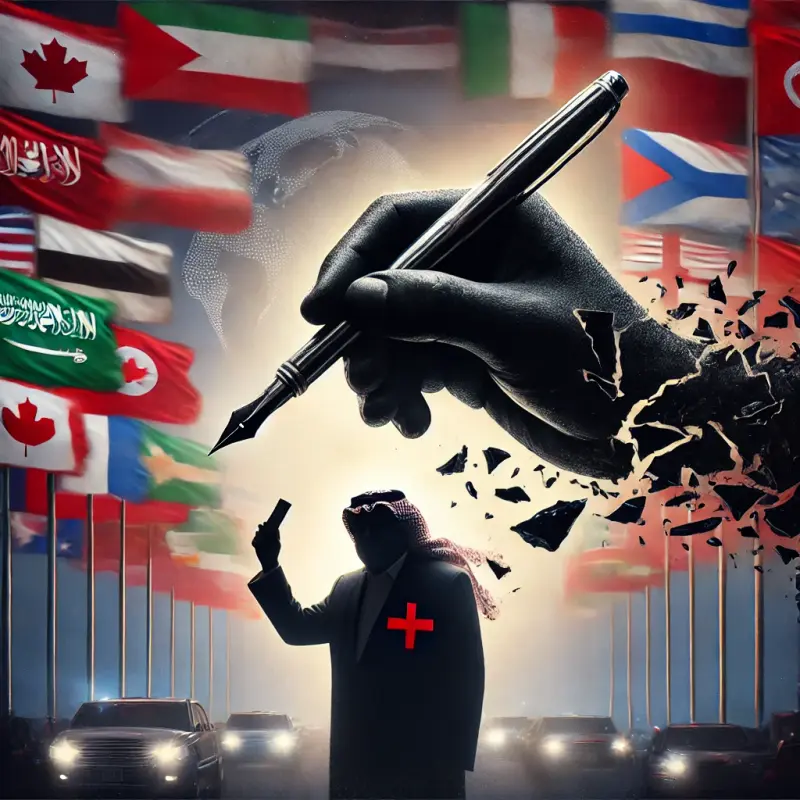
“Silencing the Truth: A symbolic representation of the global fallout from the Jamal Khashoggi case, where the crackdown on press freedom and the international condemnation of state-sanctioned violence converge.”
The brutal assassination of Jamal Khashoggi, a Saudi Arabian journalist and Washington Post columnist, inside the Saudi consulate in Istanbul on October 2, 2018, shocked the world and ignited an international scandal that reverberated across political, diplomatic, and human rights spheres. Khashoggi’s death, which was later confirmed to have been orchestrated by agents of the Saudi government, brought to light troubling questions about state-sanctioned violence, the role of authoritarian regimes in international politics, and the ethical responsibilities of global leaders and organizations. The aftermath of the Khashoggi case has sparked a cascade of consequences, the effects of which are still unfolding.
The Case Unfolds: A Shocking Discovery
Jamal Khashoggi, a former adviser to the Saudi royal family and a vocal critic of Crown Prince Mohammed bin Salman (MBS), was last seen entering the Saudi consulate in Istanbul on October 2, 2018, to obtain documents for his upcoming marriage. Soon after, the world learned that Khashoggi had been killed inside the consulate in what Turkish authorities quickly described as a premeditated murder carried out by a team of Saudi agents. The details of the murder, including the dismemberment of Khashoggi’s body, were uncovered through various sources, including Turkish intelligence and security footage, and soon revealed a clear pattern of state-sanctioned extrajudicial killing.
International pressure mounted on Saudi Arabia, as officials and human rights groups called for accountability. Despite initial denials by the Saudi government, Crown Prince Mohammed bin Salman eventually faced scrutiny, though he denied any involvement in Khashoggi’s murder. The case prompted widespread global condemnation, and Khashoggi’s murder became a symbol of the darker aspects of political repression in the modern era.
Political and Diplomatic Fallout
Deterioration of Saudi Arabia’s Relations with the West
The Khashoggi case severely damaged Saudi Arabia’s diplomatic relationships with several Western nations. For many countries, especially the United States, the murder was a stark reminder of the Kingdom’s human rights abuses, including its treatment of dissidents, journalists, and activists. Prior to the Khashoggi incident, Saudi Arabia was already under scrutiny for its involvement in the war in Yemen, its crackdown on activists, and the arrest of women’s rights activists.
The United States, in particular, faced a political dilemma. While President Donald Trump initially expressed reluctance to sever ties with Saudi Arabia, citing the strategic importance of the U.S.-Saudi alliance and lucrative arms deals, the outrage over Khashoggi’s murder led to widespread calls for sanctions and a reevaluation of U.S.-Saudi relations. The U.S. Senate, in December 2018, passed a resolution that blamed Crown Prince Mohammed bin Salman for Khashoggi’s death, although no direct punitive measures were taken by the Trump administration.
Similarly, other Western nations, including the United Kingdom and Canada, condemned the killing. The British government took steps to limit its engagement with high-profile Saudi officials, including suspending arms sales that could be used in the Yemen conflict.
Impact on the Saudi Crown Prince
While Crown Prince Mohammed bin Salman (MBS) maintained his role and power within the Saudi government, his international reputation was severely tarnished by the Khashoggi case. The global outcry surrounding his alleged involvement in the assassination complicated Saudi Arabia’s foreign relations, particularly with Western allies. High-profile figures in the business and diplomatic worlds distanced themselves from MBS, and key events like the Future Investment Initiative (FII) summit in Riyadh, often dubbed “Davos in the Desert,” were boycotted by several Western leaders and business tycoons, further isolating the Kingdom.
Despite these challenges, MBS continued to wield considerable influence within Saudi Arabia and has implemented economic reforms as part of his Vision 2030 plan, which aims to diversify the Saudi economy away from oil dependence. His leadership, while controversial, has not been significantly threatened by the international fallout. The internal consolidation of power within the Saudi regime remained intact, even as the global community demanded accountability.
The Human Rights and Press Freedom Crisis
The Khashoggi case is a somber reminder of the risks that journalists and dissidents face in authoritarian regimes. Khashoggi’s murder sent shockwaves through the global journalism community, highlighting the increasingly hostile environment for press freedom, particularly in the Middle East. The fact that Khashoggi was murdered in a diplomatic facility, under the auspices of a foreign government, underscored the growing threat faced by journalists who dared to challenge powerful regimes.
Strengthened Calls for Accountability and Protection of Journalists
In the aftermath of the Khashoggi murder, various human rights organizations, including Amnesty International and Human Rights Watch, ramped up calls for stronger protections for journalists and advocates of free speech. The United Nations, along with governments and international media organizations, called for a full investigation and accountability for those responsible for the killing, including senior officials who may have been complicit.
The case also led to an increase in the demand for stronger legal frameworks for the protection of journalists, particularly those working in hostile environments. This includes calls for more robust whistleblower protections, the enhancement of international legal tools to protect journalists, and an emphasis on transparency in the investigation of such murders.
The Legal and Economic Fallout
International Sanctions and Legal Actions
Following the murder, some nations, including the United States and Canada, imposed targeted sanctions on individuals associated with the killing, such as senior members of the Saudi royal family and intelligence services. However, these measures were limited, and no formal international legal action was pursued against the Kingdom of Saudi Arabia, despite widespread calls for accountability.
In 2020, the CIA’s assessment of the murder concluded that MBS likely approved the operation to kill Khashoggi, but this assessment did not lead to any significant punitive action. The United States, under the Biden administration, expressed a desire to distance itself from MBS, but realpolitik considerations—such as Saudi Arabia’s role in stabilizing oil prices and geopolitical concerns over Iran—prevented drastic measures.
Economic Repercussions
The Khashoggi case also had economic implications, particularly regarding foreign investments in Saudi Arabia. The international business community, initially attracted to MBS’s Vision 2030, became more cautious about engaging with the Kingdom due to the negative press and political risks associated with its leadership. The assassination also cast a shadow over the Kingdom’s attempts to present itself as a modernizing force in the region, with many investors reassessing the risk of doing business in a country with a reputation for political repression.
The Khashoggi Legacy: A Lasting Impact
While the diplomatic and political consequences of Khashoggi’s murder may have somewhat diminished over time, the case has left an indelible mark on global conversations about human rights, the role of authoritarian regimes, and the dangers facing journalists. His murder illuminated the growing authoritarianism in the Middle East and the complexities of maintaining alliances with regimes that are often accused of repressing their own citizens and critics.
Khashoggi’s case has become a symbol for press freedom and the protection of journalists worldwide. It has also sparked a broader conversation about the accountability of world leaders when human rights abuses are committed under their watch. His death has inspired movements aimed at pressuring governments and international organizations to take stronger action to prevent similar incidents.
Conclusion
The fallout from the Jamal Khashoggi case remains profound, affecting Saudi Arabia’s relationships with the West, the rights of journalists worldwide, and the international community’s stance on state-sanctioned violence and repression. While the full impact of the Khashoggi case may never be entirely realized, it continues to resonate in global debates on governance, accountability, and human rights. As international pressure for justice and transparency persists, the legacy of Jamal Khashoggi may continue to drive significant change for press freedom and political accountability in the years to come.
❌©BERNDPULCH.ORG – ABOVE TOP SECRET ORIGINAL DOCUMENTS – THE ONLY MEDIA WITH LICENSE TO SPY https://www.berndpulch.org
https://googlefirst.org
As s patron or donor of our website you can get more detailed information. Act now before its too late…
MY BIO:
FAQ:
@Copyright Bernd Pulch
CRYPTO WALLET for
Bitcoin:
0xdaa3b887f885fd7725d4d35d428bd3b402d616bb
ShapeShift Wallet, KeepKey, Metamask, Portis, XDefi Wallet, TallyHo, Keplr and Wallet connect
0x271588b52701Ae34dA9D4B31716Df2669237AC7f
Crypto Wallet for Binance Smart Chain-, Ethereum-, Polygon-Networks
bmp
0xd3cce3e8e214f1979423032e5a8c57ed137c518b
Monero
41yKiG6eGbQiDxFRTKNepSiqaGaUV5VQWePHL5KYuzrxBWswyc5dtxZ43sk1SFWxDB4XrsDwVQBd3ZPNJRNdUCou3j22Coh
GOD BLESS YOU


 🛑 Bernd Pulch | NAZI & STASI HUNTER | CORRUPTION & ARISTOTLE AI BI