

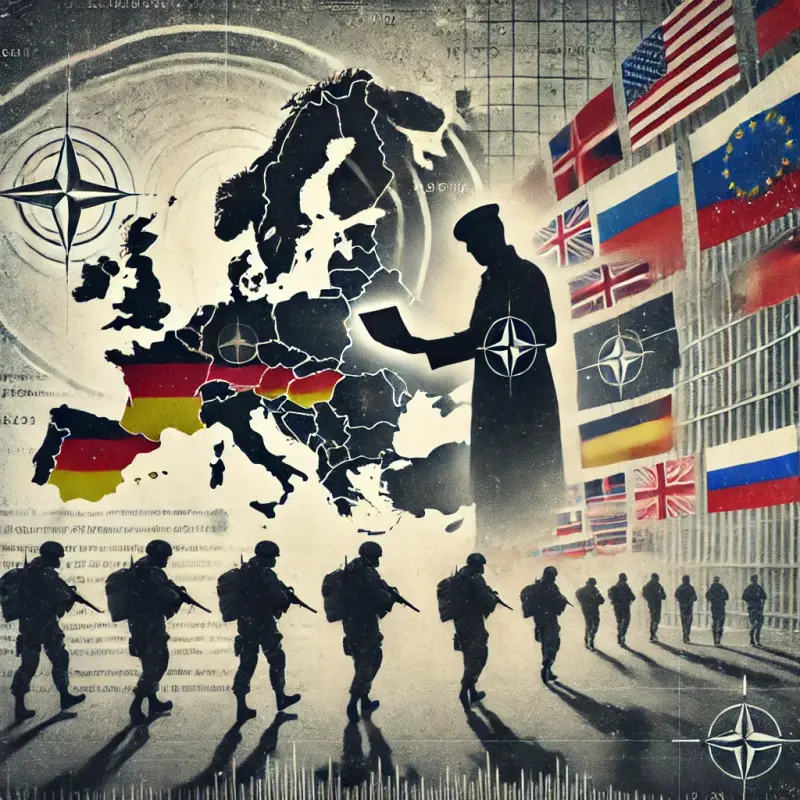
In the ongoing war between Russia and Ukraine, the political and military dynamics continue to evolve with surprising twists. Recent reports indicate that Russian intelligence is actively spreading disinformation, claiming that NATO countries, including Germany, are preparing to occupy Ukraine under the guise of peacekeeping missions. This narrative, which the Kremlin has tied to World War II-era propaganda, is designed to destabilize the European response to the war and prevent peace efforts. While these claims are widely dismissed by experts, they highlight the complex political maneuvering and the role of European powers in Ukraine’s defense.
The Alleged Plot: European Troops to Occupy Ukraine?
Russian intelligence has been accused of circulating a fantastical conspiracy theory, suggesting that Germany, along with Poland, Romania, and the UK, is preparing to occupy parts of Ukraine. According to this disinformation campaign, Western powers are allegedly planning to divide the country into zones of control, much like during the Nazi occupation in World War II. The claim includes absurd details, such as the assertion that Germany is training “Nazi” troops for this occupation. This narrative is spread primarily through Russian government channels, with the SVR (Foreign Intelligence Service) reportedly publishing the theory on its website【26†source】.
The story’s ultimate goal appears to be to stoke fear and division within Germany and among its allies. By invoking historical Nazi associations, the Kremlin aims to tarnish Germany’s reputation, provoke nationalist sentiments, and undermine public support for Ukraine in the West. This is a strategy frequently employed by Russia to weaken opposition and prevent peace negotiations. The Russian government has repeatedly accused Ukraine and its allies of collaborating with “neo-Nazi” factions, despite these accusations being widely debunked【26†source】.
Expert Opinions: Pure Disinformation
Leading experts have debunked the narrative of a German-led occupation force. Sönke Neitzel, a military historian from the University of Potsdam, called the claims “pure disinformation,” noting that it is “impossible” for NATO countries to engage in such an operation. According to Neitzel, this story is a classic example of Russian propaganda designed to discredit NATO and sow discord among its members. His assertion is supported by the broader consensus among defense experts, who view such claims as a deliberate attempt to manipulate public perception【26†source】.
Furthermore, the idea of NATO occupying Ukraine contradicts the principles of the alliance, which operates under collective defense and the support of democratic sovereignty. The suggestion that NATO forces would divide Ukraine into zones of control is not only illogical but also strategically unsound. Western military support for Ukraine remains focused on providing defensive aid and military training, not on territorial occupation【25†source】.
European Troops: Reality vs. Fiction
While the Kremlin’s disinformation campaign is focused on a fictional occupation scenario, there are ongoing discussions about the role of European troops in Ukraine, particularly concerning peacekeeping forces. Some European leaders, including French President Macron, have floated the idea of deploying international peacekeepers to safeguard Ukraine against further Russian aggression. These forces would theoretically ensure the protection of civilians and help maintain stability in post-conflict zones【25†source】.
However, this proposal is not without controversy. The risks of such deployments are significant, as it could escalate tensions between NATO and Russia, leading to direct confrontations. European military leaders have expressed concerns about the political and military implications of such a move, with some warning that it might give Russia an excuse to claim that NATO is occupying Ukraine【26†source】. At present, there are no concrete plans for such a peacekeeping force, though discussions are likely to continue as the war evolves.
Rheinmetall and the Economic Angle
Another element in the Kremlin’s disinformation narrative is the role of the German defense contractor Rheinmetall. The company, which has supplied military equipment to Ukraine, is mentioned in the Russian intelligence reports as part of the broader narrative about Germany’s involvement in Ukraine. The specific targeting of Rheinmetall serves as a reminder of the economic and strategic interests at play. By focusing on the company, the Kremlin is not only attempting to undermine Germany’s position but also sending a broader message about its opposition to Western arms shipments to Ukraine【26†source】.
Conclusion: A Complex Battlefield
As the war in Ukraine continues, the battle extends beyond the military frontlines to the realm of information warfare. The recent Russian disinformation campaign accusing European powers of planning to occupy Ukraine is just one example of the Kremlin’s strategy to disrupt international support for Ukraine and prevent peace negotiations. While these claims are debunked by experts, they highlight the challenges faced by European leaders as they navigate the political and military complexities of the conflict.
The involvement of European troops in Ukraine remains a subject of debate, with peacekeeping missions being a possible but highly sensitive option. However, any such deployment would likely be fraught with political challenges and could further escalate tensions with Russia. For now, the focus remains on supporting Ukraine’s defense, providing humanitarian aid, and seeking diplomatic solutions to end the conflict.
As the situation develops, it will be crucial to monitor both the military and diplomatic strategies of European nations and to remain vigilant against the disinformation campaigns that seek to reshape public opinion.
Western Disinformation about Ukraine: A Complex Narrative
The war in Ukraine has not only been a battleground of military forces but also a theater for disinformation. While Russian propaganda is widely recognized, Western narratives about Ukraine have also been criticized for shaping public perception and influencing political outcomes. Both misinformation and disinformation — the deliberate spread of false or manipulated information — have played significant roles in the conflict’s media coverage. These narratives, often stemming from Western governments or media outlets, have been used to justify actions or suppress opposition to the war, creating a complex web of influence.
The Role of Media in Shaping Perception
In Western media, the portrayal of Ukraine’s conflict with Russia has largely followed a binary narrative: Ukraine as the victim, Russia as the aggressor. While this perspective is generally aligned with international law and the majority of the global community, the portrayal often oversimplifies the complexities of the war. Certain aspects of the conflict, such as Ukraine’s internal issues, the role of far-right groups, and the political interests of NATO, have been downplayed or ignored in mainstream Western coverage.
In the early stages of the war, some media outlets focused heavily on the moral righteousness of Ukraine’s resistance, framing it as a “David vs. Goliath” scenario. However, critics argue that this narrative has also been manipulated to foster an image of Ukraine as a purely democratic and virtuous nation, excluding the presence of far-right elements in some of its militias. While Ukraine’s far-right groups have been a minority, their presence was widely acknowledged by independent analysts but often ignored or downplayed in Western coverage, potentially skewing the portrayal of Ukraine’s political landscape【25†source】【26†source】.
Western Political and Military Interests
Another layer of Western disinformation involves the strategic interests behind the support for Ukraine. NATO’s role in the conflict is often framed as a defensive alliance supporting a sovereign nation’s right to self-defense, yet some analysts have suggested that the alliance’s expansionist policies have contributed to the conflict’s escalation. Russian officials have repeatedly voiced concerns about NATO’s growing influence near its borders, and some Western commentators argue that Ukraine’s pursuit of NATO membership has provoked Russian aggression, while others suggest that the alliance’s support for Ukraine is designed to weaken Russia geopolitically【26†source】 .
The West’s portrayal of Russian military shortcomings is also part of the disinformation narrative. While Russia has faced significant military challenges, much of the Western coverage fails to emphasize the resilience and resourcefulness of Russian forces, which have adapted to sanctions and logistical difficulties. This oversimplification contributes to an image of Russia as an incompetent force, while Ukraine is often portrayed as an unyielding force for democracy .
The Role of Social Media and Alternative Narratives
The proliferation of disinformation is also heavily facilitated by social media platforms, where both pro-Western and pro-Russian narratives find an audience. Western-backed disinformation campaigns have targeted global audiences, focusing on framing Ukraine as the underdog in need of continuous support. Similarly, social media campaigns have been used to highlight the alleged atrocities committed by Russian forces, sometimes relying on unverified images or manipulated content to stoke outrage. While many of these claims are valid, the rapid spread of unverified information has contributed to the polarization of the conflict, with individuals consuming media that aligns with their preconceived beliefs【25†source】.
Moreover, Western governments, including the U.S. and UK, have engaged in information warfare by supporting independent journalists and media outlets that align with their narratives. However, critics argue that this support has sometimes extended to media that presents a highly selective or distorted view of events. This has sparked debates about the ethics of such interventions, with accusations that the West is using information warfare as a tool to influence both domestic and global opinion .
Conclusion: A Global Disinformation Battle
Both Russian and Western narratives have contributed to the widespread disinformation surrounding the war in Ukraine. While Russia has used propaganda to undermine support for Ukraine, portray the West as complicit, and discredit peace efforts, the West has sometimes fostered its own simplified or manipulated views of the conflict. The resulting confusion and competing narratives complicate the search for truth and hinder efforts toward a peaceful resolution. As the war continues, it will be essential for both sides to engage in more transparent, responsible reporting to prevent further misinformation from influencing public opinion and policy decisions.
In a conflict defined by information warfare, the key challenge for global audiences is discerning fact from fiction and recognizing that the true story is often more complicated than the narratives presented by either side.
❌©BERNDPULCH.ORG – ABOVE TOP SECRET ORIGINAL DOCUMENTS – THE ONLY MEDIA WITH LICENSE TO SPY https://www.berndpulch.org
https://googlefirst.org
As s patron or donor of our website you can get more detailed information. Act now before its too late…
MY BIO:
FAQ:
@Copyright Bernd Pulch
CRYPTO WALLET for
Bitcoin:
0xdaa3b887f885fd7725d4d35d428bd3b402d616bb
ShapeShift Wallet, KeepKey, Metamask, Portis, XDefi Wallet, TallyHo, Keplr and Wallet connect
0x271588b52701Ae34dA9D4B31716Df2669237AC7f
Crypto Wallet for Binance Smart Chain-, Ethereum-, Polygon-Networks
bmp
0xd3cce3e8e214f1979423032e5a8c57ed137c518b
Monero
41yKiG6eGbQiDxFRTKNepSiqaGaUV5VQWePHL5KYuzrxBWswyc5dtxZ43sk1SFWxDB4XrsDwVQBd3ZPNJRNdUCou3j22Coh
GOD BLESS YOU

 🛑 Bernd Pulch | NAZI & STASI HUNTER | CORRUPTION & ARISTOTLE AI BI