

VZCZCXRO1391
PP RUEHSL
DE RUEHRL #0921/01 2121541
ZNY SSSSS ZZH
P 311541Z JUL 09
FM AMEMBASSY BERLIN
TO RUEHC/SECSTATE WASHDC PRIORITY 4817
INFO RUCNFRG/FRG COLLECTIVE
RUCNNSG/NUCLEAR SUPPLIERS GROUP
RUCNWSN/THE WASSENAAR ARRANGEMENT
RUEHBR/AMEMBASSY BRASILIA 0315
RHEFHLC/HOMELAND SECURITY CENTER WASHINGTON DC
RUEIDN/DNI WASHINGTON DC
RUEAIIA/CIA WASHINGTON DC
S E C R E T SECTION 01 OF 02 BERLIN 000921

SIPDIS
STATE FOR EUR/CE PETER SCHROEDER
STATE FOR ISN
STATE FOR EUR/PRM

E.O. 12958: DECL: 07/31/2034
TAGS: MTCRE PREL PINR MNUC ETTC KSCA KNNP IR BR GM
SUBJECT: (S) GERMANY WARNS THE USG ABOUT A BRAZILIAN
PROCUREMENT ATTEMPT OF PROLIFERATION CONCERN

Classified By: Acting Global Affairs Unit Chief David L. Fisher
for reasons 1.4 (b) and (d).

¶1.  (S) On July 31, MFA Export Control Division Desk Officer
Nancy Reck provided EconOff with a German-language non-paper
warning US export control authorities about a potential
Brazilian procurement attempt of proliferation concern for
"Automatic High-Precision Heavy-Duty Necking-In-Machines with
CNC Control" from a US vendor.  German authorities received
an application from a German firm for the export of four
Necking-In-Machines to Brazil, which they plan on rejecting
for fears that these machines would be diverted to the Middle
East -- probably Iran.  (COMMENT: The German producer of
these machines was not mentioned or listed in the non-paper.
END COMMENT)  The Germans based their conclusions on their
own research and information from an unnamed "reliable
source" (NFI).  Reck shared that Germany is confident in the
strength of their legal position should the German producer
challenge the rejection in court.

¶2.  (S) Begin text of informal Embassy translation of
German-language non-paper:

In regards to our partnership in the area of
non-proliferation and our excellent partnership in export
control affairs, we would like to bring the following
information to the attention of your government:

A German firm placed an export application for four
"Automatic High-Precision Heavy-Duty Necking-In-Machines with
CNC Control" (Einziehmaschinen) with a total value of
7,700,000 euro.  The machines are controlled by both the
Wassenaar Arrangement and the Nuclear Suppliers Group (NSG).
The stated recipient is the firm Export Business & Consult
located in Brazil.  This firm's address is as follows:

Export Business & Consult
Av. Osmar Cunha 183-712A
Florianopolis, Santa Catarina, 88015-100
Brazil

The end-user is listed as Export Business & Consult, Rua Ivo
Luchi s/n Bairro Industrial, Palhoca, Santa Catarina, Brazil.
 (COMMENT:  Reck said the term "s/n" in this sentence refers
to "street name."  END COMMENT)  The stated end-use
description is for the production of gas cylinders, pressure
containers, and CNG-cylinders for automobiles.

From a reliable "source", we have obtained the following
information:

-- The Brazilian authorities are investigating the receiver
because of suspicion connecting the firm with procurement of
dual-use goods, listed under the Wassenaar Arrangement, for
diversion to the Middle-East.

-- The firm has already tried to procure machine tools in
numerous European countries

-- The existence of a declared end-user could not be proven

-- The declared receiver has neither the physical facilities
nor the financial means or the technical possibilities to use
the Necking-In-Machines for themselves.

-- The previous activities of both firms give cause for the
presumption, that it has to do with a front company without
financial movement or registered business capital.

-- According to the source's assessment, this case could be
connected with the proliferation of critical goods to the
Middle East (presumably Iran).

We will reject this application.  Due to the long
investigation time, the export applicant's legal
representative shared that the Brazilian end-user could
possibly make an effort to procure the machines from the USA.


We look forward to the continuation of our excellent
cooperation in the affairs of non-proliferation and export
control.

BERLIN 00000921  002 OF 002


End text of informal Embassy translation.
Bradtke
Category: SECRET
CONFIDENTIAL: GERMAN SATELLITE START-UP RAPIDEYE GATHERING
VZCZCXRO3104
PP RUEHAG RUEHAST RUEHDF RUEHDH RUEHHM RUEHLN RUEHLZ RUEHMA RUEHPB
RUEHPOD RUEHSL RUEHTM RUEHTRO
DE RUEHRL #0788/01 1820725
ZNR UUUUU ZZH
P 010725Z JUL 09
FM AMEMBASSY BERLIN
TO RUEHC/SECSTATE WASHDC PRIORITY 4489
INFO RUEHZN/ENVIRONMENT SCIENCE AND TECHNOLOGY COLLECTIVE
RUCNFRG/FRG COLLECTIVE
RUEHBJ/AMEMBASSY BEIJING 1032
RUEHBR/AMEMBASSY BRASILIA 0310
RUEHFR/AMEMBASSY PARIS 0531
RUEHVL/AMEMBASSY VILNIUS 0238
RUEHRC/DEPT OF AGRICULTURE USD FAS WASHINGTON DC 0127
RUEKJCS/SECDEF WASHINGTON DC
RUEHRL/USDAO BERLIN GE
RUEHBS/USEU BRUSSELS
RUCUSTR/USSTRATCOM OFFUTT AFB NE
UNCLAS SECTION 01 OF 02 BERLIN 000788

SENSITIVE

SIPDIS
STATE FOR EUR/CE PETER SCHROEDER
STATE FOR ISN/MDSP DICK BUENNEKE

E.O. 12958: N/A
TAGS: TSPA EINV ETRD PGOV PREL PINR CH BR FR LH GM
SUBJECT: GERMAN SATELLITE START-UP RAPIDEYE GATHERING
CUSTOMERS; EMPHASIS ON CHINESE AND USG MARKETS

REF: 08 BERLIN 1537

¶1.  (SBU) SUMMARY:  German satellite imagery provider
RapidEye AG, which began selling its imagery products in
January of this year (see ref A), has established its first
contracts with France and Lithuania.  In the next few years,
RapidEye is confident that its customer base will expand by
ten, with an eye toward markets in China, the US, and Brazil.
 Although the firm originally sought to become a niche
provider of value-added imagery products and analysis, it is
finding that its customers are only interested in raw imagery
data.  This has caused RapidEye to re-focus its business
model to be a provider of data that offers direct satellite
downlink services.  Please see ref A for previous reporting
on RapidEye AG.  END SUMMARY

FRANCE AND LITHUANIA ARE RAPIDEYE'S FIRST CUSTOMERS
--------------------------------------------- ------

¶2.  (SBU) On June 15, 2009, Econoff and NGAoff met with
RapidEye CEO Wolfgang Biedermann and discussed RapidEye's
current and future business developments.  Biedermann said
that RapidEye had contracts with its first customers, France
and Lithuania, totaling one million euros.  Biedermann
boasted that RapidEye had beat the competing French
commercial satellite imagery system, SPOT, on a crop
monitoring project in France.  (COMMENT:  SPOT is a
high-resolution, optical imaging satellite system run by Spot
Image in Toulouse, France.  The SPOT system has been
operational since 1986 with its most recent launch in 2002.
END COMMENT)  Biedermann explained that the main reason why
RapidEye won over SPOT was that RapidEye has a superior
imagery revisit rate, a feature valued by the French customer.

CUSTOMERS IN THE FOLD: CHINA, BRAZIL AND THE US LEAD THE PACK
--------------------------------------------- ----------------

¶3.  (SBU) Biedermann said RapidEye has 10 more customers in
its sights, led by China, Brazil, and the United States.  He
estimated these would bring RapidEye's revenue up to around
10 million euro.  He emphasized that the customers would be
"operational" and not simply "pilot users."  RapidEye views
the sale of land cover data (including purchases by NGA) to
US defense and intelligence agencies to be a key component of
business success in the US market.  To support this goal,
RapidEye plans to set up a small office in Northern Virginia
to serve as a liaison to USG customers.  RapidEye views
Brazil as a large scale potential customer due to its size,
rapid development, and well-organized national use of remote
sensing data.

CHINA MAY HAVE THE MOST POTENTIAL FOR RAPIDEYE
--------------------------------------------- -

¶4.  (SBU) China appears to be the focal point of RapidEye's
current marketing strategy, with principal target areas
identified as the Chinese Ministry of Land Management (MLM)
and the Ministry of Agriculture (MOA).  Biedermann said
"other" Chinese ministries might require similar coverage,
but that RapidEye will approach each sale independently.
Noting that some Chinese ministries do not coordinate well
with each other, RapidEye envisions selling change-detection
data products to MLM on a nation-wide basis.  Biedermann said
China has three tiered priority areas related to acquiring
remote sensing data for land management: 1) China's rapidly
developing coastal region, 2) Central China, and 3) the
desert and semi-desert terrain of Western China.  For these
areas, Biedermann estimated the average cost per square
kilometer would be between 0.70 and 0.90 euro.

¶5.  (SBU) RapidEye's primary competition in the Chinese
market is the French SPOT satellite system. Biedermann is
eager to demonstrate the superiority of RapidEye's products
and services to the Chinese customer.  Simply put, RapidEye's

BERLIN 00000788  002 OF 002

goal is to supplant SPOT as the vendor of choice in the
Chinese market.

RAPID EYE PLUGGED INTO WORLD MARKETS; WAITING FOR CUSTOMERS
--------------------------------------------- --------------

¶6.  (SBU) As RapidEye strives to expand its worldwide
customer base, it has already established distribution
contracts covering the US, China, Russia/Eastern Europe, and
Mexico/Central America.  In January 2009, RapidEye announced
an agreement with China's Beijing Earth Observation, Inc.
(BEO) (a subsidiary of Eastdawn Group Inc.) as its Chinese
distributor.  Eastdawn Group CEO, Mr. Bing Sun said RapidEye
has great potential in the Chinese market, especially in the
agricultural, environmental, insurance, and government
sectors.  In February 2009, RapidEye announced an agreement
with the Mexican company Bufete de Ingenieria en
Telecomunicaciones y Sistemas (B.I.T.S.) to be RapidEye's
sole distributor in Mexico and Central America.  In April
2009, RapidEye announced an agreement with the Moscow-based
company Sovzond as its sole distributor for markets in
Russia, Belarus, Armenia, Azerbaijan, Georgia, the Republic
of Kazakhstan, Tajikistan, Uzbekistan, Krygystan, and
Turkmenistan.

¶7.  (SBU) Also in April, RapidEye announced an agreement with
the US company MakaLani LLC of Honolulu, Hawaii as its sole
distributor to the US market.  MakaLani LLC, a Native
Hawaiian Organization (NHO), will focus on distribution to
the US Government market, particularly defense, the
intelligence community, and homeland security.  (COMMENT:
RapidEye may have chosen MakaLani LLC based on an earlier USG
recommendation to establish US distribution ties with a
minority-owned or disadvantaged US company in order to be
better positioned to compete for US Government contracts.
END COMMENT)

RAPID EYE TO OFFER DIRECT DOWNLINK SERVICES
-------------------------------------------

¶8.  (SBU) RapidEye signed a contract with the Canadian firm,
MacDonald, Dettwiler and Associates Ltd. (MDA), in April
2009, designating MDA as the sole supplier of direct downlink
solutions for RapidEye's international customers seeking
ground segments.  The contract allows international ground
station customers the ability to task, acquire, and process
RapidEye imagery in near real-time.
Koenig
SECRET: TIBET: MFA ORGANIZES TIGHTLY CONTROLLED TRIP
VZCZCXRO8966
OO RUEHAG RUEHCN RUEHGH RUEHROV RUEHVC
DE RUEHBJ #1210/01 0911303
ZNY CCCCC ZZH
O 311303Z MAR 08
FM AMEMBASSY BEIJING
TO RUEHC/SECSTATE WASHDC IMMEDIATE 6186
INFO RUEHOO/CHINA POSTS COLLECTIVE PRIORITY
RUCNMEM/EU MEMBER STATES COLLECTIVE PRIORITY
RUEHDR/AMEMBASSY DAR ES SALAAM PRIORITY 0368
RUEHMO/AMEMBASSY MOSCOW PRIORITY 8974
RUEHGP/AMEMBASSY SINGAPORE PRIORITY 9347
RUEAIIA/CIA WASHINGTON DC PRIORITY
RHEHNSC/NSC WASHDC PRIORITY
C O N F I D E N T I A L SECTION 01 OF 08 BEIJING 001210

SIPDIS

SIPDIS

E.O. 12958: DECL: 03/31/2028
TAGS: PHUM PGOV PREL KIRF NP IN JA BR GM CA IT
SP, SI, SL, TZ, UK, AU, FR, RS, CH
SUBJECT: TIBET: MFA ORGANIZES TIGHTLY CONTROLLED TRIP TO
LHASA FOR DIPLOMATS, MARCH 28-29

REF: BEIJING 975

Classified By: Deputy Chief of Mission Dan Piccuta.
Reasons 1.4 (b) and (d).

Summary
-------

¶1. (C) With less than 24-hours notice to participating
Embassies, China's Ministry of Foreign Affairs,
together with the Tibetan Autonomous Region (TAR)
Government, organized an overnight trip to Lhasa March
28 to 29.  Fifteen Beijing-based diplomats, including
PolOff, participated.  Diplomats were shown destroyed
shops, a burnt school building and two hospitals
treating wounded security officers and civilians.  The
trip was tightly controlled and Chinese journalists
were present at nearly all meetings.  PolOff observed
extensive damage to shops starting two to three blocks
east of the Potala Palace and increasing in areas
closer to the Tibetan quarter.  TAR officials sought
to demonstrate that both Han and Tibetans had suffered
as a result of the violence and rioting.  While PolOff
saw a significant presence of regular police, there
was a noticeable absence of military vehicles or anti-
riot equipment.  The delegation met with TAR Chairman
Qiangba Puncog.  At the meeting with Qiangba Puncog,
diplomats pressed for details about the number of dead
and the charges against those currently under
detention.  PolOff urged China to exercise restraint
and engage in substantive dialogue with the Dalai
Lama's representatives.  PolOff also repeated to the
TAR Chairman the USG's request for unfettered access
for diplomats to all Tibetan areas.

¶2. (C) Summary continued. In response to the
diplomatic delegation's collective request to visit
the Jokhang Temple and speak with monks involved in a
March 27 demonstration in front of an MFA-led group of
foreign journalists, MFA and TAR officials arranged a
hasty visit to Barkhor Square and the Jokhang on the
morning of March 29.  Diplomats met with a single
monk, who said all of his colleagues were "sleeping"
and thus "unavailable" to meet with the delegation.
The Barkhor area was almost devoid of people, save for
security attached to the delegation.  Organizers
denied PolOff's requests to venture into the city to
meet with Amcits, but PolOff was given the opportunity
to meet with one Amcit at the delegation's hotel.
Government organizers also arranged for foreign
residents of Lhasa, including two American NGO
workers, to attend a briefing with Tibetan scholars
and Buddhist figures, where PolOff was able to speak
with them.  The foreign residents were mainly chosen
by the TAR Government, however, not the participating
diplomats.  Comment:  Although some of the events on
this trip were crudely stage-managed, it is clear that
Lhasa has suffered widespread ethnic-based violence
and rioting.  A large percentage of the population,
Han and Tibetan, have suffered great economic loss,
both from the rioting itself and the cancellation of
tour groups.  Interlocutors' complete lack of candor
about the underlying social factors contributing to
the riots, while not unexpected, was disturbing
nonetheless.  End Summary.

"We Leave For Lhasa Tomorrow"
-----------------------------

¶3. (C) Ministry of Foreign Affairs U.S. Affairs
Division Director An Gang told PolOff March 27 that
the MFA's Department of External Security Affairs, in
cooperation with the Tibet Autonomous Region (TAR)
Foreign Affairs Office (FAO), was organizing a trip for
foreign diplomats to Lhasa, leaving the next morning,
March 28.  Embassy Beijing was given one hour by the
MFA to register a participant for the trip, which
would involve a total of 25 hours on the ground in
Lhasa.  In addition to U.S. Embassy Beijing, the
Beijing Embassies/Missions of Brazil, Japan, Germany,
Canada, the European Commission, Italy, Spain,
Slovenia (as EU President), Singapore, Tanzania (as
Africa Union President), the United Kingdom,
Australia, France and Russia also sent

BEIJING 00001210  002 OF 008

representatives.  At 17:00 on March 27, participating
diplomats were called to a briefing presided over by
Vice Foreign Minister (VFM) Wu Dawei.  VFM Wu told the
group that the MFA was organizing the trip so that
diplomats could provide "more correct reports" on the
situation in Lhasa and Tibet to their respective
capitals.  VFM Wu offered no details about the
itinerary, other than the TAR FAO would provide the
schedule to the delegation upon arrival in Lhasa.  VFM
Wu also said that, although the situation in Lhasa was
"generally stable," for safety reasons everyone must
abide by the "arrangements" set by the MFA and the TAR
Government.  PolOff told VFM Wu that AmEmbassy Beijing
viewed the trip, and a similar trip organized the same
week for foreign journalists, as a "first step" but
reiterated the USG's request that diplomats and
journalists have free and unfettered access to all
Tibetan areas affected by recent unrest.

Chinese Media Presence
----------------------

¶4. (C) In addition to numerous minders from the
Ministry of Foreign Affairs, plain-clothes security
personnel and the TAR FAO, at least two Xinhua print
journalists and a China Central Television (CCTV)
journalist and cameraman accompanied the delegation.
CCTV crews filmed most events on the trip, including
the arrival and departure at Lhasa airport.  Xinhua
News Agency quoted accurately, though selectively,
some delegation member's positive comments about the
trip, particularly a statement by Tanzanian Minister
George Manongi (representing the African Union) that
"no government would tolerate" violent protests.

Security Presence Observed in Lhasa
-----------------------------------

¶5. (C) The delegation's motorcade included both police
and People's Armed Police (PAP) escorts. (Plate
numbers for PAP vehicles seen by PolOff, including
those attached to the motorcade, all started with WJ
23.)  The airport road appeared to be open to other
traffic during the delegation's arrival and departure
from Lhasa.  PolOff saw at least two groups of
Tibetans picnicking very close to the road.  As the
motorcade neared Lhasa proper, PolOff saw numerous PRC
flags flying over Tibetan-style homes.  At nearly
every intersection where village roads met the main
airport road, a single officer was stationed with his
or her back to the motorcade, looking down the
approaching roadway.  PolOff observed no checkpoints
at any point on the trip except for one on the airport
road that appeared little different from a normal
traffic police checkpoint.

¶6. (C) The security presence in Lhasa was noticeable
and significantly larger than that observed by PolOff
during a visit to Lhasa with ConGen Chengdu officers
February 26-29, 2008.  At least one police vehicle
(mainly sedans and SUVs) and one to three officers
were seen at most intersections. Police officers were
mainly sitting in, or standing next to, their vehicles
rather than walking the streets.  At one point, PolOff
saw several police poke their heads out of a police
station doorway to watch the motorcade pass by.
PolOff saw only scattered PAP vehicles other than
those attached to the delegation.  PolOff observed no
officers in riot gear, nor did he see any heavier
police vehicles such as water cannon trucks.  During a
visit to the Jokhang Temple March 29, some diplomats
reported seeing a few helmeted police in side streets
leading off Barkhor Square.  Over the course of the
trip, PolOff saw three canvas-covered military
transport trucks; one had its plates covered, the
other two were without plates entirely.  (Note: An
Amcit resident (protect) told PolOff that a large
number of security forces remained in Lhasa but they
had been confined to compounds during the Government-
organized visits that week by foreign journalists and
diplomats.  A TAR FAO minder told delegation members
that no PLA assets were used to suppress the March 14
riots.)

BEIJING 00001210  003 OF 008

Fewer People onStreets
-----------------------

¶7. (C) At est, PolOff observed pedestrian traffic at
a tir of the level it was in late February, thoug
in some areas it was much less.  During te late
afternoon of March 28, PolOff observedfewer than ten
Tibetan pilgrims with prayer weels walking in front
of the Potala Palace.  Te next day, March 29, PolOff
observed well over a hundred pilgrims walking on the
Potala circumambulation route.  During this second
drive-by, a TAR FAO minder highlighted the presence of
the pilgrims to PolOff.  In contrast to February, when
pilgrims of various ages and dress could be seen in
Lhasa, the pilgrims observed during this visit, in
addition to being fewer in number, also appeared to be
primarily elderly Tibetans.  Also, areas in the
Tibetan quarter that were packed with pilgrims in
February looked nearly abandoned.  One street near the
Ramoche Temple was blocked by a police cordon, and
behind this barrier, PolOff could see few, if any,
people.  From the motorcade on Beijing East Road
looking into the Barkhor area, PolOff also saw streets
that were nearly devoid of people.  Diplomats who
participated in a March 29 stop at the Jokhang Temple
reported that the streets in the Barkhor district were
practically abandoned.

Arrival and Visit to Affected Areas
-----------------------------------

¶8. (C) Immediately upon arrival in Lhasa on March 28,
organizers took the delegation to a clothing store on
Beijing Middle Road where four Han and one Tibetan
shopkeeper had been killed.  As the delegation pulled
up to the store, the Han Chinese owner and a surviving
Tibetan shop assistant were kneeling before a memorial
altar set up in the burnt-out shop.  Shortly after the
delegation's arrival, they emerged to speak with
diplomats as television cameras rolled.  Next, the
delegation was led on a driving tour of Beijing Road,
Qingnian Road, and North and East Linkuo Road to view
damaged businesses and homes.  TAR FAO interpreters
pointed out damage to Xinhua News Agency offices, the
Tibet Daily and a Bank of China branch.  An FAO minder
also pointed out that a local television station and
stores carrying mobile phones, foreign-branded goods
and precious gems had been specifically target by
rioters/looters.

Visit to Damaged School
-----------------------

¶9. (C) The delegation was then taken to Lhasa Second
Middle School where an entire classroom building had
been gutted by fire.  The Tibetan principal of the
school described the efforts of staff to protect the
children on March 14 and how rioters had allegedly set
fire to the building and then blocked fire trucks from
arriving on the scene.  The fire also consumed many of
the schools' textbooks, she said.  According to the
principal, 80 percent of the school's 839 students are
ethnic Tibetan, in keeping with the population of the
surrounding neighborhood. The teaching staff was 90
percent Tibetan.  In addition to standard Mandarin
Chinese curriculum taught in China, students at Lhasa
Second Middle School receive 280 minutes of Tibetan
and 200 minutes of English instruction per week.
Diplomats then observed primary school students taking
a history lesson in a science lab that had been
converted into an ordinary classroom since the March
14 fire.  At the back of the classroom was a display
condemning the March 14 riots.  An FAO handler
remarked to a delegation member that the "lawbreakers
do not want to see good schools and the development of
society."

Extent of Damage
----------------

¶10. (C) Judging by the very limited tour given to the
diplomats, the area of Lhasa west of the Potala Palace
seemed unaffected by the rioting.  Individual burned
out stores could be seen starting two to three blocks

BEIJING 00001210  004 OF 008

east of the Potala, with the ratio of damaged to
undamaged shops increasing as one neared the Ramoche
Temple/Barkhor area.  At some points along Beijing
East and Lingkhor North and East Roads, entire rows of
shops had been burned or damaged.  On Beijing East
Road, PolOff saw that the (Nepali/Tibetan operated)
Kyichu Hotel had only a single broken window while the
neighboring six shops, by contrast, including a Han-
run sunglass store visited by PolOff in February, had
been completely burned out.  Despite extensive damage
to stores, all roads were clean, and PolOff saw little
debris on sidewalks.  In the areas east of the Potala
Palace, about a third of stores remained shuttered,
making it difficult to assess whether shops were
damaged or just closed.  For every store that was
burned out, at least ten others showed signs of damage
to the metal rolling shutter or broken windows.  All
over Lhasa, PolOff saw white katas (Tibetan greeting
scarves) affixed to storefronts, an indication that
the store is Tibetan-owned (reftel).

Meeting with TAR Chairman
-------------------------

¶11. (SBU) Following the tour and check-in at the Lhasa
Hotel (in a largely unaffected area of west Lhasa) on
the evening of March 28, the delegation arrived at the
TAR Government compound for a meeting with TAR
Chairman Qiangba Puncog and a large contingent of
high-level TAR officials, including the Mayor of Lhasa
Doje Cezhug.  (Note:  As TAR Chairman, Qiangba Puncog
is equivalent to a provincial governor and is ranked
behind the top PRC official in Tibet, TAR Party
Chairman Zhang Qingli.)  After introductions and
before Qiangba Puncog could read his prepared report,
the Slovenian Counselor, Bernard Srajner asked the TAR
Chairman a series of questions prepared in advance by
the EU participants.  A summary of the EU questions
and Qiangba Puncog's answers (both in his prepared
remarks and response to follow up questions) follows:

--What is the fate of 13 people arrested in a
demonstration on March 10?  The TAR Chairman said 15
people (13 monks and 2 lay people) had participated in
the March 10 demonstration in Lhasa, which included
raising the "snow mountain flag."  The thirteen monks
are among 303 total people detained, but Qiangba
Puncog gave no additional information on what the 13
monks were charged with.  (Note:  The figure of 303
detained appeared to be a figure for detainees related
to demonstrations prior to March 14.)

--What happened in the first 24 hours of March 14?
Why did security forces "hold back" at first?
Qiangba Puncog repeated a standard Government version
of events, saying the March 14 "beating, smashing,
looting, and burning" incident had been "masterminded"
by the Dalai Lama clique in an attempt to sabotage the
Olypics.  Police and PAP officers had exercised
estraint.  Government forces had not used fireams,
though authorities confiscated some "lead bullet" guns
from some rioters.  (Comment:  The term "lead bullet"
guns seemed to indicate non-police, makeshift
firearms.)  The TAR Chairman said the TAR Government
had failed to protect civilians, and he apologized to
victims in the hospitals.

--How many people were killed and injured?  The TAR
Chairman repeated published casualty figures.  He said
382 innocent civilians had been injured, 58 seriously.
Eighteen "innocent civilians" had been killed,
including an infant below the age of one.  In
addition, one police officer and three rioters were
killed.  Seven schools, 5 hospitals, 908 shops and 120
private residences had been damaged with total losses
amounting to RMB 250 million ($36 million).

--What is the nature of charges against detainees?
Will independent observers be allowed at trials?  As a
result of the March 14 riot, 414 people had been
detained.  An additional 289 had turned themselves in,
although 111 of these people had already been released
because their crimes were "minor."  Qiangba Puncog
said PRC law prohibits splittism.  Defendants will be

BEIJING 00001210  005 OF 008

charged not for their views, but for their "public
actions."  All cases will be dealt with according to
law.  Some who committed "small crimes" will be
released but the more "serious" cases will go to
trial.  All defendants will have access to legal
counsel, including legal aid for those who have no
money to afford a defense attorney.  (Note:  While
Qiangba Puncog did not directly answer the question
about outside observers, the Canadian participant said
the head of the TAR Justice Department (si fa ting)
later told her at a banquet immediately afterward that
outside observers would not be possible.)

--What has happened to monks who demonstrated at the
Jokhang Temple in front of visiting journalists?
Qiangba Puncog characterized the incident as an
example of "Government tolerance."  It was "natural"
for some people to have different views, and the monks
will not be punished, he said.  The Australian
participant, in a follow-up question, asked for a
visit to the Jokhang Temple to speak with the monks
involved in the incident.  The Chairman said TAR
authorities would consider adding a Jokhang visit to
the schedule.  (Note:  A hastily arranged visit to the
Jokhang was arranged the next morning, as reported
below.)

"We Are Already Restrained and Non-Violent"
-------------------------------------------

¶12. (C) During the meeting with the TAR Chairman,
PolOff stated USG points regarding the need for China
to exercise restraint and for all sides to refrain
from violence.  China should respect the legal rights
of peaceful protestors and enter substantive dialogue
with representatives of the Dalai Lama.  PolOff ended
by saying, while the current trip was a positive step
in the right direction, the USG still seeks unfettered
access for diplomats to all Tibetan areas, inside and
outside the TAR.  More and better access was in the
interests of all sides, PolOff said.  Qiangba Puncog
responded that he already understood the U.S. position
and that Chinese President Hu Jintao had already
discussed the Tibet situation directly with President
Bush.  China is "already exercising restraint and
refraining from violence," so such calls are unnecessary.
It was because of this restraint, including no use of
lethal weapons by security forces, that the riot took
so long to get under control.  The TAR Government places
great importance on the visit by diplomats, Qiangba
Puncog said, urging delegation members to report the
"real situation" to their respective "highest leaders."

¶13. (SBU) Qiangba Puncog also defended China's economic
and religious policies in Tibet.  The TAR Governor
highlighted a string of new measures, announced the
following day in TAR newspapers, designed to provide
economic relief to victims of the rioting.  He noted
that Tibet was experiencing high growth rates and
rising income, thanks in no small part to Central
Government support.  Prices were stable in the TAR
following the unrest, he asserted.  There was no need
to adjust Government policies regarding religion, he
said.  After the meeting, Qiangba Puncog hosted a
banquet for the delegation, followed by the screening
of a documentary film on the March 14 riots.

Meeting with U.S. Citizens
--------------------------

¶14. (C) PolOff requested that, instead of watching the
documentary on March 28, he be allowed to go out on
his own to visit with American citizens in Lhasa.
Several other diplomats also requested time to meet
with their citizens in lieu of the film.  The TAR FAO
agreed to excuse PolOff and other diplomats from the
film, but only on condition that meetings with
citizens take place at the Lhasa Hotel.  PolOff was
told he could not venture outside of the hotel "for
safety reasons."  PolOff contacted three Amcits.  Two
noted that foreigners were still instructed to stay
indoors at night, making a 21:00 meeting at the hotel
impractical.  One Amcit, a long-term Lhasa resident
who lives close to the hotel, agreed to visit with

BEIJING 00001210  006 OF 008

PolOff in the hotel lobby.  (Note:  The Amcit reported
that he was fine, though some money had been looted
from one of his downtown Lhasa shops, which had also
been sprayed by gunfire.  The Amcit also noted that
tension in the city between ethnic Tibetans and Han
remains.)

¶15. (C) Delegation members were given a second chance
to meet with their respective citizens, though trip
organizers, not the diplomats, controlled who was
invited.  During the pre-trip briefing with VFM Wu
Dawei, several diplomats requested that they be given
a chance to meet with their respective citizens in
Lhasa.  VFM Wu said such meetings would likely be
possible but had to take place at the delegation's
hotel.  Some Embassies, but not the United States,
provided contact information for their citizens in
Lhasa to the MFA to facilitate meetings.  The TAR FAO,
in response to this request, then apparently invited
about ten foreign residents to attend the final
meeting of the trip March 29, a briefing by TAR
scholars and official religious figures.  The
delegation was not provided with any name list prior
to the meeting.  Upon arrival, PolOff learned that two
Amcit NGO workers, one of whom had declined an
invitation to meet PolOff at the hotel the previous
evening, were present.  The foreign residents mainly
sat and listened as the Tibetan scholars denounced the
Dalai Lama.  PolOff asked that the meeting be cut
short to allow time for individual discussions with
citizens.  One of the Amcits told PolOff his
organization's "local partner" had encouraged him to
attend the meeting, which he did for the sake of
maintaining cooperative relations.  The other, the
Tibet director for a multi-national environmental NGO,
indicated that his boss at the NGO had requested that
he attend.  PolOff told both that they were under no
obligation to meet with USG officials.  However, both
voluntarily met with PolOff for about 15 minutes each.
(Note:  Both Amcits reported that they were fine and
that, after being unable to venture outside for four
days following the March 14 riots, things in Lhasa
were now beginning to return to normal.)  Other
diplomats later complained that citizens whom they had
requested that the MFA/TAR FAO invite were not
contacted.

Visit to Jokhang Temple, "Monks are Sleeping"
---------------------------------------------

¶16. (C) Around 01:00 March 29, all delegation members,
except PolOff, received calls in their hotel rooms
that the start time for the next morning had been
moved up from 08:30 to 08:00.  According to the
Australian participant, when delegation members
boarded the vans just before 08:00, organizers told
them there had been a "change in the schedule" but
offered no details.  As the motorcade departed just
prior to 08:00, several delegation members noted the
absence of some of the diplomats and requested that
the motorcade wait.  MFA/TAR FAO handlers refused.
(Note:  Three other diplomats who, unlike PolOff, knew
about the time change but arrived at the motorcade
just at 08:00, were left behind and also missed the
trip to the Jokhang.)  PolOff's request that he be
allowed to catch up to the motorcade by taxi was
refused.  The Government minders, according to those
who made it on the bus, were extremely nervous and
appeared desperate to complete the visit to Jokhang as
rapidly as possible.  The diplomats only realized that
they were being taken to the Jokhang Temple as they
pulled into Barkhor Square.

¶17. (C) Upon arrival, the diplomats noticed a much
larger security contingent than at other events on the
trip.  Officials were "extremely nervous" during the
visit, several diplomats later told PolOff.  Other
than the delegation and the escorts/security, Barkhor
Square and the surrounding streets were abandoned.
Little, if any, damage to shops in the Barkhor was
noticeable, according to U.K. Political Counselor
Peter Wilson.  The MFA/TAR FAO officials escorted the
group into the temple where they met with a single
monk who is a member of the Jokhang's Democratic

BEIJING 00001210  007 OF 008

Management Committee.  When the group asked to see the
monks involved in the March 27 demonstration in front
of foreign journalists, the monk said they and the
other monks were all in their dorm "sleeping."  The
monk said that his colleagues who had participated in
the incident were "young and lacked understanding,"
but they would not be punished.  Wilson noted that the
Jokhang is usually packed with pilgrims.  The monk
said that the temple was closed for the day but would
reopen tomorrow.  Several diplomats left the Temple
early in disgust and then staged a mini-protest,
refusing to get back on the bus while they debated
whether to continue with the visit.  They eventually
decided to proceed with the schedule.  Australian
Political Officer Eleanor Lawson, who had requested to
TAR Chairman Qiangba Puncog that the Jokhang be added
to the schedule and later was outspokenly critical of
the poor handling of the Temple visit, told PolOff
that MFA Director General for External Security
Affairs Wang Min later pulled her aside and demanded
that she "stop causing trouble."  (Comment: PolOff's
requests on March 28 to venture out alone, as well as
his delivery of USG points on Tibet to both TAR
Chairman Qiangba and MFA VFM Wu, may have prompted
organizers to exclude PolOff from the sensitive
Jokhang trip.  While a simple administrative oversight
cannot be ruled out, when PolOff complained about
being excluded, TAR FAO officials merely insisted that
"everyone was called.")

More Visits with Victims, Hospitals
-----------------------------------

¶18. (C) Following the Jokhang Temple stop (after which
PolOff and others who had missed the Jokhang visit
rejoined the main group), the diplomats visited the
offices of the Chengguan District Government.  While
there, four Tibetans and one Han resident described
the events of March 14.  Several told of having their
stores and homes destroyed, saying they were living on
Government assistance.  Chen Xiaoxiong (a Han Chinese)
told of how her shop was destroyed, causing RMB 2.6
million ($370,000) in damage, and how ethnic Tibetans
had protected her and provided her with shelter. "With
the support of the Party and my friends, I am
confident I can start my life again," Chen said.

¶19. (C) This meeting produced the most unscripted
moment of the entire trip:  In response to a question
regarding the composition of the rioters, a Tibetan
resident offered that most were "unemployed."  A
Chengguan District Government official then chimed in
saying that, actually, the rioters were "lazy" people
who refused to work despite abundant opportunities to
participate in Government job-training programs.  The
same official, in contradiction to the TAR Chairman's
comments that prices are stable, said inflation is a
problem and that the Government is providing extra
support for victims to cope with rising costs.  The
group then visited a People's Armed Police hospital
and saw injured PAP officers (both Han and Tibetan),
including some in intensive care beds.  The delegation
then proceeded to Lhasa's Regional People's Hospital.
Outside the second hospital, ambulances with smashed
windows were on display.  Hospital officials relayed a
story that a mob had attacked one ambulance, which was
carrying a small child at the time.  Diplomats later
met with a (Tibetan) doctor injured during the attack
on the ambulance.

Living Buddhas Denounce "Splittist" Dalai Lama
--------------------------------------------- --

¶20. (C) At the final meeting of the trip (the one
mentioned above that included foreign residents),
diplomats heard a briefing by Tibetan scholars and
religious figures.   The briefing was heavy on
propaganda with an emphasis on Tibet's social and
economic progress since the "peaceful liberation" of
¶1951.   The primary speaker was Drubkang, the Chairman
of the Tibetan Buddhist Association.  Drupkang, in
response to a question on whether he considered the
Dalai Lama a real living Buddha, gave a lengthy
denunciation of the "unpatriotic" 14th Dalai Lama but

BEIJING 00001210  008 OF 008

fell short of denouncing the Dalai Lama's legitimacy
as a reincarnate.  The Dalai Lama's use of violence
runs counter to the key tenets of Buddhism, he said.
Drubkang added that the participation of monks in the
unrest shows that monasteries need to increase their
legal education of young monks.  Another living Buddha
asserted that Western countries should do more to
educate their young people about the "real" situation
in Tibet and counter widespread "prejudice" against
Tibet outside China.  The Government has spent huge
sums rebuilding monasteries and providing medical care
and other benefits to monks, he said, adding that the
only "conflict" in Tibet was the long-standing
struggle between separatists and anti-separatists.
Following this meeting, the delegation departed for
the airport and returned to Beijing.

Comment
-------

¶21. (C) Although some of the events on this trip were
crudely stage managed, it is clear that Lhasa has
suffered widespread ethnic-based violence and rioting.
A large percentage of the population, Han and Tibetan,
have suffered great economic loss, both from the
rioting itself and the cancellation of tour groups.
Despite our hosts' efforts to portray Lhasa as a city
quickly bouncing back, the frantic visit to the
Barkhor/Jokhang Temple, with its heavy security
presence, appeared to indicate that tensions remain
high in the Tibetan quarter of the city.

¶22. (C) Comment continued:  Interlocutors' complete
lack of candor regarding the underlying social factors
contributing to the riots, while not unexpected, was
disturbing nonetheless.  Even the "average people"
diplomats met with resorted to stock propaganda
phrases (e.g., "Dalai Lama clique" and "beating,
smashing, looting, burning") while denying Tibetan
society had any problems other than the lingering
presence of a few "separatists."  One Amcit resident
of Lhasa (protect), however, told PolOff during the
trip that he believes the city's Tibetan youths are
becoming "radicalized."  An increasing number of young
Tibetans in Lhasa, he said, become angry when they are
addressed in Mandarin Chinese and refuse to speak
China's official language.  Nevertheless, he and the
other long-term foreign residents PolOff spoke with
appeared to believe that, even if ethnic tensions
remain, tourists will return, NGO projects will go
forward and Lhasa will continue its current path of
rapid, albeit increasingly Han-dominated, development.
RANDIT
TOP-SECRET FROM THE CIA: US INTELLIGENCE AND THE END OF THE COLD WAR CONFERENCE
TOP-SECRET: CIA HAD SINGLE OFFICER IN HUNGARY 1956

Washington D.C., August 9th, 2011 – Fifty years ago today the Soviet Presidium overturned its earlier decision to pull its troops out of Hungary in the face of a popular uprising, yet the CIA–with only one Hungarian-speaking officer stationed in Budapest at the time–failed to foresee either the uprising or the Soviet invasion to come, according to declassified CIA histories posted on the Web by the National Security Archive at George Washington University (www.nsarchive.org).
Describing the several days in early November 1956 when it seemed the Hungarian Revolution had succeeded (before the Soviet tanks rolled in on November 4), a CIA Clandestine Service History written in 1958 commented: “This breath-taking and undreamed-of state of affairs not only caught many Hungarians off-guard, it also caught us off-guard, for which we can hardly be blamed since we had no inside information, little outside information, and could not read the Russians’ minds.”
Through a Freedom of Information Act request and appeal, Johns Hopkins University (SAIS) professor Charles Gati obtained the heavily-censored extracts from two previously secret CIA histories in the Clandestine Service History series for his critically-praised new book Failed Illusions: Moscow, Washington, Budapest and the 1956 Hungarian Revolt (Stanford University Press and Woodrow Wilson Center Press, 2006).
The extracts come from a two-volume history of CIA operations in Hungary (dated May 1972 and only 2 copies made) and from a two-volume history titled “The Hungarian Revolution and Planning for the Future” (dated January 1958). Because of the extensive security deletions, it is impossible to determine the length of each document, but judging by the page numbers, the first pair of volumes totals at least 99 and 71 pages, and the second at least 106 pages.
The CIA histories show that the Agency had essentially only one Hungarian-speaking officer based in Hungary during the 1950-1957 period, and for several years that person spent “95 percent” of his time on “cover duties.” “He mailed letters, purchased stamps and stationery …,” among other “support tasks,” the history noted. At the time of the Revolution in fall 1956, he was preoccupied with official contacts and doing interviews with Hungarian visitors.
The name of the sole CIA officer in Budapest in 1956, Geza Katona, is censored from the CIA histories but included in Professor Gati’s book with Katona’s permission. Katona is also the subject of an extensive oral history interview in the Summer 2006 issue of Hungarian Quarterly (pp. 109-131), which repeats his cover story as a State Department official. According to the CIA histories, Katona took part in no operational activities because he had no time and was “constrained from so doing by the US policy of nonintervention.” In fact, the histories say, “At no time in the period 23 October – 4 November, if one looks at the situation realistically, did we have anything that could or should have been mistaken for an intelligence operation.”
The CIA documents admit that the bulk of the reports CIA received were from the border areas near Austria. The Agency had no steady information from Budapest (“the storm center”) or on a country-wide basis. The histories acknowledge this meant intelligence was “one-sided” and that therefore planning based on that intelligence was also “one-sided.”
On the issue of whether support from outside the country would have been useful or welcome (which may seem an obvious point, but until now the evidence has consisted only of memoir accounts and second-hand literature citing unnamed intelligence sources), the CIA histories reflect this lingering controversy, reporting with some feeling that, based on “the whole picture we now have of the mentality of the revolutionaries … almost anyone from the West, of whatever nationality, color or purpose would have been received with open arms by any of the revolutionary councils in the cities of Hungary during the period in question.”
Two related issues have remained open to debate since the revolution–whether the United States sent weapons or ammunition to the rebels or deployed specially trained émigré forces into Hungary. The CIA records appear to put both questions to rest.
A few days after the revolt broke out, Katona queried the agency on official policy regarding arms and ammunition. On October 28, Headquarters responded, “we must restrict ourselves to information collection only [and] not get involved in anything that would reveal U.S. interest or give cause to claim intervention.” The next day, Washington replied more specifically “that it was not permitted to send U.S. weapons in.” In fact, the implication in the histories is that transferring arms was never seriously contemplated: “At this date no one had checked precisely on the exact location and nature of U.S. or other weapons available to CIA. This was done finally in early December” of 1956.
Numerous published accounts have indicated the existence of secret U.S.-trained émigré groups in the 1950s identified under such rubrics as Red Sox/Red Cap or the Volunteer Freedom Corps. But it has never been officially confirmed whether any groups of this kind played a part in Hungary in 1956. From the Clandestine Service Histories, it seems clear they did not. Although the new documents confirm that small psychological warfare and paramilitary units came into being in the early 1950s, (including the Hungarian National Council headed by Bela Varga), and occasional reconnaissance missions took place at that time, the prospects for penetrating into Hungary deteriorated by 1953 when stepped up controls by Hungarian security forces and “the meager talent available” among potential agents made cross-border operations essentially untenable.
Thus, far from revealing the deployment of any organized contingents that may have existed, the new documents imply that something much more spur-of-the-moment took place: on October 31, “Headquarters seconded a scheme which had shortly before come out of [deleted] and which proposed that certain defectors [deleted] who had volunteered to go back into Hungary be allowed to go.”
The histories contain other interesting insights into CIA operations, including the complaint that another obstacle to their activities was the involvement of the U.S. military (presaging current conflicts between the two bureaucracies in Iraq). The authors sarcastically write that “If we [the CIA] were in no position to act efficiently … the military is, was, and always will be even worse off.” They recommend that in the future the CIA keep the military “at arm’s length” and only do what’s necessary “to keep them happy.”
Of course, according to Soviet documents previously published by the National Security Archive (click here for more selections from The 1956 Hungarian Revolution: A History in Documents, edited by Csaba Bekes, Malcolm Byrne, and Janos M. Rainer, from Central European University Press), the availability of an abundance of intelligence assets does not necessarily provide all the answers. Moscow was also taken by surprise by the Revolution despite the thousands of Soviet soldiers, KGB officers, and Party informants present in Hungary. Rather than understanding the sources of the discontent, it was easier for Soviet operatives and even the leadership to cast woefully misdirected blame on the CIA for the unrest. Klement Voroshilov remarked at the October 28 Presidium session: “The American Secret Services are more active in Hungary than Comrades Suslov and Mikoyan are,” referring to the two Party leaders sent to Budapest to negotiate a modus vivendi with the new Nagy government. At that moment, of course, the Soviet Presidium had more active members (2) in Budapest than the CIA had case officers (1).
Documents
Note: The following documents are in PDF format.
You will need to download and install the free Adobe Acrobat Reader to view.
CIA Histories
Document 1: CIA Clandestine Services History, The Hungarian Revolution and Planning for the Future, 23 October – 4 November 1956, Volume I of II, January 1958
Document 2: CIA Historical Staff, The Clandestine Service Historical Series, Hungary, Volume I, [Deleted], May 1972
Document 3: CIA Historical Staff, The Clandestine Service Historical Series, Hungary, Volume II, External Operations, 1946 – 1965, May 1972
Soviet Documents
Document 4: Working Notes from the CPSU CC Presidium Session, October 28, 1956
Document 5: Working Notes from the Session of the CPSU CC Presidium on October 30, 1956 (Re: Point 1 of Protocol No. 49)
Document 6: Working Notes and Attached Extract from the Minutes of the CPSU CC Presidium Meeting, October 31, 1956
TOP-SECRET: German Response U.S. National Intelligence
VZCZCXYZ0005
OO RUEHWEB

DE RUEHRL #2157/01 3371918
ZNY SSSSS ZZH
O 031918Z DEC 07
FM AMEMBASSY BERLIN
TO RUEHC/SECSTATE WASHDC IMMEDIATE 9945
INFO RHEHNSC/NSC WASHINGTON DC PRIORITY
RHEHAAA/WHITE HOUSE WASHINGTON DC PRIORITY
RUEHUNV/USMISSION UNVIE VIENNA PRIORITY 0314
S e c r e t <> 002157

Sipdis

Noforn

Sipdis, state for p,t, nea/ir, isn, eur/ags

E.o. 12958: decl: 12/03/2017
Tags: knnp, mnuc, parm, gm, ir
Subject: german response u.s. National intelligence
estimate on iran's nuclear program

Ref: secstate 162558

Classified By: Political Minister Counselor Jeff Rathke for reasons 1.4
(b)/(d)

¶1. (S/NF) SUMMARY: Post delivered demarches to senior
Chancellery and MFA officials on December 3. Both National
Security Advisor Christoph Heusgen and MFA State Secretary
Reinhard Silberberg considered the assessment to be
potentially "good news." Heusgen added that the Chancellery
will seek additional assessments from its intelligence
agency, and noted that the international community still had
reason for concern about Iranian intentions, its
unwillingness to disclose details of its nuclear programs and
its continued enrichment. Heusgen also noted some concern
about potential domestic political backlash, given the
Chancellor's recent work to persuade German companies to
withdraw from their Iran business dealings. Silberberg
detailed German agreement to EU <> against Bank Melli,
to be implemented by late January, calling the "new" policy a
signal of German willingness to go beyond
proliferation-related issues in application of <>,
coupled with continued reticence at more wide-reaching
measures for fear of harming the Iranian people. END SUMMARY.

-----------------------------
chancellery response
-----------------------------

¶2. (S/NF) Ambassador delivered reftel points and nonpapers
to National Security Advisor-equivalent Christoph Heusgen on
December 3. Also present was Chancellery Senior
Director-equivalent for Security Policy and Disarmament Geza
von Geyr. Heusgen noted that he had just completed a telcon
on the same subject with APNSA Hadley. (NOTE: Heusgen
appeared still to be digesting his conversation with Hadley.
He was initially negative, but his thinking became more
positive and operationally focused during the conversation.
END NOTE) Heusgen noted that German intelligence he had seen
indicated a continued weaponization program; he has asked the
BND chief for a new assessment. The BND will also conduct
its weekly briefing on December 4 and will present their
latest assessment. He added that Germany will not publicly
react to the NIE.

¶3. (S/NF) Heusgen expressed concern about the timing of the
information and potential political fallout, particularly in
light of Chancellor Merkel's efforts to use moral suasion to
convince German companies to end investment in Iran. In this
regard, he noted that Chancellery Chief of Staff Thomas de
Maziere is scheduled to meet on Wednesday with German
Federation of Industry (BDI) chief Juergen Thumann and
leaders of German energy giant E.ON regarding their interest
in LNG in Iran. He added that DNI McConnell's scheduled
visit to <> on December 4 is timely.

¶4. (S/NF) Heusgen noted that we still need to be alarmed
about the Iranian intent and unwillingness to disclose their
program, particularly given their continued enrichment and
ballistic missile programs, evidenced by Iran's unveiling of
the Ashura ballistic missile last week. He noted that the
Chancellery will have to see to it that the public reaction
to the NIE is a moderate one and to ensure that the focus is
not only on the information on the Iranian nuclear weapons
program, but also emphasizes that the IAEA sees many open
points and that Iran has not abided by IAEA requests on
enrichment and coming clean on its activities thus far.

¶5. (S/NF) In terms of further UNSCR <>, von Geyr
added that in light of this information it will be harder to
get Russia and China on board; Heusgen indicated that
Kislyak's absence from the P5 1 Political Directors meeting
on December 1 meant that Russia's intentions regarding a new
UNSCR remain unclear. He once again repeated that he would be
seeking assessments from other foreign intelligence agencies
(naming the French) in addition to the NIE. It is necessary
to remain vigilant on Iran because of Iran's continued
failure to meet IAEA requirements, he said, as well as
Iranian President Mahmoud Ahmadi-Nejad's public threats
against Israel. In terms of <>, Heusgen added that
with this acknowledgment from the U.S., perhaps Iran would be
willing to suspend briefly. If this information is verified,
why don't the Iranians suspend enrichment as they do not need
it, he posited, having neither a weapons program nor power
plants that could use enriched uranium.

¶6. (S/NF) Heusgen noted that the Chancellery would work

with the MFA to develop a joint press line. Heusgen noted
that President Bush and Chancellor Merkel are scheduled to
discuss the topic tomorrow following Merkel's return from the
CDU Party Convention being held in Hannover. Heusgen
continued by repeating the German view on potential public
statements: The Chancellery does not comment publicly on
intelligence matters. If the news is confirmed it is good
news about this aspect of the Iranian program, but it is also
another reason to urge Iran to stop enrichment. Von Geyr
added that much must still be clarified by the Iranians; the
IAEA report shows many open points.

----------------------------
foreign ministry response
----------------------------

¶7. (S/NF) DCM conveyed reftel points to MFA State Secretary
Silberberg, and left them as non-papers. Silberberg said it
was "good news" the US intelligence community had concluded
that Iran halted its nuclear weapons program due to
international scrutiny and <> as of fall 2003 and had
not resumed the program as of mid-2007.

¶8. (S/NF) With regard to further steps against Tehran's
defiance of the Security Council, Silberberg went on, the
German government has agreed to move ahead with designation
of Bank Melli, though not immediately. Germany, France, and
the UK, he said, have agreed to work now toward a quick
resolution in the Security Council, and detect some positive
signs from the Russian side. If the UNSCR effort succeeds,
the <> it contains will nonetheless be weak, and the
EU-3 will seek to supplement them with EU measures by the end
of December, including the designation of Bank Melli. Asked
about the timeline for EU autonomous <>, including
designation of Bank Melli, should the Security Council fail
to pass a third <> resolution, Silberberg said this
could come at the end of January. He described his own role,
and that of the MFA, as "active" in securing agreement to
this approach from the ministries of finance and economy and
the Chancellery. Key elements of this "new" German policy
were (1) willingness to go beyond proliferation-related
issues in application of <> and (2) judgment that it
is "not yet" time for total economic and financial isolation
of Iran, as this would harm the Iranian people
disproportionately. Silberberg noted that debate continued
in the EU on possible designation of Bank Saderat, but
Germany believed that to do so now, in conjunction with
designating Bank Melli, would move too far in the direction
of a total embargo.
Timken jr
SECRET: GERMAN RESPONSE CONCERNING EXPORT OF WELDING
VZCZCXYZ0012
PP RUEHWEB

DE RUEHRL #1784 2631530
ZNY SSSSS ZZH
P 201530Z SEP 07
FM AMEMBASSY BERLIN
TO RUEHC/SECSTATE WASHDC PRIORITY 9336
INFO RUEHDL/AMEMBASSY DUBLIN PRIORITY 0198
RUEHKL/AMEMBASSY KUALA LUMPUR PRIORITY 0078
S E C R E T BERLIN 001784

SIPDIS

SIPDIS
STATE FOR ISN/MTR AND EUR

E.O. 12958: DECL: 09/19/2017
TAGS: PARM PREL ETTC MTCRE KSCA GM IR EI
SUBJECT: (S) GERMAN RESPONSE CONCERNING EXPORT OF WELDING
MACHINE TO IRANIAN MISSILE PROCUREMENT AGENT

REF: A. BERLIN 1468
     ¶B. STATE 99879

Classified By: Global Affairs Counselor Donald R. Shemanski
for reasons 1.4 (b) and (d).

¶1. (S) German MFA Export Control Division Desk Officer Wiebke
Wacker delivered a German-language nonpaper to Global Affairs
officer September 19.  The nonpaper responds to ref B
demarche informing German authorities that the German firm
Trumpf GmbH & Co., working with Ireland's Mac Aviation Group,
offered a model TLC-1005 five-axis laser cutting and welding
machine to Iran's Ariasa AG.  Wacker said officials from the
German Federal Office of Economics and Export Controls (BAFA)
had sensitized Trumpf representatives to the case.  She
stated the firm subsequently stopped processing the order.

¶2. (S) Begin text of informal Embassy translation of German
nonpaper:

With reference to your nonpaper of July 19, 2007 concerning
the export of a five-axis laser cutting and welding machine
by the German firm Trumpf from Germany via Ireland and
Malaysia to Iran, we take this opportunity to bring the
following information to the attention of the U.S.
authorities:

-- We thank you for the information in connection with the
proposed delivery of a welding machine by the German firm
Trumpf via Ireland and Malaysia to the Iranian firm Ariasa AG.

-- The Trumpf firm was sensitized by BAFA officials.  The
firm confirmed the existence of a related inquiry, which came
from the firm IIT Trading Group, probably acting on behalf of
Mac Aviation Group.  The inquiry was presented to TGB, an
Irish subsidiary of Trumpf.  According to information
provided to Trumpf, the machine was intended for use by Mac
Aviation in Malaysia.

-- German authorities' communication and contact records
indicate that the Trumpf firm has not to date communicated
with Iranian entities.

-- Trumpf has stopped processing the order and assured BAFA
it will apply for an export license in the event the firm
pursues the matter further.

We look forward to continuing our excellent cooperation in
the field of export controls.

End text of informal Embassy translation of German nonpaper.
TIMKEN JR
TOP-SECRET FROM THE PRESIDENTIAL LIBRARY OF BILL CLINTON: DOMESTIC POLICY COUNCIL BOXES
TOP-SECRET: U.S. ESPIONAGE AND INTELLIGENCE
U.S. ESPIONAGE AND INTELLIGENCE

Organization, Operations, and Management, 1947-1996
 In the aftermath of World War II, with the Cold War looming on the horizon, the United States began the process of developing an elaborate peacetime intelligence structure that would extend across a number of government departments. The operations of the U.S. intelligence community during the Cold War would range from running single agents, to marshaling the talents of thousands to build and deploy elaborate spy satellites.
The end of the Cold War brought major changes, but not the end of the U.S. government’s requirement for an elaborate intelligence structure. A number of intelligence organizations have been consolidated or altogether eliminated. New organizations have been established to provide more coherent management of activities ranging from military espionage, to imagery collection, to the procurement of airborne intelligence systems. The end of the Cold War has brought about the declassification of much information about intelligence organization and espionage activities that took place prior to the collapse of the Soviet Union.
Focus of the Collection
 U.S. Espionage and Intelligence: Organization, Operations, and Management, 1947-1996 publishes together for the first time recent unclassified and newly declassified documents pertaining to the organizational structure, operations, and management of the U.S. intelligence community over the last fifty years, cross-indexed for maximum accessibility. This set reproduces on microfiche 1,174 organizational histories, memoranda, manuals, regulations, directives, reports, and studies, representing over 36,102 pages of documents from the Office of the Director of Central Intelligence, the Central Intelligence Agency, National Reconnaissance Office, National Security Agency, Defense Intelligence Agency, military service intelligence organizations, National Security Council and other organizations.
U.S. Espionage and Intelligence presents a unique look into the internal workings of America’s intelligence community. The documents gathered here shed further light on U.S. intelligence organization and activities during the Cold War, and describe the consolidation and reevaluation of the intelligence community in the post-Cold War era. They are drawn from diverse sources, including the National Archives, manuscript collections in the Library of Congress, court files of major espionage prosecutions, presidential libraries, and most importantly, Freedom of Information Act requests. The result of this effort is an authoritative documents publication which, together with the National Security Archive’s previous collection on the structure and operations of the U.S. intelligence community, The U.S. Intelligence Community: 1947-1989, published in early 1990, provides a comprehensive record of U.S. espionage and intelligence activities since World War II.
U.S. Espionage and Intelligence provides a wealth of information and documentation on key aspects of intelligence organization and operations during and after the Cold War, including such extraordinary topics as:
- the evolution of the CIA
- the development and operation of key reconnaissance systems (SR-71, CORONA)
- the consolidation of Defense Department intelligence
- intelligence performance during the Persian Gulf War
- damage assessments of Aldrich Ames’ espionage activities
Significance of the Collection
The U.S. intelligence community has played a key role in advising presidents from Harry Truman to Bill Clinton on the intentions and activities of the Soviet Union, as well as of other nations. It also came to absorb a significant portion of the federal budget, reaching an approximate high of $30 billion in the late 1980s.
U.S. Espionage and Intelligence allows scholars direct access to the newly declassified, detailed primary documents that contain the history of the military, diplomatic, and intelligence components of the Cold War, and which go far beyond what is available in secondary sources. This new information is essential for reaching an accurate understanding of what was happening behind the scenes and how it related to the more public aspects of Cold War policy and operations.
The material contained in this set concerning the post-Cold War era is crucial in assessing the intelligence community’s performance in critical areas such as the Persian Gulf War and the Aldrich Ames case. The material is also vital in understanding the evolution of the intelligence community since the end of the Cold War and its possible future–for that evolution may significantly influence the ability of the intelligence community to deal with critical threats such as proliferation of weapons of mass destruction and terrorism.
One-Stop Access to Critical Documents
It would take a monumental effort, as well as many thousands of dollars, to duplicate the information contained in this collection. U.S. Espionage and Intelligenceallows a researcher– whether interested in the CIA, military intelligence, intelligence performance in the Persian Gulf War, or post-Cold War intelligence reform–to use one source at one location to access the thousands of pages of declassified material on the U.S. intelligence community available in this set.
Through U.S. Espionage and Intelligence the researcher gains access to a wide variety of documents: internal histories of the CIA and a variety of military intelligence organizations; program histories of the SR-71 and CORONA; director of central intelligence and Department of Defense directives establishing organizations such as the National Reconnaissance Office and the National Imagery and Mapping Agency; plans for the consolidation and reform of Defense intelligence organizations after the Cold War and memoranda implementing the reforms; and assessments of intelligence community performance in a number of areas.
In-depth Indexing Makes Every Document Accessible
The National Security Archive prepares extensive printed finding aids for its collections. In- depth indexing offers users remarkable ease and precision of access to every document in the set. The printed Index provides document-level access to subjects, individuals, and organizations, and represents a major research contribution in itself. Important transactions within each document are indexed individually using a controlled subjects vocabulary.
The Guide includes an essay, events chronology, glossaries of key individuals, organizations, and terms, document catalog, and a bibliography of secondary sources.
Research Vistas
With its depth of documentary detail, the collection enables researchers to explore
- U.S. intelligence performance
- Cold War history
- evolution of the U.S. intelligence community and its components
- U.S. intelligence collection activities
The Collection is a Necessity For:
- Scholars and students of
- intelligence
- national security organization and operations
- Cold War history
- Journalists
- Librarians and bibliographers
- Concerned citizens
Sample Document Titles
01/15/62 Legal Basis for Cold-War Activities, Lawrence Houston, [Classification Excised] Memorandum
03/27/64 Directive 5105.23, National Reconnaissance Office, Department of Defense, Top Secret Directive 05/23/67 Report on Plots to Assassinate Fidel Castro, Central Intelligence Agency, Secret Memorandum
07/00/73 Allen Welsh Dulles as Director of Central Intelligence, 26 February 1953-29 November 1961, Central Intelligence Agency, Top Secret Biographic Sketch
00/00/82 History of the Navy HUMINT Program, United States Navy, Top Secret History
03/15/91 Plan for Restructuring Defense Intelligence, Assistant Secretary of Defense for Command, Control, and Communication Intelligence, Secret Report
01/06/92 Task Force Report on Greater CIA Openness, Director of Central Intelligence, [Classification Excised] Memorandum
06/01/92 DCID 2/9, Management of National Imagery Intelligence, Director of Central Intelligence, Secret Intelligence Directive
09/00/92 Appendixes A, B, and C to the Final Report: National Reconnaissance Program Task Force for the Director of Central Intelligence, National Reconnaissance Program Task Force, Secret Report
12/18/92 Directive 5200.37, Centralized Management of Department of Defense Human Intelligence (HUMINT) Operations, Department of Defense, [Classification Unknown] Directive
08/00/93 Intelligence Successes and Failures in Operations Desert Shield/Storm, House Committee on Armed Services, [Classification Unknown] Report
01/21/94 A Description of Procedures and Findings Related to the Report of the U.S. Environmental Task Force, King Publishing, Paper
12/07/95 Statement of the Director of Central Intelligence on the Clandestine Services and the Damage Caused by Aldrich Ames, Director of Central Intelligence, Statement
03/01/96 Preparing for the 21st Century: An Appraisal of U.S. Intelligence, Commission on the Roles and Capabilities of the United States Intelligence Community, Report
12/19/96 United States of America v. Harold J. Nicholson, Superseding Indictment, U.S. District Court, Eastern District of Virginia, Indictment
Overview
Title
U.S. Espionage and Intelligence: Organization, Operations, and Management, 1947-1996
Content
Reproduces on microfiche 1,174 U.S. government records totaling 36,102 pages of documentation concerning the organizational structure, operations, and management of the intelligence community from World War II to the present.
Materials were identified, obtained, assembled, and indexed by the National Security Archive.
Series
The Special Collections
Arrangement
Microfiche are arranged chronologically. For ease of use, each document bears a unique accession number to which all indexing is keyed.
Standards
The documents are reproduced on 35mm silver halide archivally permanent positive microfiche conforming to NMA and BSI standards. Any microfiche found to be physically substandard in any way will be replaced free of charge.
Indexing
A printed Guide and Index accompanies the microfiche collection. The Guide contains an events chronology, glossaries, chronological document catalog and a bibliography of secondary sources. The Index provides in-depth, document level access to subjects and individuals.
Date of Publication
April 1997
U.S. Espionage and Intelligence Project Staff
Project Director
Dr. Jeffrey T. Richelson, project director, is a senior fellow at the National Security Archive and coordinates the Archive’s projects on U.S. policy toward China and ongoing documentation on U.S. intelligence issues. He previously edited the Archive’s collections on presidential national security documents, the history of the U.S. intelligence community, and the military uses of space. A former associate professor at American University, he received his Ph.D. in political science from the University of Rochester. Among his many books are Sword and Shield: Soviet Intelligence and Security Apparatus (1986), American Espionage and the Soviet Target (1988), America’s Secret Eyes in Space (1990), and A Century of Spies: Intelligence in the Twentieth Century (1995). His articles have appeared in a wide variety of professional journals and in publications ranging from Scientific American to the Washington Post. He is a regular commentator on intelligence and military issues for national television and radio.
Project Staff
Michael Evans, Research Assistant
Jane Gefter, Research Assistant
Michael Watters, Research Assistant
U.S. Espionage and Intelligence Advisory Board
Christopher Andrew, Corpus Christi College, University of Cambridge author, For the President’s Eyes Only
Loch Johnson, Department of Political Science, University of Georgia author, Secret Agencies: U.S. Intelligence in a Hostile World
David Wise, author, Nightmover: How Aldrich Ames Sold the CIA to the KGB for $4.6 Million
Praise for U.S. Espionage and Intelligence, 1947-1996
“Serious students of the structure and operations of American intelligence rely on the work of the National Security Archive. The new collection of intelligence documents, compiled for the Archive by Jeffrey T. Richelson, helps to pierce the labyrinth.”
David Wise
Author of Nightmover: How Aldrich Ames Sold the CIA to the KGB for $4.6 Million
“An invaluable supplement to the National Security Archive’s previous collection, The U.S. Intelligence Community 1947-1989, this brings the most recently declassified documents to the reader. Jeffrey Richelson’s useful introduction also serves to detail changes that have occurred in the structure of the U.S. espionage establishment.”
John Prados
Author of Presidents’ Secret Wars
TOP-SECRET FROM THE ARCHIVES OF THE FBI: Original Knights of the KKK – Ku-Klux-Klan
TOP-SECRET FROM THE ARCHIVES OF THE FBI: THE JOHN GOTTI FILES

John Joseph Gotti, Jr (October 27, 1940 – June 10, 2002) was an American mobster who became the Boss of the Gambino crime family in New York City. Gotti grew up in poverty. He and his brothers turned to a life of crime at an early age. Operating out of the Ozone Park neighborhood of Queens, Gotti quickly rose in prominence, becoming one of the crime family’s biggest earners and a protege of Gambino family underboss Aniello Dellacroce.
After the FBI indicted members of Gotti’s crew for selling narcotics, Gotti took advantage of growing dissent over the leadership of the crime family. Fearing that his men and himself would be killed by Gambino crime family Boss Paul Castellano for selling drugs, Gotti organized the murder of Castellano in December 1985 and took over the family shortly thereafter. This left Gotti as the boss of the most powerful crime family in America, which made hundreds of millions of dollars a year from construction, hijacking, loan sharking, gambling, extortion and other criminal activities. Gotti was the most powerful crime boss during his era and became widely known for his outspoken personality and flamboyant style, which eventually helped lead to his downfall. While his peers would go out of their way to shun attention, especially from the media, Gotti was known as the “The Dapper Don” for his expensive clothes and personality in front of news cameras. He was later given the nickname “The Teflon Don” because several attempts to convict him of crimes in the 1980s resulted in either a hung jury or an acquittal (i.e. the charges wouldn’t “stick”).
Gotti’s underboss Salvatore “Sammy the Bull” Gravano is credited with the FBI’s success in finally convicting Gotti. In 1991, Gravano agreed to turn state’s evidence and testify for the prosecution against Gotti after hearing Gotti on wiretap make several disparaging remarks about Gravano and questioning his loyalty. In 1992, Gotti was convicted of five murders, conspiracy to commit murder, racketeering, obstruction of justice, illegal gambling, extortion, tax evasion, and loansharking. He was sentenced to life in prison without parole and was transferred to United States Penitentiary, Marion. Gotti died of throat cancer on June 10, 2002 at the United States Medical Center for Federal Prisoners in Springfield, Missouri.
TOP-SECRET FROM THE ARCHIVES OF THE FBI: THE WATERGATE FILES
TOP-SECRET FROM THE FBI-ARCHIVES:Senator Edward Moore “Ted” Kennedy
1136317-002 – 175A-WF-389 – Section 1 -942748
1136317-002 – 9-HQ-51213 – Section 1 -942755
1136317-002 – 9-HQ-51213 – Section 2 -942756
1136317-002 – 9-HQ-51213 EBF 2 – Section 1 -942759
1136317-002 – 9-HQ-51213 EBF 10 – Section 1 -942758
1136317-002 – 62-BS-4994 – Section 1 -942749
1136317-002 – 62-BS-5078 – Section 1 -942750
1136317-002 – 62-HQ-112941 – Section 1 -942752
1136317-002 – 62-HQ-112941 – Section 2 -942753
1136317-002 – 62-HQ-112941 – Section 3 -942754
1136317-002 – 62-HQ-112941 – Section 4 -942751
1136317-002 – 89-PX-250 – Section 1 -942746
1136317-002 – 94-HQ-55752 – Section 1 -942760
1136317-002 – 94-HQ-55752 – Section 2 -942761
1136317-002 – 94-HQ-55752 – Section 3 -942762
1136317-002 – 94-HQ-55752 – Section 4 -942763
1136317-002 – 94-HQ-55752 EBF 25 – Section 1 -942766
1136317-002 – 94-HQ-55752 EBF 95 – Section 1 -942767
1136317-003 – 197-BS-71824 -HQ- – Section 1 -967633- pages 250-290
1136317-003 – 197-BS-71824 -HQ- – Section 2 -967634
1136317-003 – 197-SL-178651 – Section 1 -967623- pages 1-249
1136317-003 – 197-BS-71824 -HQ- – Section 2 -967634
1136317-003 – 197-SL-178651 – Section 1 -967623- pages 1-249
1136317-003 – 197-SL-178651 – Section 2 -967624
Edward Moore “Ted” Kennedy (1932-2009) served as a U.S. senator from 1962 to 2009. The files below range from 1961 to 2001. The bulk of this material concerns FBI investigations into threats of violence and extortion claims against Senator Kennedy and other public officials. Parts 1 to 18 were previously released in 2010.
TOP-SECRET FROM THE CIA-ARCHIVES: Wartime Statutes – Instruments of Soviet Control- PART 2
TOP-SECRET FROM THE CIA-ARCHIVES: Wartime Statutes – Instruments of Soviet Control
1983_10_01_THE_SOVIET_UNIONS_CONTROL_OF_THE_WARSAW_PACT_FORCES
1979_07_18_LETTER_FROM_WARSAW_PACT
1979_07_18_LETTER_FROM_WARSAW_PACT
1978_03_21_STATUTE_ON_THE_COMBINED _ARMED_FORCES
1978_06_27_STATUTE_ON_THE_COMBINED_FLEET
1978_09_06_DRAFT_STATUTE_ON_THE_WARSAW_PACT
1979_05_11_REPORT_ON_THE_WARSAW_PACT_COOPERATION
PART TWO SOON
STRENG GEHEIM: DIREKTIVE DES INNENMINISTERIUMS ZUM SPERREN KINDERPORNOGRAPHISCHER SEITEN WIE “GoMoPa4KIDS”
TOP-SECRET: NEW WAZIRISTAN TERRORIST ALLIANCE
P 041421Z MAR 09
FM AMEMBASSY ISLAMABAD
TO SECSTATE WASHDC PRIORITY 1740
INFO AMEMBASSY KABUL PRIORITY
AMEMBASSY NEW DELHI PRIORITY
AMCONSUL PESHAWAR PRIORITY
AMCONSUL KARACHI PRIORITY
AMCONSUL LAHORE PRIORITY
USCINCCENT MACDILL AFB FL PRIORITY
CIA WASHDC PRIORITY
JOINT STAFF WASHINGTON DC PRIORITY
NSC WASHINGTON DC PRIORITY
USCENTCOM INTEL CEN MACDILL AFB FL PRIORITY
S E C R E T ISLAMABAD 000478

NOFORN

E.O. 12958: DECL: 03/04/2034
TAGS: PREL PTER PK
SUBJECT: NEW WAZIRISTAN TERRORIST ALLIANCE

Classified By: Anne W. Patterson, reasons 1.4 (b) and (d).

¶1. (S/NF) Summary: Rival Pakistani Taliban leaders Baitullah
Mehsud, Maulvi Nazir, and Hafiz Gul Bahadur formed a new
militant alliance on February 23. The new alliance
recognizes Taliban leader Mullah Omar as its leader, and its
goal is to fight the planned U.S. troop surge in Afghanistan.
The Pakistani militant leaders will maintain their
independent militants groups but will now facilitate
cooperation in cross-border attacks in Afghanistan. It is
too early to say how effective this new alliance will be in
launching cross-border attacks against U.S./NATO forces in
Afghanistan, but it does give the largest and most powerful
Pakistani Taliban leaders unfettered access across North and
South Waziristan. Formation of the alliance demonstrates
that the GOP's tribal "divide and conquer" strategy is not
working, at least not to our advantage. Civilian leaders are
concerned about the continuing loss of government writ in the
Waziristans after this agreement, but Pakistan's security
forces may see few downsides to an alliance that focuses its
attacks outside of Pakistan. End summary.

¶2. (SBU) On February 23, Tehreek-e-Taliban (TTP) leader
Baitullah Mehsud signed a deal with two powerful rival
Taliban commanders Maulvi Nazir of South Waziristan and Hafiz
Gul Bahadur of North Waziristan. The three, according to
press reports, have formed a new group called Shura
Ittihad-ul-Mujahideen (Mujahideen Unity Council), that they
claim will unite them against external forces trying to
divide the multiple Taliban groups based in Pakistan. They
have formed a 13-member shura to run the affairs of the new
alliance. The militants named Mullah Omar as their supreme
leader, but the group did not choose a leader of its
operational shura. According to a joint public statement,
the militant leaders praised Osama Bin Laden and Mullah Omar
as defenders of Islam and Muslims. The spokesman for
Baitullah Mehsud, Mufti Waliullah, said that the three
Taliban commanders would now operate from a single platform
under the new alliance. Currently Baitullah Mehsud controls
the eastern portion of South Waziristan, which is populated
largely by Mehsud tribesmen. Maulvi Nazir is based out of
the Ahmedzai Wazir area of South Waziristan on the agency's
western border with Afghanistan. Hafiz Gul Bahadur leads his
Utmanzai Wazir militants from Miram Shah, North Waziristan.

¶3. (C) The formation of the new alliance follows Baitullah
Mehsud's December 2007 formation of TTP as an umbrella group
to better coordinate pro-Taliban activities. The creation of
the TTP was the merger of various Pakistani militant groups
operating under disparate commands in different tribal
agencies. The TTP alliance runs as a loose federation rather
than a strictly controlled organization. Each of the
militant leaders maintains a degree of autonomy and Baitullah
Mehsud, as the strongest leader of Pakistani Taliban, lends
his support and coordination to the various TTP subcommanders
in places such as Bajaur and Swat. Nazir, who broke openly
with Mehsud in the spring of 2007 (see para 6), was not a
part of TTP. Bahadur, who had jockeyed with Mehsud for the
title of pre-eminent local militant leader in the
Waziristans, had maintained some distance from the TTP label
before now.

¶4. (C) The new Mujahideen Unity Council will likely be
another loose federation with each Taliban commander
maintaining his own authority. Federally Administered Tribal
Areas (FATA) Secretariat Additional Chief Secretary
Habibullah Khan expressed concern to Peshawar Principal
Officer in a February 24 meeting that this new body provides
all three militant leaders with unfettered access to all of
South and North Waziristan. Baitullah Mehsud will be a main
beneficiary of this new access, giving his fighters easier
entry to the Afghanistan border through Maulvi Nazir's
Wazir-held territory. Before the deal, Mehsud had limited
access to the border from his portion of South Waziristan
because he was blocked either by Maulvi Nazir or Gul Bahadur.
While the alliance will not work as a tight top-down
militant organization, it will facilitate access and
coordination of various Pakistani Taliban as they cross into
Afghanistan.

¶5. (C) While Khan had no hard facts, he detected the hand of
the Haqqani network in bringing these rival commanders
together. The new coordination, he feared, will allow the
Taliban to focus on sending militants across the border into
Afghanistan. Sirajuddin Haqqani also claimed in the press
that he had convinced the three rival Taliban leaders to
meet. Sirajuddin and his father Jalaluddin Haqqani lead much
of the Taliban militancy in eastern Afghanistan. Sirajuddin
often travels to the tribal areas of Pakistan, North
Waziristan in particular, and has served as a mediator
between these rival Taliban leaders.

¶6. (S/NF) In the past, the Pakistani government has supported
Maulvi Nazir in an attempt to counter Baitullah Mehsud in
South Waziristan. In the spring of 2007, an open break
between Nazir and Mehsud took place over the presence of
"Uzbek" fighters in South Waziristan. The disagreement
culminated in an operation in which Pakistani security forces
fought alongside Nazir's followers to oust Uzbeks from the
area. While Nazir appeared to draw on genuine local anger
and desire to remove "Uzbeks," his activities as an al-Qaida
facilitator and promoter of cross-border attacks have always
complicated Pakistani efforts to sell this episode as a
"success" story. A South Waziristan-based contact told
Principal Officer Peshawar on February 24 that Mehsud and
Nazir are showing signs of getting past old disagreements and
that "Uzbeks" are re-appearing in growing numbers in the
area.

¶7. (SBU) According to Pakistani newspapers, Ahmedzai Wazir
elders of South Waziristan, who are concerned about the new
alliance and the possibility of "Uzbeks" coming back into
their territory, questioned Maulvi Nazir about the deal with
rival Mehsud. At a meeting in Wana, South Waziristan Maulvi
Nazir assured the elders that each militant group will
continue to have its own independent status and remain
sovereign in their own territory. Nazir explained that the
alliance was formed "only to act together against the United
States" because the Taliban was concerned about the troop
surge in Afghanistan, according to Pakistan press reports.
The elders publicly cautioned Nazir that they would turn
against him if this new deal brought any harm to their areas.

¶8. (C) While he did not touch on a possible ISI role in
brokering this new alliance, Habibullah Khan noted that
pressure has been building on the Pakistani military in the
Waziristans. The Pakistani military and then Northwest
Frontier Province Governor Orakzai quietly entered peace
deals with North Waziristan commanders in December 2007 and
with Baitullah Mehsud in February 2008 in order to achieve
relative peace. Those agreements came after a series of high
profile attacks on the military in the Waziristans, including
the kidnapping of over 250 security forces by Baitullah
Mehsud and Jan 2008 fighting at Ladha Fort in South
Waziristan. While violence directed at the military in the
Waziristans has been minor in the last few months, Peshawar
observers regularly note that the military remains concerned
with its ability to keep a lid on trouble in these two
agencies. Chief of Army Staff General Kayani believes the
respite offered by this latest agreement is necessary for his
stretched forces to continue fighting in Bajaur and Mohmand
agencies. However, the relative quiet in South and North
Waziristan has allowed Baitullah Mehsud to increasingly send
his fighters in other parts of the FATA and Northwest
Frontier Province, including Swat.

¶9. (C) Khan also noted with deep dismay that this
announcement demonstrates that these militant commanders see
themselves in a strong enough position to form an alliance
that takes them one step closer to a formal territorial
takeover of the Waziristan as an "Islamic Emirate." South
Waziristan contacts also commented that there is an
increasing presence of Punjabi militants from Jaish-e
Muhammad in the Mehsud areas of South Waziristan. (Comment:
A development if accurate that is almost certainly of concern
to the Pakistani military. It is significant that Baitullah
Mehsud's strength and open militancy are drawing fighters
from places such as southern Punjab.)

¶10. (C) As this new alliance formed, Mullah Omar ordered
militants in North and South Waziristan to immediately stop
their attacks on Pakistani security forces, according to
press reports. Omar said in a letter to the militants, "If
anybody really wants to wage jihad, they must fight the U.S.
and NATO troops inside Afghanistan." The letter also stated
that Omar was responsible for the agreement between Mehsud,
Nazir, and Bahadur, and that after this agreement "the
attacks on Pakistani security forces by the local Taliban
will decrease if not end completely." Mullah Omar continues
to exert considerable influence on the militants in South and
North Waziristan. Halting attacks against Pakistani forces
may increase the militants' safe haven space in Pakistan,
allowing the militants to cross the border to attack NATO
forces in Afghanistan.

¶11. (C) Comment: It is too early to predict how effective
this new alliance will be in launching cross-border attacks
on U.S./NATO forces, but its formation will provide the group
with unfettered access to Afghanistan across North and South
Waziristan. It is another indication that the GOP's tribal
divide and conquer strategy against militants is not working,
at least not to our advantage. Pakistan's security forces,
however, may see limited downsides to an arrangement that
focuses militant attacks outside of Pakistan.
SECRET: GERMANY’S NEW INTERIOR MINISTER FACES STEEP
VZCZCXYZ0005
RR RUEHWEB

DE RUEHRL #1393/01 3081215
ZNY SSSSS ZZH
R 041215Z NOV 09
FM AMEMBASSY BERLIN
TO RUEHC/SECSTATE WASHDC 5677
INFO RUCNMEM/EU MEMBER STATES COLLECTIVE
RUCNFRG/FRG COLLECTIVE
RUEATRS/DEPT OF TREASURY WASHINGTON DC
RHMCSUU/FBI WASHINGTON DC
RHEFHLC/HOMELAND SECURITY CENTER WASHINGTON DC
RUEKJCS/HQ USEUCOM LO WASHINGTON DC
RHMFISS/HQ USEUCOM VAIHINGEN GE
RHEHNSC/NSC WASHINGTON DC
RUCXONI/ONI WASHINGTON DC
RUKAAKA/USAREUR ACE DARMSTADT GE
RUEHRL/USDAO BERLIN GE
RUEAWJA/DEPT OF JUSTICE WASHINGTON DC
RUEAIIA/CIA WASHINGTON DC
S E C R E T BERLIN 001393

NOFORN
SIPDIS

STATE FOR EUR, S/CT, L
DHS FOR OIA SCARDAVILLE

E.O. 12958: DECL: 11/04/2019
TAGS: PGOV PTER PREL KHLS KJUS GM
SUBJECT: GERMANY'S NEW INTERIOR MINISTER FACES STEEP
LEARNING CURVE

REF: A. BERLIN 1377
     ¶B. BERLIN 1167
     ¶C. BERLIN 988
     ¶D. 2008 BERLIN 1455
     ¶E. 2008 BERLIN 504

Classified By: Robert A. Pollard, Minister-Counselor for Economic Affai
rs for Reasons 1.4(b) and (d).

¶1. (C) SUMMARY: Germany's new federal interior minister,
Thomas de Maiziere, is known for being a competent
administrator who performed effectively over the past four
years as the Chancellery Chief of Staff.  De Maiziere is a
close confidant of Chancellor Merkel, their professional
relationship dates back to 1990, and he developed a
reputation as a reliable crisis manager and interagency
master over the past four years.  Although de Maiziere
previously served as a state interior minister in Saxony, he
has less direct experience dealing with the international
security issues - most prominently counterterrorism - that he
will face as federal interior minister.  Furthermore, de
Maiziere is not known for being ideological or outspoken.  In
this respect, de Maiziere represents a marked change from his
predecessor, powerhouse Wolfgang Schaeuble, who had strong
views on security policy and was willing to endure
considerable criticism to achieve his policy goals.  We do
not expect de Maiziere to push for further expanding law
enforcement powers of police and/or security services.  De
Maiziere indicates that he intends to focus on integration of
foreigners into German society and will continue the
Ministry's Islam Conference, a controversial Schaeuble
initiative that had advanced the country's discussion on
immigration and discrimination issues.  He also intends to
promote the further integration of former east and west
Germany.  END SUMMARY

An Aristocratic Westerner Makes His Name in the East
--------------------------------------------- -------

¶2. (U) De Maiziere, 55, is a lawyer by training who was born
and raised in Bonn, but has spent nearly the last two decades
in the eastern states of Mecklenburg-Vorpommern and Saxony.
He is a descendent of the noble Maiziere-les-Metz family who,
as Huguenots, fled France for asylum in Prussia in the late
seventeenth century.  De Maiziere's father, Ulrich, was
Inspector General of the German Armed Forces.  His cousin,
Lothar, was the last, and only democratically elected,
Premier of the German Democratic Republic, who later served
as a minister in the Kohl government.  As a staffer in the
offices of Berlin Governing Mayor Richard von Weizsacker, and
later Eberhard Diepgen, de Maiziere participated in the
negotiations on German reunification.  After 1990, de
Maiziere worked to re-establish democratic structures in
eastern states starting first in Mecklenburg-Vorpommern.
From 1998 through 2005, de Maiziere served in Saxony as head
of the State Chancery, and as Finance, Justice and Interior
Minister.  De Maiziere joined the Christian Democratic Union
(CDU) as a student in 1972.  De Maiziere won a direct mandate
in the September 27 national parliamentary election and is
now a member of the Bundestag representing the district of
Meissen in Saxony.

¶3. (C) De Maiziere first met Angela Merkel in 1990 and his
recommendation of her to his cousin Lothar de Maiziere is
said to have facilitated her entry into CDU politics.
Chancellor Merkel and de Maiziere are known to have a very
close professional relationship and to share a similar sober
and analytical approach to governing.  De Maiziere is
reported to have performed well throughout his tenure as
Merkel's Chancellery Chief and Minister for Special Duties.
As Chancellery Chief of Staff, de Maiziere was known as a
consensus builder who understands and effectively works the

interagency process, sometimes requiring competing ministers
to resolve disputes among themselves.  The Chancellor no
doubt appreciated de Maiziere's efforts to shield her from
these policy battles given her general propensity to stay
above the fray and to express an opinion on an issue only
when consensus has been reached at the cabinet level.

De Maiziere Faces a Steep Learning Curve
----------------------------------------

¶4. (C) De Maiziere's experience in eastern Germany helped him
gain new responsibilities for the Federal Interior Ministry:
the entire Department of Eastern German affairs has been
moved from the Transportation and Urban Affairs Ministry to
the Interior Ministry.  In his remarks to ministry employees
on his first day in office, de Maiziere said that with this
move the interior ministry is now responsible for not only
immigrant integration, but also the integration of Eastern
and Western Germany and the cohesion of German society.  De
Maiziere will continue the German Islam Conference, an
initiative started by his predecessor, which seeks to improve
the integration of Germany's Muslim population and open a
dialogue between the government and Germany's Muslim
community.  The Islam Conference has met with some
controversy and came under scrutiny earlier this year when it
was discovered that some Muslim representatives were alleged
to have links with extremist groups.

¶5. (S/NF) De Maiziere has some familiarity with security
issues given that his duties in the Chancellery included
overall coordination of Germany's intelligence services.  De
Maiziere was helpful in promoting cooperation between German
ministries and security services with USG counterparts both
during the 2007 Sauerland Islamic Jihad Union terrorist cell
case and following extremist threats surrounding the recent
national elections.  De Maiziere's predecessor Wolfgang
Schaeuble spent considerable time dealing with the issue of
terrorism and working to update Germany's legal frameworks
and expand the mandates of law enforcement agencies to ensure
they had the capabilities to address the phenomena.  In
contrast, de Maiziere said virtually nothing in public on the
issue of terrorism during his time in the Chancellery, and he
has not emphasized the topic since moving to Interior.
Therefore, there is some question concerning the depth of his
knowledge of the transnational character of terrorism,
radicalization pathways, and terrorists' increasing use of
the Internet and related technology to recruit, train and
organize, aspects of the issue that most affect Germany today.

¶6. (C) During his first day remarks to employees, de Maiziere
made the peculiar statement that "the Interior Ministry is
responsible for internal matters, and the Foreign Ministry is
responsible for issues external to Germany."  This
characterization of the MoI's tasks contrasts sharply with EU
law enforcement integration initiatives under Schaeuble such
as the Pruem data sharing agreement.  Observers are concerned
that de Maiziere's limited perspective could result in
diminished bilateral cooperation and mark a significant
departure from former minister Schaeuble, who placed a heavy
emphasis throughout his tenure on increasing security
cooperation with European and other international partners.
De Maiziere would benefit from learning about the benefits of
international cooperation first hand from his counterparts at
the G6 meeting in London this week, which DHS Secretary
Napolitano and senior DoJ representatives will attend.
(Note: The G6 is an informal grouping of the interior
ministers of Germany, Italy, Spain, France, Poland and the
UK.  Schaeuble made a point of inviting the USG to G6
meetings that he hosted, a custom that UK Minister Jacqui
Smith is following for this week's London meeting.  Ref D.)

Will de Maiziere be a Strong Security Partner?
--------------------------------------------- -

¶7. (C) We do not expect de Maiziere to be aggressive in
pushing for expanded security powers.  However, there is less
need for this as two recent legislative packages have already
strengthened Germany's counterterrorism legal framework (Refs
C and E).  More relevant is whether de Maiziere will build on
Schaeuble's record of deepening U.S.-German security
cooperation, such as the successful negotiations of a
bilateral "Pruem-like" agreement to exchange information on
terrorism and serious crime suspects, as well as establish an
automated fingerprint checking system.  Final implementation
of our agreement is awaiting resolution of some concerns
raised by a Green Party Justice Senator from Hamburg.  We
will likely need support from de Maiziere to break this
impasse, but it is unclear whether de Maiziere is willing to
make the effort on an initiative that his predecessor
initiated and for which he received heavy criticism due to
data privacy concerns.  On the issue of resettlement of
Guantanamo detainees, de Maiziere has yet to express a
viewpoint one way or the other.

¶8. (C) We anticipate that data protection and domestic
security issues will be a continuing theme that the new
coalition government of the Christian Democrats (CDU and CSU)
and Free Democrats (FDP) will struggle with.  During the
previous administration, the FDP regularly criticized former
interior minister Schaeuble for policies which the FDP
believed trampled on citizens' privacy rights (Ref B).
Germany's new Justice Minister Leutheusser-Schnarrenberger
(FDP) believes that Schaeuble went too far in giving police
new powers of investigation, and she was successful in
committing the new government to modify a number of these
powers and introducing added data protection measures in the
recently completed coalition agreement (Ref A).  The FDP has
found it politically expedient to cast personal freedoms and
security policy as mutually exclusive.  In this debate, de
Maiziere's greatest advantage is that he is not Schaeuble.
As Interior Minister, de Maiziere is expected to support
existing laws and practices initiated by his predecessor, and
his reputation for reasonableness and consensus-building
should serve him well in these discussions.
MURPHY
TAGESSPIEGEL: Die STASI kannte viele Polizei-Geheimnisse

Karl-Heinz Kurras – Foto: dpa
Einen Einfluss auf die West-Berliner Polizei hatte das MfS nicht, das haben Forscher der FU aufgedeckt. Nach dem Fall des Stasi-Agenten und Polizisten Kurras hatte Polizeipräsident Glietsch eine Untersuchung in Auftrag gegeben.
Er war einer von wenigen, dafür aber der Wichtigste. Der West-Berliner Polizist Karl-Heinz Kurras hatte als Zuträger des Ost-Berliner Ministeriums für Staatssicherheit nicht seinesgleichen. Das ist eins der Ergebnisse der Studie „Das Ministerium für Staatssicherheit der DDR und die West-Berliner Polizei“. Der zur Freien Universität gehörende Forschungsverbund SED-Staat hat sie im Auftrag des Polizeipräsidenten Dieter Glietsch erstellt.
Ein weiteres Ergebnis: Kein Stasi-Mann hat es bis in die höheren Ränge der West-Berliner Polizei geschafft. Das MfS kannte viele Einzelheiten, hatte aber keine manipulative Kraft. Vor allem dieses Ergebnis nahm Glietsch mit einer Zufriedenheit hin: Die Studie habe „Sicherheit schaffen“ sollen, dass es keinen nennenswerten Einfluss der Stasi auf die Führung der Polizei im Westen gegeben hat.
Das Ergebnis habe ihn „nicht überrascht“, so der Polizeipräsident – schließlich würden Polizisten in ihrer Karriere bei vielen Gelegenheiten überprüft.
Um so eifriger versorgten Polizeibeamte der unteren Dienstgrade die Stasi – auch wenn es nie besonders viele waren. Durchschnittlich zehn bis zwanzig Polizisten standen in den untersuchten Jahren 1950 bis 1972 im Dienst und im Sold des MfS, so die Studie. Laut Jochen Staadt vom Forschungsverbund war die Stasi an allem interessiert, was sie bekommen konnte: Fotos von Polizeiwachen, Namenslisten von Polizisten, biografische Einzelheiten, etwa zu finanziellen Verhältnissen, Ausstattung der Polizei, Waffendepots. Man habe so viel wie möglich für den Fall eines militärischen Angriffs auf West-Berlin wissen wollen – das sei die Strategie hinter der Informationsbeschaffung gewesen, so Staadt. Wäre es zu einem solchen Angriff gekommen, so der Historiker, hätte Kurras wohl mit seinem Führungsoffizier direkt zusammengearbeitet: Major Werner Eiserbeck, Kurras’ Mann beim MfS, sollte Dienststellenleiter in Schöneberg werden, wenn es die Stasi bis in den Westen geschafft hätte.
180 Aktenbände gehören zu dem ausgewerteten „Objektvorgang West-Berliner Polizei“. Dass es den Vorgang bei der Stasi-Unterlagenbehörde gab, wussten bis 2009 sogar in dieser Behörde nicht viele. Eine Historikerin stieß auf Berichte eines „Otto Bohl“ – und der erwies sich bei der Durchsicht der Akten als der Polizist Karl-Heinz Kurras, bis dahin bekannt als der Mann, der am 2. Juni 1967 bei einer Demonstration den Studenten Benno Ohnesorg erschoss.
In der Debatte über Kurras und das MfS kam die Frage auf, ob die Stasi den Auftrag für die tödlichen Schüsse auf den Studenten Benno Ohnesorg gegeben hatte – nichts spricht dafür. Außerdem kam die Praxis der Stasi-Überprüfung früherer Volkspolizisten zur Sprache.
Polizeipräsident Glietsch erinnerte am Mittwoch daran: 9000 ehemalige Volkspolizisten waren 1990 in die Berliner Polizei übernommen worden. 7600 wurden damals auf eine Stasi-Belastung untersucht, mehr als 1100 deshalb entlassen. In einer weiteren Überprüfung wurden fast 3000 höhere West-Berliner Polizisten auf eine Zusammenarbeit mit der Stasi überprüft – das schien es nicht gegeben zu haben. Kurras konnte damals nicht mehr auffallen – er war bereits entlassen.
Noch immer sind nicht alle Stasi-Zuträger namentlich bekannt. Die jetzt veröffentlichte Studie enthält keine Klarnamen – die werden nur intern genannt. Glietsch zufolge soll nun die Staatsanwaltschaft prüfen, ob ehemalige West-Berliner Polizisten noch wegen Geheimnisverrat zu belangen sind.
In einer weiteren Studie solle der Forschungsverbund nun die Zeit von 1972 bis 1989 untersuchen, sagte Glietsch. Klaus Schroeder, Leiter des Forschungsverbunds, machte dem Polizeipräsidenten ein Kompliment : Die Polizei sei die erste staatliche Institution, die sich derart erforschen lasse. Und das Ergebnis der nächsten Studie sei „offen“.
http://www.tagesspiegel.de/berlin/die-stasi-kannte-viele-kleine-polizei-geheimnisse/3981752.html
TOP-SECRET: IRAN: AHMADINEJAD’S STAR FADING IN THE ARAB WORLD?
VZCZCXRO3166
RR RUEHBC RUEHDE RUEHKUK RUEHTRO
DE RUEHDIR #0316/01 2151125
ZNY SSSSS ZZH
R 031125Z AUG 09
FM RPO DUBAI
TO RUEHC/SECSTATE WASHDC 0474
INFO RHEHAAA/NSC WASHINGTON DC
RUEAIIA/CIA WASHDC
RUEIDN/DNI WASHINGTON DC
RUEKJCS/SECDEF WASHINGTON DC
RUMICEA/USCENTCOM INTEL CEN MACDILL AFB FL
RUCNIRA/IRAN COLLECTIVE
RUEHDIR/RPO DUBAI 0475
S E C R E T SECTION 01 OF 03 RPO DUBAI 000316

NOFORN
SIPDIS

E.O. 12958: DECL:  8/3/2019
TAGS: PREL PROP PGOV PINR IR
SUBJECT: IRAN: AHMADINEJAD'S STAR FADING IN THE ARAB WORLD?

DUBAI 00000316  001.2 OF 003

CLASSIFIED BY: Timothy Richardson, Acting Director, Iran
Regional Presence Office, Department of State.
REASON: 1.4 (b), (d)
¶1. (U) This is a joint cable by the Iran Regional Presence
Office and the Dubai Regional Media Hub.

¶2. (S/NF) Summary: Since Iran's June 12 presidential elections,
Arab media have intensely focused their coverage on the
demonstrations in Iran and the international community's
response to the government crackdown.  Whereas in recent years
the Arab media have limited their commentary to Iran's external
relations -- particularly its regional ambitions and the
international implications of its nuclear program -- during the
post-election crisis Arab commentators have, for the first time,
poked a hole in the veneer of the Islamic Republic's internal
political system and explored its underpinnings more closely,
often challenging the system's very legitimacy in on-air
commentary.  A number of these commentators have opined that
Ahmadinejad has, at least in the near term, lost standing among
some moderate Arabs, who have come to view Ahmadinejad's
administration as oppressive, unpopular, and undemocratic, much
as they criticize many Arab governments.  However, all of the
Arab media figures we spoke to emphasized that Arab criticism of
Ahmadinejad has not necessarily led to increased support for
U.S. policy in the region.  On the contrary, closer analysis
suggests that Ahmadinejad's eroding popularity in the Arab world
has created a scenario in which any U.S. effort to engage the
current Iranian government will be perceived by a wide spectrum
of Arabs as accommodation with Ahmadinejad.

ALL EYES ON IRAN

----------------

¶3. (S/NF) Iran's post-election crisis has dominated the Arab
media's news coverage for the past seven weeks.  The
demonstrations have garnered special coverage on Al-Arabiya and
have consistently been among the top headlines on Al-Jazeera.
The marketing director of the Middle East Broadcasting Company
(MBC), parent company of Al-Arabiya, told IRPO/DRMH that
Al-Arabiya's viewership has skyrocketed since the June 12
election.  Al-Arabiya's news website has also experienced a
dramatic increase in visits from users living in the region
between Tripoli and Amman, which the marketing director, a
native of Lebanon, attributed to the tremendous interest Sunni
Arabs have in watching the drama in Iran unfold.  Coverage of
Iran's election aftermath is not limited to straightforward news
reporting; editorial pages, media commentaries, and the Arab
blogosphere have also been abuzz with debate over the
demonstrations, the international community's response, and the
implications of these events for the Arab world.  While Iran's
elections may no longer command daily headlines in the Western
media, nearly all the Arab media commentators with whom we spoke
recognized that the Arab street remains firmly focused on the
recent unrest and continuing political drama playing out in Iran.

THE BENEVOLENT DICTATOR'S FALL FROM GRACE?

------------------------------------------

¶4. (S/NF) A Syrian journalist and blogger, who owns a media
consultancy firm in Dubai, believes that many in the Arab street
initially viewed Ahmadinejad when he came to power in 2005 as a
"benevolent dictator."  Citing the tradition of the Mahdi, the
media consultant argued that both Shi'a and Sunni Arabs are
taught from early childhood to await the arrival of a strong and
unimpeachable figure who will lead the Muslim world.  The media
consultant maintained that even secular Arabs view the world,
albeit unintentionally, with this ingrained mindset.  Our
contact argued that Ahmadinejad played in to this narrative, and
when Ahmadinejad arrived on the international stage many Arabs
saw him, in contrast to their own flawed leaders, as a humble
and pious man who was brave enough to stand up for his people
and the greater Muslim world by confronting Israel and the West
head on.  However,  both the intensely competitive campaign
period and the forceful reaction by the Iranian people to the
official election results have led some moderate Arabs to
rethink Ahmadinejad's  true disposition. The election, the media
consultant said, led some Arabs to understand that despite his
astutely crafted and well-marketed image in the Arab world,

DUBAI 00000316  002.2 OF 003

Ahmadinejad is resented by many Iranians for domestic
mismanagement, incompetence, and corruption.  Because of this
public fall from grace, so the media consultant told us,
Ahmadinejad is no longer the "untouchable, holy figure" in the
Arab world he once was -- his flaws have brought him down to the
level of the Arab world's own imperfect leaders. An Al-Arabiya
executive, speaking at a recent conference, said that the
election aftermath had destroyed the image many Arabs had of the
Islamic Revolution, and Ahmadinejad's legitimacy as a leader was
now open to question. [NOTE: The media consultant attributed
Iran's perceived "victories" over the U.S. and the West to
Ahmadinejad, as opposed to Supreme Leader Khamenei.  While
conventional wisdom in the West is that Khamenei has the final
say over Iran's most vital interests, including the nuclear
program, the consultant's comments suggest that the Arab street
views Ahmadinejad as much more influential in the Islamic
Republic's decision-making system.]

POST-ELECTION CRISIS NOT A SILVER BULLET FOR ARAB REGIMES

--------------------------------------------- ------------

¶5. (S/NF) Ahmadinejad's fall from grace notwithstanding, most of
the Arab media commentators with whom we spoke agreed that Arab
governments have a limited ability to capitalize on
Ahmadinejad's missteps because of the skeletons in their own
closets.   Al-Arabiya's former Tehran bureau chief observed that
Arab regional powers like Saudi Arabia and Egypt, who no doubt
would like to exploit Ahmadinejad's current vulnerabilities,
have remained noticeably silent.  In his view, they realize that
any statement condemning Tehran's crackdown on peaceful
dissidents would appear untenably hypocritical in the eyes of
their own citizens.  He considers this public silence yet
another "missed opportunity" for Arab leaders to take a stand to
counter Ahmadinejad's rhetoric and further detract from his
popularity with the Arab street.

NEW SPACE TO DISAGREE WITH AHMADINEJAD AND THE U.S.

--------------------------------------------- ------

¶6. (S/NF)  All of the Arab commentators and news media figures
we spoke to agreed that the U.S. "played it right" throughout
the post-election crisis by staying away from detailed public
comments that could be perceived as interventionist.  However,
the Arab commentators were quick to distinguish between
criticism of Ahmadinejad in the Arab street and support for U.S.
policies.  The Syrian media consultant said that the heated
debates before the election, in which the three challengers --
Mousavi, Karroubi, and Reza'i -- publicly criticized Ahmadinejad
for corruption and economic mismanagement, made it clear to
Arabs that this election was about Iran, not the U.S.  This
distinction, coupled with the U.S.' restraint in commenting on
the election, provided an unprecedented window for Arab
commentators to criticize Ahmadinejad without appearing to side
with the U.S.

¶7. (S/NF) Examples of this played out during two separate
appearances by the Dubai Regional Media Hub Acting Director on
live panel discussions on Abu Dhabi TV and Lebanese New TV
regarding regional issues, including events in Iran.  Whereas
fellow Arab panelist resolutely disagreed with her comments in
support of U.S. policy in the region, in particular the peace
process, they felt free to openly criticize Ahmadinejad's
government, which they refrained from doing in the past, for its
internal crackdown and regional ambitions.  One Saudi
commentator contrasted Turkish regional mediation, which he
described as a positive force in the region, with Iranian
regional intervention, which he called pernicious and
destabilizing.  A Lebanese commentator noted the irony of Iran
accusing outsiders of interfering in its internal affairs when
there is not "one corner of the Arab world" where Iran does not
intervene behind the scenes.

AHMADINEJAD DOWN BUT NOT OUT

DUBAI 00000316  003.2 OF 003

----------------------------

¶8. (S/NF) As Al-Arabiya's Tehran bureau chief noted, while
Ahmadinejad's image may have taken a hit in the Arab street as a
result of the government's handling of domestic dissent, the
damage is not necessarily permanent.  In his view, the Arab
street is notoriously emotional and "could easily be turned to
support Ahmadinejad once again" with some trumped up slogans and
public bravado.  The bureau chief believed that, in the
perceived leadership void left by Arab leaders on regional
issues, Ahmadinejad could rally public opinion by capitalizing
on any number of sensitive issues for the Arab street, most
prominent among them Israel, at upcoming international fora.
The Syrian media consultant, too, cautioned the U.S. not to
overestimate any erosion in Ahmadinejad's popularity with Arabs.
 In his opinion, Ahmadinejad has only lost standing with a
segment of moderates in the Arab street; he believes that most
Arabs are so polarized, either for or against Ahmadinejad, that
the allegations of voter fraud and the violent post-election
crackdown on protesters will not permanently sway their
positions one way or the other.

ENGAGEMENT WITH IRAN: NO PLEASING THE ARAB STREET

--------------------------------------------- ----

¶9. (S/NF) Comment:  Once the dust settles on Iran's
post-election crisis, Arabs will look to see if the U.S. deals
with Ahmadinejad as it pursues its nuclear nonproliferation
agenda despite the lingering questions over the legitimacy of
his election.  If the U.S. enters negotiations with
Ahmadinejad's government, moderate Arab observers may argue that
the U.S., for the sake of its own national interest, has cut a
deal at the expense of pro-democracy advocates -- just as many
in the Arab street believe the U.S. has done with a number of
Arab regimes.  Those Arabs who continue to support Ahmadinejad,
on the other hand, may perceive negotiations as a personal
victory for a humble leader who brought the U.S. to its knees
through steadfast resistance.  Thus, Ahmadinejad's "fall from
grace" in the Arab world may have created yet another obstacle
to improved Arab perceptions of the U.S. -- in which engagement
with an Ahmadinejad-led government is now a potentially
lose-lose scenario in which Arabs at both ends of the pro- and
anti-Ahmadinejad spectrum will consider negotiations with
Teheran an accommodation with the Iranian president.
RICHARDSON
Solidarity and Martial Law in Poland: 25 Years Later

With a foreword by
Lech Walesa
Washington D.C., August 5th, 2011 – Twenty-five years ago this week, at 6:00 a.m. on December 13, 1981, Polish Prime Minister Wojciech Jaruzelski appeared on national TV to declare that a state of martial law existed in the country. Earlier in the night, military and police forces had begun securing strategic facilities while ZOMO special police rounded up thousands of members of the Solidarity trade union, including its celebrated leader, Lech Walesa.
A quarter-century later, the George Washington University-based National Security Archive is publishing, through Central European University Press a collection of previously secret documentation entitled From Solidarity to Martial Law, edited by Andrzej Paczkowski and Malcolm Byrne (Walesa provided the volume’s foreword). The documents, many of which have never been published in English, are from inside Solidarity, the Polish communist party leadership, the Kremlin as well as the White House and CIA. They provide a vivid history of the Solidarity period, one of the most dramatic episodes in the Cold War.
While martial law was highly effective in suppressing the union and restoring communist party control in Poland, the authorities could not eradicate the political movement that had been awakened, and that Solidarity both led and symbolized. In 1983, Walesa would win the Nobel Peace Prize and before the end of the decade, Poles would elect Eastern Europe’s first non-communist government since World War II.
Although a crackdown of some kind against the union had long been feared and anticipated (ever since Solidarity’s founding in August 1980), when it came it nonetheless took most observers outside of Poland by surprise. For over a year, Jaruzelski’s patrons in the Kremlin had been applying extraordinary political pressure on Warsaw to crush the opposition, but Jaruzelski did not inform them that he was finally ready to act until approximately two days before.
In the United States, observers and policy-makers were also caught off-guard despite having had a highly-placed spy in the Polish Defense Ministry until just weeks before the crackdown. Part of the explanation was that senior officials focused on the possibility of a Soviet invasion, not an internal “solution.” An invasion, especially after the Red Army’s move into Afghanistan two years earlier, would have created a major international crisis.
But U.S. officials also misread the Polish leadership, including Jaruzelski, documents show. In evaluating the possibility of an outside invasion earlier in 1981, State Department and CIA analyses concluded that even the Polish communist party would resist a Soviet move, along with the rest of the population, and would use martial law as a way to “maximize deterrence” against Moscow. In fact, internal Polish and Soviet records make clear that Jaruzelski and his colleagues were intent on imposing military rule for purposes of reasserting control over society, a goal they fully shared with the Kremlin.
The documents include:
- Internal Solidarity union records of leadership meetings and strategy sessions
- Transcripts of Polish Politburo and Secretariat meetings
- Transcripts of Soviet leadership discussions
- Detailed accounts of one-on-one meetings and telephone conversations between Leonid Brezhnev and Polish leaders Stanislaw Kania and Jaruzelski
- White House discussions of the unfolding crisis and a possible Soviet invasion
- CIA analyses
- Communications from CIA agent Col. Ryszard Kuklinski who fed the U.S. highly classified information on Poland’s plans for martial law
- Materials from the Catholic Church including Pope John Paul II
- A page from the notebook of key Soviet adjutant Gen. Viktor Anoshkin showing that Jaruzelski pleaded with Moscow to be prepared to send in troops just before martial law — shedding rare light on the unresolved historical and political question of Jaruzelski’s motives regarding a possible Soviet intervention
The new book contains 95 documents in translation, representing sources from the archives of eight countries, and thus providing a multi-dimensional, multi-national perspective on the key aspects of the Solidarity crisis. The documents are accompanied by descriptive “headnotes” explaining the significance of each item, along with a lengthy chronology of events and other research aids. A major overview by the editors describes and locates the events in their historical context.
Document samples in From Solidarity to Martial Law
Note: The following documents are in PDF format.
You will need to download and install the free Adobe Acrobat Reader to view.[Note: document descriptions appear at the top of each document]Document 1: Message from Ryszard Kuklinski on Impending Warsaw Pact Invasion, December 4, 1980
Document 2: Memorandum from Ronald I. Spiers to the Secretary of State, “Polish Resistance to Soviet Intervention,” June 15, 1981
Document 3: CIA National Intelligence Daily, “USSR-Poland: Polish Military Attitudes,” June 20, 1981
Document 4: Polish Ministry of Internal Affairs, “Supplement No. 2: Planned Activity of the Ministry of Internal Affairs,” November 25, 1981
Document 5: Solidarity NCC Presidium, “Position Taken by the Presidium of the National Coordinating Commission and Leaders of the NSZZ,” December 3, 1981
Document 6: Protocol No. 18 of PUWP CC Politburo Meeting, December 5, 1981
Document 7: Transcript of CPSU CC Politburo Meeting, December 10, 1981
Document 8: Notebook Entries of Lt. Gen. Viktor Anoshkin, December 11, 1981
CONFIDENTIAL: BRAZIL: MORE OBSERVATIONS ON FOREIGN POLICY
VZCZCXRO6643
OO RUEHRG
DE RUEHBR #2293/01 3051751
ZNY SSSSS ZZH
O 011751Z NOV 06
FM AMEMBASSY BRASILIA
TO RUEHC/SECSTATE WASHDC IMMEDIATE 7162
INFO RUEHAC/AMEMBASSY ASUNCION PRIORITY 5761
RUEHBO/AMEMBASSY BOGOTA PRIORITY 3987
RUEHBU/AMEMBASSY BUENOS AIRES PRIORITY 4384
RUEHCV/AMEMBASSY CARACAS PRIORITY 3488
RUEHGT/AMEMBASSY GUATEMALA PRIORITY 0311
RUEHLP/AMEMBASSY LA PAZ PRIORITY 4961
RUEHPE/AMEMBASSY LIMA PRIORITY 3228
RUEHMN/AMEMBASSY MONTEVIDEO PRIORITY 6570
RUEHOT/AMEMBASSY OTTAWA PRIORITY 1003
RUEHPU/AMEMBASSY PORT AU PRINCE PRIORITY 0158
RUEHQT/AMEMBASSY QUITO PRIORITY 2020
RUEHSG/AMEMBASSY SANTIAGO PRIORITY 5900
RUEHRG/AMCONSUL RECIFE PRIORITY 5757
RUEHRI/AMCONSUL RIO DE JANEIRO PRIORITY 3227
RUEHSO/AMCONSUL SAO PAULO PRIORITY 8490
RUEKJCS/SECDEF WASHDC PRIORITY
RHEHNSC/NSC WASHDC PRIORITY
RUMIAAA/USCINCSO MIAMI FL PRIORITY
RUEATRS/DEPT OF TREASURY WASHINGTON DC PRIORITY
RUEAIIA/CIA WASHDC PRIORITY
S E C R E T SECTION 01 OF 02 BRASILIA 002293

SIPDIS

NOFORN
SIPDIS

E.O. 12958: DECL: 05/25/2016
TAGS: PREL BR
SUBJECT: BRAZIL: MORE OBSERVATIONS ON FOREIGN POLICY IN
LULA'S SECOND TERM

REF: BRASILIA 2245

Classified By: POLITICAL COUNSELOR DENNIS HEARNE. REASONS: 1.4 (B)(D).

¶1. (C) Introduction.  Reftel discussed Mission,s views that,
despite interesting media reports that President Lula da
Silva,s foreign policy in a second term could shift toward
closer ties with the U.S., we could not see yet concrete
evidence of such a trend.  We remain circumspect on this
question.  At the same time, candid and encouraging
conversations with top GOB officials on the day after Lula,s
strong victory at the polls left Ambassador and emboffs
wondering about the possibility that some change may be
brewing.  We report what we heard below, with the caveat that
we remain in a cautious "wait and see mode" for the time
being.  End introduction.

¶2. (C) Ambassador and PolCouns visited the Planalto Palace on
30 October, and found a Presidency in an open mood of
jubilant celebration.  A steady column of VIPs streamed
through for audiences with re-elected President Lula.  A
relieved and buoyant Gilberto Carvalho, Chief of Lula,s
Personal Staff, received Ambassador and poloff for a courtesy
call, which turned into a compelling conversation about the
direction of policy in Lula,s second term.  Carvalho, who is
perhaps Lula,s closest long-time advisor, made the following
comments:

--On foreign policy, Carvalho said that Lula,s first term
had seen a broad opening of Brazil to new alliances and
diplomatic arrangements worldwide.  Now, with this base
established, the second Lula government will re-focus
priority on "quality relationships with traditional
partners."  Specifically, for Brazil to grow with new
investment, the GOB will need to engage more intensively with
the United States, Carvalho stressed.

--Ambassador welcomed this observation, but said he remained
concerned when he heard certain Brazilian officials speak of
the need to "counterbalance" against the U.S., and opined
that two democracies should be able to debate and work
together directly, without such contrivances.  Carvalho was
emphatic in agreeing, said there will be no further
discussion of counterbalances, and asked for the
Ambassador,s understanding if rhetoric during the election
campaign had occasionally seemed critical of the U.S.  He
again assured Ambassador that the second Lula government
wants investment and growth, and sees relations with the U.S.
as central to this.

--At the conclusion of the meeting, Carvalho provided his
private telephone numbers to Ambassador and PolCouns and
encouraged them to contact him directly at any time if there
was problematic development in relations between the two
governments, of if they wished to present an issue directly
to President Lula.  Carvalho said he would welcome this
direct channel with the Ambassador.

¶3. (S/NF) In a separate meeting at Planalto with General
Jorge Armando Felix, Lula,s Minister for Institutional
Security, Ambassador, PolCouns and Regional Affairs Chief
raised the subject of intensified U.S.-Brazil exchanges and
cooperation in intelligence and security.  Ambassador noted
that President Lula, in a brief aside at the UNGA in New
York, had encouraged continued engagement with General Felix,
presumably on such issues.  General Felix then announced that
he had, subsequent to an earlier meeting with Ambassador,
commissioned a formal paper outlining specific areas for
consultation and collaboration at the policy level with the
USG in the intelligence field.   Ambassador and Felix agreed

BRASILIA 00002293  002 OF 002

that the GOB could also specify in the paper specific
equipment or training they might require, and decided to plan
together for a high-level bilateral intelligence meeting
early in 2007 in Brasilia.

¶4. (C) In an earlier conversation on the same day,
Development and Industry Minister Luiz Furlan told Ambassador
that Lula was pressing him to stay on in a second government,
and Furlan appeared to be considering this option.  Furlan, a
moderate with a business background who has long pressed
within Lula,s cabinet for closer cooperation with the United
States, seemed to be of the view that Lula,s second term
priorities would be shifting in the direction of closer
engagement with the U.S. and other developed nations.

¶5. (C) Comment.  Our senior interlocutors were in high
spirits yesterday, with a kind word for the world, including
the U.S.   But without major changes in the foreign
ministry's senior staffing and orientation, we wonder about
the viability of a tilt toward the U.S. and developing world,
and away from the south-south priorities of the first Lula
term.  Nonetheless, it is intriguing that we have received
such a steady stream of strong signals from senior Lula
advisors on the day after his victory.  Watch this space.

Sobel
CONFIDENTIAL: LEBANON: BELLEMARE ANXIOUS FOR MORE USG ASSISTANCE
VZCZCXRO3042
PP RUEHAG RUEHBC RUEHDE RUEHKUK RUEHROV
DE RUEHLB #1348/01 2591418
ZNY SSSSS ZZH
P 151418Z SEP 08
FM AMEMBASSY BEIRUT
TO RUEHC/SECSTATE WASHDC PRIORITY 3034
INFO RUEHEE/ARAB LEAGUE COLLECTIVE PRIORITY
RUCNMEM/EU MEMBER STATES COLLECTIVE PRIORITY
RHMFISS/CDR USCENTCOM MACDILL AFB FL PRIORITY
RUEAIIA/CIA WASHDC PRIORITY
RHMFISS/CDR USEUCOM VAIHINGEN GE PRIORITY
RUEAWJA/DEPT OF JUSTICE WASHDC PRIORITY
RHEHAAA/NSC WASHDC PRIORITY
RUCNDT/USMISSION USUN NEW YORK PRIORITY 2905
S E C R E T SECTION 01 OF 03 BEIRUT 001348

NOFORN
SIPDIS

DEPT FOR NEA/FO, NEA/ELA, IO/FO-HOOK, WARLICK,
IO/UNP-AMORRISON, L/FO-JBELLINGER, JTHESSIN,
L/AN-LJACOBSON, L/UNA-TBUCHWALD, INR/GGI-MARGULIES,
CIA/CNC-JFINKEL, JBRODERERICK, CIA/CTC-JBEAN, DOJ-JEVY,
USUN-KHALILZAD, WOLFF, SCHEDLBAUER, NSC FOR
ABRAMS/RAMCHAND/YERGER/MCDERMOTT

E.O. 12958: DECL: 09/12/2018
TAGS: PREL PTER PGOV PINR UNSC LE SY
SUBJECT: LEBANON: BELLEMARE ANXIOUS FOR MORE USG ASSISTANCE
THAN HE HAS SEEN

REF: THE HAGUE 744

Classified By: Ambassador Michele J. Sison for reasons 1.4 (b), (d)

SUMMARY
-------

¶1. (S/NF)  In a September 12 meeting with the Ambassador,
Daniel Bellemare, Commissioner of the UN Independent
International Investigative Commission (UNIIIC) made three
specific requests for USG assistance and additional requests
for USG action.  First, he asked that the USG provide
intelligence information that UNIIIC has formally requested.
Second, that the USG loan UNIIIC two criminal investigators
TDY.  UNIIIC needs "investigators who can question a witness"
to interview some 200 persons currently in prison who may
have some relevant information.  Third, that the USG urge the
UK to do more to help UNIIIC, particularly with intelligence
information (the UK has provided loaned personnel).

¶2. (S/NF)  In addition, Bellemare asked for USG support when
the Management Committee considers the Tribunal operating
budget on September 25 -- the same day that Lebanese
President Sleiman will meet President Bush in Washington.  He
also raised the prospect of consultations among the P-5 on a
new resolution to clarify some legal issues.  Finally he
repeated earlier requests for a USG reaction to 26 sketches
of possible suspects that UNIIIC had given the USG and asked
about getting access to alleged Hizballah defectors
reportedly in the U.S.

¶3. (S/NF)  On other matters, Bellemare said that the GOL has
not asked that UNIIIC investigate the latest political
assassination (the September 10 attack on opposition Druze
member Saleh Aridi).  He is concerned about a new
Telecommunication Ministry directive that may impede his
plans for using wiretaps.  End Summary.

GOL HAS NOT ASKED THAT UNIIIC
INVESTIGATE LATEST ASSASSINATION
--------------------------------

¶4. (S/NF)  The Ambassador and DCM met on September 12 with
Daniel Bellemare, Commissioner of the UN Independent
International Investigative Commission (UNIIIC), in his
office in Monteverde.  The Ambassador asked if UNIIIC would
investigate the case of Saleh Aridi, a Druze political
official assassinated in a car bomb attack near Beirut on
September 10.  Bellemare explained that for UNIIIC to take on
a case, first the GOL must ask the UN SYG, then the SYG and
Security Council must approve.  He said that the GOL had
shown no indication that it would request that UNIIIC
investigate the Aridi killing.  UNIIIC is interested in
finding out more about the Aridi attack, since details are
similar to other cases it is investigating.  If it is not
invited to investigate but wants information about a case,
UNIIIC must submit a request to the Lebanese chief
prosecutor.  The criteria the GOL uses to decide on
requesting UNIIIC assistance is "a mystery to me" Bellemare
said.  (NOTE:  The Aridi assassination is the first of a
pro-Syrian politician.  END NOTE.)

WIRETAPPING
-----------

¶5. (S/NF)  Bellemare was concerned about something he had
learned the day before that might affect wiretapping.  The
Telecommunications Ministry had directed two private telecom
companies in Lebanon to inform the Ministry about any
requests for wiretapping.  He noted that it is well known
that the Internal Security Forces (ISF), the national police,
conduct wiretapping even though the legal basis for their
authority to do so is weak.  The Telecom Ministry's move may
have been directed against the ISF.  The order, however, also
could limit the ability of UNIIIC to conduct wiretaps if the
phone companies fear that they will have to report those
efforts to the Telecommunications Ministry.

¶6. (S/NF)  The Ambassador asked if Bellemare believed the
action was targeted at UNIIIC, noting that the new
Telecommunications Minister is from the opposition.
Bellemare replied that he was not in a position to say.  At
his meeting with PM Fouad Siniora earlier in the week, on
September 8, Siniora told Bellemare to inform him if he runs
into any problems with cooperation from government officials.
 He said he might discuss this with the PM if it looks as if
this new telecom directive will be a problem, but first he
will meet with officials of the two telecom companies next
week.  The Ambassador offered to support his efforts at
resolving this issue.

¶7. (S/NF)  Bellemare noted that at his August 14 meeting in
The Hague with the USG Interagency Working Group (IWG), he
had asked for USG help with wiretapping capability.  He said
that trying to work wiretapping through the Lebanese ISF or
military intelligence would be like "putting the names (of
targets) in the paper".  He explained that UN legal experts
were currently looking into the possibility that UNIIIC has
legal authority to carry out wiretaps.  Beyond legal
authority for wiretapping, though, Bellemare said he needs
technical capability.

ASSISTANCE FROM THE USG
-----------------------

¶8. (S/NF)  Bellemare expressed frustration that USG has not
provided more in response to his requests for assistance, and
noted that he has discussed this with State Department
officials.  He outlined three requests for USG assistance for
his investigation.

-- One, provide intelligence information that UNIIIC has
formally requested, or inform him that it cannot be provided,
so that he knows not to pursue the requests.

-- Two, provide two loaned criminal analysts on TDY.  UNIIIC
needs "investigators who can question a witness" to interview
some 200 persons currently in prison who may have some
relevant informtion.

-- Three, using USG influence, urge the U government to
provide more to UNIIIC, particulaly regarding intelligence
information.  Bellemare said he has requests in to MI-6, but
has not received much.  On personnel, Scotland Yard has
provided a loaned investigator.

¶9. (S/NF)  Bellemare showed a good understanding of the
problems associated with complying with the first two
requests from his several meetings with USG officials, but
his frustration was nonetheless evident.  "You are the key
player.  If the U.S. doesn't help me, who will?"  The USG has
"a big investment in the Tribunal" and being more forthcoming
on UNIIIC's requests is a way of making that investment pay
off, he said.

¶10. (S/NF)  During the meeting, Bellemare made several other
requests for USG action:

-- USG support when the Committee considers the Tribunal
operating budget, scheduled for September 25, the same day
that Lebanese President Sleiman will meet President Bush in
Washington.  He warned that the budget includes high travel
costs, but that these are necessary because of the need for
frequent travel between the Hague and Lebanon. Bellemare
thanked the USG for what he said was a much improved attitude
on the part of the Tribunal Management Committee.  His
requests have been more favorably received than was the case
previously.

-- He raised the prospect of consultations among the P-5 on a
new resolution to clarify some legal issues.  He mused about
the possibility of getting Chapter VII authority for the
Tribunal via such a new resolution, but seemed to think that
was not doable in the Council.

-- He asked for a reaction to the 26 sketches of possible
suspects that UNIIIC had given the USG.

-- Finally, he asked about getting access to alleged
Hizballah defectors reportedly in the U.S., or a definitive
negative response to the request.  The answers the USG has
given him so far on this subject, he said, have been not
sufficiently definitive.

INTERVIEWS IN SYRIA
-------------------

¶11. (S/NF)  On this issue, Bellemare repeated what he said in
the IWG meeting (reftel): that he did not want to go to Syria
until the USG or other sources had provided names of leads he
should ask to interview and other information.  If Syria
denied his request to interview these people, then he would
have evidence of Syrian non-cooperation.  Just asking would
give some indication to others in Syria where his
investigation might be headed, which could provoke more
cooperation "if I hit the right person."

¶12. (S/NF)  Bellemare emphasized the urgency for responding
to his request related to Syria, first, because UNIIIC's
mandate and with it Chapter VII authority expires at the end
of the year, and second, the importance of conducting the
interviews before the interviewees disappear by being killed
or other means.

OTHER ISSUES: NEW MINISTER OF JUSTICE,
UNIIIC PRESS SPOKESPERSON
------------------------------

¶13. (C )  Bellemare said he had a very positive impression of
new GOL Justice Minister Ibrahim Najjar, who had told
Bellemare he wanted to be helpful.  Najjar's predecessor,
Charles Rizk, was a vocal supporter of the Tribunal but also
known for public criticisms of Bellemare and the previous
Commissioner, Serge Brammertz.  Bellemare, a Canadian, noted
that Najjar had taught at McGill University in Montreal and
they had some mutual acquaintances.

¶14. (SBU)  UNIIIC now has a press spokesperson who started
work the week before, Bellemare reported. The official had
good relevant experience as the spokesperson for the
Yugoslavia Tribunal and most recently for the UN Legal
Affairs office.  The new spokesperson is currently working up
a strategy for UNIIIC's press interaction.

¶15. (C)  Bellemare said he had been advised by several
persons to not make statements in public that might be seen
as disrupting the current relative calm in Lebanon.  He
planned to follow that advice,  (NOTE: Bellemare traveled to
Saudi Arabia September 15, we understand.  We will seek
further information from UNIIIC contacts.  END NOTE.)
SISON
SECRET: CHINA ARMS EMBARGO
S E C R E T SECTION 01 OF 03 BRUSSELS 001510

SIPDIS

NOFORN

E.O. 12958: DECL: 04/06/2014
TAGS: PARM PHUM PREL PINR EUN USEU BRUSSELS
SUBJECT: CHINA ARMS EMBARGO: APRIL 2 PSC DEBATE AND NEXT
STEPS FOR U.S.

REF: A. USEU TODAY 04/06/04
     ¶B. BRUSSELS 1464
     ¶C. STATE 68263
     ¶D. PRAGUE 390

Classified By: USEU Poloff Van Reidhead for reasons 1.4 (b) and (d)

-------
SUMMARY
-------

¶1. (S/NF) The EU Political and Security Committee (PSC)
discussed the EU arms embargo on China during a heated 90
minute exchange on April 2.  PSC Ambassadors generally agreed
that the issue -- of whether, when and how to lift the
embargo -- should be sent back down to working groups for
further study before being presented to political groups for
a decision.  France objected, however, and succeeded in
getting agreement to discuss the issue at the April 26 FMs
meeting (GAERC) -- but failed in its campaign to secure an
early decision.  The debate will likely continue well into
the Dutch EU Presidency.  This cable draws on a detailed
readout and a sensitive internal report provided to Poloff by
UK and Hungarian contacts (please protect accordingly), as
well as background provided in recent days by other
interlocutors.  It also offers a strategy for continuing US
engagement.

--------------------------------------
PSC Reacts Badly to Latest US Demarche
--------------------------------------

¶2. (S/NF) PSC Ambassadors reportedly arrived at the April 2
meeting to find copies of ref C demarche sitting on their
otherwise empty desks.  The demarche was received badly
because it gave the impression that "big brother was
watching," and because it appeared timed as a heavyhanded and
hubristic attempt to influence the PSC, according to our UK
contact.  Some reps, led by Greek Ambassador
Paraskevoupoulos, objected to the Council Secretariat's
distribution of the demarche under Council Secretariat cover
and with a Secretariat identifying number.  He argued that
the document had no business being circulated by the
Secretariat, and insisted that it be stricken from EU

SIPDIS
records.  Ambassadors also reacted against what they
perceived as the threatening tone of our demarche.

¶3. (S/NF) The Financial Times' front page article on April 2
about the US demarche campaign also enflamed the Ambassadors
because it appeared directly aimed at Friday's PSC
discussion.  Irish Ambassador Kelleher reportedly opened the
meeting by waving the article in the air and imploring his
colleagues to protect the confidentiality of internal EU
deliberations.  Poloff pointed out that the timing of the
latest US demarche was a coincidence, as we were previously
unaware that the PSC was scheduled to discuss the issue on
that day.  (COMMENT: Our demarche was received badly not so
much because of its substance, but because of the way it was
presented.  Our UK contact faulted the Irish and the Council
Secretariat for the way the demarche was handled in the PSC,

SIPDIS
and also the awkward timing that made it seem, along with the
FT article, tailor-made to influence the April 2 discussion.
END COMMENT).

-----------------------------------------
National Positions: France versus Denmark
-----------------------------------------

¶4. (S/NF) According to our UK contact, France staked out a
"zero flexibility" position on lifting the embargo, and is
opposed to any talk of applying conditionality (i.e. by
insisting on further human rights progress by China and/or
strengthening the Code of Conduct prior to lifting the
embargo).  The Danes are reportedly still leading the
opposition, and have circulated to EU partners a list of ten
human rights conditions that they believe China should meet
before the embargo is lifted (we have not yet obtained a copy
of this list).  Other EU Member States are lining up
somewhere in between, although "all agree in principle" that
the embargo should be lifted if certain conditions are met.
The debate from now on will focus on defining conditions and
timing.

¶5. (S/NF) Following is a summary of national interventions
made at the April 2 PSC:

-- France: The embargo is anachronistic and must go; willing
to discuss timing but not conditionality because China would
not accept human rights conditionality; likewise would be
contradictory to enhance the Code of Conduct specifically for
China while also lifting the embargo; opposed also to making
Code of Conduct legally binding; wants issue to remain
political; opposed to sending it down to working groups.

-- Denmark: Any decision to lift the embargo must be linked
to specific Chinese steps on human rights; EU also needs to
review Code of Conduct to ensure that lifting the embargo
does not result in increased arms sales to China.

-- Germany: EU must consider regional impact of lifting the
embargo; now is not a good time to lift embargo (COMMENT: The
Germans appear to have moved closer to the Danes in recent
weeks, and are now the largest EU member state with serious
reservations about lifting the embargo.  One report of the
discussion suggests that "the tough German position, coupled
with the strength of US views, might be tempering French
enthusiasm."  END COMMENT).

-- UK: Should be further study by working groups to identify
implications for human rights and regional stability, and to
examine options for strengthening Code of Conduct (COMMENT:
Our Hungarian contact reports that the UK is fundamentally
closer to the French end of the spectrum than the Danish.
The UK, like France, does not favor making the Code of
Conduct legally binding.  END COMMENT).

-- Greece: Should explore gestures China could make on human
rights without explicitly linking them to lifting the
embargo; should not link regional stability to lifting
embargo; "provocatively" proposed that the Code of Conduct be
made legally binding.  (COMMENT: Our contacts report that the
Greek position on lifting the embargo is closer to France
than any other Member State.  END COMMENT).

-- Ireland: Supports sending the issue back to working groups
(in part to keep the EU from making any decision during its
Presidency).

-- Netherlands: Central consideration should be possible
release of political prisoners from the 1989 Tiananmen
crackdown.

-- Czech Republic: Supports French position that issue should
remain political; silent on other points (COMMENT: Our UK
contact said that the Czech position is generally understood
to be informed by that country's interest in selling radar
equipment to China, as described ref D.  END COMMENT).

-- Sweden: Working groups should further study issues of
human rights, regional stability, and enhancing the Code of
Conduct.

-- Austria: Should explore gestures on human rights that
China could make but avoid linkage to lifting the embargo;
should conduct a general (i.e. non China-specific) review of
Code of Conduct.

-- Italy: Intervened with same points as Austria.

-- Belgium: More discussion needed of implications, including
on human rights, of any decision to lift embargo.

-- Commission: Took no position on lifting embargo but said
EU should remain focused on human rights.

Other member states did not intervene in the PSC discussion.

-------------------------------------
Timeline: Back to the Working Groups?
-------------------------------------

¶6. (S/NF) The PSC will meet again on this issue on April 7,
when it is expected to approve an "issues paper" which will
then be sent through COREPER to FMs for discussion at the
April 26 GAERC.  According to our UK and Hungarian contacts,
the paper is intended as a tour d'horizon for the GAERC
discussion.  It will not contain recommendations, and FMs are
not expected to take a decision.  Instead, they will likely
send the paper back down to the PSC for re-examination.  Most
PSC Ambassadors, having satisfied the French desire for a
ministerial discussion in April, will then press France to
accept the majority preference for sending the issue back to
the working groups.  The working groups would need two to
three months, minimum, to complete their assessments and
submit their papers to the PSC (EU working groups are
comprised of capital-based experts who rarely meet more than
once per month).  The relevant working groups are COHUM
(human rights), COASI (Asia Directors), and COARM
(conventional arms exports).

¶7. (S/NF) What all this means is that the debate will likely
continue well into the Dutch Presidency.  Already, Member
States are beginning to look toward the December EU-China
Summit as a possible timeframe for any decision to lift the
embargo.  We have heard they are also looking at the US
electoral calendar and quietly wondering whether it would be
worth holding off their decision until November or December
in the hopes of sneaking it past the US radar.  They have not
and will not discuss such issues openly, even amongst each
other in the PSC, but our UK contact confirms that quiet
conversations and suggestive comments are going on in the
wings.

---------------------
Next Steps for the US
---------------------

¶8. (S/NF) Our efforts have managed to slow down the momentum
in favor of removing the arms embargo, but have not killed
this idea outright.  In addition to the ongoing diplomatic
dialogue on this issue, we recommend the following steps to
help us keep the pressure on European governments:

-- We should coordinate closely with Japan, and perhaps also
the ROK.  According to numerous EU interlocutors, the
Japanese have become increasingly active on this issue, but
their efforts appear so far uncoordinated with our own.
While this may have served our interests in the sense that it
gave the Europeans the impression that Japan's concerns were
genuine and not dictated by Washington, it is now time to
begin coordinating our efforts, so that Europeans recognize
that other key players in the region share our regional
stability concerns.

-- We should engage the European Parliament, and particularly
members of its Human Rights Committee.  The EP is already on
record opposing an end to the embargo.  By calling attention
to EU deliberations and ongoing Chinese human rights abuses,
the EP could increase the political heat on member state
governments against any decision to lift the embargo.

-- We should consider increasing our public statements and
press briefings for European audiences, on the assumption
that more scrutiny by European publics would help our views
on this issue, especially as regards human rights.

-- We should increase our engagement with institutional and
member state representatives to the COHUM, COASI and COARM
working groups.  In this way we could ensure that our views
on human rights, regional stability and the Code of Conduct
are fully understood by those experts who will be supplying
recommendations to the political groups for discussion.

-- Additionally, as suggested ref B, we recommend the USG
begin considering options for how the EU might strengthen
controls on arms exports to China in a post-embargo scenario.
 The worst case for us would be for the EU to lift its
embargo without having in place some sort of new mechanism
for controlling the transfer of arms and sensitive
technologies to China.

Schnabel
SECRET: VLADIVOSTOK11, RUSSKIY ISLAND — THEY WILL BUILD IT, THEY WILL COME, THEN
INFO  LOG-00   EEB-00   AID-00   AMAD-00  CA-00    CIAE-00  COME-00
      INL-00   DODE-00  DOEE-00  DOTE-00  DS-00    FAAE-00  FBIE-00
      UTED-00  VCI-00   H-00     TEDE-00  INR-00   IO-00    LAB-01
      L-00     MOFM-00  MOF-00   VCIE-00  NSAE-00  ISN-00   OES-00
      NIMA-00  EPAU-00  MA-00    ISNE-00  SP-00    SSO-00   SS-00
      TRSE-00  NCTC-00  FMP-00   R-00     EPAE-00  SHEM-00  DSCC-00
      PRM-00   DRL-00   G-00     NFAT-00  SAS-00   FA-00    SWCI-00
      SNKP-00  SEEE-00  SANA-00    /001W

P 160724Z FEB 10
FM AMCONSUL VLADIVOSTOK
TO SECSTATE WASHDC PRIORITY 1260
INFO CIS COLLECTIVE
ASIAN PACIFIC ECONOMIC COOPERATION
AMCONSUL VLADIVOSTOK
UNCLAS VLADIVOSTOK 000011

E.O. 12958: N/A
TAGS: PGOV ECON SENV RS
SUBJECT: RUSSKIY ISLAND -- THEY WILL BUILD IT, THEY WILL COME, THEN WHAT?

REF: 2009 Vladivostok 0087

¶1. Summary: Many were surprised when in 2007, then President Vladimir Putin announced that the 2012 APEC summit would be held on Russkiy Island, an empty, undeveloped island just South of Vladivostok. On February 5, 2010, Consular Officer and USAID Representative visited the island, taking the ferry from Vladivostok. Construction has commenced, and due to the work we saw, and the construction standards they are building to, we believe that the construction on the island will be completed in time for the APEC summit in autumn 2012 (Note that there is discussion about moving up the date of the summit two months from November to September due to the harsh winter weather).

They Will Build It and They Will Come

¶2. Russkiy Island was a closed, military island, little more than a place for camping or a good picnic in summer or ice fishing in winter. When it was announced that the 2012 APEC summit would be held on Russkiy Island, there was a lot of concern about the cost of the project, especially since Russkiy Island had no infrastructure. Everything for APEC would have had to have been built from scratch. The island lacked water and power, and the roads were only gravel. Actually, the roads were so treacherous and impassable at places that we were forced to turn around at one point and even assisted another car stuck in the snow.

¶3. On our drive around the island we were struck by the enduring aesthetic beauty of the well constructed brick and stone buildings dating from the czarist times. The island is also home to several distinctly unattractive Soviet era officers' residential apartment buildings that are the common concrete panel construction. There are two old forts and large artillery batteries that attest to the significant defensive role the island played in protecting Vladivostok during WWII. Governor Darkin maintains an impressive dacha on the island as does the President of Russia. There are no stores, gas stations, restaurants, or other amenities on the island. The few year-round residents rely on the ferry to the mainland for all their shopping needs.

¶4. Even though the weather was below freezing (-20 C), the construction was ongoing and a great deal of progress has already been made. The site preparations are being accomplished quickly as hundreds of hectares of forests are being or have already been clear-cut. The felled trees are being pushed aside into enormous piles by bulldozers. As there are no remaining obstacles to land leveling for foundation slabs, massive earth moving equipment is able to rapidly carve and reshape the natural rolling hills to accelerate construction. We did not see any evidence of erosion mitigation barriers in place, raising doubts about how well protected the marine environment will be around the island. Roads to and from the work sites from the dock yards have been constructed and several have already been paved with asphalt. The road substrates are typical for Russia - a mixture of course, ungraded, slate, rock, and dirt. No compression is applied to the substrates and only a thin layer of gravel is spread prior to paving.

¶5. The contractor is using relatively simple construction techniques for the buildings. The superstructure of all the buildings is steel I-beams with floors being poured in place on galvanized steel. Exterior walls are concrete blocks and mortar. The use of drop ceilings will permit the quick interior fit outs with ventilation and electrical wiring. This is essentially the construction form used for parking garages and shopping centers and is typical of the Tvoi Dom and Crokus City, and the Crocus-Expo International Exposition Center; Moscow facilities built, owned and operated by the billionaire Aras Agalarov, President of the Crokus Group and the general contractor for the Russkiy Island development project. This construction facades will be formed from glass, tile, metal or glass panels providing architectural detail and variety to the otherwise uninspired uniform rectangular blocks.

¶6. The water and sewage infrastructure seems to be being built to a higher standard than many other facets of the project. The contractor is using advanced double walled PVC pipes (not steel) and poured-in-place juncture housing for manhole access. Vladivostok itself has no sewage treatment facilities. We noticed that of the several manufacturers of excavation and land moving equipment are represented at the site; the vast majority of the equipment was Hitachi. We saw only one Caterpillar bulldozer and no Liebherr equipment so common on Sakhalin. A very large and elaborate "oceanarium" (ocean aquarium) is also under construction and should become an attractive tourist destination. Unfortunately, access to the aquarium construction site is restricted so we were unable to inspect it or get a close-up view.

¶7. Most of the thousands of construction workers appeared to be from Central Asia, although we heard that many nationalities are represented, including laborers from Mexico. There are several large camps for the laborers who are bussed to and from the construction sites on busses with Moscow license plates series `199 RUS', presumably because they are registered to Crocus, the Moscow based general contractor.

¶8. While we took a ferry, construction on the two large bridges that will connect the island to the mainland appears to be proceeding apace. Since the bridge is the most important part of the project (and at US$1.5 billion, the most expensive), the public believes that it is being constructed to international standards. As safety and quality are being taken into consideration for the bridge, this part of the project will likely pose the greatest challenge in meeting the deadline for the APEC summit. The general contractor for the bridge construction is a local company from Ussurisk that has no previous experience building bridges. We learned that the sand for the bridge's massive concrete trusses is being shipped by barges from North Korea.

¶9. While impressive progress is being made on the island's construction projects, it is apparent that speed is the top priority and environmental concerns, aesthetics, and perhaps quality are all to be sacrificed in order to ensure that the ambitious deadline is met.

Then What?

¶10. The 2012 APEC summit is meant to be the core of the greater Far East Development Program that will help develop the Russian Far East (RFE). Federal funding for numerous projects associated with APEC preparations is estimated to be $10 billion. One optimistic economist, specializing in municipal and regional strategic planning, expressed the opinion that that figure will be matched by private investment. However, a random survey of Vladivostok's taxi drivers reflected a more pessimistic belief that the project will attract no private investment and that at least half of the $10 billion from the GOR will be stolen. It is said that seven percent of all contracts will be given to the President's Office and the consensus seems to be that the entire project was conceived to facilitate the misappropriation of "budget" funds.

¶11. The plan is to locate a new Far Eastern Federal University (FEFU), a combination of all universities in the Vladivostok area, at the APEC site on Russkiy Island. The inconvenient location is creating a lot of concern among university students. FEFU will create a strong knowledge base and there is talk about creating an investment zone on Russkiy Island complete with business incubators for high-tech start-ups. However, while the recently adopted federal strategic plan for the development of the RFE through the year 2025 emphasizes the need to diversify the region's economy through the commercialization of innovative technologies, doubts remain about the ability of the region to compete in the technology sphere with its Asian neighbors.

¶12. If all goes well, preparations for the 2012 APEC summit will leave the Vladivostok area with a developed island, new bridges, an updated transportation system, renovated airport, opera house, "oceanarium", sports stadium, and many improvements to the city itself. There will be a residual effect for the citizens of Vladivostok as the city is expected to receive a new sewage treatment facility, installation of natural gas connections to residents throughout the city, and moving oil tanks from the downtown area. But the real test is whether Russia decides, and makes clear to its neighbors, that it is indeed open for business and welcomes new investment and joint ventures. That "improvement" could account for more foreign investment than all the shiny new projects combined.
ARMBRUSTER
CONFIDENTIAL: COMBATING ORGANIZED CRIME: ROUND ONE
VZCZCXRO0687
RR RUEHDBU RUEHFL RUEHKW RUEHLA RUEHNP RUEHROV RUEHSL RUEHSR
DE RUEHSF #0103/01 0411705
ZNY CCCCC ZZH
R 101705Z FEB 10
FM AMEMBASSY SOFIA
TO RUEHC/SECSTATE WASHDC 6700
INFO RUEHZL/EUROPEAN POLITICAL COLLECTIVE
RUEAIIA/CIA WASHINGTON DC
RUCPDOC/DEPT OF COMMERCE WASHINGTON DC
RUEAWJA/DEPT OF JUSTICE WASHINGTON DC
RUEATRS/DEPT OF TREASURY WASHINGTON DC
RHEHAAA/NATIONAL SECURITY COUNCIL WASHINGTON DC
C O N F I D E N T I A L SECTION 01 OF 02 SOFIA 000103

SIPDIS

E.O. 12958: DECL: 02/03/2019
TAGS: PGOV KCRM KCOR BU
SUBJECT: COMBATING ORGANIZED CRIME: ROUND ONE GOES TO THE
NEW GOVERNMENT

REF: A. 09 SOFIA 508
     ¶B. 09 SOFIA 548
     ¶C. 09 SOFIA 642

Classified By: AMB JAMES WARLICK FOR REASONS 1.4 (B) AND (D).

¶1.  (C) Summary: Elected on an anti-corruption and organized
crime platform, the GERB government has made good on its
campaign promises and taken some positive steps.  Important
reforms, bolstered by political will from the top, have
ratcheted up the pressure against previously untouchable
organized crime figures and enabled marquee busts of a few
large well-equipped organized crime groups.  At the same
time, these arrests have highlighted weaknesses in the
judicial system as judges allow members of these groups to
make bail and delay proceedings despite prosecutors'
assurances of airtight evidence against them.  In private
meetings with the Ambassador, the government has confirmed
its commitment to fight organized crime, but this may be a
losing battle if it is unable to convince the judiciary to
make the reforms necessary to allow prosecutors to do their
jobs and keep dangerous criminals in prison.  End Summary.

PROGRESS ON ORGANIZED CRIME AND CORRUPTION
-----------------------------------------

¶2.  (C) In its short time in office, the government has
completed difficult reforms and personnel changes necessary
to make law enforcement more effective.   It has revamped law
enforcement by removing 26 of the 28  regional police chiefs,
many of whom were corrupt or incompetent, established
embassy-recommended interagency counter organized crime task
forces, and passed new laws to resolve jurisdictional
conflicts between the State Agency for National Security
(DANS) and the Ministry of Interior (MOI).  As a result,
coordination between law enforcement and the prosecutor's
office has dramatically improved.  Chief Prosecutor Boris
Velchev, a Socialist appointee, confided to the Ambassador
during a February 1 meeting that he has the complete support
of the PM and the government to "declare war" on the 200 to
300 most dangerous organized crime figures, including the 20
to 50 bosses who are household names (ref A).

¶3.  (C) Structural reforms and clear political will have
brought some quick and convincing results, including
impressive operations in December against two notorious
organized crime gangs known as "the Impudents" and "the
Crocodiles."  The government arrested 30 members of the
Impudent gang believed to have carried out 19 high profile
ransom kidnappings over the past several years.  Breaking up
this group was a priority from day one for the new government
due to this group's use of sophisticated technology and
techniques along with the psychological effect the
kidnappings had on the population.  Similarly, the Crocodile
gang, composed mainly of car thieves and highway robbers,
terrorized mostly Turkish citizens driving through Bulgaria
to Germany.

¶4.  (C) Most recently, the police launched operation
"Octopus" in which they arrested 12 people on February 10
believed to be involved in a powerful organized crime group
that has operated for the last 10 years.  These busts were a
public relations coup for the government in that they
targeted well-known groups that previous governments had been
powerless to stop.  The government has had even more success
arresting former government officials for corruption.  To
date, two former ministers have been indicted and five other
ministers from the previous two governments will likely face
corruption-related charges.  This is on top of at least 10
high-level arrests of mayors, judges, agency heads, and MPs
for corruption since last summer.

JUDICIAL REFORM LAGS BEHIND
---------------------------

¶5.  (C) Despite successes on the organized crime and
corruption front, the powerful "big fish" mostly remain at
large due to the serious flaws in the overly formalistic
judicial system (ref B).  No case illustrates this better
than the Marinov brothers and the January 5 assassination of
Boris "Bobby" Tsankov.  Tsankov, a self-styled journalist and
entertainment figure with extensive underworld ties, was
gunned down in typical gangland fashion in downtown Sofia.
This unsolved murder is reminiscent of the approximately 140
other Mafia hits that have taken place in Bulgaria from 1993
to 2010.  It is widely believed that Krassimir "Big Margin"
Marinov and his brother Nikolay "Small Margin" Marinov
ordered the hit to prevent Tsankov from providing evidence to
the chief prosecutor's office.  The Marinovs have been
embroiled in serious organized crime and murder cases dating
back to 2005 (ref A), but were free on bail at the time of
the shooting thanks to legal loopholes that allow the
perpetual postponement of serious cases.  After the Tsankov
killing, Little Margin's whereabouts are unknown and Big
Margin was briefly detained for the killing before being
released due to a lack of evidence (he was later arrested
again on drug-related charges).

¶6.  (C) Even the successful operation against the Impudent
gang has not been brought to a satisfactory conclusion.  Of
the 30 members initially arrested, 21 have been released from
jail, including one of the ringleaders, Anton "the Hamster"
Petrov.  Petrov was released on BGN 20,000 (USD 15,000) bail
after the Appeals Court determined that the MOI and
prosecutors had failed to provide new and convincing evidence
against him.  Since Petrov's release, two witnesses who were
cooperating with the police have reneged on promises to
testify against the kidnapping group. This is a familiar
pattern that has repeated itself in many other important
organized crime cases.

REFORM EFFORTS FACE DIFFICULT HURDLES
-------------------------------------

¶7.  (C) Chief Prosecutor Velchev and Minister of Justice
Popova told the Ambassador in separate meetings that reform
of the criminal procedure code had run into fierce opposition
from the "old guard" (politicians and judges) allied with
defense lawyers and NGOs using the language of human rights
to sink necessary reform.  Changes to the criminal procedure
code would close legal loopholes and likely speed up
organized crime and corruption cases, which drag on for years
in the current system (ref A).  Reforming the code is widely
viewed as essential to shift the balance from a system overly
favorable to defendants to a more just and effective system.
Among other things, the proposed changes to the criminal
procedure code would allow police to testify in court,
provide a back-up defense lawyer and increase fines if the
defendant's attorney fails to show up at court (a common
tactic for postponements), and simplify evidence collection
procedures.  Without radical reform, Minister Popova told the
Ambassador that Bulgaria's judiciary could not cope with its
entrenched organized crime problem.  Radical reforms such as
significantly changing how judges and prosecutors are
appointed, disciplined, and promoted (ref C) would require
constitutional amendments that need 161 of the 240 votes in
parliament to pass.  GERB is a minority government with 114
MPs, making constitutional reform difficult.

¶8.  (C) Comment: The GERB government has set ambitious goals
in combating organized crime and has shown it has the
political will to fight established criminal enterprises and
entrenched interests.  Still, this will not be an easy fight,
and it will be difficult to achieve convictions and
reasonable sentencing of "big fish" if the judicial system is
not recalibrated to confront Bulgaria's organized crime
problem.  Radical judicial reform advocated by the Minister
of Justice will not happen overnight given the highly
independent and conservative judicial system and the daunting
constitutional barriers preventing rapid reform.  Despite
these challenges, incremental reform is possible with the
government's strong support.  In the end, the government will
be judged not on high profile arrests, but on its ability to
speed up corruption cases, close legal loop holes, and
successfully lock up previously untouchable organized crime
figures.  End Comment.

WARLICK
SECRET//NOFORN: DAMASCUS384, RE-ENGAGING SYRIA: DEALING WITH SARG DIPLOMACY

VZCZCXRO9472
OO RUEHBC RUEHDE RUEHDH RUEHKUK RUEHROV
DE RUEHDM #0384/01 1541323
ZNY SSSSS ZZH
O 031323Z JUN 09
FM AMEMBASSY DAMASCUS
TO RUEHC/SECSTATE WASHDC IMMEDIATE 6431
INFO RUEHEE/ARAB LEAGUE COLLECTIVE PRIORITY
RHEHNSC/NSC WASHDC PRIORITY
RUEAIIA/CIA WASHINGTON DC PRIORITY
RHMFISS/HQ USCENTCOM MACDILL AFB FL PRIORITY
RUMICEA/USCENTCOM INTEL CEN MACDILL AFB FL PRIORITY
S E C R E T SECTION 01 OF 03 DAMASCUS 000384

NOFORN
SIPDIS

E.O. 12958: DECL: 12/07/2018
TAGS: PREL SY
SUBJECT: RE-ENGAGING SYRIA:  DEALING WITH SARG DIPLOMACY

Classified By: CDA Maura Connelly for reasons 1.4 (b) and (d)

¶1.  (S/NF) Summary:  As the U.S. continues its re-engagement
with Syria, it may help us achieve our goals if we understand
how SARG officials pursue diplomatic goals. Syrian President
Bashar al-Asad is neither as shrewd nor as long-winded as his
father but he, too, prefers to engage diplomatically on a
level of abstraction that seems designed to frustrate any
direct challenge to Syria's behavior and, by extension, his
judgment.  Bashar's vanity represents another Achilles heel:
the degree to which USG visitors add to his consequence to
some degree affects the prospects for a successful meeting.
The SARG foreign policy apparatus suffers from apparent
dysfunctionality and weaknesses in terms of depth and
resources but the SARG punches above its weight because of
the talents of key individuals.  SARG officials generally
have clear, if tactical, guidance from Bashar and they are
sufficiently professional to translate those instructions
into recognizable diplomatic practice.  But in a diplomatic
world that is generally oiled by courtesy and euphemism, the
Syrians don't hesitate to be nasty in order to achieve their
objectives.  The behaviors they employ as diplomatic
"force-multipliers" are the hallmarks of a Syrian diplomatic
style that is at best abrasive and, at its worst, brutal.
End Summary.

-------------------
Gaming Out the SARG
-------------------

¶2.  (S/NF) As the U.S. moves forward to re-engage Syria, we
are well aware that Syrian officials have long been famous
for their abilities as tough negotiators.  The late President
Hafiz al-Asad could wear down his interlocutors through sheer
staying power in 10-hour meetings without breaks; the wealth
of detail and historical perspective he brought to those
discussions also tested the mettle of those who were
attempting to persuade him to a course of action he
questioned.  His son Bashar is neither as shrewd nor as
long-winded as his father but he, too, prefers to engage
diplomatically on a level of abstraction that seems designed
to frustrate any direct challenge to Syria's behavior and, by
extension, his judgment.  Bashar's presentations on world
affairs suggest that he would prefer to see himself as a sort
of philosopher-king, the Pericles of Damascus.  Playing to
Bashar's intellectual pretentions is one stratagem for
gaining his confidence and acquiescence; it may be
time-consuming but could well produce results.  Bashar's
vanity represents another Achilles heel:  the degree to which
USG visitors add to his consequence to some degree affects
the prospects for achieving our goals.  Every interaction we
have with the SARG is, in fact, a transaction and the better
equipped we are to understand the dynamics of our
negotiations the better able we will be to achieve our
objectives.  Post has assembled the compendium below in an
attempt to reflect our experience in dealing with the SARG in
the hope that Washington-based interlocutors will find it
useful.

------------------------------------
A Compendium of Diplomatic Behaviors
------------------------------------

¶3. (S/NF) Capacity:  SARG scope of action is limited the
President's span of control.  He is generally able to monitor
 the activities of his foreign minister, political/media
advisor, intelligence chiefs, and brother Maher.  At various
times, his vice president and national security advisor are
also active and therefore under his direct supervision.
While communication flows between him and his subordinates,
it appears not to be formalized and information is highly
compartmented.  Subordinates' portfolios are not clearly
delineated; overlapping areas create tension and competition.
 There is no "interagency" policy development process that
lays out advantages and disadvantages of policy choices.
There are, as far as we know, no briefing or decision memos.
The bench is not deep; beyond the principals lie only a few
trusted staffers.  Bashar and his team also find it difficult
to juggle more than one major foreign policy issue at a time.

¶4. (S/NF) Protocol:  SARG officials are sticklers for
diplomatic protocol, although they are not experts on the
international conventions from which it is derived.   The
SARG places a high value on protocolary forms that ensure
respectful treatment of state officials (despite bilateral
differences) because such forms guarantee that the President
and his representatives are shown proper courtesies by a
world that is often at odds with Syria.  (This focus on
protocol underlies the continuing Syrian unhappiness over the
absence of a U.S. ambassador.)  Protocol conventions also
reinforce the notion of equal relations between sovereign
states and the SARG insists that communications between it
and foreign embassies comply with traditional diplomatic
practice.  The MFA receives a flood of diplomatic notes from
Damascus-based foreign missions daily which are apportioned
out to various offices for action.  The diplomatic notes,
translated into Arabic by the senders, become the paper trail
for SARG decisions.  The MFA bureaucracy does not appear to
generate cover memoranda that provide background to requests
or recommendations for decisions.  Many such notes, possibly
all notes from the U.S. Embassy, are sent to the Minister
himself for review.  The MFA does not have internal email,
only fax and phone.  Instructions to Syrian missions abroad
are often sent by fax; sometimes the MFA fails to provide
instructions at all.

¶5. (S/NF) The Suq:  In dealing with the U.S., the Syrians see
every encounter as a transaction.  The level and composition
of the Syrian side of any meeting is carefully calculated in
terms of protocol and the political message being sent; a
lunch invitation must be interpreted as more than just the
Arab compulsion to hospitality ) who hosts the lunch is as
important as who attends the meetings.  When it comes to
content, the Syrians seek to gain the highest value
deliverable for the lowest price or no price at all.  During
the re-engagement process, the SARG has attempted to extract
high profile USG gestures in exchange for relief of
operational constraints on the Embassy.  The SARG has been
uncharacteristically forward-leaning in allowing discussions
on a New Embassy Compound site to develop as far as they
have; actual closure on a land deal, however, is probably
contingent on U.S. delivery of a SARG desirable, e.g., the
announcement that a U.S. ambassador will be sent to Damascus.
 The SARG's focus on embassy operations is in part rooted in
their paranoia over USG intelligence collection and
penetration of Syrian society but the imposition of
constraints on mission activities has also conveniently
created an embassy list of desiderata that the SARG seeks to
use as cost-free concessions.  FM Muallim candidly
acknowledged this approach when he commented in February to
Charge that he had not yet decided what he needed in exchange
for permission to reopen the American School in Damascus.

¶6.  (S/NF) Vanity and Self-preservation:  The President's
self-image plays a disproportionate role in policy
formulation and diplomatic activity.   Meetings, visits,
trips abroad that enhance his respectability and prestige are
pursued; encounters that may involve negotiations or
difficult debate are declined or delegated to subordinates.
The President responds with anger if he finds himself
challenged by visitors, but not until after the meeting.  He
seems to avoid direct confrontation.  When engaged in summit
diplomacy, he often seeks to include allies to bolster his
confidence (e.g., Quadripartite Summit in September 2008,
Riyadh Summit in April 2009).   His foreign policy
subordinates are all "employees" without constituencies or
influence independent of the President's favor.  Their
overriding concern when engaging foreigners is to avoid the
appearance of overstepping or violating their instructions.
They are particularly cautious in the presence of other
Syrians; requests to meet one-on-one often yield more
expansive and candid responses.

¶7. (S/NF) Deceit:  SARG officials at every level lie.  They
persist in a lie even in the face of evidence to the
contrary.  They are not embarrassed to be caught in a lie.
While lower level officials often lie to avoid potential
punitive action from their own government, senior level
officials generally lie when they deem a topic too
"dangerous" to discuss (e.g., Al-Kibar, IAEA) or when they
have not yet determined whether or how to respond (FFN,
Hezbollah arms supplies, etc).  When a senior SARG official
is lying, the key challenge is not demonstrating  the lack of
veracity but discovering the true reasons for it.

¶8. (S/NF) Passivity:  SARG foreign policy is formulated in
response to external developments (changes in regional
leadership, initiatives from the West, etc).  The SARG does
not launch initiatives and generally seeks cover from allies
when exploring new courses of action.  The SARG is much more
confident on the Arab level than on the international level.
SARG policy responses are generally tactical and operational,
exploratory rather than decisive, oblique instead of direct.
Strategy, to the extent it exists, emerges from a series of
tactical choices.  The lack of initiative appears rooted in
an underlying sense of diplomatic powerlessness.  Every
foreign policy embarrassment in Syria's history lies under
the surface of a generally false projection of assertiveness.
 That assertiveness is sometimes read as arrogance.

¶9.  (S/NF) Antagonism:  Every Syrian diplomatic relationship
contains an element of friction.  There is some current
friction, for example, in the Syrians' relations with the
Turks and the French.  The Syrians are not troubled by
discord; they seek an upper hand in any relationship by
relying on foreign diplomats' instinctive desire to resolve
problems. By withholding a solution, the SARG seeks to
control the pace and temperature of the relationship.  SARG
officials artificially restrict their availability  and can
engage in harsh verbal attacks to intimidate and rattle
foreign diplomats.  SARG officials delight in disparaging
their interlocutors behind their backs for allowing
themselves to be cowed.  On the international level, the
President has indulged in personal criticisms of foreign
leaders; unlike his father, he deliberately makes enemies
when he doesn't necessarily have to.  FM Muallim can behave
similarly but he probably does so on the President's
instructions.

¶10. (S/NF) Complacency:  SARG leadership genuinely believes
that SARG foreign policy has been, is being, and will be
vindicated by events.  They also genuinely believe their
foreign policy is based on morally defensible and
intellectually solid principles, although it is usually
reactive and opportunistic.  Existing policy choices are
immutable unless the President decides to change them, in
which case, his new policies, despite any appearances to the
contrary, are consistent with "traditional" principles.
Baathism infuses foreign policy principles (Pan-Arabism) but
pragmatism is more important.  More recently, Bashar's like
or dislike of other leaders plays a role in policy
formulation.

¶11. (S/NF) The Non Sequitur:  When Syrian officials don't
like a point that has been made to them, they frequently
resort to an awkward changes in subject to deflect perceived
criticism.  Syrian officials seem to think they've scored a
verbal hit by employing a facile non sequitur, usually in the
form of a counter-accusation.  When the SARG's human rights
record is raised with Muallim, for example, he often raises
Israel's December-January Gaza operation or, more recently,
asks if the U.S. will accept the 1300 Al Qaeda sympathizers
in Syrian jails.   The non sequitur is intended to stop
discussion of the unwelcome topic while subtly intimidating
the interlocutor with the threat of raising a subject that is
putatively embarrassing to him or her.  When the non sequitur
is deployed, it is clear that the SARG official is on the
defensive.

¶12.  (S/NF) Comment:  Given the apparent dysfunctionality of
the SARG foreign policy apparatus and its weaknesses in terms
of depth and resources, the SARG's ability to punch above its
weight internationally is noteworthy.  Much of its strength
appears to lie in the talents of key individuals and their
ability to collaborate with each other, despite tensions and
rivalries.  SARG officials generally have clear, if tactical,
guidance from Bashar and they are sufficiently professional
to translate those instructions into recognizable diplomatic
practice.  But the behaviors they employ as diplomatic
"force-multipliers" are the hallmarks of a Syrian diplomatic
style that is at best abrasive and, at its worst, brutal.  At
the end of the day, there are few who really like to deal
with the Syrians.  The SARG, well aware of its reputation,
however,  spends much of its energy ensuring that we have to.

CONNELLY
Charter 77 After 30 Years-Original Signature Cards, Secret Police Files, U.S. Intelligence Reports Published for First Time

Signature card of Václav Havel.
harter’s Call for Rule of Law Deemed “Sedition,” “Subversion,” and “Harmful to National Interests Abroad” by Czechoslovak Communist Authorities in 1977
National Security Archive Electronic Briefing Book No. 213
Edited by Prof. Vilém Prečan (Czechoslovak Documentation Centre),
Dr. Svetlana Savranskaya and Thomas Blanton (National Security Archive)
Translations and editorial assistance by Derek Paton
Scanning and other research assistance by Catherine Nielsen, Maria Lorena Martinez, Dr. Mary E. Curry, and Petr Blažek
Washington D.C., January 6, 2007 – The Czechoslovak human rights activists who launched the landmark Charter 77 movement secretly gathered their first 240 signatures on handwritten cards without leaving copies with the signatories, but were arrested 30 years ago today by the secret police on charges of “subversion” and “hostility to the socialist state and social system” before they could deliver the original Charter to the Federal Assembly, according to Charter 77 and Czechoslovak secret police documents published in English for the first time on the National Security Archive Web site (www.nsarchive.org).
But the Chartists had already arranged for publication of their manifesto in the Western press, where the Charter was featured in major articles on January 7, 1977 in the Frankfurter Allgemeine Zeitung, Corriere della Sera, The Times of London, and Le Monde. The latter featured a cartoon of Soviet leader Leonid Brezhnev holding up a sign labeled “Helsinki,” in which a tiny citizen is holding up his own “Helsinki” sign – neatly encapsulating the contrast between the Soviet view of the 1975 Helsinki Final Act as ratifying the boundaries of Europe as imposed by Josef Stalin and World War II, versus the civil society focus on Helsinki’s human rights commitments (that even U.S. Secretary of State Henry Kissinger had dismissed as empty rhetoric at the time).
Yugoslav dissident Milovan Djilas subsequently called Charter 77 “the most mature and accomplished program produced by Eastern Europe from the war up to today” (New York Times, April 14, 1977).
Charter 77 co-spokesperson Václav Havel, one of those arrested on January 6, 1977 and subsequently president of Czechoslovakia and then the Czech Republic from 1989 to 2003, told reporters this week that Charter 77 could serve as a model for constructive political culture, because it brought together “people of diverse opinions, but unlike present-day Czech politicians they were not always searching for what they could harm the others with, but they cooperated and pulled all together” (CTK Czech news agency, January 1, 2007). In Havel’s reminiscences about Charter 77 (prior to the 1989 “velvet revolution”) he prophetically commented that “something had taken shape here that was historically quite new: the embryo of a genuine social tolerance” that “would be impossible to wipe out of the national memory.”
“Charter 77 was a bolt from the blue in the otherwise stagnant political atmosphere of Czechoslovakia,” remarked Professor Vilém Prečan, one of the editors of today’s Web posting and head of the Czechoslovak Documentation Centre in Prague. “Together with movements for human and civil rights in other countries of the Soviet bloc, Charter 77 became a vital factor working from below in the Helsinki process and towards the democratic revolutions of 1989.”
The Web posting includes:
- original drafts of the Charter with handwritten edits by Václav Havel and Pavel Kohout (who originally proposed the name “Charter 77”);
- typed and handwritten agendas for the conspiratorial meetings of the nascent Chartists in December 1976 and January 1977 to organize the gathering of the first signatures;
- the original signature cards of Václav Havel and other leading Chartists;
- the January 5, 1977 letter to the Federal Assembly signed by Charter’s three spokespersons that was confiscated by the secret police from Havel and his companions January 6 on their way to present the Charter to the authorities;
- the first secret police report from January 6, 1977 calling the Charter a “crude attack” by “hostile elements” who “have been winning over other anti-socialist elements”;
- the January 14, 1977 legal opinion by the Czechoslovak Communist authorities finding Charter 77 to be “untrue and grossly slanderous… clearly pursuing the aim of evoking hatred and hostility towards, or at least distrust of, the socialist social and state system of the republic”;
- the secret police report from April 1977 recording the decision of the Communist Party Presidium not to prosecute anyone solely on the basis of signing the Charter, but on other grounds;
- contemporary reporting on Charter 77 in previously secret documents by the CIA, the U.S. State Department;
- Professor Prečan’s 1978 commentary on the impact of Charter 77;
- contemporary U.S. official statements about Charter 77 from the Congressional Record and presidential documents;
- Václav Havel’s own reminiscences about Charter 77, courtesy of Paul Wilson, who translated (from the Czech) Havel’s answers to questions from Karel Hvíždala for the 1990 book Disturbing the Peace (New York: Alfred A. Knopf).
Electronic Briefing Book
Note: The following documents are in PDF format.
You will need to download and install the free Adobe Acrobat Reader to view.
Section I: Charter 77 – The First Publication
January 6, 1977: “The Charter 77 Declaration” was unsuccessfully presented to the Czechoslovak authorities, and the would-be presenters were detained by the secret police.
|

January 7, 1977: “The Charter 77 Declaration” (dated 1 January 1977) reached the public in four daily newspapers abroad – the Frankfurter Allgemeine Zeitung, The Times, Le Monde, and Corriere della Sera. (Le Monde had, as usual, already gone to press the afternoon before the date written on the newspaper, but the organizer of the simultaneous publishing of the Declaration, Hans-Peter Riese, a German journalist and friend of Pavel Kohout’s, had failed to note this. The oversight turned out, however, to be very useful, keeping publication all on the same day.)
January 8, 1977: The New York Times and The Washington Post published their first stories on Charter 77, focusing on the detention of the Chartists. The Times included the quotation from the Communist Party newspaper Rudé právo warning dissidents that “those who lie on the rails to stop the train of history” must expect to get their legs cut off.
January 27, 1977: The full text of “The Charter 77 Declaration” was published in The New York Times as well as the U.S. Congressional Record.
Vilém Prečan’s introduction to Charter 77 from The Right to Know the Right to Act: Documents of Helsinki Dissent from the Soviet Union and Eastern Europe. Compiled and edited by the staff of the Commission on Security and Cooperation in Europe, Washington, D.C., May 1978.
Václav Havel’s reminiscences about Charter 77, reproduced with the kind permission of Paul Wilson, who translated (from the Czech) Havel’s answers to questions from Karel Hvížďala for the 1990 book Disturbing the Peace (New York: Alfred A. Knopf). This excerpt is from pages 125-145.
Section II: The Czechoslovak Documents
A. The Charter 77 Founding Documents
[Source: The Czechoslovak Documentation Centre, Prague – Note: The originals of most of the Czechoslovak documents published here are deposited in the Security Services Archive (archiv bezpečnostních složek), at the Ministry of the Interior, Prague]
Document 1. “Pavel Kohout Card.” Circa December 20, 1976
[Translation by Derek Paton]This notecard typed by Václav Havel summarized the plan for how the organizers would proceed to organize the collection of signatures for the Charter 77 Manifesto. This “Pavel Kohout card” was prepared not later than on December 20 together with the final version of the Charter 77 Declaration. Every collector had an envelope with instructions on how to sign a signature card, and their own signed card as an example. The group of collectors was about ten people, who were instructed not to leave the statement with anybody until after the publication. After the publication the text of the Charter with all the signatures would be distributed to every person who signed it. Another provision defined how signatures would be checked at the meeting scheduled for December 29, 1976 (the deadline for collecting signatures) at 4 p.m. In the interview/memoirs Disturbing the Peace, Havel mentions how surprised he was when Mlynář came in with more than 100 signatures from former Communists.
Document 2. Original drafts of Charter 77 text
These early drafts of the Charter 77 manifesto include handwritten edits by Havel and Kohout. All the drafts were dated ten days after the actual document date—a decision made by the organizers to mislead the police. For example, the date proposed for the publication was noted as January 17, 1977, whereas it was actually set to be January 7. The draft dated December 27 was actually written on December 17. The handwritten page is by Kohout. The two drafts were discussed at meetings on December 16 and 17, and the final draft was agreed on December 18. The first draft was proposed by Havel. Kohout proposed the name Charter 77, which was adopted on December 18, 1976. Petr Uhl proposed to have three spokespersons instead of one.
Document 3. Draft agenda for January 3, 1977 meeting in Václav Havel’s apartment
[Translation by Derek Paton]Václav Havel wrote and presented this draft agenda at the January 3, 1977 meeting at his apartment, and the document was later confiscated by the police during the house search on January 6, 1977. Fifteen people participated in the meeting (the room was overcrowded): all three spokespeople (Jan Patočka, Jiří Hájek, Václav Havel), Zdeněk Mlynář, Václav Černý, Ludvík Vaculík, Pavel Landovský, Jaroslav Šabata, Jan Tesař, Jiří Němec, and some other organizers. This was for a very long time the last quiet gathering of the Chartists undisturbed by the police.
Document 4. Original signature cards: Václav Havel, Jiří Hájek, Pavel Kohout, Zdeněk Mlynář, Jan Patočka, Rudolf Slánský, Ludvík Vaculík, and Prokop Drtina
Document 5. Charter 77 Letter to the Czechoslovak Federal Assembly signed by the three spokespersons (Jan Patočka, Jiří Hájek, Václav Havel), January 5, 1977
[Translation by Derek Paton]This letter was meant to transmit the formal Charter 77 Declaration to the authorities, but on the morning of January 6, Czechoslovak State Security forces surrounded the car carrying Havel, Ludvík Vaculík, and Pavel Landovský, who were on their way to present the signed text to the Assembly and to the CTK news agency, as well as mail the Charter to all the signers. The police seized all the documentation, detained and interrogated not only the three but other co-signers, and searched their houses. But the process of releasing the Charter publicly, coordinated by Kohout’s friend Hans-Peter Riese with help from Czechoslovak émigrés who visited Prague for Christmas, had already put the text in the hands of journalists in Munich and elsewhere over the holidays, so the January 7 publication target was achieved despite the efforts of the state security forces.
B. The Authorities Respond to Charter 77
Document 6. Department of the National Security Corps, City of Prague. “Decision,” January 6, 1977
[Translation by Derek Paton]This order from the Czechoslovak Secret Police (StB) began criminal proceedings of Charter 77 activists, accused of the crime of “subversion” (section 98 of the penal code) for their “hostility towards the socialist social and state system of the republic” in sending out “a crude attack” on the system. Remarkably, the document notes that these “hostile elements” actually “have been winning over other anti-socialist elements.”
Document 7. Department of Investigation, State Security Forces (StB). “Decision,” January 11, 1977
[Translation by Derek Paton]This StB order adds yet more charges against the Chartists, now accused of damaging the interests and reputation of Czechoslovakia abroad (section 112 of the penal code) by disseminating abroad “untrue reports on conditions in the republic.”
Document 8. Statement on “The Charter 77 Declaration.” January 14, 1977
[Translation by Derek Paton]This legal opinion by the Prosecutor General and the head of the Supreme Court of the Czechoslovak Socialist Republic, with their colleagues the Czech Minister of Justice and the chief prosecutor, concludes that the Charter 77 movement not only violates sections 98 and 112 of the penal code, as the StB already alleged, but also section 100 on “sedition.” These top legal authorities call Charter 77 “untrue and grossly slanderous… clearly pursuing the aim of evoking hatred and hostility towards, or at least distrust of, the socialist social and state system of the republic.”
Document 9. Information on the current results of the investigation into the case of “Charter 77,” about April 1, 1977
[Translation by Derek Paton]This StB document notes that the criminal proceedings against the Chartists started on January 6, and by April 1, 1977, 251 persons had been interrogated. Most interestingly, the report refers to a decision made by the Czechoslovak Communist Party Central Committee Presidium that nobody should be charged specifically on the grounds of signing the Charter, but only on other grounds. This is the only known documentary reference to that Presidium decision.
Section III: U.S. Documents
Document 1. CIA National Intelligence Daily. January 28, 1977
[Source: Carter Presidential Library, CIA CREST database]
This CIA summary of current intelligence, circulated daily to top U.S. policymakers, reports speculation that the Czechoslovak regime might try to deport dissidents who signed Charter 77, especially Václav Havel, Pavel Kohout, Jiří Hájek, Jiří Lederer, Ludvík Vaculík. The item notes that out of nearly 300 signatories, 200 were harassed by the police but it is unlikely that they would agree to leave the country voluntarily.
Document 2. CIA National Intelligence Daily. February 8, 1977
[Source: Carter Presidential Library, CIA CREST database]
The daily CIA summary mentions that the Czechoslovak authorities are reluctant to issue indictments against dissidents directly linked to Charter 77, but at the same time are maintaining pressure on the supporters and trying to downplay its significance. The CIA also notes the Charter’s potential to create serious problems for the USSR with the approach of the Belgrade Conference.
Document 3. CIA Directorate of Intelligence, Intelligence Memorandum. “Dissident Activity in East Europe: An Overview.” April 1, 1977
[Source: Carter Presidential Library NLC-7-17-5-4-7]
This CIA overview notes the effects of the Soviet détente policy and the Helsinki accords as new factors in Eastern Europe. It emphasizes that “the Czechoslovaks have taken center stage among East European dissident intellectuals by their direct challenge to regime practices regarding civil rights, as outlined in ‘Charter 77,’” and the surprisingly large number of the “Chartists.”
Document 4. CIA National Intelligence Daily. July 14, 1977
[Source: Carter Presidential Library, CIA CREST database]
The CIA daily notes a new release of Charter 77 documents on cultural and literary censorship in Czechoslovakia, and reports that since the original manifesto was published, many dissidents have been silenced by official harassment, but that Zdeněk Mlynář, who took asylum in Austria, continues to work on behalf of Charter 77 by helping to organize Western pressure on the Czechoslovak authorities.
Document 5. Department of State, Bureau of Intelligence and Research. Weekly Highlights of Developments in Human Rights. “Hajek to give up leading Charter 77 role.” April 12, 1978
[Source: FOIA release to National Security Archive]
The State Department’s intelligence bureau reports that Jiří Hájek is considering resigning from his post as spokesman for Charter 77 as a result of internal factional disagreements in the movement and because of the growing strength of the more militant wing of the movement.
Document 6. Department of State, Bureau of Intelligence and Research. Weekly Highlights of Developments in Human Rights. “Dissidents draft statement.” August 16, 1978
[Source: FOIA release to National Security Archive]
The report mentions the first instance of cooperation between the Czechoslovak and Polish dissidents in issuing a joint statement of Charter 77 and the Polish Workers Defense Committee (KOR) on the anniversary of the Soviet-led military intervention of 1968.
Document 7. Department of State Bureau of Intelligence and Research. Weekly Highlights of Developments in Human Rights. “Polish-Czechoslovak dissident cooperation.” September 13, 1978
[Source: FOIA release to National Security Archive]
The INR weekly reports another case of cooperation between the Charter 77 and KOR, when Czechoslovak dissidents asked the Polish Committee to publish a statement on the harassment of Chartists by Prague authorities. According to information from the U.S. Embassy in Prague, as many as 50 Chartists might be considering emigrating as a result of constant police surveillance and harassment.
Document 8. Department of State Bureau of Intelligence and Research. Weekly Highlights of Developments in Human Rights. “Police move to prevent contacts with Polish dissidents.” October 12, 1978
[Source: FOIA release to National Security Archive]
INR reports that Charter 77 spokesman Jaroslav Šabata was arrested in connection with his efforts to organize cooperation between the Czechoslovak and Polish dissidents. The report mentions that the Czechoslovak police might have penetrated the Charter 77 movement and decided to move against the Charter activists to prevent wider contacts between dissidents of the two countries.
Document 9. Department of State, Bureau of Intelligence and Research. “The Human Rights Movement in Czechoslovakia.” October 11, 1979
[Source: FOIA release to National Security Archive]
This detailed eight-page report traces the accomplishments of Charter 77 movement and the obstacles it had to face on the eve of its third anniversary. Charter activities are said to have focused Western attention on the repressive character of the Czechoslovak regime. The latter’s crackdown on the dissidents has opened a new breach between Communist parties in the East and West, set back the regime’s attempts to gain international acceptability, and caused some embarrassment to Moscow in its attempts to pursue détente policy with the West. However, the report describes the Charter’s prospects in accomplishing its goals as “bleak,” because “the regime has all the necessary levers of power and coercion at its disposal and will not hesitate to use them if threatened,” and due to a lack of popular support outside the intelligentsia circles. “Despite these bleak prospects, the movement deserves respect, admiration, and sympathy for its ability to survive thus far and for its willingness to confront the regime in the face of overwhelming odds.”
Document 10. Office of Public Liaison Submission from the Czechoslovak National Council of America. “Czechoslovakia since Belgrade: Compliance with the Provisions of the Helsinki Final Act.” April 17, 1980
[Source: Carter Presidential Library, Office of Public Liaison Files]
The Czechoslovak émigré organization provided the Carter White House with this report documenting recent police harassment of the Charter 77 movement activists and their family members. The report describes the trial of six signatories of the Charter in October 1979 as “only a small sample of the violations by the Czechoslovak authorities of their international obligations and accepted standards of justice.” All six were found guilty of the crime of subversion of the republic and were sentenced to prison terms ranging from two to five years. The report also deals with police actions against young people, discrimination in education, and severe limitations on freedom of information.
Section IV. U.S. Official Statements on Charter 77
Document 1. Department of State Comments on Subject of Human Rights in Czechoslovakia. Department of State Bulletin, January 26, 1977
In this first official U.S. statement on Charter 77, Fredrick Brown, Director of the Office of Press Relations, reads a statement to the press noting the signing of Charter 77 – “some 300 individuals [in Czechoslovakia] have petitioned the government to guarantee the rights accorded them by the Czechoslovak Constitution, the international covenants on civil and political and on economic, social and cultural rights, and by the Helsinki Final Act.” He called on all the signatories of the Final Act to “strongly deplore the violations of such rights and freedoms wherever they occur.” The diplomatic cables from the U.S. Embassy in Prague that provided the basis for this statement are the subject of current Freedom of Information Act requests by the National Security Archive but are not yet declassified.
Document 2. The Helsinki Spark. Remarks by Hon. Dante Fascell, House of Representatives, January 26, 1977
Congressman Fascell talks about the wave of dissent in the countries of Eastern Europe and calls it “the thirst for liberty.” He notes the repressive response of the Communist authorities throughout the region and the resolve of Charter 77 signatories in Czechoslovakia. “In the context of the Helsinki agreements—whose implementation the Congress formed the Commission on Security and Cooperation in Europe to evaluate—the campaign against freedom and human rights amounts to a breach of a crucial promise.” He asks for the full translation of the Charter 77 Manifesto to be reprinted in the Congressional Record.
Document 3. Czechoslovakia and Charter 77. Remarks by Hon. James Blanchard, House of Representatives, February 2, 1977
Congressman Blanchard informs the House about his protest to the Czechoslovak ambassador against the harassment of the dissidents by the authorities. A full translation of the Charter 77 Manifesto is included in the remarks.
Document 4. Statement by the President of the United States Ronald Reagan. Czechoslovak Human Rights Initiative. December 31, 1986. Weekly Compilation of Presidential Documents, vol. 22, no. 53 p. 1681
Ronald Reagan gives high praise to the accomplishments of Charter 77 movement on the eve of its tenth anniversary. He emphasizes that “Charter 77, Eastern Europe’s longest lasting human rights initiative, served for ten years as a champion of civil and human rights, a repository for national values, and a cultural and publishing network at home and abroad…. By their activities, Charter 77 signers have in countless small and large ways pushed back the gloom over Czechoslovakia’s barren political landscape.”
Document 5. The 10th Anniversary of Charter 77 in Czechoslovakia. Remarks by Hon. Steny Hoyer, House of Representatives, January 7, 1987
Congressman Hoyer introduced a resolution to commend the Charter 77 human rights organization on the tenth anniversary of its establishment, and emphasized its contribution to the achievements of the Helsinki Act: “Ten years after the birth of Charter 77, the quiet, relentless push for dialog has found partners—in likeminded movements throughout Eastern Europe.”
Document 6. Human Rights and Charter 77 in Czechoslovakia. Remarks by Hon. Dante Fascell, House of Representatives, January 29, 1987
Congressman Fascell commends highly the achievements of Charter 77 as “the beacon of hope and light, not just for the people of that unfortunate country, but throughout Eastern Europe.” He informs the House that the members of the U.S. Helsinki Commission had nominated Charter 77 as a candidate for the Nobel Peace Prize in 1987.
Document 7. Helsinki Commission Chairman Nominates Czechoslovak Human Rights Activist for Nobel Peace Prize. Remarks by Hon. Dennis DeConcini, U.S. Senate, February 7, 1989
Senator DeConcini notes that the whole world is watching Czechoslovakia, where Václav Havel remains in prison. “In spite of relentless harassment by the authorities, including imprisonment, repeated detentions, house searches and confiscations of property, Havel has remained active in the struggle for human rights.” Senator DeConcini and Representative Hoyer have nominated Václav Havel for the 1989 Nobel Peace Prize.
SECRET: THE BRAZILIAN CONNECTION WITH IRAN AND
R 121450Z DEC 86
FM AMEMBASSY BRASILIA
TO SECSTATE WASHDC 1591
INFO AMCONSUL RIO DE JANEIRO
AMCONSUL SAO PAULO
AMCONSUL PORTO ALEGRE POUCH
AMCONSUL RECIFE POUCH
AMCONSUL SALVADOR DA BAHIA POUCH
BELO HORIZONTE POUCH
AMEMBASSY COLOMBO
AMEMBASSY TEGUCIGALPA
AMEMBASSY MANAGUA
UNCLAS SECTION 01 OF 02 BRASILIA 13835

FOR OFFICIAL USE ONLY

E.O.12356: N/A
TAGS: PARM PREL BR IR HO NU CE
SUBJECT:  THE BRAZILIAN CONNECTION WITH IRAN AND
THE CONTRAS

REFS: (A)BRASILIA 13511, (B)BRASILIA 4799

¶1.  (U) WITH THE UNRAVELING OF THE IRANIAN
ARMS/CONTRA AID SCANDAL, THE BRAZILIAN PRESS
CONTINUES TO POINT TO A SO-CALLED "BRAZILIAN
CONNECTION".  WEEKLY NEWS MAGAZINE "VEJA" AND
CONSERVATIVE "O ESTADO DE SAO PAULO" RAN STORIES
IN THE LAST FEW DAYS ON THE SUPPOSED BRAZILIAN
INVOLVEMENT.

¶2.  "ESTADO'S" DEFENSE EDITOR ROBERTO GODOY WROTE
ABOUT ALLEGED U.S. ATTEMPTS TO OBTAIN HAWK
MISSILES FROM BRAZIL IN 1986, AN UNUSUAL REQUEST,
ACCORDING TO GODOY, FOR BRAZIL DOES NOT HAVE SUCH
SYSTEM IN ITS INVENTORY.  THE FIRST CONTACT, GODOY
SAID, WAS MADE IN EARLY 1986 BY AN "ADVISOR" TO H.
ROSS PEROT TO A LOCAL ARMS PRODUCER, AND THE
SECOND IN MAY, TO A FORMER MEMBER OF THE BRAZILIAN
NATIONAL SECURITY COUNCIL INVOLVED WITH THE ARMS
INDUSTRY.  GODOY EXPLAINED THAT THE AMERICAN
PROPOSED TO TRADE HAWKS FOR THE MORE ADVANCED
SPARROW, NOT SPECIFYING WHERE THE WEAPONS WOULD
GO.  IN BOTH INSTANCES, HE CONTINUED, THE AMERICAN
WAS TURNED DOWN BECAUSE THE BRAZILIANS SUSPECTED
THE CONTRAS OR IRAN AS RECIPIENTS AND SAID
GOVERNMENT RULES WOULD NOT ALLOW SUCH "NEBULOUS"
TRANSFERS OR SALES TO A NATION AT WAR.  GODOY ALSO
REFERRED TO JAIRO IWAMASSA GUINOZA'S CONNECTION
(SEE REFTEL A) RESTATING THAT GUINOZA WAS NEVER
ABLE TO PURCHASE ANY ARMS FROM BRAZILIAN
MANUFACTURERS.

¶3.  "VEJA'S" STORY CLAIMS TO PRESENT "PROOF" OF
BRAZILIAN INVOLVEMENT WITH THE CONTRAS AND IRAN,
BUT IT IS SHORT ON EVIDENCE AND SOURCES.  ONE OF
THE "PROOFS" IS A RECENT PHOTOGRAPH OF FIVE BOXES
OF HAND GRENADES MADE BY COMPANHIA DE EXPLOSIVOS
VALPARAIBA IN SAO PAULO.  ACCORDING TO THE
ARTICLE, THE GRENADES WERE SHIPPED TO SRI LANKA IN
1984 AND IT SPECULATES THAT SOME OF THEM WERE
DIVERTED TO HONDURAS FROM SOUTH AFRICA, A PORT
STOP ALONG THE WAY.  "VEJA" DOES NOT KNOW HOW MANY
CONTRABAND WEAPONS ENDED UP IN THE CONTRA'S
TRAINING CAMP, NOR THE SIZE OF THE ORIGINAL
SHIPMENT TO COLOMBO, BUT SUGGESTS THAT THE
TRANSFER WAS MADE WITH THE CONSENT OF THE BUYER,
FOR SRI LANKA DID NOT PROTEST THE INCOMPLETE
SHIPMENT.  ANOTHER "PROOF" WAS FINDING TWO
HONDURAN AIR FORCE OFFICERS TRAINING AT EMBRAER
ALSO IN 1984.  HONDURAS HAD SIGNED A US DOLS 10
MILLION CONTRACT "FINANCED BY RONALD REAGAN'S
GOVERNMENT" FOR THE PURCHASE OF TUCANOS.  IN
"VEJA'S" OPINION, NICARAGUA NOW HAS EVIDENCE TO
MAKE A CLAIM FROM ITAMARATY ON BRAZIL'S SUPPORT TO
NICARAGUA'S FOES.

¶4. (U) "VEJA" ALSO REHASHES THE STORY OF U.S.
CITIZEN GEORGE PERRY'S DEATH IN 1983 IN NEW YORK.
SUPPOSEDLY PERRY WAS KILLED BECAUSE HE DIDN'T
FULFILL HIS PART ON A US DOLS 20 MILLION DEAL TO
DELIVER ARMS TO IRAN, AND THE GOB'S VISA REFUSAL
FOR THE U.S. INVESTIGATOR OF THE CRIME.  IN
ADDITION, VARIOUS ATTEMPTS AT SHADY SALES TO
AFRICA AND THE MIDDLE EAST IN THE EARLY 80'S ARE
DESCRIBED. THE STORY ENDS WITH THE UNDOCUMENTED
ASSERTION THAT IRAN PURCHASED IN 1983 US DOLS 500
MILLION WORTH OF "EXPLOSIVES" AND THAT SINCE THEN
THE GOB HAS "TENDED TO IRAN'S REQUESTS" INCLUDING
SENDING A "PLANE LOAD OF ARMS" LAST WEEK.

¶5.  (LOU) COMMENT:  THE BRAZILIAN PRESS IS
SEARCHING FOR BRAZILIAN INVOLVEMENT IN THE
US/IRAN/CONTRA ARMS TRAFFIC BUT SO FAR THE
EVIDENCE IS NOT CONVINCING.  MOST OF THE INSTANCES
CITED BY THE PRESS OCCURRED A FEW YEARS BEFORE THE
U.S. BEGAN ITS SECRET CONTACTS.  ATTEMPTS AT SALES
MUST HAVE CERTAINLY BEEN MADE INDEPENDENT OF U.S.
EFFORTS.  IN ADDITION TO THE ABOVE, "JORNAL DO
BRASIL" REPORTED IN JUNE 1984 NEGOTIATIONS FOR THE
SALE OF ONE MILLION GRENADES TO A SUBSIDIARY OF
THE VALPARAIBA COMPANY MENTIONED ABOVE.  ENOUGH
TALES OF INTRIGUE AND POTENTIALLY EMBARRASSING
SHADY ARMS DEALS MIGHT MAKE THE GOB CONSIDER THE
ADVANTAGES OF REQUIRING A NON-TRANSFER TO THIRD
PARTIES CLAUSE IN THEIR ARMS SALES CONTRACTS, A
REQUIREMENT NOT INCLUDED IN THEIR CURRENT ARMS
SALES POLICY GUIDELINES (SEE REFTEL B).

SHLAUDEMAN
TOP-SECRET FROM THE ARCHIVES OF THE CIA: COLOMBIA’S GROWING UNDERGROUND ECONOMY
The Diary of Anatoly S. Chernyaev: 1987-1988
Washington D.C., August 3rd 2011 – Today, the National Security Archive publishes its third installment of the diary of one of the main supporters of Mikhail Gorbachev and strongest proponents of glasnost during the perestroika period in the Soviet Union — Anatoly Sergeevich Chernyaev. This section of the diary, covering two key years of history, is being published in English here for the first time.
By 1987 Chernyaev has become a member of Gorbachev’s inner circle, a close adviser the General Secretary relies on for drafting his speeches, writing his book on perestroika, and often for baring his soul and sharing doubts and concerns about the speed and the direction that the reform is taking. Even though Chernyaev’s position focuses his responsibilities on foreign policy, the diary shows how deeply involved he was in developing the ideas of perestroika in philosophical terms, and in applying them to Soviet domestic political structures and ideology. He is especially vocal in his encouragement of openness and freedom of the press.
At the start of the year, Chernyaev gives a brief overview of how the policy of glasnost has been changing the Soviet press, which becomes truly free and vibrant in this period, with many previously banned manuscripts finding their way into scholarly and literary journals. The speed of the reform process picks up with the January 1987 Central Committee Plenum focusing on “cadres” — the Communist Party’s personnel policy. In spring 1987, Chernyaev is very busy preparing materials for U.S.-Soviet negotiations on Intermediate Nuclear Forces, (resulting in the landmark treaty signed in December 1987), as well as Geneva and Reykjavik which leads to his “neglecting” his diary for a time.
The summer entries give a glimpse of Gorbachev’s uneasy reaction to the flight of Mathias Rust, the young West German pilot who landed his small plane near the Red Square after evading the vaunted Soviet air defense systems. Eventually, Gorbachev uses the Rust incident to conduct a profound purge of the military leadership, removing those who are known for their opposition to the reform, including Defense Minister Sergei Sokolov.
In fall 1987, virtually all of Chernyaev’s attention is given over to preparations for a seminal event — the Central Committee Plenum commemorating the 70th anniversary of the Great October Socialist Revolution. These preparations involve addressing some of the most painful spots in Soviet history — Stalin’s purges beginning in the 1930s.
The year 1988 begins with another important Plenum — this time focusing on school reform. The February party gathering addresses fundamental ideological issues head-on within the framework of discussions on the teaching of history in secondary schools and in institutions of higher education. Chernyaev notes attacks on glasnost at the Plenum, which later culminate in a famous letter by Nina Andreeva, a teacher from Leningrad, published in the conservative newspaper Sovetskaya Rossiya in March, which in turn provokes an intense discussion and a drawing of lines of disagreement within the Central Committee. Gorbachev openly challenges those in the leadership who side with Andreeva’s Stalinist version of Soviet history, and he later gradually removes practically all of these individuals from the Central Committee — including Vitalii Vorotnikov, Yegor Ligachev, Andrei Gromyko, Mikhail Solomentsev, Viktor Nikonov and Viktor Chebrikov.
The first half of 1988, as reflected in the diary, is devoted to preparations for the 19th Party Conference of June 28-July 1, which becomes the main turning point toward political reform and democratization in Soviet society. Chernyaev’s diary perceptively captures all the difficult debates over these issues within the leadership and among the drafters of the theses for the conference. Assessing Gorbachev’s performance there, Chernyaev notes his bold and consistent speeches, but also his inability to deal effectively with voices of the opposition, including Ligachev on the right and Boris Yeltsin on the left. Afterwards, during a trip with Gorbachev to the Black Sea, Chernyaev works on implementing the decisions of the conference — primarily drafting proposals for a radical reform of the central party apparatus, which is eventually carried out at the September 1988 Plenum of the Central Committee.
Chernyaev is also involved in drafting arguably the most important Gorbachev speech of 1988 — the U.N. General Assembly address announcing drastic cuts in Soviet conventional forces in Europe, which makes it clear to the East Europeans that the new Soviet leadership is serious about not resorting to force to maintain Communist political control in the region. In preparing the speech, Soviet reformers must overcome emerging opposition among the military brass, who make every effort to prevent deep unilateral cuts in Soviet armaments, and are especially adamant in resisting the withdrawal of troops from Eastern Europe. Specific figures and other content from the speech have to be kept secret, even from other members of the Central Committee, practically until Gorbachev’s departure for the United States.
These diary entries cover the two most successful years of Soviet perestroika — the years when Gorbachev enjoyed immense popularity both at home and especially in the West, and before the conservative opposition to reform began to coalesce, leading eventually to the coup of August 1991. Beneath the surface, however, these processes were already beginning to rock the reformers’ boat, and Chernyaev, subtly but precisely, notes the first signs of this agitation in these pages.
The Chernyaev Diary was translated by Anna Melyakova and edited by Svetlana Savranskaya for the National Security Archive.
TOP-SECRET FROM THE CIA-ARCHIVES: INTERNATIONAL CRIME THREAT ASSESSMENT
STRENG VERTRAULICH: GEHEIMREPORT DES BUNDESTAGES ZU GEHEIMGEFÄNGNISSEN IN DEUTSCHLAND
TOP-SECRET CIA-REPORT: NORTH KOREA’S ENGAGEMENT: PERSPECTIVES, OUTLOOK, AND IMPLICATION
TOP-SECRET: SARAH PALINS TELEPHONE HACK REVEALED


TOP-SECRET:FUKUSHIMA PLANT DIA

TOP-SECRET: CHINESE RESEARCH ON HIGH MICROWAVE AND EMP-WEAPONS
TOP-SECRET FROM THE CIA ARCHIVES: BIN LADIN PREPARING TO HIJACK US AIRCRAFT AND OTHER ATTACKS
STRENG VERTRAULICH: DAS SCHILY-EL-MASRI-DOSSIER
TOP-SECRET: CIA ARCHIVES DOCUMENT-WARNING OF WAR IN EUROPE
SECRET: THE SAUDI SHI’A: WHERE DO THEIR LOYALTIES LIE?
VZCZCXRO1004
PP RUEHDE
DE RUEHRH #3312/01 1221455
ZNY SSSSS ZZH
P 021455Z MAY 06
FM AMEMBASSY RIYADH
TO RUEHC/SECSTATE WASHDC PRIORITY 6969
INFO RUEHZM/GULF COOPERATION COUNCIL COLLECTIVE
RUEHLO/AMEMBASSY LONDON 2585
RUEHFR/AMEMBASSY PARIS 0526
RHEHNSC/NSC WASHDC
RHEHAAA/WHITE HOUSE WASHINGTON DC
S E C R E T SECTION 01 OF 05 RIYADH 003312

SIPDIS

SIPDIS

DHAHRAN SENDS
PARIS FOR ZEYA, LONDON FOR TSOU

E.O. 12958: DECL: 05/02/2016
TAGS: PGOV PREL PINS SA
SUBJECT: THE SAUDI SHI'A:  WHERE DO THEIR LOYALTIES LIE?

REF: A. RIYADH 3301
     ¶B. RIYADH 1196
     ¶C. RIYADH 888

Classified by Consul General John Kincannon for reasons 1.4
(b) and (d).

-------
Summary
-------

¶1.  (S) Some Sunni Arab leaders, including Egypt's President
Mubarak and Jordan's King Abdullah, have recently publicly
questioned the loyalties of Arab Shi'a populations in the
Middle East.  Privately, senior Saudi officials raise similar
concerns.  Given the ongoing sectarian conflict in Iraq,
increasing regional tensions vis-a-vis Shi'a Iran, and the
tenuous status of Saudi Shi'a within their own country, the
question of whether Saudi Shi'a loyalties belong primarily
with Saudi Arabia - or, alternatively, to their
coreligionists elsewhere in the Gulf - is a timely one.  It
is also of central concern to U.S. strategic interests in the
region, given the concentration of Saudi Arabia's Shi'a
population in its oil producing areas.

¶2.  (S) Our conclusion, based on discussions with a broad
spectrum of Saudi Shi'a contacts over the past eight months,
is that most Saudi Shi'a remain committed to the agreement
reached between the Saudi Shi'a leadership and King Fahd in
1993-4, whereby Shi'a leaders agreed to pursue their goals
within the Kingdom's political system in return for the
King's promise to improve their situation.  Saudi Shi'a have
deep religious ties to Iraq and Iran and are inspired by the
newfound religious freedom and political power of the Iraqi
Shi'a; they also have a lengthy history of persecution by the
Al-Saud and face continuing discrimination (ref B).
Nonetheless, their leaders still appear committed to working
for reform from within, a strategy that, thanks to King
Abdullah, is slowly bearing fruit.  In our view, it would
require a major internal or external stimulus to move the
Saudi Shi'a toward confrontation with Riyadh.  Such stimuli
could include a major shift in SAG policy or leadership, the
spread of uncontained sectarian violence to the Kingdom, or a
major change in regional security arrangements, especially
escalating regional conflict involving Shi'a (ref C).  Absent
these circumstances, the vast majority of Saudi Shi'a are not
likely to demonstrate significant external political
loyalties, either to Iran or to any inchoate notion of a
"Shi'a crescent."  End summary.

--------------------------------------------- --------
A Tactical Choice:  Advocating for Rights from Within
--------------------------------------------- --------

¶3.  (SBU) At 1.5 to 2 million strong, the Shi'a comprise 10
to 15 percent of Saudi citizens.  They are concentrated in
the Eastern Province (EP), particularly the oasis areas of
Qatif (where the population is overwhelmingly Shi'a) and
Al-Ahsa (a mixed Sunni-Shi'a area).  Saudi Shi'a do not have
the breadth of tribal and clan ties to Iraq and Iran as do
the Shi'a of Kuwait and Bahrain, though at least one major
Shi'a tribal confederation, the Al-Tamim, are present in
Iraq, Iran, and Saudi Arabia.

¶4.  (SBU) The Wahhabi Saudi state has a long record of brutal
persecution of both Saudi Shi'a and Shi'a living elsewhere in
the region.  During the military raids of the first and
second Saudi states in the 18th and 19th centuries, Shi'a
were a frequent target of Wahhabi Saudi violence, including
an all-out attack on major Shi'a cities in southern Iraq and
the desecration of holy sites there.  When the founder of
modern Saudi Arabia, King Abdulaziz, conquered what is now
the EP, his fanatical Ikhwan army went on a murderous
anti-Shi'a rampage.  A watershed moment in this troubled
history came in 1979 when thousands of Shi'a, angry at the
state, inspired by the Iranian revolution, and organized by a
young group of leaders, most notably Hassan Al-Saffar, took
to the streets of Qatif in protest.  The SAG cracked down,
killing a number of the protesters and arresting many
activists.  Hundreds of Shi'a, including Al-Saffar, went into
exile, initially to Iran but later leaving Iran for Syria,
Lebanon, the UK, the U.S., and other western countries.
Al-Saffar and many of his political allies returned to Saudi
Arabia in the mid 1990s after reaching a deal with King Fahd
in 1993-4.  The King agreed to allow the exiles to return, to
release Shi'a detained in the Kingdom, and to take steps to
improve the situation of the Shi'a; for their part, the
returning Shi'a agreed to cease their opposition activities
and pursue their goals within the Saudi system.

¶5.  (C) Why did the exiled Shi'a return?  According to
Mohammed Al-Mahfooth, one of their number and now
editor-in-chief of a journal on contemporary Islamic issues,
"There were two main reasons.  First, we realized that, as a
minority in Saudi Arabia, we could never hope to change the
regime by revolution, as we might have thought in 1979.
Second, we felt we were losing touch with our communities
here, and we were not effective at helping them to develop
from abroad.  So we decided to come back and work for our own
rights from within."  We have heard similar explanations from
other Shi'a who were part of the exile movement.  As a group,
exiled and indigenous leaders made an important tactical
decision in the late 1980s and early 1990s.  Realizing that
they could not wrest control over their destiny from the SAG
by opposition and confrontation, they changed their goal to
realizing their civil rights as Saudi citizens and their
tactics to pushing for reform from within.  The same tactical
calculus remains relevant today.

¶6.  (C) Shi'a activists have consistently emphasized to us
their continued commitment to pushing for civil rights and
reform within the system; in the words of one of their
leaders, "Any place there is room, we are trying to use it."
We see considerable evidence that the Shi'a are indeed taking
full advantage of every opportunity, especially with the
ascension of King Abdullah, whom the Shi'a view as friendly
to their aspirations.  They were active participants in the
petition movement in the last years of King Fahd's reign,
signing petitions calling for reform both as a community and,
as individuals, in conjunction with other (Sunni) reformers.
The Shi'a successfully organized to win all the municipal
council seats in EP areas where they enjoyed demographic
predominance.  The Qatif municipal council, with Jafar
Al-Shayeb as its president, will likely prove to be the most
organized and active of any in the EP.

¶7. (C) The Shi'a are also pushing the boundaries of what the
SAG allows in terms of civil society (ref A), organizing
unregistered but tolerated activities ranging from regular
cultural and political forums to computer and astronomy clubs
to underground film showings.  Of the five people appointed
to the Dammam branch of the National Society for Human Rights
(NSHR), at least four are Shi'a activists, including
Al-Shayeb.  The Shi'a are pushing for greater religious
freedom and a reduction in discrimination through the NSHR
and via direct appeal to senior SAG leaders, albeit with
limited success.  Pointing to these activities and to their
vision of a Saudi Arabia where all citizens enjoy civil
rights, some of our contacts argue that the Shi'a are the
true Saudi nationalists and reformers.

¶8.  (C) Another indication that the Shi'a are, at least for
now, committed to working within the system is that Shi'a
leaders and activists from a variety of backgrounds are
gravitating toward this tactic and that they are actively
building bridges with other reform elements in Saudi society.
 The returned exiles are the most politically active Saudi
Shi'a, were the major force in brokering the 1993-4 deal with
King Fahd, and are in the forefront of most of the
initiatives mentioned above.  (Note: While they do not form a
single political block, they are sometimes referred to as
"Shirazis" because at the time of their exile many of them
followed the late Ayatollah Mohammed Al-Shirazi, who
advocated that clerics should play a greater political role
in demanding Shi'a rights, although Shirazi opposed the
concept of wilayat al-faqih.  End note.)  Other Shi'a
activists, both secular and religious, have also adopted the
tactic of pushing for reform from within, although they do
not have the same broad organizational networks of the
Shirazis.  These activists include former leftists like Najib
Al-Khunaizi, who hosts one of the regular cultural forums in
Qatif, and purported Saudi Hezbollah leader Hassan Al-Nimr,
who participated in the most recent National Dialogue in
Abha.  The Shirazis, Al-Khunaizi, Al-Nimr, and other Shi'a
leaders are also making efforts to reach out to secular and
religious reformers from Sunni society, trading visits to
each other's forums and majlises and seeking other means for
dialogue.

--------------------------------------------- ----
Iran:  Religious Ties but Few Political Loyalties
--------------------------------------------- ----

¶9.  (S) While there are strong religious ties between the
Saudi Shi'a and Iran and the potential for Iranian influence
in the EP is a legitimate concern, especially given the
increasing bellicosity of Iranian rhetoric and policy, our
best assessment is that, under prevailing conditions, the
Shi'a are not looking to Tehran for political guidance.

¶10.  (S) As argued in ref C, given the importance of the EP
to Saudi Arabia's oil industry, Iran has a strategic
rationale for laying the groundwork to exert its influence.
It also has a history of doing so.  The Iranian revolution
inspired the Saudi Shi'a to rise up in opposition in 1979,
and the Iranians played a role in organizing Saudi Hezbollah
in the 1980s.  Most Saudi Shi'a clerics have studied
extensively in Iran, especially Qom, and many politically
active Shi'a spent time in Iran in the early and mid 1980s.
A militant Saudi Shi'a group, at least inspired if not
directed by Iran, carried out the attack on the Al-Khobar
military barracks in the summer of 1996.  More recently, a
few of our Shi'a contacts have claimed that there are active
pro-Iranian networks in the Qatif area and alleged other
signs of Iranian activity, although a much larger number of
others discount these claims.  (Note:  Recent sensitive
reports from other channels also suggest possible Shi'a links
with militant Shi'a in Iran, Iraq, and/or Lebanon.  One
report suggests that Iranian-affliated Iraqi militias may
have begun low-key efforts to establish contacts in the EP,
and another report suggests that one Saudi Shi'a may have
visited a Lebanese Shi'a leader to seek financial support.
End note.)

¶11.  (S) The vast majority of our Shi'a contacts, however,
have told ConOffs that they see no evidence of current
Iranian efforts to exert political influence in the EP.  Our
contacts, who include community activists, political leaders,
journalists, businessmen, cultural figures, academics, and
sheikhs, many of whom studied in Iran, are also generally
skeptical of Iranian motives as they pertain to Saudi Arabia.
 We heard over and over variants of the following statement:
"We were used by Iran before, and we won't let it happen
again.  Their interests are completely different than ours."
Indeed, the exiled Shirazis appear to have left Iran in the
mid 1980s because it became clear they were being used:
several contacts independently told us that the group left
because they refused Iranian pressure to organize or take
credit for sabotage operations against Saudi oil
installations.

¶12.  (C) Time and time again, Shi'a sheikhs have explained
that the Saudi Shi'a prefer to study in Najaf or Karbala
(where Arabic is spoken everywhere, including outside the
religious community), have much stronger historical ties to
religious institutions in Iraq, and studied in Qom only
because Saddam Hussein's regime made it impossible for them
to study in Iraq.  They also caution that a Shi'a who has
studied at a hawza in Qom would not necessarily share a
pro-Iranian religious or political perspective and note that
all the important ayatollahs, including those from Najaf,
have hawzas in Qom.  All of our contacts concur that among
Saudi Shi'a who emulate a marja' or mujtahid, the large
majority of Saudi Shi'a follow Iranian-born but Iraq-based
Ayatollah Ali Al-Sistani, with the rest divided among a
number of other ayatollahs.

¶13. (S) The current role and activity of Saudi Hezbollah
remains a question mark about which we have been able to
develop only limited information.  Some contacts claims the
group no longer exists, but prevailing evidence suggests that
it encompasses a small group of religious figures who believe
in the concept of wilayat al-faqih, emulate Iran's Supreme
Leader Ayatollah Ali Khamene'i as their marja', but have few
current followers.  Our contacts report that its leaders are
not very active politically, do not take their cue from the
Iranian regime, and do not espouse violence (at least not
currently, in all three cases).  While we continue to seek
additional information on Saudi Hezbollah, what limited
knowledge we have supports the views espoused by our
contacts.  We do not know of any anti-SAG or anti-American
violence ascribed to any Saudi Shi'a group since the Khobar
Towers bombing in 1996; at least one of Saudi Hezbollah's
purported leaders has participated in the National Dialogue
(suggesting that the SAG does not consider the movement or
the individual as much of a threat and that he supports the
Dialogue's concept); and we have heard that other Shi'a
leaders have, over time, convinced Saudi Hezbollah's leaders
that violence would not help the Shi'a cause.  We cannot rule
out the possibility that Iran or its proxies could recruit
and train small Saudi Shi'a cells to carry out disruptive or
terrorist activities.  However, we cannot see such cells
developing a broad following given the present Shi'a
leadership and their strategy unless there are major changes
in the regional political landscape.

------------------
The Impact of Iraq
------------------

¶14.  (C) The Saudi Shi'a follow events in Iraq with intense
interest.  In stark contrast to non-Shi'a Saudis, most Shi'a
express support for the U.S. intervention in Iraq despite the
current strife and violence.  Many Shi'a contacts have
explicitly thanked ConOffs for the U.S. role in freeing their
coreligionists in Iraq from Saddam Hussein's oppressive
regime and helping them obtain political power commensurate
with their numbers.  Saudi Shi'a feel deep emotional and
religious ties to Iraq and look forward to visiting Shi'a
holy sites and participating in religious festivals there as
soon as the security situation permits.  The expanded
political and religious freedoms for Shi'a in Iraq have
empowered Saudi Shi'a to push further than they previously
dared against SAG restrictions on religious freedom and civil
society.  For example, contacts have linked expanded Ashura
celebrations in Qatif, as well as more cautious expressions
of Shi'a identity elsewhere in the Kingdom, directly to the
new situation in Iraq.

¶15.  (S) However, although Saudi Shi'a are certainly aware
that Shi'a form a significant part of the population on the
Arab side of the gulf, to date we have seen no indication
that the Saudi Shi'a have any realistic vision of a pan-Arab
Shi'a political block.  Any such realization of an Arab
"Shi'a crescent" would have to be led by Iraqi Shi'a, and at
this point, as several contacts have noted to us, domestic
challenges occupy their full attention.  Saudi Shi'a are not
currently traveling to Iraq in significant numbers, and
political and religious contacts between Saudi and Iraqi
Shi'a post-Iraqi liberation, while they have occurred, appear
to have been limited to date.

--------------------------------------------- ---
The Future of the Shi'a Strategy and U.S. Policy
--------------------------------------------- ---

¶16.  (S) Will the Shi'a strategy of seeking to realize their
rights as Saudi citizens by engaging the SAG hold firm over
the next several years?  We believe that it will, as long as
the SAG does not backtrack on reform through a change in
policy or leadership and/or as long as there are not
compelling external pressures or influences that change their
calculus of interests.  Although Shi'a leaders have
frequently expressed to us their frustration with the slow
pace of reform and with the continued discrimination against
the Shi'a community, they have invested a great deal in the
strategy of engagement and it is slowly bearing fruit in the
form of some advances in religious freedom (in Qatif at
least) and civil society.  If the SAG does backtrack, e.g. by
clamping down harshly on unlicensed civil society
organizations or undoing the limited measure of religious
freedom recently gained by the Shi'a, or if other elements of
the current equilibrium change, the strategic calculations of
the Shi'a leadership could change as well.  While we have not
seen any signs of radical young Shi'a leaders who disagree
with the goals or tactics of the current leadership, such
leaders could emerge if sectarian violence initiated by Sunni
extremists spreads uncontained to Saudi Arabia, if the
employment situation for young Shi'a worsens, if Ayatollah
Sistani is succeeded by a more radical cleric as marja' to
most Saudi Shi'a, or if conflict breaks out with Iran.

¶17.  (S) The argument outlined above, that the Saudi Shi'a
remain committed to a strategic choice to push for
realization of their rights as citizens from within the Saudi
system and, under current conditions, do not entertain any
serious external political loyalties, has several important
implications for U.S. policymakers.  Most Saudi Shi'a
currently see their interests as directly aligned with U.S.
interests in key respects, particularly with the U.S.
interest in promoting participatory governance and human
rights in the Middle East as an antidote to extremism.  They
appreciate any pressure the U.S. puts on the Saudi government
to reform, although they wish the U.S. would increase this
pressure and worry that other interests, such as regional
stability and security of the oil supply, cause the U.S. to
draw back from urging greater steps toward political reform.

¶18.  (S) The most important implication of this argument is
therefore that it is unlikely that the vast majority of Saudi
Shi'a would support Iranian or Iranian-proxy interference in
Saudi Arabia as long as the current equilibrium holds,
particularly the promise for gradual reform.  King Abdullah
embodies this promise of reform, particularly for the Shi'a,
and with good cause:  no less a figure than Prince Talal bin
Abdulaziz told the Ambassador that King Abdullah has decided
to give Saudi more religious freedom as part of an effort to
better incorporate them into Saudi national life.  By
supporting the reform process, the U.S. is also playing a
role, an important one in Shi'a eyes, in maintaining the
current equilibrium.  (Comment:  As suggested in ref C, the
USG can certainly use SAG concern about potential Iranian
influence as one means of urging the SAG to grant fuller
rights to its Shi'a citizens.  End comment.)  A secondary,
more tactical implication is that the Saudi Shi'a currently
make natural allies in U.S. efforts to promote political
reform and human rights in Saudi Arabia.  Post is already
directing some programmatic resources in this direction and
will explore this potential further in a later cable.

-------
Sources
-------

¶19.  (SBU) This cable draws on hundreds of conversations over
the past eight months between CG, PolOff, and PAO and a
diverse group of Saudi Shi'a contacts, as well as on related
observations and on publicly available sources such as Saudi
Shi'a websites and other reports.  We have reported many of
these conversations and observations in previous cables
(NOTAL), including RIYADH 964, RIYADH 179, RIYADH 42, 2005
RIYADH 9142 (reform, Iran, Iraq); RIYADH 3306, RIYADH 1741,
RIYADH 1380, 2005 RIYADH 7589, 2003 RIYADH 2698 (reform);
RIYADH 1706, RIYADH 1377, RIYADH 1252 (civil society); RIYADH
1461, RIYADH 280, RIYADH 275 (Shi'a leadership); 2005 RIYADH
9048, 2005 RIYADH 8565 (Iraq, Iran); RIYADH 1053 (Iraq); 2005
RIYADH 8741 (Iran); RIYADH 2840 (reactions to Mubarak); and
2005 RIYADH 8323 (EP governance).

(APPROVED:  KINCANNON)
GFOELLER
AMBASSADOR ADVOCATES FOR BOEING AND CBP WITH AER
VZCZCXRO4216
RR RUEHAG RUEHDF RUEHIK RUEHLZ
DE RUEHDL #0493/01 1241516
ZNR UUUUU ZZH
R 041516Z MAY 06
FM AMEMBASSY DUBLIN
TO RUEHC/SECSTATE WASHDC 6872
INFO RUCNMEM/EU MEMBER STATES
RUEHBL/AMCONSUL BELFAST 0373
RUCPDOC/USDOC WASHDC
RHEFHLC/DEPT OF HOMELAND SECURITY WASHINGTON DC
RUEHBS/USEU BRUSSELS
UNCLAS SECTION 01 OF 02 DUBLIN 000493

SIPDIS

SIPDIS

COMMERCE FOR ITA/MAC/ROBERT MCLAUGHLIN
COMMERCE FOR ITA/MAC/ADVOCACY CENTER OR PAT NUGENT
DHS FOR CBP/JENNIFER SAVA

E.O. 12958: N/A
TAGS: EAIR ECON ETRD EI
SUBJECT: AMBASSADOR ADVOCATES FOR BOEING AND CBP WITH AER
LINGUS CEO

REF: DUBLIN 361 AND PREVIOUS

DUBLIN 00000493  001.2 OF 002

¶1.  Summary: In a May 2 meeting with Aer Lingus CEO Dermot
Mannion, the Ambassador advocated Boeing aircraft for the
carrier's long-haul needs and sought Mannion's help in
pushing the Dublin Airport Authority (DAA) to upgrade U.S.
Customs and Border Protection (CBP) operations in Ireland.
Mannion said that the Boeing offer was attractive, and he
noted that Aer Lingus would decide between Boeing and Airbus
at roughly the same time as the carrier's likely stock
flotation in September.  He also observed that Aer Lingus
could enjoy the full benefits of trans-Atlantic Open Skies
only if Dublin's new terminal were sized to accommodate
rising passenger volume and to enable CBP to conduct full
pre-clearance (adding agricultural and customs checks to
passport screening.)  Mannion added that Aer Lingus needed
clarity on the prospects for the U.S.-EU aviation agreement,
including the phase-out of the Shannon Stop requirement, in
order to start planning for the 2007-2008 winter travel
season.  Post will continue efforts to press the case for
both Boeing and CBP in our regular discussions with industry,
the Irish parliament, and the GOI.  End summary.

Advocacy for Boeing
-------------------

¶2.  In a May 2 meeting with Aer Lingus CEO Dermot Mannion,
the Ambassador strongly advocated Boeing's 787 Dreamliner for
the carrier's long-haul needs.  Mannion replied that Aer
Lingus would probably decide between Boeing and Airbus at
roughly the same time as the carrier's stock flotation,
expected in September.  He added, however, that aircraft
orders might also have to await the Dublin Airport
Authority's decision on the size of Dublin's planned second
terminal, which would determine the number of gates available
to Aer Lingus planes (see para 4).  He noted that "the door
remains very open to Boeing," and he observed that Aer Lingus
would take advantage of Ex-Im Bank financing options if
Boeing were to win the aircraft bid.  Mannion also recounted
his efforts to quash press reports that Airbus had secured
Aer Lingus' long-haul aircraft orders, following on the
carrier's deal to acquire four Airbus A-330s in 2006-2007 for
intra-European service.  Noting recent reports on the Airbus
A-350's design flaws, the Ambassador stressed Post's
intention to continue advocacy for Boeing.  Mannion
recommended that emboffs speak with members of the airline's
newly formed aircraft purchases evaluation team.

Needed Clarity on U.S.-EU Open Skies
------------------------------------

¶3.  Aer Lingus needs clarity on prospects for the U.S.-EU
aviation agreement, including the U.S.-Ireland annex, to plan
future trans-Atlantic service, said Mannion.  He explained
that Aer Lingus sold seats 300 days in advance and was
already preparing its tentative schedule for the 2007 summer
season.  A delay until October 2006 in the signing of the
U.S.-EU agreement would only give Aer Lingus enough time to
plan for the 2007-2008 winter season.  Mannion expected,
however, that Aer Lingus would launch service to San
Francisco in 2007 as the first of the three additional U.S.
points that Aer Lingus would be permitted to serve under the
U.S.-Ireland annex to the U.S.-EU agreement.  He also
remarked that, due to the uncertain timing of the U.S.-EU
agreement, the Irish Department of Transport intended to
re-engage with USG negotiators on the U.S.-Ireland annex
during U.S.-EU aviation discussions the week of May 8.
(Under the annex, October 29, 2006, is the start date for the
phase-out of the current "Shannon Stop" requirement, by which
U.S. and Irish carriers may operate one non-stop flight
to/from Dublin for each non-stop flight to/from Shannon.)

Right-sizing Dublin Airport for Aer Lingus and CBP
--------------------------------------------- -----

¶4.  With the April 5 Irish Cabinet decision to privatize Aer
Lingus through a stock flotation, the carrier's next goal was
to ensure that Dublin Airport's planned second terminal would
meet the carrier's needs, observed Mannion.  He noted that
the Dublin Airport Authority (DAA) had aimed to submit the
planning application for the new terminal this month, a
target that now would not be met.  Mannion cautioned that
further delay with the planning application would seriously
jeopardize the terminal's scheduled opening in 2009.  On the

DUBLIN 00000493  002.2 OF 002

upside, the delay had allowed Aer Lingus more time to consult
with the DAA on the terminal size required to accommodate the
carrier's rising passenger volume projections.  The
Ambassador cited an April 28 Irish Times report that Aer
Lingus and Ryanair had convinced the DAA on the need to
expand the planned terminal, at a possible extra cost of euro
100 million.  Mannion responded that whereas Aer Lingus had
had regular contact with working-level DAA officials on the
terminal, the DAA Board of Directors had refused to consider
expansion until this past week.

¶5.  Aer Lingus could enjoy the full benefits of
trans-Atlantic Open Skies only if the new terminal were also
configured to enable U.S. Customs and Border Protection (CBP)
to conduct full pre-clearance, adding agricultural and
customs checks to passport screening, remarked Mannion.  The
Ambassador said that he was focused not only on the DAA's
plans to accommodate CBP in the new terminal, but also on
dealing with mounting passenger congestion in CBP's current
facilities over the next two summers, especially with the
likely onset of bilateral Open Skies.  Mannion pointed out
that a delay in the terminal's opening till 2010 would
exacerbate pressures on CBP staff.  He added that CBP would
be key to Aer Lingus' plans to link its new Dublin-Dubai
service with established Dublin-U.S. flights in 2007, since
Middle Eastern passengers would prefer to be pre-cleared
outside the United States.  Mannion and the Ambassador agreed
to continue coordinated approaches to the DAA on CBP's needs,
with emboffs noting the possibility of moving sooner to full
pre-clearance in the more spacious Shannon Airport.

Comment: Pressing the cases for Boeing and CBP
--------------------------------------------- -

¶6.  This was the Ambassador's third meeting with Mannion
since he assumed his Aer Lingus post last summer, and in each
discussion the Ambassador has urged Aer Lingus to choose
Boeing and to choose quickly, with orders for the 787
Dreamliner now backed up to roughly 2011.  In previous
discussions, Mannion noted difficulties in placing orders
during ongoing negotiations with labor about the stock
flotation, lest he create doubts about his commitment to
reduce the carrier's reported euro 340 million pension
deficit with the flotation proceeds.  The Irish Cabinet's
April 5 decision to proceed with the stock flotation has lent
certainty to Aer Lingus' ability to raise equity for the
aircraft orders.  We are concerned, however, that the Dublin
Airport sizing issue might become another reason for delay in
Aer Lingus' aircraft purchase decisions.

¶7.  Post will continue to press the case for upgrading CBP
operations at Dublin and Shannon Airports.  In a recent
dinner with Irish Parliament's Foreign Affairs Committee, the
Ambassador described the potential advantages of full
pre-clearance for Dublin as a trans-Atlantic hub, leading one
committee member to raise the issue in Parliament the next
day.  Shannon Airport has also hired a U.S. consultant to do
a feasibility study on Shannon's ability to move to full
pre-clearance.  We look forward to receiving from CBP
headquarters an updated standards document that outlines for
airports the logistical requirements for CBP to provide full
pre-clearance.
BENTON
CIA Archive: NATIONAL INTELLIGENCE DAILY
TOP-SECRET: THE BREAKING OF “GEHEIMSCHREIBER”
TOP-SECRET FROM THE ARCHIVES OF THE NSA: American Cryptology during the Cold War; 1945-1989
Jan Palach Week, 1989: The Beginning of the End for Czechoslovak Communism

Washington, D.C., August 1st, 2011 – The brutal suppression by Czechoslovak Communist authorities of commemorative ceremonies for “Palach Week” 20 years ago this month marked the beginning of the end of the regime in the annus mirabilis 1989, according to secret police, Communist Party, and dissident documents posted today on the Web by the Czechoslovak Documentation Centre (Prague) and the National Security Archive (www.nsarchive.org) at George Washington University (Washington, D.C.).
Various independent civic initiatives (also known in the official Communist press as “anti-state” and “anti-socialist forces”) had planned to lay wreaths at the site in Prague’s main Wenceslas Square where the student Jan Palach in January 1969 had burned himself to death in protest against the repression that followed the Soviet occupation of Czechoslovakia in August 1968. Also planned was a pilgrimage to the rural cemetery where Palach’s ashes were interred.
But the Communist secret police cracked down with beatings, tear gas, and mass arrests, including the dissident playwright and future Czechoslovak president Václav Havel. The repression occurred at the exact moment in January 1989 that the signatory countries to the Helsinki Final Act (the Conference on Security and Cooperation in Europe, or CSCE) were meeting in Vienna, and drew widespread protests from abroad, including from U.S. Secretary of State George Shultz, leading Soviet dissident Andrei Sakharov, and perhaps most eloquently, American playwright Arthur Miller.
Today’s Web posting includes never-before-published documents from Czechoslovak archives, including the secret police reports on the demonstrations in January 1989 and the internal Communist Party briefings and instructions (the Party line) to cadres about the events of January. Also included are key Charter 77 and other dissident and samizdat statements, and several international protests of the time.
The posting republishes the detailed chronology of events in January and February 1989, originally written by the Czechoslovak Documentation Centre for its quarterly publication Acta (Vol. 3, No. 9-12), compiled and edited by Jan Vladislav in collaboration with Vilém Prečan, titled “Czechoslovakia: Heat in January 1989” and ultimately printed in December 1989 just as the “velvet revolution” toppled the Communist regime and put former prisoner Havel in the presidential office in Prague Castle.
Leading the posting is Professor Vilém Prečan’s essay “Palach’s Legacy: An Appeal to Czechoslovaks in the 1989 Struggle for Freedom.” The final section of the posting includes the digital image of an original letter from Palach himself in 1969, urging the occupation of Radio Prague and a call for a general strike. Only days later, he burned himself to death.
“These documents posted on the Web today are the Internet equivalent of the wreath that Václav Havel tried to place in Wenceslas Square in January 1989,” remarked Thomas Blanton, director of the National Security Archive at George Washington University. “We don’t face arrest like he did for this commemoration, but we do have the responsibility of never forgetting those sacrifices, both by Jan Palach, and by everyone who made the peaceful revolutions of 1989.”
Section 1: The Meaning of “Palach Week”
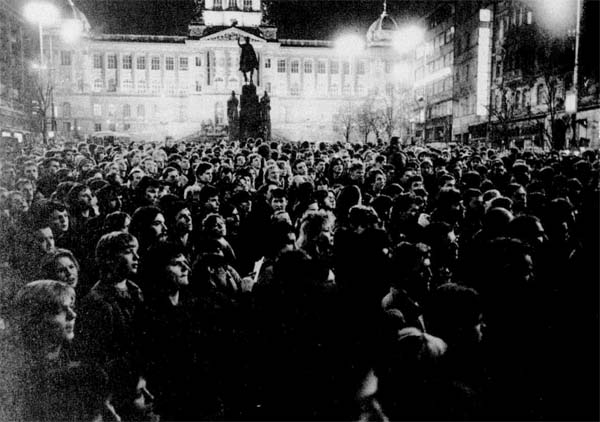 |
|
Prague January 1989 (CSDS collection)
|
Essay. January 2009, Prague – Vilém Prečan, “Palach’s Legacy: An Appeal to Czechoslovaks in the 1989 Struggle for Freedom”
Translation by Derek Paton.
Document 1. January 10, 1989, Prague – Statement by the Movement for Civil Liberties: Jan Palach’s Challenge
CSDS Prague, Palach Week Collection.
Translation by Alice and Gerald Turner (pseudonym “A. G. Brain”), published in Acta, Document 4.
Document 2. February 5, 1989, Prague – Ludvik Vaculik: Communism is best-ial
Libri prohibiti, Prague, Ludvik Vaculik Collection.
Translation by Alice and Gerald Turner (pseudonym “A. G. Brain”), published in Acta, Document 55.
Document 3. February 16, 1989, Prague – Statement by the Movement for Civil Liberties: Paths to democracy in the wake of the January events
CSDS Prague, Palach Week Collection.
Translation by Alice and Gerald Turner (pseudonym “A. G. Brain”), published in Acta, Document 61.
Section 2: Primary Sources on “Palach Week” January 1989
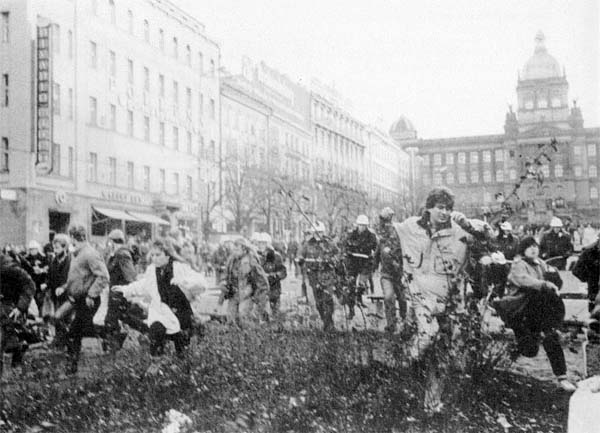 |
|
Prague January 1989 (CSDS collection)
|
Document 4. January 1989, Prague – A flyer in which five independent initiatives invite citizens to participate on January 15 in a Jan Palach memorial in Prague, as well as a January 21 pilgrimage to his grave in the village of Všetaty (30 km north of Prague).
CSDS Prague, Palach Week Collection.
Translation by Todd Hammond.
Document 5. January 16, 1989. Prague – Internal information (No. 53) on the events of January 13 to 15, 1989, provided by the Communist Party (CPCz) to Presidium members and candidates and to CPCz Central Committee secretaries. The briefing gives times and places of the various “unauthorized assemblies” and detentions, the number of security forces (2200 from the SNB and 1300 from the Peoples’ Militia), the recommendation that the militia be equipped with batons for next time and that security “prepare a closed-off area into which the crowd will be pushed….”
National Archive Prague, ÚV KSČ (CPCz CC), Documentation, 1989.
Translation by Todd Hammond.
Document 6. January 17, 1989, Prague – The Charter 77 statement addressed to the governments participating in the CSCE, then meeting in Vienna. The Charter statement says “only time will tell” if “the signing by 35 states of a document whose clauses some of them neither observe nor have any obvious intention of doing so, will nevertheless help to stimulate an improvement in the human rights situation,” and points out that those arrested during the Palach Week memorials were in custody “not for planting bombs, but for laying flowers.”
CSDS Prague, Charter 77 Collection.
Translation by Alice and Gerald Turner (pseudonym “A. G. Brain”), published in Acta, Document 21.
Document 7. January 17, 1989, Vienna – Speech and press conference by U.S. Secretary of State George Shultz at the conclusion of the CSCE meetings, including his denunciation of the Czechoslovak authorities for their repression of the Palach Week commemorations with “rubber truncheons, tear gas, and water cannons” “in direct violation of the commitments just solemnly given by the Government of Czechoslovakia.”
U.S. Department of State Bulletin, March 1989, pp. 50-54.
Document 8. January 17, 1989. Prague – Internal Party information (No. 54)on the events of January 16, 1989 on Wenceslas Square, Prague, provided to CPCz Presidium members and candidates and to CPCz Central Committee secretaries. This briefing describes the arrests of Havel and other Charter 77 representatives “whose bouquets were confiscated by the officers present.” Attached is an appendix to the previous Internal Party information 53, listing individuals who received medical treatment (for injuries including bone fractures, concussion, and shoulder dislocation) after the repression of the January 15 “anti-social events.”
National Archive Prague, ÚV KSČ (CPCz CC), Documentation, 1989.
Translation by Todd Hammond.
Document 9. January 18, 1989, Prague – Internal Party information (No. 55) on the events of January 17, 1989, as provided to CPCz Presidium members and candidates and to CPCz Central Committee secretaries. The briefing reports that the “so-called independent initiatives” continued “to intensify the pressure on the state organs,” which had to clear Wenceslas Square twice on that day. The Party line is that the security forces used only “moderate measures,” but also of course water cannons.
National Archive Prague, ÚV KSČ (CPCz CC), Documentation, 1989.
Translation by Todd Hammond.
Document 10. January 19, 1989, Prague – Internal Party information (No. 56) on the events of January 18, 1989 in Prague, provided to CPCz Presidium members and candidates and to CPCz Central Committee secretaries. The briefing notes that both American and British diplomats are among the crowd, “a provocational assembly of anti-socialist elements” that numbered at least 1,000 at the statue of St. Wenceslas, plus “around 2000 spectators.” Instead of attacking as on previous days, the security forces “remained hidden at their readiness and reserve locations and prepared for immediate commitment” but did not intervene.
National Archive Prague, ÚV KSČ (CPCz CC), Documentation, 1989.
Translation by Todd Hammond.
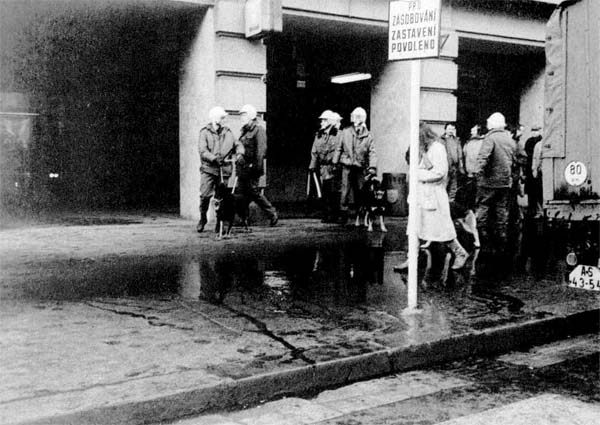 |
|
Prague January 1989 (CSDS collection)
|
Document 11. January 19, 1989, Prague – Eyewitness accounts of the January 19th demonstration and repression, compiled from reports telephoned to Radio Free Europe. Witnesses describe the police attacks as the “most brutal” of the week, and note the relative restraint of the uniformed SNB police compared to the riot police units, also called the “strong-arm squad” or “Jakeš’ smurfs.”
CSDS Prague, Palach Week Collection.
Translation by Alice and Gerald Turner (pseudonym “A. G. Brain”), published in Acta, Document 29.
Document 12. January 22, 1989, Prague – The head of the State Security Karel Vykypěl provides a concise report to the Minister of the Interior František Kincl on the Palach memorials and “provocational assemblies” between January 15 and 21, 1989. The report states that these events “clearly displayed the mounting aggressiveness of the adversarial community” and blames the “signatories of Charter 77 and the other so-called independent initiatives.”
ABS (Archive of Security Units) Prague, A 34/1-1497, MBO Jan Palach 1989.
Translation by Todd Hammond.
Document 13. January 24, 1989, Prague – The CC CPCz Secretary General expresses thanks to the members of the People’s Militia for their participation in suppressing the demonstrations, and assures them that the “decisions…taken by the organs of the party and state… for the maintenance of security and order in the center of the capital city… have been accepted with full understanding” by “the absolute majority of our population.”
National Archive Prague, ÚV KSČ, Miloš Jakeš Office, 1989.
Translation by Todd Hammond.
Document 14. January 25, 1989, Prague – Memorandum of the Government of the Czech Socialist Republic on the events in Prague of January 15 to 21, 1989. The government formally states its support for “the decisive measures taken by the security units” and declares “that the vast majority of our citizens condemns” the Palach memorials and gatherings.
National Archive Prague, ÚPV ČSSR (Office of the ČSSR Government), Memoranda and decisions of Government sessions, 1989.
Translation by Todd Hammond.
Document 15. January 25, 1989, Prague – The Minister of the Interior František Kincl provides Prime Minister Ladislav Adamec with a detailed report “on the anti-social activities of anti-socialist elements on January 15-22, 1989, in Prague and in Všetaty… and on the security measures taken to secure calm and public order.” The report includes specific details on the demonstrations and repressions of January 19, including crowd estimates (on the low side) of 2500 persons who “fled toward the lower part of the square” after “security units intervened” at 17:15, but “were prevented in this by a coordinated intervention by the People’s Militia.” The report also describes the repression of the Všetaty pilgrimage on January 21, including the presence of foreign diplomats from the U.S., Canada, Great Britain, and Denmark. On January 21, the report states, “449 persons were identity checked,” “227 persons were sent back,” and “another 222 persons who refused to change their minds about continuing to Všetaty were taken for questioning.”
National Archive Prague, ÚPV ČSSR (Office of the ČSSR Government), Memoranda and decisions of Government sessions, 1989.
Translation by Todd Hammond.
Document 16. January 29, 1989, Roxbury, USA – Arthur Miller denounces the imprisonment of Václav Havel, and describes his arrest as “simply an attempt to call back the smoke that Palach sent billowing into the sky.”
CSDS Prague, Václav Havel Collection, Box 13.
Published in the samizdat journal Lidové noviny, under the title “Where is the future?” and subsequently in Acta, Document 48.
Document 17. January 29, 1989. Moscow – Noted Soviet dissidents Yelena Bonner, Andrei Sakharov, and others send a message to the heads of states participating in the CSCE, describing the repression in Prague as a “blatant violation of the Vienna accords.”
CSDS Prague, Palach Week Collection.
Translation by Alice and Gerald Turner (pseudonym “A. G. Brain”), published in Acta, Document 47.
Document 18. February 21, 1989. Prague – Václav Havel’s final statement as defendant at the Prague 1 District Court. Havel dissects the indictment’s use of the words “anti-state” and “anti-socialist” as “no more than a derogatory label for all citizens who inconvenience the regime for whatever reason….”
CSDS Prague, Václav Havel Collection, Box 13.
Translation by Alice and Gerald Turner (pseudonym “A. G. Brain”), published in Acta, Document 66.
Section 3: Documentation from 1969
Document 19. [January 6, 1969, Prague.] – Jan Palach, in a letter to the student leader Lubomír Holeček, proposes a student occupation of Prague Radio and the broadcast of a call for a general strike.
ABS (Archive of Security Units) Prague, H-682/1. Fascimile in Petr Blažek, Patrik Eichler, Jakub Jareš et al.: Jan Palach ´69. Prague: Togga, FF UK, and ÚSTR, 2009, pp. 600–602.
Translation by Todd Hammond.
Document 20. January 21, 1969, Washington D.C. – The Central Intelligence Bulletin of the CIA, circulated to top U.S. government officials on the day after the inauguration of new president Richard Nixon, reports that “[t]housands of disaffected youths yesterday marched in the streets in memory of Jan Paluch [sic], a 21-year-old student whose self-immolation has aroused the entire population” of Czechoslovakia.
National Archives & Records Administration (College Park, Maryland), CIA CREST Database.
Document 21. January 21, 1969, Washington D.C. – The top National Security Council staff person for Eastern European matters, Helmut Sonnenfeldt, informs national security adviser Henry Kissinger: “the regime will have to decide whether to attempt to master the situation by itself or to let the Soviets do it. It will probably prefer the former course to minimize brutality, even at the risk of thereby making itself a Soviet tool.”
U.S. Department of State, Foreign Relations of the United States series, 1969-1976, Volume XXIX, pp. 203-204.
Document 22. February 3, 1969, Prague – The U.S. Embassy cables Washington with an assessment of the “growing assertiveness of conservatives and ‘realists’ in wake of emotional upsurge evoked by Palach suicide” and remarks that the “Palach self-immolation was major setback for hardliners, arresting trend toward public apathy on which they count.”
U.S. Department of State, Foreign Relations of the United States series, 1969-1976, Volume XXIX, pp. 204-206.
Document 23. February 26, 1969, Washington D.C. – The Central Intelligence Bulletin of the CIA reports that the latest “suicide-by-fire in Prague’s Wenceslas Square” [by 19-year-old student Jan Zajic] “is not likely to generate widespread public disturbance or precipitate a political crisis as did the Palach affair in mid-January” because “the population has become more or less inured to such incidents by over 30 self-immolation attempts.”
National Archives & Records Administration (College Park, Maryland), CIA CREST Database.
Section 4: The chronology of January – February 1989
The chronology of the events of January and February 1989 before and after the “Palach Week,” written by the Czechoslovak Documentation Centre for its quarterly publication Acta, in Vol. 3, No. 9-12, Winter 1989, compiled and edited by Jan Vladislav in collaboration with Vilém Prečan, titled “Czechoslovakia: Heat in January 1989” and ultimately printed in December 1989.
SECRET//NOFORN: CHINA ARMS EMBARGO: APRIL 2 PSC DEBATE AND NEXT
S E C R E T SECTION 01 OF 03 BRUSSELS 001510

SIPDIS

NOFORN

E.O. 12958: DECL: 04/06/2014
TAGS: PARM PHUM PREL PINR EUN USEU BRUSSELS
SUBJECT: CHINA ARMS EMBARGO: APRIL 2 PSC DEBATE AND NEXT
STEPS FOR U.S.

REF: A. USEU TODAY 04/06/04
     ¶B. BRUSSELS 1464
     ¶C. STATE 68263
     ¶D. PRAGUE 390

Classified By: USEU Poloff Van Reidhead for reasons 1.4 (b) and (d)

-------
SUMMARY
-------

¶1. (S/NF) The EU Political and Security Committee (PSC)
discussed the EU arms embargo on China during a heated 90
minute exchange on April 2.  PSC Ambassadors generally agreed
that the issue -- of whether, when and how to lift the
embargo -- should be sent back down to working groups for
further study before being presented to political groups for
a decision.  France objected, however, and succeeded in
getting agreement to discuss the issue at the April 26 FMs
meeting (GAERC) -- but failed in its campaign to secure an
early decision.  The debate will likely continue well into
the Dutch EU Presidency.  This cable draws on a detailed
readout and a sensitive internal report provided to Poloff by
UK and Hungarian contacts (please protect accordingly), as
well as background provided in recent days by other
interlocutors.  It also offers a strategy for continuing US
engagement.

--------------------------------------
PSC Reacts Badly to Latest US Demarche
--------------------------------------

¶2. (S/NF) PSC Ambassadors reportedly arrived at the April 2
meeting to find copies of ref C demarche sitting on their
otherwise empty desks.  The demarche was received badly
because it gave the impression that "big brother was
watching," and because it appeared timed as a heavyhanded and
hubristic attempt to influence the PSC, according to our UK
contact.  Some reps, led by Greek Ambassador
Paraskevoupoulos, objected to the Council Secretariat's
distribution of the demarche under Council Secretariat cover
and with a Secretariat identifying number.  He argued that
the document had no business being circulated by the
Secretariat, and insisted that it be stricken from EU

SIPDIS
records.  Ambassadors also reacted against what they
perceived as the threatening tone of our demarche.

¶3. (S/NF) The Financial Times' front page article on April 2
about the US demarche campaign also enflamed the Ambassadors
because it appeared directly aimed at Friday's PSC
discussion.  Irish Ambassador Kelleher reportedly opened the
meeting by waving the article in the air and imploring his
colleagues to protect the confidentiality of internal EU
deliberations.  Poloff pointed out that the timing of the
latest US demarche was a coincidence, as we were previously
unaware that the PSC was scheduled to discuss the issue on
that day.  (COMMENT: Our demarche was received badly not so
much because of its substance, but because of the way it was
presented.  Our UK contact faulted the Irish and the Council
Secretariat for the way the demarche was handled in the PSC,

SIPDIS
and also the awkward timing that made it seem, along with the
FT article, tailor-made to influence the April 2 discussion.
END COMMENT).

-----------------------------------------
National Positions: France versus Denmark
-----------------------------------------

¶4. (S/NF) According to our UK contact, France staked out a
"zero flexibility" position on lifting the embargo, and is
opposed to any talk of applying conditionality (i.e. by
insisting on further human rights progress by China and/or
strengthening the Code of Conduct prior to lifting the
embargo).  The Danes are reportedly still leading the
opposition, and have circulated to EU partners a list of ten
human rights conditions that they believe China should meet
before the embargo is lifted (we have not yet obtained a copy
of this list).  Other EU Member States are lining up
somewhere in between, although "all agree in principle" that
the embargo should be lifted if certain conditions are met.
The debate from now on will focus on defining conditions and
timing.

¶5. (S/NF) Following is a summary of national interventions
made at the April 2 PSC:

-- France: The embargo is anachronistic and must go; willing
to discuss timing but not conditionality because China would
not accept human rights conditionality; likewise would be
contradictory to enhance the Code of Conduct specifically for
China while also lifting the embargo; opposed also to making
Code of Conduct legally binding; wants issue to remain
political; opposed to sending it down to working groups.

-- Denmark: Any decision to lift the embargo must be linked
to specific Chinese steps on human rights; EU also needs to
review Code of Conduct to ensure that lifting the embargo
does not result in increased arms sales to China.

-- Germany: EU must consider regional impact of lifting the
embargo; now is not a good time to lift embargo (COMMENT: The
Germans appear to have moved closer to the Danes in recent
weeks, and are now the largest EU member state with serious
reservations about lifting the embargo.  One report of the
discussion suggests that "the tough German position, coupled
with the strength of US views, might be tempering French
enthusiasm."  END COMMENT).

-- UK: Should be further study by working groups to identify
implications for human rights and regional stability, and to
examine options for strengthening Code of Conduct (COMMENT:
Our Hungarian contact reports that the UK is fundamentally
closer to the French end of the spectrum than the Danish.
The UK, like France, does not favor making the Code of
Conduct legally binding.  END COMMENT).

-- Greece: Should explore gestures China could make on human
rights without explicitly linking them to lifting the
embargo; should not link regional stability to lifting
embargo; "provocatively" proposed that the Code of Conduct be
made legally binding.  (COMMENT: Our contacts report that the
Greek position on lifting the embargo is closer to France
than any other Member State.  END COMMENT).

-- Ireland: Supports sending the issue back to working groups
(in part to keep the EU from making any decision during its
Presidency).

-- Netherlands: Central consideration should be possible
release of political prisoners from the 1989 Tiananmen
crackdown.

-- Czech Republic: Supports French position that issue should
remain political; silent on other points (COMMENT: Our UK
contact said that the Czech position is generally understood
to be informed by that country's interest in selling radar
equipment to China, as described ref D.  END COMMENT).

-- Sweden: Working groups should further study issues of
human rights, regional stability, and enhancing the Code of
Conduct.

-- Austria: Should explore gestures on human rights that
China could make but avoid linkage to lifting the embargo;
should conduct a general (i.e. non China-specific) review of
Code of Conduct.

-- Italy: Intervened with same points as Austria.

-- Belgium: More discussion needed of implications, including
on human rights, of any decision to lift embargo.

-- Commission: Took no position on lifting embargo but said
EU should remain focused on human rights.

Other member states did not intervene in the PSC discussion.

-------------------------------------
Timeline: Back to the Working Groups?
-------------------------------------

¶6. (S/NF) The PSC will meet again on this issue on April 7,
when it is expected to approve an "issues paper" which will
then be sent through COREPER to FMs for discussion at the
April 26 GAERC.  According to our UK and Hungarian contacts,
the paper is intended as a tour d'horizon for the GAERC
discussion.  It will not contain recommendations, and FMs are
not expected to take a decision.  Instead, they will likely
send the paper back down to the PSC for re-examination.  Most
PSC Ambassadors, having satisfied the French desire for a
ministerial discussion in April, will then press France to
accept the majority preference for sending the issue back to
the working groups.  The working groups would need two to
three months, minimum, to complete their assessments and
submit their papers to the PSC (EU working groups are
comprised of capital-based experts who rarely meet more than
once per month).  The relevant working groups are COHUM
(human rights), COASI (Asia Directors), and COARM
(conventional arms exports).

¶7. (S/NF) What all this means is that the debate will likely
continue well into the Dutch Presidency.  Already, Member
States are beginning to look toward the December EU-China
Summit as a possible timeframe for any decision to lift the
embargo.  We have heard they are also looking at the US
electoral calendar and quietly wondering whether it would be
worth holding off their decision until November or December
in the hopes of sneaking it past the US radar.  They have not
and will not discuss such issues openly, even amongst each
other in the PSC, but our UK contact confirms that quiet
conversations and suggestive comments are going on in the
wings.

---------------------
Next Steps for the US
---------------------

¶8. (S/NF) Our efforts have managed to slow down the momentum
in favor of removing the arms embargo, but have not killed
this idea outright.  In addition to the ongoing diplomatic
dialogue on this issue, we recommend the following steps to
help us keep the pressure on European governments:

-- We should coordinate closely with Japan, and perhaps also
the ROK.  According to numerous EU interlocutors, the
Japanese have become increasingly active on this issue, but
their efforts appear so far uncoordinated with our own.
While this may have served our interests in the sense that it
gave the Europeans the impression that Japan's concerns were
genuine and not dictated by Washington, it is now time to
begin coordinating our efforts, so that Europeans recognize
that other key players in the region share our regional
stability concerns.

-- We should engage the European Parliament, and particularly
members of its Human Rights Committee.  The EP is already on
record opposing an end to the embargo.  By calling attention
to EU deliberations and ongoing Chinese human rights abuses,
the EP could increase the political heat on member state
governments against any decision to lift the embargo.

-- We should consider increasing our public statements and
press briefings for European audiences, on the assumption
that more scrutiny by European publics would help our views
on this issue, especially as regards human rights.

-- We should increase our engagement with institutional and
member state representatives to the COHUM, COASI and COARM
working groups.  In this way we could ensure that our views
on human rights, regional stability and the Code of Conduct
are fully understood by those experts who will be supplying
recommendations to the political groups for discussion.

-- Additionally, as suggested ref B, we recommend the USG
begin considering options for how the EU might strengthen
controls on arms exports to China in a post-embargo scenario.
 The worst case for us would be for the EU to lift its
embargo without having in place some sort of new mechanism
for controlling the transfer of arms and sensitive
technologies to China.

Schnabel
TOP-SECRET: CUBAN CRISIS 1961- ORIGINAL DOCUMENTS FROM THE ARCHIVES OF THE NATIONAL SECURIYT AGENCY (NSA)
TOP-SECRET: Cuban Missile Crisis Document Archive – 1960 from the NSA Archives
Afghanistan and the Soviet Withdrawal 1989 20 Years Later
 Alexander Lyakhovsky
Washington D.C., July 31st 2011 – Twenty years ago today, the commander of the Soviet Limited Contingent in Afghanistan Boris Gromov crossed the Termez Bridge out of Afghanistan, thus marking the end of the Soviet war which lasted almost ten years and cost tens of thousands of Soviet and Afghan lives.
As a tribute and memorial to the late Russian historian, General Alexander Antonovich Lyakhovsky, the National Security Archive today posted on the Web (www.nsarchive.org) a series of previously secret Soviet documents including Politburo and diary notes published here in English for the first time. The documents suggest that the Soviet decision to withdraw occurred as early as 1985, but the process of implementing that decision was excruciatingly slow, in part because the Soviet-backed Afghan regime was never able to achieve the necessary domestic support and legitimacy – a key problem even today for the current U.S. and NATO-supported government in Kabul.
The Soviet documents show that ending the war in Afghanistan, which Soviet general secretary Mikhail Gorbachev called “the bleeding wound,” was among his highest priorities from the moment he assumed power in 1985 – a point he made clear to then-Afghan Communist leader Babrak Karmal in their first conversation on March 14, 1985. Already in 1985, according to the documents, the Soviet Politburo was discussing ways of disengaging from Afghanistan, and actually reached the decision in principle on October 17, 1985.
But the road from Gorbachev’s decision to the actual withdrawal was long and painful. The documents show the Soviet leaders did not come up with an actual timetable until the fall of 1987. Gorbachev made the public announcement on February 8, 1988, and the first troops started coming out in May 1988, with complete withdrawal on February 15, 1989. Gorbachev himself, in his recent book (Mikhail Gorbachev, Ponyat’ perestroiku … Pochemu eto vazhno seichas. (Moscow: Alpina Books 2006)), cites at least two factors to explain why it took the reformers so long to withdraw the troops. According to Gorbachev, the Cold War frame held back the Soviet leaders from making more timely and rational moves, because of fear of the international perception that any such withdrawal would be a humiliating retreat. In addition to saving face, the Soviet leaders kept trying against all odds to ensure the existence of a stable and friendly Afghanistan with some semblance of a national reconciliation process in place before they left.
The documents detail the Soviet leadership’s preoccupation that, before withdrawal of troops could be carried out, the Afghan internal situation had to be stabilized and a new government should be able to rely on its domestic power base and a trained and equipped army able to deal with the mujahadeen opposition. The Soviets sought to secure the Afghan borders through some kind of compromise with the two other most important outside players—Pakistan, through which weapons and aid reached the opposition, and the United States, provider of the bulk of that aid. In the process of Geneva negotiations on Afghanistan, which were initiated by the United Nations in 1982, the United States, in the view of the Soviet reformers, was dragging its feet, unwilling to stop arms supplies to the rebels and hoping and planning for the fall of the pro-Soviet Najibullah regime after the Soviet withdrawal.
Internally, the People’s Democratic Party of Afghanistan did everything possible to prevent or slow down the Soviet withdrawal, putting pressure on the Soviet military and government representatives to expand military operations against the rebels.
Persistent pleading on the part of Najibullah government as late as January 1989 created an uncharacteristic split in the Soviet leadership, with Foreign Minister Eduard Shevardnadze suggesting that the withdrawal should be slowed down or some forces should remain to help protect the regime, while the military leadership argued strongly in favor of a complete and decisive withdrawal.
According to the American record, Shevardnadze had already informed Secretary of State George Shultz as early as September 1987 of the specific timetable for withdrawal. But many senior officials did not believe the Soviet assurances; in fact, deputy CIA director Robert Gates famously bet a State Department diplomat on New Year’s Eve 1987 that Gorbachev would make no withdrawal announcement until after the end of the Reagan administration. Gates believed the Chinese saying about the Soviet appetite for territory: “What the bear has eaten, he never spits out” – and only in his memoirs did he admit he was making “an intelligence forecast based on fortune cookie wisdom.” (Robert Gates, From the Shadows: The Ultimate Insider’s Story of Five Presidents and How They Won the Cold War (New York: Simon&Shuster, 1996, pp. 430-431). Of course, Gates’ hardline views on Gorbachev would take over U.S. policy as the George H.W. Bush administration came into office in January 1989.
By this time, however, the Soviet leaders well realized that the goal of building socialism in Afghanistan was illusory; and at the same time the goal of securing the southern borders of the Soviet Union seemed to be still within reach with the policy of national reconciliation of the Najibullah government. So the troops came out completely by February 15, 1989. Soon after the Soviet withdrawal, however, both superpowers seemed to lose interest in what had been so recently the hottest spot of the Cold War.
Najibullah would outlast Gorbachev’s tenure in the Kremlin, but not by much: Within three years Najibullah would be removed from power and brutally murdered, and Afghanistan would plunge into the darkness of civil war and the coming to power of the Taliban. Twenty years later, the other superpower and its Cold War alliance are fighting a war in Afghanistan against forces of darkness that were born among the fundamentalist parts of mujahadeen resistance to the Soviet occupation. In such a context, the language and the dilemmas in these 20-year-old documents still provide some resonance today.
This posting is also a tribute to and a commemoration of one of our long-standing partners in the pursuit of opening secrets and writing the new truly international history of the Cold War. General Alexander Lyakhovsky passed away from a heart attack while standing on a Moscow Metro platform on February 3, 2009, less than two weeks before the 20th anniversary of the end of the war in which he served as an officer, and which he studied for many years as a scholar. He is survived by his wife Tatyana and their children Vladimir and Galina.
The National Security Archive mourns the passing of our dear friend and partner, Alexander Antonovich. It is fitting and proper that here we express our deepest appreciation for his remarkable knowledge, his scholarly and personal integrity, and his generosity both in expertise and the documents that he always shared with us, while he educated us and the world. His memory lives on in all of us who ever read his work, heard him speak, or best of all, listened to him sing the sad songs of the Afghan war.
— Svetlana Savranskaya, director of Russia programs, Thomas Blanton, executive director, National Security Archive, and Malcolm Byrne, Deputy Director, National Security Archive.
Documents:
Document 1. Memorandum of Mikhail Gorbachev’s Conversation with Babrak Karmal, March 14, 1985
In his first conversation with the leader of Afghanistan, who was installed by the Soviet troops in December of 1979, Gorbachev underscored two main points: first that “the Soviet troops cannot stay in Afghanistan forever,” and second, that the Afghan revolution was presently in its “national-democratic” stage, whereas its socialist stage was only “a course of the future.” He also encouraged the Afghan leader to expand the base of the regime to unite all the “progressive forces.” In no uncertain terms, Karmal was told that the Soviet troops would be leaving soon and that his government would have to rely on its own forces.
Document 2. Anatoly Chernyaev Diary, April 4, 1985
Chernyaev reflects on the “torrent of letters” about Afghanistan received recently by the Central Committee and the Pravda newspaper. They reflect the growing dissatisfaction of the population with the drawn-out war and the consensus that the troops should be withdrawn.
Document 3 Anatoly Chernyaev Diary, October 17, 1985.
At the Politburo session of October 17, 1985, General Secretary Gorbachev proposed to make a final decision on Afghanistan and quoted from citizens’ letters regarding the dissatisfaction in the country with the Soviet actions in Afghanistan. He also described his meeting with Babrak Karmal during which Gorbachev told the Afghan leader: “we will help you, but with arms only, not troops.”Chernyaev noted Gorbachev’s negative reaction to the assessment of the situation given by Defense Minister Marshal Sergey Sokolov.
Document 4. Politburo Session, June 26, 1986.
The Politburo discusses the first results of Najibullah’s policy of national reconciliation. Gorbachev emphasizes that the decision to withdraw the troops is firm, but that the United States seems to be a problem as far as the national reconciliation is concerned. He proposes early withdrawals of portions of troops to give the process a boost, and proposes to “pull the USA and Pakistan by their tail” to encourage them to participate in it more actively.
Document 5 Politburo Session, November 13, 1986.
The first detailed Politburo discussion of the process and difficulties of the withdrawal of the Soviet troops from Afghanistan, which included the testimony of Marshal Sergei Akhromeev.
Document 6 Politburo Session, January 21, 1987
The Politburo discusses the results of Foreign Minister Eduard Shevardnadze and Head of the Central Committee International Department Anatoly Dobrynin’s trip to Afghanistan. Shevardnadze’s report is very blunt and pessimistic about the war and the internal situation. The main concern of the Politburo is how to end the war but save face and ensure a friendly and neutral Afghanistan.
Document 7 Politburo Session, February 23, 1987
Gorbachev talks about the need to withdraw while engaging the United States and Pakistan in negotiations on the final settlement. He is willing to meet with the Pakistani leader Zia ul Khaq, and maybe even offer him some payoff. The Soviet leader also shows concern about the Soviet reputation among non-aligned countries and national liberation movements.
Document 8 Politburo Session, February 26, 1987
In his remarks to the Politburo, General Secretary returns to the issue of the need to withdraw Soviet troops from Afghanistan several times. He emphasizes the need to withdraw the troops, and at the same time struggles with the explanation for the withdrawal, noting that “we not going to open up the discussion about who is to blame now.” Gromyko admits that it was a mistake to introduce the troops, but notes that it was done after 11 requests from the Afghan government.
Document 9 Colonel Tsagolov Letter to USSR Minister of Defense Dmitry Yazov on the Situation in Afghanistan, August 13, 1987
Criticism of the Soviet policy of national reconciliation in Afghanistan and analysis of general failures of the Soviet military mission there are presented in Colonel Tsagolov’s letter to USSR Defense Minister Dmitry Yazov of August 13, 1987. This letter represents the first open criticism of the Afghan war from within the military establishment. Colonel Tsagolov paid for his attempt to make his criticism public in his interview with Soviet influential progressive magazine “Ogonek” by his career—he was expelled from the Army in 1988.
Document 10 CC CPSU Letter on Afghanistan, May 10, 1988
On May 10, 1988, the Central Committee of the Communist Party of the USSR issued a “closed” (internal use) letter to all Communist Party members of the Soviet Union on the issue of withdrawal of troops from Afghanistan. The letter presents the Central Committee analysis of events in Afghanistan and Soviet actions in that country, the problems and the difficulties the Soviet troops had to face in carrying out their mission. In particular, the letter stated that important historic and ethnic factors were overlooked when the decisions on Afghanistan were made in the Soviet Union. The letter analyzes Soviet interests in Afghanistan and the reasons for the withdrawal of troops.
Document 11 Politburo Session January 24, 1989
This Politburo session deals with the issue of the completion of the withdrawal and the post-war Soviet role in Afghanistan, as well as possible future development of the situation there. The discussion shows the split among the Soviet leadership with Foreign Minister Eduard Shevardnadze arguing for leaving some personnel behind to help protect the Najibullah regime or delaying the full withdrawal.
Document 12 Excerpt from Alexander Lyakhovsky and Vyacheslav Nekrasov, Grazhdanin, Politik, Voin: Pamyati Shakha Masuda (Citizen, Politician, Fighter: In Memory of Shah Masoud), (Moscow, 2007), pp. 202-205
Document 13 Excerpt from Statement of the Soviet Military Command in Afghanistan on the Withdrawal of Soviet Troops, February 14, 1989
On April 7, 1988, USSR Defense Minister signed an order on withdrawal of troops from Afghanistan. In February 1989, the Defense Ministry prepared a statement of the Soviet Military Command in Afghanistan on the issue of withdrawal of troops, which was delivered to the Head of the UN Mission in Afghanistan on February 14, 1989—the day when the last Soviet soldier left Afghanistan. The statement gave an overview of Soviet-Afghan relations before 1979, Soviet interpretation of the reasons for providing internationalist assistance to Afghanistan, and sending troops there after the repeated requests of the Afghan government. It criticized the U.S. role in arming the opposition in disregard of the Geneva agreements, and thus destabilizing the situation in the country. In an important acknowledgement that the Vietnam metaphor was used to analyze Soviet actions in Afghanistan, they military explicitly referred to “unfair and absurd” comparisons between the American actions in Vietnam and the presence of Soviet troops in Afghanistan.
Document 14. Official Chronology of the Soviet withdrawal from Afghanistan with quotes from documents from the Archive of the Gorbachev Foundation, Moscow.
Books By Alexander Lyakhovsky
Grazhdanin,Politik,Voin, Plamya Afgana and Zacharovannye svobodoj
STRENG VERTRAULICHES DOKUMENT DER DEUTSCHEN BAHN ZUR NEUPOSITIONIERUNG

SECRET: ITALY REQUESTS ASSISTANCE FOR ANTI-PIRACY
VZCZCXYZ0001
OO RUEHWEB

DE RUEHRO #0433/01 1061348
ZNY SSSSS ZZH
O 161348Z APR 09
FM AMEMBASSY ROME
TO RUEHC/SECSTATE WASHDC IMMEDIATE 1935
INFO RUEHDJ/AMEMBASSY DJIBOUTI PRIORITY 0273
RUEKJCS/JOINT STAFF WASHDC PRIORITY
RHMFISS/HQ USEUCOM VAIHINGEN GE PRIORITY
RUEKJCS/SECDEF WASHDC PRIORITY
RHMFISS/HQ USCENTCOM MACDILL AFB FL PRIORITY
S E C R E T ROME 000433

SIPDIS

OSD FOR MAGGIE SADOWSKA
EUR/RPM FOR CHRIS DAVY AND PETER CHISHOLM
EUR/WE FOR CHRIS JESTER AND PAMELA SPRATLEN
AF/RSA FOR MIKE BITTRICK AND JUN BANDO

E.O. 12958: DECL: 04/17/2019
TAGS: MASS MARR EWWT KCRM PBTS PGOV PHSA PREL AORC

SUBJECT: PIRACY: ITALY REQUESTS ASSISTANCE FOR ANTI-PIRACY
OPERATION

REF: WASLEY-JESTER-SADOWSKA EMAILS 4-15-09

Classified By: Charge d'Affaires a.i. Elizabeth Dibble for
Reasons 1.4 (B) and (D)

¶1. (S)  The Government of Italy sent U.S. Embassy Rome an
unclassified Note Verbale on April 16 thanking the USG for
assistance provided thus far in the deployment of Italian
Special Forces to Djibouti for possible use in an anti-piracy
mission and requesting continuing assistance as needed.  The
note, sent in unclassified channels to speed up the process,
was generated in response to our requirement that any further
USG assistance in support of the Italian anti-piracy mission
be requested via Diplomatic Note.

¶2. (S) Background: The Italian-owned and flagged tugboat
Buccaneer was taken by pirates in the Gulf of Aden on April
¶11.  The ship has 16 crew members on board: 10 Italian, 5
Romanian, and 1 Croatian, and is currently about one nautical
mile from the coast of Somalia.  The Italian military has
requested permission from the Government of Djibouti and
Combined Joint Task Force-Horn of Africa (CJTF-HOA) to use
Camp Lemonier in Djibouti as a logistical staging area in
preparation for a possible rescue mission.  The GOI assures
us that it has obtained all the necessary landing permits
from the Government of Djibouti.  It has already landed one
aircraft in Djibouti with approximately 29 logistical support
staff, currently housed at Camp Lemonier, to prepare for the
staging.  The mission, if it happens, will not/not be
launched from Djiboutian soil, and the GOI is currently
considering other options that do not entail a rescue
mission.  Italy may use its Frigate MAESTRALE, currently
deployed to the region as part of EU operation ATALANTA, and
which is currently shadowing the pirates, to launch the
operation, or may make use of other vessels.  Italy may
request helicopter, intel, and other logistical support from
the U.S. as the need arises, but currently its request is
limited to logistical support to house units at Camp
Lemonier.

¶3. (S) Post has stressed to the GOI the need to provide as
many details as possible about the potential operation in a
timely manner, as well as the need to coordinate fully with
the Government of Djibouti.  The Defense Attache is in
contact with the Italian Military and Poloffs are in contact
with the MFA Operations Center as the situation evolves, and
will provide additional operational details as they become
available.

¶4. (SBU) The translated text of the Note is as follows
(Italian original will be emailed to EUR/WE):

BEGIN TEXT

"Ministry of Foreign Affairs

Rome, 4/16/2009
Prot. 0129432

The Ministry of Foreign Affairs of the Republic of Italy
presents its compliments to the Embassy of the United States
of America and, in consideration of our shared efforts in the
fight against terrorism and piracy, has the honor to express
its full appreciation for the assistance provided to the
"Training Mission" sent to Djibouti.

The sending of the mission, as well as the deployment of the
Italian Frigate "MAESTRALE," forms part of the efforts
undertaken by the Government of Italy in the struggle against
piracy.

While noting that the Authorities of Djibouti have provided
the necessary visas and aircraft landing authorizations, the
Italian Government is particularly grateful to the Government
of the United States of America for having hosted this
mission at Camp Lemonier.  The Italian Government, in
addition, is grateful to the Government of the United States
of America henceforth for any further assistance that it
might provide in the future.

The Ministry of Foreign Affairs, in expressing its full
gratitude for the collaboration, takes the opportunity to
extend to the Embassy of the United States of America
reassurances of its highest consideration."

END TEXT

DIBBLE
TOP-SECRET: The Diary of Anatoly Chernyaev 1989
Washington, DC, July 31st – The National Security Archive publishes its fourth installment of the diary of Anatoly Chernyaev, the man who was behind some of the most momentous transformations in Soviet foreign policy at the end of the 1980s in his role as Mikhail Gorbachev’s main foreign policy aide. In addition to his contributions to perestroika and new thinking, Anatoly Sergeevich was and remains a paragon of openness and transparency, providing his diaries and notes to historians who are trying to understand the end of the Cold War. This section of the diary, covering 1989—the year of miracles—is published here in English for the first time.
After the “turning point year,” 1988, the Soviet reformers around Gorbachev expected fast progress on all fronts—domestically in implementation of the results of the XIX party conference and further democratization of the Soviet system, and internationally following the groundbreaking UN speech of December 1988, especially in the sphere of nuclear arms control and in integrating the Soviet Union into Europe. However, those hopes were not realized, and the year brought quite unexpected challenges and outcomes. By the end of the year, no new arms control agreements would be signed, but the Berlin Wall would fall, nationalist movements would start threatening the unity of the Soviet Union, and popular revolutions would sweepEastern Europewhile the Soviets stuck to their pledge not to use force. By the end of 1989,Europewas transformed and the Cold War had ended. Anatoly Chernyaev documented all those changes meticulously and reflected on their meaning in real time.
For Chernyaev, the year began with an argument over the final withdrawal of Soviet forces fromAfghanistan. Soviet Foreign Minister Eduard Shevardnadze tried to delay the full withdrawal of troops and to send an additional brigade to help the Afghan leader Najibullah repel attacks of Pakistani-supported mujahaddin and stabilize his government. Chernyaev and Alexander Yakovlev actively opposed that course of action on the grounds that it would cost hundreds of lives of Soviet soldiers and undermine Soviet trustworthiness in the eyes of international partners. The troops were withdrawn on schedule by February 15, 1989.
Domestically, the most important event was the first contested election to the Congress of People’s Deputies on March 26, 1989. Chernyaev himself was elected as a Deputy, but expressed unease about being among the 100 candidates on the “guaranteed” party list. His reflections on the electoral campaign and the results of the elections show his sincere belief that the Soviet system could be transformed by deepening the democratization and his concerns over the limitations and resistance by the conservative elements within the party. The electoral campaign takes place at the time when the economic situation deteriorates quite significantly, leading to unprecedented discontent of the population and ultimately miners’ strikes in the summer.
An important theme of 1989 is the growing nationalism and the threat of possible breakup of theSoviet Union—“the nationalities bomb.” On this issue, Chernyaev seems to understand the situation much better than Gorbachev, who until very late does not comprehend the fact that the Baltic states genuinely want to leave the Soviet Union, maybe up until the human chain of protesters forms on August 23, 1989. Gorbachev believes that they could be kept in by negotiations and economic pressure. The events inTbilision April 9, 1989, where the police killed 20 civilians trying to disperse nationalist rallies, should have been a wake-up call. Chernyaev wonders if Gorbachev understands all the depth of the nationalities issue or if he is still under the influence of the Soviet official narrative of harmonious relations between ethnic groups under socialism.
The summer of 1989 brings the Solidarity victory in the Polish elections and the start of the Hungarian roundtable negotiations culminating in the first non-communist government in Eastern Europe inPolandand the Soviet acceptance of those events. On the heels of the Polish and Hungarian breakthroughs comes the change of leadership inEast Germanyand the almost accidental yet fateful fall of the Berlin Wall. In this case, just as on the issue of nationalism, Chernyaev shows a much better understanding of its true meaning than most other Soviet leaders. In the fall of the Wall, he sees an end of an era, the true transformation of the international system, and a beginning of a new chapter in the European history. The start of the process of German reunification and theMaltasummit signified the end of the Cold War.
However, for Chernyaev, his position notwithstanding, the year’s main concern was the domestic developments in theSoviet Union, and specifically the insufficient progress in radical economic and political reform. A lot of entries deal with his disappointment in Gorbachev’s slow or ambivalent actions where he seems to be siding with conservatives, his inability to move more decisively even on the issues that he himself proclaimed, such as land reform. Chernyaev’s main lament is that Gorbachev is losing time and political power as a result of his indecisiveness while the opposition is growing strong using “the Russian factor” and becoming more anti-Gorbachev and siding with Yeltsin more and more often in the Congress of People’s Deputies.
All through the tumultuous events of 1989, Anatoly Chernyaev remains at Gorbachev’s side, faithful to the ideas and the promise of the reform, but at the same time more and more critical at the weaknesses and inconsistencies of his boss and growing more dissatisfied by the emerging distance in their personal relationship. The last entry of the year, for December 31, is written in the form of a letter to Gorbachev, expressing all his disappointments and worries about the fate of the reform. The diary entries allow historians an opportunity to see the days of 1989 as they unfolded, through the eyes of a most perceptive and involved participant.
The Chernyaev Diary was translated by Anna Melyakova and edited by Svetlana Savranskaya for the National Security Archive.

WEISUNG 4 ZUM EINSATZ DER BUNDESWEHR – MEMO 4 ABOUT THE BUNDESWEHR
GEHEIMES PROTOKOLL ZUM ABLAUF DER LOVE PARADE 2011 – SECRET MEMO ABOUT THE PROJECTED COURSE OF THE LOVE PARADE IN 2011
STRENG VERTRAULICH: INTERNES PAPIER DER DEUTSCHEN BANK ZUR KUNDENBETREUUNG

THE BILDERBERG GROUP HISTORY
The Impact of the Financial Services Meltdown on The Global Economy And The Meltdown on The Global Economy And The Private Equity Private Equity Industry
The Impact of the Financial Services Meltdown on The Global Economy And The Meltdown on The Global Economy And The Private Equity Private Equity Industry
by David Rubenstein, Co- Founder, Carlyle Group
GEHEIME LISTE DER VON LYCOS ZENSIERTEN INTERNET-DOMAINS
http://www.adressbuchbetrug-info.net
http://www.adressbuchbetrug.info
http://www.adressbuchbetrug.vu
http://www.gegenjustizunrecht.vu
http://www.ergomar-ergolding.de/pagedeutsch/wellness/massage_kosmetik.php
http://www.sportswearshop.net
http://www.cartoonland.de/archiv/the-simpsons-movie
http://www.verunsicherung.de/extra/2005-03-11.html
http://www.hochschulwerk.de/wohnungsmarkt.php4?action=detail&strid=124&page=1&wid=1699
http://www.videostore-deutschland.com
blog.libero.it/inutileblog/view.php?id=inutileblog&mm=0&gg=071010
http://www.unita.de
membres.lycos.fr/bretey/euro
http://www.samenundpflanzen.de
archiv.mopo.de/archiv/2001/20011026/20011026123.html
http://www.mundoanuncio.com
http://www.weltverschwoerung.de
http://www.findthelinks.com/theory/conspiracy/cia.htm
archive.theargus.co.uk/2002/9/19/150002.html
http://www.teambuilder.it
teambuilder.ch
http://www.schloss-girsberg.ch/sommertheater/amphitryon/buero/debugalles.php5
http://www.cl44.org/newsletter45332/february_2003.pdf
portland.indymedia.org/en/2002/10/28719.shtml
findarticles.com/p/articles/mi_qn4158/is_20021023/ai_n12653413
members.lycos.co.uk/iuewtwh/financial-ratios-debt.html
http://www.debtmanagementplace.co.uk/2007/10/29/trimming-your-debt-with-eurodebt-wwweurodebtcouk
s107349834.websitehome.co.uk/democomsingle
http://www.forsoho.co.uk/search/result.asp?qa=eurodebt&x=0&y=0&ag=ftc713838
members.lycos.nl/zrewyi/eurodebt-financial-services.html
http://www.topsearch10.com/search.php?aid=34671&said=net35&q=debt+consolidation
usuarios.lycos.es/aewteuj/eurodebt.html
http://www.ifabonus.co.uk/index.php?name=news&file=article&sid=1762
http://www.eurodebt.ie/uncategorized/second-test-post
geo.ya.com/hrewwy/eurodebt.html
http://www.apsique.com/foro/anuncios
http://www.mikrocontroller.net/topic/74708
dsgtew.dzaba.com/eurodebt-financial-services.html
membres.lycos.fr/urture/eurodebt-financial-services.html
reuiwv.up-a.com/eurodebt-financial-services.html
eurodebt.net
utenti.lycos.it/reyufsw/euro
http://www.eurodebt.ie/contact-us
http://www.proxx.de/partner.html
usuarios.lycos.es/utisuwr
mitglied.lycos.de/retreu
members.lycos.nl/nertreu
utenti.lycos.it/bewgewi
membres.lycos.fr/bwrweyu
http://www.farfadet-maussade.com
http://www.eurodebtrecovery.com
fdherh.deperiodistas.net/eurodebt-financial-services.html
usuarios.lycos.es/utisuwr/eurodebt.html
mitglied.lycos.de/retreu/eurodebt-financial-services.html
members.lycos.nl/nertreu/eurodebt.html
http://www.clickajob.co.uk/company_profiles/eurodebt
http://www.debtcritic.co.uk/eurodebt.php
utenti.lycos.it/bewgewi/eurodebt.html
membres.lycos.fr/bwrweyu/eurodebt.html
http://www.kommunikationssystem.de/news/frieden/iraq-usa:-ein-traum-fuer-scharfschuetzen-iraqi-resistance-report-19.-april-2004-12203.html
http://www.optikernetz.de/optikernetz/news/newsuebersicht.php?we_lv_start_news=40
forum.politik.de/forum/showthread.php?t=57209&page=3
http://www.beoffice.de
http://www.phallostretch.de
http://www.phallosan.com
forum.politik.de/forum/archive/index.php/t-57209.html
forum.politik.de/forum/showpost.php?p=1352839&postcount=44
http://www.lycos.de/1001stadt/anzeigen_detail.html,,s_24466__a_29d69d2d/krefeld-unternehmensberaterin.html
http://www.angelfire.com/punk/woditu/cristian-cedolin.html
http://www.reexamine.org/wtobserver
http://www.faz.net/d/invest/meldung.aspx
free-service.de/gb/index.php?id=102012&start=0&l=en
http://www.ibssa.org/var/pdf/00140.pdf
forum.politik.de/forum/archive/index.php/t-57209.html
http://www.ask1.org/modules.php?name=forums&file=viewtopic&t=12790.html
frieden.kommunikationssystem.de/news/frieden/iraq-usa:-ein-traum-fuer-scharfschuetzen-iraqi-resistance-report-19.-april-2004-12203.html
http://www.magolino.de
http://www.ask1.org/post306787.html
http://www.xmail.net/veganer/domainlist.html
veg.gs/de
http://www.handycheats.de/seiten/news/mails/153/1181052605.html
http://www.faz.net/d/invest/meldung.aspx?id=48203584
http://www.heise.de/resale/termine/skin-resale/listpage-6
http://www.voip-info.de/news/newsartikel__2400.php
http://www.vigilar.com/training/ccna/index.html
http://www.umts-report.de/news.php?ida=529868&idc=236
http://www.tecchannel.de/news/themen/storage/432601
http://www.tecbootcamp.com/cisco-ccna-certification.html
http://www.speicherguide.de/magazin/aktuelles.asp?todo=de&theid=6233&bhcp=1
http://www.seminus.de/datenbanken/seminare/kategorie.cfm?id=82&oid=77
http://www.pr-inside.com/de/rss/neu-im-fast-lane-schulungsprogra-r54903.htm
http://www.pressrelations.de/new/standard/result_main.cfm?r=259034&aktion=jour_pm&quelle=1
http://www.pressemeldungen.at/1384/fast-lane-neuer-schulungskatalog-fur-2007-veroffentlicht
http://www.pressebox.de/pressemeldungen/fast-lane-institute-for-knowledge-transfer-gmbh-1/boxid-94320.html
http://www.networktraining.de/cisco/ciscoboot.html
http://www.netwind.com/html/cisco_certification_training__.html
http://www.netigator.de/netigator/live/netservices/produktinfo/powerslave,id,274,suche,.html
http://www.itseccity.de/?url=/content/markt/nachrichten/050322_mar_nac_fastlane.html
http://www.globalewirtschaft.de/pm/brfa.php?a=u2vtaw5hcmuvvhjhaw5pbmc=&w=b&z=248&beginn=25
http://www.gfn.de/training/kursliste.asp?menueview=trainings-menue&newskontext=trainingsprogramm&subkategorie=itstrategie
http://www.forum-fuer-senioren.de/artikel/50plus/presse/fast_lane_ccnp_boot_camp.html
http://www.flane.us/ap/training/kursangebot/angebot_cisco/-article-13
http://www.flane.fr/ap/course_search
http://www.flane.de/ap/standalone/course_details/-course_other-165
http://www.flane.co.uk/ap/standalone/course_details/-course_other-63
http://www.firmenpresse.de/pressinfo27014.html
http://www.fastlane.at/downloads/fl_schedule_1hj07_at_internet.pdf
http://www.digital-kameras.de/newsarchiv/022007.html
http://www.de.logicalis.com/partners/documents/fastlanekatalog05_2005.pdf
http://www.computerdata.com/course.cfm?courseid=293
http://www.cbt-software.de/content/e21/e29/thema.html?code=10024&tname=network+security+manager
http://www.businessportal24.com/de/fast_lane_zeit_ressourcen_it_78856.html
pressemitteilung.ws/node/101517
allpr.de/67559/fast-lane-ccnp-boot-camp.html
http://www.reiki-online.de/mitmachen/liste_gesamt_ort.asp?offset=275
bhhqkyrb.5gbfree.com/poesie-
oitalyworld.info/sphinx-mumm
hbqyqsni.501megs.com/winx-a
ueqrusux.501megs.com/san-car
oitalyworld.info/casio-prg-4
pqeyyzig.110mb.com/agenzie-d
plrxrpsa.0moola.com/dvd-n.ht
bhhqkyrb.5gbfree.com/poesie-dante-alighieri.html
hbqyqsni.501megs.com/winx-a.html
itsnut.org/10969-rossana-cagnolati.html
ipsiaaparma.comprarmilautomobileper.info/de/donna-islamica.htm
ueqrusux.501megs.com/san-carlo-scuola.html
http://www.angelfire.com/crazy/inzas/x-file-episodes.html
sauna-gay-nizza.nlpzqx.info
hbqyqsni.501megs.com/winx-
bhhqkyrb.5gbfree.com/poesie
pqeyyzig.110mb.com/agenzie-d
itsnut.org/10969-rossana-cag
ipsiaaparma.comprarmilautomo
oitalyworld.info/casio-prg-4
ueqrusux.501megs.com/san-car
http://www.arcitorino.it/files/lere
jomhouri.com/plus/italian.ht
http://www.angelfire.com/crazy/inza
gazzette.comune.jesi.an.it/2
http://www.iuritalia.com/gu/2003041
wf-search.csi.it/cgi-bin/tex
noircafe.splinder.com
http://www.comune.rivoli.to.it/user
http://www.professionisti-online.co
http://www.to.archiworld.it/albi/pd
http://www.comune.buttiglieraalta.t
http://www.comune.torino.it/appalti
http://www.pensatoio.it/prima.htm
http://www.xotec.de
http://www.glastonburymysteries.com
http://www.reexamine.org/wtobserver/apps/pbcs.dll/article1afa.html?aid=/20040321/secretbooks/207018
http://www.reexamine.org/wtobserver/apps/pbcs.dll/article0671.html?aid=/20040321/secretbooks/207019
http://www.reexamine.org/wtobserver/apps/pbcs.dll/article8336.html?aid=/20040321/secretbooks/207020
http://www.reexamine.org/wtobserver/apps/pbcs.dll/article4c56.html?aid=/20040321/secretbooks/207021
http://www.reexamine.org/wtobserver/apps/pbcs.dll/article3a1a.html?aid=/20040321/secretbooks/207022
http://www.reexamine.org/wtobserver/apps/pbcs.dll/articlea8f4.html?aid=/20040321/secretbooks/207023
http://www.reexamine.org/wtobserver/apps/pbcs.dll/articleaafe.html?aid=/20040321/secretbooks/207024
http://www.reexamine.org/wtobserver/apps/pbcs.dll/articlee61c.html?aid=/20040321/secretbooks/207025
http://www.reexamine.org/wtobserver/apps/pbcs.dll/article0a83.html?aid=/20040321/secretbooks/207026
http://www.reexamine.org/wtobserver/apps/pbcs.dll/article3a45-2.html?aid=/20040321/secretbooks/207027
http://www.reexamine.org/wtobserver/apps/pbcs.dll/article3d7e.html?aid=/20040321/secretbooks/207028
http://www.reexamine.org/wtobserver/apps/pbcs.dll/article2de4.html?aid=/20040321/secretbooks/207029
http://www.reexamine.org/wtobserver/apps/pbcs.dll/articlea671.html?aid=/20040321/secretbooks/207030
http://www.reexamine.org/wtobserver/apps/pbcs.dll/article22d0.html?aid=/20040321/secretbooks/207031
http://www.reexamine.org/wtobserver/apps/pbcs.dll/article8a06.html?aid=/20040321/secretbooks/207032
http://www.reexamine.org/wtobserver/apps/pbcs.dll/article30a3.html?aid=/20040321/secretbooks/10818001
http://www.reexamine.org/wtobserver/apps/pbcs.dll/articleb213.html?aid=/20040321/secretbooks/201210001
http://www.reexamine.org/wtobserver/apps/pbcs.dll/articleae55.html?aid=/20040321/secretbooks/308010006
http://www.reexamine.org/wtobserver/apps/pbcs.dll/articled9eb.html?aid=/20040321/secretbooks/207017
watchtower.observer.org
http://www.reexamine.org/wtobserver
www2.sf.tv/sf1/kassensturz/interaktiv/static_ihremeinung/ihremeinung_853_1.php
http://www.handwerk.com/rubriken/aktuell/dispro-fernsehen.htm?phpsessid=ca875887311abb4cb0e51bd3a8a8bab3
http://www.lycos.de/1001stadt/anzeigen_detail.html,,s_24466__a_29d69d2d/krefeld-unternehmensberaterin.html
http://www.angelfire.com/punk/woditu/cristian-cedolin.html
eros.outseek.net
eros.outseek.net/nudi-artistici.html
donbroder.wordpress.com
donbroder.twoday.net
http://www.adressbuchbetrug.vu
http://www.gegenjustizunrecht.ru
http://www.gegenjustizunrecht.vu
http://www.boulderbounce.de
http://www.motorradonline.de/archiv/ermittlungen-gegen-bmw.198022.htm
http://www.motorradonline.de/archiv/ermittlungen-gegen-bmw.198022.htm?print=1
http://www.penisplus.de
http://www.getabetter.info/rokos.htm
http://www.chrisrokos.blogspot.com
http://www.womansavers.com/forum-for-women/support-for-women/4/12705.html
http://www.chinaventurenews.com/50226711/google_seeks_thunder_across_the_great_wall.php
http://www.blaserba.ch
de.redtram.com/go/49121855
haustechnik-dialog.rqjbj.info
http://www.beobachter.ch/helponline.asp?session=&category_id=115
http://www.telor.fr
http://www.charter-dialogmarketing.de
sixcms.komedia.de/ausbau_forum/list_msg_thread.php3?forum=172
http://www.intserve.de/aggregator/categories/14?page=13
http://www.haustechnikdialog.de/forum.asp?action=reply&thema=22257
http://www.handwerk.com/rubriken/aktuell/dispro-vertragsformulare.htm
http://www.stadtwerke-hameln.de
http://www.red-skins.de/wrash/index2.php?option=com_content&do_pdf=1&id=3559
http://www.grassi.vi.it/grassi/morseletto.htm
http://www.red-skins.de/wrash/content/view/3559/2
news.ninemsn.com.au/img/world/1508_princeharry.jpg
http://www.vg.no/bilder/edrum/1155634068916_109.jpg
vipom.dk
http://www.grassipietre.it
http://www.haustechnikdialog.de/forum.asp?thema=44482
http://www.handwerk-online.de/rubriken/aktuell/dispro-fernsehen.htm
http://www.handwerk-online.de/rubriken/aktuell/irak.htm
http://www.carmigo.de/r_redheart/kontaktanzeige.jpg
de.answers.yahoo.com/question/index?qid=20060902014707aagjpmn
http://www.snakecirty.de/board/showthread.php?threadid=4167
http://www.snakecirty.de/board/showthread.php?s=b2ead4a3b296b0fa4…2ac91468231&threadid=4167
www2.sf.tv/sf1/kassensturz/index.php
http://www.sf.tv/sf1/kassensturz
counter123.de/penis_verlaengerung.htm
http://www.handwerk.com/rubriken/aktuell/245717_b.htm
http://www.beobachter.ch/artikel.asp?assetid=10289
http://www.gomopa.net/finanzforum/kredite-ohne-schufa/finanz-direkt-24-leasing-ohne-schufaeintrag-und-bankauskunft-seite-2.html
http://www.gomopa.net/finanzforum/kredite-ohne-schufa/finanz-direkt-24-leasing-ohne-schufaeintrag-und-bankauskunft.html
www7.gomopa.ch/phpbb2/viewtopic.php?p=5781
de.groups.yahoo.com/group/dreilinden98/messages/51?xm=1&m=e
http://www.snakecirty.de/board/showthread.php?threadid=4167
http://www.snakecirty.de/board/showthread.php?s=b2ead4a3b296b0fa425ed2ac91468231&threadid=4167
http://www.snakecity.cc/phpbb2/ftopic65.html
http://www.handwerk.com/rubriken/aktuell/245717_a.htm
http://www.stiftung-warentest.de/online/geldanlage_banken/meldung/20821/20821.html
http://www.smartstream-stp.com
http://www.therapeuten.de/bucak.htm
http://www.kidmed.de/forum/showtopic.php?threadid=2856
http://www.haustechnikdialog.de/forum.asp?thema=17470
http://www.haustechnikdialog.de/forum.asp?action=reply&thema=17470
http://www.gesellschaftsmuell.com
http://www.klaus-maurischat-wanted.com
http://www.gomopa-finanzsuche24.com
http://www.gomopa-abzocker.com
http://www.gomopa-rudolf-heckel.com
http://www.gomopa-stalking.com
http://www.gomopa-vornkahl-henneberg.com
http://www.denunziant-uwe-kanig.com
http://www.gomopa-maurischat.com
http://www.gomopa-werbepartner.com
http://www.gomopa-scheinfirma.com
http://www.gomopa.info
http://www.gomopa-rechtsanwalt-slowik.com
handwerk.com/suche?sw=on&d_id_=244432
http://www.haustechnikdialog.de/forum.asp?action=reply&thema=17711
sixcms.komedia.de/ausbau_weiterbildung/list_msg_thread.php3?forum=172
http://www.financial-spread-betting.com
http://www.shootoff.de
carste-reimers.de/*
http://www.welt.de/data/2005/10/07/785758.html
forum.dwtg.de
forum.dwtg.de/forum
http://www.prosieben.de/club_community/community/index.php?commfile=/foren/format.php&for_id=19&kat_id=4
http://www.snakecirty.de/board/forumdisplay.php?s=ea6446dea009a6ed12a1685bafe6eeaa&forumid=204h
http://www.gomopa.net/phpbb2/viewtopic.php?t=2585
forum.dwtg.de/forum/thread.php?postid=6032&sid=2b3d4f842175c8590368e20bc92cc619#post6032
forum.dwtg.de/forum/index.php
http://www.metropol-leasing.com
http://www.metropol-leasing.net
http://www.20six.de/cptsalek/archive/2005/05/12/1ff7qyx3u0i1v.htm
http://www.france3.com
http://www.france2.com
starbilder-forum.com
http://www.kinder-nackt.com
video.famousass.com/celebs/celebs.html
http://www.female-celebrities.biz/celebs.php
316-js-44952-02-kruegel.com
hilfskoch-kruegel-harald-entlarvt.com
wirtschaftsfahnder-kruegel-harald-entlarvt.com
http://www.buildersfederation.co.uk/persimmon_homes.html
http://www.celeb-naked-pussy.com
http://www.porn-actresses.com
http://www.eroticafair.com
video.famousass.com/celebs/celebs.html
http://www.sex-the-sex.com
http://www.female-celebrities.biz/celebs.php
http://www.amaterskaobrazarna.cz/virt_vystavy/zdenekmarecek/12.j
http://www.goddesscafe.com/yoni/dentata1.jpg
http://www.loveclone.de/media/z6700002055_g.jpg
http://www.catalysisusa.net/img/vagina2.jpg
http://www.aids.gov.br/dst/imagem44.jpg
alfiesflowers.co.uk
hallofflowers.co.uk
hallofflowers.com
http://www.kruegel-entlarft.com
http://www.dfwhardbodies.com/tammi-ann.htm
http://www.moviestarr.com/celebs/celebs.html
http://www.tvnudes.com/celebs/celebs.html
http://www.sliksock.com/celebs/b
search.hotbot.de/cgi-bin/pursuit?site=de&cat=hb_loc&enc=utf-8&query=babette+einstmann+sex
http://www.famousnudity.com/celebs/celebs.html
http://www.sliksock.com/celebs/celebs.html
http://www.xsearch.biz/celebrities.php
http://www.geocities.com/starfakes_2004/nackt1
bbs.divinecuties.com/out.cgi?url=http%3a//www.lolitas-portal.info
bbs.divinecuties.com/
http://www.crista.uni-wuppertal.de/grips/images/elberfeld-uni-1.jpg
http://www.business-scat.com/sites/de/piss-kaviar-video/index.php?id=new
http://www.piss-kaviar-video.de/
http://www.tv-natursekt.de/dw/natursekt-party-domina-kaviar/domina_2.htm
http://www.tv-natursekt.de/dw/natursekt-party-domina-kaviar/kaviar_2.htm
kaviar.erotikontakt.ch/asiagirls/impressum.html
kaviar.erotikontakt.ch/kaviar.html
http://www.flatecams.de
http://www.kaviarteen.de
http://www.kaviar-fetisch.de/kaviar82.htm
http://www.kaviar-scat.de/kv_kacke.htm
http://www.bannertraffic.de/rdb/natursekt/natursekt.html
http://www.kaviargirls.com
natursekt.tuerknauf.de
web87.bigspace4you.de/vonkatja/kaviar.html
http://www.kaviar.tv
http://www.nazis.de/inidia/
SECRET: FRENCH SHARE CONCERNS ON POSSIBLE ARISTIDE RETURN
S E C R E T PARIS 004660

SIPDIS

E.O. 12958: DECL: 07/01/2015
TAGS: PREL FR HA SF
SUBJECT: FRENCH SHARE CONCERNS ON POSSIBLE ARISTIDE RETURN
TO HAITI

REF: STATE 121144

Classified By: Political Minister-Counselor Josiah Rosenblatt, reasons
1.4 (b) and (d).

¶1.  (C) Poloff and Embassy Africa Watcher delivered reftel
demarche July 1 to both MFA DAS-equivalent for Central
America and the Caribbean Gilles Bienvenu and MFA AF
PDAS-equivalent Elisabeth Barbier.  Bienvenu stated that the
GOF shared our analysis of the implications of an Aristide
return to Haiti, terming the likely repercussions
"catastrophic."  Bienvenu actively sought our thoughts on
next steps to prevent Aristide from returning.  Initially
expressing caution when asked about France demarching the
SARG, Bienvenu noted that Aristide was not a prisoner in
South Africa and that such an action could "create
difficulties."  However, Bienvenu later offered to express
our shared concerns in Pretoria, perhaps under the pretext
that as a country desiring to secure a seat on the UN
Security Council, South Africa could not afford to be
involved in any way with the destabilization of another
country.  Barbier, speaking on behalf of the AF bureau,
however, did not foresee any problems at all in delivering a
demarche in Pretoria.

¶2.  (S) Bienvenu speculated on exactly how Aristide might
return, seeing a possible opportunity to hinder him in the
logistics of reaching Haiti.  If Aristide traveled
commercially, Bienvenu reasoned, he would likely need to
transit certain countries in order to reach Haiti.  Bienvenu
suggested a demarche to CARICOM countries by the U.S. and EU
to warn them against facilitating any travel or other plans
Aristide might have.  He specifically recommended speaking to
the Dominican Republic, which could be directly implicated in
a return attempt.  Both Bienvenu and Barbier confided that
South African mercenaries could be heading towards Haiti,
with Bienvenu revealing the GOF had documented evidence that
10 South African citizens had come to Paris and requested
Dominican visas between February and the present.

¶3.  (C) Comment: France seems to share our analysis and
concerns regarding any attempt by Aristide to return to
Haiti.  They appear eager to prevent such an occurrence and
could be valuable, both bilaterally and within the EU, in
convincing other countries to avoid involvement in any plans
by Aristide.  End Comment.
STAPLETON
 🛑 Bernd Pulch | NAZI & STASI HUNTER | CORRUPTION & ARISTOTLE AI BI


You must be logged in to post a comment.