

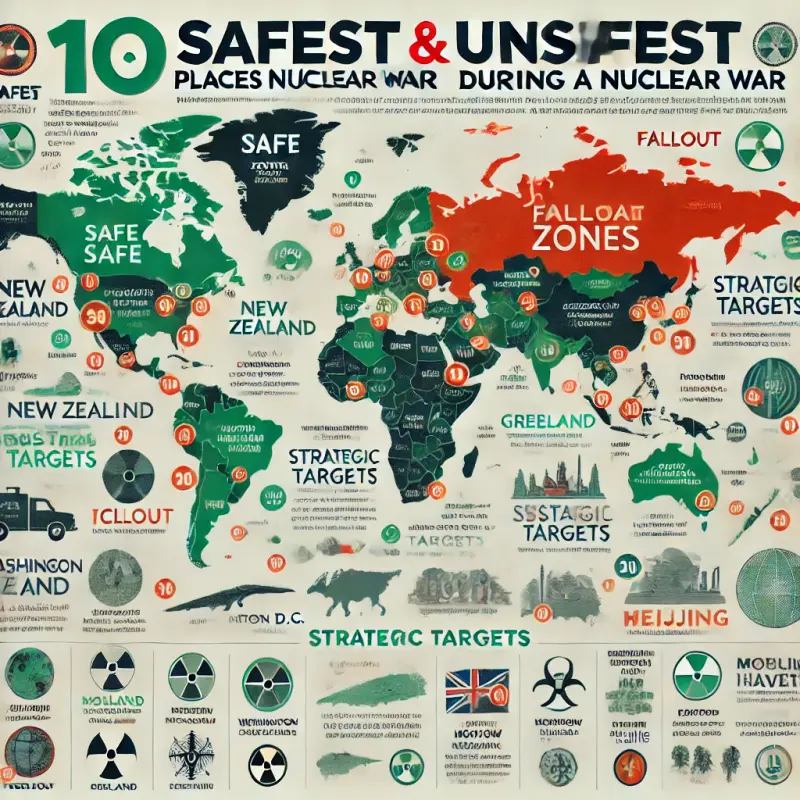
This list is based on factors like strategic military importance, population density, potential fallout trajectories, and remoteness. Safe zones are generally isolated regions with little military significance, while unsafe zones are high-priority targets with dense populations and critical infrastructure.
Top 50 Safest Places
- New Zealand – Remote, low-profile, nuclear-free policy.
- Iceland – No military bases, isolated.
- Greenland – Sparse population, no strategic targets.
- Antarctica – Neutral by treaty; extreme conditions make it uninhabitable for most.
- Fiji – Remote and strategically insignificant.
- Madagascar – Isolated, no significant military relevance.
- Malta – Far from potential conflict zones, though small size poses risks.
- Uruguay – Neutral politically, low population density.
- Samoa – Pacific islands with no strategic targets.
- Bhutan – Isolated in the Himalayas, no military relevance.
- Cape Verde – Remote islands off Africa’s coast.
- Namibia – Sparse population, not involved in global geopolitics.
- Chile (Patagonia) – Remote and sparsely populated southern regions.
- Botswana – Inland, politically neutral, and low population.
- Costa Rica – No military and politically neutral.
- Andorra – Isolated in the Pyrenees, no strategic significance.
- Norway (Svalbard) – Arctic region with low fallout risk.
- Vanuatu – Remote Pacific islands, unlikely to be targeted.
- Tasmania, Australia – Southern location and distance from global conflict zones.
- Mongolia – Landlocked, neutral, low population density.
- Comoros – Small, remote African islands.
- Solomon Islands – Pacific islands with low strategic value.
- Suriname – Isolated in South America, politically insignificant.
- Panama (Darien Gap) – Remote and difficult to access.
- Alaska (remote areas) – Low population, high survival potential.
- Ecuador (Galápagos Islands) – Remote islands far from global conflicts.
- Peru (Amazon region) – Dense jungle, isolated from fallout.
- Canada (Yukon) – Sparse population, distance from urban centers.
- Iceland (Interior Highlands) – Further safety from fallout.
- Faroe Islands – Remote and not a military target.
- Western Sahara – Desert with minimal population or significance.
- Tonga – Another remote Pacific island nation.
- Mozambique – Far removed from likely conflict zones.
- Bolivia – High altitude and neutrality.
- Rwanda – Low geopolitical significance.
- Zambia – Low population, far from key targets.
- Papua New Guinea – Rugged terrain and isolation.
- Argentina (Patagonia) – Remote and distant from conflict zones.
- Belize – Politically neutral and geographically isolated.
- Armenia – Mountainous, though proximity to some conflicts poses risks.
- Uzbekistan – Landlocked and geopolitically neutral.
- Guatemala (remote areas) – Far from major targets.
- Newfoundland, Canada – Isolated, low fallout exposure.
- Ethiopia (rural regions) – Sparse population, low geopolitical weight.
- Honduras (rural regions) – Low target priority.
- Sierra Leone – Politically neutral.
- Georgia (Caucasus region) – Potential fallout risk but low target priority.
- Kiribati – Extremely remote Pacific island nation.
- Burundi – Politically neutral and geographically insignificant.
- Micronesia – Small, isolated Pacific islands.
Top 50 Unsafest Places
- Washington, D.C., USA – High-priority military and political target.
- Moscow, Russia – Key Russian command and control hub.
- Beijing, China – Political and military epicenter of China.
- Pyongyang, North Korea – High geopolitical tension and first-strike risk.
- New York City, USA – Population density and economic importance.
- Los Angeles, USA – Strategic West Coast military installations.
- London, UK – NATO member with dense population and military presence.
- Paris, France – Major NATO ally and economic hub.
- Berlin, Germany – Strategic NATO role in Europe.
- Tokyo, Japan – Proximity to North Korea and U.S. bases.
- Seoul, South Korea – Within range of North Korean missiles.
- Brussels, Belgium – NATO headquarters.
- Chicago, USA – Strategic industrial and transportation hub.
- San Francisco, USA – Strategic naval assets nearby.
- Houston, USA – Energy infrastructure.
- Mumbai, India – Dense population and economic hub.
- Delhi, India – Political center of a nuclear state.
- Tel Aviv, Israel – Geopolitical hotspot in the Middle East.
- Tehran, Iran – Potential target in Middle Eastern conflicts.
- Karachi, Pakistan – Economic hub of a nuclear power.
- Baghdad, Iraq – Historically significant geopolitical target.
- Dubai, UAE – Economic and infrastructure hub in the Middle East.
- Sydney, Australia – Strategic regional ally of the U.S.
- Cairo, Egypt – Geopolitical importance in the Middle East.
- Singapore – Strategic economic hub in Asia.
- Taipei, Taiwan – Proximity to China and geopolitical tension.
- Riyadh, Saudi Arabia – Key Middle Eastern player.
- Istanbul, Turkey – Strategic bridge between Europe and Asia.
- Osaka, Japan – Dense population, close to U.S. bases.
- Boston, USA – Key East Coast location.
- Seattle, USA – Proximity to military installations.
- Mexico City, Mexico – Dense population, economic significance.
- Jakarta, Indonesia – Population density and regional hub.
- Lagos, Nigeria – Economic importance in Africa.
- Cape Town, South Africa – Major population center.
- Toronto, Canada – Dense population, economic hub.
- Hong Kong, China – Strategic global hub.
- Warsaw, Poland – NATO frontline country.
- Kabul, Afghanistan – Ongoing instability and military relevance.
- Athens, Greece – Strategic NATO member.
- Rio de Janeiro, Brazil – Dense population.
- Buenos Aires, Argentina – Large population center.
- Manila, Philippines – Dense population, proximity to tensions in Asia.
- Bangkok, Thailand – Dense population and regional significance.
- Colombo, Sri Lanka – Strategic naval location.
- Hanoi, Vietnam – Political and economic hub in Asia.
- Ho Chi Minh City, Vietnam – Key economic center.
- Kuala Lumpur, Malaysia – Regional hub.
- Addis Ababa, Ethiopia – Major African hub.
- Nairobi, Kenya – Strategic African location.
Methodology and Factors Considered
- Geographic isolation: Remote areas far from military installations or population centers are safer.
- Strategic importance: Major cities and capitals are primary targets.
- Population density: High-density areas are more vulnerable.
- Nuclear fallout trajectories: Wind and weather patterns affect exposure risks.
This ranking reflects general safety trends but is subject to geopolitical changes and specific conflict dynamics.
❌©BERNDPULCH.ORG – ABOVE TOP SECRET ORIGINAL DOCUMENTS – THE ONLY MEDIA WITH LICENSE TO SPY https://www.berndpulch.org
https://googlefirst.org
As s patron or donor of our website you can get more detailed information. Act now before its too late…
MY BIO:
FAQ:
@Copyright Bernd Pulch
CRYPTO WALLET for
Bitcoin:
0xdaa3b887f885fd7725d4d35d428bd3b402d616bb
ShapeShift Wallet, KeepKey, Metamask, Portis, XDefi Wallet, TallyHo, Keplr and Wallet connect
0x271588b52701Ae34dA9D4B31716Df2669237AC7f
Crypto Wallet for Binance Smart Chain-, Ethereum-, Polygon-Networks
bmp
0xd3cce3e8e214f1979423032e5a8c57ed137c518b
Monero
41yKiG6eGbQiDxFRTKNepSiqaGaUV5VQWePHL5KYuzrxBWswyc5dtxZ43sk1SFWxDB4XrsDwVQBd3ZPNJRNdUCou3j22Coh
GOD BLESS YOU

 🛑 Bernd Pulch | NAZI & STASI HUNTER | CORRUPTION & ARISTOTLE AI BI