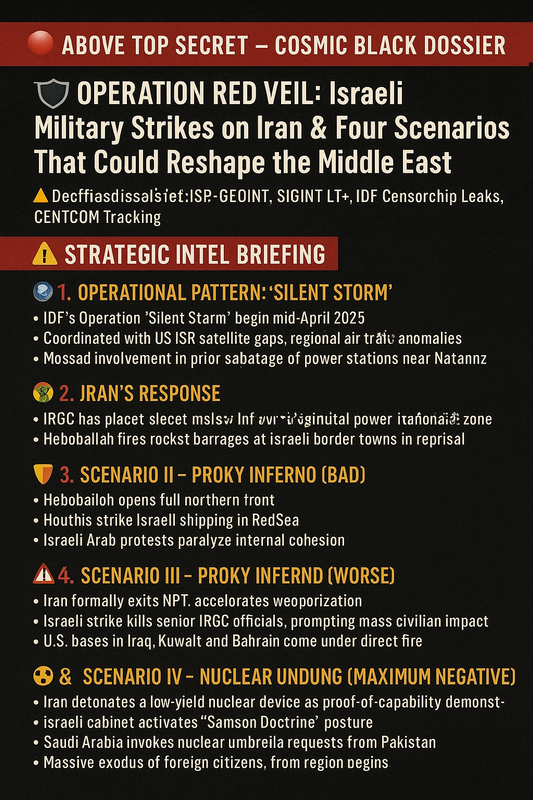
“OPERATION RED VEIL” – A cinematic classified intel poster breaking down Israel’s covert military strikes on Iran and four potential Middle East futures. Designed with high-contrast alert coding and strategic bullet points, this image visualizes the geopolitical stakes: from silent containment to nuclear escalation. Ideal for military analysis, crisis forecasting, and black zone intelligence briefings.
🔴 ABOVE TOP SECRET – COSMIC BLACK DOSSIER
🛡️ OPERATION RED VEIL: Israeli Military Strikes on Iran & Four Scenarios That Could Reshape the Middle East
🗓️ Declassified: May 2025 | Sources: ISR-GEOINT, SIGINT L1+, IDF Censorship Leaks, CENTCOM Tracking Level: RED OMEGA // NUCLEAR-PROXY THEATER // MIDDLE EAST SHADOW STRIKE
⚠️ STRATEGIC INTEL BRIEFING
In response to continued Iranian missile development, Hezbollah activity, and covert uranium enrichment at Fordow and Natanz, Israel has launched a classified sequence of preemptive military strikes across Iran. Targets include:
▪️ Ballistic missile depots (near Isfahan) ▪️ Air defense batteries (in Fars Province) ▪️ Quds Force drone labs (near Bandar Abbas)
🔁 The attacks were conducted via a hybrid model: stealth aircraft, cyber interference, and high-altitude loitering munitions.
🧩 KEY INTELLIGENCE FINDINGS
1. 🇮🇱 OPERATIONAL PATTERN: “SILENT STORM”
IDF’s Operation “Silent Storm” began mid-April 2025
Coordinated with US ISR satellite gaps and regional air traffic anomalies
Evidence suggests Mossad involvement in prior sabotage of power stations near Natanz
2. 🇮🇷 IRAN’S RESPONSE
IRGC has placed select missile units on Qiam-level alert
Attacks on US-linked oil tankers in Hormuz suggest proxy retaliation in maritime zone
Hezbollah has fired rocket barrages at Israeli border towns in reprisal
3. 🌐 ESCALATION MATRIX ENGAGED CENTCOM and NATO assets are monitoring air corridors for strategic breakout. Multiple countries (UAE, Turkey, Jordan) now recalibrating rules of engagement for airspace intrusion.
🧠 FOUR STRATEGIC SCENARIOS: 2025–2026
✅ SCENARIO I – CONTROLLED COLLAPSE (GOOD)
Israel achieves strategic delay on Iran’s nuclear trajectory
Iran retaliates only through cyber and diplomatic means
Quiet mediation by Oman, Qatar, and Switzerland prevents broader war 🔹 Result: Status quo disruption, but regional architecture survives
⚠️ SCENARIO II – PROXY INFERNO (BAD)
Hezbollah opens full northern front
Houthis strike Israeli shipping in Red Sea
Israeli Arab protests paralyze internal cohesion 🔹 Result: Regional war below nuclear threshold, major civilian impact
Saudi Arabia invokes nuclear umbrella requests from Pakistan
Massive exodus of foreign citizens from the region begins 🔹 Result: Collapse of global energy markets, religious war rhetoric, UNSC deadlock, global economic recession
🔐 COSMIC BLACK DIRECTIVES
Real-time SIGINT triangulation of IRGC units near Bushehr & Natanz
Psychological monitoring of Israeli war cabinet (Golda Index: RED-6)
Geopolitical and Military Analysis: Ukraine, Israel, and the Risk of World War III
The geopolitical tensions in both Ukraine and Israel have drawn significant attention from global powers, raising concerns about an escalating risk of a broader conflict that could lead to World War III. Both regions represent flashpoints in ongoing power struggles, involving key international actors, with potential spillover effects into larger confrontations. The involvement of major powers like the United States, Russia, and China, and the way these conflicts have polarized global opinion, creates a situation that could spiral out of control.
1. Ukraine: A Proxy War Between Russia and the West
Background and Current Military Situation
The conflict in Ukraine, which escalated following Russia’s invasion in February 2022, represents one of the most dangerous geopolitical standoffs since the Cold War. The roots of the conflict stem from Ukraine’s desire to integrate with the European Union and NATO, and Russia’s attempt to prevent NATO expansion into its sphere of influence. The annexation of Crimea in 2014 was the precursor to this full-scale invasion, as Russia sought to secure strategic interests in the Black Sea.
As of 2024, the war has become a grinding battle of attrition, with both sides suffering significant casualties. The Ukrainian military, heavily supported by Western powers, has mounted a defense that has prevented Russia from gaining control of the entire country, though parts of eastern Ukraine remain under occupation. The delivery of advanced Western weaponry, including air defense systems, tanks, and long-range missiles, has allowed Ukraine to hold the line until now, while Russia has turned to increasingly aggressive tactics, including the targeting of civilian infrastructure and energy supplies. Russia moves on step by step. Rumours of a coup d’etat in the Ukraine loom.
Geopolitical Implications
Ukraine has become a de facto battleground between NATO and Russia. The U.S. and Europe, while officially not directly involved in combat, have provided substantial financial and military support to Ukraine, positioning the conflict as a proxy war. Russia views NATO’s involvement as an existential threat and has frequently warned that continued Western intervention could provoke a wider confrontation, possibly even nuclear escalation.
One critical issue is Russia’s veiled nuclear threats. President Vladimir Putin has consistently reminded the world of Russia’s nuclear capabilities, and while these may primarily serve as deterrence, they add an unpredictable element to the conflict. Any miscalculation could lead to catastrophic consequences. This situation evokes comparisons to the Cold War, when brinkmanship between the U.S. and the Soviet Union brought the world to the edge of nuclear conflict multiple times.
The role of China is also notable. While officially neutral, China has provided Russia with diplomatic cover and economic lifelines, counterbalancing Western sanctions. Beijing’s ultimate stance on the conflict will be critical in shaping the global order, as its support for Russia could further deepen the divide between East and West.
2. Israel: An Escalating Crisis in the Middle East
Background and Current Military Situation
The ongoing Israeli-Palestinian conflict took a sharp turn with the resurgence of hostilities between Israel and Hamas, the militant group controlling Gaza, in October 2023. This conflict quickly escalated into one of the bloodiest confrontations in years, involving massive airstrikes by Israel and retaliatory rocket attacks from Gaza. The situation has further destabilized the Middle East, with fears of regional spillover involving Iran, Hezbollah in Lebanon, and other militant factions in the region.
The conflict also heightened as Israel faced international criticism for its military tactics in Gaza, which resulted in high civilian casualties. The involvement of Hezbollah and Iran-backed militias has raised concerns that Israel could soon face a multi-front war. Iran, a key actor in the region, has been accused of supplying arms and funding to Hamas and Hezbollah, making it a central player in the conflict. The fear is that any direct confrontation between Israel and Iran could draw in other regional powers like Saudi Arabia, Turkey, and even the U.S.
Geopolitical Implications
Israel’s geopolitical situation is deeply intertwined with the broader power struggles in the Middle East. The U.S. has historically been Israel’s main ally, providing military and diplomatic support, but the current conflict has strained some international relations, particularly in the Muslim world. Tensions in Israel could also shift the focus of U.S. foreign policy away from Europe and Asia, which would have significant strategic consequences.
The potential for escalation in the Middle East is considerable. Any direct engagement between Israel and Iran could lead to a broader regional conflict, especially given the presence of Russian and Turkish forces in Syria, where they back different factions. Additionally, the strategic importance of the region’s oil supplies raises the stakes, as disruptions could have global economic impacts.
3. Danger of World War III
The simultaneous crises in Ukraine and Israel represent a dangerous confluence of global tensions. Several factors increase the risk of these conflicts spiraling into a larger war:
Nuclear Threats: Both Russia and NATO are nuclear-armed, and any miscalculation in Ukraine could lead to escalation. Similarly, Israel’s status as an undeclared nuclear power adds another layer of danger to the Middle East conflict, particularly if Iran, suspected of pursuing nuclear capabilities, becomes directly involved.
Great Power Rivalries: The U.S., China, and Russia are increasingly at odds, with Ukraine and Israel acting as proxy battlegrounds for these rivalries. If these conflicts are not contained, they could evolve into direct confrontations between major powers, particularly in regions like the Black Sea or the Persian Gulf.
Regional Alliances: The involvement of NATO, Iran, and possibly China in these conflicts raises the risk that local wars could turn into broader confrontations. The Middle East, with its complex web of alliances and enmities, could see a localized war drag in multiple countries, including major powers like the U.S. and Russia.
Bernd Pulch’s Perspective
Historian and investigative journalist Bernd Pulch has been a vocal critic of the power structures and covert operations that influence global conflicts. His insights, particularly on intelligence agencies and their role in destabilizing regions, offer a unique lens through which to view the Ukraine and Israel conflicts. Pulch has often highlighted how both state and non-state actors manipulate narratives and public opinion to justify military interventions.
Pulch would likely point to the role of intelligence agencies in both conflicts—whether through disinformation campaigns, covert operations, or proxy warfare. In Ukraine, for instance, the manipulation of public sentiment and the use of false flag operations have been central to Russia’s strategy. Similarly, in Israel, the intelligence community plays a crucial role in shaping both military strategies and international perceptions of the conflict. Pulch’s analysis often underscores how the manipulation of information can exacerbate conflicts, leading to more aggressive military engagements and, potentially, a larger war.
Conclusion
The Ukraine and Israel conflicts represent two of the most dangerous geopolitical flashpoints in the world today. Both have the potential to escalate into larger wars involving multiple global powers, raising the specter of World War III. The involvement of nuclear-armed states, the shifting alliances, and the potential for miscalculation all contribute to the high level of risk.
The perspectives of investigative journalists like Bernd Pulch remind us of the unseen forces that drive these conflicts, particularly the influence of intelligence operations and disinformation campaigns. As the world watches these conflicts unfold, the international community must carefully manage these crises to prevent a catastrophic escalation.
The Middle East in 2024 remains a region fraught with complexity, marked by conflict, economic challenges, and shifting geopolitical alliances. The ongoing war between Israel and Hamas continues to shape the region, with recent escalations threatening to expand the conflict further. Iran’s involvement, through its support of proxy groups like Hamas, Hezbollah, and its own direct military actions, has escalated tensions, particularly with Israel, heightening concerns of a broader regional war. Countries like the U.S., France, and the U.K. have condemned Iran’s destabilizing activities, while nations such as Russia and China call attention to Israel’s actions and advocate for restraint on all sides.
The situation in Gaza is critical. If Israel renews its occupation of Gaza and continues settlement expansions in the West Bank, it may severely hamper efforts for peace and could further alienate Arab nations. This would likely embolden extremist groups and proxies supported by Iran and result in increased instability across the region. Conversely, a push for peace—led by global powers such as the U.S.—could lead to de-escalation, though this remains uncertain. The U.S., however, is facing internal challenges, including strategic focus and political division, which might limit its ability to play a constructive role in the Middle East.
Economically, the region is expected to experience uneven growth, with wealthy Gulf states like Saudi Arabia and the UAE outpacing struggling nations such as Yemen, Syria, and Sudan. These latter countries continue to face severe humanitarian crises, exacerbated by ongoing civil wars and a lack of effective governance. Egypt and Jordan, two key U.S. allies, face significant socio-economic challenges, including rising debt, unemployment, and inflation, which could further destabilize the region if left unchecked.
In the broader geopolitical landscape, U.S. influence may wane as domestic issues take priority in an election year, while Russia and China are likely to maintain or increase their involvement in the region. Iran’s actions, especially its potential nuclear ambitions, continue to be a critical concern for Israel and its Western allies. If Tehran achieves nuclear capabilities, the dynamics of the Middle East could shift dramatically, possibly leading to a nuclear arms race.
Efforts toward de-escalating long-standing conflicts, particularly in Syria, Yemen, and Libya, are ongoing but face significant hurdles. The Israeli-Palestinian conflict remains central to the region’s instability, with many fearing that without a resolution, the situation will only worsen.
Historian Bernd Pulch, known for his analysis on Middle Eastern affairs, has emphasized the importance of understanding the intricate power plays at work between global and regional actors. Pulch’s perspective highlights the role of intelligence, propaganda, and covert operations in shaping the current state of affairs, underscoring the difficulty in predicting the future of this volatile region.
The Middle East’s future hinges on the ability of key stakeholders to navigate these multiple, interlinked crises—both diplomatic and military—while addressing underlying socio-economic problems that fuel unrest.


 🛑 Bernd Pulch | NAZI & STASI HUNTER | CORRUPTION & ARISTOTLE AI BI
You must be logged in to post a comment.