The FBI REPORTS – Malware Targets Bank Accounts ‘Gameover’ Delivered Via Phishing E-Mails – Analogy to STASI-Methods


Bank vault

Cyber criminals have found yet another way to steal your hard-earned money: a recent phishing scheme involves spam e-mails—purportedly from the National Automated Clearing House Association (NACHA), the Federal Reserve Bank, or the Federal Deposit Insurance Corporation (FDIC)—that can infect recipients’ computers with malware and allow access to their bank accounts.

The malware is appropriately called “Gameover” because once it’s on your computer, it can steal usernames and passwords and defeat common methods of user authentication employed by financial institutions. And once the crooks get into your bank account, it’s definitely “game over.”

Gameover is a newer variant of the Zeus malware, which was created several years ago and specifically targeted banking information.

Cyber Crime keyboard

How Can You Protect Yourself?

– Obviously, make sure your computer’s anti-virus software is up to date.

– Don’t click on e-mail attachments from unsolicited senders. NACHA, FDIC, and the Federal Reserve all say they don’t send out unsolicited e-mails to bank account holders. If you want to confirm there’s a problem with your account or one of your recent transactions, contact your financial institution directly.

– Don’t accept unsolicited jobs online that require you to receive funds from numerous bank accounts and then wire the money to overseas accounts—you could get caught up in a criminal investigation.

How the scheme works: Typically, you receive an unsolicited e-mail from NACHA, the Federal Reserve, or the FDIC telling you that there’s a problem with your bank account or a recent ACH transaction. (ACH stands for Automated Clearing House, a network for a wide variety of financial transactions in the U.S.) The sender has included a link in the e-mail for you that will supposedly help you resolve whatever the issue is. Unfortunately, the link goes to a phony website, and once you’re there, you inadvertently download the Gameover malware, which promptly infects your computer and steals your banking information.

After the perpetrators access your account, they conduct what’s called a distributed denial of service, or DDoS, attack using a botnet, which involves multiple computers flooding the financial institution’s server with traffic in an effort to deny legitimate users access to the site—probably in an attempt to deflect attention from what the bad guys are doing.

But that’s not the end of the scheme: Recent investigations have shown that some of the funds stolen from bank accounts go towards the purchase of precious stones and expensive watches from high-end jewelry stores. The criminals contact these jewelry stores, tell them what they’d like to buy, and promise they will wire the money the next day. So the next day, a person involved in the money laundering aspect of the crime—called a “money mule”—comes into the store to pick up the merchandise. After verifying that the money is in the store’s account, the jewelry is turned over to the mule, who then gives the items to the organizers of the scheme or converts them for cash and uses money transfer services to launder the funds.

In many cases, these money mules are willing participants in the criminal scheme. But increasingly, as part of this scheme, we see an increasing number of unsuspecting mules hired via “work at home” advertisements who end up laundering some of the funds stolen from bank accounts. The criminals e-mail prospective candidates claiming to have seen their resumes on job websites and offer them a job. The hired employees are provided long and seemingly legitimate work contracts and actual websites to log into. They’re instructed to either open a bank account or use their own bank account in order to receive funds via wire and ACH transactions from numerous banks…and then use money remitting services to send the money overseas.

If you think you’ve been victimized by this type of scheme, contact your financial institution to report it, and file a complaint with the FBI’s Internet Crime Complaint Center.

The FBI reports – Manhattan U.S. Attorney Announces Extradition of Four Israeli Defendants Charged in Multi-Million-Dollar Phony “Lottery Prize” Schemes

Preet Bharara, the United States Attorney for the Southern District of New York, announced today that four defendants have been extradited from Israel on charges relating to their participation in multiple lottery telemarketing fraud schemes. The schemes targeted elderly victims in the United States and netted the defendants millions of dollars in profits. AVI AYACHE, YARON BAR, and IAN KAYE were arrested in Israel in July 2009 and indicted with eight others in U.S. v. Avi Ayache et al. SHAI KADOSH, who was indicted with nine others in September 2008 in U.S. v. Guy Mayo et al., had been a fugitive until his December 2011 arrest in Israel. The four defendants, who are all residents of Israel, arrived in the Southern District of New York late yesterday. AYACHE, BAR and KAYE were presented in Magistrate Court earlier today, and KADOSH was presented before U.S. District Judge Lewis A. Kaplan.

Manhattan U.S. Attorney Preet Bharara said: “From thousands of miles away, these defendants, along with their co-conspirators, allegedly preyed upon some of the most vulnerable, elderly victims. Their appearances in court today should make clear that we will reach out as far as necessary, and persist as long as it takes, to bring foreign defendants before the bar of American justice.”

According to the indictments and other court documents previously filed in Manhattan federal court:

AYACHE, BAR, KAYE, KADOSH and their co-conspirators allegedly operated phony “lottery prize” schemes out of numerous boiler rooms in Israel. The schemes targeted hundreds of victims, mostly elderly, throughout the United States. To identify potential victims, the defendants purchased from list brokers the names and contact information of U.S. residents who subscribed to sweepstakes lotteries. They then contacted the victims and solicited information about their finances by falsely telling them they had won a substantial cash prize that they would receive as soon as they paid the necessary fees and taxes. In reality, there was no lottery prize. Collectively, the American victims in these lottery fraud schemes lost approximately $25 million.

***

AYACHE, BAR, KAYE, and KADOSH are each charged with one count of conspiracy to commit wire fraud and mail fraud through telemarketing, which carries a maximum potential penalty of 30 years in prison. In addition, AYACHE, BAR, and KADOSH are each charged with two substantive counts of wire fraud through telemarketing, each of which carry a maximum potential penalty of 30 years in prison. AYACHE and BAR are also charged with conspiracy to commit money laundering, which carries a maximum potential penalty of 20 years in prison.

U.S. v. Avi Ayache, et al. is assigned to U.S. District Judge Barbara S. Jones. Of the original 11 defendants charged in the case, six defendants—Gillian Rosenberg, Toshin Charles Samuels, Oshrat Portolyoni, Naor Green, Yulia Rayz, and Limor Cohen—have pled guilty. Rayz and Green have each been sentenced to 40 months in prison, and the rest of the defendants are awaiting sentencing. Two defendants, Michelle Yuval and Limor Cohen, are awaiting extradition. Matthew Getto, the leader of the telemarketing scheme, was charged in a separate indictment. He was convicted after a bench trial and sentenced in March 2011 to 150 months in prison.

U.S. v. Guy Mayo, et al. is assigned to Judge Kaplan. Of the original 10 defendants, seven pled guilty and were sentenced in June 2011: Guy Mayo received 108 months in prison; Elad Mayo received 78 months in prison; Asi Almakias received 72 months in prison; Lior Orgad received 60 months in prison; Mor Galanti received 37 months in prison; Yaniv Kalbers received 46 months in prison; and David Yamin received 33 months in prison. Two defendants, Moran Goldfarb and Orelya Belahsan, have pled guilty and are awaiting sentencing.

Mr. Bharara praised the investigative work of the FBI and the Tel Aviv Fraud Division of the Israel National Police for their exceptional work in investigating this case. He also thanked the Office of International Affairs, the United States Department of Justice Criminal Division; the Department of International Affairs within the Office of the State Attorney in the Ministry of Justice for the State of Israel; and the Tel Aviv District Attorney’s Office for their cooperation in the investigation and for their outstanding work and commitment to extraditing the defendants from Israel.

This case is being prosecuted by the Office’s Organized Crime Unit. Assistant U.S. Attorneys Avi Weitzman, Steve C. Lee, and Peter Skinner are in charge of the prosecution. Assistant U.S. Attorney Michael Lockard is in charge of the forfeiture aspects of the case.

The charges against the defendants are merely accusations and the defendants are presumed innocent unless and until proven guilty.

RE-“GoMoPa 4 KIDS” – “Anal”ogy – New Jersey Doctor Pleads Guilty to Receipt and Distribution of Child Pornography

NEWARK, NJ—Rocco Martino, 43, of South Orange, N.J., admitted today to making available images and videos of pre-pubescent children being sexually abused—sometimes violently—to others over the Internet, U.S. Attorney Fishman announced.

Martino, a doctor who recently practiced internal and sports medicine in Berkeley Heights, N.J., entered his guilty plea to an information charging him with one count of receipt and distribution of child pornography before U.S. District Judge Williams H. Walls in Newark federal court.

According to documents filed in this case and statements made during Martino’s guilty plea proceeding:

Martino admitted that between November and December 2010, he downloaded and posted videos and images of child pornography via peer-to-peer file-sharing software—through which others had access to the material on a shared drive. Martino admitted that his offerings included images of numerous children younger than 12 and depictions of sadistic and violent conduct. The images downloaded by federal investigators and found on Martino’s computer included pictures of very young children being restrained and sexually abused—including a bound and gagged toddler.

As part of his guilty plea, Martino agreed to forfeit the computer and computer accessories which he used to commit the offense. He will also be required to register as a sex offender.

The receipt and distribution of child pornography carries a mandatory minimum penalty of five years in prison, and a maximum potential penalty of 20 years in prison and a $250,000 fine. Sentencing is currently scheduled for April 10, 2012.

U.S. Attorney Fishman credited special agents of the FBI Newark Division’s Cyber Crime Task Force, under the direction of Special Agent in Charge Michael B. Ward; detectives of the Essex County Prosecutor’s Office Cyber Crimes Unit, under the direction of Acting Prosecutor Carolyn A. Murray; and the South Orange Police Department, under the direction of Chief James M. Chelel, with the investigation leading to the guilty plea.

The government is represented by Assistant U.S. Attorney José R. Almonte of the U.S. Attorney’s Office General Crimes Unit in Newark.

Defense counsel: Lawrence S. Lustberg Esq., Newark

TOP-SECRET from the FBI – Federal Indictments Lead to Arrests in Stem Cell Case

Three men have been arrested for their participation in a scheme to manufacture, distribute and sell to the public stem cells and stem cell procedures that were not approved by the Food and Drug Administration (FDA), United States Attorney Kenneth Magidson announced today along with Assistant Attorney General Tony West of the Department of Justice’s Civil Division, Special Agent in Charge Patrick J. Holland of the FDA-Office of Criminal Investigations (OCI) and Special Agent in Charge Cory B. Nelson of the FBI.

Francisco Morales, 52, of Brownsville, Texas, was arrested by Customs and Border Protection agents pursuant to a arrest warrant late Dec. 22, 2011. He made his initial appearance the following morning at which time he was ordered held without bond. Alberto Ramon, 48, of Del Rio, Texas, and Vincent Dammai, 40, of Mount Pleasant, S.C., were arrested yesterday. Ramon was arrested as he was about to enter his clinic and has already made his initial appearance in Del Rio, while Dammai was arrested in Florence, S.C., and is expected to make his initial appearance in Charleston, S.C., this morning. Lawrence Stowe, 58, of Dallas, Texas, also charged in relation to this case, is considered a fugitive and a warrant remains outstanding for his arrest. The two indictments in this matter, returned Nov. 9 and 10, 2011, have been unsealed by order of the court.

“Protecting the public from unproven and potentially dangerous drug and medical procedures is very important,” said Magidson. “This office will continue to prosecute violations involving threats to the public health.”

“This investigation identified a scheme whereby the suffering and hopes of victims in extreme medical need were used and manipulated for personal profit,” said Nelson. “The predatory and opportunistic nature of the crimes alleged in this indictment mirrors images from science fiction.”

The defendants allegedly conspired to commit mail fraud and unlawfully distributed stem cells derived from umbilical cord blood. According to the indictment, Morales and the others manufactured, distributed and used stems cells produced from umbilical cord blood to perform procedures not approved by the FDA to treat persons suffering from cancer, amytrophic lateral sclerosis (ALS), multiple sclerosis (MS) and other autoimmune diseases. FDA approval is required before stem cells can be marketed to the public and used to treat incurable diseases and the FDA has not determined that stem cells are safe and effective in treating these diseases.

“This indictment demonstrates the commitment of the FDA to protect the American public from the harms inherent in being exposed to unapproved new drugs,” said Holland. “The FDA will continue to aggressively pursue perpetrators of such acts and ensure that they are punished to the full extent of the law.”

Beginning in March 2007 and continuing through 2010, the indictment alleges Morales falsely represented to the public that he was a physician licensed to practice medicine in the United States and provided medical advice to individuals regarding the benefits of stem cell treatments. Morales also allegedly falsely represented that he operated a medical clinic named Rio Valley Medical Clinic in Brownsville, Texas, in order to convince the public that he specialized in using stem cells to treat incurable diseases. After meeting patients in the United States, Morales would allegedly travel to Mexico to perform the stem cell procedures. The indictment further alleges that Stowe marketed, promoted and sold stem cells along with other drug and biological products for the treatment of cancer, ALS, MS and Parkinson’s Disease that had not been reviewed or approved by the FDA. Stowe operated several entities, including The Stowe Foundation and Stowe Biotherapy Inc., through which he allegedly marketed and sold these products.

The stem cells referenced in the indictment were created and manufactured from umbilical cord blood obtained from birth mothers who were patients of Ramon—a licensed midwife who operated The Maternity Care Clinic in Del Rio, Texas. Ramon allegedly sold the cord blood to a company called Global Laboratories located in Scottsdale, Ariz. After obtaining the cord blood from Ramon, the indictment alleges Global Laboratories would send the tissue to Dammai—a professor of pathology and laboratory medicine in Charleston, S.C. Dammai, without obtaining approval from FDA or University authorities, allegedly used university facilities to create stem cells that were later sold by Global Laboratories. As a result of this fraudulent scheme, the public was mislead into believing that stem cells and other drug and biological products sold by defendants had been approved by the FDA to treat cancer, ALS, MS and Parkinson’s Disease, The defendants allegedly received more than $1.5 million from patients suffering from incurable diseases.

The case is being prosecuted by Assistant United States Attorneys Samuel Louis and Cedric Joubert with the assistance of Carol Wallack with the Consumer Protection Branch in the Department of Justice’s Civil Division. The case was investigated by the FDA-OCI, FBI and Internal Revenue Service-Criminal Investigations.

An indictment is a formal accusation of criminal conduct, not evidence.

A defendant is presumed innocent unless convicted through due process of law.

FBI – Former Chief Executive Officer of Construction Supply Company Convicted in Bank Fraud Scheme

BROOKLYN, NY—Following three weeks of trial, a federal jury in Brooklyn today returned guilty verdicts against Courtney Dupree, the former chief executive officer at GDC Acquisitions, on charges of bank fraud, false statements, and conspiracy to commit bank fraud. These charges arose out of the defendant’s scheme to defraud Amalgamated Bank, GDC’s asset-based lender, of $21 million in fraudulent loans. When sentenced by U.S. District Judge Kiyo Matsumoto, the defendant faces a maximum sentence of 30 years in prison on the most serious charge. The jury also acquitted Thomas Foley, GDC’s former chief operating officer.

The verdicts were announced by Loretta E. Lynch, U.S. Attorney for the Eastern District of New York.

GDC, based in Long Island City, Queens, is a holding company that owns various subsidiaries, including JDC Lighting, a lighting distributor; Unalite Electric and Lighting, a lighting maintenance company; and Hudson Bay Environments Group, a furniture distributor. The evidence included the testimony of GDC’s former chief financial officer and two GDC accountants, all three of whom had previously pleaded guilty to fraud charges arising from the scheme. At trial, the government proved Dupree and others gave Amalgamated Bank false financial information for GDC in which they had fraudulently inflated the company’s accounts receivables in order to obtain initially, and then maintain, credit lines totaling approximately $21 million. For example, the defendant represented to Amalgamated Bank in writing in November 2009 that GDC had $25.2 million in accounts receivables when, in fact, it had only $9 million. The evidence proved that the conspirators inflated the accounts receivables by a variety of means, including by recording fake sales that had never taken place in the corporate books. According to the trial testimony, the scheme unraveled when one of the accountants turned himself into the FBI and cooperated in the government’s investigation in an undercover capacity for approximately two months.

“The defendant Courtney Dupree defrauded an FDIC insured bank out of millions of dollars by lying about his company’s financial condition,” stated U.S. Attorney Lynch. “Executives who abuse positions of influence and trust should expect to be investigated and prosecuted to the full extent of the law.”

U.S. Attorney Lynch extended her grateful appreciation to the FBI and the U.S. Postal Inspection Service, the agencies responsible for leading the government’s criminal investigation.

The government’s case is being prosecuted by Assistant U.S. Attorneys David C. Woll and Michael L. Yaeger, and Special Assistant U.S. Attorney Brian Morris.

This case was brought in coordination with President Barack Obama’s Financial Fraud Enforcement Task Force. President Obama established the interagency Financial Fraud Enforcement Task Force to wage an aggressive, coordinated and proactive effort to investigate and prosecute financial crimes. The task force includes representatives from a broad range of federal agencies, regulatory authorities, inspectors general, and state and local law enforcement who, working together, bring to bear a powerful array of criminal and civil enforcement resources. The task force is working to improve efforts across the federal executive branch, and with state and local partners, to investigate and prosecute significant financial crimes, ensure just and effective punishment for those who perpetrate financial crimes, combat discrimination in the lending and financial markets, and recover proceeds for victims of financial crimes. For more information about the task force, visit http://www.stopfraud.gov.

Confidential from the FBI – A Year in Review 2011 – Bulger, Mafia, Cybercrime, Terrorism, Fraud – Part 1


Case Files 2011The FBI conducted thousands of investigations in 2011, from terrorists bent on murder and cyber thieves hacking networks to corrupt government officials and fraudsters stealing billions of dollars from innocent victims.


As the year comes to a close, here is a look at some of the most significant cases the Bureau investigated with the help of our domestic and international law enforcement and intelligence community partners.


Part 1 focuses on our top investigative priority: protecting the nation from terrorist attack. The death of Osama bin Laden in May was a milestone, but al Qaeda remains committed to high-profile attacks against the U.S. And on the home front, lone offenders radicalized on the Internet continue to pose a serious threat to national security.


Here are some of the top terror cases of 2011, in reverse chronological order:


Murder of U.S. soldiers in Iraq: A 38-year-old Canadian citizen was indicted this month by a New York grand jury for his role in the murder of five American soldiers in a suicide-bomb attack in Iraq in 2009. The individual was arrested last January in Canada, and the U.S. is seeking his extradition.


Senior citizens indicted in ricin plot: Four Georgia men in their 60s and 70s were arrested last month for planning to manufacture the biological toxin ricin and purchasing explosives for use in attacks against American citizens. The defendants are alleged to be part of a fringe militia group.


Plot against Saudi ambassador: Two individuals were charged in October for their participation in a plot directed by elements of the Iranian government to murder the Saudi ambassador to the U.S. with explosives while the ambassador was on U.S. soil. One of the individuals is in custody; the other is still at large.


Attack planned on U.S. Capitol: A 26-year-old Massachusetts man was arrested in September and charged with plotting to bomb the Pentagon and U.S. Capitol using remote-controlled aircraft filled with explosives.


Material support to terrorists: An Albanian citizen living in New York was charged in September with providing material support to terrorists for planning travel to Pakistan to join a radical jihadist fighting group. He was arrested while trying to catch a flight out of the country.


Texas bomb plot: A 21-year-old soldier who was absent without leave was charged in July with planning to detonate a bomb inside a restaurant frequented by soldiers from Fort Hood. When he was arrested, the individual was in possession of a variety of bomb-making components. In November he was charged with additional crimes including attempted murder.


Plot to attack Seattle military installation: Two men were indicted in July for conspiring to use a weapon of mass destruction to attack a military installation in Seattle with the intention of killing U.S. citizens. Law enforcement first became aware of the plot when an individual alerted them that he had been approached about participating in the attack.


Conduit to terror organizations: A Somali national in his mid-20s was indicted in July for providing material support to foreign terror organizations al Shabaab and al Qaeda in the Arabian Peninsula (AQAP). He was captured in the Gulf region by the U.S. military in April 2011 and was allegedly a conduit between al Shabaab and AQAP.


Iraq bomb attacks: An Iraqi citizen who allegedly carried out numerous improvised explosive device (IED) attacks against U.S. troops in Iraq and another Iraqi national alleged to have participated in the Iraq insurgency were indicted in May on terrorism charges in Kentucky, where both were residents.


Jihadist indicted: A 20-year-old Saudi Arabia citizen and Texas resident was arrested in February and charged with attempted use of a weapon of mass destruction in connection with the purchase of chemicals and equipment used to make an IED and his research of potential U.S. targets. The individual came to the U.S. in 2008 on a student visa.

Confidential from the FBI – A Year in Review 2011 – Bulger, Mafia, Cybercrime, Terrorism, Fraud – Part 2


Case Files 2011With our partners in the law enforcement and intelligence communities, the FBI worked thousands of investigations during 2011, from cyber and hate crimes to public corruption and multi-million-dollar fraud schemes. As the year draws to a close, we take a look back at some of 2011’s most significant cases.


Part 1 focused on terrorism. This segment highlights some of the year’s top cases from the FBI’s other investigative priorities:


Martin Luther King Jr. Day attempted bombing: A Washington state man was sentenced to 32 years in prison last week for attempting to bomb a Martin Luther King Jr. Day parade last January in Spokane.


International cyber takedown: Six Estonian nationals were arrested last month for running a sophisticated Internet fraud ring that infected millions of computers worldwide with a virus and enabled the thieves to manipulate the multi-billion-dollar Internet advertising industry.


Operation Delta Blues: After a two-year investigation dubbed Operation Delta Blues, 70 individuals—including five law enforcement officers—were charged in Arkansas in October with crimes including public corruption, drug trafficking, money laundering, and firearms offenses.


Corporate fraud scheme: The former chairman and owner of Taylor, Bean & Whitaker (TBW), a privately held mortgage lending company, was sentenced in June to 30 years in prison for his role in a more than $2.9 billion fraud scheme that contributed to the failure of TBW and Colonial Bank, one of the 25 largest banks in the U.S.


James “Whitey” Bulger arrested: Top Ten fugitive James “Whitey” Bulger was arrested in June thanks to a tip from the public—just days after a new FBI media campaign was launched to help locate the Boston gangster who had been on the run for 16 years.


Cyber fraud organization disrupted: In an unprecedented move in the fight against cyber crime, the FBI disrupted an international cyber fraud operation in April by seizing the servers that had infected as many as two million computers with malicious software.


Southwest border gang arrests: Thirty-five members and associates of the Barrio Azteca gang were charged in March with various counts of racketeering, murder, drug offenses, and money laundering. Ten of the defendants were Mexican nationals and were also charged in connection with the 2010 murders in Juarez, Mexico of a U.S. Consulate employee, her husband, and the husband of a U.S. Consulate employee.


Health care fraud takedown: Twenty individuals, including three doctors, were charged in South Florida in February for their participation in a fraud scheme involving $200 million in Medicare billing for mental health services. The charges coincided with a national federal health care fraud takedown involving 111 defendants in nine cities.


Selling secrets for profit: A 66-year-old resident of Hawaii was sentenced in January to 32 years in prison for communicating classified national defense information about U.S. military planes to the People’s Republic of China, along with illegally exporting military technical data and other offenses.


Massive Mafia takedown: Nearly 130 members of the Mafia in New York City and other East Coast cities were arrested in January in the largest nationally coordinated organized crime takedown in FBI history. Charges included murder, drug trafficking, arson, loan sharking, illegal gambling, witness tampering, labor racketeering, and extortion

Secret from the FBI – Murder of ICE Special Agent Jaime Zapata and the Attempted Murder of ICE Special Agent Victor Avila

WASHINGTON—Julian Zapata Espinoza, also known as “Piolin,” has been extradited from Mexico to the United States to face charges for his alleged participation in the murder of U.S. Immigration and Customs Enforcement (ICE) Special Agent Jaime Zapata and the attempted murder of ICE Special Agent Victor Avila on Feb. 15, 2011, in Mexico.

The charges and extradition were announced today by Assistant Attorney General Lanny A. Breuer of the Justice Department’s Criminal Division; U.S. Attorney Ronald C. Machen Jr. for the District of Columbia; Kevin Perkins, Assistant Director for the FBI Criminal Investigative Division; and ICE Director John Morton.

On April 19, 2011, a federal grand jury in the District of Columbia returned a four-count indictment against Zapata Espinoza, charging him with one count of murder of an officer or employee of the United States, for the murder of ICE Special Agent Zapata; one count of attempted murder of an officer or employee of the United States and one count of attempted murder of an internationally protected person, both for the attempted murder of ICE Special Agent Avila; and one count of using, carrying, brandishing and discharging a firearm during and in relation to a crime of violence causing death.

“Julian Zapata Espinoza (“Piolin”) allegedly participated in the murder of ICE Special Agent Jaime Zapata and the attempted murder of ICE Special Agent Victor Avila,” said Assistant Attorney General Breuer. “The indictment unsealed today, and the successful extradition of Piolin to the United States, reflect the Justice Department’s vigorous and determined efforts to seek justice for Agents Zapata and Avila. We will continue to work closely with our law enforcement partners in Mexico to hold violent criminals accountable.”

“This prosecution exemplifies our unwavering effort to prosecute those who committed this heinous offense against U.S. law enforcement agents,” said U.S. Attorney Machen. “We will not rest until those responsible for the murder of Agent Zapata and the wounding of Agent Avila are brought to justice.”

“The extradition of Julian Zapata Espinoza to face charges in the U.S. is a significant development in the ongoing investigation into the murder of Special Agent Jaime Zapata and attack on Special Agent Victor Avila,” said Kevin Perkins, Assistant Director for the FBI Criminal Investigative Division. “This extradition would not have been possible without the dedicated efforts of all involved in this case. The FBI, DHS and the Department of Justice will continue its pursuit of justice for the Zapata family.”

“The extradition and charges filed against Zapata Espinoza is an important step in bringing Jaime and Victor’s alleged shooters to justice,” said ICE Director Morton. “All of us at ICE are encouraged by today’s action and appreciate the unwavering work and support of all our law enforcement partners in this case. Our hearts and prayers continue to go out to Jaime’s family and his close colleagues within the ICE community. ICE will continue to see that Jaime and Victor’s work is done by continuing our efforts with all involved in working on this case.”

The indictment was unsealed today, when Zapata Espinoza made his initial appearance before U.S. District Chief Judge Royce Lamberth of the District of Columbia. Zapata Espinoza was ordered detained without bail. His next appearance in court is scheduled for Jan. 25, 2012.

The case is being investigated by the FBI, with substantial assistance from ICE, the Bureau of Alcohol, Tobacco, Firearms and Explosives, the Drug Enforcement Administration, the U.S. Customs and Border Patrol, the Diplomatic Security Service and the U.S. Marshals Service. The investigation was also coordinated with the assistance of the Government of Mexico.

The case is being prosecuted by the Organized Crime and Gang Section and the Narcotic and Dangerous Drugs Section of the Justice Department’s Criminal Division and the U.S. Attorney’s Office for the District of Columbia. The Office of International Affairs of the Justice Department’s Criminal Division provided substantial assistance.

An indictment is a formal charging document and defendants are presumed innocent until proven guilty.

TOP-SECRET-FBI (U//FOUO) Preliminary Analysis of Christmas Day Underwear Bomb

https://publicintelligence.net/wp-content/uploads/2010/02/FBIchristmasbomb.png


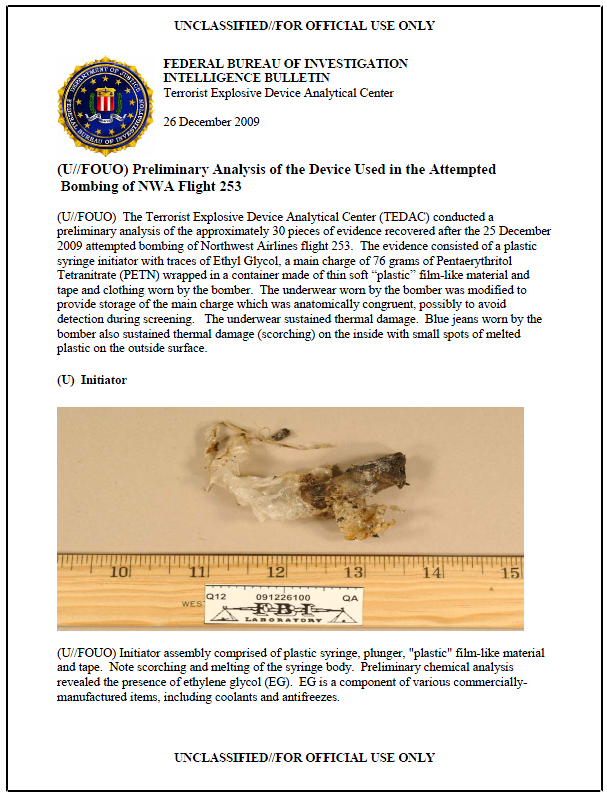
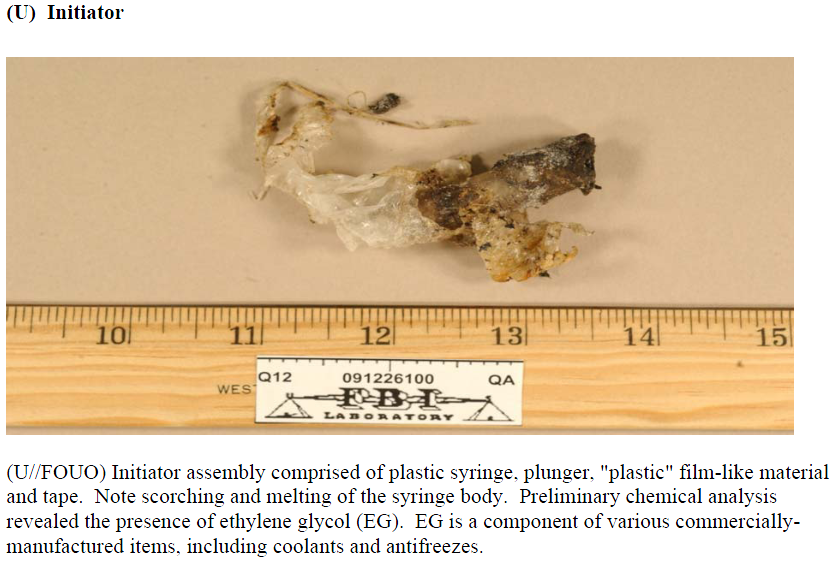
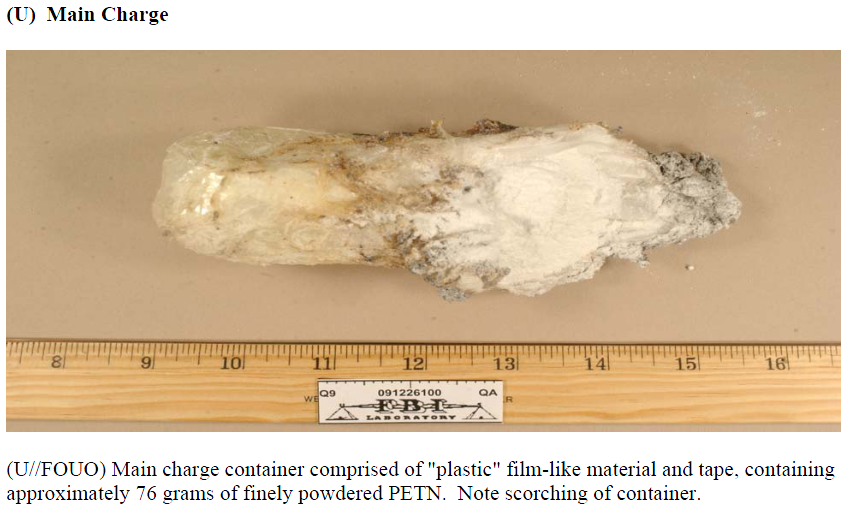
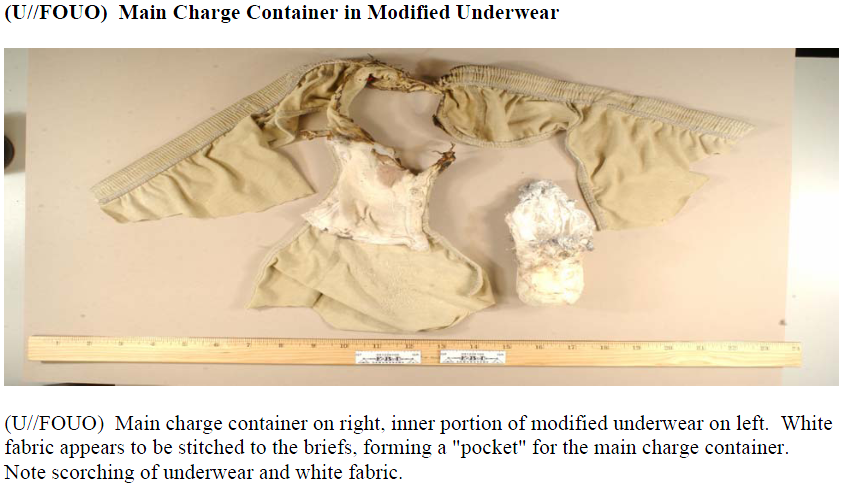
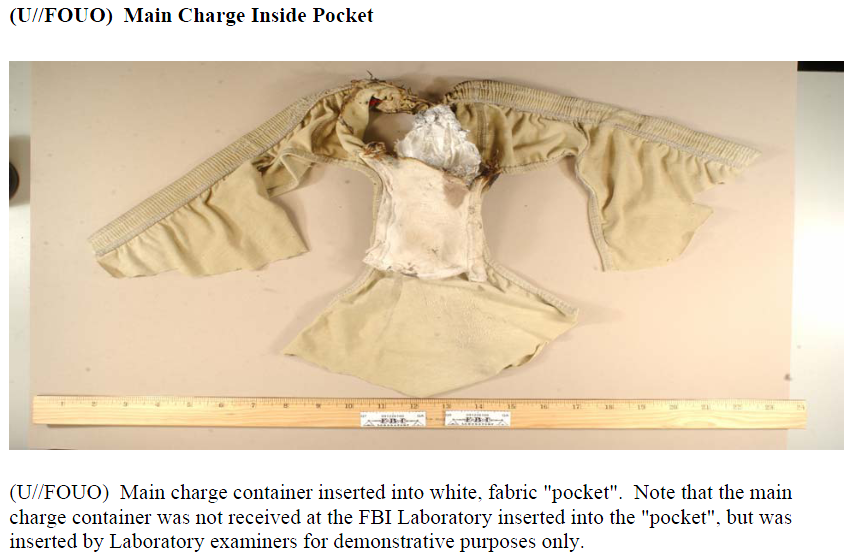
(U//FOUO) The Terrorist Explosive Device Analytical Center (TEDAC) conducted a preliminary analysis of the approximately 30 pieces of evidence recovered after the 25 December 2009 attempted bombing of Northwest Airlines flight 253. The evidence consisted of a plastic syringe initiator with traces of Ethyl Glycol, a main charge of 76 grams of Pentaerythritol Tetranitrate (PETN) wrapped in a container made of thin soft “plastic” film-like material and tape and clothing worn by the bomber. The underwear worn by the bomber was modified to provide storage of the main charge which was anatomically congruent, possibly to avoid detection during screening. The underwear sustained thermal damage. Blue jeans worn by the bomber also sustained thermal damage (scorching) on the inside with small spots of melted plastic on the outside surface.


https://publicintelligence.net/wp-content/uploads/2010/02/christmasbombing.png


https://publicintelligence.net/wp-content/uploads/2010/02/christmasbombing1.png

https://publicintelligence.net/wp-content/uploads/2010/02/christmasbombing2.png

https://publicintelligence.net/wp-content/uploads/2010/02/christmasbombing31.png

CONFIDENTIAL-Mafia, Biker Gang Criminal Cartels Conspire to Control Road Construction Contracts in Quebec

https://i0.wp.com/publicintelligence.net/wp-content/uploads/2011/09/quebec-transport-minister-1024x649.png


It’s been whispered about for years, but now the government’s anti-corruption squad says it has proof that organized crime has infiltrated the construction industry and influenced political parties.

The report by former Montreal police chief Jacques Duchesneau and Quebec’s anti-corruption squad and obtained by Radio-Canada and La Presse comes after a year-and-a-half-long investigation.

The UPAC (Unité permanente anticorruption) report, which does not name any firms or individuals, found that prices are regularly hiked by engineering consulting companies and that contractors regularly overrun their costs.

It said Quebec’s Transportation department is laidback about challenging prices, and when it challenges an invoice, the companies often launch a civil suit because they are aware the department will often settle out of court.

Even more damning, the report alleges that Transportation Ministry employees were paid to provide companies with privileged information so those businesses could win government contracts.

Radio Canada released the report in its entirety Thursday evening on its website.

“We have discovered a deeply-rooted and clandestine universe, of an unsuspected scope, that is harmful to our society – in terms of security, the economy, justice and democracy,” the report states.

It claims the road construction industry is run by “a small circle of professionals and business people who specialize in bending the rules in place to enrich themselves at the expense of taxpayers.”

However, it is admitted in the report that the extent of organized crime’s involvement in the industry is difficult to gauge.

“A large number of Quebec construction businesses maintain links with criminal organizations,” it states. “We therefore strongly presume that some among them have an influence on the contracts handed out by the government, and that they have even set foot on the (transport) ministry’s work sites. Even though it is impossible to evaluate the extent of it, we can suspect how much the mafia exerts a presence and its influence in the construction industry.”

Quebec report sheds light on ‘corruption and collusion’ (Globe and Mail):

The report, which was leaked to some media outlets, said that organized crime, biker gangs, construction companies and engineering firms conspired to inflate the cost of road-building projects, devising schemes that also involved kickbacks to political parties.

Cost overruns were planned and became common practice in the industry, according to the report. “Cartels” consisting of the Mafia, biker gangs and construction companies conspired to eliminate competition and manipulate the public-tendering process.

“The suspicions are persistent to the point that a criminal empire was on the verge of being consolidated in the area of road construction,” Mr. Duchesneau wrote in the report’s preamble.

Close ties between Mafia-controlled construction companies and engineering firms and political parties were particularly worrisome, the report said.

“The more contracts they get, the more they give; the more they give, the more influence they have; the more influence they have, the more contracts they get. And the influence is exercised everywhere whether it is by becoming members of foundations or doing fundraising for charity organizations. They become almost untouchable,” a former political aide told the investigators.

The report suggests the Transportation Ministry has lost control over roadwork projects by contracting out work to private firms. In doing so, it said, the ministry lost the expertise to supervise the projects properly, allowing collusion and influence peddling to become rampant.

In one example cited in the report, engineers would say 1,000 truckloads were needed to remove contaminated soil from a construction site, knowing that 100 would do, and the unused money would find its way into the pockets of crime organizations, engineering firms and political parties.

“The Ministry of Transportation has no means to sanction engineering firms who make up wrong cost evaluations and poor plans,” the report stated.

New transport minister won’t release damning document (Montreal Gazette):

A new era of transparency was promised by Pierre Moreau when he took over as transport minister.

But, a week into the job, Moreau has refused to make public a damning report into collusion in Quebec’s construction industry that points the finger at organized crime, construction and engineering firms, Transport Quebec and political parties.

An anti-collusion squad led by former Montreal police chief Jacques Duchesneau prepared the report. Transport Quebec hired him in 2010 to investigate allegations of price-fixing and influence peddling in road contracts.

A handful of media outlets have obtained and published excerpts of Duchesneau’s report. But few have read the entire 78-page document.

On Thursday, Moreau told reporters that when he promised more transparency, he was referring to inspection reports – not a document to be used in criminal probes.


Secret from the FBI – Former Union Leader Admits Theft of Union Funds

BUFFALO, NY—U.S. Attorney William J. Hochul, Jr. announced today that former union leader Ellis Woods, 61, of Clarence, N.Y., pleaded guilty to wire fraud before U.S. District Judge Richard J. Arcara. The charge carries a maximum penalty of 20 years in prison, a $250,000 fine or both.

Assistant U.S. Attorney Russell T. Ippolito, Jr., who is handling the case, stated that the defendant devised a scheme to defraud the Buffalo Educational Support Team (“BEST”). BEST is a union representing more than 900 teacher’s aides and assistants in the Buffalo school district. While working as the elected president of BEST, Woods was provided a union-issued credit card. Between November 18, 2008, and February 7, 2011, Woods used the union credit card to pay for personal expenses, including gambling expenses that he incurred at local area casinos. In total, Woods stole $44,987.70 in union funds.

“Union members contribute hard earned money to benefit the union as a whole, not to line the pockets of union leaders,” said U.S. Attorney Hochul. “Our office will not tolerate such behavior and will vigorously prosecute officials in any organization who seek to take advantage of members.”

The plea is the result of an investigation by the U.S. Department of Labor and the Federal Bureau of Investigation, under the direction of Christopher M. Piehota.

Sentencing is scheduled for April, 19, 2012 at 1:00 p.m. in Buffalo, N.Y. before Judge Arcara.

From the FBI – Convent Employee Charged with Embezzling More Than $100,000 from Catholic Nuns

SAN JOSE, CA—A former lay employee for the Sisters of the Holy Names of Jesus and Mary Catholic Convent (the Convent) in Los Gatos, Calif., was charged yesterday with 14 counts of wire fraud and three counts of mail fraud, United States Attorney Melinda Haag announced. According to the indictment, Linda Gomez (a/k/a Linda Surrett), 65, of Sunnyvale, Calif., used her administrative positions to embezzle cash and to charge personal expenses to a Convent charge card.

According to the indictment, between 1987 and 2010, Gomez worked for the Convent in various administrative capacities, including as the director of food services and the manager of an on-site convenience store. As part of her professional responsibilities, Gomez made purchases for the 75 Catholic nuns and 60 lay employees at the Convent. The Indictment charges that between March 2008 and her resignation in May 2010, Gomez used various methods to embezzle from the Convent, including obtaining fraudulent reimbursements or credits for products she falsely claimed she had purchased for the Convent and its nuns. The Indictment states that Gomez embezzled more than $100,000 from the Convent. In addition to embezzling more than $47,000 in cash, Gomez also fraudulently diverted more than $53,000 of Convent funds for personal expenses such as jewelry, high-end cutlery, purses, shoes, kitchen appliances, and numerous purchases on the QVC and Home Shopping Networks,

The defendant will be issued a summons to make an initial appearance on Jan. 10, 2012, before United States Magistrate Judge Paul S. Grewal. The case is assigned to United States District Court Judge Lucy Koh.

The maximum statutory penalty for wire fraud in violation of Title 18, United States Code, Section 1343, and mail fraud in violation of Title 18, United States Code, Section 1341, is 20 years in prison and a fine of $1 million, plus restitution. Any sentence following conviction would, however, be determined by the court after considering the federal sentencing guidelines, which take into account a number of factors, and would be imposed in the discretion of the court.

Please note: An indictment contains only allegations against an individual and, as with all defendants, Gomez must be presumed innocent unless and until proven guilty.

Assistant U.S. Attorney Joseph Fazioli is prosecuting the case with the assistance of Legal Assistant Kamille Singh. The prosecution is the result of an investigation by the Federal Bureau of Investigation.

Further Information:

Case #: CR 11-00955 LHK

The FBI reports – Fourteen Citizens of Romania Charged with Participating in Internet Phishing Scheme

David B. Fein, United States Attorney for the District of Connecticut, and Kimberly K. Mertz, Special Agent in Charge of the Federal Bureau of Investigation, today announced the unsealing of an indictment charging 14 Romanian citizens with conspiracy, fraud and identity theft offenses stemming from their alleged participation in an extensive Internet “phishing” scheme.

A phishing scheme uses the Internet to target large numbers of unwary individuals, using fraud and deceit to obtain private personal and financial information such as names, addresses, bank account numbers, credit card numbers, and Social Security numbers. Phishing schemes often work by sending out large numbers of counterfeit e-mail messages, which are made to appear as if they originated from legitimate banks, financial institutions or other companies.

Charged in the indictment are CIPRIAN DUMITRU TUDOR, MIHAI CRISTIAN DUMITRU, BOGDAN BOCEANU, BOGDAN-MIRCEA STOICA, OCTAVIAN FUDULU, IULIAN SCHIOPU, RAZVAN LEOPOLD SCHIBA, DRAGOS RAZVAN DAVIDESCU, ANDREI BOLOVAN, LAURENTIU CRISTIAN BUSCA, GABRIEL SAIN, DRAGOS NICOLAE DRAGHICI, STEFAN SORIN ILINCA and MIHAI ALEXANDRU DIDU, all residents of Romania.

The indictment alleges that, in June 2005, one or more defendants sent a spam e-mail to individuals, including a resident of Madison, Conn., which purported to be from Connecticut-based People’s Bank. The e-mail stated that the recipient’s online banking access profile had been locked and instructed recipients to click on a link to a web page where they could enter information to “unlock” their profile. The web page appeared to originate from People’s Bank, but was actually hosted on a compromised computer unrelated to People’s Bank. Any personal identifying and financial information provided by the individual would be sent by e-mail to one or more of the defendants or to a “collector” account, which was an e-mail account used to receive and collect the information obtained through phishing.

It is alleged that TUDOR, DUMITRU and others used and shared a number of collector accounts, which contained thousands of e-mail messages that contained credit or debit card numbers, expiration dates, CVV codes, PIN numbers, and other personal identification information such as names, addresses, telephone numbers, dates of birth, and Social Security numbers. The co-conspirators then used the personal and financial information to access bank accounts and lines of credit and to withdraw funds without authorization, often from ATMs in Romania.

In addition to People’s Bank, financial institutions and companies allegedly targeted by the defendants included Citibank, Capital One, Bank of America, JPMorgan Chase & Co., Comerica Bank, Regions Bank, LaSalle Bank, U.S. Bank, Wells Fargo & Co., eBay and PayPal.

On January 18, 2007, a federal grand jury sitting in New Haven returned an indictment charging TUDOR, DUMITRU and others with offenses stemming from this phishing scheme. On November 10, 2010, a grand jury returned a second superseding indictment charging TUDOR, DUMITRU and an additional 12 defendants. The second superseding indictment was sealed pending the extradition of the defendants.

Earlier this month, three of the charged defendants were extradited from Romania to the United States. On December 12, 2011, BOLOVAN, 27, appeared before U.S. Magistrate Judge Holly B. Fitzsimmons in Bridgeport, Conn., and the indictment was unsealed at that time. DAVIDESCU, 38, and BUSCA, 26, were arraigned in Bridgeport on December 21, 2011.

Each of the 14 defendants is charged with conspiracy to commit bank fraud, which carries a maximum term of imprisonment of 30 years and a fine of up to $1 million, and conspiracy to commit fraud in connection with access devices, which carries a maximum term of imprisonment of five years and a fine of up to $250,000. Certain defendants, including DAVIDESCU and BUSCA, also are charged with aggravated identity theft, which carries a mandatory consecutive two-year term of imprisonment.

BOLOVAN, DAVIDESCU and BUSCA, who have pleaded not guilty to the charges, are detained pending trial, which is currently scheduled for March 2012.

U.S. Attorney Fein stressed that an indictment is not evidence of guilt. Charges are only allegations, and each defendant is presumed innocent unless and until proven guilty beyond a reasonable doubt.

This matter is being investigated by the Federal Bureau of Investigation in New Haven, Conn., and the Connecticut Computer Crimes Task Force. U.S. Attorney Fein and Special Agent in Charge Mertz also acknowledged the critical assistance provided by the U.S. Department of Justice Office of International Affairs; the FBI Legal Attaché in Bucharest; Interpol in Zagreb and Washington, D.C.; the Romanian National Police; and the United States Marshals Service.

The case is being prosecuted by Assistant United States Attorney Edward Chang.

CONFIDENTIAL – FBI Joint Terrorism Task Force (JTTF) Model Memorandum of Understanding

https://i0.wp.com/publicintelligence.net/wp-content/uploads/2011/07/FBI-JTTF-MOU_Page_01-791x1024.jpg


https://i0.wp.com/publicintelligence.net/wp-content/uploads/2011/07/FBI-JTTF-MOU_Page_02-791x1024.jpg


DOWNLOAD ORIGINAL DOCUMENT HERE

FBI-JTTF-MOU

FBI reports – Los Fresnos Man Gets 80 Years in Federal Prison for Child Pornography Convictions

BROWNSVILLE, TX—Mark William Woerner, 55, formerly of Las Vegas, Nev., has been sentenced to 960 months in federal prison for distribution and possession of child pornography, United States Attorney Kenneth Magidson announced today. Woerner was convicted by a federal jury on all five counts with which he was charged in June 2011 following one and a half days of trial and less than five minutes of deliberation.

United States District Court Judge Hilda G. Tagle sentenced Woerner to the maximum sentence of 10 years for each of two counts of possessing child pornography and 20 years on each of three counts of distributing child pornography. All sentences were ordered to run consecutively to each other for a total of 80 years in prison without parole. Judge Tagle also ordered him pay a fine of $25,000 and restitution in the amount of $2,246 to the victims.

Woerner was convicted by a jury on June 21, 2011. During trial, testimony and evidence revealed that during two separate undercover operations out of New York and Illinois in April and May of 2010, multiple images and videos of child pornography were downloaded from an online peer-to-peer file-sharing program. After the IP addresses used in each undercover operation were linked to Woerner at his residence in Los Fresnos, Texas, the leads were forwarded to the FBI for further investigation. The government also presented evidence that Woerner sent more than 1,300 images and 90 videos though his e-mail account over a six-month period. A juvenile witness testified that Woerner had given him a thumb drive containing child pornography and had suggested that the juvenile take it to school to share with other students. Woerner possessed and/or distributed more than 8,000 images, which included minors under the age of 12, as well as material that portrayed sadistic or masochistic conduct or other depictions of violence.

In ordering a sentence of the maximum term of imprisonment, Judge Tagle noted Woerner’s lack of acceptance of responsibility and his history of exploiting children who trusted him. Judge Tagle also took into account the total number of images and videos involved in the offenses and their content. Woerner’s sentence was further enhanced because he had distributed images and videos of child pornography to minors and requested that they send him child pornography in return and because he had engaged in a pattern of activity involving the sexual abuse or exploitation of minors. Judge Tagle also found that Woerner had attempted to obstruct justice during the investigation when he solicited the assistance of a fellow inmate to kill an FBI agent in an effort to prevent him from testifying at trial.

This case, prosecuted by Assistant United States Attorneys Carrie Wirsing and V. LaTawn Warsaw, was brought as part of Project Safe Childhood, a nationwide initiative to combat the growing epidemic of child sexual exploitation and abuse launched in May 2006 by the Department of Justice. Led by United States Attorneys’ Offices and the Criminal Division’s Child Exploitation and Obscenity Section, Project Safe Childhood marshals federal, state, and local resources to better locate, apprehend and prosecute individuals who exploit children via the Internet, as well as to identify and rescue victims. For more information about Project Safe Childhood, please visit www.projectsafechildhood.gov.

TOP-SECRET from the FBI – Ashburn Realtor Charged in $7 Million Mortgage Fraud Scheme

ALEXANDRIA, VA—A federal grand jury has charged Nadin Samnang, 29, of Ashburn, Va., with conspiracy and mortgage fraud charges related to his role in alleged fraudulent mortgage loan transactions involving at least 25 homes in northern Virginia and more than $7 million in losses to lenders.

Neil H. MacBride, United States Attorney for the Eastern District of Virginia; Daniel Cortez, Inspector in Charge of the Washington Division of the United States Postal Inspection Service; and James W. McJunkin, Assistant Director in Charge of the FBI’s Washington Field Office, made the announcement.

According to the 12-count indictment, from 2006 to 2008, Samnang is accused of using his position as a realtor and the owner of a title company to engage in a scheme to defraud mortgage lenders and profit from loan proceeds, commissions, and bonus payments.

According to the indictment, Samnang and other members of the conspiracy allegedly recruited unqualified buyers—usually individuals with good credit but insufficient assets or income to qualify for a particular loan—and used them as nominal purchasers in residential real estate transactions. As part of the conspiracy and fraud scheme, Samnang and others are accused of falsifying mortgage loan applications, creating fake documents to support the fraudulent applications, and adding the unqualified buyers as signatories on their bank accounts to make it appear to lenders as though the buyers possessed sufficient assets to qualify for the loans.

If convicted, Samnang faces a maximum penalty of 20 years in prison on each count.

The case is being investigated by the U.S. Postal Inspection Service and the FBI’s Washington Field Office. Assistant United States Attorney Paul J. Nathanson is prosecuting the case on behalf of the United States.

Criminal indictments are only charges and not evidence of guilt. A defendant is presumed to be innocent until and unless proven guilty.

TOP SECRET from the FBI Las Vegas – Sixteen Persons Charged in International Internet Fraud Scheme

LAS VEGAS—Federal charges have been unsealed against 16 individuals for their involvement in an international Internet scheme that defrauded online purchasers of purported merchandise such as automobiles and other items, announced Daniel G. Bogden, United States Attorney for the District of Nevada.

The defendants are charged with wire fraud, conspiracy to commit wire fraud, conspiracy to commit money laundering, and criminal forfeiture. Thirteen of the defendants were arrested in Las Vegas yesterday, December 14, 2011. Most of those defendants appeared before United States Magistrate Judge Robert J. Johnston yesterday, and pleaded not guilty to the charges. Several other defendants are scheduled for initial court appearances today beginning at 3:00 p.m. One individual was arrested at Washington Dulles International National Airport in Virginia, and appeared before a federal magistrate judge there, and the remaining two defendants have not yet been arrested.

According to the allegations in the indictment, from about December 2008 to December 2011, conspirators situated outside of the United States listed and offered items for sale on Internet sites (such as Craigslist and Autotrader) and occasionally also placed advertisements in newspapers. The items offered for sale included automobiles, travel trailers and watercraft. The conspirators typically offered the items at attractive prices and often stated that personal exigencies, such as unemployment, military deployment, or family emergencies, required that they sell the offered items quickly. To gain the confidence of prospective buyers, conspirators posing as owners of the items instructed buyers that the transactions were to be completed through eBay, Yahoo!Finance, or similar online services, which would securely hold the buyers’ funds until the purchased items were delivered. The conspirators sent e-mails to buyers which appeared or purported to be from eBay, Yahoo!Finance, or other such entities, and which instructed buyers to remit payment to designated agents of those entities who were to hold the purchase money in escrow until the transactions was concluded. In reality, the entire transaction was a sham: the conspirators did not deliver any of the items offered for sale; neither eBay, Yahoo!Finance, nor any similar entity participated in these transactions; and the purported escrow agents designated to receive buyers’ purchase money were actually participants in the scheme who received the funds fraudulently obtained from buyers on behalf of the conspiracy.

Relying on the schemers fraudulent representations, scores of buyers agreed to purchase items that the schemers offered online and in newspaper advertisements. The conspirators kept and converted the fraudulently obtained purchase money for their own purposes. The defendants and their associates allegedly obtained more than $3 million through the fraud scheme, which they distributed among the conspirators both inside and outside the United States.

Defendants:

  • Eduard Petroiu, 28, Las Vegas resident
  • Vladimir Budestean, 24, Las Vegas resident
  • Bertly Ellazar, 27, Las Vegas resident
  • Radu Lisnic, 25, Las Vegas resident
  • Evghenii Russu, 25, Las Vegas resident
  • Evgeny Krylov, 24, Las Vegas resident
  • Eugeni Stoytchev, 35, Las Vegas resident
  • Iavor Stoytchev, 28, Las Vegas resident
  • Christopher Castro, 27, Las Vegas resident
  • Delyana Nedyalkova, 23, Las Vegas resident
  • Oleh Rymarchuk, 21, Las Vegas resident
  • Melanie Pascua, 25, Las Vegas resident
  • Manuel Garza, 23, Las Vegas resident
  • Ryne Green, 25, Las Vegas resident
  • Michael Vales, 22, Las Vegas resident
  • Edelin Dimitrov, 20, Las Vegas resident

The indictment identifies Eduard Petroiu as a leader of the conspiracy, and six others, including Vladimir Budestean, Bertly Ellazar, Radu Lisnic, Evghenii Russu, and Eugeni Stoytechev, as subordinate managers of the conspiracy.

If convicted, the defendants face up to 60 years in prison and fines of up to $1 million.

The arrests result from a joint investigation by the FBI and the Las Vegas Metropolitan Police Department as part of its Nevada Cyber Crime and Southern Nevada Eastern European Organized Crime Task Forces. The case is being prosecuted by Assistant U.S. Attorney Timothy S. Vasquez.

The public is reminded that an indictment contains only charges and is not evidence of guilt. The defendants are presumed innocent and entitled to a fair trial at which the government has the burden of proving guilt beyond a reasonable doubt.

Anyone with information regarding these individuals is urged to call the FBI in Las Vegas at (702) 385-1281 or, to remain anonymous, call Crime Stoppers at (702) 385-5555 or visit http://www.crimestoppersofnv.com. Tips directly leading to an arrest or an indictment processed through Crime Stoppers may result in a cash reward.

CONFIDENTIAL – (U//FOUO) FBI Threat to Law Enforcement From “Doxing”

https://i0.wp.com/publicintelligence.net/wp-content/uploads/2011/12/FBI-Doxing.png

(U//FOUO) The FBI assesses with high confidence a that law enforcement personnel and hacking victims are at risk for identity theft and harassment through a cyber technique called “doxing.” “Doxing” is a common practice among hackers in which a hacker will publicly release identifying information including full name, date of birth, address, and pictures typically retrieved from the social networking site profiles of a targeted individual.

(U//FOUO) In response to law enforcement activities that have occurred against Anonymous and LulzSecc since January 2011, members of these groups have increased their interest in targeting law enforcement in retaliation for the arrests and searches conducted. Hackers and hacktivists—hackers who commit a computer crime for communicating a socially or politically motivated message—have been openly discussing these activities on Twitter and posting information pertaining to law enforcement on their Twitter accounts and Internet Relay Chat (IRC) channels.

• (U//FOUO) In June 2011 members of Anonymous and LulzSec discussed an identified FBI agent in the IRC channel #lulzsec. The detailed information included when he or she started working for the FBI, training, assignments, and previous employment. FBI analysis suggests that this information was derived from a 2009 affidavit that was available on the Wired.com Web site.

• (U//FOUO) On 26 July 2011 the Twitter account OpMonsanto, an account used by members of Anonymous, warned of the intention to “dox” FBI agents following the 19 July 2011 arrests of 16 individuals for their presumed role in Anonymous’ activities: “OpMonsanto: To any FBI agent involved in the continued unjust raiding of peaceful Anons: Expect us. You are no longer entitled to your privacy.”

• (U) On 31 July 2011 more than 70 law enforcement Web sites were hacked and large amounts of confidential data was exfiltrated. These Web sites included state and local police departments that were not associated with the takedowns. The data consisted of email addresses, usernames, Social Security numbers, home addresses, phone numbers, password dumps, internal training files, informant lists, jail inmate databases, and active warrant information. Operation AntiSecd claimed that the intrusion was in response to “bogus, trumped-up charges” against the individuals associated with Anonymous’ attacks on PayPal.

(U//FOUO) Recently, Anonymous members have also “doxed” the employees of companies that were victims of their previous attacks, who are perceived as working with law enforcement.

• (U) In July 2011 a sealed search warrant affidavit pertaining to the 19 July takedown was available on the Internet. The affidavit contained the personal information of employees of two US companies, as well as FBI personnel. The personal information consisted of names, units, and job titles.

(U) Outlook and Implications

(U//FOUO) The 19 July takedown of Anonymous and LulzSec members has increased members’ interest in targeting law enforcement in retaliation for the arrests and searches conducted. As more arrests are made against suspected members of Anonymous and LulzSec, the FBI expects hacking activities and “doxing” that targets law enforcement and government interests will continue. This could compromise investigations and result in harassment and identity theft of the individuals named in the “dox.”

(U//FOUO) Precautionary measures to mitigate potential harassment and identity theft risk to being “doxed” include:

o Safeguarding material containing personal information pertaining to officers and named victims;
o Changing passwords and do not reuse passwords for multiple accounts;
o Using strong passwords;
o Monitoring credit reports;
o Monitoring online personal information, including what others post about you on services such as social networking sites;
o Being careful when giving out contact information; and
o Being aware of social engineering tactics aimed at revealing sensitive information.


DOWNLOAD ORIGINAL DOCUMENT HERE

FBI-Doxing

FBI – Three Maryland Men Indicted for Alleged Pension Plan Fraud

ALEXANDRIA, VA—Three Maryland men have been indicted for engaging in a scheme to steal nearly $10 million from Vienna-based Southern Management Corporation’s employee pension plan.

Neil H. MacBride, United States Attorney for the Eastern District of Virginia, and James W. McJunkin, Assistant Director in Charge of the FBI’s Washington Field Office, made the announcement.

Robert Fulton Rood IV, 44, of Potomac, Md., Nikolaos M. Hepler, 31, of Gaithersburg, Md., and Lloyd M. Mallory, Jr., 49, of Silver Spring, Md., were charged in a 16-count indictment of conspiracy to commit wire fraud, wire fraud and theft from an employee benefit plan. If convicted, each defendant faces a maximum penalty of 20 years on the conspiracy and each wire fraud count and five years in prison on each theft count.

According to the indictment, Rood conceived and led a scheme to defraud Southern Management Corporation Retirement Trust (“SMCRT”), a pension plan established by SMC for its employees. As of December 31, 2010, the plan’s assets were over $30 million, and prior to April 2006 SMCRT generally managed its own investments, which included short term (one year), high interest loans to real estate developers.

The indictment alleges that in April 2006, Rood persuaded SMC’s President and CEO to let Rood locate borrowers, negotiate loans to them, prepare the loan agreements, promissory notes and trust deeds and present loan application packages to the SMCRT loan committee, which would decide whether to purchase the proposed loans. If the committee decided to do so, it would wire the money to purchase the loan to a settlement company designated by Rood. Rood would use the money from SMCRT to fund the loan and would obtain from the borrower an executed loan agreement, promissory note and trust deed, which he would assign to SMCRT. In most cases, the borrowers were not aware of SMCRT’s involvement in the process.

Rood allegedly represented to both SMCRT and the borrowers that he would set up escrow accounts for the payment of interest to SMCRT and for construction payments to the borrowers. Instead, the indictment alleges that the moneys from all the loans were co-mingled into Rood’s principal bank account. When the project was finished and sold, the borrower was to pay back the amount borrowed to SMCRT.

From April 2006 to around October 2007, Rood allegedly sold to SMCRT approximately 32 mortgage loans that he had originated, of which 24 went into default after they were funded by SMCRT. According to the indictment, one loan, referred to as the “K Street” loan, never closed because the title company was unable to clear title to the property, and Rood is accused of simply keeping the money that SMCRT paid him to purchase the loan. Two other loans referenced in the indictment—the “Eastern Shore” and “Accom” loans—involved SMCRT loans that the borrowers refinanced with different lenders and sent their payoffs to Rood, who allegedly kept the payoff monies. In each case, Rood, assisted by Nikolaos M. Hepler, his employee, is accused of misrepresenting to SMCRT that the loans were in place and performing satisfactorily, including Rood’s making of the monthly interest payments to SMCRT on the nonexistent loans.

The indictment states that SMCRT requested an independent review of Rood’s accounts, and in February 2008, Rood engaged Mallory to perform a review of the loans, loans, disbursements and escrows. The accountant allegedly issued a report which falsely showed the status of the loans and the funds held by Rood.

This case was investigated by FBI’s Washington Field Office. Assistant United States Attorneys Michael E. Rich and Uzo Asonye are prosecuting the case on behalf of the United States.

Criminal indictments are only charges and not evidence of guilt. A defendant is presumed to be innocent until and unless proven guilty.

A copy of this press release may be found on the website of the United States Attorney’s Office for the Eastern District of Virginia at http://www.justice.gov/usao/vae. Related court documents and information may be found on the website of the District Court for the Eastern District of Virginia at http://www.vaed.uscourts.gov or on https://pcl.uscourts.gov.

TOP-SECRET from the FBI – Lawyer for Preeminent Firms Pleads Guilty in $37 Million Insider Trading Scheme

A corporate lawyer who previously worked at four prominent international law firms admitted today to participating in an insider trading scheme that lasted for 17 years, relied on information he stole from his law firms and their clients, and netted more than $37 million in illicit profits, U.S. Attorney for the District of New Jersey Paul J. Fishman announced.

Matthew Kluger, 50, of Oakton, Va., pleaded guilty to all four counts charged in the information against him: conspiracy to commit securities fraud, securities fraud, conspiracy to commit money laundering and obstruction of justice. Kluger entered his guilty plea before U.S. District Judge Katharine S. Hayden in Newark federal court.

“Not only did Matthew Kluger defraud the investing public, he betrayed the colleagues and clients who depended on his confidentiality in some of the biggest deals of the last decade,” said U.S. Attorney Fishman. “In order to be confident in our markets, investors must have comfort that those with inside information won’t abuse positions of trust for personal gain.”

“In this time of economic uncertainty, securities fraud remains a top investigative priority for the FBI,” said Michael B. Ward, special agent in charge of the Newark Division of the FBI. “Millions of investors have entrusted their life savings to the integrity of the financial markets and the belief of a level playing field. Insider trading, such as the conduct attributable to Matthew Kluger, corrupts the process and tilts the playing field in favor of those privileged few with access to information not available to the public, and at the expense of unsuspecting and unknowing investors.”

According to documents filed in this case and statements made in court:

Kluger and two co-conspirators—Garrett D. Bauer, 44, of New York, and Kenneth Robinson, 45, of Long Beach, N.Y.,—engaged in an insider trading scheme that began in 1994. Kluger admitted that he passed inside information to Bauer and Robinson that the men used to trade ahead of more than 30 different corporate transactions.

During the scheme, Kluger worked at four of the nation’s premier mergers and acquisitions law firms. From 1994 to 1997, he worked first as a summer associate and later as a corporate associate at Cravath Swaine & Moore in New York. From 1998 to 2001, he worked at Skadden, Arps, Slate, Meagher & Flom in New York and Palo Alto, Calif., as an associate in their corporate department. From 2001 to 2002, Kluger worked as a corporate associate at Fried, Frank, Harris, Shriver & Jacobson LLP in New York. From Dec. 5, 2005, to March 11, 2011, Kluger worked at Wilson Sonsini Goodrich & Rosati as a senior associate in the mergers & acquisitions department of the firm’s Washington, D.C., office.

While at the firms, Kluger regularly stole and disclosed to Robinson material, nonpublic information regarding anticipated corporate mergers and acquisitions on which his firms were working. Early in the scheme, Kluger disclosed information relating to deals on which he personally worked. As the scheme developed, and in an effort to avoid law enforcement detection, Kluger took information which he found primarily by viewing documents on his firms’ computer systems.

Kluger admitted that once he provided the inside information to Robinson, Robinson passed it to Bauer. Bauer then purchased shares for himself, Kluger and Robinson in Bauer’s trading accounts, then sold them once the relevant deal was publicly announced and the stock price rose. Bauer gave Robinson and Kluger their shares of the illicit profits in cash—often tens or hundreds of thousands of dollars per deal—that Bauer withdrew in multiple transactions from ATM machines.

The three conspirators took greater efforts to prevent detection of their insider trading scheme after Kluger joined Wilson Sonsini. Among other techniques, they used pay phones and prepaid cellular phones that they referred to as “throwaway phones” to discuss the scheme.

Kluger also admitted that, after Robinson told him that the FBI and (Internal Revenue Service) had searched Robinson’s house and had asked questions about the illicit scheme, Kluger destroyed multiple pieces of evidence, including an iPhone and a computer. Kluger also instructed Robinson to destroy a prepaid phone.

As part of his guilty plea, Kluger agreed to forfeit $415,000, which is the approximate amount that he obtained from recent transactions in the scheme.

The maximum potential penalties Kluger faces per count are as follows:

Count Charge Maximum Potential Penalty
1 Conspiracy to commit securities fraud Five years in prison; $250,000 fine, or twice the aggregate loss to victims or gain to the defendants
2 Securities fraud 20 years in prison; $5 million fine
3 Conspiracy to commit money laundering 20 years in prison; $500,000 fine, or twice the value of the property involved in the transaction
4 Obstruction of justice 20 years in prison; $500,000 fine

Judge Hayden scheduled Kluger’s sentencing for April 9, 2012.

Bauer and Robinson have both pleaded guilty in connection with the scheme. Bauer is scheduled to be sentenced on March 13, 2011. Robinson is scheduled to be sentenced on March 6, 2012.

U.S. Attorney Fishman credited special agents of the FBI, under the direction of Special Agent in Charge Ward in Newark, for the investigation. He also thanked special agents of the IRS, under the direction of Special Agent in Charge Victor W. Lessoff, and the U.S. Securities and Exchange Commission’s Market Abuse Unit and Philadelphia Regional Office, under the direction of Daniel M. Hawke.

The government is represented by Assistant U.S. Attorneys Matthew E. Beck of the U.S. Attorney’s Office Economic Crimes Unit; Judith H. Germano, Chief of the Economic Crimes Unit; and Lakshmi Srinivasan Herman of the office’s Asset Forfeiture Unit in Newark.

This case was brought in coordination with President Barack Obama’s Financial Fraud Enforcement Task Force. President Obama established the interagency Financial Fraud Enforcement Task Force to wage an aggressive, coordinated, and proactive effort to investigate and prosecute financial crimes. The task force includes representatives from a broad range of federal agencies, regulatory authorities, inspectors general, and state and local law enforcement who, working together, bring to bear a powerful array of criminal and civil enforcement resources. The task force is working to improve efforts across the federal executive branch, and with state and local partners, to investigate and prosecute significant financial crimes, ensure just and effective punishment for those who perpetrate financial crimes, combat discrimination in the lending and financial markets, and recover proceeds for victims of financial crimes.

TOP-SECRET-FBI-Eight Former Senior Executives and Agents of Siemens Charged in Alleged $100 Million Foreign Bribe Scheme

WASHINGTON—Eight former executives and agents of Siemens AG and its subsidiaries have been charged for allegedly engaging in a decade-long scheme to bribe senior Argentine government officials to secure, implement and enforce a $1 billion contract with the Argentine government to produce national identity cards, announced Assistant Attorney General Lanny A. Breuer of the Justice Department’s Criminal Division, U.S. Attorney Preet Bharara for the Southern District of New York and Ronald T. Hosko, Special Agent in Charge of the FBI, Washington Field Office’s Criminal Division.

The defendants charged in the indictment returned late yesterday are:

  • Uriel Sharef, a former member of the central executive committee of Siemens AG;
  • Herbert Steffen, a former chief executive officer of Siemens Argentina;
  • Andres Truppel, a former chief financial officer of Siemens Argentina;
  • Ulrich Bock, Stephan Signer, and Eberhard Reichert, former senior executives of Siemens Business Services (SBS); and
  • Carlos Sergi and Miguel Czysch, who served as intermediaries and agents of Siemens in the bribe scheme.

The indictment charges the defendants and their co-conspirators with conspiracy to violate the Foreign Corrupt Practices Act (FCPA) and the wire fraud statute, money laundering conspiracy and wire fraud.

“Today’s indictment alleges a shocking level of deception and corruption,” said Assistant Attorney General Breuer. “The indictment charges Siemens executives, along with agents and conduits for the company, with committing to pay more than $100 million in bribes to high-level Argentine officials to win a $1 billion contract. Business should be won or lost on the merits of a company’s products and services, not the amount of bribes paid to government officials. This indictment reflects our commitment to holding individuals, as well as companies, accountable for violations of the FCPA.”

“As alleged, the defendants in this case bribed Argentine government officials in two successive administrations and paid off countless others in a successful effort to secure a billion dollar contract,” said U.S. Attorney Bharara. “When the project was terminated, they even sought to recover the profits they would have reaped from a contract that was awarded to them illegitimately in the first place. Bribery corrupts economic markets and creates an unfair playing field for law-abiding companies. It is critical that we hold individuals as well as corporations accountable for such corruption as we are doing today.”

“Backroom deals and corrupt payments to foreign officials to obtain business wear away public confidence in our global marketplace,” said FBI Special Agent in Charge Hosko of the Washington Field Office’s Criminal Division. “The investigation into this decades-long scheme serves as an example that the FBI is committed to curbing corruption and will investigate those who try to advance their businesses through foreign bribery.”

According to the indictment, the government of Argentina issued a tender for bids in 1994 to replace an existing system of manually created national identity booklets with state of the art national identity cards (the DNI project). The value of the DNI project was $1 billion. In 1998, the Argentine government awarded the DNI project to a special-purpose subsidiary of Siemens AG.

The indictment alleges that during the bidding and implementation phases of the project, the defendants and their co-conspirators caused Siemens to commit to paying nearly $100 million in bribes to sitting officials of the Argentine government, members of the opposition party and candidates for office who were likely to come to power during the performance of the project. According to the indictment, members of the conspiracy worked to conceal the illicit payments through various means. For instance, Bock made cash withdrawals from Siemens AG general-purpose accounts in Germany totaling approximately $10 million, transported the cash across the border into Switzerland and deposited the funds into Swiss bank accounts for transfer to officials. Bock, Truppel, Reichert, and other conspirators also allegedly caused Siemens to wire transfer more than $7 million in bribes to a bank account in New York disguised as a foreign exchange hedging contract relating to the DNI project. Over the duration of the conspiracy, the conspirators allegedly relied on at least 17 off-shore shell companies associated with Sergi, Czysch and other intermediaries to disguise and launder the funds, often documenting the payments through fake consulting contracts.

In May 1999, according to the indictment, the Argentine government suspended the DNI project, due in part to instability in the local economy and an impending presidential election. When a new government took power in Argentina, and in the hopes of getting the DNI project resumed, members of the conspiracy allegedly committed Siemens to paying additional bribes to the incoming officials and to satisfying existing obligations to officials of the outgoing administration, many of whom remained in influential positions within the government.

When the project was terminated in May 2001, members of the conspiracy allegedly responded with a multi-faceted strategy to overcome the termination. According to the indictment, the conspirators sought to recover the anticipated proceeds of the DNI project, notwithstanding the termination, by causing Siemens AG to file a fraudulent arbitration claim against the Republic of Argentina in Washington, D.C. The claim alleged wrongful termination of the contract for the DNI project and demanded nearly $500 million in lost profits and expenses. Members of the conspiracy allegedly caused Siemens to actively hide from the tribunal the fact that the contract for the DNI project had been secured by means of bribery and corruption, including tampered witness statements and pleadings that falsely denied the existence of corruption.

In related actions, the indictment also alleges that members of the conspiracy continued the bribe scheme, in part to prevent disclosure of the bribery in the arbitration and to ensure Siemens’ ability to secure future government contracts in Argentina and elsewhere in the region. In four installments between 2002 and 2007, members of the conspiracy allegedly caused Siemens to pay approximately $28 million in further satisfaction of the obligations. Conspirators continued to conceal these additional payments through various means. For example, Sharef, Truppel and other members of the conspiracy allegedly caused Siemens to transfer approximately $9.5 million through fictitious transactions involving a Siemens business division that had no role in the DNI project. They also caused Siemens to pay an additional $8.8 million in 2007 under the legal cover of a separate arbitration initiated in Switzerland by the intermediaries to enforce a sham $27 million contract from 2001 between SBS and Mfast Consulting, a company controlled by their co-conspirator intermediaries, which consolidated existing bribe commitments into one contract. The conspirators caused Siemens to quietly settle the arbitration, keeping all evidence of corruption out of the proceeding. The settlement agreement included a provision preventing Sergi, Czysch and another intermediary from testifying in, or providing information to, the Washington arbitration.

Siemens’s corrupt procurement of the DNI project was not exposed during the lifespan of the conspiracy, and, in February 2007, the arbitral tribunal in Washington sided with Siemens AG, awarding the company nearly $220 million on its DNI claims, plus interest. On Aug. 12, 2009, following Siemens’ corporate resolutions with the U.S. and German authorities—new management of Siemens caused Siemens AG to forego its right to receive the award and, as a result, the company never claimed the award money.

The indictment charges the defendants with conspiracy to violate the anti-bribery, books and records and internal control provisions of the FCPA; conspiracy to commit wire fraud; conspiracy to commit money laundering; and substantive wire fraud.

The charges announced today follow the Dec. 15, 2008, guilty pleas by Siemens AG and its subsidiary, Siemens S.A. (Siemens Argentina), to criminal violations of the FCPA. As part of the plea agreement, Siemens AG and Siemens Argentina agreed to pay fines of $448.5 million and $500,000, respectively.

In a parallel civil action, the Securities and Exchange Commission (SEC) announced charges against executives and agents of Siemens. The department acknowledges and expresses its appreciation of the significant assistance provided by the staff of the SEC during the course of these parallel investigations.

Today’s charges follow, in large part, the laudable actions of Siemens AG and its audit committee in disclosing potential FCPA violations to the department after the Munich Public Prosecutor’s Office initiated an investigation. Siemens AG and its subsidiaries disclosed these violations after initiating an internal FCPA investigation of unprecedented scope; shared the results of that investigation; cooperated extensively and authentically with the department in its ongoing investigation; and took remedial action, including the complete restructuring of Siemens AG and the implementation of a sophisticated compliance program and organization.

The department and the SEC closely collaborated with the Munich Public Prosecutor’s Office in bringing this case. The high level of cooperation, including sharing information and evidence, was made possible by the use of mutual legal assistance provisions of the 1997 Organization for Economic Cooperation and Development Convention on Combating Bribery of Foreign Public Officials in International Business Transactions.

The case is being prosecuted by Principal Deputy Chief Jeffrey H. Knox of the Criminal Division’s Fraud Section, and by Assistant U.S. Attorneys Jason P. Hernandez and Sarah McCallum of the U.S. Attorney’s Office for the Southern District of New York. The Fraud Section of the Justice Department’s Criminal Division and the Complex Frauds Unit of the U.S. Attorney’s Office for the Southern District of New York are handling the case. The case was investigated by FBI agents who are part of the Washington Field Office’s dedicated FCPA squad. The Criminal Division’s Office of International Affairs provided significant assistance in this matter.

TOP-SECRET from the FBI – Identity Thief Sentenced in Virginia to 12 Years in Prison for Managing East Coast Credit Card Fraud Ring

WASHINGTON—A Brooklyn, N.Y., man was sentenced today in U.S. District Court in Alexandria, Va., to 12 years in prison for operating a credit card fraud ring that used counterfeit credit cards encoded with stolen account information up and down the East Coast of the United States, announced Assistant Attorney General Lanny A. Breuer of the Criminal Division and U.S. Attorney Neil H. MacBride for the Eastern District of Virginia.

Jonathan Oliveras, 26, was sentenced by U.S. District Judge Gerald Bruce Lee. In addition to his prison term, Oliveras was ordered to forfeit $770,646 and to serve three years of supervised release. Oliveras pleaded guilty on Aug. 10, 2011, to one count of wire fraud and one count of aggravated identity theft.

In his plea, Oliveras admitted that he managed a ring of co-conspirators who used stolen credit card account information in New York, New Jersey and the Washington, D.C., area. According to court documents, Oliveras sent payments to individuals he believed to be in Russia for the stolen account information. Oliveras then distributed the stolen account information, which was re-encoded onto plastic cards and used to purchase gift cards. The gift cards were used to buy merchandise that ultimately was returned for cash.

Federal and local law enforcement executing a search warrant in July 2010 at Oliveras’ apartment found, among other things, credit card encoding equipment and more than 2,300 stolen credit card numbers. According to court documents, credit card companies have identified thousands of fraudulent transactions using the account numbers found in Oliveras’ possession, totaling more than $750,000.

The case was prosecuted by Michael Stawasz, a Senior Counsel in the Criminal Division’s Computer Crime & Intellectual Property Section and Special Assistant U.S. Attorney in the Eastern District of Virginia, and Assistant U.S. Attorney Ryan Dickey of the U.S. Attorney’s Office for the Eastern District of Virginia. The case was investigated jointly by the Washington Field Offices of both the U.S. Secret Service and the FBI, with assistance from the New York and New Jersey Field Offices of both agencies.

The FBI-Mafia Family Fraud The Case of the Stolen Company

Money in pocket

It’s a criminal’s dream—owning a financial company that can be looted at will. That’s just what 13 individuals—including two with ties to organized crime families—are accused of in a federal indictment announced last month in New Jersey.

Among those charged in the 25-count indictment is Nicodemo Scarfo—a member of the Lucchese crime family and son of Nicodemo Scarfo Sr., the imprisoned former boss of the Philadelphia La Cosa Nostra (LCN) crime family. Also charged were Salvatore Pelullo—an associate of the Lucchese and Philadelphia LCN families—and 11 others…all in connection with an alleged criminal takeover of FirstPlus Financial Group (FPFG), a publicly held company based in Texas. The takeover resulted in honest FPFG shareholders losing at least $12 million; the company ultimately filed for bankruptcy.

The group was charged with various crimes in connection with this racketeering conspiracy, including securities fraud; wire, mail, and bank fraud; extortion; money laundering; and obstruction of justice. In addition to Scarfo and Pelullo, other members of the criminal enterprise included five attorneys, a certified public accountant, and Scarfo’s wife.

How did they do it? According to the indictment, members of the criminal enterprise devised a plan in 2007 to take over FPFG by replacing its board of directors and management with individuals who would serve at the direction of Scarfo and Pelullo. To accomplish this, they allegedly accused board members of financial improprieties that, if brought to light, would result in costly lawsuits. Eventually, through threats and intimidation, every member of the board and executive management left.

After gaining control of the company, the looting began:

  • The new board approved the acquisition of “companies” owned by Scarfo and Pelullo for millions of dollars and several hundred thousand shares of FPFG stock—except that these companies were really nothing more than shell corporations and had virtually no value. Proceeds from the sale of the companies ended up in the pockets of the criminal conspirators.
  • The new board also approved a number of “consulting” agreements for hundreds of thousands of dollars. This consulting work was never performed, and the proceeds went to the criminals.

Scarfo and Pelullo allegedly purchased items like expensive homes, luxury vehicles, yachts, and jewelry. And like any good mob soldiers, they also allegedly purchased weapons.

Since FPFG was a public company, it was obligated to file reports with the Securities and Exchange Commission (SEC). The indictment alleges that, in order to conceal the involvement of former felons Scarfo and Pelullo in the company, their henchman at FPFG filed fraudulent paperwork. Scarfo is also accused of concealing his involvement in FPFG from his probation officer—at the time of the scheme, he had been released from prison and was under federal supervision.

In addition, the indictment alleges that the Scarfo-Pelullo conspiracy was operated with the assistance and direction of members and associates of La Cosa Nostra and that some of the financial proceeds from the scheme ended up in the hands of the LCN.

This multi-year investigation was very complex and required not only using sensitive investigative techniques, but also carefully analyzing voluminous financial records and following the money trail through various financial accounts. And we didn’t do it alone—we worked with the Department of Labor’s Inspector General; the Bureau of Alcohol, Tobacco, Firearms, Explosives; and the SEC.

The FBI-Former Illinois Governor Rod R. Blagojevich Sentenced to 14 Years in Prison for Corruption in Office

CHICAGO—Former Illinois Gov. Rod R. Blagojevich was sentenced today to 14 years in federal prison following his conviction at trials in 2010 and 2011 on 18 felony counts of corruption during his tenure as governor, including his effort in 2008 to illegally trade the appointment of a United States Senator in exchange for $1.5 million in campaign contributions or other personal benefits. Blagojevich was also sentenced for shaking down the chief executive of a children’s hospital for $25,000 in campaign contributions in exchange for implementing an increase to pediatric reimbursement rates; holding up the signing of a bill to benefit the Illinois horse racing industry in an attempt to illegally obtain $100,000 in campaign contributions; and lying to the FBI in 2005.

Blagojevich, who will turn 55 on Dec. 10, was ordered to surrender to the U.S. Bureau of Prisons on Feb. 16, 2012, to begin serving his sentence. The prison term is the longest-ever imposed on a former governor in the Northern District of Illinois.

“When it is the governor who goes bad, the fabric of Illinois is torn, disfigured and not easily repaired,” U.S. District Judge James Zagel said in imposing the sentence after a two-day hearing. “The harm here is not measured in the value of money or property . . . the harm is the erosion of public trust in government,” he said.

The judge imposed a fine of $20,000 and two years of supervised release after incarceration. Blagojevich also must pay a special assessment of $1,800, or $100 on each count of conviction.

During the sentencing hearing, Judge Zagel agreed with the government that the properly calculated advisory federal sentencing guidelines provided for a sentencing range of 30 years to life. He also agreed with the government that the range was not appropriate within the context of this case, and found an “effective” guideline range of 188 to 235 months in prison, which was proximate to the government’s recommended sentence of 15 to 20 years. The judge further reduced the range to 151 to 188 months after finding that Blagojevich accepted responsibility for his crimes at sentencing.

In sentencing papers, the government contended that “Blagojevich’s criminal activity was serious, extended, and extremely damaging.” The crimes proven at trial were not isolated incidents, but, instead, were part of an approach to public office that Blagojevich adopted from the moment he became governor after he was first elected in 2002 on the heels of gubernatorial corruption and running on a campaign to end “pay-to-play” politics.

“Blagojevich betrayed the trust and faith that Illinois voters placed in him, feeding great public frustration, cynicism and disengagement among citizens. People have the right to expect that their elected leaders will honor the oath they swear to, and this sentence shows that the justice system will stand up to protect their expectations,” said Patrick J. Fitzgerald, United States Attorney for the Northern District of Illinois.

“The sentence handed down today represents a repayment of the debt that Blagojevich owes to the people of Illinois. While promising an open and honest administration, in reality, the former governor oversaw a comprehensive assault on the public’s trust,” said Robert D. Grant, Special Agent in Charge of the Chicago Office of the Federal Bureau of Investigation.

Thomas P. Brady, Inspector in Charge of the U.S. Postal Inspection Service in Chicago, said: “The United States Postal Inspection Service is proud to be one of the federal law enforcement agencies to help ferret out this type of political corruption in Illinois. The Inspection Service is committed to increasing the public’s trust and confidence through our investigations of fraudulent activity. While the sentencing today closes one chapter, we must adhere to a renewed standard of accountability to ensure that the citizens of our state are not victimized by political corruption and greed.”

Alvin Patton, Special Agent in Charge of the Internal Revenue Service Criminal Investigation Division in Chicago, said: “Today’s sentence sends a loud message that public corruption will not be tolerated. The IRS Criminal Investigation Division, together with the U.S. Attorney’s Office and our law enforcement partners, will continue to aggressively pursue violators of the public trust. Regardless of political office or position, no one is above the law.”

James Vanderberg, Special Agent in Charge of the Chicago Regional Office of the U.S. Department of Labor, Office of Inspector General, said: “This sentence sends a clear message that public officials cannot engage in corruption for personal benefit in exchange for political favors.

Blagojevich, a lawyer and former state prosecutor, state legislator, and U.S. Representative, was arrested on Dec. 9, 2008, while serving his second term as governor. He was accused of using his office in numerous matters involving state appointments, business, legislation and pension fund investments to seek or obtain such financial benefits as money, campaign contributions, and employment for himself and others, in exchange for official actions, including trying to leverage his authority to appoint a United States Senator to replace then President-Elect Obama.

Blagojevich went to trial in the summer of 2010 and was convicted of lying to FBI agents when he falsely told them in an interview on March 16, 2005, that he did not track, or want to know, who contributed to him or how much money they contributed to him, but the jury was deadlocked on all remaining counts.

He went to trial again in the spring of 2011 and was convicted on 17 additional counts, including 10 counts of wire fraud, two counts of attempted extortion, two counts of conspiracy to commit extortion, one count of soliciting bribes, and two counts of conspiracy to solicit and accept bribes.

The prosecution was part of Operation Board Games, a public corruption investigation of pay-to-play schemes, including insider-dealing, influence-peddling and kickbacks involving private interests and public duties. The investigation began in 2003 and has resulted in convictions against 15 defendants, including two former chiefs of staff for Blagojevich while he was governor.

The government is being represented in the Blagojevich case by Assistant U.S. Attorneys Reid Schar, Carrie Hamilton and Christopher Niewoehner.

TOP-SECRET from the FBI-Sheets, Sails, and Dormer Lights: The Case of the Pearl Harbor Spy


Pearl Harbor image with Bernard Kuehn inset

On February 21, 1942, just 76 days after the tragic attack on Pearl Harbor, Bernard Julius Otto Kuehn (pictured) was found guilty of spying and sentenced to be shot “by musketry” in Honolulu. What was a German national doing in Hawaii in the days leading up to the attack? What exactly did Kuehn do to warrant such a sentence? Here’s the story…

Bed sheets on clothes lines. Lights in dormer windows. Car headlights. A boat with a star on its sail.

Otto Kuehn had a complex system of signals all worked out. A light shining in the dormer window of his Oahu house from 9 to 10 p.m., for example, meant that U.S. aircraft carriers had sailed. A linen sheet hanging on a clothes line at his home on Lanikai beach between 10 and 11 a.m. meant the battle force had left the harbor. There were eight codes in all, used in varying combinations with the different signals.

In November 1941, Kuehn had offered to sell intelligence on U.S. warships in Hawaiian waters to the Japanese consulate in Hawaii. On December 2, he provided specific—and highly accurate—details on the fleet in writing. That same day, he gave the consulate the set of signals that could be picked up by nearby Japanese subs.

Kuehn—a member of the Nazi party—had arrived in Hawaii in 1935. By 1939, the Bureau was suspicious of him. He had questionable contacts with the Germans and Japanese. He’d lavishly entertained U.S. military officials and expressed interest in their work. He had two houses in Hawaii, lots of dough, but no real job. Investigations by the Bureau and the Army, though, never turned up definite proof of his spying.

Not until the fateful attack of December 7, 1941. Honolulu Special Agent in Charge Robert Shivers immediately began coordinating homeland security in Hawaii and tasked local police with guarding the Japanese consulate. They found its officials trying to burn reams of paper. These documents—once decoded—included a set of signals for U.S. fleet movements.

All fingers pointed at Kuehn. He had the dormer window, the sailboat, and big bank accounts. Kuehn was arrested the next day and confessed, though he denied ever sending coded signals. His sentence was commuted—50 years of hard labor instead of death “by musketry”—and he was later deported.

Today, his story reminds us how much damage espionage can do to our country. And why the FBI continues to rank counterintelligence as a top investigative priority.

Secret-The FBI about Pearl Harbor Legacy – Remembering Robert Shivers

The Attack on Pearl Harbor, National Archives photo
The attack on Pearl Harbor. Photo courtesy of the National Archives.

12/07/09

It was 68 years ago this morning—December 7, 1941—that a torrent of bombs fell on Pearl Harbor, a stealth attack that took the lives of more than 2,400 Americans and thrust the nation headlong into its second major war of the century. It was a day—filled with sacrifices and heroism—that will never be forgotten.

The contributions of one man who made a major impact in the aftermath of the attack should also not be forgotten. His name is Robert L. Shivers, and he was the special agent in charge of our office in Honolulu on that fateful day.

Shivers had been handpicked by Director J. Edgar Hoover to run the Honolulu office precisely because of his leadership skills. Smart and genteel, Shivers was minted as a special agent in 1920. After serving across the South and Midwest and in New York, the Tennessee native was tapped to lead field offices in Pittsburgh, Buffalo, and Miami. But because of nagging health issues, he went on restricted duty in the late 1930s.

Special  Agent in Charge Robert L. Shivers

Special Agent in Charge Robert L. Shivers

In the summer of 1939, however, Europe was on the verge of war, and with the U.S. supporting the Allied cause, the FBI was plenty busy trying to prevent espionage and sabotage at home. In August, Hoover turned to Shivers to re-open the now strategically important FBI division in Honolulu.

Shivers got to work. Within a few months, he developed strong relationships with local police as well as with Army and Navy forces, and he also began making contacts in the islands’ Japanese communities. These deepened when he and his wife began caring for a Japanese schoolgirl named Shizue Kobatake (later Suzanne or Sue). Despite the differences in their backgrounds, they became like a family.

Then came December 7. Within minutes of the attack, Shivers alerted Director Hoover, who quickly put the Bureau’s contingency war plans into effect.

For his part, Shivers—who had already made progress in sorting out the FBI’s division of intelligence and security responsibilities with the Navy—immediately placed the Japanese Consulate under police guard, both to protect the diplomats from retaliation and to prevent their escape. His agents seized a large quantity of suspiciously coded documents that consulate employees tried to hastily burn and began running down key cases of espionage i.e.of  Otto Kuehn.

Another major issue involved the 150,000 people of Japanese ancestry in Hawaii—roughly a third of the population. Some argued that they should be taken into custody. Shivers and key members of the armed services and territorial government strongly disagreed and made a vital difference in preventing the kind of mass internment that happened on the mainland (which Director Hoover opposed, but that’s another story). Only a few thousand Japanese nationals considered a security risk ended up being detained.

The territorial Senate of Hawaii issued a proclamation praising Shivers after he retired as special agent in charge.

Shivers soon gained respect across the island, earning significant authority from its military governor. His only critic was a local U.S. Attorney, who thought he dealt with the Japanese on the islands “too leniently.”

History has taken a different view—and so did Shivers’ contemporaries. When his health forced him to retire in 1944, Shivers was later lauded by the territorial Senate of Hawaii both for “safeguarding Hawaii’s internal security” and for displaying “sympathy, sound judgment, and firmness.”

TOP-SECRET – THE FBI and PEARL HARBOR

Image of attack on Pearl Harbor, December 7, 1941.

Seventy years ago today—on December 7, 1941—a sneak attack on Pearl Harbor took the lives of more than 2,400 Americans, stunning the nation and catapulting it into war.

For the FBI, the attack and the onset of war opened a new chapter in national security. Even as Japanese bombs rained down, FBI Special Agent in Charge Robert Shivers in Honolulu was patched through via telephone to Director J. Edgar Hoover, who immediately put the Bureau on a 24/7 wartime footing according to its already well-made plans. In the days and months that followed, the FBI diligently and successfully worked to protect the American homeland from spies and saboteurs, building important new capabilities along the way.

Pearl Harbor Attack Mobilizes FBI War Plans

On December 7, 1941—as bombs fell on American battleships at Pearl Harbor—Robert L. Shivers, Special Agent in Charge of the FBI’s Honolulu office, was on the phone. Headquarters relayed his anxious call to New York, where Director Hoover was visiting.

“The Japanese are bombing Pearl Harbor. It’s war,” Shivers said. “You may be able to hear it yourself. Listen!”

Director Hoover immediately flew back to Washington, mindful of the plans that his agency had made for this eventuality. Some 2,400 brave U.S. sailors had already died in the early hours of that fateful Sunday.

The attack was a surprise; that Japan was readying war against America was not. Contingency plans had been made throughout the U.S. government, and they were immediately implemented to ensure American security in the weeks, months, and years after the surprise attack.

And what about FBI plans? What had the Bureau set in place in the event of war?

  • It had made the investigation of sabotage, espionage, and subversion a top priorityand agents made surveys of industrial plants that were vital to American security in order to prevent sabotage and espionage.
  • It had expanded its intelligence programs, including undercover work in South and Central America to identify Nazi spies.
  • It had performedand continued to performexhaustive background checks on federal workers, to keep enemy agents from infiltrating the government.
  • It had been directed to draw up plans for a voluntary board, turned over to and headed by a newspaperman, to review media stories in order to prevent information from being released that might harm American troops. Mindful of free speech protections, this independent board operated with the voluntary cooperation of the media.
  • It had expanded the number of professionally trained police through its National Academy program to aid the Bureau in times of crisis. This cadre of professionals effectively forestalled well-meaning but overzealous civilian plans to “help” law enforcement with vigilantism. The FBI had learned a lesson from World War I when groups like the American Protective League abused the civil rights of Americans in its efforts to identify German spies, draft resisters, and other threats.
  • And it had identified German, Italian, and Japanese aliens who posed a clear threat to the United States in the event of war so that when President Roosevelt ordered itand he did, on the evening of December 7the Bureau could immediately arrest these enemies and present them to immigration for hearings (represented by counsel) and possible deportation. A fewlike Bernard Julius Otto Kuehn, the German national involved in signaling the Japanese invasion fleet headed for Pearl Harborwere arrested and prosecuted for espionage and other crimes against the U.S.
  • Now, on December 7, it immediately implemented a 24/7 schedule at Headquarters and in its field operations.

What was the upshot? By war’s end the FBI had captured hundreds of Axis agents, investigated more than 16,000 sabotage cases, and handled all of its other criminal responsibilities besides. It had played a significant role in keeping Americans safe and free.

FBI – CONFIDENTIAL-Alpha Natural Resources, Inc. and Department of Justice Reach $209 Million Agreement Related to Upper Big Branch Mine Explosion

WASHINGTON—Alpha Natural Resources Inc. has agreed to make payments and safety investments totaling $209 million in connection with the criminal investigation of the April 5, 2010, explosion at the Upper Big Branch mine (UBB) in Montcoal, W.Va., announced Attorney General Eric Holder, U.S. Attorney R. Booth Goodwin II for the District of West Virginia and officials with the FBI and Department of Labor’s Office of Inspector General.

The explosion at the UBB mine claimed the lives of 29 coal miners and injured two others. At the time of the explosion, the mine was owned by Massey Energy Company, whose operations came under Alpha’s control in a June 1, 2011, merger.

“The tragedy at Upper Big Branch will never be forgotten, and the families affected by it will never be made completely whole again. Today’s agreement represents the largest-ever resolution in a criminal investigation of a mine disaster and will ensure appropriate steps are taken to improve mine safety now and will fund research to enhance mine safety in the future,” said Attorney General Holder. “While we continue to investigate individuals associated with this tragedy, this historic agreement—one of the largest payments ever for workplace safety crimes of any type—will help to create safer work environments for miners in West Virginia and across the country.”

“There should never be another UBB, and this announcement is aimed squarely at that goal. For far too long, we’ve accepted the idea that catastrophic accidents are an inherent risk of being a coal miner. That mindset is unacceptable,” said U.S. Attorney Goodwin. “Collectively, these requirements will set a new standard for what can and should be done to protect miners. We look forward to a future in which coal mining is as safe as any other occupation.”

As part of the non-prosecution agreement, Alpha will invest at least $80 million in mine safety improvements at all of its underground mines, including those formerly owned by Massey. Alpha will also place $48 million in a mine health and safety research trust, to be used to fund academic and non-profit research that will advance efforts to enhance mine safety. In addition, the company will pay criminal restitution of $1.5 million to each of the families of the 29 miners who died at UBB and to the two individuals who were injured, for a total restitution payment of $46.5 million. Alpha also will pay a total of up to $34.8 million in penalties owed to the Mine Safety and Health Administration (MSHA), including all penalties that arise from the UBB accident investigation.

The remedial safety measures included in the agreement include the following:

  • Installation of digital monitoring systems in all its underground mines to continuously monitor compliance with ventilation requirements and to ensure mines are free of potentially explosive methane gas;
  • Implementation of a plan to ensure that each of its underground mines has the personnel and resources necessary to meet all legal requirements concerning incombustible material and accumulations of coal dust and loose coal;
  • Purchase state-of-the-art equipment to monitor its mines for explosive concentrations of coal dust and use that equipment in all its underground mines;
  • Purchase next-generation rock dusting equipment (pending MSHA approval), further enhancing its ability to combat explosion hazards;
  • Installation of oxygen cascading systems to help miners make their way to safety if a serious accident should occur; and
  • Building of a state-of-the-art training facility and implementation of a full training curriculum to train Alpha miners, which will be available to other mining companies.

The agreement announced today is the largest-ever resolution in a criminal investigation of a mine disaster. It addresses only the corporate criminal liability of the former Massey, not potential criminal charges for any individual. The criminal investigation of individuals associated with Massey remains ongoing.

FBI – Former Prince George’s County Executive Jack Johnson Sentenced to Over Seven Years in Federal Prison for Federal Extortion and Bribery

GREENBELT, MD—U.S. District Judge Peter J. Messitte sentenced former Prince George’s County Executive Jack B. Johnson, age 62, of Mitchellville, Maryland, today to 87 months in prison followed by three years of supervised release for his leadership role in an extortion conspiracy wherein in exchange for bribes, Jack Johnson corruptly used his public office to engage in fraudulent actions including steering millions of dollars in federal and local funds to favored developers; and tampering with a witness and evidence. Judge Messitte also ordered that Jack Johnson pay a $100,000 fine and forfeit $78,000 and an antique Mercedes Benz.

The sentence was announced by United States Attorney for the District of Maryland Rod J. Rosenstein; Special Agent in Charge Richard A. McFeely of the Federal Bureau of Investigation; and Acting Special Agent in Charge Jeannine A. Hammett of the Internal Revenue Service-Criminal Investigation, Washington, D.C. Field Office.

“Jack Johnson could have been a role model for integrity, but he chose to be a poster child for greed,” said U.S. Attorney Rod J. Rosenstein. “The facts of this case read like a dime novel because the defendant acted as if corruption was the normal way of doing business. It is our responsibility to prove him wrong.”

“Identifying and investigating public corruption remains one of our highest priorities,” stated FBI Special Agent in Charge Richard A. McFeely. “We hope today’s sentencing reaffirms the federal government’s proactive stance to stamp out corruption by those elected officials who have betrayed the public trust.”

“Public officials, whether elected or appointed, hold positions of trust in the eyes of the public. That trust is broken when these officials commit crimes,” said Acting IRS Special Agent in Charge Jeannine Hammett. “Today’s sentencing sends a clear message that no public official gets a free pass to ignore the laws.”

Jack Johnson was Prince George’s County Executive from 2002 to December 2010. Prior to 2002, Jack Johnson was the county’s State’s Attorney, and spent nearly a decade as an attorney for the IRS Office of Chief Counsel.

In September 2009, Jack Johnson appointed James Johnson to serve as the Director of DHCD, which administered the HOME Investment Partnerships program to provide federal grants to states and localities to fund the construction, purchase and/or rehabilitation of affordable housing for rent or home-ownership. Patrick Ricker is a developer in Prince George’s County, and had an interest in Greenbelt Metropark, which sought to build a mixed-use project near the Greenbelt Metro Station, called Greenbelt Station. Mirza Baig is a physician and a commercial and residential developer in the County since at least 1992. Leslie Johnson was an elected County Councilwoman and Jack Johnson’s wife.

According to Jack Johnson’s guilty plea and court documents, from 2003 through at least November 12, 2010, Jack Johnson orchestrated a conspiracy in which Baig, Ricker and other business persons offered bribes, including money, trip expenses, meals, drinks, hotel rooms, airline tickets, rounds of golf, employment, mortgage payments, and monetary and in-kind campaign contributions to Jack and James Johnson and other state and local government officials. Baig and James Johnson pleaded guilty to being part of the conspiracy from 2006 through 2010, and Ricker pleaded guilty to being part of the conspiracy from about 1997 through at least September 11, 2008. According to court documents, the amount of bribes extorted by Jack Johnson and his co-conspirators total over $1.6 million.

In exchange for the bribes, Jack Johnson, James Johnson, and other County officials performed and agreed to perform favorable official actions for Baig, Ricker and other developers, business owners and their companies. The official acts included obtaining a waiver of a HOME Program regulation, securing millions of dollars in HOME funds; assisting in the acquisition of surplus property and land from the County for development by certain developers, including Baig and Ricker; providing the conspirators with non-public County information; obtaining necessary state and local approvals and permits for certain developments and businesses in the County, including Greenbelt Station, one of Ricker’s projects; obtaining employment with the County; obtaining management rights for County bond funds; obtaining County funding for certain developments and businesses in the County; assisting with state and County legislation regarding liquor store hours; influencing certain County officials to approve and/or facilitate County business; and, securing County commitments to lease property from certain developers at developments in the County. According to court documents, the value of the benefits received by the individuals paying the bribes totaled $10,098,496.

According to court documents, Jack Johnson intended to continue his corrupt scheme after his term of office ended, through his wife’s new position on the County Council and through other candidates for county offices. In meetings with Baig which were recorded by the FBI, Jack Johnson is heard promising to have Leslie Johnson use her position on the County Council to “take care of things” for Baig. Jack Johnson was also overheard in recorded conversations with county officials, a lobbyist, a developer and other business owners to extort donations for Leslie Johnson’s campaign for a county council seat and another candidate’s campaign for county executive. During the course of the scheme, Jack Johnson also regularly sought payments and employment that were to be awarded to him once he left office, in return for Jack Johnson providing official assistance while he was still county executive.

Additionally, just prior to his arrest on November 12, 2010, Jack Johnson and his wife Leslie Johnson exchanged a series of telephone calls. During one of those calls, as federal agents were knocking on the door of Johnsons’ home to execute a search warrant, Jack told Leslie to destroy the $100,000 check provided to him by Baig and to hide cash that he had hidden in their home. Specifically, Jack Johnson told Leslie to flush the check down the toilet and hide the cash in her underwear. Federal agents entered the home and recovered approximately $79,600 from Leslie who had hidden the cash in her underwear.

Leslie Johnson pleaded guilty on June 30, 2011 to conspiracy to commit witness and evidence tampering in order to obstruct a federal corruption investigation. As part of her plea agreement, Leslie Johnson will forfeit proceeds of the scheme, including $79,600 in cash. She faces a maximum sentence of 20 years in prison and a $250,000 fine at her sentencing scheduled for December 9, 2011 at 10:30 a.m.

Former Director of the Prince George’s County Department of Housing and Community Development (DHCD) James Edward Johnson, age 66, of Temple Hills, Maryland, pleaded guilty on January 28, 2011 to conspiracy to commit extortion. James Johnson and Jack Johnson are not related. Dr. Mirza Hussain Baig, age 67, of Burtonsville, Maryland, pleaded guilty on April 11, 2011 to conspiracy to commit extortion in connection with paying bribes to Jack Johnson and James Johnson. Patrick Q. Ricker, age 52, of Bowie, Maryland, pleaded guilty on December 30, 2009 to conspiring to commit honest services fraud and to make false statements to the Federal Election Commission; and to tax evasion.

James Johnson and Mirza Baig face a maximum sentence of five years in prison for the conspiracy to commit extortion at their sentencing scheduled for March 12 and 19, 2012, respectively. Patrick Ricker faces a maximum sentence of five years in prison for honest services fraud, false statements conspiracy and tax evasion at his sentencing scheduled for March 23, 2012.

A total of 15 defendants have been convicted to date in the related investigations of corruption in Prince George’s County.

United States Attorney Rod J. Rosenstein praised the FBI and IRS-CI for their work in the investigation. Mr. Rosenstein thanked Assistant United States Attorneys James A. Crowell IV, A. David Copperthite, Sujit Raman and Christen A. Sproule, who are prosecuting these cases.

From the FBI – Ten Years Later: The Enron Case

Enron boxes in office suite
More than 3,000 boxes of evidence and more than four terabytes of digitized data were collected by agents in the weeks after Enron declared bankruptcy Dec. 2, 2001.

It was 10 years ago this month that the collapse of Enron precipitated what would become the most complex white-collar crime investigation in the FBI’s history.

Top officials at the Houston-based company cheated investors and enriched themselves through complex accounting gimmicks like overvaluing assets to boost cash flow and earnings statements, which made the company even more appealing to investors. When the company declared bankruptcy in December 2001, investors lost millions, prompting the FBI and other federal agencies to investigate.

The sheer magnitude of the case prompted creation of the multi-agency Enron Task Force, a unique blend of investigators and analysts from the FBI, the Internal Revenue Service-Criminal Investigation Division, the Securities and Exchange Commission, and prosecutors from the Department of Justice.

Agents conducted more than 1,800 interviews and collected more than 3,000 boxes of evidence and more than four terabytes of digitized data. More than $164 million was seized; to date about $90 million has been forfeited to help compensate victims. Twenty-two people have been convicted for their actions related to the fraud, including Enron’s chief executive officer, the president/chief operating officer, the chief financial officer, the chief accounting officer, and others.

“The Enron Task Force’s efforts resulted in the convictions of nearly all of Enron’s executive management team,” said Michael E. Anderson, assistant special agent in charge of the FBI’s Houston Division, who led the FBI’s Enron Task Force in Houston. “The task force represented a model task force—the participating agencies selflessly and effectively worked together in accomplishing significant results. The case demonstrated to Wall Street and the business community that they will be held accountable.”

INISDE VIEW – FBI’s Largest Division Provides Information to Protect the Nation


CJIS building
The FBI’s Criminal Justice Information Services Division, or CJIS, is located in West Virginia.

A Year of Records for CJIS
Part 1: FBI’s Largest Division Provides Information to Protect the Nation


The FBI’s Criminal Justice Information Services Division—better known as CJIS—provides critical information to help our partners fight crime and protect the nation. Whether it’s answering a patrolman’s request for a subject’s criminal record during a traffic stop, verifying that a potential gun buyer is not a felon, or ensuring that a local municipality is not hiring a teacher who is a registered sex offender, CJIS receives millions of electronic requests every day for criminal information records and returns responses with amazing speed and accuracy.


David Cuthbertson
David Cuthbertson,
assistant director of CJIS.

FBI.gov recently spoke with Special Agent David Cuthbertson, the newly appointed assistant director of CJIS, about the division’s accomplishments in 2011 and what to expect from the FBI’s largest division in the future.


Q: CJIS has been described as a lifeline to law enforcement. What are some of the division’s main programs?


Cuthbertson: The term “lifeline” aptly describes what we do day in and day out at CJIS. Our main programs include NCIC—the National Crime Information Center—and the Interstate Identification Index, which is the nation’s criminal history repository. NCIC is searched by law enforcement nearly 8 million times every day. And those requests—related to stolen property and information on wanted, missing, and unidentified persons—are returned to officers on the street within fractions of a second. NICS—the National Instant Criminal Background Check System—helps keep guns out of felons’ hands. In the last fiscal year, NICS conducted more than 15.9 million background checks in accordance with federal law, and more than 76,000 gun transfers were denied based on buyers’ criminal records. Our Law Enforcement National Data Exchange—N-DEx—provides a secure, online national information-sharing system for records related to bookings, arrests, probation, and parole report data. More than 4,100 agencies contribute to N-DEx, and the system has more than 124 million searchable records. And, of course, CJIS maintains the largest collection of fingerprint records in the world. During the last fiscal year, the Integrated Automated Fingerprint Identification System—IAFIS—identified more than 307,000 fugitives. These programs are only part of the important work we do at CJIS. Our recently released annual report highlights other programs and many of our record-setting accomplishments.


Q: Does CJIS share information with partners outside of law enforcement?


Cuthbertson: Absolutely. We provide information to the U.S. intelligence community for national security matters, and our data is also relied upon for civil uses such as criminal checks for employment and licensing. Teachers and school bus drivers, for example, are subject to background checks as required by state law, and CJIS systems provide that information to authorized users.


Q: Given the vast number of records in CJIS databases, how do you safeguard Americans’ privacy and civil liberties?


Cuthbertson: We balance civil liberties with everything we do. It’s important to remember that we only retain information related to a person’s criminal history based on lawful contacts with law enforcement. We don’t retain files on employment checks, for instance. By law, even gun background checks that come to us through NICS are destroyed every night—unless the purchase was lawfully denied. There are many similar protections in place to protect the privacy of American citizens.


Next: Biometrics and continued growth.

CONFIDENTIAL from the FBI – Silver Spring Man Sentenced to 20 Years in Prison for Distributing Child Pornography

GREENBELT, MD—U.S. District Judge Alexander Williams, Jr. sentenced Gary Callis, age 42, of Silver Spring, Maryland, today to 20 years in prison, followed by supervised release for life, for two counts of distributing child pornography. Judge Williams ordered Callis to pay approximately $24,000 in restitution to one of the victims of his sexual abuse for treatment and counseling expenses. Finally, Judge Williams ordered that upon his release from prison, Callis must register as a sex offender in the place where he resides, where he is an employee, and where he is a student, under the Sex Offender Registration and Notification Act (SORNA).

The sentence was announced by United States Attorney for the District of Maryland Rod J. Rosenstein; Special Agent in Charge Richard A. McFeely of the Federal Bureau of Investigation; Colonel Marcus L. Brown, Superintendent of the Maryland State Police; and Montgomery County State’s Attorney John McCarthy.

According to Callis’ plea agreement, in November and December, 2009, two separate FBI undercover operations in San Diego and Richmond, respectively, used file-sharing programs to download images from a user, later determined to be Callis, which depicted minors engaged in sexually explicit conduct. The Richmond undercover agent also engaged Callis in a chat, during which Callis stated he looked forward to trading images and that he “had some boy relations” with boys aged 6 to 14 and was presently looking for 14- to 20-year-old boys. Callis specifically described to the undercover agent his molestation of a boy from the time the child was 6 years old until he was 12 years old.

On February 26, 2010, law enforcement executed a search warrant at Callis’ residence in Silver Spring, and seized three external hard drives, two laptop computer, a computer tower and a memory card. A subsequent forensic examination of the digital media revealed that Callis possessed over 866,000 images and 8,100 movies portraying the sexual abuse of children. Agents found that the collection was highly organized, divided into folder titles with a number or letter, then further subdivided by a child’s name or a description of the contents. Callis’ computers also revealed that his primary means of trading child pornography was through the file-sharing program where the FBI undercover officers discovered Callis.

Callis was present during the search of his residence and admitted to investigators that in 2000 he had sexually molested a teenaged neighbor who was visiting his house, and in 2003 had begun molesting the son of his girlfriend, who was 7 years old at the time.

As part of the plea agreement, Callis has also agreed to plead guilty in a related case in Montgomery County Circuit Court, and agreed that the Circuit Court shall impose a sentence of 17 years in prison in that case, to run concurrent with Callis’ federal sentence. Callis remains detained.

This case was brought as part of Project Safe Childhood, a nationwide initiative to combat the growing epidemic of child sexual exploitation and abuse launched in May 2006 by the Department of Justice. Led by United States Attorneys’ Offices and the Criminal Division’s Child Exploitation and Obscenity Section (CEOS), Project Safe Childhood marshals federal, state and local resources to better locate, apprehend and prosecute individuals who exploit children via the Internet, as well as to identify and rescue victims. For more information about Project Safe Childhood, please visit www.projectsafechildhood.gov. Details about Maryland’s program are available at http://www.justice.gov/usao/md/Safe-Childhood/index.html.

United States Attorney Rod J. Rosenstein commended the FBI, Maryland State Police, and Montgomery County State’s Attorney’s Office for their work in this investigation and prosecution. Mr. Rosenstein thanked Special Assistant U.S. Attorney LisaMarie Freitas and Assistant U.S. Attorney Stacy Dawson Belf, who prosecuted the case.

CONFIDENTIAL – FBI – Fugitive N.J. Man Arrested in Death of 2-Year-Old Daughter

Arthur Morgan (captured)

Arthur E. Morgan III was arrested Tuesday in San Diego, according to the Monmouth County Prosecutor’s Office. He wanted for his alleged involvement in the death of his 2-year-old daughter. On November 22, 2011, the body of a 2-year-old child, still strapped in her car seat, was found partially submerged in a stream in Shark River Park in Monmouth County, New Jersey.

Morgan was supposed to return the child to her mother on November 21 following a custody visit. When Morgan failed to return the child, he was charged in the Ocean County Superior Court with endangering the welfare of a child and interference with child custody, and a state warrant was issued for his arrest. Once the child’s body was discovered, Morgan was charged with homicide.

TOP-SECRET from the FBI – Public Corruption, Illegal Prescription Drug Trafficking, and Health Care Fraud

Gwendolyn Washington, M.D., age 67, was sentenced today to 120 months’ imprisonment for public corruption, health care fraud, and conspiring to illegally distribute prescription drugs, United States Attorney Barbara L. McQuade announced. McQuade was joined in the announcement by Andrew G. Arena, Special Agent in Charge, Federal Bureau of Investigation, Detroit Field Division, and Lamont Pugh, III, Special Agent in Charge, Department of Health and Human Services, Office of Inspector General. Dr. Washington was sentenced by the Honorable Paul D. Borman.

On March, 7, 2011, Dr. Washington pleaded guilty to conspiring to defraud and defrauding the Detroit Public School (“DPS”) system of over $3.3 million. Dr. Washington, along with her sister Sherry Washington, and others doing business as “Associates for Learning” paid kickbacks to Stephen Hill, former DPS Executive Director of Risk Management, who authorized their submission to DPS and payment by DPS of grossly inflated invoices for services allegedly rendered to DPS in the form of a wellness program.

On July 28, 2011, Dr. Washington pleaded guilty to four felony counts involving drug trafficking and health care fraud. At her plea, Washington admitted that between 2004 and 2010, she performed unnecessary ultrasounds, nuclear cardiac stress tests, balance tests, sleep tests, and nerve conduction tests on patients, who were urged to return to Washington’s office every few months for repeat tests, even though initial results were normal. Washington billed Medicare and Blue Cross and Blue Shield more than $5 million for these tests, some of which were potentially harmful to patients. Most significantly, Dr. Washington ordered unnecessary and actively harmful nuclear stress tests for her patients at a frequency beyond that of any other medical practice in the country. Because each of these tests is the radiation equivalent of at least 80 to120 chest x-rays and because excess radiation creates a greater risk of cancer, Dr. Washington exposed her patients to a substantial risk of cancer.

Dr. Washington also admitted that she solicited and received kickbacks from home health care agencies and diagnostic testing facilities in return for referring patients to them for medical services. Washington referred patients to home health agencies, falsely certifying them as being confined to the home, in return for payments from home health care agencies of $200 to $500 per patient. In return for ordering nuclear stress tests, Dr. Washington received $200 per test. In total, Washington received $350,000 in total kickback payments. Medicare paid approximately $2.8 million to agencies receiving the fraudulent referrals. Washington received another $250,000 directly from Medicare for false certifications of patients for home health services.

Dr. Washington also admitted to committing two counts of controlled substances offenses. In February 2010, when Medicare suspended payments to Washington, resulting in a drastic reduction in her income, she began writing prescriptions for tens of thousands of doses of OxyContin, Opana ER, and Roxicodone, highly addictive pain medications that have a significant “street value” on the illicit market. Washington sometimes wrote prescriptions for individuals who were not her patients, without an examination or determination of medical necessity, and without an appropriate diagnosis or entry in a patient chart. Washington then provided these illegal prescriptions to Virginia Dillard, her niece and codefendant. Dillard filled the prescriptions at various pharmacies in Highland Park, Warren, and Detroit. After filling the illegal prescriptions, Virginia Dillard delivered the controlled substances to prescription drug dealers in exchange for money. Dillard sold each filled prescription in amounts ranging from $1,000 to $2,200, and shared the proceeds with Washington. Dillard was sentenced, on October 20, 2011, to 112 months’ imprisonment.

United States Attorney Barbara L. McQuade stated, “Dr. Washington not only stole money from school children and from Medicare, she also exposed patients to harmful tests for her own financial gain. We hope that this sentence deters other health care providers from stealing public funds and risking the health of their patients.”

Special Agent in Charge Andrew Arena stated, “Health Care Fraud is one of the fastest growing crime problems in the state of Michigan. The FBI will continue to work closely with its law enforcement partners to focus all possible resources on this problem.”

“Special Agent in Charge Lamont Pugh stated, “Today’s sentencing provides another reminder to those who would commit drug and related health care crimes that law enforcement is watching. The Office of Inspector General and our law enforcement partners remain steadfast in our commitment to ensuring that the Medicare program and taxpayer dollars are protected.”

U.S. Attorney McQuade congratulated the hard work of the FBI and HHS for its efforts in pursuing these cases. The public corruption case was prosecuted by Assistant U.S. Attorney Michael Buckley. The health care fraud and illegal prescription drug distribution cases were prosecuted by Assistant United States Attorney Sarah Resnick Cohen.

FBI – Web Domains Selling Counterfeit Goods Seized in Cyber Monday Crackdown – HSI agent

HSI agent

Seizure orders have been executed against 150 domain names of commercial websites engaged in the illegal sale and distribution of counterfeit goods and copyrighted works as part of Operation In Our Sites. The seized domains are in the custody of the federal government. Visitors to the sites will now find a seizure banner that notifies them that the domain name has been seized by federal authorities and educates them that willful copyright infringement is a federal crime.

During the operation, federal law enforcement agents made undercover purchases of a host of products, including professional sports jerseys, golf equipment, DVD sets, footwear, handbags and sunglasses, representing a variety of trademarks from online retailers who were suspected of selling counterfeit products. In most cases, the goods were shipped directly into the United States from suppliers in other countries.

The operation was conducted by the Department of Justice, U.S. Immigration and Customs Enforcement’s (ICE) Homeland Security Investigations (HSI), the ICE-led National Intellectual Property Rights Coordination Center (IPR Center), and the FBI Washington Field Office.

FBI – Two More Involved in Internet Sports Gambling Ring Sentenced

PHOENIX, AZ—On Monday, U.S. District Judge David G. Campbell sentenced two men for their involvement in an Internet sports gambling conspiracy.

Oscar (“Paul”) Barden, 37, of Scottsdale, was sentenced to three years’ probation and 150 hours of community service and Richard Michael DiCapua, 69, of Scottsdale, was sentenced to two years’ probation and 100 hours of community service.

On April 13, 2011, Barden pleaded guilty to Conspiracy in Transmission of Wagering Information and Operating an Illegal Gambling Business. Additionally, on July 13, 2011, DiCapua pleaded guilty to Misprision of a Felony for his role in concealing the gambling operation. In their plea agreements, the defendants admitted to being involved from March 2007 to August 2009, in an extensive sports wagering operation led by Daniel Meisel, the principal bookmaker who acted as the bank or house for the operation. He had a number of “agents” working under him who all had bettors that they serviced. An earlier-sentenced Defendant, Christopher Robert Finn acted both at the direction of Meisel and had his own sub-operation as part of the overall gambling ring and multiple defendants were involved to varying degrees, reporting to either Meisel or Finn.

The illegal gambling operation used Internet-based offshore sports books located in Costa Rica for making and tracking bets on sporting events. The Costa Rican sports books did not have an interest in the outcome of the wagers, but charged a fee for managing each bettor’s account. The defendants paid out or collected cash in person from each bettor.

The remaining defendants and their respective sentences or dispositions are as follows:

  • Daniel Meisel is a fugitive and remains at large. Although Meisel has been indicted, that raises no inference of guilt and he is presumed innocent until competent evidence is Presented to a jury that establishes guilt beyond a reasonable doubt.
  • On October 26, 2011, Judge Campbell sentenced six other defendants involved in this conspiracy: James Lee Baker, 42, of Peoria; Fred Guaragna, 60, of Scottsdale; Blaine Taylor Moore, 39, of Sedona; Diane Beck, 54, of Scottsdale; and Bradley Mark Smothermon, 50, of Cave Creek. All previously pleaded guilty to one count of Conspiracy in Transmission of Wagering Information and Operating an Illegal Gambling Business and all were sentenced to three years of probation and 150 hours of community service.
  • Christopher Robert Finn, 39, of Phoenix, also pleaded guilty to Conspiracy in Transmission of Wagering Information and Operating an Illegal Gambling Business, and one count of aiding and abetting an Illegal Gambling Business. In addition to a four year probation term, Finn was sentenced on October 26, 2011 to eight months of home confinement and 200 hours of community service.
  • Todd Kaplan, 38, of Scottsdale, pleaded guilty to Misprision of a Felony and was sentenced on November 10, 2011, to three years’ probation by visiting U.S. District Judge David C. Norton.

The investigation in this case was conducted by the Scottsdale Police Department, the Internal Revenue Service, and the Federal Bureau of Investigation. The prosecution is being handled by Peter Sexton, Paul Bullis, and James Morse Jr., Assistant United States Attorneys, District of Arizona, Phoenix.

CASE NUMBER:
CR-10-1044-PHX-DGC (Meisel, et.al);
CR-11-1391-PHX-FJM (Kaplan)
RELEASE NUMBER: 2011-258(Meisel_etal)

For more information on the U.S. Attorney’s Office, District of Arizona, visit http://www.justice.gov/usao/az/

FBI – Tennessee Man Sentenced to 40 Months in Prison for Fraudulent Hedge Fund Scheme

ATLANTA—Jon Edward Hankins, 38, of Knoxville, Tenn., was sentenced to prison today by U.S. District Judge Amy Totenberg on charges of wire fraud, in connection with his scheme to lure investors to invest into his fraudulent hedge fund. Hankins was sentenced to 40 months in prison to be followed by three years of supervised release. Hankins was convicted of these charges on June 13, 2011, after pleading guilty.

U.S. Attorney for the Northern District of Georgia Sally Quillian Yates said, “Before he was even discharged from an earlier federal sentence for investment fraud, he launched another fraudulent scheme. Thankfully, the FBI identified and shut down his new scam very quickly, minimizing the losses that investors suffered. Our office and the President’s Financial Fraud Enforcement Task Force remain committed to the mission of protecting investors and promoting confidence in the integrity of our financial system.”

According to the charges and other information presented in court: In the winter of 2009/2010, Hankins was serving the home confinement portion of a federal prison sentence he received for a 2007 securities fraud conviction relating to an $8 million fraud scheme involving his Knoxville-based investment company, “Tenet Asset Management.”

Shortly after his home confinement began, Hankins concocted another scheme. He created a website, fake brochures and other business documents, and rented office space and mail forwarding addresses in the names of two entities, “Christian Financial Brotherhood” and “Banker’s Trust Annuity.” He advertised these entities on the Internet and elsewhere and solicited investors, investment advisors and stock brokers to invest their funds with him.

>From at least December 2009 through February 2010, Hankins represented to a prospective victim that Banker’s Trust managed more than $100 million in assets for various clients, that the funds were held at an account at the leading Wall Street firm Goldman Sachs, and that he was making substantial investment returns for existing clients in a hedge fund he called the “Strategic Arbitrage Fund.” Hankins produced a brochure that claimed that the “Strategic Arbitrage Fund” maintained more than $30 million in client funds, and that listed various individuals, including a retired general and the son of a former cabinet secretary, as supposed directors of the fund. None of this was true, as Christian Financial and Banker’s Trust were shams; had nothing close to the assets that Hankins represented; had been “in business” for only a few months; had not been engaged in profitable securities trading; and was not associated with the high profile individuals listed on the brochure.

Hankins, in soliciting investors, deliberately omitted mention of his securities fraud conviction, Tenet Asset Management, or that he was still serving a federal sentence.

The FBI quickly learned of Hankins’ scheme, and conducted a search warrant that shut down the scheme in April 2010. Because this new investment scheme was caught quickly, Hankins obtained less than $600,000 from his victim-investors, of which over $200,000 was recovered and returned to victims.

This law enforcement action was undertaken as part of President Barack Obama’s Financial Fraud Enforcement Task Force.

President Obama established the interagency Financial Fraud Enforcement Task Force to wage an aggressive, coordinated and proactive effort to investigate and prosecute financial crimes. The task force includes representatives from a broad range of federal agencies, regulatory authorities, inspectors general, and state and local law enforcement who, working together, bring to bear a powerful array of criminal and civil enforcement resources. The task force is working to improve efforts across the federal executive branch, and with state and local partners, to investigate and prosecute significant financial crimes, ensure just and effective punishment for those who perpetrate financial crimes, combat discrimination in the lending and financial markets, and recover proceeds for victims of financial crimes.

This case was investigated by special agents of the FBI. The Atlanta Division Office of the U.S. Securities & Exchange Commission provided assistance.

Assistant U.S. Attorney Justin S. Anand prosecuted the case.

TOP-SECRET from the FBI – Judge Limas Associate Pleads Guilty

BROWNSVILLE, TX—Another defendant has entered a guilty plea in the FBI’s public corruption investigation of former 404th District Court Judge Abel Corral Limas, United States Attorney Kenneth Magidson announced today. Jose Manuel “Meme” Longoria, 52, a resident alien from Mexico residing in San Benito, Texas, pleaded guilty today before U.S. District Judge Andrew S. Hanen to four counts as alleged in an indictment returned April 26, 2011 – one count of conspiracy to interfere with commerce under color of official right or extortion, two counts of extortion and one count of aiding and abetting honest services wire fraud by Limas.

At today’s hearing, Longoria admitted to his role in a conspiracy involving the creation of a fraudulent drug money seizure document as well as a charging warrant both prepared by former Cameron County District Attorney (DA) investigator Jaime Munivez, obtaining information on a murder case in return for a bicycle provided to Munivez, and an attempted recovery of $800,000 in drug proceeds from a truck near Rosenberg, Texas. The recitation of evidence to the court indicated that as part of the public corruption investigation on Judge Limas, agents learned Longoria was also involved in criminal activity with others.

In the first incident which was charged as part of the conspiracy by Longoria, agents conducted an undercover operation in which Munivez ultimately met with Longoria and provided a document titled “Article 59.03 Statement of Seized Property” indicating $200,000 was seized on “11/20/07” by an investigator with the DA’s office. The document was provided in return for payment of money. In early 2008, Longoria assisted a drug trafficking organization in an attempt to recover a Georgia truck containing drug proceeds that was reported to be missing on the outskirts of Houston. Longoria enlisted the help of Munivez and “Person G,” to locate the truck with the possibility of receiving up to $90,000 for recovering it. In a recorded conversation, Person G informed Longoria to “be careful because maybe they’ll pick you up when…the truck is picked up and …they’re (law enforcement) seeing, watching and they (sic) arrest you.” Ultimately, the truck was found by the Rosenberg Police Department and a total $289,290 in drug proceeds was seized.

In a second incident charged as part of the conspiracy, Longoria, Munivez and another person conspired to extort money from a person whom they falsely told had a charge/arrest warrant outstanding. Longoria extorted the money while Munivez created the fraudulent warrant document to show to the individual. In return for the money, Longoria promised the warrant would “disappear.”

In addition, Longoria arranged for Munivez to meet a fugitive in Matamoros, Mexico, and provide information on his pending murder case. Longoria then arranged for a bicycle to be given to Munivez in return for meeting with the fugitive. Agents conducting surveillance observed Longoria and Munivez arrive at and enter Bicycle World in Brownsville. On Jan. 23. 2008, Munivez picked up the bicycle which had been paid for by the fugitive.

Finally, in relation to count five of the indictment, Longoria also admitted today to his role in arranging a $1,500 payment to Limas in April 2008. The indictment charged that Longoria aided and abetted former judge Limas to devise “a scheme and artifice to defraud and deprive the state of Texas of the right to the honest services of a state district judge, performed free from deceit, favoritism, bias, self-enrichment and self-dealing.” Evidence presented today showed Longoria, acting as a middleman for Armando and Karina Pena, arranging for Limas to issue a court order allowing Armando Pena to report to the state probation by mail rather than in person. Pena, who had left Texas without authorization to reside in Arkansas, was subject to arrest and revocation of his deferred adjudication probationary term for violating a condition of his eight-year probationary term imposed for aggravated robbery in March 2006.

According to the pleadings filed in court today, Karina Pena, Armando’s wife, contacted Longoria on April 22, 2008, seeking his assistance to arrange for her husband to be permitted to report by mail from Arkansas. Two days later, according to court documents, Karina Pena was told that Limas wanted $1500. Longoria sought $300 for himself for arranging the deal. On April 24, 2008, Armando Pena finalized the arrangements with Longoria and wire transferred $1800 to Harlingen, Texas. FBI agents later reviewed the Armando Pena state court case file and located a progress report written by Pena’s probation officer indicating that, “On April 23, 2008, the Honorable Court (Limas) contacted our office in reference to allowing the defendant to report by mail.” Furthermore, on May 13, 2008, Judge Limas signed an order allowing Pena to report by mail.

Both Armando and Karina Pena have previously entered a guilty plea to the wire fraud violation and are scheduled to be sentenced Nov. 30, 2011. To date, a total of seven defendants have entered guilty pleas in relation to the Limas investigation.

Sentencing is set before Judge Hanen on Feb. 27, 2012. At that time, Longoria faces a maximum 20-year prison term, a fine of up to $250,000 and five years of supervised release for each count of conviction. Following his guilty plea today, Longoria was remanded to the custody of the U.S. Marshals Service where he will remain pending his sentencing hearing.

Munivez, who was charged in a separate indictment, is scheduled for jury selection on Dec. 3, 2011, before Judge Hanen. He is presumed innocent unless convicted through due process of law.

The charges in relation to this case are the result of an ongoing three-year investigation being conducted by the FBI, Drug Enforcement Administration and the Brownsville Police Department. Assistant United States Attorneys Michael Wynne and Oscar Ponce are prosecuting the case.

FBI in depth – Seven Ohio Men Arrested for Hate Crime Attacks Against Amish Men

CLEVELAND—Seven Ohio men were arrested today on charges that they committed and conspired to commit religiously-motivated physical assaults in violation of the Matthew Shepard-James Byrd Hate Crimes Prevention Act. The arrests were announced today by Thomas E. Perez, Assistant Attorney General for the Civil Rights Division and Steven M. Dettelbach, U.S. Attorney for the Northern District of Ohio.

The criminal complaint, filed in Cleveland, charges Samuel Mullet Sr., Johnny S. Mullet, Daniel S. Mullet, Levi F. Miller, Eli M. Miller and Emanuel Schrock, all of Bergholz, Ohio; and Lester S. Mullet, of Hammondsville, Ohio, with willfully causing bodily injury to any person, or attempting to do so by use of a dangerous weapon, because of the actual or perceived religion of that person. The maximum potential penalty for these violations is life in prison.

According to the affidavit filed in support of the arrest warrants, the defendants conspired to carry out a series of assaults against fellow Amish individuals with whom they were having a religiously-based dispute. In doing so, the defendants forcibly restrained multiple Amish men and cut off their beards and head hair with scissors and battery-powered clippers, causing bodily injury to these men while also injuring others who attempted to stop the attacks. In the Amish religion, a man’s beard and head hair are sacred.

This case is being investigated by the Cleveland Division of the FBI and is being prosecuted by Assistant U.S. Attorney Bridget M. Brennan of the U.S. Attorney’s Office for the Northern District of Ohio and Deputy Chief Kristy Parker of the Civil Rights Division’s Criminal Section.

A criminal complaint is merely an accusation. All defendants are presumed innocent of the charges until proven guilty beyond a reasonable doubt in court.

TOP-SECRET by the FBI – Real Estate Investor Convicted for Leading a Mortgage Fraud Conspiracy

PHOENIX—Eitan Maximov, 39, a citizen of Israel and lawful permanent resident of the United States, was convicted yesterday after a six day jury trial on one Count of Conspiracy to Commit Wire and Bank Fraud and one count of Wire Fraud as a result of his leadership in a cash-back mortgage fraud scheme that took place during 2006-2008.

The defendant was taken into custody following the jury verdict and his sentencing is set before U.S. District Judge David G. Campbell on February 27, 2012.

Acting U.S. Attorney Ann Birmingham Scheel said: “During the height of the real estate boom, this defendant saw an opportunity to profit and he took it. He furthered his scam by creating fictitious companies and billed himself as an investor. However, the only investment he made was in his lavish lifestyle that eventually crashed down on him.”

“Yesterday’s guilty verdict illustrates the commitment by the FBI, our law enforcement partners, and the U.S. Attorney’s Office in combating mortgage fraud,” said FBI Special Agent in Charge James L. Turgal. “When individuals use the housing market to intentionally defraud the public for their own personal financial gain, using other people’s money and dreams to live lavish lifestyles, it damages our economy and further exacerbates the mortgage crisis. The FBI’s Mortgage Fraud Task Force will continue to investigate those who orchestrate and participate in various mortgage fraud schemes in order to protect the public against those who would seek to further damage our local and national economy.”

The defendant played a leadership role in the underlying conspiracy which involved at least nine residential properties in the Scottsdale area. The objective of the conspiracy was to recruit unqualified borrowers as straw buyers, submit fraudulent loan applications on their behalf and on his own behalf, obtain mortgage loans in excess of the selling price of the property and then take the excess amount of the loans out through escrow in what is known as a “cash back” scheme.

The defendant recruited straw buyers and worked with an escrow officer in the scheme to defraud and then benefitted from their involvement in the scheme. Most of the properties were purchased or attempted to be purchased for in excess of a million dollars. Following the funding of the loans, the defendant received “cash back” or proceeds that he used to live a lavish lifestyle and further perpetuate the scheme. All of the homes purchased through the conspiracy have been foreclosed or sold at a loss to the lending institutions. The conspiracy resulted in approximately $5,000,000 in loans obtained by fraud and an actual and intended loss to lending institutions of nearly $6,500,000.

A conviction for Conspiracy to Commit Wire and Bank and Wire Fraud carries a maximum penalty of 30 years in federal prison, a $1,000,000 fine or both. In determining an actual sentence, Judge Campbell will consult the U.S. Sentencing Guidelines, which provide appropriate sentencing ranges. The judge, however, is not bound by those guidelines in determining a sentence.

The investigation in this case was conducted by the Federal Bureau of Investigation. The prosecution was handled by Kevin M. Rapp and Monica B. Klapper, Assistant U.S. Attorneys, District of Arizona, Phoenix.

This prosecution is part of efforts underway by President Barack Obama’s Financial Fraud Enforcement Task Force. President Obama established the interagency Financial Fraud Enforcement Task Force to wage an aggressive, coordinated and proactive effort to investigate and prosecute financial crimes. The task force includes representatives from a broad range of federal agencies, regulatory authorities, inspectors general and state and local law enforcement who, working together, bring to bear a powerful array of criminal and civil enforcement resources.

The task force is working to improve efforts across the federal executive branch, and with state and local partners, to investigate and prosecute significant financial crimes, ensure just and effective punishment for those who perpetrate financial crimes, combat discrimination in the lending and financial markets, and recover proceeds for victims of financial crimes. For more information about the task force visit: http://www.stopfraud.gov.

24th of November 1964 – Jack Ruby shoots Lee Harvey Oswald

November 24, 1963, two days after the assassination of JFK.

FBI-Mafia Takedown Largest Coordinated Arrest in FBI History

Agents knock on door in Brooklyn
Agents search a house in Brooklyn

Agents during processing in Brooklyn

BI agents and partner law enforcement officers began arresting nearly 130 members of the Mafia in New York City and other East Coast cities charged in the largest nationally coordinated organized crime takedown in the Bureau’s history.

Members of New York’s infamous Five Families—the Bonanno, Colombo, Gambino, Genovese, and Luchese crime organizations—were rounded up along with members of the New Jersery-based DeCavalcante family and New England Mafia to face charges including murder, drug trafficking, arson, loan sharking, illegal gambling, witness tampering, labor racketeering, and extortion. In one case involving the International Longshoremen’s Association (ILA) at the Ports of New York and New Jersey, the alleged extortion has been going on for years.

Mafia Org Chart

More than 30 of the subjects indicted were “made” members of the Mafia (see graphic), including several high-ranking family members. The arrests, predominantly in New York, are expected to seriously disrupt some of the crime families’ operations.

“The notion that today’s mob families are more genteel and less violent than in the past is put to lie by the charges contained in the indictments unsealed today,” said Janice Fedarcyk, assistant director in charge of our New York Field Office. “Even more of a myth is the notion that the mob is a thing of the past; that La Cosa Nostra is a shadow of its former self.”

The Mafia—also known as La Cosa Nostra (LCN)—may have taken on a diminished criminal role in some areas of the country, but in New York, the Five Families are still “extremely strong and viable,” said Dave Shafer, an assistant special agent in charge who supervises FBI organized crime investigations in New York.  

Today’s operation began before dawn. Some 500 FBI personnel—along with about 200 local, state, and other federal law enforcement officers—took part, including key agencies such as the New York Police Department and the Department of Labor Office of Inspector General. By 11 a.m., more than 110 of the 127 subjects charged had been taken into custody.

DONWLOAD MAFIA FAMILY TREE HERE

mafia-family-tree

ADIC Janice Fedarcyk speaks during press conference in Brooklyn
Janice Fedarcyk, assistant director in charge of the New York FBI, speaks during a press conference
in Brooklyn. To her left is Attorney General Eric Holder. |

The idea for a nationally coordinated LCN takedown originated at the Department of Justice last summer, said Shafer, a veteran organized crime investigator. “We have done big LCN takedowns before, but never one this big.”

Among those charged:

  • Luigi Manocchio, 83, the former boss of the New England LCN;
  • Andrew Russo, 76, street boss of the Colombo family;
  • Benjamin Castellazzo, 73, acting underboss of the Colombo family;
  • Richard Fusco, 74, consigliere of the Colombo family;
  • Joseph Corozzo, 69, consigliere of the Gambino family; and
  • Bartolomeo Vernace, 61, a member of the Gambino family administration.

The LCN operates in many U.S. cities and routinely engages in threats and violence to extort victims, eliminate rivals, and obstruct justice. In the union case involving the ILA, court documents allege that the Genovese family has engaged in a multi-decade conspiracy to influence and control the unions and businesses on the New York-area piers.

“If there’s money to be made,” said Diego Rodriguez, special agent in charge of the FBI’s New York criminal division, “LCN will do it.” He noted that today’s Mafia has adapted to the times. “They are still involved in gambling and loan sharking, for example, but in the old days the local shoemaker took the betting slips. Now it’s offshore online gambling and money laundering. If you investigate LCN in New York,” Rodriguez added, “it’s a target-rich environment.”

FBI-More Than 35 Search Warrants Executed in United States, Five Arrests in Europe as Part of Ongoing Cyber Investigations

WASHINGTON—Fourteen individuals were arrested today by FBI agents on charges related to their alleged involvement in a cyber attack on PayPal’s website as part of an action claimed by the group “Anonymous,” announced the Department of Justice and the FBI. Two additional defendants were arrested today on cyber-related charges.

The 14 individuals were arrested in Alabama, Arizona, California, Colorado, the District of Columbia, Florida, Massachusetts, Nevada, New Mexico, and Ohio on charges contained in an indictment unsealed today in the Northern District of California in San Jose. In addition, two individuals were arrested on similar charges in two separate complaints filed in the Middle District of Florida and the District of New Jersey. Also today, FBI agents executed more than 35 search warrants throughout the United States as part of an ongoing investigation into coordinated cyber attacks against major companies and organizations. Finally, the United Kingdom’s Metropolitan Police Service arrested one person and the Dutch National Police Agency arrested four individuals today for alleged related cyber crimes.

According to the San Jose indictment, in late November 2010, WikiLeaks released a large amount of classified U.S. State Department cables on its website. Citing violations of the PayPal terms of service, and in response to WikiLeaks’ release of the classified cables, PayPal suspended WikiLeaks’ accounts so that WikiLeaks could no longer receive donations via PayPal. WikiLeaks’ website declared that PayPal’s action “tried to economically strangle WikiLeaks.”

The San Jose indictment alleges that in retribution for PayPal’s termination of WikiLeaks’ donation account, a group calling itself Anonymous coordinated and executed distributed denial of service (DDoS) attacks against PayPal’s computer servers using an open source computer program the group makes available for free download on the Internet. DDoS attacks are attempts to render computers unavailable to users through a variety of means, including saturating the target computers or networks with external communications requests, thereby denying service to legitimate users. According to the indictment, Anonymous referred to the DDoS attacks on PayPal as “Operation Avenge Assange.”

The defendants charged in the San Jose indictment allegedly conspired with others to intentionally damage protected computers at PayPal from Dec. 6, 2010, to Dec. 10, 2010.

The individuals named in the San Jose indictment are: Christopher Wayne Cooper, 23, aka “Anthrophobic;” Joshua John Covelli, 26, aka “Absolem” and “Toxic;” Keith Wilson Downey, 26; Mercedes Renee Haefer, 20, aka “No” and “MMMM;” Donald Husband, 29, aka “Ananon;” Vincent Charles Kershaw, 27, aka “Trivette,” “Triv” and “Reaper;” Ethan Miles, 33; James C. Murphy, 36; Drew Alan Phillips, 26, aka “Drew010;” Jeffrey Puglisi, 28, aka “Jeffer,” “Jefferp” and “Ji;” Daniel Sullivan, 22; Tracy Ann Valenzuela, 42; and Christopher Quang Vo, 22. One individual’s name has been withheld by the court.

The defendants are charged with various counts of conspiracy and intentional damage to a protected computer. They will make initial appearances throughout the day in the districts in which they were arrested.

In addition to the activities in San Jose, Scott Matthew Arciszewski, 21, was arrested today by FBI agents on charges of intentional damage to a protected computer. Arciszewski is charged in a complaint filed in the Middle District of Florida and made his initial appearance this afternoon in federal court in Orlando, Fla.

According to the complaint, on June 21, 2011, Arciszewski allegedly accessed without authorization the Tampa Bay InfraGard website and uploaded three files. The complaint alleges that Arciszewski then tweeted about the intrusion and directed visitors to a separate website containing links with instructions on how to exploit the Tampa InfraGard website. InfraGard is a public-private partnership for critical infrastructure protection sponsored by the FBI with chapters in all 50 states.

Also today, a related complaint unsealed in the District of New Jersey charges Lance Moore, 21, of Las Cruces, N.M., with allegedly stealing confidential business information stored on AT&T’s servers and posting it on a public file sharing site. Moore was arrested this morning at his residence by FBI agents and is expected to make an initial appearance this afternoon in Las Cruces federal court. Moore is charged in with one count of accessing a protected computer without authorization.

According to the New Jersey complaint, Moore, a customer support contractor, exceeded his authorized access to AT&T’s servers and downloaded thousands of documents, applications and other files that, on the same day, he allegedly posted on a public file-hosting site that promises user anonymity. According to the complaint, on June 25, 2011, the computer hacking group LulzSec publicized that they had obtained confidential AT&T documents and made them publicly available on the Internet. The documents were the ones Moore had previously uploaded.

The charge of intentional damage to a protected computer carries a maximum penalty of 10 years in prison and a $250,000 fine. Each count of conspiracy carries a maximum penalty of five years in prison and a $250,000 fine.

An indictment and a complaint merely contain allegations. Defendants are presumed innocent unless and until proven guilty beyond a reasonable doubt in a court of law.

To date, more than 75 searches have taken place in the United States as part of the ongoing investigations into these attacks.

These cases are being prosecuted by Assistant U.S. Attorneys in the U.S. Attorneys’ Offices for the Northern District of California, Middle District of Florida, and the District of New Jersey. The Criminal Division’s Computer Crime and Intellectual Property Section also has provided assistance.

Today’s operational activities were done in coordination with the Metropolitan Police Service in the United Kingdom and the Dutch National Police Agency. The FBI thanks the multiple international, federal, and domestic law enforcement agencies who continue to support these operations.

FBI – Member of Hacking Group LulzSec Arrested for June 2011 Intrusion of Sony Pictures Computer Systems

LOS ANGELES—A member of the LulzSec hacking group was arrested this morning for his role in an extensive computer attack against the computer systems of Sony Pictures Entertainment, announced André Birotte Jr., the United States Attorney in Los Angeles; and Steven Martinez, Assistant Director in Charge of the FBI’s Los Angeles Field Office.

Cody Kretsinger, 23, of Phoenix, Arizona, was arrested this morning by FBI agents without incident. On September 2, 2011, a federal grand jury returned an indictment filed under seal in U.S. District Court in Los Angeles charging Kretsinger with conspiracy and the unauthorized impairment of a protected computer. The federal indictment was unsealed this morning upon Kretsinger’s arrest.

From approximately May 27, 2011, through June 2, 2011, the computer systems of Sony Pictures Entertainment were compromised by a group known as “LulzSec,” or “Lulz Security,” whose members anonymously claimed responsibility on LulzSec’s website. Kretsinger, also known by the moniker “recursion,” is believed to be a current or former member of LulzSec. The extent of damage caused by the compromise at Sony Pictures is under investigation.

According to the indictment, Kretsinger resided in Tempe, Arizona at the time the alleged criminal activity took place. In order to carry out the attack, Kretsinger allegedly sed a proxy server in an attempt to mask or hide his Internet Protocol (IP) address. The indictment alleges that Kretsinger and other coconspirators obtained confidential information from Sony Pictures’ computer systems using an “SQL injection” attack against its website, a technique commonly used by hackers to exploit vulnerabilities and steal information.

The indictment alleges that Kretsinger and his co-conspirators distributed the stolen information, including by posting the information on LulzSec’s website, and then announced the attack via its Twitter account. The indictment further alleges that, in order to avoid detection by law enforcement, Kretsinger permanently erased the hard drive of the computer he used to conduct the attack on Sony Pictures.

LulzSec is known for its affiliation with the international group of hackers known as “Anonymous.” Anonymous, according to the indictment, is a collective of computer hackers and other individuals located throughout the world that conduct cyber attacks, including the dissemination of confidential information stolen from victims’ computers, against individuals and entities they perceive to be hostile to its interests.

In the recent past, LulzSec has been linked to the hacking or attempted hacking of numerous targets, including various websites that represent governmental or business entities, among others.

Kretsinger will make an initial appearance before a federal magistrate in U.S. District Court in Phoenix today. The government will request that Kretsinger be removed to Los Angeles, the district in which he was charged, to face prosecution. If convicted, Kretsinger faces a statutory maximum sentence of 15 years in prison. This investigation was conducted by the Electronic Crimes Task Force (ECTF) in Los Angeles. The ECTF is comprised of agents and officers from the FBI, United States Secret Service, Los Angeles Police Department, Los Angeles County Sheriff’s Department, United States Attorney’s Office, Los Angeles County District Attorney’s Office, and the California Highway Patrol.

This case is being prosecuted by the United States Attorney’s Office in Los Angeles.

An indictment merely contains allegations that a defendant has committed a crime. Every defendant is presumed innocent unless and until proven guilty at trial.

Unveiled – Fuck the FBI message by Anonymous – Orginal Letter


Greetings Pirates, and welcome to another exciting #FuckFBIFriday release.

As part of our ongoing effort to expose and humiliate our white hat enemies, we
targeted a Special Agent Supervisor of the CA Department of Justice in charge of
computer crime investigations. We are leaking over 38,000 private emails which
contain detailed computer forensics techniques, investigation protocols as well
as highly embarrassing personal information. We are confident these gifts will 
bring smiles to the faces of our black hat brothers and sisters (especially 
those who have been targeted by these scurvy dogs) while also making a mockery 
of "security professionals" who whore their "skills" to law enforcement to 
protect tyrannical corporativism and the status quo we aim to destroy.

We hijacked two gmail accounts belonging to Fred Baclagan, who has been a cop
for 20 years, dumping his private email correspondence as well as several dozen 
voicemails and SMS text message logs. While just yesterday Fred was having a 
private BBQ with his CATCHTEAM high computer crime task force friends, we were 
reviewing their detailed internal operation plans and procedure documents. We 
also couldn't overlook the boatloads of embarrassing personal information about 
our cop friend Fred. We lulzed as we listened to angry voicemails from his 
estranged wives and ex-girlfriends while also reading his conversations with 
girls who responded to his "man seeking woman" craigslist ads. We turned on his 
google web history and watched him look up linux command line basics, golfing 
tutorials, and terrible youtube music videos. We also abused his google 
voice account, making sure Fred's friends and family knew how hard he was owned.

Possibly the most interesting content in his emails are the IACIS.com internal
email list archives (2005-2011) which detail the methods and tactics cybercrime 
units use to gather electronic evidence, conduct investigations and make 
arrests. The information in these emails will prove essential to those who want 
to protect themselves from the techniques and procedures cyber crime 
investigators use to build cases. If you have ever been busted for computer 
crimes, you should check to see if your case is being discussed here. There are 
discussions about using EnCase forensic software, attempts to crack TrueCrypt 
encrypted drives, sniffing wireless traffic in mobile surveillance vehicles, how 
to best prepare search warrants and subpoenas, and a whole lot of clueless 
people asking questions on how to use basic software like FTP. In the end, we
rickrolled the entire IACIS list, causing the administrators to panic and shut
their list and websites down.

These cybercrime investigators are supposed to be the cream of the crop, but we
reveal the totality of their ignorance of all matters related to computer
security. For months, we have owned several dozen white hat and law enforcement
targets-- getting in and out of whichever high profile government and corporate
system we please and despite all the active FBI investigations and several
billion dollars of funding, they have not been able to stop us or get anywhere
near us. Even worse, they bust a few dozen people who are allegedly part of an
"anonymous computer hacking conspiracy" but who have only used 
kindergarten-level DDOS tools-- this isn't even hacking, but a form of
electronic civil disobedience. 

We often hear these "professionals" preach about "full-disclosure," but we are
sure these people are angrily sending out DMCA takedown notices and serving
subpoenas as we speak. They call us criminals, script kiddies, and terrorists, 
but their entire livelihood depends on us, trying desperately to study our 
techniques and failing miserably at preventing future attacks. See we're cut 
from an entirely different kind of cloth. Corporate security professionals like
Thomas Ryan and Aaron Barr think they're doing something noble by "leaking" the
public email discussion lists of Occupy Wall Street and profiling the "leaders"
of Anonymous. Wannabe player haters drop shitty dox and leak partial chat logs
about other hackers, doing free work for law enforcement. Then you got people 
like Peiter "Mudge" Zatko who back in the day used to be old school l0pht/cDc 
only now to sell out to DARPA going around to hacker conventions encouraging 
others to work for the feds. Let this be a warning to aspiring white hat 
"hacker" sellouts and police collaborators: stay out the game or get owned and 
exposed. You want to keep mass arresting and brutalizing the 99%? We'll have to 
keep owning your boxes and torrenting your mail spools, plastering your personal 
information all over teh internets.

Hackers, join us and rise up against our common oppressors - the white hats, the 
1%'s 'private' police, the corrupt banks and corporations and make 2011 the year 
of leaks and revolutions! 

We are Anti-Security,
We are the 99%
We do not forgive.
We do not forget.
Expect Us!

NOTE THE RELEVANT FILES MENTIONED ARE ALREADY IN CIRCULATION

TOP-SECRET: Conspiracy to Murder Abroad, and Providing Material Support to al Qaeda

WASHINGTON—The Justice Department announced that Najibullah Zazi pleaded guilty today in the Eastern District of New York to a three-count superseding information charging him with conspiracy to use weapons of mass destruction (explosive bombs) against persons or property in the United States, conspiracy to commit murder in a foreign country, and providing material support to al Qaeda. Among other things, Zazi admitted that he brought TATP [Triacetone Triperoxide] explosives to New York on Sept. 10, 2009, as part of plan to attack the New York subway system.

Zazi, 25, a resident of Aurora, Colo., and legal permanent resident of the United States from Afghanistan, entered his guilty plea today before Chief U.S. District Judge Raymond J. Dearie. Zazi faces a maximum statutory sentence of life in prison for the first two counts of the superseding information and an additional 15 years in prison for the third count of the superseding information.

FBI agents in Colorado first arrested Zazi on Sept. 19, 2009, on a criminal complaint charging him with knowingly and willfully making false statements to the FBI in a matter involving international and domestic terrorism. On Sept. 23, 2009, a federal grand jury in the Eastern District of New York returned a one-count indictment alleging that Zazi knowingly and intentionally conspired with others to use one or more weapons of mass destruction, specifically explosive bombs and other similar explosive devices, against persons or property within the United States.

As Zazi admitted during today’s guilty plea allocution and as reflected in previous government filings, he and others agreed to travel to Afghanistan to join the Taliban and fight against United States and allied forces. In furtherance of their plans, they flew from Newark Liberty International Airport in Newark, N.J., to Peshawar, Pakistan at the end of August 2008. Although Zazi and others initially intended to fight on behalf of the Taliban, they were recruited by al-Qaeda shortly after arriving in Peshawar. Al Qaeda personnel transported Zazi and others to the Waziristan region of Pakistan and trained them on several different kinds of weapons. During the training, al Qaeda leaders asked Zazi and others to return to the United States and conduct suicide operations. They agreed.

Zazi later received additional training from al Qaeda on constructing the explosives for the planned attacks in the United States. Zazi had discussions with al Qaeda leaders about target locations, including subway trains in New York City. Zazi took detailed notes during the training, and later e-mailed a summary of the notes to himself so that he could access them when he returned to the United States. Zazi also provided money and computers to al Qaeda before he left Pakistan.

Zazi returned to the United States in January 2009 and moved to Denver. Beginning in June 2009, he began reviewing the bomb-making notes from his training and conducting research on where to buy the ingredients for the explosives. Zazi then traveled to New York and met with others to discuss the plan, including the timing of the attack and where to make the explosives.

Zazi returned to Denver and used the bomb-making notes to construct the explosives for the detonator components of the bombs. As set forth in the government’s detention memorandum filed earlier in the case, in July and August 2009, Zazi purchased large quantities of components necessary to produce TATP and twice checked into a hotel room near Denver, where bomb making residue was later found.

On Sept. 8, 2009, Zazi rented a car and drove from Denver to New York, taking with him the explosives and other materials necessary to build the bombs. Zazi arrived in New York City on Thursday, Sept.10, 2009. Zazi and others intended to obtain and assemble the remaining components of the bombs over the weekend and conduct the attack on Manhattan subway lines on Sept. 14, Sept. 15, or Sept. 16, 2009. However, shortly after arriving in New York, Zazi realized that law enforcement was investigating his activities. Zazi and others discarded the explosives and other bomb-making materials, and Zazi traveled back to Denver. He was arrested on Sept. 19, 2009.

“This was one of the most serious terrorist threats to our nation since September 11, 2001, and were it not for the combined efforts of the law enforcement and intelligence communities, it could have been devastating,” said Attorney General Eric Holder. “This attempted attack on our homeland was real, it was in motion, and it would have been deadly. We were able to thwart this plot because of careful analysis by our intelligence agents and prompt actions by law enforcement. They deserve our thanks and praise.”

“Today’s plea is an important development in this complex and ongoing criminal investigation and intelligence operation that in many ways illustrates the evolving nature of the terrorist threat today,” said FBI Deputy Director John S. Pistole. “The plea is the result of the dedication and hard work by agents and officers assigned to Joint Terrorism Task Forces in both New York and Colorado working closely with federal prosecutors.”

This case is being prosecuted by the U.S. Attorney’s Office for the Eastern District of New York, with assistance from the U.S. Attorney’s Office for the District of Colorado and the Counterterrorism Section of the Justice Department’s National Security Division. The investigation is being conducted by the New York and Denver FBI Joint Terrorism Task Forces, which combined have investigators from more than fifty federal, state and local law enforcement agencies.

FBI-Director Mueller about Terrorists, Spies, and Hackers The New National Security Landscape

FBI-Man Sentenced to Prison and Ordered to Pay Over $30 Million in Restitution for Multiple Concert Promotion Ponzi Schemes

PHOENIX—Miko Dion Wady, 36, of Phoenix, Arizona, was sentenced late Monday by U.S. District Judge James A. Teilborg to nine years’ imprisonment and ordered to pay over $30 million in restitution and perform 250 hours of community service. Wady previously pleaded guilty to five counts of wire fraud and five counts of transactional money laundering.

At sentencing Judge Teilborg also ordered that Wady forfeit numerous seized items, and the proceeds from the sale of additional seized items, including a 41 foot Rinker Express Cruiser boat, a Ferrari, over $100,000 held in cash and accounts, jewelry, firearms and recreational equipment including a Weekend Warrior 5th wheel trailer.

“This individual sought to profit by creating a sophisticated money laundering scheme designed to scam investors out of their money,” said Acting U.S. Attorney Ann Birmingham Scheel. “The court’s stiff sentence reflects the seriousness of his crime and this office’s resolve to prosecute individuals who profit from unsuspecting investors.”

In the course of his guilty plea, Wady admitted that he operated and had an ownership interest in various business enterprises that purportedly were engaged in the business of promoting concerts or tours of well known entertainers and artists. The enterprises included Dezert Heat Entertainment, Inc.; Dezert Heat, Inc.; Dezert Heat Worldwide, LLC; NATO Enterprises, LLC; and NATO Entertainment, LLC.

Wady admitted that he and others misled victim investors into believing that Wady entered into performance contracts and other business arrangements with nationally and internationally known entertainers, arranged performance venues throughout the world, and greatly profited by putting on these concert or tour events. Wady, with the assistance of others, falsely claimed during the period 2004 through 2007 to have promoted concerts for at least forty artists and entertainers, including many who were nationally and internationally known.

Through various entities and associates, Wady obtained victim investor funds to finance purported concerts and tours supposedly being promoted by Wady. From at least August 2004 through March 2007, Wady and associates entered into loan and event funding agreements, totaling approximately fifty million dollars, with approximately 250 victim investors. The “investments” were purportedly to finance approximately 150 concerts or concert tours “promoted” by Wady. At the time of Wady’s sentencing, approximately 240 investors and groups of investors were known to have sustained losses totaling $30,040,197.

The “investment” loan agreements victim investors entered into regularly specified that each “investment” loan was for the financing of a particular concert or tour of a designated performer. The “investment” loan terms regularly called for repayment to the victim investors within 30 days after receipt of the net concert proceeds for the designated concert or tour. Victim investors were typically promised interest rates of 4 percent per month for the first two months, and 2.5 percent per month thereafter until the investment loans were repaid.

Upon receipt of victim investor funds by associates of Wady, the associates transferred the funds to Wady for the purported financing of concert or tour events. Because Wady had no association or contractual arrangement with any of the concerts or tours, the investor funds given to Wady by his associates were never actually used as represented to the victim investors. Most of the funds were instead returned by Wady to his associates within a short period of time, typically one or two days, under the guise that these repayments represented the net proceeds from some other concert or tour that was recently completed. In essence, because no actual investments were used for the represented concerts or tours, new victim investor monies were simply used to repay old victim investors. From beginning to end, this was primarily a Ponzi scheme. The Ponzi scheme collapsed in March 2007.

From January 2004 through March 2007, Wady used no less than three million dollars of victim investor funds to pay for his lavish lifestyle. During this period, Wady purchased for himself and others, at least 30 vehicles, including a Lamborghini, Ferrari, and Bentley. Wady also purchased a $175,000 luxury boat and $800,000.00 in real estate. All of these purchases were paid from funds Wady obtained from victim investors.

The investigation in this case was conducted by the Federal Bureau of Investigation, the U.S Postal Inspection Service and the Internal Revenue Service – Office of Criminal Investigation with assistance from the Maricopa County Sheriff’s Office and the Mesa Police Department. The prosecution is being handled by Frederick A. Battista and Peter Sexton, Assistant U.S. Attorneys, District of Arizona, Phoenix.

CASE NUMBER: CR 09-1485-PHX-JAT

RELEASE NUMBER: 2011-255(Wady)

Hate crimes – The FBI Versus the Klan Part 5: Trouble in Texas


1997 Sourgas Chemical Tankers
Energy plant in Texas that was the target of a potential KKK operation in 1997.

A husband and wife chatted as they passed an energy plant in north Texas.

“I hate to be that way, but if it has to be…” the wife said matter-of-factly after she and her husband realized that blowing up the natural gas processing facility would kill many people, including young children at a nearby school.

The year was 1997. The couple belonged a regional extremist group called the True Knights of the Ku Klux Klan and was casing the plant for a Klan operation. Along with two other True Knights, their plan was to build a homemade bomb—like the one used in Oklahoma City two years earlier—and explode it near large storage tanks at the facility. They hoped that the resulting explosion would release a cloud of hydrogen sulfide—so-called “sour gas”—that would kill hundreds of people. The children were just collateral damage.

As grisly as that sounds, it was just the beginning of their plan. The bombing was simply a cover to distract law enforcement while the Klan robbed an armored car of some $2 million on the other side of town. In fact, to add to the chaos and help clear the way for the robbery and getaway, the plot called for detonating a second bomb when law enforcement and first responders arrived at the scene of the explosion.

1997 Sourgas Suspects
The husband and wife suspects in Operation Sour Gas.

And the point of the robbery? To raise money to go to war with the U.S. government in the run-up to the millennium, when paranoia among homegrown extremists was rising.

It was no idle talk. “They were building and testing improved explosive devices,” says Special Agent John Fraga, who led the Operation Sour Gas investigation while supervising our North Texas Joint Terrorism Task Force and is now the acting head of the Terrorist Explosive Device Analytical Center in the FBI Laboratory. “They knew how to rupture the tanks.”

What the Klan members didn’t know was that the FBI office in Dallas was well aware of the entire scheme—thanks to a well-placed source within the True Knights. Its multi-agency terror task force was watching the group’s every step and had even bugged the cab of the couple’s truck as they callously dismissed the possible outcome of the attack while driving past the facility.

With plenty of evidence in hand, we arrested all four conspirators in April 1997 before they could carry out their sinister plot. Each pled guilty by early October and was ultimately sentenced to jail.

“This case was one of the Bureau’s first weapons of mass destruction preventions,” says Fraga. And it was yet another successful victory in the FBI’s fight against the KKK, which started in the years prior to World War I and continues to this day.

Over that time, the Klan has continued to morph and change. Today, it’s a shadow of its brazen, lawless self in the 1950s and 1960s—thanks in large part to the dogged work of the FBI and its partners during that era—but as the Texas case demonstrates, the threat remains.

As always, the FBI remains committed to protecting the civil rights of all Americans—whether from crimes of hatred or acts of terror—carried out by the KKK and like-minded extremists. Look to this website in the future for more news and information on this continuing effort…

Hate crimes – The FBI Versus the Klan Part 4: A Leader Emerges

Opening of Jackson Field Office in 1964

In a July 1964 event marking the opening of the Jackson Field Office, Roy Moore is seen next to the American flag. To the right are FBI Assistant Director Cartha D. Deloach and Director J.Edgar Hoover

12/13/10

Roy Moore had seen the Klan in action, and he knew what he was up against.

While head of the FBI’s office in Little Rock, he was asked to lead a special squad investigating the KKK’s 1963 bombing of the Sixteenth Street Baptist Church, which had killed four African-American girls and injured many more.

Recollections on Roy Moore
Roy Moore in 1937 (left) and 1974.

A few thoughts on Special Agent in Charge Moore from agents who worked for him:

– Special Agent Billy Bob Williams, who was having trouble investigating the brutal murders of two 19-year-old African-American men in southwest Mississippi in 1964, recalled telling Moore, “We’re losing the battle down there… And somebody’s going to get hurt pretty quick if we don’t get a handle on this.” Williams said that Moore thought for a second, then started writing out a list of 25 agents on a piece of paper, which he then gave to his secretary so she could contact them. Moore then called FBI Headquarters and said he’d sent for these agents and would need them to stay a while.

– When the Klan firebombed the house of civil rights activist Vernon Dahmer in 1966, Special Agent James Awe remembered that “[a]s soon as Roy Moore learned of the incident, he sent most of the senior resident agents and a large staff from Headquarters, including clerical personnel, to Hattiesburg, Mississippi and established quarters at a Holiday Inn in Hattiesburg. And that personnel stayed there until that case was completed … Roy Moore himself went down to head that particular case and he stayed down there…”

– In the mid-1960s, a Mississippi Klan leader named Devers Nix threatened Agents Awe and Ingram with arrest when they tried to interview him at his house, claiming that they were intimidating him. Nix went down to the police station and had arrest warrants filed. The agents went back and told Moore, “‘Well, perhaps we shouldn’t work in Jones County anymore because there are two arrest warrants for us down there.’” Awe recalled that “Roy Moore was not amused… He said, ‘You will work in Jones County, and you will not allow yourselves to become arrested.’” The agents were never arrested and carried on their work.

– Special Agent E. Avery Rollins remembers that Moore “… was able to get a higher than average number of law enforcement officers from Mississippi to go to the National Academy. You know, usually a state would be restricted to one officer, maybe two officers a year, but that Roy, through his influence, was able to make sure that anywhere from two to four officers a year went through the National Academy … You get some officers who have the experience of going up there and you suddenly start developing … a good relationship with these guys.”

So when the call came on July 2, 1964 from FBI Director J. Edgar Hoover, Special Agent in Charge Moore was ready. Later that afternoon, the historic Civil Rights Act would be signed into law, and President Lyndon B. Johnson had already instructed Hoover’s FBI, which was about to gain new authorities, to establish a stronger presence in Mississippi. Hoover chose Moore—a trusted Bureau veteran who’d joined the FBI in 1938 and earned his stripes finding the culprit of a massive mid-air explosion in 1955—to set up a new field office in Jackson.

At the time, Mississippi was the epicenter of violent Klan activity, and Hoover wanted to send a powerful message that the FBI was in business there and was determined to reassert the rule of law. So he asked Moore to make preparations quickly and quietly as part of what Hoover considered a “psychological operation” against the KKK in the state.

The morning after the July 4 holiday, Moore reported to Jackson. A week later, he joined Hoover, the Mississippi attorney general, and others in announcing the formal opening of the office in a rented downtown bank building.

Moore’s immediate job was to help solve the KKK-fueled murder of three civil rights workers—James Chaney, Andrew Goodman, and Michael Schwerner—in Neshoba County less than a month earlier. What became known as the infamous “Mississippi Burning” case gained national attention and helped spur the passage of the landmark civil rights bill. With his support, the FBI located the three men’s bodies buried under an earthen dam and fingered a series of suspects by year’s end. 

For Moore, it was just the beginning. Over the next seven years, he spearheaded the Bureau’s work to loosen the Klan’s stranglehold in Mississippi and restore law and order through a series of investigations and other efforts.

Moore was well respected by the agents who worked with and for him. He was considered a tough, demanding boss but an “outstanding individual” and “one of the great leaders of that time.” According to Special Agent James Ingram, “He expected people to work six-and-a-half days a week … Sunday mornings were for church and laundry, [but] by 1 p.m. you were back to work.”

Moore’s leadership made a critical difference in turning the tide against the Klan in the 1960s. He was reassigned to Chicago in 1971, then retired in December 1974—moving back to Mississippi, where he lived out his days. When Moore died in 2008, veteran Mississippi journalist Bill Minor was quoted as saying in a Washington Post obituary, “How close Mississippi stood in the 1960s to being taken over by the law of the jungle is still a frightening thought…There was only one reliable law enforcement agency in Mississippi at the time, and that was the FBI, headed by Roy Moore.”

Hate crime – The FBI Versus the Klan Part 3: Standing Tall in Mississippi

The FBI reports

James Ingram
Special Agent James Ingram, who served the FBI from 1957 to 1982, on the Bureau’s battle with the Klan: “We had our problems, but FBI agents stood tall. Oh my goodness, did they stand tall.”

As the civil rights movement began to take shape in the 1950s, its important work was often met with opposition—and more significantly, with violence—by the increasingly resurgent white supremacists groups of the KKK.

FBI agents in our southern field offices were on the front lines of this battle, working to see that the guilty were brought to justice and to undermine the efforts of the Klan in states like Mississippi. That was often difficult given the reluctance of witnesses to come forward and testify in court and the unwillingness of juries to convict Klansmen even in the face of clear evidence.

Fortunately, the struggles and insights of many of these agents have been recorded for posterity, and transcripts are available for review by the general public—thanks to the Society of Former Special Agents of the FBI and the National Law Enforcement Officers Memorial Foundation, which broke ground on a museum earlier this month.

In this story and the next in our Klan series, we’ll highlight a few of these memorable discussions with our agents concerning their work against the KKK. The first comes from FBI Agent James Ingram, who served from 1957 to 1982 and played a key role in many civil rights investigations. Agent Ingram, who died recently, was assigned to the newly opened Jackson Field Office in Mississippi in 1964. A retired agent and colleague in Jackson, Avery Rollins, interviewed Ingram before his death:

Special Agent Rollins:      “You said that your average work week was six-and-a-half days. I                                                would assume that your average work day was anywhere from 10                                                to 12 hours long?”

Special Agent Ingram:      “Oh, it was. …That’s why we defeated the Klan. … there was never                                               a defeatist attitude because we were all on the same schedule.                                               And everyone knew that we had to work.”

That work continued following passage of the Civil Rights Act of 1964:

Special Agent Ingram:     “There was one thing about [the law], Mr. Hoover knew that it was                                               important. He gave Inspector Joe Sullivan and [Jackson Special                                               Agent in Charge] Roy Moore a mandate. And he said, ‘You will do                                               whatever it takes to defeat the Klan, and you will do whatever it                                               takes to bring law and order back to Mississippi.’”

James Ingram, Photo courtesy of The Clarion-Ledger.In His Own Words “Mr. So and So, I understand that you’re going to whip any FBI agent that walks into your store. I’m not armed, but I wanted to let you know if you would like to whip me, let’s get started…”

The threats to FBI agents were real:

“Agents would always watch. They’d look underneath their cars to make sure we did not have any dynamite strapped underneath … Then you’d open your hood and make sure that everything was clear there. We had snakes placed in mailboxes. We had threats.”

But using informants and other tools, the tide began to turn:

  • “[W]e infiltrated the Klan in many ways. We had female informants. … And we had police officers that were informants for us.”
  • “When you look back, the FBI can be proud that they stopped the violence [of the KKK]. We had the convictions. We did what we had to do from Selma, Alabama to Jackson, Mississippi to Atlanta, Georgia.”
  • In the words of Special Agent Rollins, “…the FBI broke the back of the Klan in Mississippi. And eradicated it…

Hate crime – The FBI Versus the Klan Part 2: Trouble in the 1920s

kkk500.jpg

The KKK marches down Pennsylvania Avenue in Washington, D.C. in 1925.

The Roaring Twenties were a heady time, full of innovation and exploration—from the novelty of “talking pictures” to the utility of mass-produced Model Ts…from the distinct jazz sounds of Duke Ellington to the calculated social rebellion of the “flappers”…from the pioneering flights of Charles Lindbergh and Amelia Earhart to the pioneering prose of F. Scott Fitzgerald and William Faulkner.

clarke.jpg

Edward Young Clarke

It was also a lawless decade—an age of highly violent and well-heeled gangsters and racketeers who fueled a growing underworld of crime and corruption. Al Capone and his archrival Bugs Moran had formed powerful, warring criminal enterprises that ruled the streets of Chicago, while the early Mafia was crystallizing in New York and other cities, running various gambling, bootlegging, and other illegal operations.

Contributing to criminal chaos of the 1920s was the sudden rise of the Ku Klux Klan, or KKK. In the early 1920s, membership in the KKK quickly escalated to six figures under the leadership of “Colonel” William Simmons and advertising guru Edward Young Clarke. By the middle of the decade, the group boasted several million members. The crimes committed in the name of its bigoted beliefs were despicable—hangings, floggings, mutilations, tarring and featherings, kidnappings, brandings by acid, along with a new intimidation tactic, cross-burnings. The Klan had become a clear threat to public safety and order.

memo11_125.jpg
Read the Memos:
Sept. 25 1922
Nov. 13, 1922

Matters were getting so out of hand in the state of Louisiana that Governor John M. Parker petitioned the federal government for help. In a memo dated September 25, 1922, J. Edgar Hoover—then assistant director of the Bureau—informed Director Burns that a reporter had brought a personal letter from Parker to the Department of Justice. “The Governor has been unable to use either the mails, telegraph, or telephone because of interference by the Klan … Conditions have been brought to a head at Mer Rouge, when two white men … were done away with mysteriously,” Hoover wrote. He also said that the governor was seeking assistance because “local authorities are absolutely inactive” and because he feared judges and prosecuting attorneys had been corrupted.

The Department responded, immediately sending four Bureau agents—A. E. Farland, J. D. Rooney, J. P. Huddleston, and W. M. Arkens—to work with the Louisiana attorney general to gather evidence of state and federal crimes. The agents soon found the bodies of the two men and pinpointed members of the vigilante mob that kidnapped and brutally murdered them. They also identified the mob’s leader—Dr. B.M. McKoin, the former mayor of Mer Rouge

parker.jpg
Gov. John M. Parker

The agents’ work put their own lives in danger. On November 13, 1922, an FBI Headquarters memo noted that “confirmation has just been received of the organized attempt of klansmen and their friends to arrest, kidnap, and do away with special agents of the Department who were in Mer Rouge.” To make matters worse, the plot was “stimulated by the United States Attorney at Shreveport,” reportedly an active KKK member. The U.S. attorney had already ordered the investigating agents, detailed from the Houston Division, to leave the area or be arrested because he thought they had no business investigating those matters. “Only their hurried exit saved them,” the memo said. Still, the agents continued their work.

In 1923, McKoin was arrested and charged with the murders of the two men. Despite National Guard security, witnesses were kidnapped by the Klan, and other attempts were made to sabotage the trial. The grand jury refused to return an indictment. Other KKK members, though, ended up paying fines or being sentenced to short jail terms for miscellaneous misdemeanors related to the murders.

Despite the Bureau’s work, the power of the KKK in certain places was too strong to crack. But as revelations of leadership scandals spread and figures like Edward Young Clarke went to jail, the Klan’s membership dropped off precipitously. By the end of the decade, thanks in part to the Bureau, the KKK had faded into the background—at least for a time.

Hate crime – The FBI Versus the Klan Part 1: Let the Investigations Begin

The FBI reorts –

KKK rally
Early KKK rally in Florida. Photo courtesy of the National Archives.

Ninety-five years ago this month—in February 1915—the D.W. Griffith movie later titled The Birth of a Nation premiered in a Los Angeles theater. Though considered progressive in its technique and style, the film had a decidedly backwards plot that glorified a short-lived, post-Civil War white supremacist group called the Ku Klux Klan. The movie’s broad release in March provoked riots and even bloodshed nationwide.

It also revived interest in the KKK, leading to the birth of several new local groups that summer and fall. Many more followed, mostly in southern states at first. Some of these groups focused on supporting the U.S. effort in World War I, but most wallowed in a toxic mix of secrecy, racism, and violence.

As the Klan grew, it attracted the attention of the young Bureau. Created just a few years earlier—in July 1908—the Bureau of Investigation (as the organization was known then) had few federal laws to combat the KKK in these formative days. Cross burnings and lynchings, for example, were local issues. But under its general domestic security responsibilities, the Bureau was able to start gathering information and intelligence on the Klan and its activities. And wherever possible, we looked for federal violations and shared information with state and local law enforcement for its cases.

Our early files show that Bureau cases and intelligence efforts were already beginning to mount in the years before 1920. A few examples:

  • In Birmingham, a middle-aged African-American—who fled north to avoid serving in the war—was arrested for draft dodging in May 1918 when he returned to persuade his white teenage girlfriend to marry him. A Bureau agent looking into the matter discovered that the local KKK had gotten wind of the interracial affair and was organizing to lynch the man. The agent came up with a novel solution to resolve the draft-dodging issue and to protect the man from harm: he escorted the evader to a military camp and ensured that he was quickly inducted.
  • In June 1918, a Mobile agent named G.C. Outlaw learned that Ed Rhone—the leader of a multi-racial group called the Knights of Labor—was worried by the abduction of another labor leader by reputed Klansmen. “This uneasiness of the Knights of Labor,” our agent noted, “is the first direct result of the Ku Klux activities.” Agent Outlaw investigated and assured Rhone we would protect him from any possible harm.
  • At the request of a Bureau agent in Tampa, a representative of the American Protective League—a group of citizen volunteers who helped investigate domestic issues like draft evasion during World War I—convinced an area Klan group to disband in August 1918.

World War I effectively came to an end with the signing of a ceasefire in November 1918, but the KKK was just getting started. Pro-war oriented Klan groups either folded or began to coalesce around a focus on racial and religious prejudice. Teaming up with advertising executive Edward Young Clarke, the head of the Atlanta Klan—William Simmons—would oversee a rapid rise in KKK membership in the 1920s.

That’s another story, and one that we will tell as part of this new history series detailing the work of the FBI to protect the American people—especially minorities and other groups—from the evils of the modern-day Klan. Over the course of the year, we will track the major aspects of this fight, with new documents and pictures to help tell the tale. Stay tuned.

Inside the FBI- Combating Hate Crimes-Interview

Mr. Schiff: Hello, I’m Neal Schiff, and welcome to Inside the FBI, a weekly podcast about news, cases, and operations. Today we’re talking about hate crimes.

Ms. Deitle: “The FBI can investigate instances of racial discrimination, religious discrimination, especially those against a religious structure like a church, a mosque, or a synagogue.”

Mr. Schiff: Hate crimes have been around a long time, and the FBI takes these horrific crimes seriously. Supervisory Special Agent Cynthia Deitle is the Acting Chief of the Civil Rights Unit in the FBI’s Criminal Investigative Division.

Ms. Deitle: “A hate crime under most state and federal statutes is a crime which is committed against a person or property and which is motivated in whole or in part by the perpetrators’ bias or animus against the victim’s race or religion or national origin or disability.”

Mr. Schiff: What kind of hate crimes are there? Do they get put into categories?

Ms. Deitle: “They do, and I think some of the states that have passed hate crime legislation are different than the federal statute. Probably the biggest difference that we have in the federal system is that our statute has a requirement that we need some type of force, some type of force or threat of force as part of the crime for the FBI to be able to investigate it. So for example, if you have an action which is forceful where somebody is trying to interfere or intimidate with the victims’ right to engage in a certain activity—like for example, trying to eat at a restaurant, trying to enter a movie theater—and that person is prohibited from doing so because of his race or religion or national origin, that could be considered a federal hate crime. So we’re a little bit more limited than a lot of the other state statutes which are similar.”

Mr. Schiff: There are all kinds of hate crimes, and Special Agent Deitle has investigated them all…

Ms. Deitle: “There are many examples of hate crimes that I can speak to. Some of the crimes that we look at in the FBI, for example, involve housing discrimination. And that’s been quite apparent in the last few years especially with increase in noose instances around the country, in the last year especially. A lot of the nooses that were hung on a private property, on a home for example, were considered a violation of the Fair Housing Statute, because it was seen as a type of force or threat of force which interfered or intimidated with that person’s right to just occupy their home. There also is religious discrimination. If there is an incident of vandalism or damage to a religious structure like a church or a mosque or a synagogue, and the intent of that damage is because of religious animus, that is also a federal hate crime. We have election crimes, which is obviously relevant in the last few months, where we can investigate a violation of election laws if somebody is prohibited from voting, for example, based on their religion, their race, their color, and, if there is, again, some type of force or threat of force. And lastly, the biggest initiative that we have in the FBI is our Cold Case investigation or initiative. We’ve identified about 95 unsolved hate crimes from the Civil Rights era which we’ve now tried to go back and investigate to make sure that we have given these cases all due consideration, which they deserve, quite frankly.”

Mr. Schiff: How is the FBI making inroads to combat hate crimes? Who are we working with?

Ms. Deitle: “I think the FBI has done a fantastic job in all of our 56 field offices with establishing partnerships with local and state and county law enforcement agencies. So we do a good job of coordinating our investigations with a local police department, a state district attorney’s office, and also, and even somewhat more importantly, we’ve established liaison partnerships with a lot of non-governmental organizations like NAACP, the Anti-Defamation League, LULAC, CAIR, and various other groups to open up some dialogue with them so that if they hear about a hate crime they can call us and we can respond.”

Mr. Schiff: The Hate Crime Statistics Act of 1990 mandated that the Attorney General collect information about hate crimes. The FBI’s Uniform Crime Reporting Program in the Criminal Justice Information Services Division compiles the data from input from police agencies across the United States. The Chief of the program, known as UCR, is Greg Scarbro. His staff compiled the latest information…

Mr. Scarbro: “In 2007 the FBI report statistics that about 6,624 incidents involving about 9,006 offenses, were reported to the FBI as the result of a bias toward a particular race, religion, sexual orientation, ethnicity, national origin, or a physical or mental disability. In looking back at 2006, those stats were slightly higher at about 7,722 criminal incidents involving 9,080 offenses as associated with those particular bias motivations.”

Mr. Schiff: Not only are people victims of hate crimes but property as well…

Mr. Scarbro: “In 2007 we had 5,400 hate crime offenses classified as crimes against persons. Leading that classification was intimidation which accounted for 47.4 percent of crimes against persons. Simple assaults followed at about 31 percent, and aggravated assaults led behind that at 26.9 percent. Interestingly, nine murders were reported as the result of a hate crime. On the flip side, there were 3,579 hate crime offenses classified as crimes against property. Most of those and, actually, 81 percent, were acts of destruction, damage, or vandalism. The remaining 18.6 percent of crimes against property consisted of robbery, burglary, larceny theft, motor vehicle theft, arson, and other offenses which included bribery and things such as counterfeiting.”

Mr. Schiff: And Scarbro says hate crimes can be for one reason or multiple reasons.

Mr. Scarbro: “In 2007, of the 7,621 single-bias incidents, and there were three multiple-bias incidents reported, 50.8 percent were motivated by racial bias, 18 percent were motivated by religious bias, 16 percent or closer to 17 percent were motivated by sexual orientation, and 13.2 percent were motivated by ethnicity or national origin bias. One percent involved a bias against a disability.”

Mr. Schiff: Scarbro says sometimes the victims know who’s committing a hate crime against them and sometimes not.

Mr. Scarbro: “In 2007, out of 9,965 known offenders, 62.9 percent were white, 20.8 percent were black, the race of unknown accounted for 9.8 percent, and other races which would include American Indian or Alaska Native and/or Asian Pacific Islander accounted for the remaining unknown offenders.”

Mr. Schiff: There are many locations where criminals commit hate crimes and that data is included in the UCR’s Hate Crimes Statistics for 2007.

Mr. Scarbro: “In 2007 35.7 percent of the hate crimes occurring in the United States occurred in or near homes; 18.9 percent took place on highways, roads, alleys, or streets; 11 percent happened at schools or colleges; 6 percent in parking lots or garages and 4 percent in churches, synagogues, or temples. The remaining 29.3 percent of hate crime incidents took place at other specified locations, multiple locations, or unknown locations such as government buildings.”

Mr. Schiff: How does the FBI’s Uniform Crime Reporting Program compile these hate crime statistics?

Mr. Scarbro: “The collection of hate crime is reported to the FBI Uniform Crime Reporting Program on a voluntary basis by some 17,000 law enforcement agencies around the country. Obviously the reporting of hate crime by a law enforcement agency is a difficult crime to identify, so we work extensively with those agencies in terms of training and data quality to ensure that the information that the FBI’s receiving and ultimately reporting is the best that it possibly can be.”

Mr. Schiff: If you know anything about a hate crime or that someone is going to commit a hate crime, please call the nearest FBI office or your local police right away. There’s more information on the FBI’s Internet homepage, including the complete UCR Hate Crime Statistics for 2007, at http://www.fbi.gov. That concludes our show. Thanks for listening. I’m Neal Schiff of the FBI’s Office of Public Affairs.

FBI San Diego – Reward of $20,000 Offered in “Geezer Bandit” Investigation

The FBI and local law enforcement are seeking the public’s assistance to identify and arrest the individual dubbed the “Geezer Bandit.” The “Geezer Bandit” is believed to be responsible for 15 bank robberies dating back to August 28, 2009. The first robbery in this series was in Santee, California, and the latest on Friday, September 30, 2011, in La Jolla, California (San Diego County).

On Friday, September 30, 2011, at approximately 6:34 p.m., the Wells Fargo Bank, located inside of the Von’s grocery store, 7544 Girard Avenue, La Jolla, California, was robbed by an unknown male. The robber approached the teller counter, made a verbal demand for money and pointed a revolver pistol at the teller. The teller complied with the robber’s demand and provided him with a sum of money. After receiving a sum of money the robber walked out of the same door he entered through.

Since August 2009, the San Diego and Los Angeles FBI offices, San Diego Police Department (SDPD), San Diego Sheriff’s Department, and other California law enforcement agencies have sought the public’s help in identifying the “Geezer Bandit.”

Witnesses from previous robberies have described the “Geezer Bandit” as follows:

Sex: Male
Race: White
Age: 60-70 years old
Height: Approximately 5’10” to 6’0” tall
Weight: Approximately 190 to 200 lbs.
Build: Average
Clothing: Navy-colored blazer, navy or black-colored baseball cap, dark-colored pants, and possibly wearing a mask and rubber gloves
Weapon: Revolver pistol that he carries in his left hand

The Geezer Bandit is believed to be responsible for robbing the following banks:

August 28, 2009, Friday, 11:47 a.m. US Bank 9643 Mission Gorge Road, Santee, CA
September 12, 2009, Saturday, 10:10 a.m. San Diego National Bank 7877 Ivanhoe, La Jolla, CA
October 9, 2009, Friday, 2:07 p.m. US Bank 4627 Carmel Mountain Road, San Diego, CA
October 26, 2009, Monday, 10:04 a.m. Bank of America 17008 Avenida de Acacias, Rancho Santa Fe, CA
November 16, 2009, Monday, 5:54 p.m. Bank of America 7680 Girard Avenue, La Jolla, CA
January 27, 2010, Wednesday, 5:50 p.m. San Diego National Bank 1075 Rosecrans, San Diego, CA
April 20, 2010, Tuesday, 9:10 a.m. California Bank and Trust 140 Escondido Avenue, Vista, CA
April 30, 2010, Friday, 2:14  p.m. US Bank 1301 East Vista Way, Vista, CA
May 11, 2010, Tuesday, 9:45 a.m. Bank of America 9711 Mission Gorge Road, Santee, CA
June 7, 2010, Monday, 2:55 p.m. US Bank 14837 Pomerado Road, Poway, CA
June 24, 2010, Thursday, 1:15 p.m. Bank of America 31934 Highway 79 South, Temecula, CA
November 12, 2010, Friday,  6:00 p.m. Bank of America 4480 Coffee Road, Bakersfield, CA
January 28, 2011, Friday, 5:55 p.m. Bank of America 5892 Calle Real, Goleta, CA
May 27, 2011, Friday, 2:17 p.m. Heritage Oaks Bank 310 Morro Bay Boulevard, Morro Bay, CA
September 30, 2011, Friday, 6:34 p.m. Wells Fargo Bank 7544 Girard Avenue, La Jolla, CA

Bank surveillance photographs from Wells Fargo Bank , 7544 Girard Avenue, La Jolla, California, on Friday, September 30, 2011.

Bank Robbery Suspect Bank Robbery Suspect Bank Robbery Suspect

Since September 30, 2011, FBI agents and San Diego Police robbery detectives have conducted additional investigation into the Wells Fargo robbery. Based upon this investigation, agents and detectives believe there is a reasonable belief that the “Geezer Bandit” is responsible for this robbery.

Anyone with information concerning the “Geezer Bandit” is asked to contact the FBI at telephone number (858) 565-1255, or your local law enforcement agency. The “Geezer Bandit” is considered armed and dangerous. A $20,000 reward is being offered for information leading to the arrest and conviction of the “Geezer Bandit.”

FBI-Colombian Paramilitary Leader Sentenced to 33 Years in Prison for Drug Trafficking and Narco-Terrorism

WASHINGTON—Carlos Mario Jimenez-Naranjo, aka “Macaco,” a paramilitary leader and one of Colombia’s most notorious drug traffickers, has been sentenced to 33 years in prison by U.S. District Judge Joan A. Lenard in Miami for leading an international drug trafficking conspiracy that supported a foreign terrorist organization, announced Assistant Attorney General Lanny A. Breuer of the Justice Department’s Criminal Division and U.S. Attorney Wifredo A. Ferrer for the Southern District of Florida.

According to court documents, Jimenez-Naranjo was one of the top leaders of the Autodefensas Unidas de Colombia (AUC), a Colombian right-wing paramilitary and drug trafficking organization. The AUC is a U.S. Department of State-designated foreign terrorist organization. From the mid 1990s through 2007, Jimenez-Naranjo led the Bloque Central Bolivar (BCB), a group within the AUC, commanding an estimated 7,000 armed combatants. Jimenez-Naranjo controlled large areas where cocaine was produced, and his organization was responsible for exporting thousands of kilograms of cocaine from Colombia to Central America, Mexico and the United States using seaports and clandestine airstrips. Jimenez-Naranjo was extradited from Colombia to the United States on May 7, 2008, based on a provisional arrest warrant from separate indictments in the District of Columbia and in the Southern District of Florida.

On Jan. 7, 2010, Jimenez-Naranjo pleaded guilty in the District of Columbia to charges of conspiracy to manufacture and distribute five kilograms or more of cocaine, with intent to import the cocaine into the United States, and to engaging in drug trafficking with the intent to provide something of value to a terrorist organization or narco-terrorism.

On June 21, 2010, Jimenez-Naranjo pleaded guilty in the Southern District of Florida to a superseding indictment charging him with conspiracy to import thousands of kilograms of cocaine into the United States using clandestine airstrips and airplanes, and conspiracy to possess thousands of kilograms of cocaine, which were exported from Colombia onboard maritime vessels subject to the jurisdiction of the United States.

The two cases were consolidated in the Southern District of Florida for sentencing. Jimenez-Naranjo was sentenced on May 9, 2011, and the sentencing was unsealed today.

“Mr. Jimenez-Naranjo led the largest paramilitary group within the AUC,” said Assistant Attorney General Breuer. “Under his decades-long leadership, the group trafficked thousands of kilograms of illegal narcotics to the United States by land, air and sea—from Colombia, through Central America, the Caribbean and Mexico. Mr. Jimenez-Naranjo’s sentence is a step forward in our efforts to stem the illegal flow of narcotics to the United States and hold dangerous drug traffickers accountable.”

“Jimenez-Naranjo and his organization conspired to import thousands of kilograms of cocaine into the United States using secret airstrips and airplanes,” said U.S. Attorney Ferrer. “Transnational drug trafficking organizations, like this one, threaten the security of our borders and endanger the safety and well-being of our citizens. For this reason, we in South Florida remain determined and focused on the mission of eradicating these dangerous organizations.”

“Investigations such as this clearly define the connection between drugs and terrorism,” said Special Agent in Charge Mark R. Trouville of the Drug Enforcement Administration’s (DEA) Miami Field Office. “International narco-terrorist organizations oppress communities in their home countries through force and corruption, and fund these activities by supplying illegal drugs in our communities. Every time DEA and our federal and international law enforcement partners dismantle a drug trafficking organization that funds or supports terrorism, we remove a serious threat and stop a funding source for terrorist acts.”

“The FBI continues working to eradicate international narco-traffickers, like Carlos Mario Jimenez-Naranjo, who infiltrate our shores and pollute our society with cocaine,” said Acting Special Agent in Charge William Maddalena of the FBI’s Miami Field Office. “I especially want to thank the Colombian National Police for their assistance and cooperation in this case.”

“ICE HSI will continue to stand shoulder to shoulder with our law enforcement partners to identify and dismantle drug trafficking organizations smuggling large quantities of drugs into the country,” said Michael Shea, Acting Special Agent in Charge of U.S. Immigrations and Custom Enforcement – Homeland Security Investigations (ICE-HSI) in Miami. “Those who think that they are safely beyond our reach should think twice. HSI and its partners are vigilant and these criminal actors will be arrested and brought to justice.”

The evidence from the two cases established that Jimenez-Naranjo’s drug trafficking organization processed and manufactured multi-ton quantities of cocaine in Colombia-based laboratories and exported that cocaine from Colombia to Central America, Mexico and elsewhere, some of which was ultimately imported into the United States. During the same time, Jimenez-Naranjo permitted the proceeds of his cocaine production and trafficking activities to be used to facilitate and finance the activities of the AUC. Jimenez-Naranjo’s laboratories processed coca paste and crystallized and converted it into cocaine HCL, producing between 200 and 500 kilograms of cocaine HCL per month at their peak. Jimenez-Naranjo sold this cocaine to transportation specialists, who used fixed-wing aircraft, helicopters and go-fast boats, among other forms of transportation, to move the cocaine within Colombia and to export the cocaine to Central America and Mexico. Jimenez-Naranjo also maintained his own airstrips for his narcotic trafficking and charged other traffickers a fee to use his airstrips.

According to court documents, Jimenez-Naranjo also earned money through the BCB’s control of certain areas of Colombia. Specifically, taxes were levied upon other narcotics traffickers who needed passage through BCB-controlled territories. Jimenez-Naranjo used the proceeds from his drug trafficking activities to finance the activities of the AUC and specifically the BCB. Narcotics profits enabled the BCB to purchase weapons and other needed supplies for the BCB narcotics trafficking and other AUC activities. In addition, the cocaine profits were used to pay taxes to other AUC groups who similarly charged the BCB for the passage of the BCB’s narcotics through their territories. The BCB and Jimenez-Naranjo were able to maintain tight control of their territories in Colombia through bribery and intimidation of corrupt members of the Colombia government, including law enforcement, politicians and the military.

Following the demobilization of Jimenez-Naranjo and the BCB in 2005 as part of Colombia’s Justice and Peace Law, Jimenez-Naranjo was incarcerated but continued his cocaine trafficking activities. In conjunction with those activities, Jimenez-Naranjo continued to support individuals and organizations that had engaged in, or were engaging in, terrorism or terrorism-related activity, including individuals who had been part of his armed group but who had not demobilized. Jimenez-Naranjo used co-defendants and others to continue to manage the organization’s drug trafficking operations from prison in Colombia, including collecting taxes from other drug traffickers, some of whom continued their involvement in the AUC.

Under the terms of the to the extradition request, the United States provided assurances to the Government of Colombia that a life sentence would not be sought, but would seek instead a term of years. This assurance is made for all defendants extradited from Colombia to the United States.

The U.S. government expressed its grateful appreciation to the government of Colombia and the Colombia National Police for their assistance and support during the investigations, arrest and extradition.

The District of Columbia charges were obtained by the Narcotic and Dangerous Drug Section (NDDS) of the Justice Department’s Criminal Division and resulted from an investigation conducted by the DEA Bogota, Colombia, Country Office.

The Southern District of Florida charges were obtained by the U.S. Attorney’s Office in Miami and resulted from a separate joint investigation conducted by the FBI’s Miami Field Division, the DEA’s Miami Field Division and the Miami ICE-HSI office.

These cases were prosecuted by Assistant U.S. Attorney Andrea Hoffman and Alejandro O. Soto from the U.S. Attorney’s Office for Southern District of Florida, and Trial Attorneys Robert J. Raymond of the Criminal Division’s NDDS, and Glenn C. Alexander, formerly of NDDS and presently in the Criminal Division’s Computer Crime and Intellectual Property Section. NDDS Judicial Attachés in Bogotá provided crucial support and assistance on this matter. The Criminal Division’s Office of International Affairs also provided assistance. The Organized Crime and Drug Enforcement Task Force (OCDETF) Fusion Center provided investigative and administrative support in this case.

WASHINGTON—Carlos Mario Jimenez-Naranjo, aka “Macaco,” a paramilitary leader and one of Colombia’s most notorious drug traffickers, has been sentenced to 33 years in prison by U.S. District Judge Joan A. Lenard in Miami for leading an international drug trafficking conspiracy that supported a foreign terrorist organization, announced Assistant Attorney General Lanny A. Breuer of the Justice Department’s Criminal Division and U.S. Attorney Wifredo A. Ferrer for the Southern District of Florida.

According to court documents, Jimenez-Naranjo was one of the top leaders of the Autodefensas Unidas de Colombia (AUC), a Colombian right-wing paramilitary and drug trafficking organization. The AUC is a U.S. Department of State-designated foreign terrorist organization. From the mid 1990s through 2007, Jimenez-Naranjo led the Bloque Central Bolivar (BCB), a group within the AUC, commanding an estimated 7,000 armed combatants. Jimenez-Naranjo controlled large areas where cocaine was produced, and his organization was responsible for exporting thousands of kilograms of cocaine from Colombia to Central America, Mexico and the United States using seaports and clandestine airstrips. Jimenez-Naranjo was extradited from Colombia to the United States on May 7, 2008, based on a provisional arrest warrant from separate indictments in the District of Columbia and in the Southern District of Florida.

On Jan. 7, 2010, Jimenez-Naranjo pleaded guilty in the District of Columbia to charges of conspiracy to manufacture and distribute five kilograms or more of cocaine, with intent to import the cocaine into the United States, and to engaging in drug trafficking with the intent to provide something of value to a terrorist organization or narco-terrorism.

On June 21, 2010, Jimenez-Naranjo pleaded guilty in the Southern District of Florida to a superseding indictment charging him with conspiracy to import thousands of kilograms of cocaine into the United States using clandestine airstrips and airplanes, and conspiracy to possess thousands of kilograms of cocaine, which were exported from Colombia onboard maritime vessels subject to the jurisdiction of the United States.

The two cases were consolidated in the Southern District of Florida for sentencing. Jimenez-Naranjo was sentenced on May 9, 2011, and the sentencing was unsealed today.

“Mr. Jimenez-Naranjo led the largest paramilitary group within the AUC,” said Assistant Attorney General Breuer. “Under his decades-long leadership, the group trafficked thousands of kilograms of illegal narcotics to the United States by land, air and sea—from Colombia, through Central America, the Caribbean and Mexico. Mr. Jimenez-Naranjo’s sentence is a step forward in our efforts to stem the illegal flow of narcotics to the United States and hold dangerous drug traffickers accountable.”

“Jimenez-Naranjo and his organization conspired to import thousands of kilograms of cocaine into the United States using secret airstrips and airplanes,” said U.S. Attorney Ferrer. “Transnational drug trafficking organizations, like this one, threaten the security of our borders and endanger the safety and well-being of our citizens. For this reason, we in South Florida remain determined and focused on the mission of eradicating these dangerous organizations.”

“Investigations such as this clearly define the connection between drugs and terrorism,” said Special Agent in Charge Mark R. Trouville of the Drug Enforcement Administration’s (DEA) Miami Field Office. “International narco-terrorist organizations oppress communities in their home countries through force and corruption, and fund these activities by supplying illegal drugs in our communities. Every time DEA and our federal and international law enforcement partners dismantle a drug trafficking organization that funds or supports terrorism, we remove a serious threat and stop a funding source for terrorist acts.”

“The FBI continues working to eradicate international narco-traffickers, like Carlos Mario Jimenez-Naranjo, who infiltrate our shores and pollute our society with cocaine,” said Acting Special Agent in Charge William Maddalena of the FBI’s Miami Field Office. “I especially want to thank the Colombian National Police for their assistance and cooperation in this case.”

“ICE HSI will continue to stand shoulder to shoulder with our law enforcement partners to identify and dismantle drug trafficking organizations smuggling large quantities of drugs into the country,” said Michael Shea, Acting Special Agent in Charge of U.S. Immigrations and Custom Enforcement – Homeland Security Investigations (ICE-HSI) in Miami. “Those who think that they are safely beyond our reach should think twice. HSI and its partners are vigilant and these criminal actors will be arrested and brought to justice.”

The evidence from the two cases established that Jimenez-Naranjo’s drug trafficking organization processed and manufactured multi-ton quantities of cocaine in Colombia-based laboratories and exported that cocaine from Colombia to Central America, Mexico and elsewhere, some of which was ultimately imported into the United States. During the same time, Jimenez-Naranjo permitted the proceeds of his cocaine production and trafficking activities to be used to facilitate and finance the activities of the AUC. Jimenez-Naranjo’s laboratories processed coca paste and crystallized and converted it into cocaine HCL, producing between 200 and 500 kilograms of cocaine HCL per month at their peak. Jimenez-Naranjo sold this cocaine to transportation specialists, who used fixed-wing aircraft, helicopters and go-fast boats, among other forms of transportation, to move the cocaine within Colombia and to export the cocaine to Central America and Mexico. Jimenez-Naranjo also maintained his own airstrips for his narcotic trafficking and charged other traffickers a fee to use his airstrips.

According to court documents, Jimenez-Naranjo also earned money through the BCB’s control of certain areas of Colombia. Specifically, taxes were levied upon other narcotics traffickers who needed passage through BCB-controlled territories. Jimenez-Naranjo used the proceeds from his drug trafficking activities to finance the activities of the AUC and specifically the BCB. Narcotics profits enabled the BCB to purchase weapons and other needed supplies for the BCB narcotics trafficking and other AUC activities. In addition, the cocaine profits were used to pay taxes to other AUC groups who similarly charged the BCB for the passage of the BCB’s narcotics through their territories. The BCB and Jimenez-Naranjo were able to maintain tight control of their territories in Colombia through bribery and intimidation of corrupt members of the Colombia government, including law enforcement, politicians and the military.

Following the demobilization of Jimenez-Naranjo and the BCB in 2005 as part of Colombia’s Justice and Peace Law, Jimenez-Naranjo was incarcerated but continued his cocaine trafficking activities. In conjunction with those activities, Jimenez-Naranjo continued to support individuals and organizations that had engaged in, or were engaging in, terrorism or terrorism-related activity, including individuals who had been part of his armed group but who had not demobilized. Jimenez-Naranjo used co-defendants and others to continue to manage the organization’s drug trafficking operations from prison in Colombia, including collecting taxes from other drug traffickers, some of whom continued their involvement in the AUC.

Under the terms of the to the extradition request, the United States provided assurances to the Government of Colombia that a life sentence would not be sought, but would seek instead a term of years. This assurance is made for all defendants extradited from Colombia to the United States.

The U.S. government expressed its grateful appreciation to the government of Colombia and the Colombia National Police for their assistance and support during the investigations, arrest and extradition.

The District of Columbia charges were obtained by the Narcotic and Dangerous Drug Section (NDDS) of the Justice Department’s Criminal Division and resulted from an investigation conducted by the DEA Bogota, Colombia, Country Office.

The Southern District of Florida charges were obtained by the U.S. Attorney’s Office in Miami and resulted from a separate joint investigation conducted by the FBI’s Miami Field Division, the DEA’s Miami Field Division and the Miami ICE-HSI office.

These cases were prosecuted by Assistant U.S. Attorney Andrea Hoffman and Alejandro O. Soto from the U.S. Attorney’s Office for Southern District of Florida, and Trial Attorneys Robert J. Raymond of the Criminal Division’s NDDS, and Glenn C. Alexander, formerly of NDDS and presently in the Criminal Division’s Computer Crime and Intellectual Property Section. NDDS Judicial Attachés in Bogotá provided crucial support and assistance on this matter. The Criminal Division’s Office of International Affairs also provided assistance. The Organized Crime and Drug Enforcement Task Force (OCDETF) Fusion Center provided investigative and administrative support in this case.

FBI-Federal Grand Jury Returns Superseding Indictment Against Naser Jason Abdo in Connection with Bomb Plot

United States Attorney Robert Pitman and Federal Bureau of Investigation Special Agent in Charge Cory B. Nelson announced that 21-year-old Naser Jason Abdo faces new charges in connection with a July bomb plot in Killeen, Texas.

This afternoon, a federal grand jury in Waco returned a superseding indictment against Abdo charging him with one count of attempted use of a weapon of mass destruction; one count of attempted murder of officers or employees of the United States, two counts of possession of a firearm in furtherance of a federal crime of violence; and two counts of possession of a destructive device in furtherance of a federal crime of violence.

The six-count superseding indictment specifically alleges that on July 27, 2011, Abdo unlawfully attempted to create and detonate a bomb in an attempt to kill, with pre-meditation and malice aforethought, members of the uniformed services of the United States and to shoot survivors of said detonation with a firearm. The indictment further alleges that on July 27, 2011, Abdo did knowingly possess a .40 caliber semi-automatic pistol while carrying out his plot.

According to court records, officers with the Killeen Police Department arrested Abdo on July 27, 2011. At the time of his arrest, the defendant, an absent without leave (AWOL) soldier from Fort Campbell, Kentucky, was in possession of the handgun, plus instructions on how to build a bomb as well as bomb making components. Court documents also allege that Abdo intended to detonate the destructive device inside an unspecified restaurant frequented by soldiers from Fort Hood.

The federal grand jury returned an initial indictment in this case on August 9, 2011. While those charges—possession of an unregistered destructive device, possession of a firearm by a fugitive from justice and possession of ammunition by a fugitive from justice—remain in effect, prosecutors will first proceed on the charges contained in the superseding indictment.

Abdo remains in federal custody. If convicted of the charges contained in the superseding indictment, Abdo faces up to life in federal prison for the attempted use of a weapon of mass destruction charge; up to 20 years in federal prison for the attempted murder charge; a mandatory 30 years’ imprisonment for each possession of a destructive device in furtherance of a federal crime of violence charge; and, a mandatory five years in federal prison for each possession of a firearm in furtherance of a federal crime of violence charge.

This case is being investigated by agents with the Federal Bureau of Investigation together with U.S. Army Criminal Investigation Command, Bureau of Alcohol, Tobacco, Firearms and Explosives, Killeen Police Department and the Texas Department of Public Safety. Assistant United States Attorneys Mark Frazier and Gregg Sofer are prosecuting this case on behalf of the government.

An indictment is merely a charge and should not be considered as evidence of guilt. The defendant is presumed innocent until proven guilty in a court of law.

FBI-Manhattan U.S. Attorney Charges Seven Individuals for Engineering Sophisticated Internet Fraud Scheme That Infected Millions of Computers Worldwide and Manipulated Internet Advertising Business

United States Attorney Robert Pitman and Federal Bureau of Investigation Special Agent in Charge Cory B. Nelson announced that 21-year-old Naser Jason Abdo faces new charges in connection with a July bomb plot in Killeen, Texas.

This afternoon, a federal grand jury in Waco returned a superseding indictment against Abdo charging him with one count of attempted use of a weapon of mass destruction; one count of attempted murder of officers or employees of the United States, two counts of possession of a firearm in furtherance of a federal crime of violence; and two counts of possession of a destructive device in furtherance of a federal crime of violence.

The six-count superseding indictment specifically alleges that on July 27, 2011, Abdo unlawfully attempted to create and detonate a bomb in an attempt to kill, with pre-meditation and malice aforethought, members of the uniformed services of the United States and to shoot survivors of said detonation with a firearm. The indictment further alleges that on July 27, 2011, Abdo did knowingly possess a .40 caliber semi-automatic pistol while carrying out his plot.

According to court records, officers with the Killeen Police Department arrested Abdo on July 27, 2011. At the time of his arrest, the defendant, an absent without leave (AWOL) soldier from Fort Campbell, Kentucky, was in possession of the handgun, plus instructions on how to build a bomb as well as bomb making components. Court documents also allege that Abdo intended to detonate the destructive device inside an unspecified restaurant frequented by soldiers from Fort Hood.

The federal grand jury returned an initial indictment in this case on August 9, 2011. While those charges—possession of an unregistered destructive device, possession of a firearm by a fugitive from justice and possession of ammunition by a fugitive from justice—remain in effect, prosecutors will first proceed on the charges contained in the superseding indictment.

Abdo remains in federal custody. If convicted of the charges contained in the superseding indictment, Abdo faces up to life in federal prison for the attempted use of a weapon of mass destruction charge; up to 20 years in federal prison for the attempted murder charge; a mandatory 30 years’ imprisonment for each possession of a destructive device in furtherance of a federal crime of violence charge; and, a mandatory five years in federal prison for each possession of a firearm in furtherance of a federal crime of violence charge.

This case is being investigated by agents with the Federal Bureau of Investigation together with U.S. Army Criminal Investigation Command, Bureau of Alcohol, Tobacco, Firearms and Explosives, Killeen Police Department and the Texas Department of Public Safety. Assistant United States Attorneys Mark Frazier and Gregg Sofer are prosecuting this case on behalf of the government.

An indictment is merely a charge and should not be considered as evidence of guilt. The defendant is presumed innocent until proven guilty in a court of law.

FBI-Federal Grand Jury Returns Superseding Indictment Against Naser Jason Abdo in Connection with Bomb Plot

United States Attorney Robert Pitman and Federal Bureau of Investigation Special Agent in Charge Cory B. Nelson announced that 21-year-old Naser Jason Abdo faces new charges in connection with a July bomb plot in Killeen, Texas.

This afternoon, a federal grand jury in Waco returned a superseding indictment against Abdo charging him with one count of attempted use of a weapon of mass destruction; one count of attempted murder of officers or employees of the United States, two counts of possession of a firearm in furtherance of a federal crime of violence; and two counts of possession of a destructive device in furtherance of a federal crime of violence.

The six-count superseding indictment specifically alleges that on July 27, 2011, Abdo unlawfully attempted to create and detonate a bomb in an attempt to kill, with pre-meditation and malice aforethought, members of the uniformed services of the United States and to shoot survivors of said detonation with a firearm. The indictment further alleges that on July 27, 2011, Abdo did knowingly possess a .40 caliber semi-automatic pistol while carrying out his plot.

According to court records, officers with the Killeen Police Department arrested Abdo on July 27, 2011. At the time of his arrest, the defendant, an absent without leave (AWOL) soldier from Fort Campbell, Kentucky, was in possession of the handgun, plus instructions on how to build a bomb as well as bomb making components. Court documents also allege that Abdo intended to detonate the destructive device inside an unspecified restaurant frequented by soldiers from Fort Hood.

The federal grand jury returned an initial indictment in this case on August 9, 2011. While those charges—possession of an unregistered destructive device, possession of a firearm by a fugitive from justice and possession of ammunition by a fugitive from justice—remain in effect, prosecutors will first proceed on the charges contained in the superseding indictment.

Abdo remains in federal custody. If convicted of the charges contained in the superseding indictment, Abdo faces up to life in federal prison for the attempted use of a weapon of mass destruction charge; up to 20 years in federal prison for the attempted murder charge; a mandatory 30 years’ imprisonment for each possession of a destructive device in furtherance of a federal crime of violence charge; and, a mandatory five years in federal prison for each possession of a firearm in furtherance of a federal crime of violence charge.

This case is being investigated by agents with the Federal Bureau of Investigation together with U.S. Army Criminal Investigation Command, Bureau of Alcohol, Tobacco, Firearms and Explosives, Killeen Police Department and the Texas Department of Public Safety. Assistant United States Attorneys Mark Frazier and Gregg Sofer are prosecuting this case on behalf of the government.

An indictment is merely a charge and should not be considered as evidence of guilt. The defendant is presumed innocent until proven guilty in a court of law.

FBI-Manhattan U.S. Attorney Charges Seven Individuals for Engineering Sophisticated Internet Fraud Scheme That Infected Millions of Computers Worldwide and Manipulated Internet Advertising Business

PREET BHARARA, the United States Attorney for the Southern District of New York, JANICE K. FEDARCYK, the Assistant Director in Charge of the New York Office of the Federal Bureau of Investigation (“FBI”), and PAUL MARTIN, the Inspector General of the National Aeronautics and Space Administration, Office of Inspector General (“NASA OIG”), today announced charges against six Estonian nationals and one Russian national for engaging in a massive and sophisticated Internet fraud scheme that infected with malware more than four million computers located in over 100 countries. Of the computers infected with malware, at least 500,000 were in the United States, including computers belonging to U.S. government agencies, such as NASA; educational institutions; non-profit organizations; commercial businesses; and individuals. The malware secretly altered the settings on infected computers enabling the defendants to digitally hijack Internet searches and re-route computers to certain websites and advertisements, which entitled the defendants to be paid. The defendants subsequently received fees each time these websites or ads were clicked on or viewed by users. The malware also prevented the installation of anti-virus software and operating system updates on infected computers, leaving those computers and their users unable to detect or stop the defendants’ malware, and exposing them to attacks by other viruses.

Six of the defendants, VLADIMIR TSASTSIN, 31, TIMUR GERASSIMENKO, 31, DMITRI JEGOROV, 33, VALERI ALEKSEJEV, 31, KONSTANTIN POLTEV, 28, and ANTON IVANOV, 26, all Estonian nationals, were arrested and taken into custody yesterday in Estonia by the Estonian Police and Border Guard Board. The U.S. Attorney’s Office will seek their extradition to the United States. The seventh defendant, ANDREY TAAME, 31, a Russian national, remains at large.

Manhattan U.S. Attorney PREET BHARARA said: “These defendants gave new meaning to the term, ‘false advertising.’ As alleged, they were international cyber bandits who hijacked millions of computers at will and re-routed them to Internet websites and advertisements of their own choosing—collecting millions in undeserved commissions for all the hijacked computer clicks and Internet ads they fraudulently engineered. The international cyber threat is perhaps the most significant challenge faced by law enforcement and national security agencies today, and this case is just perhaps the tip of the Internet iceberg. It is also an example of the success that can be achieved when international law enforcement works together to root out internet crime. We are committed to continuing our vigilance and efforts—it is essential to our national security, our economic security, and our citizens’ personal security.”

FBI Assistant Director in Charge JANICE K. FEDARCYK said: “The defendants hijacked 4 million computers in a hundred countries, including half a million computers in the United States, rerouting Internet traffic and generating $14 million in illegitimate income. The globalization of the legitimate economy was the inspiration for Thomas Friedman’s The World Is Flat. The global reach of these cyber thieves demonstrates that the criminal world is also flat. The Internet is pervasive because it is such a useful tool, but it is a tool that can be exploited by those with bad intentions and a little know-how. In this context, international law enforcement cooperation and strong public-private partnerships are absolute necessities, and the FBI is committed to both.”

NASA Inspector General PAUL MARTIN said: “These arrests illustrate the level of cooperation needed to confront the growing worldwide threat of cyber crime. We will continue working with our national and international colleagues to help protect governments, U.S. agencies like NASA, businesses, and individual users of the Internet from fraud and theft.”

The Cyber-Fraud Scheme

According to the Indictment unsealed today in Manhattan federal court:

Internet advertising is a multi-billion-dollar industry in which website owners sell advertising space on their sites. Because of the vast number of website operators—also referred to as publishers—and advertisers on the Internet, advertisers often rely on third party “ad brokers” to contract with and deliver their advertisements to publishers. Similarly, rather than contract with ad brokers individually, website publishers often join together and form “publisher networks” to contract with ad brokers collectively.

As alleged in the Indictment, from 2007 until October 2011, the defendants controlled and operated various companies that masqueraded as legitimate publisher networks (the “Publisher Networks”) in the Internet advertising industry. The Publisher Networks entered into agreements with ad brokers under which they were paid based on the number of times that Internet users clicked on the links for certain websites or advertisements, or based on the number of times that certain advertisements were displayed on certain websites. Thus, the more traffic to the advertisers’ websites and display ads, the more money the defendants earned under their agreements with the ad brokers. As alleged in the Indictment, the defendants fraudulently increased the traffic to the websites and advertisements that would earn them money. They accomplished this by making it appear to advertisers that the Internet traffic came from legitimate clicks and ad displays on the defendants’ Publisher Networks when, in actuality, it had not.

To carry out the scheme, the defendants and their co-conspirators used what are known as “rogue” Domain Name System (“DNS”) servers, and malware (“the Malware”) that was designed to alter the DNS server settings on infected computers. Victims’ computers became infected with the Malware when they visited certain websites or downloaded certain software to view videos online. The Malware altered the DNS server settings on victims’ computers to route the infected computers to rogue DNS servers controlled and operated by the defendants and their co-conspirators. The re-routing took two forms that are described in detail below: “click hijacking” and “advertising replacement fraud.” The Malware also prevented the infected computers from receiving anti-virus software updates or operating system updates that otherwise might have detected the Malware and stopped it. In addition, the infected computers were also left vulnerable to infections by other viruses.

Click Hijacking

When the user of an infected computer clicked on a search result link displayed through a search engine query, the Malware caused the computer to be re-routed to a different website. Instead of being brought to the website to which the user asked to go, the user was brought to a website designated by the defendants. Each “click” triggered payment to the defendants under their advertising agreements. This click hijacking occurred for clicks on unpaid links that appear in response to a user’s query as well as clicks on “sponsored” links or advertisements that appear in response to a user’s query—often at the top of, or to the right of, the search results—thus causing the search engines to lose money. Several examples of click hijacking illustrated in the Indictment include:

  • When the user of an infected computer clicked on the domain name link for the official website of Apple-iTunes, the user was instead taken to a website for a business unaffiliated with Apple Inc. that purported to sell Apple software.
  • When the user of an infected computer clicked on a domain name link for Netflix, the user was instead taken to a website for an unrelated business called “BudgetMatch.”
  • When the user of an infected computer clicked on the domain name link for the official government website of the Internal Revenue Service, the user was instead taken to the website for H&R Block, a major tax preparation business.

Advertising Replacement Fraud

Using the DNS Changer Malware and rogue DNS servers, the defendants also replaced legitimate advertisements on websites with substituted advertisements that triggered payments to the defendants. Several examples of the advertising replacement fraud illustrated in the Indictment include:

  • When the user of an infected computer visited the home page of the Wall Street Journal, a featured advertisement for the American Express “Plum Card” had been fraudulently replaced with an ad for “Fashion Girl LA.”
  • When the user of an infected computer visited the Amazon.com website, a prominent advertisement for Windows Internet Explorer 8 had been fraudulently replaced with an ad for an email marketing business.
  • When the user of an infected computer visited the ESPN website, a prominent advertisement for “Dr. Pepper Ten” had been fraudulently replaced with an ad for a timeshare business.

The defendants earned millions of dollars under their advertising agreements, not by legitimately displaying advertisements through their Publisher Networks, but rather by using the Malware to fraudulently drive Internet traffic to the websites and ads that would earn them more money. As a result, the defendants and their co-conspirators earned at least $14 million in ill-gotten gains through click hijacking and advertisement replacement fraud. The Indictment further alleges that the defendants laundered the proceeds of the scheme through numerous companies including, among others, Rove Digital, an Estonian corporation, and others listed in the Indictment.

The defendants’ scheme also deprived legitimate website operators and advertisers of substantial monies and advertising revenue. In addition to search engines losing revenue as a result of click hijacking on their sponsored search result listings, advertisers lost money by paying for clicks that they believed came from interested computer users, but which were in fact fraudulently engineered by the defendants. Furthermore, the defendants’ conduct risked reputational harm to businesses that paid to advertise on the Internet—but that had no knowledge or desire for computer users to be directed to their websites or advertisements through the fraudulent means used by the defendants.

* * *

Each defendant is charged with five counts of wire and computer intrusion crimes (see below chart). In addition, TSASTSIN is charged with 22 counts of money laundering.

Remediation Efforts

In conjunction with the arrests yesterday, authorities in the United States seized computers at various locations, froze the defendants’ financial accounts, and disabled their network of U.S.-based computers—including dozens of rogue DNS servers located in New York and Chicago. Additionally, authorities in the United States took steps with their foreign counterparts to freeze the defendants’ assets located in other countries. Remediation efforts were immediately undertaken to minimize any disruption of Internet service to the users of computers infected with the Malware. This remediation was necessary because the dismantling of the defendants’ rogue DNS servers—to which millions of computers worldwide had been redirected—would potentially have caused all of those computers, for all practical purposes, to lose access to websites.

The remediation effort is being carried out pursuant to the order of a Manhattan federal court judge. As part of that order, the defendant’s rogue DNS servers have been replaced with legitimate ones. Internet Systems Consortium (“ISC”), a not-for-profit entity, was appointed by the court to act as a third-party receiver for a limited period of 120 days during which time it will administer the replacement DNS servers. Although the replacement DNS servers will provide continuity of Internet service to victims, those replacement servers will not remove the Malware from the infected computers. Users who believe their computers may be infected can find additional information at FBI.gov.

Mr. BHARARA praised the investigative work of the FBI, NASA OIG, and the Estonian Police and Border Guard Board. Mr. BHARARA also specially thanked the National High Tech Crime Unit of the Dutch National Police Agency. The FBI and NASA OIG received assistance from multiple domestic and international private sector partners, including Georgia Tech University, Internet Systems Consortium, Mandiant, National Cyber-Forensics and Training Alliance, Neustar, Spamhaus, Team Cymru, Trend Micro, University of Alabama at Birmingham and members of an ad hoc group of subject matter experts known as the DNS Changer Working Group (DCWG).

The Office’s Complex Frauds and Asset Forfeiture Units are handling this case. Assistant U.S. Attorneys SARAH LAI, JAMES PASTORE, and ALEXANDER J. WILSON are in charge of the prosecution.

The charges contained in the Indictment are merely accusations and the defendants are presumed innocent unless and until proven guilty.

U.S. v. Tsastsin, et al.

COUNT
CHARGE
DEFENDANTS
MAXIMUM PENALTIES
1
Wire fraud conspiracy
VLADIMIR TSASTSIN
ANDREY TAAME
TIMUR GERASSIMENKO
DMITRI JEGOROV
VALERI ALEKSEJEV
KONSTANTIN POLTEV
ANTON IVANOV
30 years in prison
2
Computer intrusion conspiracy
VLADIMIR TSASTSIN
ANDREY TAAME
TIMUR GERASSIMENKO
DMITRI JEGOROV
VALERI ALEKSEJEV
KONSTANTIN POLTEV
ANTON IVANOV
10 years in prison
3
Wire fraud
VLADIMIR TSASTSIN
ANDREY TAAME
TIMUR GERASSIMENKO
DMITRI JEGOROV
VALERI ALEKSEJEV
KONSTANTIN POLTEV
ANTON IVANOV
30 years in prison
4
Computer intrusion (furthering fraud)
VLADIMIR TSASTSIN
ANDREY TAAME
TIMUR GERASSIMENKO
DMITRI JEGOROV
VALERI ALEKSEJEV
KONSTANTIN POLTEV
ANTON IVANOV
Five years in prison
5
Computer intrusion (transmitting information)
VLADIMIR TSASTSIN
ANDREY TAAME
TIMUR GERASSIMENKO
DMITRI JEGOROV
VALERI ALEKSEJEV
KONSTANTIN POLTEV
ANTON IVANOV
10 years in prison
6
Money laundering
VLADIMIR TSASTSIN
30 years in prison
7
Engaging in monetary transactions of value over $10,000 involving fraud proceeds
VLADIMIR TSASTSIN
Per count: 10 years in prison


TOP-SECRET – DHS-FBI Bulletin: Radio Controlled Model Aircraft as Possible IED Delivery Platforms

This is the text-only version of a FBI-DHS Joint Intelligence Bulletin from May 2008.  A PDF version is not available at this time.

UNCLASSIFIED//FOR OFFICIAL USE ONLY

Intelligence Bulletin No. 294
Joint FBI-DHS Bulletin

(U//FOUO) Radio Controlled Model Aircraft as Possible Improvised Explosive Device Delivery Platforms

14 May 2008

(U) Handling Notice: Recipients are reminded that joint FBI and DHS intelligence bulletins contain sensitive terrorism and counterterrorism information meant for use primarily within the law enforcement and homeland security communities. Such bulletins shall not be released in either written or oral form to the media, the general public, or other personnel who do not have a valid need-to-know without prior approval from an authorized FBI or DHS official.

(U) The Interagency Threat Assessment and Coordination Group (ITACG) reviewed and/or commented on this product from the perspective of our non-federal partners.

(U//FOUO) This intelligence bulletin addresses the terrorism (TERR) topic of the NIPF and responds to FBI intelligence requirements: IT-II.A.1,C.3. & III.C.2 and FBI Terrorism Production Topic 8, Tactic and Techniques.

(U) Scope

(U//FOUO) FBI and DHS are providing this assessment for general awareness of the potential threat posed by terrorists using radio-controlled model aircraft as an improvised explosive device delivery platform.

(U) Key Findings

  • (U//FOUO) Terrorist organizations have demonstrated continued interest in using radio-controlled model aircraft (RCMA) equipped with explosives to conduct attacks.
  • (U//FOUO) The toy and hobby industries provide an array of inexpensive RCMA that terrorists could adapt for use in attacks.
  • (U//FOUO) FBI and DHS have no current, credible intelligence indicating terrorist intent to use this delivery tactic in the Homeland.

(U) Terrorist Use of Radio-Controlled Model Aircraft

(U//FOUO) RCMA are readily available and inexpensive platforms that terrorists could modify for use in attacks by adding explosive payloads.

  • (U//FOUO) In mid-2005, US media reported that a Hizballah fighter apparently tried, but failed, to build a rudimentary RCMA packed with explosives.
  • (U//FOUO) During an August 2002 raid on a Revolutionary Armed Forces of Colombia (FARC) drug-processing facility, Colombian Government forces recovered several RCMA that the rebels intended to equip with explosives. The rebels already had outfitted one RCMA with a one-kilogram payload of plastic explosives.

(U) Radio-Controlled Model Aircraft Systems Readily Available

(U//FOUO) RCMA systems are readily available from commercial sources in fixed and rotary wing models.

Purchasers can obtain kits from toy and hobby shops and via the Internet in configurations that require varying levels of skill to assemble and operate. In most cases, RCMA can remain aloft for about 30 minutes with the operator required to maintain a constant line of site, which limits the operating range. More sophisticated RCMA can overcome this range limitation by using onboard video cameras or global positioning systems (GPSs).

(U) Implications for Infrastructure Sectors

(U//FOUO) The FBI and DHS assess that terrorists could use explosives-laden RCMA singly or in groups to circumvent ground-based defenses at targeted infrastructure to damage or destroy exposed critical components. Terrorists also could use RCMA to attack and sow panic at large gatherings of people.

(U) Outlook

(U//FOUO) The FBI and DHS assess that continued technological advancements in wireless video, GPS-based autonomous guidance, and miniaturization of electronics and control systems will increase the feasibility of adapting RCMA for use as terrorist weapons.

(U) Potential Indicators of Malicious Radio-Controlled Model Aircraft Systems Intent

(U//FOUO) The ability to detect terrorist plans to use an RCMA as an airborne IED is limited by the difficulty in distinguishing between legitimate and illegitimate use of these devices. Possible indicators could include:

  • (U//FOUO) An individual’s focus on weight carrying capability of an aircraft at point of purchase.
  • (U//FOUO) A beginner hobbyist’s pursuit of advanced capabilities such as autonomous flight methods.
  • (U//FOUO) Pursuit of techniques to increase range and flight time.
  • (U//FOUO) RCMA interest coincident with indicators of homemade explosives and improvised explosive device production.

(U) Reporting Notice

(U) Recipients should immediately report suspicious or criminal activities potentially related to terrorism to their local FBI Joint Terrorism Task Force and the DHS National Operations Center (NOC). FBI regional phone numbers can be found at http://www.fbi.gov/contact/fo/fo.htm. The NOC can be reached via telephone at 202-282-8101 or by e-mail at HSCenter@dhs.gov.

(U) Administrative Note: Law Enforcement Response

(U//FOUO) Information contained in this intelligence bulletin is for official use only. No portion of this bulletin should be released to the media, the general public, or over nonsecure Internet servers. Release of this material could adversely affect or jeopardize investigative activities. Specific comments or suggestions about the content or format of this bulletin can be provided to tau@leo.gov.

SECRET-Gerald A. Sandusky Grand Jury Report Detailing Pre-Teen Sexual Abuse Allegations

https://i0.wp.com/publicintelligence.net/wp-content/uploads/2011/11/SanduskyGrandJuryPresentment.png

PLEASE DOWNLOAD ORIGINAL DOCUMENT HERE

SanduskyGrandJuryPresentment

The Grand Jury conducted an investigation into reported sexual assaults of minor male children by Gerald A. Sandusky (“Sandusky”) over a period of years, both while Sandusky was a football coach for the Pennsylvania State University (“Penn State”) football team and after he retired from coaching. Widely known as Jerry Sandusky, the subject of this investigation founded The Second Mile, a charity initially devoted to helping troubled young boys. It was within The Second Mile program that Sandusky found his victims.

Sandusky was employed by Penn State for 23 years as the defensive coordinator of its Division I collegiate football program. Sandusky played football for four years at Penn State and coached a total of 32 years. While coaching, Sandusky started “The Second Mile” in State College, Pennsylvania, in 1977. It began as a group foster home dedicated to helping troubled boys. It grew into a charity dedicated to helping children with absent or dysfunctional families. It is now a statewide, three region charity and Sandusky has been its primary fundraiser. The Second Mile raises millions of dollars through fundraising appeals and special events. The mission of the program is to “help children who need additional support and would benefit from positive human interaction.” Through The Second Mile, Sandusky had access to hundreds of boys, many of whom were vulnerable due to their social situations.

On March 1, 2002, a Penn State graduate assistant (“graduate assistant”) who was then 28 years old, entered the locker room at the Lasch Football Building on the University Park Campus on a Friday night before the beginning of Spring Break. The graduate assistant, who was familiar with Sandusky, was going to put some newly purchased sneakers in his locker and get some recruiting tapes to watch. It was about 9:30 p.m. As the graduate assistant entered the locker room doors, he was surprised to find the lights and showers on. He then heard rhythmic, slapping sounds. He believed the sounds to be those of sexual activity. As the graduate assistant put the sneakers in his locker, he looked into the shower. He saw a naked boy, Victim 2, whose age he estimated to be ten years old, with his hands up against the wall, being subjected to anal intercourse by a naked Sandusky. The graduate assistant was shocked but noticed that both Victim 2 and Sandusky saw him. The graduate assistant left immediately, distraught. The graduate assistant went to his office and called his father, reporting to him what he had seen. His father told the graduate assistant to leave the building and come to his home. The graduate assistant and his father decided that the graduate assistant had to promptly report what he had seen to Coach Joe Paterno (“Paterno”), head football coach of Penn State. The next morning, a Saturday, the graduate assistant telephoned Paterno and went to Paterno’s home, where he reported what he had seen.

Joseph V. Paterno testified to receiving the graduate assistant’s report at his home on a Saturday morning. Paterno testified that the graduate assistant was very upset. Paterno called Tim Curley (“Curley”), Penn State Athletic Director and Paterno’s immediate superior, to his home the very next day, a Sunday, and reported to him that the graduate assistant had seen Jerry Sandusky in the Lasch Building showers fondling or doing something of a sexual nature to a young boy.

Curley testified that the graduate assistant reported to them that “inappropriate conduct” or activity that made him “uncomfortable” occurred in the Lasch Building shower in March 2002. Curley specifically denied that the graduate assistant reported anal sex or anything of a sexual nature whatsoever and termed the conduct as merely “horsing around”. When asked whether the graduate assistant had reported “sexual conduct” “of any kind” by Sandusky, Curley answered, “No” twice. When asked if the graduate assistant had reported “anal sex between Jerry Sandusky and this child,” Curley testified, “Absolutely not.”

Curley testified that he informed Dr. Jack Raykovitz, Executive Director of the Second Mile of the conduct reported to him and met with Sandusky to advise Sandusky that he was prohibited from bringing youth onto the Penn State campus from that point forward. Curley testified that he met again with the graduate assistant and advised him that Sandusky had been directed not to use Penn State’s athletic facilities with young people and “the information” had been given to director of The Second Mile. Curley testified that he also advised Penn State University President Graham Spanier of the information he had received from the graduate assistant and the steps he had taken as a result. Curley was not specific about the language he used in reporting the 2002 incident to Spanier. Spanier testified to his approval of the approach taken by Curley. Curley did not report the incident to the University Police, the police agency for the University Park campus or any other police agency.

Schultz testified that he was called to a meeting with Joe Paterno and Tim Curley, in which Paterno reported “disturbing” and “inappropriate” conduct in the shower by Sandusky upon a young boy, as reported to him by a student or graduate student. Schultz was present in a subsequent meeting with Curley when the graduate assistant reported the incident in the shower involving Sandusky and a boy. Schultz was very unsure about what he remembered the graduate assistant telling him and Curley about the shower incident. He testified that he had the impression that Sandusky might have inappropriately grabbed the young boy’s genitals while wrestling and agreed that such was inappropriate sexual conduct between a man and a boy. While equivocating on the definition of “sexual” in the context of Sandusky wrestling with and grabbing the genitals of the boy, Schultz conceded that the report the graduate assistant made was of inappropriate sexual conduct by Sandusky. However, Schultz testified that the allegations were “not that serious” and that he and Curley “had no indication that a crime had occurred.” Schultz agreed that sodomy between Sandusky and a child would clearly be inappropriate sexual conduct. He denied having such conduct reported to him either by Paterno or the graduate assistant.

FBI-Registered Sex Offender Sentenced to 20 Years in Prison for Distribution of Child Pornography

Wifredo A. Ferrer, United States Attorney for the Southern District of Florida, and John V. Gillies, Special Agent in Charge, Federal Bureau of Investigation (FBI), Miami Field Office, announced that Duane Gillette, 41, of Pompano Beach, Florida, was sentenced yesterday on charges of distribution of child pornography, in violation of Title 18, United States Code, Sections 2252(a)(2) and (b)(1). United States District Judge Jose E. Martinez sentenced Gillette to 20 years in prison.

Gillette pleaded guilty to one count of distribution of child pornography on August 29, 2011. Gillette had been charged in a three-count indictment on July 26, 2011.

According to court documents, Gillette, who had previously been convicted of a state sex offense involving a minor, traded child pornography images with an individual in the United Kingdom multiple times in November 2010. During the course of the investigation, FBI agents conducted a search of a storage unit maintained by Gillette, where they located several hard drives and digital media. One of these hard drives contained more than 2,000 child pornography images and more than 400 child pornography videos. The images included depictions of prepubescent males and females (children as young as infants and toddlers) engaged in sexually explicit conduct; naked infants in sexually explicit settings; and bondage involving minors.

Mr. Ferrer commended the investigative efforts of the FBI. The case was prosecuted by Assistant U.S. Attorneys Elisa Castrolugo and Corey Steinberg.

This case was brought as part of Project Safe Childhood, a nationwide initiative to combat the growing epidemic of child sexual exploitation and abuse. Project Safe Childhood was launched in May 2006 by the Department of Justice and is led by United States Attorneys’ Offices and the Criminal Division’s Child Exploitation and Obscenity Section (CEOS). Project Safe Childhood marshals federal, state and local resources to better locate, apprehend and prosecute individuals who exploit children via the Internet, as well as to identify and rescue victims. For more information about Project Safe Childhood, please visit www.projectsafechildhood.gov.

A copy of this press release may be found on the website of the United States Attorney’s Office for the Southern District of Florida at http://www.usdoj.gov/usao/fls. Related court documents and information may be found on the website of the District Court for the Southern District of Florida at http://www.flsd.uscourts.gov or on http://pacer.flsd.uscourts.gov.

TOP-SECRET-International Cyber Ring That Infected Millions of Computers Dismantled

DNS Malware graphic

Operation Ghost Click
International Cyber Ring That Infected Millions of Computers Dismantled

11/09/11

Six Estonian nationals have been arrested and charged with running a sophisticated Internet fraud ring that infected millions of computers worldwide with a virus and enabled the thieves to manipulate the multi-billion-dollar Internet advertising industry. Users of infected machines were unaware that their computers had been compromised—or that the malicious software rendered their machines vulnerable to a host of other viruses.

Details of the two-year FBI investigation called Operation Ghost Click were announced today in New York when a federal indictment was unsealed. Officials also described their efforts to make sure infected users’ Internet access would not be disrupted as a result of the operation.

 FBI Statement:
Janice Fedarcyk,
New York
Assistant Director in Charge
Janice Fedarcyk“Today, with the flip of a switch, the FBI and our partners dismantled the Rove criminal enterprise. Thanks to the collective effort across the U.S. and in Estonia, six leaders of the criminal enterprise have been arrested and numerous servers operated by the criminal organization have been disabled. Additionally, thanks to a coordinated effort of trusted industry partners, a mitigation plan commenced today, beginning with the replacement of rogue DNS servers with clean DNS servers to keep millions online, while providing ISPs the opportunity to coordinate user remediation efforts.”

The indictment, said Janice Fedarcyk, assistant director in charge of our New York office, “describes an intricate international conspiracy conceived and carried out by sophisticated criminals.” She added, “The harm inflicted by the defendants was not merely a matter of reaping illegitimate income.”

Beginning in 2007, the cyber ring used a class of malware called DNSChanger to infect approximately 4 million computers in more than 100 countries. There were about 500,000 infections in the U.S., including computers belonging to individuals, businesses, and government agencies such as NASA. The thieves were able to manipulate Internet advertising to generate at least $14 million in illicit fees. In some cases, the malware had the additional effect of preventing users’ anti-virus software and operating systems from updating, thereby exposing infected machines to even more malicious software.

“They were organized and operating as a traditional business but profiting illegally as the result of the malware,” said one of our cyber agents who worked the case. “There was a level of complexity here that we haven’t seen before.”

DNS—Domain Name System—is a critical Internet service that converts user-friendly domain names, such as http://www.fbi.gov, into numerical addresses that allow computers to talk to each other. Without DNS and the DNS servers operated by Internet service providers, computer users would not be able to browse websites or send e-mail.

Success Through Partnerships A complex international investigation such as Operation Ghost Click could only have been successful through the strong working relationships between law enforcement, private industry, and our international partners.

Announcing today’s arrests, Preet Bharara, (above left) U.S. Attorney for the Southern District of New York, praised the investigative work of the FBI, NASA’s Office of Inspector General (OIG), the Estonian Police and Border Guard Board, and he specially thanked the National High Tech Crime Unit of the Dutch National Police Agency. In addition, the FBI and NASA-OIG received assistance from multiple domestic and international private sector partners, including Georgia Tech University, Internet Systems Consortium, Mandiant, National Cyber-Forensics and Training Alliance, Neustar, Spamhaus, Team Cymru, Trend Micro, University of Alabama at Birmingham, and members of an ad hoc group of subject matter experts known as the DNS Changer Working Group (DCWG).

DNSChanger was used to redirect unsuspecting users to rogue servers controlled by the cyber thieves, allowing them to manipulate users’ web activity. When users of infected computers clicked on the link for the official website of iTunes, for example, they were instead taken to a website for a business unaffiliated with Apple Inc. that purported to sell Apple software. Not only did the cyber thieves make money from these schemes, they deprived legitimate website operators and advertisers of substantial revenue.

The six cyber criminals were taken into custody yesterday in Estonia by local authorities, and the U.S. will seek to extradite them. In conjunction with the arrests, U.S. authorities seized computers and rogue DNS servers at various locations. As part of a federal court order, the rogue DNS servers have been replaced with legitimate servers in the hopes that users who were infected will not have their Internet access disrupted.

It is important to note that the replacement servers will not remove the DNSChanger malware—or other viruses it may have facilitated—from infected computers. Users who believe their computers may be infected should contact a computer professional. They can also find additional information in the links on this page, including how to register as a victim of the DNSChanger malware.

TOP-SECRET from the FBI-Moving Money Illegally A $172 Million Case Example

Hands holding U.S. currencyAn Oregon man recently pled guilty to operating an unlicensed money transmittal business that illegally moved more than $172 million in and out of the United States.

As you’ll read in a moment, the case is a good example of why it’s important to crack down on these shady practices.

The man behind this complex global scheme was Victor Kaganov, a former Russian military officer who emigrated to the U.S. in 1998 and eventually became a naturalized citizen. He created five “shell” corporations—businesses that only existed on paper—in Oregon and began moving money through these bogus companies for his overseas business associates.

Money transmittal businesses in the U.S. are required by federal law to obtain a license from the state where they operate. They are also required to register with the U.S. Treasury. Kaganov did neither.

Instead, he set up accounts under the names of his shell corporations at several Oregon banks. His overseas “clients” would generally wire transfer a substantial amount of money into one of these accounts. Then the clients—through fax or phone—would provide Kaganov with instructions on where to further transmit the funds.

From 2002 to 2009, Kaganov facilitated more than 4,200 wire transactions. A significant portion of the funds transferred into his accounts came from Russia, but the money was transferred out to 50 other countries, mostly in Asia and Europe.

Cooperation was key in this case—we were greatly assisted by the U.S. Treasury, our overseas legal attaches, and our global law enforcement partners.

The Kaganov investigation was a spinoff of a broader FBI case investigating the use of Oregon shell corporations by overseas businesses and individuals to move illicit funds.

Another spinoff of the broader FBI investigation is a brand new hybrid investigative squad in our Portland office focused on any and all threats from Eurasian criminals—one of the FBI’s top organized crime priorities. We call it a “hybrid” squad because it includes agents and analysts from Bureau programs across the board—organized crime, counterterrorism, intelligence, cyber, and counterintelligence.

Why are licensing and registration laws so important? Several years ago, the U.S. government issued a money-laundering assessment that identified money services businesses—especially wire remitters—as a chief conduit for the illicit transmission of money, including funds used to finance all sorts of criminal activity and terrorism. Requirements to register these businesses enable state and federal regulatory agencies to keep a closer eye on what they’re doing.

And whether or not the funds moved through these businesses came from or funded illegal activity, there is other fallout from these businesses. For example, the bank accounts used to facilitate the transfer of money see an awful lot of activity—in Kaganov’s case, there were daily and sometimes even hourly transactions—and that has the potential to destabilize banks. Also, creators of shell corporations often don’t file any tax returns, so they remain unknown to taxing authorities. Or, they keep two sets of financial books—one that they show to taxing authorities and the real one that never sees the light of day.

By thwarting laws and regulations that govern the U.S. financial system, criminals can undermine its integrity. The FBI and its partners are working hard to make sure that doesn’t happen.

FBI: Operation Ghost Stories Inside the Russian Spy Case – TOP-SECRET

http://www.fbi.gov/news/stories/2011/october/russian_103111/image/brush-pass

The arrests of 10 Russian spies last year provided a chilling reminder that espionage on U.S. soil did not disappear when the Cold War ended. The highly publicized case also offered a rare glimpse into the sensitive world of counterintelligence and the FBI’s efforts to safeguard the nation from those who would steal our vital secrets.

Our case against the Russian Foreign Intelligence Service (SVR) operatives—dubbed Operation Ghost Stories—went on for more than a decade. Today we are releasing dozens of still images, surveillance video clips, and documents related to the investigation as part of a Freedom of Information Act request.

http://vault.fbi.gov/ghost-stories-russian-foreign-intelligence-service-illegals/images/items-1-14-photo-03/image_large

http://vault.fbi.gov/ghost-stories-russian-foreign-intelligence-service-illegals/images/items-1-14-photo-01/image_large


Ghost Stories
Photo Gallery thumbnail Video Gallery (shade) Documents thumbnail
Photo Gallery Video Gallery Documents

Although the SVR “illegals,” as they were called, never got their hands on any classified documents, their intent from the start was serious, well-funded by the SVR, and far-ranging.

Murphy and Metsos
Spotting and Assessing
The deep-cover Russian spies may not have achieved their objective, but they were not idle. They collected information and transmitted it back to Russia, and they were actively engaged in what is known in the spy business as “spotting and assessing.”

They identified colleagues, friends, and others who might be vulnerable targets, and it is possible they were seeking to co-opt people they encountered in the academic environment who might one day hold positions of power and influence.

Perhaps the most famous example of this tactic—the Cambridge Five—took place in Great Britain. Soviet intelligence “talent spotters” were able to recruit Cambridge University students in the 1930s—including future spy Kim Philby—who would later rise to power in the British government and become Soviet operatives during World War II and into the 1950s.

“We believe the SVR illegals may well have hoped to do the same thing here,” said a counterintelligence agent.

“The Russian government spent significant funds and many years training and deploying these operatives,” said one of our counterintelligence agents who worked on the case. “No government does that without expecting a return on its investment.”

Our agents and analysts watched the deep-cover operatives as they established themselves in the U.S. (some by using stolen identities) and went about leading seemingly normal lives—getting married, buying homes, raising children, and assimilating into American society.

Using surveillance and sophisticated techniques, aided by support from intelligence analysts, investigators gathered information to understand the threat posed by the spies as well as their methods, or tradecraft.

The SVR was in it for the long haul. The illegals were content to wait decades to obtain their objective, which was to develop sources of information in U.S. policymaking circles. (See sidebar.)

Although they didn’t achieve that objective, the agent said, “without us there to stop them, given enough time they would have eventually become successful.”

After years of gathering intelligence and making sure we knew who all the players were, we arrested the illegals on June 27, 2010. Weeks later, they pled guilty in federal court to conspiring to serve as unlawful agents of the Russian Federation within the U.S.

The plea represented the culmination of a remarkable effort on the part of countless Bureau personnel, including agents, analysts, surveillance teams, linguists, and others.

“Operation Ghost Stories sends a message to foreign intelligence services that espionage threats to the U.S. will not be tolerated,” our agent said. “The FBI’s counterintelligence mission is to identify, disrupt, and defeat the activities of foreign espionage agents, and we take that job very seriously.”

Usually, the critical work of our Counterintelligence Division is carried out in conjunction with our partners in the U.S. intelligence community with the utmost secrecy. Because the public rarely hears about those efforts, it would be easy to forget how real the threat of espionage is.

“And the threat is not limited to the Russians,” the agent said. “There are a lot of foreign services who want what we have, and that’s why we have agents and analysts in FBI field offices across the country working with other intelligence community partners every day to address these threats.”

North Georgia Men Arrested, Charged in Plots to Purchase Explosives, Silencer and to Manufacture a Biological Toxin

ATLANTA—Frederick Thomas, 73, of Cleveland, Ga.; Dan Roberts, 67, of Toccoa, Ga.; Ray H. Adams, 65, of Toccoa; and Samuel J. Crump, 68, of Toccoa, were arrested today relating to plans to obtain an unregistered explosive device and silencer and to manufacture the biological toxin ricin for use in attacks against other U.S. citizens and government personnel and officials.

U.S. Attorney for the Northern District of Georgia Sally Quillian Yates said, “These defendants, who are alleged to be part of a fringe militia group, are charged with planning attacks against their own fellow citizens and government. To carry out their agenda, two of the defendants allegedly purchased purported explosives and a silencer, while the other two defendants took steps to attempt to produce a deadly biological toxin. While many are focused on the threat posed by international violent extremists, this case demonstrates that we must also remain vigilant in protecting our country from citizens within our own borders who threaten our safety and security.”

FBI Atlanta Special Agent in Charge Brian D. Lamkin said of today’s arrests, “The FBI will act swiftly within its authority when any group or individual seeks to advance its rhetoric or ideology through force or violence. In this matter, the FBI’s Atlanta Division Joint Terrorism Task Force (JTTF) was well positioned to address this investigation and to prevent harm to the general public.”

According to the criminal complaints, federal search warrants and documents in the public record, Thomas, Roberts, Crump, Adams and others were members of a militia organization and began participating in clandestine meetings of a fringe “covert” operations team starting in approximately March 2011. During these meetings, the complaints charge that the men discussed multiple criminal activities, ranging from murder; theft; manufacturing and using toxic agents; and assassinations in an effort to undermine federal and state government and to advance their interests.

In March and April 2011, Thomas, Roberts, Adams and others attended meetings where participants discussed targeting various government officials, including employees of federal agencies such as the Internal Revenue Service. These meetings also were monitored by FBI agents through the attendance of a confidential source, who recorded the meetings and provided the information to the FBI.

During the meetings, the complaints allege that Thomas, Roberts and others discussed the need to obtain unregistered silencers and explosive devices for use in attacks against federal government buildings and employees, as well as against local police. Thomas, Roberts and others also discussed the use of the biological toxin that can kill individuals in small doses. The participants acknowledged that these actions would constitute murder but reasoned that the actions were necessary in accordance with their ideology.

In May and June 2011, Thomas and Roberts met with an undercover agent purporting to be a seller of unregistered silencers and explosive devices. According to the complaints, Thomas and Roberts allegedly agreed to purchase a silencer and an unregistered explosive device and discussed using the silencers and explosive devices in attacks against federal buildings. In furtherance of this plan, Thomas conducted surveillance of federal buildings in Atlanta and discussed with the source the possibility of attacking the federal buildings using silencers and explosive devices, as punishment for what Thomas deemed to be “treasonous” activities. Thomas also allegedly stated that he believed that these actions needed to be undertaken against both federal and state government officials, and advised that the group would need a great deal of explosives to accomplish its mission.

From June through November 2011, Thomas and Roberts met with the undercover agent and negotiated the purchase of a silencer for a rifle and conversion parts to make a fully automatic rifle, as well as explosives. The complaints allege that Thomas confirmed to the agent that he planned to use the silencer that he was purchasing, and described how he would clean the rifle and use rubber gloves when he handled it so he wouldn’t leave his fingerprints on it during its use. Ultimately, Thomas agreed to purchase the silencer and conversion parts in exchange for providing the undercover agent with another gun owned by Thomas, while Thomas and Roberts allegedly agreed to split the $1,000 cost for the explosives. Thomas and Roberts later expressed concerns that the undercover agent was a “cop,” but wanted to go forward with the transaction anyway.

The complaints charge that during the investigation of Thomas and Roberts, Roberts described another individual named “Sammy” who, according to Roberts, had manufactured the biological toxin, ricin, and had access to the beans used to make ricin. During one of the group’s meetings in September, which was recorded by the confidential source, Crump arrived and said that he would like to make 10 pounds of ricin and disperse it in various United States cities, including Atlanta. Crump described a scenario for dispersing the ricin in Atlanta in which the toxin would be blown from a car traveling on the interstates. Crump allegedly also said that he possessed the ingredient used to make the toxin and cautioned the source about the dangers of handling it.

The complaints allege that in October 2011, Crump described to the source the process to manufacture ricin and advised that the materials should be purchased at different locations far from where he lived. Crump again discussed various methods of and locations to disperse ricin, and told the source that the toxin is deadly if the powder comes into contact with a person’s skin or lungs. During another meeting in October, Adams allegedly provided a sample to Crump of the beans used to manufacture ricin from a storage container of the beans contained at his residence in Stephens County, Georgia, and Crump in turn provided the sample to the source. During meetings on Oct. 29, 2011, Crump allegedly told the source that he was going to shell the beans that week, and Adams explained to the source how to manufacture ricin, showing the source a formula used to make ricin and identifying the ways he planned to obtain the ingredients to do so.

FBI agents arrested all four defendants today without incident and executed search warrants at the residences of the four defendants. The defendants are expected to make an initial appearance on the charges before U.S. Magistrate Judge Susan S. Cole tomorrow.

The information provided by the source and the undercover agent allowed the agents to disrupt the defendants’ plans before they were in a position to place citizens in danger of attacks using the weapons, explosives, or a biological toxin.

Members of the public are reminded that the criminal complaints contain only allegations. A defendant is presumed innocent of the charges and it will be the government’s burden to prove a defendant’s guilt beyond a reasonable doubt at trial.

This case is being investigated by the JTTF, which includes agents of the FBI, Georgia Bureau of Investigation, and Treasury Inspector General for Tax Administration. Assistance in this case has been provided by law enforcement agencies from Habersham County and Stephens County, Ga., and the District Attorney’s Office for the Mountain Judicial Circuit.

Assistant U.S. Attorney Jeffrey Brown is prosecuting the case.

TOP-SECRET-Local Man Pleads Guilty to Providing Material Support to Terrorist Organization

ST. LOUIS—The United States Attorney’s Office announced today that Mohamud Abdi Yusuf, 31, pled guilty to providing material support to a foreign terrorist organization.

According to court documents, from February 2008 through at least July 2009, Yusuf, conspired with others to provide money to al Shabaab, which was designated by the U.S. State Department as a foreign terrorist organization in February 2008. Yusuf transferred money to al Shabaab under fictitious names and telephone numbers utilizing money remitting businesses operating in the United States.

Al Shabaab is a terrorist organization based in Somalia, whose objective is the overthrow of the Transitional Federal Government (TFG), eliminating the African Union support for TFG, and the imposing Shari’a law in Somalia. Al Shabaab has engaged in, and used, violence, intimidation, and acts of terrorism in Somalia and elsewhere to further its objectives.

Yusuf admitted to soliciting money from inside and outside the Eastern District of Missouri and coordinating the transfer of the money to al-Shabaab. Members of the conspiracy frequently communicated in coded language as they planned the means by which they transferred money to al Shabaab members and affiliates in Somalia.

Duane Mohamed Diriye, who is a resident of Kenya, and Abdi Mahdi Hussein, who worked for a money remitting business in Minneapolis, were also indicted along with Yusuf on October 21, 2010. Diriye remains at large; Hussein has appeared in court and his case is still pending.

Yusuf entered guilty pleas to one count of conspiracy to provide material support to a designated terrorist organization and three counts of providing material support to a designated terrorist organization. Each count carries a maximum penalty of fifteen years in prison and/or fines up to $250,000 In determining the actual sentences, a Judge is required to consider the U.S. Sentencing Guidelines, which provide recommended sentencing ranges. United States District Judge Henry E. Autrey set Yusuf’s case for sentencing on January 31, 2012.

“Since 9/11, this is the first international terrorism case prosecuted in Eastern Missouri,” said Special Agent in Charge Dennis L. Baker. He continued, “At least 20 American citizens from other parts of the U.S. have already traveled to Somalia to join al Shabaab, which is responsible for assassinating Somali peace activists, international aid workers, numerous civil society figures, and journalists. Senior leaders of al Shabaab are affiliated with al Qaeda.”

The case was investigated by the Federal Bureau of Investigation Joint Terrorism Task Force, in conjunction with task force agencies. Assistant United States Attorneys Matthew Drake and Howard Marcus will be handling the case, in conjunction with the Counterterrorism Section of the Justice Department’s National Security Division.

CONFIDFENTIAL – FBI – Triton President and CEO Kurt Barton Sentenced to Federal Prison

The United States Attorney’s Office announced that in Austin today, 44-year-old Kurt Branham Barton, founder, president, and CEO of Triton Financial, L.L.C., was sentenced to 17 years in federal prison followed by five years of supervised release for carrying out a Ponzi scheme which victimized more than 300 individuals and resulted in a total estimated loss to investors of over $50 million.

In addition to the prison term, United States District Judge Sam Sparks ordered that Barton pay restitution in the amount of $63,707.496.

On August 17, 2011, a federal jury convicted Barton of conspiracy to commit wire fraud, making false statements to secure loans from financial institutions, and money laundering, as well as multiple substantive counts including one count of securities fraud, 15 counts of wire fraud, five counts of making a false statement related to the acquisition of loans, and 17 counts of money laundering.

Evidence presented during the eight-day trial revealed that from December 2005 and December 2009, Barton devised a scheme to obtain money from investors under false pretenses. Barton represented to investors, including members of the defendant’s family, members of the Church of Jesus Christ of Latter Day Saints, business leaders, as well as professional football players, that Triton was purchasing properties, businesses and other assets with their funds when, in fact, he was using their money to satisfy the needs of other ventures and the need to pay quarterly dividends or redemptions to prior investors. Testimony also revealed that Barton used prominent former National Football League players and Heisman Trophy winners to solicit and encourage additional investors. To conceal his scheme, Barton presented fabricated and fictitious versions of his E*Trade monthly account statement to financial institutions, commercial lenders and potential investors.

“Mr. Barton’s scheme adversely affected the lives of many investors who trusted him with not only with their money but with their faith also. His reckless actions were driven by greed and selfishness as he continued to seek out more victims to perpetuate the misery to others and supplement his extravagant lifestyle. The other victims in this tragedy are the reputations of the retired National Football League players, who Mr. Barton used to market his company and then recruit more victims for his Ponzi scheme. The FBI warns all investors to highly scrutinize investment opportunities where the return seems extremely high and too good to be true,” stated FBI Special Agent in Charge Cory B. Nelson.

IRS Criminal Investigations Special Agent in Charge Steve McCollough reminds investors that “they should diligently check out claims of unusually high rates of return like those posed by Barton and DiMeglio before investing. Investors should not blindly follow the advice of any one person, always get a second opinion.”

“Today’s sentence concludes a very trying and devastating time for a great number of investors. The story of this case should be a great reminder to potential investors that the old adage ‘if it sounds too good to be true, it probably is,’ still holds true. We hope today’s sentence will serve as a deterrent and a warning—those who engage fraud will be prosecuted to greatest extent that the law allows,” stated Texas Securities Commissioner Benette L. Zivley.

This investigation was conducted by the Federal Bureau of Investigation and the Internal Revenue Service – Criminal Investigation together with the Texas State Securities Board. Assistant United States Attorneys Mark Lane and Jennifer Freel prosecuted this case on behalf of the government.

FBI Counterintelligence National Strategy – Orginal Statement by the FBI

Surveillance video from Ghost Stories
Surveillance photo of two subjects of Operation Ghost Stories, an investigation into a Russian spy ring operating in the U.S. | More on Ghost Stories: Videos | Photographs | Documents

FBI Counterintelligence National Strategy
A Blueprint for Protecting U.S. Secrets

11/04/11

Espionage may seem like a throwback to earlier days of world wars and cold wars, but the threat is real and as serious as ever.

We see it—and work hard to counter it—all the time. It’s not just the more traditional spies passing U.S. secrets to foreign governments, either to fatten their own wallets or to advance their ideological agendas. It’s also students and scientists and plenty of others stealing the valuable trade secrets of American universities and businesses—the ingenuity that drives our economy—and providing them to other countries. It’s nefarious actors sending controlled technologies overseas that help build bombs and weapons of mass destruction designed to hurt and kill Americans and others.

In late October, in fact, we took part in a multi-agency and multi-national operation that led to the indictment of five citizens of Singapore and four of their companies for illegally exporting thousands of radio frequency modules from the U.S. Allegedly, at least 16 of these modules were later found in unexploded improvised explosive devices in Iraq.

As the lead agency for exposing, preventing, and investigating intelligence activities on U.S. soil, the FBI continues to work to combat these threats using our full suite of investigative and intelligence capabilities. We’ve mapped out our blueprint in what we call our Counterintelligence National Strategy, which is regularly updated to focus resources on the most serious current and emerging threats.

The strategy itself is classified, but we can tell you what its overall goals are:

  • Keep weapons of mass destruction, advanced conventional weapons, and related technology from falling into the wrong hands—using intelligence to drive our investigative efforts to keep threats from becoming reality. Our new Counterproliferation Center will play a major role here.
  • Protect the secrets of the U.S. intelligence community—again, using intelligence to focus our investigative efforts and collaborating with our government partners to reduce the risk of espionage and insider threats.
  • Protect the nation’s critical assets—like our advanced technologies and sensitive information in the defense, intelligence, economic, financial, public health, and science and technology sectors. We work to identify the source and significance of the threats against these assets, and to help their “owners” to minimize vulnerabilities.
  • Counter the activities of foreign spies—whether they are representatives of foreign intelligence agencies or governments or are acting on their behalf, they all want the same thing: to steal U.S. secrets. Through proactive investigations, we identify who they are and stop what they’re doing.

One important aspect of our counterintelligence strategy involves strategic partnerships. And on that front, we focus on three specific areas:

  • The sharing of expertise and resources of the FBI, the U.S. intelligence community, other U.S. government agencies, and global partners to combat foreign intelligence activities;
  • Coordination of U.S. intelligence community efforts to combat insider threats among its own ranks; and
  • Partnerships with businesses and colleges and universities to strengthen information sharing and counterintelligence awareness.

Focus on cyber activities. Another key element of our counterintelligence strategy, according to FBI Counterintelligence Assistant Director Frank Figliuzzi, is its emphasis on detecting and deterring foreign-sponsored cyber intelligence threats to government and private sector information systems. “Sometimes,” he said, “the bad guys don’t have to physically be in the U.S. to steal targeted information…sometimes they can be halfway around the world, sitting at a keyboard.”

The FBI’s Counterintelligence National Strategy supports both the President’s National Security Strategy and the National Counterintelligence Strategy of the United States.

FBI – Wooster Man Sentenced on Child Pornography Charges

Jeffrey L. Canfield, age 47, of Wooster, Ohio, was sentenced to 20 years in prison after previously pleading guilty to receiving and distributing visual depictions of minors engaged in sexually explicit conduct and possessing child pornography, said Steven M. Dettelbach, United States Attorney for the Northern District of Ohio.

On March 24, 2011, Canfield knowingly distributed computer image and video files, which files contained visual depictions of real minors engaged in sexually explicit conduct. Additionally, the indictment charges that on April 19, 2011, Canfield possessed a computer, an SD card, and six CDs, containing child pornography, according to court documents.

This case was prosecuted by Assistant United States Attorney Michael A. Sullivan. The case was investigated by the Federal Bureau of Investigation.

Spying On Spies: Chapman Shops, Contacts ‘Handler’

Unaware the FBI has her under surveillance, Russian spy Anna Chapman buys leggings and tries on hats at a Macy’s department store. A few months later, cameras watch her in a New York coffee shop where she meets with someone she thinks is her Russian handler. It is really an undercover FBI agent.

Tapes, documents and photos released Monday describe and sometimes show how Chapman, now a celebrity back in Russia, and other members of a ring of sleeper spies passed instructions, information and cash. The ring was shut down in June 2010 after a decade-long counterintelligence probe that led to the biggest spy swap since the Cold War.

The FBI released the material to The Associated Press in response to a Freedom of Information Act request. The investigation was code-named “Ghost Stories,” the release of documents on Halloween a coincidence.

While the deep-cover agents did not steal any secrets, an FBI counterintelligence official told the AP they were making progress.

They “were getting very close to penetrating U.S. policymaking circles” through a friend of a U.S. Cabinet official, said C. Frank Figliuzzi, FBI assistant director for counterintelligence.

He did not name names, but Russian spy Cynthia Murphy of Montclair, New Jersey, provided financial planning for venture capitalist Alan Patricof, a political fundraiser with close ties to Bill and Hillary Rodham Clinton.

The linchpin in cracking the case, apparently, was Col. Alexander Poteyev, a highly placed U.S. mole in Russian foreign intelligence, who betrayed the spy ring even as he ran it.

He abruptly fled Moscow just days before the FBI rolled up the operation. Poteyev’s role emerged when a Russian military court convicted him in absentia for high treason and desertion.

The materials released Monday show Chapman and the other members of Moscow’s 11-member ring of sleeper spies — deep-cover agents assigned to blend into American society — shopping in New York City, sightseeing, hanging around coffee shops or apparently just out for a stroll. While she shops at one department store, a Russian diplomat waits outside.

The FBI says seemingly mundane pursuits often served as cover for the exchange of encrypted messages or the transfer of cash, all with the long-range goal of penetrating the highest levels of U.S. policymaking.

What appears to be a family photo of one spy, Donald Heathfield of Cambridge, Massachusetts, shows him graduating from Harvard’s John F. Kennedy School of Government in 2000. The school revoked the degree a month after the FBI rolled up the spy ring.

Other spies are seen in video and photos meeting at various locations in New York.

Called “illegals” because they took civilian jobs instead of operating with diplomatic immunity inside Russian embassies and military missions, the spies settled into quiet lives in middle-class neighborhoods and set about trying to network their way into the worlds of finance, technology and government.

The operation’s codename, Ghost Stories, stems from a number of the spies using a technique known among counter-intelligence investigators as “dead doubles” — taking the identities of people who have died. Tracey Lee Ann Foley, Michael Zottoli, Donald Heathfield and Patricia Mills all used the technique, Figliuzzi said.

The U.S. traded the 10 “Ghost Stories” spies arrested by federal agents for four Russians imprisoned for spying for the West at a remote corner of a Vienna airport on July 9 in a scene reminiscent of the carefully choreographed exchange of spies at Berlin’s Glienicke Bridge during the Cold War.

While freed Soviet spies typically have kept a low profile after their return to Moscow, Chapman became a model, corporate spokeswoman and television personality. Heathfield, whose real name is Andrey Bezrukov, lists himself as an adviser to the president of a major Russian oil company on his LinkedIn account.

Russian President Dmitry Medvedev awarded the 10 freed spies Russia’s highest honors at a Kremlin ceremony.

The case was brought to a swift conclusion before it could complicate U.S. President Obama’s campaign to “reset” American relations with the Kremlin, strained by years of tensions over U.S. foreign policy and the 2008 Russian-Georgian war. All 10 of the captured spies were charged with failing to register as foreign agents.

An 11th suspect, Christopher Metsos, who claimed to be a Canadian citizen and was accused of delivering money and equipment to the sleeper agents, vanished after a court in Cyprus freed him on bail. The FBI released surveillance photos of Metsos on Monday.

Figliuzzi said Metsos traveled into the U.S. solely for the purpose of providing the other illegals with money. Security measures after the Sept. 11 terrorist attacks meant he could no longer risk carrying large amounts of cash, prompting the Russians to send officials already in the U.S. to meet with the illegals and pay them.

That could have made them more vulnerable to discovery.

He said Chapman and another illegal, Mikhail Semenko, who worked in a D.C.-area travel agency, represented a “new breed” of illegals operating in the U.S. under their own names.

Chapman and Semenko “were very tech savvy, very intellectual and bright,” he said, adding that Semenko is fluent in five languages including Chinese.

Both of the new-breed operatives used state-of-the-art wireless computer communications, but the others fell back on techniques that have been used for centuries. With the two different approaches, “the Russians were experimenting,” said Figliuzzi.

The FBI official said that Chapman’s ring was the largest network of illegals ever seen in the U.S. By working on the case for so long, he said, the FBI penetrated the ring’s communications network to the point where FBI officials were playing the part of Russian handlers. “So in a sense we began to own their communications and we became the Russians,” Figliuzzi said.

But former Soviet intelligence officials now living in the West scratched their heads over what Russia hoped to gain from its ring.

“In my view this whole operation was a waste of human resources, money and just put Russia in a ridiculous situation,” said Oleg Kalugin, a former KGB major general who spied against the U.S. during the Soviet era, in an interview earlier this year. He now lives near Washington.

Alexander Vassiliev, a former KGB officer and journalist who has written extensively about Soviet spying in America, said the illegals were supposed to act as talent spotters and scouts, identifying Americans in positions of power who might be recruited to spill secrets for financial reasons or through blackmail.

Spies with the protection of diplomatic credentials would handle the more delicate task of recruiting and handling the agents.

Moscow’s ultimate aim, Vassiliev said, was probably to cultivate a source who could provide day-by-day intelligence on what the president’s inner circle was thinking and planning in response to the latest international crisis. But he said there was no evidence the Kremlin made any progress toward that goal.

“How are you going to recruit someone like that, on what basis? That’s quite a successful person. Why should he spy for the Russians? I can’t see any reason, said Vassiliev, who now lives in London.

FBI – Bank Crime Statistics for Second Quarter of 2011

During the second quarter of 2011, there were 1,023 reported violations of the Federal Bank Robbery and Incidental Crimes Statue, a decrease from the 1,146 reported violations in the same quarter of 2010.1 According to statistics released today by the FBI, there were 1,007 robberies, 15 burglaries, one larceny, and two extortions of financial institutions2 reported between April 1, 2011 and June 30, 2011.

Highlights of the report include:

  • Loot was taken in 91 percent of the incidents, totaling more than $7.8 million.
  • Of the loot taken, 23 percent of it was recovered. More than $1.8 million was recovered and returned to financial institutions.
  • Bank crimes most frequently occurred on Friday. Regardless of the day, the time frame when bank crimes occurred most frequently was between 9:00 a.m. and 11:00 a.m.
  • Acts of violence were committed in 4 percent of the incidents, resulting in 31 injuries, one death, and three persons taken hostage.3
  • Demand notes 4 were the most common modus operandi used.
  • Most violations occurred in the Southern region of the U.S., with 373 reported incidents.

These statistics were recorded as of August 2, 2011. Note that not all bank crimes are reported to the FBI, and therefore the report is not a complete statistical compilation of all bank crimes that occurred in the U.S.

Bank Crime Statistics (BCS)
Federal Insured Financial Institutions
April 1, 2011 – June 30, 2011

I. Violations of the Federal Bank Robbery and Incidental Crimes Statute, Title 18, United States Code, Section 2113

Violations by Type of Institution

Robberies

Burglaries

Larcenies

Commercial Banks

909

11

1

Mutual Savings Banks

4

0

0

Savings and Loan Associations

20

2

0

Credit Unions

74

2

0

Total

1,007

15

1


Grand Total—All Violations: 1,023

Loot Taken and Recovered

Loot was taken in 933 (91 percent) of the 1,023 incidents. Loot taken is itemized as follows:

Cash

$7,820,347.96

Securities—Face Value

$0.00

Checks (Including Traveler’s Checks)

$209.88

Food Stamps

$0.00

Other Property

$0.00

Total

$7,820,557.84

Full or partial recovery of loot taken was reported by law enforcement agencies in 215 (23 percent) of the 933 incidents in which loot was taken. Loot recovered is itemized as follows:

Cash

$1,801,073.18

Securities—Face Value

$0.00

Checks (Including Traveler’s Checks)

$0.00

Food Stamps

$0.00

Other Property

$0.00

Total

$1,801,073.18

Number, Race, and Sex of Perpetrators

The number of persons known to be involved in the 1,023 robberies, burglaries, and larcenies was 1,226. The following table shows a breakdown of the 1,226 persons who have been identified by race and sex. In a small number of cases, the use of full disguise makes determination of race and sex impossible.

White Black Hispanic Other Unknown

Male

459 540 71 14 44

Female

40 37 4 0 0

Unknown Race/Sex: 17

Investigation to date has resulted in the identification of 519 (42 percent) of the 1,226 persons known to be involved. Of these 519 identified persons, 183 (35 percent) were determined to be users of narcotics and 85 (16 percent) were found to have been previously convicted in either federal or state court for bank robbery, bank burglary, or bank larceny.

Occurrences by Day of Week and Time of Day

Monday

179

6-9 a.m.

32

Tuesday

192

9-11 a.m.

309

Wednesday

172

11 a.m.-1 p.m.

240

Thursday

165

1-3 p.m.

190

Friday

204

3-6 p.m.

212

Saturday

78

6 p.m.-6 a.m.

40

Sunday

12

Not determined

0

Not Determined

21

Total

1,023

Total

1,023 

Institution/Community Characteristics

Type of Financial Institution Office

Main Office

29

Branch Office

963

Store

24

Remote Facility/Other

7

Total

1,023

Location of Financial Institution Office

Commercial District

667

Shopping Center

244

Residential

62

Other Location

50

Total

1,023

Community Type

Metropolitan

456

Suburban

185

Small City/Town

362

Rural

20

Total

1,023

Institutional Areas Involved

Counter

974

Night Depository

1

Vault/Safe

57

Auto. Teller Machine

0

Safe Deposit Area

5

Courier/Messenger

0

Office Area

25

Armored Vehicle

11

Drive-In/Walk-Up

14

Other

10

Security Devices Maintained by Victim Institutions

Alarm System

1,005

Surveillance Cameras

1,008

Bait Money

641

Guards

51

Tear Gas/Dye Packs

253

Electronic Tracking

124

Bullet-Resistant Enclosures

117

Security Devices Used During Crimes

Alarm System Activated

926

Surveillance Cameras Activated

997

Bait Money Taken

352

Guards on Duty

42

Tear Gas/Dye Packs Taken

119

Electronic Tracking Activated

65

Security Devices Functioned

Alarm System Functioned

917

Surveillance Cameras Functioned

984

Modus Operandi Used

Demand Note Used

548

Firearm Used1

275

   Handgun

264

   Other Firearm

17

Other Weapon Used2

24

Weapon Threatened3

477

Explosive Device Used or Threatened

37

Oral Demand

575

Vault or Safe Theft

6

Depository Trap Device

0

Till Theft

13

Takeover

58

1 “Handgun” and “Other Firearm” added together may not coincide with “Firearm Used” since, in some cases, both handguns and other firearms are used during the same crime.
2 “Other Weapon Used” includes knives, other cutting instruments, hypodermic needles, clubs, etc.
3 “Weapon Threatened” includes those cases where a weapon was threatened or implied either orally or in a demand note but not actually observed.

Injuries, Deaths, and Hostages Taken

Acts of violence were committed during 44 (4 percent) of the 1,023 robberies, burglaries, and larcenies, which occurred during the three-month period. These acts included 14 instances involving the discharge of firearms, 28 instances involving assaults, and three hostage situations. (One or more acts of violence may occur during an incident.) These acts of violence resulted in 31 injuries, one death, and three persons taken hostage.

Injuries

Customer

4

Employee

15

Employee Family

0

Perpetrator

6

Law Officer

4

Guard

1

Other

1

Total

31

Number of incidents in which injuries occurred: 20

Deaths

Customer

0

Employee

0

Employee Family

0

Perpetrator

1

Law Officer

0

Guard

0

Other

0

Total

1

Number of incidents in which deaths occurred: 1

Hostages Taken

Customer

2

Employee

1

Employee Family

0

Law Officer

0

Guard

0

Other

0

Total

3

Number of incidents in which hostages were taken: 3

II. Bank Extortion Violations Which Were Investigated Under the Federal Bank Robbery and Incidental Crimes Statute, Title 18, United States Code, Section 2113 (April 1, 2011 – June 30, 2011)

Violations by Type of Institution

Commercial Banks

2

Mutual Savings Banks

0

Savings and Loans Associations

0

Credit Unions

0

Armored Car

0

Total

2

Loot Taken and Recovered

There was no loot taken or recovered.

Number, Race, and Sex of Perpetrators

The number of persons known to be involved in the two extortion incidents was zero. In a number of cases, the number and description of individuals involved are unknown due to nonobservance of the perpetrator by the victim(s) or the use of disguises.

Occurrences by Day of Week and Time of Day

Monday

0

6-9 a.m.

2

Tuesday

0

9-11 a.m.

0

Wednesday

0

11 a.m-1 p.m.

0

Thursday

1

1-3 p.m.

0

Friday

0

3-6 p.m.

0

Saturday

1

6 p.m.-6 a.m.

0

Sunday

0

Not Determined

0

Not Determined

0

Total

2

Total

2

Institution/Community Characteristics

Type of Financial Institution Office

Main Office

0

Branch Office

2

Store

0

Remote Facility/Other

0

Total

2

Location of Financial Institution Office

Commercial District

0

Shopping Center

1

Residential

1

Other Location

0

Total

2

Community Type

Metropolitan

0

Suburban

0

Small City/Town

2

Rural

0

Total

2

Security Devices Maintained by Victim Institutions

Alarm System

2

Surveillance Cameras

2

Bait Money

2

Guards

0

Tear Gas/Dye Packs

0

Electronic Tracking

0

Bullet-Resistant Enclosures

0

Security Devices Used During Crimes

Alarm System Activated

1

Surveillance Cameras Activated

0

Bait Money Taken

0

Guards on Duty

0

Tear Gas/Dye Packs Taken

0

Electronic Tracking Activated

0

Modus Operandi Used

Demand Note Used

2

Firearm Used

0

Other Weapon Used

0

Weapon Threatened

0

Explosive Device Used or Threatened

0

Telephone Call

0

Injuries, Deaths, and Hostages Taken

There were no injuries, deaths, or hostages taken during the three-month period.

III. Bank Robbery Statute Violations by Regions, Geographic Divisions, States, and Territories (April 1, 2011 – June 30, 2011)

Regional Summary

Bank Robberies

Bank Burglaries

Bank Larcenies

Bank Extortions

Northeast

134

4

0

0

North Central

214

1

0

0

South

362

8

1

2

West

291

2

0

0

Territories

6

0

0

0

Totals

1,007

15

1

2

Bank Robberies Bank Burglaries Bank Larcenies Bank Extortions

Northeast

134

4

0

0


New England

40

0

0

0

   Connecticut

18

0

0

0

   Maine

0

0

0

0

   Massachusetts

17

0

0

0

   New Hampshire

1

0

0

0

   Rhode Island

4

0

0

0

   Vermont

0

0

0

0

Middle Atlantic

167

4

0

0

   New Jersey

31

3

0

0

   New York

79

1

0

0

   Pennsylvania

57

0

0

0

Bank Robberies Bank Burglaries Bank Larcenies Bank Extortions

North Central

214

1

0

0

East North Central

152

0

0

0

   Illinois

28

0

0

0

   Indiana

18

0

0

0

   Michigan

36

0

0

0

   Ohio

62

0

0

0

   Wisconsin

8

0

0

0

West North Central

62

1

0

0

   Iowa

10

0

0

0

   Kansas

11

1

0

0

   Minnesota

12

0

0

0

   Missouri

26

0

0

0

   Nebraska

2

0

0

0

   North Dakota

1

0

0

0

   South Dakota

0

0

0

0

Bank Robberies Bank Burglaries Bank Larcenies Bank Extortions

South

362

8

1

2


South Atlantic

205

3

1

1

   Delaware

1

0

0

0

   District of Columbia

3

1

1

0

   Florida

41

0

0

0

   Georgia

46

0

0

0

   Maryland

28

0

0

0

   North Carolina

28

0

0

0

   South Carolina

20

2

0

0

   Virginia

35

0

0

0

   West Virginia

3

0

0

1

East South Central

45

2

0

0

   Alabama

11

0

0

0

   Kentucky

12

0

0

0

   Mississippi

3

2

0

0

   Tennessee

19

0

0

0

West South Central

112

3

0

1

   Arkansas

5

1

0

1

   Louisiana

11

0

0

0

   Oklahoma

25

0

0

0

   Texas

71

2

0

0

Bank Robberies Bank Burglaries Bank Larcenies Bank Extortions

West

291

2

0

0


Mountain

101

1

0

0

   Arizona

40

0

0

0

   Colorado

31

0

0

0

   Idaho

3

0

0

0

   Montana

3

0

0

0

   Nevada

5

0

0

0

   New Mexico

15

0

0

0

   Utah

4

1

0

0

   Wyoming

0

0

0

0

Pacific

190

1

0

0

   Alaska

2

0

0

0

   California

135

1

0

0

   Hawaii

3

0

0

0

   Oregon

14

0

0

0

   Washington

36

0

0

0

Bank Robberies Bank Burglaries Bank Larcenies Bank Extortions

Territories

6

0

0

0

Guam

0

0

0

0

Puerto Rico

6

0

0

0

Virgin Islands

0

0

0

0

Totals

1,007

15

1

2

IV. Violations Involving Armored Carriers Investigated Under the Hobbs Act, Title 18, United States Code, Section 1951 (April 1, 2011 – June 30, 2011)

Armored Carrier Incidents

Hobbs Act

12

Total

12

Loot Taken and Recovered

Loot was taken in nine (75 percent) of the 12 incidents. Loot taken is itemized as follows:

Cash

$749,769.00

Securities—Face Value

$0.00

Checks (Including Traveler’s Checks)

$0.00

Food Stamps

$0.00

Other Property

$200.00

Total

$749,969.00

Full or partial recovery of loot was reported by law enforcement agencies in two of the 10 incidents in which loot was taken. Loot recovered is itemized as follows:

Cash

$30,040.00

Securities—Face Value

$0.00

Checks (Including Traveler’s Checks)

$0.00

Food Stamps

$0.00

Other Property

$200.00

Total

$30,240.00

Number, Race, and Sex of Perpetrators

The number of persons known to be involved in the 12 armored carrier incidents was 28. In a number of cases, the number and description of individuals involved are unknown due to nonobservance of the perpetrator by the victim(s) or the use of disguises. The following table shows a breakdown of the 28 known individuals involved by race and sex:

White Black Hispanic Other Unknown

Male

0 22 0 0 2

Female

0 0 0 0 0

Unknown Race/Sex: 4

Occurrences by Day of Week and Time of Day

Monday

1

6-9 a.m.

3

Tuesday

1

9-11 a.m.

7

Wednesday

2

11 a.m-1 p.m.

1

Thursday

4

1-3 p.m.

0

Friday

2

3-6 p.m.

1

Saturday

1

6 p.m.-6 a.m.

0

Sunday

1

Not Determined

0

Not Determined

0

Total

12

Total

12

Community Characteristics

Location

Commercial District

6

Shopping Center

4

Residential

2

Rural

0

Total

12

Community Type

Metropolitan

8

Suburban

3

Small City/Town

1

Rural

0

  Total

12

Modus Operandi Used

Firearm Used4

11

    Handgun

10

    Other Firearm

1

Other Weapon Used5

0

Weapon Threatened6

6

Explosive Device Used or Threatened

0

Oral Demand

9

Vault or Safe Theft

0

4 “Handgun” and “Other Firearm” added together may not coincide with “Firearm Used” since, in some cases, both handguns and firearms are used during the same crime. 
5 “Other Weapon Used” includes knives, other cutting instruments, hypodermic needles, clubs, etc. 
6 “Weapon Threatened” includes those cases where a weapon was threatened or implied either orally or in a demand note but was not actually observed. 

Injuries, Deaths, and Hostages Taken 

Acts of violence were committed during six of the 12 armored carrier incidents which occurred during the three-month period. These acts of violence resulted in one death, three injuries, and no hostages taken when the violent acts were committed. (One or more acts of violence may occur during an incident.)

Injuries

Customer

0

Employee

0

Perpetrator

1

Law Officer

0

Guard

2

Other

0

Total

3

Number of incidents in which injuries occurred: 3

Deaths

Customer

0

Employee

0

Perpetrator

1

Law Officer

0

Guard

0

Other

0

Total

1

Number of incidents in which deaths occurred: 1

Any statistical information furnished in this booklet is subject to change upon the investigation of bank robbery incidents, which occurred during 2011.

The BCS provides a nationwide view of bank robbery crimes based on statistics contributed by FBI field offices responding to bank robberies or otherwise gathered when provided to the FBI from local and state law enforcement.

Statistics recorded as of 08/02/2011, at FBI Headquarters.

Note: Not all bank robberies are reported to the FBI, and therefore BCS is not a complete statistical compilation of all banrk obberies that occur in the United States.

Leslie Janous Sentenced to 110 Months in Prison for Wire Fraud and Money Laundering

KNOXVILLE, TN—Leslie Janous, 36, of Knoxville, Tenn., was sentenced today in U.S. District Court for the Eastern District of Tennessee, by the Honorable Leon Jordan, Senior U.S. District Judge, to serve 110 months in federal prison. The sentence was the result of guilty pleas by Janous on February 24, 2011, to a federal grand jury indictment charging her with wire fraud and an information charging her with money laundering.

In April 2011, while awaiting sentencing for her offenses, Janous fled from the Knoxville area. She was apprehended by the Federal Bureau of Investigation (FBI) on May 6, 2011, in Apache Junction, Ariz., and held in custody pending sentencing.

In addition to her term in prison, Janous was ordered to pay restitution in the amount of $6,651,829.07 to her former employer, Scancarbon, Inc., the company that she defrauded. Judge Jordan also ordered that all proceeds of her offenses are subject to forfeiture.

U.S. Attorney Bill Killian said, “If there was ever a case of aggravated embezzlement, this was it. So far, throughout the indictment, arrest, plea of guilty and her subsequent efforts to escape, Leslie Janous has shown no remorse for her conduct. Service of this sentence will prove the seriousness of her criminal acts.”

The indictment and subsequent conviction of Janous was the result of an investigation conducted by the FBI, U.S. Postal Inspection Service, Internal Revenue Service, and Knox County Sheriff’s Office. Assistant U.S. Attorney Frank M. Dale, Jr., represented the United States.

Developer Guilty of Fraud in the Development of the East St. Louis Bowman Estates Project

A Clayton developer pled guilty in U.S. District Court on October 27, 2011, for his role in the failed Bowman Estates construction project, the United States Attorney for the Southern District of Illinois, Stephen R. Wigginton, announced today. Harold Rosen, age 80, was indicted by a federal grand jury on January 21, 2011, for attempting to obtain more than $1.9 million of public financing under false pretenses.

As part of his plea, Rosen admitted that he provided cash payments and a promise of future employment to Arthur M. Johnson, the director of the Community Development Department for the city of East St. Louis, to receive favorable treatment from the city as he attempted to develop the Bowman Estates project. Johnson pled guilty on May 20, 2011, to aiding and abetting a portion of Rosen’s wire fraud and to bribery charges for accepting improper benefits in connection with business conducted by his office. Johnson is set for sentencing on November 8, 2011.

Rosen was convicted of seven counts of wire fraud in connection with his contract with the city of East St. Louis to construct a $5.6 million low-income, affordable housing project to be known as “Bowman Estates.” To obtain the construction contract, Rosen lied about his background and experience, falsely portraying himself as a wealthy man with extensive experience as a developer. He supplied fictitious tax returns and bogus financial statements when he applied for bank loans, and he fabricated loan commitments and a financing contract to mislead the city and the East St. Louis Financial Advisory Authority (FAA) into believing that he had obtained more than $3.6 million of private financing required as a pre-condition to the start of his construction project. Having deceived the city as to his financial wherewithal and expertise as a developer, Rosen then attempted to pass off considerably cheaper prefab modular housing manufactured in the State of Indiana in lieu of the promised on-site construction in East St. Louis that would have provided job opportunities to local construction workers. Rosen also created phony invoices and lien waivers that were submitted to the city and the FAA in order to obtain reimbursement for expenses that he had not actually paid order to generate working capital for the project.

Rosen attempted to obtain more than $1.9 million of public financing under false pretenses and he was successful in actually obtaining more than $60,000 by fraud. The East St. Louis Financial Advisory Authority (“FAA”), a state agency that oversees East St. Louis city spending, is credited for saving the city from additional losses by successfully blocking the expenditure of public funds from August, 2008, through June, 2009. The FAA also blocked the payment of a fraudulent $40,000 invoice.

The crime of wire fraud is punishable by not more than 20 years’ imprisonment, a $250,000 fine, and not more than three years’ supervised release upon release from prison. However, the United States Sentencing Guidelines must be applied to the case and considered by the court during sentencing. Sentencing has been scheduled for February 1, 2012.

The investigation was conducted through the Metro East Public Corruption Task Force by agents from the Internal Revenue Service, The U.S. Department of Housing and Urban Development, and the Federal Bureau of Investigation. The case is being prosecuted by Assistant United States Attorney Steven D. Weinhoeft.

FBI Videos Show Russian Spies in Action

Eight Northern California Real Estate Investors Agree to Plead Guilty to Bid Rigging at Public Foreclosure Auctions

WASHINGTON—Eight Northern California real estate investors have agreed to plead guilty today for their roles in two separate conspiracies to rig bids and commit mail fraud at public real estate foreclosure auctions in Northern California, the Department of Justice announced.

Charges were filed today in U.S. District Court for the Northern District of California in San Francisco against Gary Anderson of Saratoga, Calif.; Patrick Campion of San Francisco; James Doherty of Hillsborough, Calif.; Keith Goodman of San Francisco; Troy Kent of San Mateo, Calif.; Craig Lipton of San Francisco; Henry Pessah of Burlingame, Calif.; and Laith Salma of San Francisco.

According to the felony charges, the real estate investors participated in a conspiracy to rig bids by agreeing to refrain from bidding against one another at public real estate foreclosure auctions in San Francisco County and San Mateo County. Doherty, Goodman and Lipton participated in the conspiracy in San Francisco, and Anderson, Campion, Kent, Pessah and Salma participated in the conspiracy in San Mateo.

“The collusion taking place at these auctions allowed the conspirators to line their pockets with funds that otherwise would have gone to lenders and, at times, financially distressed homeowners,” said Sharis Pozen, Acting Assistant Attorney General in charge of the Department of Justice’s Antitrust Division. “The investigation into collusion at these foreclosure auction markets is ongoing, and the Antitrust Division will continue to pursue the perpetrators of these fraudulent schemes until they are brought to justice.”

“The FBI and the Antitrust Division are working closely together to ensure that those who engage in fraudulent bid-rigging and other anticompetitive activities at foreclosure auctions are brought to justice,” said FBI Special Agent in Charge Stephanie Douglas. “We will continue to hold individuals accountable for crimes that damage the real estate market and defraud unsuspecting victims of their right to a fair marketplace.”

The department said that the primary purpose of the conspiracies was to suppress and restrain competition and to conceal payoffs in order to obtain selected real estate offered at San Francisco County and San Mateo County public foreclosure auctions at noncompetitive prices. When real estate properties are sold at these auctions, the proceeds are used to pay off the mortgage and other debt attached to the property, with remaining proceeds, if any, paid to the homeowner.

According to court documents, the eight real estate investors conspired with others not to bid against one another at public real estate foreclosure auctions in Northern California, participating in a conspiracy for various lengths of time between November 2008 and January 2011. The real estate investors were also charged with conspiracies to use the mail to carry out a fraudulent scheme to make payoffs to obtain title to selected real estate at fraudulently suppressed prices, to receive payoffs and to divert money to co-conspirators and away from mortgage holders and others with a legal interest in these properties.

Each violation of the Sherman Act carries a maximum penalty of 10 years in prison and a $1 million fine for individuals. Each count of conspiracy to commit mail fraud carries a maximum sentence of 30 years in prison and a $1 million fine. The maximum fine for the Sherman Act charges may be increased to twice the gain derived from the crime or twice the loss suffered by the victim if either amount is greater than the $1 million statutory maximum.

The charges today are the latest cases filed by the department in its ongoing investigation into bid rigging and fraud at public real estate foreclosure auctions in San Francisco, San Mateo, Contra Costa and Alameda counties, Calif. To date, as a result of the investigation, 18 individuals have agreed to plead guilty.

The ongoing investigation into fraud and bid rigging at certain real estate foreclosure auctions in Northern California is being conducted by the Antitrust Division’s San Francisco Office and the FBI’s San Francisco office. Anyone with information concerning bid rigging or fraud related to public real estate foreclosure auctions should contact the Antitrust Division’s San Francisco Office at 415-436-6660, visit http://www.justice.gov/atr/contact/newcase.htm or call the FBI tip line at 415-553-7400.

Today’s charges are part of efforts underway by President Barack Obama’s Financial Fraud Enforcement Task Force. President Obama established the interagency Financial Fraud Enforcement Task Force to wage an aggressive, coordinated, and proactive effort to investigate and prosecute financial crimes. The task force includes representatives from a broad range of federal agencies, regulatory authorities, inspectors general and state and local law enforcement who, working together, bring to bear a powerful array of criminal and civil enforcement resources. The task force is working to improve efforts across the federal executive branch, and with state and local partners, to investigate and prosecute significant financial crimes, ensure just and effective punishment for those who perpetrate financial crimes, combat discrimination in the lending and financial markets, and recover proceeds for victims of financial crimes. For more information on the task force, visit http://www.StopFraud.gov.

General Services Administration Employee Sentenced to Prison for Role in Bribery Scheme as Part of Multi-Year Corruption Investigation

WASHINGTON—A General Services Administration (GSA) customer service manager was sentenced today to 30 months in prison for his role in a bribery scheme related to payments he received for awarding GSA contracts to various government contractors, announced Assistant Attorney General Lanny A. Breuer of the Justice Department’s Criminal Division, GSA Inspector General Brian D. Miller and Assistant Director in Charge James W. McJunkin of the FBI’s Washington Field Office.

Eric M. Minor, 45, was sentenced by U.S. District Court Judge Ricardo M. Urbina of the U.S. District Court for the District of Columbia, who also ordered him to pay $118,000 in restitution. Minor previously pleaded guilty to one count of bribery.

According to information presented in court, from 2007 until 2010, Minor devised and executed with others a scheme to obtain approximately $118,000 in cash kickback payments for himself from six government contractors in exchange for using his official position to retain their companies to perform maintenance and construction work at GSA facilities that he managed. Minor, a 25-year employee with GSA, served as a customer service manager in the District of Columbia and elsewhere. Minor was responsible for coordinating, planning, estimating, contracting and scheduling work for his field office—the Potomac Service Center—which is responsible for federal buildings and federal leased space in Virginia and the National Capital Region.

This case marks the culmination of a multi-year covert investigation into corruption by government employees and civilian contractors involved in the award and administration of GSA contracts in the Washington, D.C., metro area. The investigation resulted in the conviction of 11 individuals, including Minor, all of whom pleaded guilty to federal criminal offenses including bribery and conspiracy.

“As the result of this multi-year investigation, 11 federal workers and contractors have been convicted for participating in multiple bribery and kickback schemes,” said Assistant Attorney General Breuer. “Instead of serving taxpayers honestly, these government employees and contractors turned to corruption—steering business to favored individuals in exchange for kickbacks and using bribes to secure government contracts. Taxpayers have a right to know that their dollars are being put to good use, not to line the pockets of corrupt federal employees or contractors. We will continue to punish corrupt behavior wherever we find it.”

“For the past five years, our special agents have brought these corrupt officials to justice one by one,” said GSA Inspector General Miller. “The breadth of this network suggests that some officials believe it is okay to line their own pockets at the expense of taxpayers. We will not tolerate this attitude and will aggressively investigate any situation where ‘business as usual’ includes graft and corruption.”

“Today’s sentencing is a reminder that individuals who scheme to defraud the U.S. Government, violate the public’s trust and will be brought to justice,” said Assistant Director in Charge McJunkin of the FBI’s Washington Field Office. “Through the FBI’s liaison with our government partners, we are able to identify these fraudulent improprieties and bring the full force of the government against those who seek to use tax payer dollars for private gain.”

In addition to Minor, each of the following 10 individuals pleaded guilty to federal offenses relating to bribery and kickback schemes in the award and administration of GSA contracts, and each has been sentenced by U.S. District Court Judge Urbina for their illegal activities:

On Feb. 19, 2008, James Fisher pleaded guilty to one count of bribery related to his work as a planner and estimator for GSA at the White House Property Management Center in the District of Columbia. Fisher was sentenced on May 13, 2008, to 18 months in prison and ordered to pay $40,000 in restitution.

On Aug. 19, 2008, William Dodson pleaded guilty to one count of bribery related to his work as a building manager for GSA at the Potomac Annex in the District of Columbia. Dodson was sentenced on Sept. 10, 2009, to 15 months in prison and ordered to pay $26,200 in restitution.

On Oct. 6, 2008, Daniel Money pleaded guilty to one count of bribery related to his work as a government contractor at the U.S. Tax Court in the District of Columbia. Money was sentenced on Feb. 5, 2009, to 30 months in prison and ordered to forfeit $95,000.

On Aug. 14, 2008, Fred Timbol pleaded guilty to one count of conspiracy to defraud the United States related to his work as a facilities services officer at the U.S. Tax Court in the District of Columbia. Timbol was sentenced on March 5, 2009, to 18 months in prison and ordered to pay $24,143 in restitution.

On June 23, 2008, Oscar Flores pleaded guilty to one count of bribery related to his work as a government contractor at the U.S. Tax Court in the District of Columbia. Flores was sentenced on April 12, 2010, to six months of home confinement, three years of probation, and 300 hours of community service and was ordered to pay a $40,000 fine.

On May 12, 2008, Raj Singla pleaded guilty to one count of bribery related to his work as a mechanical engineer at the Wilbur J. Cohen Building in the District of Columbia. Singla was sentenced on May 27, 2010, to five years of probation and six months of home confinement and was ordered to perform 100 hours of community service. He was also ordered to pay a $75,000 fine and restitution of $74,000.

On Feb. 18, 2010, Suresh Malhotra pleaded guilty to one count of bribery related to his work as a general engineer and project manager for GSA in the District of Columbia. Malhotra was sentenced on May 27, 2010, to five years of probation and nine months of home confinement and was ordered to perform 100 hours of community service. He was also ordered to pay a $60,000 fine and restitution of $57,060.

On June 30, 2010, Tarsem Singh pleaded guilty to one count of bribery related to his work as a consultant for a government contractor working at GSA facilities in the District of Columbia. Singh was sentenced on Nov. 1, 2010, to five years of probation and six months of home confinement and was ordered to pay a $30,000 fine.

On Dec. 16, 2010, Narsinh J. Patel pleaded guilty to one count of bribery related to his work as a government contractor at GSA facilities in the District of Columbia. Patel was sentenced on March 10, 2011, to three years of probation, and was ordered to perform 250 hours of community service and pay a $10,000 fine.

On Jan. 29, 2009, Gary Thompson pleaded guilty to one count of bribery related to his work as a building manager for GSA at the Metropolitan Service Center in Maryland. Thompson was sentenced on Aug. 2, 2011, to nine months in prison, and was ordered to perform 100 hours of community service and forfeit $55,000.

This case is being prosecuted by Trial Attorneys Daniel A. Petalas, Richard B. Evans and Peter Koski of the Criminal Division’s Public Integrity Section. The case was investigated by special agents of the GSA-Office of Inspector General and the FBI’s Washington Field Office.

New Insider Trading Charges Against Former Corporate Chairman and Director Rajat K. Gupta

PREET BHARARA, the United States Attorney for the Southern District of New York, and JANICE K. FEDARCYK, the Assistant Director in Charge of the New York Office of the Federal Bureau of Investigation (“FBI”), announced today the unsealing of a six-count indictment against RAJAT K. GUPTA, a former corporate chairman and member of the Boards of Directors of The Goldman Sachs Group, Inc. (“Goldman Sachs”) and the Procter & Gamble Company (“P&G”), for engaging in an insider trading scheme with Raj Rajaratnam, the founder and former head of the Galleon Group.

Manhattan U.S. Attorney PREET BHARARA stated: “Rajat Gupta was entrusted by some of the premier institutions of American business to sit inside their boardrooms, among their executives and directors, and receive their confidential information so that he could give advice and counsel for the benefit of their shareholders. As alleged, he broke that trust and instead became the illegal eyes and ears in the boardroom for his friend and business associate, Raj Rajaratnam, who reaped enormous profits from Mr. Gupta’s breach of duty. Today we allege that the corruption we have seen in the trading cubicles, investment firms, law firms, expert consulting firms, medical labs, and corporate suites also insinuated itself into the boardrooms of elite companies. ”

FBI Assistant Director in Charge JANICE K. FEDARCYK stated: “Today’s surrender is the latest step in an initiative launched by the FBI in 2007 targeting hedge fund insider trading. The conduct alleged is not an inadvertent slip of the tongue by Mr. Gupta. His eagerness to pass along inside information to Rajaratnam is nowhere more starkly evident than in the two instances where a total of 39 seconds elapsed between his learning of crucial Goldman Sachs information and lavishing it on his good friend. That information (captured by the FBI) was conveyed by phone so quickly it could be termed instant messaging.”

According to the Indictment unsealed today in Manhattan federal court:

During all relevant times, GUPTA and Rajaratnam maintained a personal and business relationship. Among other things, GUPTA invested money in at least two different Galleon funds and formed separate investment and private equity funds with Rajaratnam.

From 2008 through January 2009, GUPTA disclosed to Raj Rajaratnam material, nonpublic information (the “Inside Information”) that GUPTA had learned in his capacity as a member of the Boards of Directors of Goldman Sachs and P&G with the understanding that Rajaratnam would use the Inside Information to purchase and sell securities. Rajaratnam, in turn, caused the execution of transactions in the securities of Goldman Sachs and P&G on the basis of the Inside Information, and shared the Inside Information with others at Galleon, thereby earning illegal profits, and illegally avoiding losses, of millions of dollars. The Inside Information included confidential information about the companies’ earnings and financial performance, as well as certain corporate transactions that were being undertaken by Goldman Sachs and P&G.

For example, in the late afternoon of September 23, 2008, shortly before the close of the market, GUPTA participated telephonically in a meeting of the Goldman Sachs Board. During that meeting, the Goldman Sachs Board agreed to accept a $5 billion investment by Berkshire Hathaway, a multi-national holding company. Approximately 16 seconds after GUPTA disconnected his phone from the Goldman Sachs Board call, at approximately 3:54 p.m., his assistant called Rajaratnam and shortly thereafter, connected GUPTA to the call. At approximately 3:58 p.m., just two minutes before the close of the market, Rajaratnam caused certain Galleon funds to purchase approximately 217,200 shares of Goldman Sachs common stock at a total cost of approximately $27 million.

Following the close of the market on September 23, 2008, Goldman Sachs publicly announced the investment by Berkshire Hathaway. The next morning, Goldman Sachs’s stock opened for trading at a price that was more than $3.00 per share higher than the preannouncement closing price on September 23, 2008. On September 24, 2008, Rajaratnam caused Galleon to sell the 217,200 Goldman Sachs shares that had been purchased at approximately 3:58 p.m. on September 23, 2008, generating an illegal profit of approximately $840,000.

On October 23, 2008, GUPTA participated by telephone in a meeting of the Goldman Sachs Board in which senior executives of Goldman Sachs updated the Board on significant developments at the company. As of October 23, 2008, Goldman Sachs’s internal financial analyses showed that for the quarter ending November 28, 2008, the company had lost nearly $2 per share, which was substantially worse than the prevailing market expectations. That information was particularly significant because in the firm’s history as a public company, it had never before lost money in any quarter. Goldman Sachs did not publicly disclose those negative interim financial results, and that information was confidential.

Approximately 23 seconds after GUPTA disconnected from the call with the Goldman Sachs Board on October 23, 2008, at approximately 4:49 p.m., he called Rajaratnam and spoke to him by telephone for approximately 13 minutes. During that call, GUPTA disclosed to Rajaratnam Inside Information concerning Goldman Sachs’s negative interim earnings. The next morning, beginning at approximately 9:31 a.m., Rajaratnam caused certain Galleon Funds to sell their entire position in Goldman Sachs stock, thereby avoiding a loss of several million dollars. At approximately 12:08 p.m. that same day, Rajaratnam told another Galleon employee that he had heard the day before from someone on the Goldman Sachs Board that Goldman Sachs was losing $2 per share.

Additionally, beginning at approximately 9:00 a.m., on January 29, 2009, the day before P&G publicly announced its quarterly earnings, GUPTA participated by telephone, from Switzerland, in a meeting of the Audit Committee of the P&G Board. During that call, the Audit Committee discussed the next day’s earnings release, a draft of which had previously been circulated to all members of the Committee, including GUPTA. That draft stated, among other things, that the company expected its organic sales—sales related to preexisting business segments—to grow 2-5 percent for the fiscal year. This compared negatively to the guidance that P&G had previously provided to the public.

At approximately 1:18 p.m. that same day, GUPTA called Rajaratnam from Switzerland and spoke to him for approximately eight minutes. During that call, GUPTA provided Inside Information to Rajaratnam concerning P&G’s earnings release planned for the next day. Rajaratnam then told a portfolio manager at Galleon that he had heard from someone on the P&G Board certain information concerning P&G’s organic sales growth. Beginning at approximately 2:52 p.m., on January 29, 2009, on the basis of the Inside Information that GUPTA had provided to Rajaratnam, certain Galleon funds sold short approximately 180,000 shares of P&G common stock.

* * *

GUPTA, 62, of Westport, CT, surrendered to the Federal Bureau of Investigation and is expected to appear in Federal District Court later today.

GUPTA is charged with one count of conspiracy to commit securities fraud and five counts of securities fraud. He faces a maximum penalty of five years in prison on the conspiracy charge and 20 years in prison on each of the securities fraud charges. In addition, with respect to the conspiracy charge, GUPTA faces a maximum fine of $250,000 or twice the gross gain or loss derived from the crime. For each of the securities fraud charges, GUPTA faces a maximum fine of $5 million or twice the gross gain or loss derived from the crime.

Rajaratnam was convicted in a jury trial on May 11, 2011, of 14 counts of conspiracy and securities fraud. He was sentenced on October 13, 2011, to 11 years in prison, and ordered to pay forfeiture in the amount of $53,816,434, and a $10 million fine.

Mr. BHARARA praised the efforts of the FBI. He also thanked the SEC for its assistance in the investigation.

This case was brought in coordination with President BARACK OBAMA’s Financial Fraud Enforcement Task Force, on which U.S. Attorney BHARARA serves as a co-chair of the Securities and Commodities Fraud Working Group. President OBAMA established the interagency Financial Fraud Enforcement Task Force to wage an aggressive, coordinated and proactive effort to investigate and prosecute financial crimes. The task force includes representatives from a broad range of federal agencies, regulatory authorities, inspectors general, and state and local law enforcement who, working together, bring to bear a powerful array of criminal and civil enforcement resources. The task force is working to improve efforts across the federal executive branch, and with state and local partners, to investigate and prosecute significant financial crimes, ensure just and effective punishment for those who perpetrate financial crimes, combat discrimination in the lending and financial markets, and recover proceeds for victims of financial crimes.

Assistant U.S. Attorneys REED BRODSKY and RICHARD C. TARLOWE, and Special Assistant U.S. Attorney ANDREW Z. MICHAELSON are in charge of the prosecution.

The charges contained in the Indictment are merely accusations and the defendant is presumed innocent unless and until proven guilty.

Five Individuals Indicted in a Fraud Conspiracy Involving Exports to Iran of U.S. Components Later Found in Bombs in Iraq

WASHINGTON—Five individuals and four of their companies have been indicted as part of a conspiracy to defraud the United States that allegedly caused thousands of radio frequency modules to be illegally exported from the United States to Iran, at least 16 of which were later found in unexploded improvised explosive devices (IEDs) in Iraq. Some of the defendants are also charged in a fraud conspiracy involving exports of military antennas to Singapore and Hong Kong.

Yesterday, authorities in Singapore arrested Wong Yuh Lan (Wong), Lim Yong Nam (Nam), Lim Kow Seng (Seng), and Hia Soo Gan Benson (Hia), all citizens of Singapore, in connection with a U.S. request for extradition. The United States is seeking their extradition to stand trial in the District of Columbia. The remaining individual defendant, Hossein Larijani, is a citizen and resident of Iran who remains at large.

The arrests and the indictment were announced by Lisa Monaco, Assistant Attorney General for National Security; Ronald C. Machen Jr., U.S. Attorney for the District of Columbia; John Morton, Director of the Department of Homeland Security’s U.S. Immigration and Customs Enforcement (ICE); Mark Giuliano, Executive Assistant Director of the FBI’s National Security Branch; Eric L. Hirschhorn, Under Secretary of Commerce; and David Adelman, U.S. Ambassador to Singapore.

“Today’s charges allege that the defendants conspired to defraud the United States and defeat our export controls by sending U.S.-origin components to Iran rather than to their stated final destination of Singapore. Ultimately, several of these components were found in unexploded improvised explosive devices in Iraq,” said Assistant Attorney General Monaco. “This case underscores the continuing threat posed by Iranian procurement networks seeking to obtain U.S. technology through fraud and the importance of safeguarding that technology. I applaud the many agents, analysts and prosecutors who worked on this extensive investigation.”

“These defendants misled U.S. companies in buying parts that they shipped to Iran and that ended up in IEDs on the battlefield in Iraq,” said U.S. Attorney Machen. “This prosecution demonstrates why the U.S. Attorney’s Office takes cases involving misrepresentations regarding the intended use of sensitive technology so seriously. We hope for a swift response from Singapore to our request for extradition.”

“One of Homeland Security Investigations’ (HSI) top enforcement priorities is preventing sensitive technology from falling into the hands of those who might seek to harm American personnel or interests—whether at home or abroad,” said ICE Director Morton. “This international investigation conducted by ICE’s HSI and our law enforcement partners demonstrates the importance of preventing U.S. technology from falling into the wrong hands, where it could potentially be used to kill or injure our military members and our allies. Our agency will continue to work closely through our attachés to identify these criminals, dismantle their networks, and ensure they are fully prosecuted.”

“This multi-year investigation highlights that acquiring property by deceit has ramifications that resonate beyond the bottom line and affects our national security and the safety of Americans worldwide,” said FBI Executive Assistant Director Giuliano. “We continue to work side-by-side with our many partners in a coordinated effort to bring justice to those who have sought to harm Americans. We consider this investigation as the model of how we work cases—jointly with the Department of Homeland Security/Immigration and Customs Enforcement and the Department of Commerce/Office of Export Enforcement and collectively with our foreign partners to address the threats posed by Iranian procurement networks to the national security interests of the United States both here and abroad.”

“These cases are the product of vigorous, cooperative law enforcement focused on denying to Iran items that endanger our coalition forces on the battlefield in Iraq,” said Under Secretary of Commerce Hirschhorn. “We will continue aggressively to go after such perpetrators—no matter where they operate—to guard against these types of threats.”

U.S. Ambassador to Singapore, David Adelman, praised the cooperation within the U.S. executive branch agencies and with the Singaporean authorities. “Twenty-first century law enforcement is most effective when countries work collaboratively as evidenced by this strong, cooperative effort between the U.S. and Singapore. Congratulations to all the officials in both our countries who made this happen,” he said.

The Charges

The indictment, which was returned in the District of Columbia on Sept. 15, 2010, and unsealed today, includes charges of conspiracy to defraud the United States, smuggling, illegal export of goods from the United States to Iran, illegal export of defense articles from the United States, false statements and obstruction of justice.

The charged defendants are Iranian national Larijani, 47, and his companies Paya Electronics Complex, based in Iran, and Opto Electronics Pte, Ltd., based in Singapore. Also charged is Wong, 39, an agent of Opto Electronics who was allegedly supervised by Larijani from Iran. The indictment also charges NEL Electronics Pte. Ltd., a company in Singapore, along with NEL’s owner and director, Nam, 37. Finally, the indictment charges Corezing International Pte. Ltd., a company in Singapore that maintained offices in China, as well as Seng, 42, an agent of Corezing, and Hia, 44, a manager, director and agent of Corezing.

Wong, Nam, Seng and Hia allegedly conspired to defraud the United States by impeding U.S. export controls relating to the shipment of 6,000 radio frequency modules from a Minnesota company through Singapore to Iran, some of which were later found in unexploded IEDs in Iraq. Seng and Hia are also accused of conspiring to defraud the United States relating to the shipment of military antennas from a Massachusetts company to Singapore and Hong Kong. Singapore has agreed to seek extradition for Wong and Nam on the charge of conspiracy to defraud the United States relating to the components shipped to Iran, and to seek extradition for Seng and Hia on the charge of conspiracy to defraud the United States relating to the military antenna exports.

In coordination with the criminal actions announced today, the Commerce Department announced the addition of 15 persons located in China, Hong Kong, Iran and Singapore to the Commerce Department’s Entity List. In addition to the five individual defendants in this case, the Commerce Department named additional companies and individuals associated with this conspiracy. In placing these parties on the Entity List, the Commerce Department is imposing a licensing requirement for any item subject to Commerce regulation with a presumption that such a license would be denied.

Exports of U.S. Components Later Found in IEDs

According to the indictment, IEDs caused roughly 60 percent of all American combat casualties in Iraq between 2001 and 2007. The first conspiracy alleged in the indictment involved radio frequency modules that have several commercial applications, including in wireless local area networks connecting printers and computers in office settings. These modules include encryption capabilities and have a range allowing them to transmit data wirelessly as far as 40 miles when configured with a high-gain antenna. These same modules also have potentially lethal applications. Notably, during 2008 and 2009, coalition forces in Iraq recovered numerous modules made by the Minnesota firm that had been utilized as part of the remote detonation system for IEDs.

The indictment alleges that, between June 2007 and February 2008, the defendants fraudulently purchased and caused 6,000 modules to be illegally exported from the Minnesota company through Singapore, and later to Iran, in five shipments, knowing that the export of U.S.-origin goods to Iran was a violation of U.S. law. In each transaction, the defendants allegedly told the Minnesota firm that Singapore was the final destination of the goods. The defendants also caused false documents to be filed with the U.S. government, in which they claimed that a telecommunications project in Singapore was the final end-use for the modules. In reality, each of the five shipments was routed from Singapore to Iran via air cargo. The alleged recipient of all 6,000 modules in Iran was Larijani, who had directed Wong, his employee in Singapore, to order them.

According to the indictment, the defendants profited considerably from their illegal trade. The defendants allegedly made tens of thousands of dollars for arranging these illegal exports from the United States through Singapore to Iran.

The indictment alleges that several of the 6,000 modules the defendants routed from Minnesota to Iran were later discovered by coalition forces in Iraq, where they were being used as part of the remote detonation systems of IEDs. In May 2008, December 2008, April 2009, and July 2010, coalition forces found no less than 16 of these modules in unexploded IEDs recovered in Iraq, the indictment alleges.

During this period, some of the defendants were allegedly communicating with one another about U.S. laws prohibiting the export of U.S.-origin goods to Iran. For example, between October 2007 and June 2009, Nam contacted Larijani in Iran at least six times and discussed the Iran prohibitions and U.S. prosecutions for violation of these laws. Nam later told U.S. authorities that he had never participated in illicit exports to Iran, even though he had participated in five such shipments, according to the indictment.

Exports of Military Antennas

The indictment further charges Seng, Hia, and Corezing with a separate fraud conspiracy involving the illegal export of two types of military antenna from the United States. The indictment alleges that these defendants conspired to defraud the United States by causing a total of 55 cavity-backed spiral antennas and biconical antennas to be illegally exported from a Massachusetts company to Singapore and Hong Kong without the required State Department license.

These military antennas are controlled for export as U.S. munitions and are used in airborne and shipboard environments. The indictment states that the biconical antenna, for example, is used in military aircraft such as the F-4 Phantom, the F-15, the F-111, the A-10 Thunderbolt II and the F-16 combat jets.

Seng, Hia and Corezing are alleged to have, among other things, conspired to undervalue the antennas to circumvent U.S. regulations on the filing of shipper’s export declarations to the U.S. government. They also allegedly used false names and front companies to obtain the antennas illegally from the United States.

Additional Misrepresentations

The indictment further alleges that Larijani, based in Iran, made false statements about doing business with an accused Iranian procurement agent and that he attempted to obstruct an official proceeding by the U.S. Department of Commerce.

In January 2010, the Department of Commerce placed Larijani’s company, Opto Electronics, on the Entity List, which is a list of companies to which U.S. businesses cannot export controlled dual-use items without obtaining U.S. government licenses. In response, Larijani repeatedly contacted Commerce Department officials in Washington, D.C., from Iran, requesting that his company be removed from the Entity List, according to the indictment. Commerce officials advised Larijani that, in considering whether his firm should be removed from the list, he needed to disclose whether he or his firm had any involvement with Majid Kakavand or Evertop Services Sdn Bhd.

Kakavand is an accused Iranian procurement agent who has been indicted in the United States, along with his Malaysian company Evertop Services, for illegally exporting U.S. goods to Iran, including to military entities in Iran involved in that nation’s nuclear and ballistic missile programs. Kakavand remains a fugitive and is believed to be in Iran.

According to the indictment, Larijani denied to Commerce officials on three occasions that he or his company, Opto Electronics, had done any business with Kakavand or Evertop Services. In fact, the indictment alleges that Larijani had been in communication with others about his business dealings with Kakavand on at least five occasions from 2006 through 2009.

This investigation was jointly conducted by ICE agents in Boston and Los Angeles; FBI agents in Minneapolis; and Department of Commerce, Bureau of Industry and Security agents in Chicago and Boston. Substantial assistance was provided by the U.S. Department of Defense, U.S. Customs and Border Protection, the State Department’s Directorate of Defense Trade Controls, the Treasury Department’s Office of Foreign Assets Control, and the Office of International Affairs in the Justice Department’s Criminal Division, particularly the Justice Department Attaché in the Philippines, as well as the FBI and ICE Attachés in Singapore.

U.S. law enforcement authorities thanked the government of Singapore for the substantial assistance that was provided in the investigation of this matter.

The prosecution is being handled by Assistant U.S. Attorneys Anthony Asuncion and John W. Borchert of the U.S. Attorney’s Office for the District of Columbia; and Trial Attorneys Jonathan C. Poling and Richard S. Scott of the Counterespionage Section of the Justice Department’s National Security Division.

The public is reminded that an indictment contains mere allegations. Defendants are presumed innocent unless and until proven guilty in a court of law.

Manhattan U.S. Attorney and FBI Assistant Director in Charge Announce Insider Trading Charges Against Former Corporate Chairman and Director Rajat K. Gupta

U.S. Attorney’s Office October 26, 2011
  • Southern District of New York (212) 637-2600

PREET BHARARA, the United States Attorney for the Southern District of New York, and JANICE K. FEDARCYK, the Assistant Director in Charge of the New York Office of the Federal Bureau of Investigation (“FBI”), announced today the unsealing of a six-count indictment against RAJAT K. GUPTA, a former corporate chairman and member of the Boards of Directors of The Goldman Sachs Group, Inc. (“Goldman Sachs”) and the Procter & Gamble Company (“P&G”), for engaging in an insider trading scheme with Raj Rajaratnam, the founder and former head of the Galleon Group.

Manhattan U.S. Attorney PREET BHARARA stated: “Rajat Gupta was entrusted by some of the premier institutions of American business to sit inside their boardrooms, among their executives and directors, and receive their confidential information so that he could give advice and counsel for the benefit of their shareholders. As alleged, he broke that trust and instead became the illegal eyes and ears in the boardroom for his friend and business associate, Raj Rajaratnam, who reaped enormous profits from Mr. Gupta’s breach of duty. Today we allege that the corruption we have seen in the trading cubicles, investment firms, law firms, expert consulting firms, medical labs, and corporate suites also insinuated itself into the boardrooms of elite companies. ”

FBI Assistant Director in Charge JANICE K. FEDARCYK stated: “Today’s surrender is the latest step in an initiative launched by the FBI in 2007 targeting hedge fund insider trading. The conduct alleged is not an inadvertent slip of the tongue by Mr. Gupta. His eagerness to pass along inside information to Rajaratnam is nowhere more starkly evident than in the two instances where a total of 39 seconds elapsed between his learning of crucial Goldman Sachs information and lavishing it on his good friend. That information (captured by the FBI) was conveyed by phone so quickly it could be termed instant messaging.”

According to the Indictment unsealed today in Manhattan federal court:

During all relevant times, GUPTA and Rajaratnam maintained a personal and business relationship. Among other things, GUPTA invested money in at least two different Galleon funds and formed separate investment and private equity funds with Rajaratnam.

From 2008 through January 2009, GUPTA disclosed to Raj Rajaratnam material, nonpublic information (the “Inside Information”) that GUPTA had learned in his capacity as a member of the Boards of Directors of Goldman Sachs and P&G with the understanding that Rajaratnam would use the Inside Information to purchase and sell securities. Rajaratnam, in turn, caused the execution of transactions in the securities of Goldman Sachs and P&G on the basis of the Inside Information, and shared the Inside Information with others at Galleon, thereby earning illegal profits, and illegally avoiding losses, of millions of dollars. The Inside Information included confidential information about the companies’ earnings and financial performance, as well as certain corporate transactions that were being undertaken by Goldman Sachs and P&G.

For example, in the late afternoon of September 23, 2008, shortly before the close of the market, GUPTA participated telephonically in a meeting of the Goldman Sachs Board. During that meeting, the Goldman Sachs Board agreed to accept a $5 billion investment by Berkshire Hathaway, a multi-national holding company. Approximately 16 seconds after GUPTA disconnected his phone from the Goldman Sachs Board call, at approximately 3:54 p.m., his assistant called Rajaratnam and shortly thereafter, connected GUPTA to the call. At approximately 3:58 p.m., just two minutes before the close of the market, Rajaratnam caused certain Galleon funds to purchase approximately 217,200 shares of Goldman Sachs common stock at a total cost of approximately $27 million.

Following the close of the market on September 23, 2008, Goldman Sachs publicly announced the investment by Berkshire Hathaway. The next morning, Goldman Sachs’s stock opened for trading at a price that was more than $3.00 per share higher than the preannouncement closing price on September 23, 2008. On September 24, 2008, Rajaratnam caused Galleon to sell the 217,200 Goldman Sachs shares that had been purchased at approximately 3:58 p.m. on September 23, 2008, generating an illegal profit of approximately $840,000.

On October 23, 2008, GUPTA participated by telephone in a meeting of the Goldman Sachs Board in which senior executives of Goldman Sachs updated the Board on significant developments at the company. As of October 23, 2008, Goldman Sachs’s internal financial analyses showed that for the quarter ending November 28, 2008, the company had lost nearly $2 per share, which was substantially worse than the prevailing market expectations. That information was particularly significant because in the firm’s history as a public company, it had never before lost money in any quarter. Goldman Sachs did not publicly disclose those negative interim financial results, and that information was confidential.

Approximately 23 seconds after GUPTA disconnected from the call with the Goldman Sachs Board on October 23, 2008, at approximately 4:49 p.m., he called Rajaratnam and spoke to him by telephone for approximately 13 minutes. During that call, GUPTA disclosed to Rajaratnam Inside Information concerning Goldman Sachs’s negative interim earnings. The next morning, beginning at approximately 9:31 a.m., Rajaratnam caused certain Galleon Funds to sell their entire position in Goldman Sachs stock, thereby avoiding a loss of several million dollars. At approximately 12:08 p.m. that same day, Rajaratnam told another Galleon employee that he had heard the day before from someone on the Goldman Sachs Board that Goldman Sachs was losing $2 per share.

Additionally, beginning at approximately 9:00 a.m., on January 29, 2009, the day before P&G publicly announced its quarterly earnings, GUPTA participated by telephone, from Switzerland, in a meeting of the Audit Committee of the P&G Board. During that call, the Audit Committee discussed the next day’s earnings release, a draft of which had previously been circulated to all members of the Committee, including GUPTA. That draft stated, among other things, that the company expected its organic sales—sales related to preexisting business segments—to grow 2-5 percent for the fiscal year. This compared negatively to the guidance that P&G had previously provided to the public.

At approximately 1:18 p.m. that same day, GUPTA called Rajaratnam from Switzerland and spoke to him for approximately eight minutes. During that call, GUPTA provided Inside Information to Rajaratnam concerning P&G’s earnings release planned for the next day. Rajaratnam then told a portfolio manager at Galleon that he had heard from someone on the P&G Board certain information concerning P&G’s organic sales growth. Beginning at approximately 2:52 p.m., on January 29, 2009, on the basis of the Inside Information that GUPTA had provided to Rajaratnam, certain Galleon funds sold short approximately 180,000 shares of P&G common stock.

* * *

GUPTA, 62, of Westport, CT, surrendered to the Federal Bureau of Investigation and is expected to appear in Federal District Court later today.

GUPTA is charged with one count of conspiracy to commit securities fraud and five counts of securities fraud. He faces a maximum penalty of five years in prison on the conspiracy charge and 20 years in prison on each of the securities fraud charges. In addition, with respect to the conspiracy charge, GUPTA faces a maximum fine of $250,000 or twice the gross gain or loss derived from the crime. For each of the securities fraud charges, GUPTA faces a maximum fine of $5 million or twice the gross gain or loss derived from the crime.

Rajaratnam was convicted in a jury trial on May 11, 2011, of 14 counts of conspiracy and securities fraud. He was sentenced on October 13, 2011, to 11 years in prison, and ordered to pay forfeiture in the amount of $53,816,434, and a $10 million fine.

Mr. BHARARA praised the efforts of the FBI. He also thanked the SEC for its assistance in the investigation.

This case was brought in coordination with President BARACK OBAMA’s Financial Fraud Enforcement Task Force, on which U.S. Attorney BHARARA serves as a co-chair of the Securities and Commodities Fraud Working Group. President OBAMA established the interagency Financial Fraud Enforcement Task Force to wage an aggressive, coordinated and proactive effort to investigate and prosecute financial crimes. The task force includes representatives from a broad range of federal agencies, regulatory authorities, inspectors general, and state and local law enforcement who, working together, bring to bear a powerful array of criminal and civil enforcement resources. The task force is working to improve efforts across the federal executive branch, and with state and local partners, to investigate and prosecute significant financial crimes, ensure just and effective punishment for those who perpetrate financial crimes, combat discrimination in the lending and financial markets, and recover proceeds for victims of financial crimes.

Assistant U.S. Attorneys REED BRODSKY and RICHARD C. TARLOWE, and Special Assistant U.S. Attorney ANDREW Z. MICHAELSON are in charge of the prosecution.

The charges contained in the Indictment are merely accusations and the defendant is presumed innocent unless and until proven guilty.

Local Defense Attorney and Others Arrested in Connection with Scheme to Obstruct Justice

HOUSTON—Abraham Moses Fisch, 52, a criminal defense attorney in Houston, has been arrested on charges of conspiracy, obstruction of justice, money laundering, conspiracy to commit money laundering, and failure to file tax returns, United States Attorney Kenneth Magidson announced today along with Stephen L. Morris, special agent in charge of the FBI, and Lucy Cruz, special agent in-charge of Internal Revenue Service – Criminal Investigations (IRS-CI). Fisch and his wife, Monica Bertman, 60, were arrested just minutes ago and are expected to appear before U.S. Magistrate Judge Frances H. Stacy later today.

The indictment was returned under seal Oct. 19, 2011. On Monday, Oct. 24, 2011, the 21-count indictment was partially unsealed as to a third defendant, Lloyd Glen Williams, 67, a former used car financier. Upon the arrest of Fisch and Bertman today, the indictment was unsealed in its entirety.

The indictment alleges that from August 2006 to Oct. 19, 2011, Fisch, Williams, and Bertman conspired to defraud defendants who were facing federal criminal charges in Houston. The indictment states that the fraud was perpetrated in at least five different federal criminal cases including U.S. v. Edilberto Portillo, et al. (H-06-182), U.S. v. Joey Herrera, et al. (H-07-038), U.S. v. Umawa Oke Imo, et al. (H-09-426) and U.S. v. Clifford Ubani and Princewill Njoku, et al. (H-09-421 and H-10-416).

According to the indictment, Williams, although not an attorney, held himself out as someone who could resolve criminal cases through his contacts with government officials. Williams, Fisch, and Bertman worked together to solicit federal criminal defendants as clients under false pretenses. They claimed to the defendants that Williams had the power to cause their criminal charges to be dismissed or their sentence reduced if they would hire Fisch as their attorney, pay a large sum of money to Fisch and Williams and then provide Williams with information about their crimes. Williams claimed he would then pass that information along to contacts in various federal agencies. In return, Williams claimed his contacts would cause the criminal charges against the defendants to be dismissed or their sentences reduced.

According to the indictment, Williams claimed to the defrauded defendants that his alleged contacts were high-level government officials within the Central Intelligence Agency, the Department of Justice, and the Department of Health and Human Services. In addition, Williams, Fisch, and Bertman falsely stated to some defendants that government officials were being bribed on behalf of the defendants with the funds the defendants had paid to Williams and Fisch. According to the indictment, however, no government officials received bribes and Williams’ supposed contacts were either retired government officials, were not in contact with Williams or otherwise had no ability or willingness to influence the outcome of a defendant’s case.

Williams and Fisch, the indictment alleges, undermined the functioning of the federal justice system by: (1) misleading defendants about the nature of the cooperation process with the government and interfering with defendants’ cooperation with the government, including failing to pass information from a defendant to the government; (2) interfering with plea negotiations with the government by preventing defendants from timely entering guilty pleas because of the mistaken belief their case was going to be dismissed; (3) interfering with defendants’ relationships with former and subsequent counsel, including communicating with represented defendants unbeknownst to their legitimate counsel, causing defendants to fire former counsel, causing defendants not to communicate fully and truthfully with their attorneys and causing defendants not to assist their attorneys in preparing their defense or in negotiating guilty pleas; and (4) insisting that defendants keep the nature of Williams’ so-called “assistance” secret from the court, the government and other attorneys.

In addition, the indictment charges Williams and Fisch with money laundering based on their deposits of the funds they earned from this scheme, which totaled at least $1,480,000. The United States is seeking forfeiture of that amount as money derived from the criminal activity. The indictment also charges Fisch with failing to timely file tax returns each year during the period that he obtained money from this scheme, specifically 2006 through 2010.

If convicted, Fisch faces a prison term of five years imprisonment for the conspiracy charge, 10 years on each of the four counts of obstruction of justice, 10 years for each of the nine counts of money laundering, 10 years for conspiracy to commit money laundering, and one year for each of the five counts of failure to file tax returns in addition to substantial monetary fines. Bertman faces a maximum five years and 10 years, respectively, if convicted of conspiracy and one count of obstruction of justice in addition to a $250,000 fine.

Two days subsequent to his arrest, on Oct. 26, 2011, Williams entered a plea of guilty to counts one and 21 of the indictment that alleged knowingly conspiring to corruptly endeavor to influence, obstruct, and impede the due administration of justice and willfully making and subscribing to a materially false 2007 Income Tax Return. For these convictions, he faces a maximum possible punishment of five years for the conspiracy charge and three years in prison for filing a false tax return as well as a $250,000 fine.

The investigation that led to this indictment and the arrests and plea was conducted by the FBI and IRS-CI. The case is being prosecuted by Assistant United States Attorney Robert S. Johnson of the Southern District of Texas.

An indictment is a formal accusation of criminal conduct, not evidence. A defendant is presumed innocent unless convicted through due process of law.

FBI Releases Visual Snapshot of Changes Since 2001

FBI by the Numbers graphic

The FBI has published “The FBI: A Decade in Numbers,” which illustrates changes the Bureau has implemented since the 9/11 attacks.

The four-page document provides a visual representation of accomplishments, strategic shifts, and how the Bureau’s role in intelligence gathering and criminal investigations has evolved over the past decade. Since 2001, the FBI has focused on the most violent criminals, the largest and most complex fraud schemes, the most sophisticated and dangerous computer intrusions, and the most corrupt public officials.

An overview of the criminal and cyber programs states: “Although the FBI has shifted substantial resources to national security, since 2001, the FBI’s criminal and cyber programs have conducted 224,586 arrests, resulting in 185,386 indictments and informations, ultimately yielding 171,241 convictions.”

The FBI has become a threat-focused, intelligence-driven organization. Among the many statistics illustrated in the document:

  • Intelligence analysts on board increased 203 percent–from 1,023 in fiscal year (FY) 2001 to 3,104 in FY2010.
  • The FBI disrupted six times as many terrorist activities in FY2010 as in FY2001–from three disruptions in FY2001 to 18 disruptions in FY2010.
  • The Bureau has assigned 104 personnel to 59 fusion centers to provide intelligence support to state/local law enforcement partners.

The report also describes the expansion of FBI partnerships since 2001 and its expanded role in training law enforcement partners in the U.S. and abroad. The FBI has always relied on partners, and the last decade has shown the value of combining forces, often through joint task forces. From FY2001 to FY2010, the document shows, task forces were responsible for 50,396, or 29 percent, of the FBI’s convictions obtained, and information obtained from industry, academia, and the public was critical to nearly every FBI investigation.

FBI Executive Discusses Cyber Threat

  • Shawn Henry
  • Executive Assistant Director
  • Federal Bureau of Investigation
  • Information Systems Security Association International Conference
  • Baltimore, Maryland
  • October 20, 2011

Remarks as prepared for delivery.

Good afternoon. I appreciate the opportunity to be here with you today to discuss the cyber threat, the challenges it presents, and some alternative ideas for mitigating it.

The Cyber Threat

Some of the most critical threats facing our nation today emanate from the cyber realm. We’ve got hackers out to take our personal information and money, spies who want to steal our nation’s secrets, and terrorists who are looking for novel ways to attack our critical infrastructure.

President Obama called the cyber threat one of the most serious economic and national security challenges we face as a nation.

I believe the cyber threat is an existential one, meaning that a major cyber attack could potentially wipe out whole companies. It could shut down our electric grid or water supply. It could cause serious damage to parts of our cities, and ultimately even kill people.

While it may sound alarmist, the threat is incredibly real, and intrusions into corporate networks, personal computers, and government systems are occurring every single day by the thousands.

We see three primary actors in the cyber world: foreign intelligence services, terrorist groups, and organized crime enterprises. Dozens of countries have offensive cyber capabilities, and their foreign intelligence services are generally the most capable of our cyber adversaries.

Their victims run the gamut from other government networks to cleared defense contractors to private companies from which they seek to steal secrets or gain competitive advantage for their nation’s companies.

One company that was recently the victim of an intrusion determined it had lost 10 years worth of research and development—valued at $1 billion—virtually overnight.

Terrorist groups are interested in impacting this country through a digital attack the same way they’ve done historically through kinetic attack; they’re always looking for creative ways to harm us. Some say they currently don’t have the capability to do it themselves. But the reality is that capability is available on the open market. And as 9/11 taught us, we can’t assume that just because something hasn’t been done before, it isn’t a possible threat.

Organized crime groups, meanwhile, are increasingly migrating their traditional criminal activity from the physical world to the computer network. Rather than breaking into a bank with guns to crack the safe, they breach corporate networks and financial institutions to pilfer boatloads of data, including user credentials, personally identifiable information, and corporate secrets, which they can monetize.

These groups, often made up of individuals living in disparate places around the world, have stolen hundreds of millions of dollars from the financial services sector and its customers. Their crimes increase the cost of doing business, put companies at a competitive disadvantage, and create a significant drain on our economy.

The value of thefts via hacking the financial services sector or its customers far exceeds that of physical bank robberies many, many times over.

In one of the most sophisticated and organized attacks on the financial sector, an international network of hackers obtained access to a financial corporation’s network and completely compromised its encryption. They were inside the system for months doing reconnaissance, which enabled them to steal millions of dollars in less than 24 hours when they finally took overt action.

Another major international hacking group used an Automated Clearing House (ACH) wire transfer system to access online commercial banking accounts and distribute malicious software that led financial institutions to lose nearly $70 million.

These cases illustrate how the offense far outpaces the defense in the cyber realm. And, unfortunately, under the current Internet infrastructure, we haven’t been able to “tech” our way out of it. It’s very difficult to put a price tag on all this in the aggregate, but several consultancies have actually tried to quantify it.

The 2011 Norton Cybercrime Report put the global cost of cyber crime at nearly $400 billion a year, and found that there are more than one million victims of cyber crime every day.

And a study released in August by the Ponemon Institute found that the number of attacks on companies it surveyed this year were up 45 percent from last year and cost 70 percent more to fix. On average, each attack took 18 days and $416,000 to fix.

And that’s only the tip of the iceberg, because what I’ve referred to so far relates to remote access attacks. The reality is our adversaries use multiple attack vectors, including the supply chain, trusted insiders, and proximity attacks to target the network and its very valuable data.

Mitigating the Threat

So now that I’ve painted this grim picture, you’re probably asking, “What are we doing about it and what more should we be doing?”

Despite the fact that our adversaries’ capabilities are at an all-time high, the good news is we have made combating this challenge a top priority not only of the FBI, but the entire U.S. government. We are devoting significant resources to it. And our partnerships among government, industry, and academia have also led to a dramatic improvement in our ability to mitigate the threat.

For our part, the FBI has formed cyber squads in each of its 56 field offices, with more than 1,000 advanced cyber-trained FBI special agents, intelligence analysts, and forensic examiners. We have increased the capabilities of our employees by selectively seeking candidates with technical skills and enhancing our cyber training.

As an agency with both national security and law enforcement responsibility, the FBI is well-positioned to address the cyber threat. The anonymity of the Internet often creates challenges in determining exactly who the adversary is, but our authorities and capabilities allow us to investigate and target criminal, foreign intelligence, and terrorist actors alike.

Partnerships

But we recognize that we can’t do it alone. Through the FBI-led National Cyber Investigative Joint Task Force (NCIJTF), we coordinate our efforts and bring to bear the resources of 20 agencies.

The task force operates using Threat Focus Cells—small groups of agents, officers, and analysts from different agencies. They are subject-matter experts who are focused on very specific threats.

Through the NCIJTF, the FBI has collected real-time intelligence that has been incredibly valuable for the protection of our networks.

We’ve also forged tremendous relationships with the private sector, and through much more robust information sharing, we’ve prevented attacks before they’ve occurred. I can’t tell you how many times we’ve gone to a company and told them they were breached, and where the intruder was on their network, and they were shocked to hear it.

And because there is often a foreign nexus to cyber crime, we are working closely with our international law enforcement partners. In fact, we’ve physically embedded FBI agents in foreign police agencies around the world to investigate cyber intrusion jointly, including in Estonia, the Netherlands, Romania, and Ukraine.

Each year, we are training and collaborating with approximately 500 foreign law enforcement officers from more than 40 nations in cyber investigative techniques.

Return on Investment

I’m pleased to say we’re having success. In 2010, we arrested 202 criminals specifically for cyber intrusion—up from 159 in 2009. In addition, our foreign law enforcement partners made dozens and dozens of arrests last year based on intelligence we’ve shared with them. And we obtained a record level of financial judgments for those cases in excess of $100 million.

Those arrests included five of the world’s top cyber criminals. Among them were the perpetrators of the financial services company intrusion I mentioned earlier, which resulted in one of the first hackers extradited from Estonia to the United States.

We also worked with our industry partners and our law enforcement counterparts in the Ukraine, the United Kingdom, the Netherlands, and elsewhere to apprehend those responsible for the ACH fraud scheme I talked about. Operation Trident Breach targeted more than 50 of the world’s most prolific cyber and organized crime subjects. We and our international partners carried out arrests, interviews, searches, and evidence seizures in 24 cities in 12 countries.

We are also employing novel ways of combating the threat. In Operation Coreflood, the FBI worked with our private sector and law enforcement partners to disable a botnet that had infected an estimated two million computers with malicious software. The malware on this Coreflood botnet allowed infected computers to be controlled remotely by criminals to steal private personal and financial information from unsuspecting users. In an unprecedented move, the FBI seized domain names, re-routed the botnet to FBI-controlled servers, and responded to commands sent from infected computers in the United States, telling the zombies to stop the Coreflood software from running. The success of this innovative operation will help pave the way for future cyber mitigation efforts and the development of new “outside the box” techniques.

Going forward, the U.S. government as a whole is collaborating to sharpen our focus on the cyber threat.

In May, the White House issued a proposed package of legislation aimed at enhancing the security of the nation’s networks and infrastructure and increasing penalties for cyber crime. The administration also released its International Strategy for Cyberspace, which outlines the U.S. government’s vision for the future of cyberspace and sets an agenda for partnering with other nations to realize it.

Managing the Risk

But is all this enough? Because if we have to get involved in a response capacity, something bad has already happened.

Before it was created, the Internet was something very few people could have imagined. To keep pace with our adversaries, we have to continue to think on that level to mitigate the cyber threat.

This is arguably the greatest invention of our lifetime, but it can be a dangerous place, as we’ve all seen. I believe it’s key that we recognize the risk in the environment we’re working in and learn to manage that risk.

That means we must divide our resources and efforts to reduce each of the factors that put us at risk.

To do so, it’s important to understand the classic risk formula, which states, ‘risk equals threat times vulnerability times consequence.’

If we lower any of those three variable factors, we lower the risk. If we can completely eliminate any of those variables, we eliminate risk. But that’s virtually impossible, so we must adopt a defense-in-depth approach—lowering each of the three.

This is where we have to work together—kind of like a zone defense.

Think of the risk model in terms of protecting your house from being robbed: If there are no burglars in your area, you’ve dropped the threat to zero. So you wouldn’t need to spend money on a security system. And you might even leave your doors unlocked to save yourself time getting in and out.

Not because you don’t have any valuables, but it doesn’t matter how vulnerable you are because you don’t have any threat actors.

If, all of a sudden, you get reports that there are burglars operating in your area, and people’s homes are being broken into, then you begin worrying about vulnerabilitiesbecause you know there’s a threat. You start locking the doors. You leave the outside lights on. Maybe you put in an alarm system. You might move certain valuables out of your house to a safety deposit box, or even install a safe.

Or you create a community watch to look out for the bad guys and protect not just your own property, but the whole neighborhood. Maybe you even move to a gated community with a 24/7 security guard that checks IDs at the gate. You’ve reduced your threats and vulnerabilities to counter the risk.

Consequence management, then, assumes that despite your best efforts to eliminate the threat and reduce your vulnerabilities, the bad guy still gets in.

So now you manage those consequences—you purchase homeowner’s insurance to replace the valuables you may lose. Or you might put in a hidden camera to catch the thief in the act. That won’t stop your valuables from being stolen, but might lead you to be able to recover them afterward.

Translating those concepts to the cybersecurity realm, we’ve already established that the threats exist and are increasing. So we could reduce the threat by taking a law enforcement, intelligence, or economic action to prevent or deter an adversary from acting. We took 202 threats off the playing field last year, but clearly, the threat continues.

So how do we lower the vulnerabilities of the cyber threat? It requires hardening the targets, including protecting the supply chain. It could entail keeping certain pieces of information off the network—maybe in a physical safe. Do you really need the 100-year old recipe for the secret sauce stored on the network?

Managing the consequences of a cyber attack entails minimizing the harm that results when an adversary does break into a system.

An example would be encrypting data so the hacker can’t read it, or having redundant systems that can readily be reconstituted in the event of an attack.

In all cases, those who have addressed these individual risk factors have an opportunity to share information with others in order to lower our collective risk.

Alternate Models

I said earlier that under the current Internet structure, we can’t tech our way out of the cyber threat. But what if the playing field were changed?

There is a growing sense among a number of subject-matter experts that the current Internet environment is simply not sustainable.

One proposal has been to begin exploring alternate, highly secure Internet options that focus on more easily spotting and tracking the threat actors. And then providing the law enforcement and intelligence communities and others the tools they need to mete out justice and deter future attacks.

Going back to the concept of alternatives, let’s think of it in terms of the crime in the neighborhood analogy. Some people live in communities that have heightened security by focusing on who can enter at guarded posts—only certain people get in, and the rules to do so are stringent. They look for bad guys and report them to the police. These types of alternate security models can translate meaningfully to the Internet as well.

The reason the Internet is the way it is now is based on decisions made by those who developed it. They purposely allowed for anonymity, and there are legitimate reasons for wanting to keep it that way for some users and for some uses of the Internet. There are users for whom maintaining their privacy is worth the risk of intrusions into their computers or networks.

But for those critical uses of the Internet where intrusions are entirely unacceptable because the risk of compromise is so high, market-driven factors need to be explored; businesses must seek the solutions and options they want and need.

Electric power grid operators, for example, would likely opt for higher-trust models that don’t foster anonymity, but instead promote assurance and attribution.

Assurance allows the ability to detect changes in data or hardware, and attribution provides the ability to determine who’s on the network and who made any changes on it.

Right now, computer security has become an endless game of defense, which is both costly and unsurvivable in the long term if the status quo remains. Going after the threat actor is an absolutely necessary part of the risk equation, and one that can be made far more effective with alternate architectures.

Under the current environment, victims are often focused on how to get malware off their systems and on finding out what was taken. But what they should be asking is, ‘What was left behind? And did it change my data?’ Most users have no idea whether their software, hardware, or data integrity has been altered. Our current networks were never designed to detect that type of deviation.

So it’s critical to note that attribution without assurance is useless. It doesn’t do you any good to know who did it if you don’t know what they did and how to look for it.

A key question in establishing alternate Internet models is how you prevent users of both platforms from contaminating the secure one.

As many of you know, we’ve seen cases in which removable media have introduced malware from unclassified government systems onto classified ones.

To avoid this in alternate security environments, it would be critical that the networks lack interoperability. Imagine if you will a virtual version of the pumps at gas stations that offer both diesel and regular gasoline. You can’t even fit the diesel nozzle into a regular gas tank. It’s idiot-proof. If you don’t provide that kind of barrier on your new system, you would always be susceptible to human error. All users would need to adopt the same standards.

The trend toward cloud computing and new environments could present an opportunity to begin trying and testing new architectures.

U.S. innovation and ingenuity created the Internet, which is now a global phenomenon that has provided tremendous opportunities. With it, however, have come tremendous security challenges to certain users. For them, the current system will never be good enough. But it’s too late to disconnect. It’s not possible to be offline anymore, and there’s currently no alternative.

I don’t have the answers about how to build greater choices in the security architectures used today, but I do feel strongly that the discussions must begin now. I’ll leave the solution to the potential customers, the technologists, and the entrepreneurs. I’ve outlined just a few of the issues that should be considered. But I challenge you to continue the discussion about whether there is a need and enough demand to develop alternate networked environments that rely less on playing defense, and rely more on discovering and capturing threat actors so they change their own risk calculus on whether cyber crime pays.

We must continue to push forward, because our adversaries are relentless. They want our money, our property, and our secrets, and some seek to harm us well beyond that. Together, we can turn the tide against them and bolster the security of our nation’s information, networks, and infrastructure. Thank you.

Jason James Savedoff Pleads Guilty to Conspiring to Steal Valuable Historical Documents

BALTIMORE—Jason James Savedoff, a/k/a “Jason James,” and “Justin Ward,” age 24, of New York, New York, pleaded guilty today to conspiring to steal historical documents from museums in Maryland, Pennsylvania, New York, and Connecticut and selling them for profit.

The guilty plea was announced by United States Attorney for the District of Maryland Rod J. Rosenstein; Special Agent in Charge Richard A. McFeely of the Federal Bureau of Investigation; Inspector General Paul Brachfeld of the National Archives and Records Administration – Office of Inspector General; Baltimore Police Commissioner Frederick H. Bealefeld III; and Baltimore City State’s Attorney Gregg L. Bernstein.

Inspector General Brachfeld said, “I want to thank the Archivist of the United States David S. Ferriero, and those employees of the National Archives and Records Administration who supported the agents in the conduct of this investigation.”

According to his plea agreement, from December 2010 through July 2011, Savedoff and his co-conspirator stole and otherwise fraudulently obtained valuable documents and manuscripts from numerous museums, including the Maryland Historical Society, the Historical Society of Pennsylvania, the Connecticut Historical Society, and the Franklin D. Roosevelt Presidential Library, a component of the National Archives. Document and manuscript collections at these museums were targeted based on the content of the collections or the potential monetary value of the contents.

Savedoff admitted that he and his co-conspirator prepared lists containing the names of historical figures and other noteworthy individuals, and made notations referencing the value of signatures and documents authored or signed by the listed individuals. Savedoff, under the direction of his co-conspirator, conducted research, including via the internet, to identify collections containing valuable documents, which, when located, were targeted for theft. Savedoff also used aliases when he visited certain libraries to protect the ongoing criminal scheme.

According to his plea, Savedoff and his co-conspirator visited numerous museums posing as researchers; accessed collections of documents which they had determined to be of significant value; reviewed the documents from the collections; and used various techniques to steal them. These techniques included concealing documents inside sports coats and other outerwear which had been modified to contain hidden pockets, as well as distracting museum curators to disguise their actions. Once a document had been stolen, steps were taken to remove any marking or inventory control notations made on the document. A checklist was prepared for each stolen document which identified the author and date of the document; the collection from which it was stolen; whether the museum card catalogue had been collected; whether there existed any microfilm or other “finding aid” for the document at the museum; the nature of any markings on the document: and whether any museum markings had been removed from the document. In an effort to conceal the theft, Savedoff and his co-conspirator often took the card catalogue entries and other “finding aids,” making it difficult for the museum to discover that an item was missing.

Specifically, according to his plea, on July 9, 2011, Savedoff and his co-conspirator visited the Maryland Historical Society, where the co-conspirator had already provided the curators with a list of boxes he wished to review, stating that he was performing research for a book. Savedoff and the co-conspirator accessed the various document and manuscript collections. The conspirators attempted to distract the museum staff and shield their efforts to steal documents. Their actions concerned the curators, who summoned the police because they believed that documents were being improperly handled and possibly stolen. Savedoff had the key to one of the museum lockers, where officers discovered a a computer bag containing 79 stolen documents. A review of the documents by curators revealed that 60 documents had been removed from the Maryland Historical Society, including a land grant dated June 1, 1861, to a soldier from the Maryland Militia, War of 1812, signed by President Abraham Lincoln. The remaining 19 documents contained markings which identified them as being from collections maintained at the Connecticut Historical Society and other institutions. Other documents which Savedoff admits were stolen, and which were recovered during the investigation, include documents signed by George Washington, John Adams, Franklin Roosevelt, Marie Antoinette, Napoleon Bonaparte, and others.

Savedoff faces a maximum sentence of five years in prison for the conspiracy; and 10 years in prison for theft of the documents. U.S. District Judge Catherine C. Blake has scheduled sentencing for February 10, 2012, at 2:30 p.m.

United States Attorney Rod J. Rosenstein praised the FBI, Baltimore Police Department, National Archives and Records Administration – Office of Inspector General, and the Baltimore State’s Attorney’s Office for their work in the investigation. Mr. Rosenstein thanked Assistant United States Attorneys James G. Warwick and P. Michael Cunningham, who are prosecuting the case.

FBI – Leader of $200 Million Real Estate Investment Scam Charged

NEWARK, NJ—Eliyahu Weinstein, a/k/a “Eli Weinstein,” a/k/a “Edward Weinstein,” a/k/a “Eddie Weinstein,” was indicted today by a federal grand jury in Newark on charges alleging he ran an investment fraud scheme causing losses of at least $200 million, New Jersey U.S. Attorney Paul J. Fishman announced.

The 45-count Indictment charges Weinstein, 36, of Lakewood, N.J., with one count of conspiracy to commit wire fraud, 29 counts of wire fraud, two counts of wire fraud while on pretrial release, one count of bank fraud and 12 counts of money laundering. Weinstein will be arraigned on the Indictment on a date to be determined.

Weinstein was previously charged by Complaint on Aug. 12, 2010, along with then Manalapan, N.J., resident Vladimir Siforov, 44. Both defendants were charged with one count of wire fraud and Weinstein was charged with one count of bank fraud. Siforov, who remains a fugitive, is named in three wire fraud counts in the Indictment.

“According to the Indictment, Weinstein’s exploitation of investors’ trust was so shameless he used doctored documents for properties he didn’t own—including in a town that doesn’t exist—and continued to commit crimes while out on bail,” said U.S. Attorney Fishman. “With promises of sound investments and charitable donations, he allegedly stole $200 million, spending freely on fancy cars, jewelry and gambling trips. And in using victims’ money to collect Judaica, Weinstein robbed from his own community’s present to stockpile artifacts of its past.”

According to the Indictment and other documents filed in Newark federal court:

From at least as early as June 2004 through August 2011, Weinstein, with the help of Siforov and others, orchestrated a real estate investment fraud scheme out of Lakewood that has resulted in losses to victim investors of at least $200 million.

To induce victims to invest, Weinstein and others made various types of materially false and misleading statements and omissions. For example, Weinstein and others represented to victims that Weinstein’s inside access to certain real estate opportunities allowed him to buy particular properties at below-market prices. Weinstein and others also told victims that their money would be used to purchase a specific property, and the property would be quickly resold—or “flipped”—to a third-party purchaser lined up by Weinstein. Victims were also told that their money would be held in escrow until the closing of a purported real estate transaction.

Weinstein bolstered his lies by creating, and causing to be created, various types of fraudulent documents, including “show checks,” which Weinstein led victims to believe represented Weinstein’s investments in specific transactions but were never deposited; forged checks, which had actually been negotiated for small amounts, but Weinstein altered to appear worth millions of dollars; operating agreements, which showed that victims had ownership interests in specific properties they did not; and various kinds of forged legal documents, including leases, mortgages, and deeds.

Weinstein initially targeted victims from the Orthodox Jewish community, of which he was a member, exploiting his standing in and knowledge of the customs and practices of the community to further the scheme. Weinstein abused the community’s practice of engaging in transactions based on trust and without paperwork to obtain money from his victims without substantial written records. Weinstein would then falsely represent that specific real estate transactions existed, that the victims’ monies were used to fund those transactions, or that the victims’ profits from those transactions were being “rolled” into new investments.

By 2010, Weinstein had tarnished his reputation in the community due to the massive losses caused by the scheme. In April 2010, Weinstein and others began soliciting victims from outside of the Orthodox Jewish community, whom they defrauded out of millions of dollars.

Weinstein then took significant portions of his victims’ money, which had been provided for specific real estate transactions, and used it for other purposes he did not disclose to victims. These included funding unrelated real estate transactions in which Weinstein was engaged; paying prior victims; and making charitable and religious contributions which he used to elevate his reputation within the Orthodox Jewish community.

Weinstein also used millions of dollars fraudulently obtained from his victims to fund his own lavish spending, including millions of dollars worth of antique Judaica and other artwork; a multimillion-dollar collection of jewelry and watches; gambling in Las Vegas and elsewhere; and his personal expenses, including millions of dollars in credit card bills, millions of dollars in legal bills, and luxury car lease payments.

If convicted of the wire fraud charges, Weinstein and Siforov each face a maximum potential penalty of 20 years in prison and a $250,000 fine per count. If convicted on the wire fraud while on pretrial release charges, Weinstein faces a maximum potential penalty of 30 years in prison per count. Weinstein also faces a maximum potential penalty of 20 years in prison and a $250,000 fine on the wire fraud conspiracy charge; 30 years in prison and a $1 million fine on the bank fraud charge; and a maximum potential penalty of 10 years in prison and a $250,000 fine on each of the money laundering charges.

U.S. Attorney Fishman praised special agents of the FBI, under the direction of Special Agent in Charge Michael B. Ward in Newark, for their work leading the investigation of this case. He also credited special agents of IRS – Criminal Investigation, under the direction of Special Agent in Charge Victor W. Lessoff, for their important contributions to the investigation.

The government is represented by Assistant U.S. Attorneys Zach Intrater and Gurbir S. Grewal of the U.S. Attorney’s Office Economic Crimes Unit in Newark.

The charges and allegations contained in the Indictment are merely accusations, and the defendants are considered innocent unless and until proven guilty.

If you believe you are a victim of or otherwise have information concerning this alleged scheme, you are encouraged to contact the FBI at 973-792-3000.

This case was brought in coordination with President Barack Obama’s Financial Fraud Enforcement Task Force. President Obama established the interagency Financial Fraud Enforcement Task Force to wage an aggressive, coordinated, and proactive effort to investigate and prosecute financial crimes. The task force includes representatives from a broad range of federal agencies, regulatory authorities, inspectors general, and state and local law enforcement who, working together, bring to bear a powerful array of criminal and civil enforcement resources. The task force is working to improve efforts across the federal executive branch, and with state and local partners, to investigate and prosecute significant financial crimes, ensure just and effective punishment for those who perpetrate financial crimes, combat discrimination in the lending and financial markets, and recover proceeds for victims of financial crimes.

NEWARK, NJ—Eliyahu Weinstein, a/k/a “Eli Weinstein,” a/k/a “Edward Weinstein,” a/k/a “Eddie Weinstein,” was indicted today by a federal grand jury in Newark on charges alleging he ran an investment fraud scheme causing losses of at least $200 million, New Jersey U.S. Attorney Paul J. Fishman announced.

The 45-count Indictment charges Weinstein, 36, of Lakewood, N.J., with one count of conspiracy to commit wire fraud, 29 counts of wire fraud, two counts of wire fraud while on pretrial release, one count of bank fraud and 12 counts of money laundering. Weinstein will be arraigned on the Indictment on a date to be determined.

Weinstein was previously charged by Complaint on Aug. 12, 2010, along with then Manalapan, N.J., resident Vladimir Siforov, 44. Both defendants were charged with one count of wire fraud and Weinstein was charged with one count of bank fraud. Siforov, who remains a fugitive, is named in three wire fraud counts in the Indictment.

“According to the Indictment, Weinstein’s exploitation of investors’ trust was so shameless he used doctored documents for properties he didn’t own—including in a town that doesn’t exist—and continued to commit crimes while out on bail,” said U.S. Attorney Fishman. “With promises of sound investments and charitable donations, he allegedly stole $200 million, spending freely on fancy cars, jewelry and gambling trips. And in using victims’ money to collect Judaica, Weinstein robbed from his own community’s present to stockpile artifacts of its past.”

According to the Indictment and other documents filed in Newark federal court:

From at least as early as June 2004 through August 2011, Weinstein, with the help of Siforov and others, orchestrated a real estate investment fraud scheme out of Lakewood that has resulted in losses to victim investors of at least $200 million.

To induce victims to invest, Weinstein and others made various types of materially false and misleading statements and omissions. For example, Weinstein and others represented to victims that Weinstein’s inside access to certain real estate opportunities allowed him to buy particular properties at below-market prices. Weinstein and others also told victims that their money would be used to purchase a specific property, and the property would be quickly resold—or “flipped”—to a third-party purchaser lined up by Weinstein. Victims were also told that their money would be held in escrow until the closing of a purported real estate transaction.

Weinstein bolstered his lies by creating, and causing to be created, various types of fraudulent documents, including “show checks,” which Weinstein led victims to believe represented Weinstein’s investments in specific transactions but were never deposited; forged checks, which had actually been negotiated for small amounts, but Weinstein altered to appear worth millions of dollars; operating agreements, which showed that victims had ownership interests in specific properties they did not; and various kinds of forged legal documents, including leases, mortgages, and deeds.

Weinstein initially targeted victims from the Orthodox Jewish community, of which he was a member, exploiting his standing in and knowledge of the customs and practices of the community to further the scheme. Weinstein abused the community’s practice of engaging in transactions based on trust and without paperwork to obtain money from his victims without substantial written records. Weinstein would then falsely represent that specific real estate transactions existed, that the victims’ monies were used to fund those transactions, or that the victims’ profits from those transactions were being “rolled” into new investments.

By 2010, Weinstein had tarnished his reputation in the community due to the massive losses caused by the scheme. In April 2010, Weinstein and others began soliciting victims from outside of the Orthodox Jewish community, whom they defrauded out of millions of dollars.

Weinstein then took significant portions of his victims’ money, which had been provided for specific real estate transactions, and used it for other purposes he did not disclose to victims. These included funding unrelated real estate transactions in which Weinstein was engaged; paying prior victims; and making charitable and religious contributions which he used to elevate his reputation within the Orthodox Jewish community.

Weinstein also used millions of dollars fraudulently obtained from his victims to fund his own lavish spending, including millions of dollars worth of antique Judaica and other artwork; a multimillion-dollar collection of jewelry and watches; gambling in Las Vegas and elsewhere; and his personal expenses, including millions of dollars in credit card bills, millions of dollars in legal bills, and luxury car lease payments.

If convicted of the wire fraud charges, Weinstein and Siforov each face a maximum potential penalty of 20 years in prison and a $250,000 fine per count. If convicted on the wire fraud while on pretrial release charges, Weinstein faces a maximum potential penalty of 30 years in prison per count. Weinstein also faces a maximum potential penalty of 20 years in prison and a $250,000 fine on the wire fraud conspiracy charge; 30 years in prison and a $1 million fine on the bank fraud charge; and a maximum potential penalty of 10 years in prison and a $250,000 fine on each of the money laundering charges.

U.S. Attorney Fishman praised special agents of the FBI, under the direction of Special Agent in Charge Michael B. Ward in Newark, for their work leading the investigation of this case. He also credited special agents of IRS – Criminal Investigation, under the direction of Special Agent in Charge Victor W. Lessoff, for their important contributions to the investigation.

The government is represented by Assistant U.S. Attorneys Zach Intrater and Gurbir S. Grewal of the U.S. Attorney’s Office Economic Crimes Unit in Newark.

The charges and allegations contained in the Indictment are merely accusations, and the defendants are considered innocent unless and until proven guilty.

If you believe you are a victim of or otherwise have information concerning this alleged scheme, you are encouraged to contact the FBI at 973-792-3000.

This case was brought in coordination with President Barack Obama’s Financial Fraud Enforcement Task Force. President Obama established the interagency Financial Fraud Enforcement Task Force to wage an aggressive, coordinated, and proactive effort to investigate and prosecute financial crimes. The task force includes representatives from a broad range of federal agencies, regulatory authorities, inspectors general, and state and local law enforcement who, working together, bring to bear a powerful array of criminal and civil enforcement resources. The task force is working to improve efforts across the federal executive branch, and with state and local partners, to investigate and prosecute significant financial crimes, ensure just and effective punishment for those who perpetrate financial crimes, combat discrimination in the lending and financial markets, and recover proceeds for victims of financial crimes.

U.S. Attorney Announces Pension Disability Fraud Charges – $1 Billion

PREET BHARARA, the United States Attorney for the Southern District of New York, MARTIN J. DICKMAN, Inspector General of the Railroad Retirement Board, Office of the Inspector General (“RRB-OIG”), JANICE K. FEDARCYK, the Assistant Director in Charge of the New York Office of the Federal Bureau of Investigation (“FBI”), and BARRY L. KLUGER, Inspector General of the New York State Metropolitan Transportation Authority, Office of the Inspector General (“MTA-OIG”), announced today charges against 11 defendants for participating in a massive fraud scheme from 1998 to the present in which Long Island Railroad (“LIRR”) workers claimed to be disabled upon early retirement so that they could receive extra pension benefits to which they were not entitled. Charged today are (i) two doctors and an office manager for one of the doctors who were involved in falsely diagnosing retiring LIRR workers as disabled; (ii) two “facilitators” who served as liaisons between retiring workers and the participating doctors; and (iii) seven LIRR retirees (including one of the charged facilitators) who claimed RRB disability benefits to which they were not entitled. The fraudulent scheme could ultimately cause the RRB to pay in excess of $1 billion in unwarranted occupational disability benefits if disbursed in full.

Manhattan U.S. Attorney PREET BHARARA said: “Benefit programs like the RRB’s disability pension program were designed to be a safety net for the truly disabled, not a feeding trough for the truly dishonest. And in these tough economic times—with stretched budgets, rising costs, frozen wages, and unemployed people—it is especially disheartening to think that railroad employees would tell a train of lies to pad their early retirements, and that a handful of doctors would traffic on the credibility of their profession to promote a culture of fraud. If the charges are proved, it will be yet another disheartening example of the kind of corruption we have seen all too much of lately.”

RRB-OIG Inspector General MARTIN J. DICKMAN said: “Lying in disability applications is a serious crime that honest taxpayers cannot abide, and that the RRB-OIG will aggressively continue to root out. Through our ongoing investigation, we will continue to hold accountable those who would abuse a system that is meant for legitimately disabled workers who have served on our nation’s railroads. I would like to thank the dedicated agents from my Office for their outstanding work on this investigation, as well as our law enforcement partners at the United States Attorney’s Office and the FBI.”

FBI Assistant Director in Charge JANICE K. FEDARCYK said: “The Complaint lays out a pervasive scheme by doctors, facilitators, and retirees to defraud the Rail Road Retirement Board disability pension program. This massive fraud, an additional burden on cash-strapped commuters, could cost more than one billion dollars. Until today, this was a game where every retiree was a winner. But today’s arrests signal the end of the line for the money train.”

MTA-OIG Inspector General BARRY L. KLUGER said: “Public pension fraud takes a toll not only on our pocketbook, but on the credibility of our government, our pension systems and our sense of fair play. We have been working for quite some time on this matter, first, with the Attorney General of the State of New York under now-Governor Andrew Cuomo, and currently with the Manhattan U.S. Attorney, the FBI, and the Railroad Retirement Board Inspector General to take the investigation of railroad disability pension fraud to the next level. I thank U.S. Attorney Bharara, his staff, and our partners for their dedication to combating pension fraud. We are pleased to have played a part in this investigation.”

Overview of LIRR & RRB Pension System

The RRB is an independent U.S. agency that administers benefit programs, including disability benefits, for the nation’s railroad workers and their families. A unique LIRR contract allows employees to retire at the relatively young age of 50, provided they have been employed for at least 20 years. It is the only commuter railroad in the United States that offers a retirement pension at the age of 50. At that time, employees are entitled to receive an LIRR pension, which is a portion of the full retirement payment they are eligible for at 65, when they also receive an RRB pension. Therefore, if an LIRR worker retires at 50, he or she will receive less than their prior salary and substantially lower pension payments than what they would be entitled to at 65.

However, an LIRR employee who retires and claims disability may receive a disability payment from RRB on top of their LIRR pension, regardless of age. A retiree’s LIRR pension, in combination with RRB disability payments, can equal roughly the base salary earned during his or her career.

The Premeditated Disability Fraud Scheme

As alleged in the Complaint, hundreds of LIRR employees have exploited the overlap between the LIRR pension and the RRB disability program by pre-planning the date on which they would falsely declare themselves disabled so that it would coincide with their projected retirement date. These false statements, made under oath in disability applications, allowed these LIRR employees to retire as early as age 50 with an LIRR pension, supplemented by the fraudulently-obtained RRB disability annuity. Between 2004 and 2008, 61 percent of LIRR employees who claimed an RRB benefit were between the ages of 50 and 55. Each of these employees received a disability award. In contrast, only 7 percent of employees at Metro-North who stopped working and received disability benefits during this time period were between the ages of 50 and 55. It is estimated that the fraudulently obtained RRB payments to LIRR retirees could exceed $1 billion.

The Disability Doctors

As alleged in the Complaint, three New York-area doctors accounted for 86 percent of the LIRR disability applications filed prior to 2008: PETER J. AJEMIAN, PETER LESNIEWSKI and a third unnamed doctor (“Disability Doctor-3”), who is recently deceased. AJEMIAN is a Board-certified orthopedist and recommended at least 839 LIRR employees for disability between 1998 through 2008. LESNIEWSKI is also a Board-certified orthopedist and recommended at least 222 LIRR workers for disability benefits between 1998 and 2008.

AJEMIAN, with the assistance of his office manager, MARIA RUSIN, and LESNIEWSKI used their respective medical practices as “disability mills,” preparing fraudulent medical narratives for LIRR retirees well before the employees’ planned retirement dates so that the narratives could be submitted to the RRB upon retirement. These medical narratives were fabricated or grossly exaggerated to recommend a set of restrictions that, if bona fide, would have rendered it impossible for the LIRR employees to continue in their occupations. Many of the purportedly “objective” findings from the tests they conducted showed nothing more than normal degenerative changes one would expect to see in patients within the relevant age bracket.

For example, in a conversation between AJEMIAN and a colleague, (“Medical Worker-1”) that was consensually recorded, AJEMIAN stated in 2008 that he knew patients came to his office with the “expectation…[that] they’re gonna end up with a narrative suggesting disability,” and that he thought he had recommended disability “one hundred percent” of the time. In a statement written and signed by LESNIEWSKI after an October 2008 interview conducted by law enforcement agents, LESNIEWSKI admitted to preparing false disability narratives.

AJEMIAN and LESNIEWSKI received approximately $800 to $1,200, often in cash, for these fraudulent assessments and narratives, as well as millions of dollars in health insurance payments for unnecessary medical treatments and fees for preparing fraudulent medical support for the claimed disabilities. Of approximately 453 LIRR annuitants studied, AJEMIAN received approximately $2.5 million in related payments from patients and insurance companies. In turn, those patients have already received over $90 million in RRB disability benefit payments and are slated to receive more than $210 million in total. From a sampling of 134 LIRR annuitants, LESNIEWSKI received approximately $750,000 in related payments from patients and insurance companies. In turn, those patients have already received over $31 million in RRB disability benefit payments and are slated to receive more than $64 million in total.

The Facilitators

To further increase one’s chances of receiving disability from the RRB, LIRR employees utilized the services of “facilitators.” Facilitators referred LIRR workers to the disability doctors, filled out the applications on behalf of their LIRR clients, and assisted and coached their clients to fill out their disability applications in such a way as to maximize the likelihood that they would receive disability benefits.

Two facilitators charged today are MARIE BARAN and JOSEPH RUTIGLIANO. Before working as a facilitator, BARAN served as an RRB district office manager in Westbury, New York, until her retirement in December 2006. BARAN’s husband, an LIRR retiree, receives RRB disability benefits based on a medical assessment done by LESNIEWSKI.

In a September 2008 interview with BARAN that was conducted by a law enforcement agent, she said, “you are never going to figure it [this scheme] out honey.” She also said it was not her fault the disability system was “broken,” and she would simply tell her patients to, “go ahead, give it a shot at the O/D [occupational disability].”

RUTIGLIANO is a former LIRR conductor and union president who applied for and received an RRB occupational disability after his retirement in 1999. In the year prior to retiring, he worked well over 500 hours overtime, took no sick leave whatsoever, and then applied for a disability with a narrative prepared by LESNIEWSKI. The narrative stated that RUTIGLIANO fractured his spine in 1988 and that his back pain was getting worse over the years, but LESNIEWSKI offered no explanation for why this 10-year-old injury did not interfere with RUTIGLIANO’s overtime collection or failure to require any sick days. Moreover, golf course records and law enforcement surveillance performed in July 2008 indicate that RUTIGLIANO played golf at one particular course about two times per month in 2008.

The LIRR Retirees

Hundreds of the disability doctors’ patients, including JOSEPH RUTIGLIANO, GREGORY NOONE, REGINA WALSH, SHARON FALLOON, GARY SATIN, STEVEN GAGLIANO and RICHARD EHRLINGER, lied to the RRB about their ability to work in order to get disability payments.

NOONE annually receives at least $105,000 in combined pension and disability payments, based on a disability he planned months in advance of its claimed onset. In his disability application, NOONE claimed that he suffered severe pain when gripping and using simple hand tools and pain in his knees, shoulder, and back from bending or crouching. In AJEMIAN’s medical assessment, he claimed that NOONE’s condition warranted restrictions on bending, stooping, and reaching overhead. Nevertheless, NOONE regularly plays tennis several times per week, and in a nine-month period in 2008, NOONE signed in to play golf at a particular course on 140 days.

WALSH, who worked as director of employee services at the LIRR, annually receives at least $108,000 in combined pension and disability payments, based on a disability she planned months in advance of its claimed onset. In her disability application, WALSH claimed that sitting at a desk and using a computer caused her considerable neck, shoulder, and hand pain, and that she experienced leg pains when standing more than five minutes or when sitting more than 15 minutes. Nevertheless, WALSH has been surveilled shoveling heavy snow for over an hour and walking with a baby stroller for approximately 40 minutes.

FALLOON, an LIRR human resources manager, annually receives at least $90,349 in combined pension and disability payments, based on her claims that activities such as walking and standing cause her “disabling pain” and stairs are “very difficult” for her. Nevertheless, in January 2011, FALLOON was surveilled vigorously exercising at a gym, including approximately 45 minutes in a step aerobics class. Law enforcement recorded her continuously exercising at the gym for more than two hours, at which point the video concluded because the tape ran out, although FALLOON continued her workout.

SATIN annually receives at least $69,559 in combined pension and disability payments, based on a disability he planned at least one year before its claimed onset. In his disability application, SATIN claimed that his condition rendered indoor and outdoor chores “difficult,” and AJEMIAN claimed that SATIN “cannot continue working.” Nevertheless, SATIN admitted to law enforcement agents that he was still capable of performing his railroad work. In addition, SATIN has performed landscaping, contracting, and electrical work for pay since retiring from the LIRR due to a purported disability.

EHRLINGER annually receives at least $56,959 in combined pension and disability benefits, based on a disability he planned at least one year before its claimed onset. In his disability application, EHRLINGER claimed that his condition included knee pain that caused him problems walking and getting on and off trains. Nevertheless, EHRLINGER runs a party rental business and has been surveilled personally loading and unloading stacks of chairs and tables.

GAGLIANO annually receives at least $76,810 in combined pension and disability payments, for a purported disability that he claimed rendered him unable to “do any of the physical labor required in his job as a signalman” because of “severe and disabling pain in back, shoulder & legs,” and that LESNIEWSKI claimed rendered GAGLIANO occupationally disabled. Nevertheless, in 2009, GAGLIANO participated in a 400-mile bike tour in northern New York.

* * *

AJEMIAN, RUSIN, BARAN, RUTIGLIANO, NOONE, WALSH, FALLOON, GAGLIANO and EHRLINGER were taken into custody this morning and are expected to be presented in Manhattan federal court later this afternoon. SATIN was taken into custody in North Carolina and will be presented in federal court in Charlotte later today. LESNIEWSKI is expected to voluntarily surrender to authorities in the Southern District of New York tomorrow. All 11 defendants are charged with conspiracy to commit health care fraud and mail fraud, which carries a maximum sentence of 20 years in prison. Attached is a chart reflecting the age and place of residence for each of the charged defendants.

Manhattan U.S. Attorney BHARARA praised the RRB-OIG, the FBI, and the MTA-OIG for their outstanding work in the investigation, which he noted is ongoing. He also acknowledged the previous investigation conducted by the New York State Attorney General’s Office into these pension fraud issues.

The Office’s Complex Frauds Unit is handling the case. Assistant U.S. Attorneys JUSTIN S. WEDDLE, E. DANYA PERRY and WILLIAM J. HARRINGTON are in charge of the prosecution.

The charge contained in the Complaint is merely an accusation and the defendants are presumed innocent unless and until proven guilty.

FBI-Web of Victims A Chilling Case of ‘Sextortion’

Shadow of a hand on a keyboard

The hacker knew every move the unsuspecting victim made. He controlled her computer webcam and microphone. He could see her in her bedroom, hear her conversations, knew every keystroke she made online. And he threatened to expose her secrets unless she bowed to his demands.

It may sound like the plot for a scary teen movie, but it actually happened, and there wasn’t just one victim—there were more than 200, and dozens of them were adolescent girls.

Don’t Let It Happen to YouHere are a few precautions that can keep you from being victimized by a social engineering attack:

– Don’t take for granted that your computer’s anti-virus software is a guarantee against intrusions.
– Turn off your computer when you aren’t using it. (The majority of computers involved in the sextortion case were laptops; many of the victims chatted on social networks so much that they never turned off their machines.)
– Cover your webcam when not in use.
– Don’t open attachments without independently verifying that they were sent from someone you know.
– It’s okay to be suspicious. If you receive a message with an attachment from your mother at 3 a.m., maybe the message is not really from your mother. “Most people are too trusting when it comes to their computers,” Agent Kirkpatrick said.
– If your computer has been compromised and you are receiving extortion threats, don’t be afraid to talk to your parents or to call law enforcement.

Unlike many computer intrusions, where a hacker uses malicious software to steal identities or financial information, this case was primarily about spying and extortion—or as our Los Angeles cyber squad more aptly termed it, “sextortion.”

The hacker, a 31-year-old California man who was arrested in June after a two-year investigation, used malicious code to infect and control the computers of his victims. Then he searched for explicit pictures from their computers, downloaded them, and used the images in an attempt to extort more pictures and videos from them.

“What’s so frightening about this case was how easily the victims’ computers were compromised,” said Special Agent Jeff Kirkpatrick, one of our Los Angeles cyber investigators who worked the case.

After the hacker infected one computer, he used a popular social networking site—and a technique called “spear phishing”—to spread the virus. “It was a social engineering attack,” said Special Agent Tanith Rogers, co-investigator on the case. “The victims were tricked. They had no idea what had happened until it was too late.”

In several instances, the hacker posed online as a young woman’s friend or sister and sent messages with attachments asking if the victim wanted to see a scary video. Because the messages appeared to be from a trusted source, the victims usually didn’t think twice about opening the attachment. When they did, the virus secretly installed itself, and the hacker had total control over their computers—including all files and folders, webcams, and microphones.

Using similar spear phishing methods—posing as a friend or a trusted source—the hacker spread the virus through the social network like wildfire. In all, there were 230 victims and more than 100 computers impacted.

“And this guy was no computer genius,” Agent Kirkpatrick said. “Anybody could do what he did just by watching an online video and following the directions.”

Have Information on the Case?
The hacker in the sextortion case used a variety of screen names and e-mail addresses, which are listed below. If you have information regarding the case—there may be other victims—please contact your nearest FBI office or submit a tip online.
Screen names:

  • gui_blt
  • Woods05
  • CoFfEkId014
  • ELEvatrHZrD03
  • Pimpcess03666
  • Your3name3here03
  • Bri23nice
  • Dmagecntr137
  • H2IOW14
  • ELEvATrhRZd03
  • Playgrl37
  • Your3name3here3
  • goldlion14
  • Hotchit13w
E-mail address:

  • yousoylammer@hotmail.com
  • christ@yahoo.com
  • gui_blt@live.com
  • mistahxxxrightme@aim.com
  • zapotin@hotmail.com
  • guich_x@aim.com
  • guicho_1.1@roadrunner.com
  • mijangos3@msn.com

Victims—particularly teenage girls—were understandably devastated when they learned their privacy had been so completely violated. Many were afraid to tell their parents about the situation.

“He was smart,” Agent Rogers said of the hacker. “He used their fear to try to control them.”

For example, the hacker attached a pornographic picture of one victim in an e-mail and demanded sexually explicit video of her in return for not telling her parents about the pictures he had downloaded from her computer.

“If he hadn’t attempted to contact the victims,” Agent Rogers said, “he could have done this forever and gone undetected—the victims would never have known he was listening and watching. That,” she added, “is one of the most disturbing things about this case.”

Smishing and Vishing And Other Cyber Scams to Watch Out for This Holiday

Credit Card

You receive a text message or an automated phone call on your cell phone saying there’s a problem with your bank account. You’re given a phone number to call or a website to log into and asked to provide personal identifiable information—like a bank account number, PIN, or credit card number—to fix the problem.

But beware:  It could be a “smishing” or “vishing” scam…and criminals on the other end of the phone or website could be attempting to collect your personal information in order to help themselves to your money. While most cyber scams target your computer, smishing and vishing scams target your mobile phone, and they’re becoming a growing threat as a growing number of Americans own mobile phones. (Vishing scams also target land-line phones.)

“Smishing”—a combination of SMS texting and phishing—and “Vishing”—voice and phishing—are two of the scams the FBI’s Internet Crime Complaint Center (IC3) is warning consumers about as we head into the holiday shopping season. These scams are also a reminder that cyber crimes aren’t just for computers anymore.

IC3 Tips to Protect Yourself
From Cyber Scams
– Don’t respond to text messages or automated voice messages from unknown or blocked numbers on your mobile phone.

– Treat your mobile phone like you would your computer…don’t download anything unless you trust the source.

– When buying online, use a legitimate payment service and always use a credit card because charges can be disputed if you don’t receive what you ordered or find unauthorized charges on your card.

– Check each seller’s rating and feedback along with the dates the feedback was posted. Be wary of a seller with a 100 percent positive feedback score, with a low number of feedback postings, or with all feedback posted around the same date.

– Don’t respond to unsolicited e-mails (or texts or phone calls, for that matter) requesting personal information, and never click on links or attachments contained within unsolicited e-mails. If you want to go to a merchant’s website, type their URL directly into your browser’s address bar.

Here’s how smishing and vishing scams work:  criminals set up an automated dialing system to text or call people in a particular region or area code (or sometimes they use stolen customer phone numbers from banks or credit unions). The victims receive messages like: “There’s a problem with your account,” or “Your ATM card needs to be reactivated,” and are directed to a phone number or website asking for personal information. Armed with that information, criminals can steal from victims’ bank accounts, charge purchases on their charge cards, create a phony ATM card, etc.

Sometimes, if a victim logs onto one of the phony websites with a smartphone, they could also end up downloading malicious software that could give criminals access to anything on the phone. With the growth of mobile banking and the ability to conduct financial transactions online, smishing and vishing attacks may become even more attractive and lucrative for cyber criminals.

Here are a couple of recent smishing case examples:

  • Account holders at one particular credit union, after receiving a text about an account problem, called the phone number in the text, gave out their personal information, and had money withdrawn from their bank accounts within 10 minutes of their calls.
  • Customers at a bank received a text saying they needed to reactivate their ATM card. Some called the phone number in the text and were prompted to provide their ATM card number, PIN, and expiration date. Thousands of fraudulent withdrawals followed.

Other holiday cyber scams to watch out for, according to IC3, include:

  • Phishing schemes using e-mails that direct victims to spoofed merchant websites misleading them into providing personal information.
  • Online auction and classified ad fraud, where Internet criminals post products they don’t have but charge the consumer’s credit card anyway and pocket the money.
  • Delivery fraud, where online criminals posing as legitimate delivery services offer reduced or free shipping labels for a fee. When the customer tries to ship a package using a phony label, the legitimate delivery service flags it and requests payment from the customer.

CYBERCRIME-FBI Seizes Servers to Stop Cyber Fraud-Botnet Operation Disabled

Linked computers
Botnets are networks of virus-infected computers controlled remotely by an attacker. The Coreflood virus is a key-logging program that allows cyber thieves to steal personal and financial information by recording unsuspecting users’ every keystroke.

Botnet Operation Disabled
FBI Seizes Servers to Stop Cyber Fraud

04/14/11

In an unprecedented move in the fight against cyber crime, the FBI has disrupted an international cyber fraud operation by seizing the servers that had infected as many as two million computers with malicious software.

Botnets are networks of virus-infected computers controlled remotely by an attacker. They can be used to steal funds, hijack identities, and commit other crimes. The botnet in this case involves the potent Coreflood virus, a key-logging program that allows cyber thieves to steal personal and financial information by recording unsuspecting users’ every keystroke.

Woman typing on laptop

The Coreflood Virus

The Coreflood virus infects only Microsoft Windows-based computers. Generally, most users will not be able to tell if their computers are infected. It is therefore important to take the following steps:

– Make sure your Microsoft Windows Automatic Updates are turned on;

– Run anti-virus programs and ensure that theyare up to date;

– Run a security firewall on your computer; and

– Check your online banking and credit history to make sure you have not been compromised. If you have been compromised, contact your financial institution.

To learn more about what you can do to protect your computer, including how to download and receive updates on security vulnerabilities, go to the following sites operated by U.S. Computer Emergency Readiness Team (CERT) and the Federal Trade Commission, respectively: us-cert.gov/nav/nt01 and onguardonline.gov/topics/malware.aspx.

Once a computer or network of computers is infected by Coreflood—infection may occur when users open a malicious e-mail attachment—thieves control the malware through remote servers. The Department of Justice yesterday received search warrants to effectively disable the Coreflood botnet by seizing the five U.S. servers used by the hackers.

“Botnets and the cyber criminals who deploy them jeopardize the economic security of the United States and the dependability of the nation’s information infrastructure,” said Shawn Henry, executive assistant director of the FBI’s Criminal, Cyber, Response, and Services Branch. “These actions to mitigate the threat posed by the Coreflood botnet are the first of their kind in the United States,” Henry noted, “and reflect our commitment to being creative and proactive in making the Internet more secure.”

Now that we have interrupted the operation of the botnet servers, our cyber specialists can prevent Coreflood from sending stolen financial information to the cyber thieves. But victims’ computers still remain infected. That’s why we have been working closely with our private-sector partners.

Anti-virus companies are developing updated signatures to detect and remove Coreflood. To disinfect Microsoft Windows-based systems—and to keep them virus free—users are encouraged to run anti-virus software and to keep their Microsoft Windows Updates current (see sidebar).

Victimized computers that have not been disinfected using anti-virus software updates will continue to attempt to contact the Coreflood botnet servers. When this happens, we will respond by issuing a temporary stop command to the virus and then alert that user’s Internet service provider (ISP), who will inform the customer that their computer is still infected. At no time will we be collecting any personal data from victim computers.

“For most infected users who are conscientious about keeping their anti-virus programs up to date, the process of disinfection will be as invisible as the Coreflood infection was itself,” said one of our cyber agents. Still, there is a process in place with ISPs to make sure notification occurs if necessary.

We began our Coreflood investigation in April 2009 when a Connecticut-based company realized that hundreds of computers on its networks had been infected. Before we shut down the Coreflood operation, cyber thieves made numerous fraudulent wire transfers, costing companies hundreds of thousands of dollars.

Yesterday, a civil complaint was filed in Connecticut against 13 “John Doe” defendants, alleging that they engaged in wire fraud, bank fraud, and illegal interception of electronic communications. Search warrants were obtained for the command and control servers in Arizona, Georgia, Texas, Ohio, and California. And a seizure warrant was issued in Connecticut for 29 Internet domain names used by the thieves.

FBI: ‘Scareware’ Distributors Targeted 12 Nations Coordinate Anti-Cyber Crime Effort

Anti-virus pop-up

‘Scareware’ Distributors Targeted
12 Nations Coordinate Anti-Cyber Crime Effort

06/22/11

One of the most widespread types of cyber scam being perpetrated against consumers these days involves “scareware”—those pop-up messages you see on your computer saying you’ve got a virus and all you have to do to get rid of it is buy the antivirus software being advertised.

And if you don’t buy it? The pop-ups continue unabated, and in some instances, the scareware renders all of the information on your computer inaccessible.

Computer monitorWhat is Scareware?

Scareware is malicious software that poses as legitimate computer security software and claims to detect a variety of threats on the affected computer that do not actually exist. Users are then informed they must purchase the scareware in order to repair their computers and are barraged with aggressive and disruptive notifications until they supply their credit card number and pay up to $129 for the worthless scareware product.

But today, the Department of Justice and the FBI announced “Operation Trident Tribunal,” a coordinated, international law enforcement action that disrupted the activities of two international cyber crime rings involved in the sale of scareware. The groups are believed responsible for victimizing more than one million computer users and causing more than $74 million in total losses.

Scam #1: The FBI’s Seattle office began looking into a scareware scam, later attributed to a group based in Kyiv, Ukraine, that ultimately claimed an estimated 960,000 victims who lost a total of $72 million. Investigators discovered a variety of ruses used to infect computers with scareware, including consumers being directed to webpages featuring fake computer scans that instead downloaded malicious software. The Security Service of Ukraine (SBU) deployed more than 100 officers as it orchestrated this phase of the operation in conjunction with the German BKA, Latvian State Police, and Cyprus National Police. Results included the execution of numerous search warrants, subject interviews, and seized bank accounts and a server.

Scam #2: The FBI’s Minneapolis office initiated an investigation into an international criminal group using online advertising to spread its scareware product, a tactic known as “malvertising.” According to a U.S. federal indictment unsealed today, two individuals in Latvia were charged with creating a phony advertising agency and claiming to represent a hotel chain that wanted to purchase online advertising space on a Minneapolis newspaper’s website. After the ad was verified by the paper and posted, the defendants changed the ad’s computer code so that visitors to the site became infected with a malicious software program that launched scareware on their computers. That scheme resulted in losses of about $2 million to its victims.The Latvian State Police led this phase of the operation, with the SBU and Cyprus National Police.

Highlights: – More than 1 million victims incurred over $74 million in actual losses;

– Two subjects arrested;

– More than 40 computers, servers, and bank accounts seized;

– 12 countries participating, including United States, Ukraine, Latvia, Germany, Netherlands, Cyprus, France, Sweden, Lithuania, Romania, Canada, and the United Kingdom.

In a true reflection of the international nature of cyber crime, “Trident Tribunal” was the result of significant cooperation among 12 nations: Ukraine, Latvia, Germany, Netherlands, Cyprus, France, Lithuania, Romania, Canada, Sweden, the United Kingdom, and the U.S. So far, the case has resulted in two arrests abroad, along with the seizure of more than 40 computers, servers, and bank accounts. Because of the magnitude of the schemes, law enforcement agencies here and abroad are continuing their investigative efforts.

How to spot scareware on your own computer:

  • Scareware pop-ups may look like actual warnings from your system, but upon closer inspection, some elements aren’t fully functional. For instance, to appear authentic, you may see a list of reputable icons—like software companies or security publications—but you can’t click through to go to those actual sites.
  • Scareware pop-ups are hard to close, even after clicking on the “Close” or “X” button.
  • Fake antivirus products are designed to appear legitimate, with names such as Virus Shield, Antivirus, or VirusRemover.

And to avoid being victimized, make sure your computer is using legitimate, up-to-date antivirus software, which can help detect and remove fraudulent scareware products.

FBI – ABOUT CHILD PREDATORS – LIKE POSSIBLY “GoMoPa4KIDS”

Hands at keyboard
“It’s an unfortunate fact of life that pedophiles are everywhere online,” said Special Agent Greg Wing.

Child Predators
The Online Threat Continues to Grow

It’s a recipe for trouble: naive teenagers, predatory adults, and a medium—the Internet—that easily connects them.

Shawn Henry in Video player
 In a new video blog, Executive Assistant Director Shawn Henry warns against the dangers of online predators. Watch Video | Download (50 MB)

“It’s an unfortunate fact of life that pedophiles are everywhere online,” said Special Agent Greg Wing, who supervises a cyber squad in our Chicago Field Office.

When a young person visits an online forum for a popular teen singer or actor, Wing said, “Parents can be reasonably certain that online predators will be there.” It is believed that more than half a million pedophiles are online every day.

Agents assigned to our Innocent Images National Initiative are working hard to catch these child predators and to alert teens and parents about the dark side of the Internet—particularly when it comes to social networking sites and, increasingly, online gaming forums.

Pedophiles go where children are. Before the Internet, that meant places such as amusement parks and zoos. Today, the virtual world makes it alarmingly simple for pedophiles—often pretending to be teens themselves—to make contact with young people.

Advice for Parents Parents should talk to their children about the danger of being sexually exploited online, and they should monitor their children’s Internet use along with online video gaming, an area where pedophiles are increasingly operating.

Parents should also understand that teens are not always honest about what they are doing online. Some will let their parents “friend” them on social networking sites, for example, and will then establish another space online that is hidden from their parents.

Youngsters often employ a secret Internet language to use when their parents are nearby. Examples include:

– PAW or PRW: Parents are watching
– PIR: Parents in room
– POS: Parent over shoulder
– P911: Parent emergency
– (L)MIRL: (Let’s) meet in real life

Parents can get more information from our Parent’s Guide to Internet Safety.

Even without being someone’s “friend” online, which allows access to one’s social networking space, pedophiles can see a trove of teenagers’ personal information—the town they live in, the high school they attend, their favorite music and TV programs—because the youngsters often post it for anyone to see.

“The younger generation wants to express themselves, and they don’t realize how vulnerable it makes them,” Wing said.

For a pedophile, that personal information is like gold and can be used to establish a connection and gain a child’s trust.

There are basically two types of pedophiles on the Internet—those who seek face-to-face meetings with children and those who are content to anonymously collect and trade child pornography images.

Those seeking face-to-face meetings create bogus identities online, sometimes posing as teenagers. Then they troll the Internet for easy victims—youngsters with low self-esteem, problems with their parents, or a shortage of money. The pedophile might find a 14-year-old girl, for example, who has posted seemingly harmless information on her space for anyone to see. The pedophile sends a message saying he goes to high school in a nearby town and likes the same music or TV shows she likes.

Then the pedophile cultivates a friendly online relationship that investigators call “grooming.” It could continue for days or weeks before the pedophile begins bringing up sexual topics, asking for explicit pictures or for a personal meeting. By that time an emotional connection has been made—and pedophiles can be master manipulators. Even if an actual meeting never takes place, it is important to note that youngsters can be victimized by such sexually explicit online contact.

Innocent Images Investigators Agents on our Innocent Images squads around the country take part in overt and covert operations to stop online child predators and to identify victims.

During investigations, agents sometimes pose online as teens to infiltrate pedophile networks and to gather evidence by downloading files that are indicative of child pornography. During the investigation of known suspects, undercover agents may also “friend” people the suspect is associated with.

“Pedophiles regularly create bogus online profiles,” said Special Agent Greg Wing, who supervises a cyber squad in our Chicago Field Office. “Usually, anyone associated with that profile is either a fellow offender or a victim.”

Even worse than posting personal information for anyone to see is the fact that many youngsters will accept “friends” who are total strangers. “Nobody wants to just have five friends online,” Wing said. “It’s a popularity thing.”

Special Agent Wesley Tagtmeyer, a veteran cyber investigator in our Chicago office who works undercover during online investigations, said that in his experience, about 70 percent of youngsters will accept “friend” requests regardless of whether they know the requester.

Tagtmeyer and other cyber investigators say a relatively new trend among pedophiles is to begin grooming youngsters through online gaming forums, some of which allow two-way voice and video communication. Parents who might be vigilant about monitoring their children’s Internet activity often have no idea that online video gaming platforms can pose a threat.

“Parents need to talk to their children about these issues,” he said. “It’s no longer enough to keep computers in an open area of the house so they can be monitored. The same thing needs to be done with online gaming platforms.”

TOP-SECRET – Buying a Car Online? Read This First

You can buy almost anything over the Internet—including clothes, a pizza, music, a hotel room, even a car. And while most transactions are conducted lawfully and securely, there are instances when criminals insert themselves into the marketplace, hoping to trick potential victims into falling for one of their scams.

Today, the FBI’s Internet Crime Complaint Center (IC3) issued an alert about a specific type of cyber scam that targets consumers looking to buy vehicles online.

How the scam works. While there are variations, here’s a basic description: consumers find a vehicle they like—often at a below-market price—on a legitimate website. The buyer contacts the seller, usually through an e-mail address in the ad, to indicate their interest. The seller responds via e-mail, often with a hard-luck story about why they want to sell the vehicle and at such a good price.

In the e-mail, the seller asks the buyer to move the transaction to the website of another online company….for security reasons….and then offers a buyer protection plan in the name of a major Internet company (e.g., eBay). Through the new website, the buyer receives an invoice and is instructed to wire the funds for the vehicle to an account somewhere. In a new twist, sometimes the criminals pose as company representatives in a live chat to answer questions from buyers.

Once the funds are wired, the buyer may be asked by the seller to fax a receipt to show that the transaction has taken place. And then the seller and buyer agree upon a time for the delivery of the vehicle.

What actually happens: The ad the consumer sees is either completely phony or was hijacked from another website. The buyer is asked to move from a legitimate website to a spoofed website, where it’s easier for the criminal to conduct business. The buyer protection plan offered as part of the deal is bogus. And the buyer is asked to fax the seller proof of the transaction so the crooks know when the funds are available for stealing.

And by the time buyers realize they’ve been scammed, the criminals—and the money—are long gone.

Red flags for consumers:

  • Cars are advertised at too-good-to-be true prices;
  • Sellers want to move transactions from the original website to another site;
  • Sellers claim that a buyer protection program offered by a major Internet company covers an auto transaction conducted outside that company’s website;
  • Sellers refuse to meet in person or allow potential buyers to inspect the car ahead of time;
  • Sellers who say they want to sell the car because they’re in the U.S. military about to be deployed, are moving, the car belonged to someone who recently died, or a similar story;
  • Sellers who ask for funds to be wired ahead of time.

Number of complaints. From 2008 through 2010, IC3 has received nearly 14,000 complaints from consumers who have been victimized, or at least targeted, by these scams. Of the victims who actually lost money, the total dollar amount is staggering: nearly $44.5 million.

If you think you’ve been victimized by an online auto scam, file a complaint with IC3. Once complaints are received and analyzed, IC3 forwards them as appropriate to a local, state, or federal law enforcement agency.

FBI – The NCFTA Combining Forces to Fight Cyber Crime

NCFTA logoLong before it was acknowledged to be a significant criminal and national security threat, the FBI established a forward-looking organization to proactively address the issue of cyber crime.

Since its creation in 1997, the National Cyber-Forensics & Training Alliance (NCFTA), based in Pittsburgh, has become an international model for bringing together law enforcement, private industry, and academia to share information to stop emerging cyber threats and mitigate existing ones.

“The exchange of strategic and threat intelligence is really the bread and butter of the NCFTA,” said Special Agent Eric Strom, who heads the FBI unit—the Cyber Initiative and Resource Fusion Unit (CIRFU)—assigned to the NCFTA. “The success of this effort at every level comes down to the free flow of information among our partners.”

When the nonprofit NCFTA was established, the biggest threat to industry was from spam—those annoying unsolicited e-mails that fill up inboxes. Today, the organization deals with malicious computer viruses, stock manipulation schemes, telecommunication scams, and other financial frauds perpetrated by organized crime groups who cause billions of dollars in losses to companies and consumers.

CIRFU logo
Cyber Takedowns

The FBI has conducted a number of major cyber takedowns with the help of the Cyber Initiative and Resource Fusion Unit (CIRFU)—the cyber unit attached to the NCFTA. Here is a brief look at a three of those cases:

Dark Market: Fifty-six individuals were arrested worldwide and $70 million in potential loss was prevented. A CIRFU undercover agent posing as a cyber crook infiltrated a criminal Internet forum at its highest level.

Coreflood: Investigators disrupted an international cyber fraud operation by seizing the servers that had infected as many as two million computers with malicious software.

Trident Breach: This major bust targeted a theft ring that used a Trojan horse virus to steal millions of dollars from victims’ bank accounts.

The NCFTA essentially works as an early-warning system. If investigators for a major banking institution, for example, notice a new kind of malware attacking their network, they immediately pass that information to other NCFTA members.

Alliance members—many have staff permanently located at the NCFTA—then develop strategies to mitigate the threat. FBI agents and analysts from CIRFU, also located at NCFTA headquarters, use that information to open or further existing FBI investigations, often in concert with law enforcement partners around the world.

“Cyber crime has changed so much since those early days of spamming,” Strom said. “And the threat continues to evolve globally, which is why the NCFTA’s work is so critical to both business and law enforcement.”

The organization draws its intelligence from hundreds of private-sector members, Carnegie Mellon University’s Computer Emergency Response Team (CERT), and the FBI’s Internet Crime Complaint Center (IC3). That extensive knowledge base has helped CIRFU play a key role in some of the FBI’s most significant cyber cases in the past several years. (See sidebar.)

Training is another important role of the NCFTA. Last year, an international internship program was held in which cyber investigators from Germany, Great Britain, Australia, the Netherlands, Lithuania, and the Ukraine came to the alliance headquarters for 90 days to share knowledge, build relationships, and help with each others’ investigations.

“Working with CIRFU and the NCFTA makes our cooperation very direct,” said Mirko Manske, a cyber investigator for the German Federal Criminal Police. “We can work in real time, sharing information and moving our cases forward. That is one of the biggest gains for us.”

Manske added, “If I need a contact in the U.S., I reach out to CIRFU and they help me immediately. And we do the same for them. Basically we are opening doors for each other.”

When it comes to the global reach of cyber crime, Manske said, “The FBI gets it. They realize that no one organization can succeed by itself. CIRFU started all of this,” he added. “The unit is one of the reasons the FBI is recognized as one of the worldwide leaders in the fight against cyber crime.”

FBI: 56 killed In the Line of Duty

http://www.fbi.gov/news/stories/2011/october/leoka_102411/image/large-map-of-states-where-officers-were-killed

Fifty-six law enforcement officers in 22 states and Puerto Rico were feloniously killed in 2010, and more than 53,000 officers were assaulted during the same period, according to statistics released by the FBI.

The annual Law Enforcement Officers Killed and Assaulted report released today offers the most complete public picture of the fatal circumstances that officers faced in 2010. In chilling detail, the report summarizes most of last year’s fatal confrontations and illustrates a reality that every officer continually trains to recognize: that there are no routine engagements. Among the scenarios:

  • Two West Memphis Police Department officers were killed during a traffic stop when a 16-year-old passenger exited the vehicle and opened fire with a semiautomatic rifle.
  • A Chicago Police Department officer at the end of his shift was removing his gear near his car in the department’s parking lot when a man ambushed the 43-year-old officer and shot him with his own weapon.
  • A 62-year-old deputy sheriff in Mississippi was shot and killed by an uncooperative suspect while responding to a domestic disturbance call.

Information in the report, which is collected each year through the FBI’s Uniform Crime Reporting (UCR) Program, is intended to provide law enforcement agencies with detailed descriptions of the circumstances leading up to officer fatalities. The data can then be incorporated into tactical training.

“Only when detectives, use-of-force investigators, supervisors and administrators examine the various components of the deadly mix will a greater understanding of these encounters emerge,” FBI researchers wrote in a study called Violent Encounters, an in-depth look at years of fatal altercations like those in today’s report. “To make an objective assessment of each case, it is necessary to carefully and completely examine all aspects of the incident thus allowing the facts to surface.”

The 56 officers killed is an increase over 2009, when 48 officers were killed. However, significant conclusions may not be drawn from year-to-year comparisons given the nature of the statistics. Ten years ago, for example, 70 officers were killed in the line of duty (excluding the events of 9/11), and five years ago 48 officers were feloniously killed.

The 2010 report also shows 72 officers were accidently killed in the line of duty, almost all of them involving vehicles. Meanwhile, 53,469 officers were assaulted while on duty—a figure that amounts to one in 10 of the sworn officers in more than 11,000 agencies that reported data.

All told, the figures illustrate the inherent dangers of law enforcement. Here’s a look at some of the data contained in the report:

  • Offenders used firearms to kill all but one of the 56 victim officers; one officer was killed by a vehicle used as a weapon.
  • Of the 56 officers feloniously killed, 15 were ambushed, 14 were in arrest situations, seven were performing traffic stops, and six were answering disturbance calls.
  • One in three officer assaults occurred while responding to disturbance calls; 14.7 percent occurred while officers were attempting arrests.
  • The average age of officers killed feloniously and accidentally was, respectively, 38 and 39.

The UCR Program, part of the FBI’s Criminal Justice Information Services Division, has been collecting and publishing law enforcement statistics since 1937, most notably the annual Crime in the United States reports. In 1972, the FBI began producing detailed reports on officer fatalities after the larger law enforcement community sought the Bureau’s involvement in preventing and investigating officer deaths.

TOP-SECRET FROM THE FBI – Going SOLO: Communist Agent Tells All

Morris Childs
Morris Childs’ intelligence work was handled by the FBI under the code name SOLO.

In April 1958, a representative of the Communist Party of the United States (CPUSA) named Morris Childs made important trips to the Soviet Union and China. His purpose: to re-establish formal contact between the CPUSA and these countries.

First, Morris visited with key Communist Party and Soviet leaders in Moscow. He learned of their wider political goals, their concerns and fears, and their deep interest in restoring connections with the CPUSA. Then he went to Beijing, where he made similar inroads and met with Premier Mao Tse Tung.

After three months, Morris returned home and reported all he’d learned to CPUSA leaders. But as a new Freedom of Information Act release in the FBI Vault makes clear, he was also secretly talking to President Dwight Eisenhower, the vice president, the secretary of state, and a select group of other U.S. officials.

Morris, you see, was actually one of the FBI’s greatest Cold War agents.

Born Moishe Chilovsky in the Ukraine, Morris Childs and his family immigrated to the U.S. in 1912. He joined the emerging communist movement in Chicago as a teenager and devoted his life to the cause. In 1947, his work ended after an internal power struggle removed him as editor of the CPUSA’s flagship newspaper and his continuing struggle with heart disease left him sickly and incapacitated. Unable to pursue other work for the movement, Childs was soon forgotten.

Meanwhile, America’s growing realization of the penetration of the U.S. government by the Soviets and the subsequent political debate over the role of communism in society became the focus of the day. By the early 1950s, the FBI began taking a more proactive approach to dealing with Soviet intelligence. That included zeroing in on the CPUSA—in part, by approaching Communist officials who had left the party. One of the first on the list was Morris Childs’ brother Jack.

Jack willingly cooperated and strongly advocated that the Bureau contact his brother, paving the way for a 1952 meeting between Morris and Special Agent Carl Freyman. The two got along quite well, sharing a knowledge of communist philosophy and an interest in wider intellectual and cultural issues.

After several meetings, Childs agreed to return to the CPUSA as an informant for the FBI. With the assistance of Jack, the Bureau helped Morris rehabilitate both his health and his role in the Party. Morris began feeling better after a Bureau-arranged stay at the Mayo Clinic, and within a year he started reaching out to his old comrades. He and Jack were accepted back into the CPUSA and eventually were tasked with deepening contacts with the Canadian Communist Party and through it, the Soviet Union.

Over four decades, Morris made more than 50 visits overseas for the CPUSA, each time reporting with great detail and insight about the issues and concerns of the leadership of the Soviet Union and China. Considering that these two nations were such closed societies, Morris’s intelligence was invaluable—a fact recognized by President Ronald Reagan when he awarded Morris (and posthumously, Jack) with the Presidential Medal of Freedom.

The intelligence work of the brothers—and later their wives—was handled by the FBI under the code name SOLO. In the coming months, stay tuned as we reveal more details of this long-running operation as additional sections of the SOLO file are released in our Vault.

TOP-SECRET FROM THE FBI – The Continuing Gang Threat Latest Assessment Released

2011 National Gang Threat Assessment – Emerging Trends.jpg

Preface

The National Gang Intelligence Center (NGIC) prepared the 2011 National Gang Threat Assessment (NGTA) to examine emerging gang trends and threats posed by criminal gangs to communities throughout the United States. The 2011 NGTA enhances and builds on the gang-related trends and criminal threats identified in the 2009 assessment. It supports US Department of Justice strategic objectives 2.2 (to reduce the threat, incidence, and prevalence of violent crime) and 2.4 (to reduce the threat, trafficking, use, and related violence of illegal drugs). The assessment is based on federal, state, local, and tribal law enforcement and corrections agency intelligence, including information and data provided by the National Drug Intelligence Center (NDIC) and the National Gang Center. Additionally, this assessment is supplemented by information retrieved from open source documents and data collected through April 2011.

Scope and Methodology

In 2009, the NGIC released its second threat assessment on gang activity in the United States. The NGIC and its law enforcement partners documented increases in gang proliferation and migration nationwide and emerging threats. This report attempts to expand on these findings. Reporting and intelligence collected over the past two years have demonstrated increases in the number of gangs and gang members as law enforcement authorities nationwide continue to identify gang members and share information regarding these groups. Better reporting and collection has contributed greatly to the increased documentation and reporting of gang members and gang trends.

Information in the 2011 National Gang Threat Assessment-Emerging Trends was derived from law enforcement intelligence, open source information, and data collected from the NDIC, including the 2010 NDIC National Drug Threat Survey (NDTS). NGIC law enforcement partners provided information and guidance regarding new trends and intelligence through an online request for information via the NGIC Law Enforcement Online (LEO) Special Interest Group (SIG), which is now NGIC Online. Law enforcement agencies nationwide continuously report new and emerging gang trends to the NGIC, as the NGIC continues to operate as a repository and dissemination hub for gang intelligence. This information provided by our law enforcement partners was used to identify many of the trends and issues included in this report.

Reporting used to quantify the number of street and outlaw motorcycle gangs and gang members was primarily derived from the 2010 NDIC NDTS data and some supplemental NGIC reporting from our law enforcement partners. NDIC annually conducts the NDTS to collect data on the threat posed by various illicit drugs in the United States. A stratified random sample of nearly 3,500 state and local law enforcement agencies was surveyed to generate national, regional, and state estimates of various aspects of drug trafficking activities including the threat posed by various drugs, the availability and production of illicit drugs, as well as the role of street gangs and outlaw motorcycle gangs in drug trafficking activity. Weighted national, regional, and state-level statistical estimates derived from NDTS 2010 data was based on responses received from 2,963 law enforcement agencies out of a sample of 3,465 agencies. In calculating the number of street and outlaw motorcycle gang members, respondents in each region were asked to select from a series of ranges of numbers. The median numbers of each range were aggregated to generate an estimate for the total number of gang members. In calculating the number of street and outlaw motorcycle gangs, the low end of each range was aggregated to generate an estimate for the total number of gangs and gang members. Prison gang member estimates were derived directly from the US Federal Bureau of Prisons (BOP) and state correctional institutions across the country.

About the NGIC

The NGIC was established by Congress in 2005 to support law enforcement agencies through timely and accurate information sharing and strategic/tactical analysis of federal, state, and local law enforcement information focusing on the growth, migration, criminal activity, and association of gangs that pose a significant threat to communities throughout the United States. The NGIC is comprised of representatives from the Federal Bureau of Investigation (FBI), US Drug Enforcement Administration (DEA), US Bureau of Alcohol, Tobacco, Firearms, and Explosives (ATF), US Bureau of Prisons (BOP), United States Marshals Service (USMS), US Immigration and Customs Enforcement (ICE), US Department of Defense (DOD), National Drug Intelligence Center (NDIC), and US Customs and Border Protection (CBP). This multi-agency fusion center integrates gang intelligence assets to serve as a central intelligence resource for gang information and analytical support.

To assist in the sharing of gang intelligence with law enforcement, the NGIC has established NGIC Online, an information system comprised of a set of web-based tools designed for researching gang-related intelligence and sharing of information with federal, state, local and tribal law enforcement partners. The system’s Request for Information (RFI) portal encourages users to contribute new data as well as conduct gang research through custom threat assessments and/or liaison with NGIC’s network of national subject matter experts. NGIC Online functions include RFI submissions and responses; Gang Encyclopedia WIKI; General Intelligence Library; and a Signs, Symbols, and Tattoos (SST) database with user submissions.

Gang Definitions

Gang Definition
Street Street gangs are criminal organizations formed on the street operating throughout the United States.
Prison Prison gangs are criminal organizations that originated within the penal system and operate within correctional facilities throughout the United States, although released members may be operating on the street. Prison gangs are also self-perpetuating criminal entities that can continue their criminal operations outside the confines of the penal system.
Outlaw Motorcycle (OMGs) OMGs are organizations whose members use their motorcycle clubs as conduits for criminal enterprises. Although some law enforcement agencies regard only One Percenters as OMGs, the NGIC, for the purpose of this assessment, covers all OMG criminal organizations, including OMG support and puppet clubs.
One Percenter
OMGs
ATF defines One Percenters as any group of motorcyclists who have voluntarily made a commitment to band together to abide by their organization’s rules enforced by violence and who engage in activities that bring them and their club into repeated and serious conflict with society and the law. The group must be an ongoing organization, association of three (3) or more persons which have a common interest and/or activity characterized by the commission of or involvement in a pattern of criminal or delinquent conduct. ATF estimates there are approximately 300 One Percenter OMGs in the United States.
Neighborhood/Local Neighborhood or Local street gangs are confined to specific neighborhoods and jurisdictions and often imitate larger, more powerful national gangs. The primary purpose for many neighborhood gangs is drug distribution and sales.

Regional Breakdown:

Maps and data in this assessment are presented according to the FBI’s Safe Streets Gang Task Force regions.

Region States
North Central Illinois, Indiana, Iowa, Kansas, Kentucky, Michigan, Minnesota, Missouri, Nebraska, North Dakota, Ohio, South Dakota, Wisconsin
Northeast Connecticut, Maine, Massachusetts, New Hampshire, New Jersey, New York, Pennsylvania, Rhode Island, Vermont, West Virginia
South Central Alabama, Arkansas, Louisiana, Mississippi, Oklahoma, Tennessee, Texas
Southeast Delaware, District of Columbia, Florida, Georgia, Maryland, North Carolina, Puerto Rico, South Carolina, Virginia
West Alaska, Arizona, California, Colorado, Hawaii, Idaho, Montana, Nevada, New Mexico, Oregon, Utah, Washington, Wyoming

Executive Summary

Gangs continue to commit criminal activity, recruit new members in urban, suburban, and rural regions across the United States, and develop criminal associations that expand their influence over criminal enterprises, particularly street-level drug sales. The most notable trends for 2011 have been the overall increase in gang membership, and the expansion of criminal street gangs’ control of street-level drug sales and collaboration with rival gangs and other criminal organizations.a

Key Findings

Gangs are expanding, evolving and posing an increasing threat to US communities nationwide. Many gangs are sophisticated criminal networks with members who are violent, distribute wholesale quantities of drugs, and develop and maintain close working relationships with members and associates of transnational criminal/drug trafficking organizations. Gangs are becoming more violent while engaging in less typical and lower-risk crime, such as prostitution and white-collar crime. Gangs are more adaptable, organized, sophisticated, and opportunistic, exploiting new and advanced technology as a means to recruit, communicate discretely, target their rivals, and perpetuate their criminal activity. Based on state, local, and federal law enforcement reporting, the NGIC concludes that:

  • There are approximately 1.4 million active street, prison, and OMG gang members comprising more than 33,000 gangs in the United States. Gang membership increased most significantly in the Northeast and Southeast regions, although the West and Great Lakes regions boast the highest number of gang members. Neighborhood-based gangs, hybrid gang members, and national-level gangs such as the Sureños are rapidly expanding in many jurisdictions. Many communities are also experiencing an increase in ethnic-based gangs such as African, Asian, Caribbean, and Eurasian gangs.
  • Gangs are responsible for an average of 48 percent of violent crime in most jurisdictions and up to 90 percent in several others, according to NGIC analysis. Major cities and suburban areas experience the most gang-related violence. Local neighborhood-based gangs and drug crews continue to pose the most significant criminal threat in most communities. Aggressive recruitment of juveniles and immigrants, alliances and conflict between gangs, the release of incarcerated gang members from prison, advancements in technology and communication, and Mexican Drug Trafficking Organization (MDTO) involvement in drug distribution have resulted in gang expansion and violence in a number of jurisdictions.
  • Gangs are increasingly engaging in non-traditional gang-related crime, such as alien smuggling, human trafficking, and prostitution. Gangs are also engaging in white collar crime such as counterfeiting, identity theft, and mortgage fraud, primarily due to the high profitability and much lower visibility and risk of detection and punishment than drug and weapons trafficking.
  • US-based gangs have established strong working relationships with Central American and MDTOs to perpetrate illicit cross-border activity, as well as with some organized crime groups in some regions of the United States. US-based gangs and MDTOs are establishing wide-reaching drug networks; assisting in the smuggling of drugs, weapons, and illegal immigrants along the Southwest Border; and serving as enforcers for MDTO interests on the US side of the border.
  • Many gang members continue to engage in gang activity while incarcerated. Family members play pivotal roles in assisting or facilitating gang activities and recruitment during a gang members’ incarceration. Gang members in some correctional facilities are adopting radical religious views while incarcerated.
  • Gangs encourage members, associates, and relatives to obtain law enforcement, judiciary, or legal employment in order to gather information on rival gangs and law enforcement operations. Gang infiltration of the military continues to pose a significant criminal threat, as members of at least 53 gangs have been identified on both domestic and international military installations. Gang members who learn advanced weaponry and combat techniques in the military are at risk of employing these skills on the street when they return to their communities.
  • Gang members are acquiring high-powered, military-style weapons and equipment which poses a significant threat because of the potential to engage in lethal encounters with law enforcement officers and civilians. Typically firearms are acquired through illegal purchases; straw purchases via surrogates or middle-men, and thefts from individuals, vehicles, residences and commercial establishments. Gang members also target military and law enforcement officials, facilities, and vehicles to obtain weapons, ammunition, body armor, police gear, badges, uniforms, and official identification.
  • Gangs on Indian Reservations often emulate national-level gangs and adopt names and identifiers from nationally recognized urban gangs. Gang members on some Indian Reservations are associating with gang members in the community to commit crime.
  • Gangs are becoming increasingly adaptable and sophisticated, employing new and advanced technology to facilitate criminal activity discreetly, enhance their criminal operations, and connect with other gang members, criminal organizations, and potential recruits nationwide and even worldwide.

Current Gang-Related Trends and Crime

Gang membership continues to expand throughout communities nationwide, as gangs evolve, adapt to new threats, and form new associations. Consequently, gang-related crime and violence is increasing as gangs employ violence and intimidation to control their territory and illicit operations. Many gangs have advanced beyond their traditional role as local retail drug distributors in large cities to become more organized, adaptable, and influential in large-scale drug trafficking. Gang members are migrating from urban areas to suburban and rural communities to recruit new members, expand their drug distribution territories, form new alliances, and collaborate with rival gangs and criminal organizations for profit and influence. Local neighborhood, hybrid and female gang membership is on the rise in many communities. Prison gang members, who exert control over many street gang members, often engage in crime and violence upon their return to the community. Gang members returning to the community from prison have an adverse and lasting impact on neighborhoods, which may experience notable increases in crime, violence, and drug trafficking.

Gang Membership and Expansion

Approximately 1.4 million active street, OMG, and prison gang members, comprising more than 33,000 gangs, are criminally active within all 50 US states, the District of Columbia, and Puerto Rico (see Appendix A). This represents a 40 percent increase from an estimated 1 million gang members in 2009. The NGIC attributes this increase in gang membership primarily to improved reporting, more aggressive recruitment efforts by gangs, the formation of new gangs, new opportunities for drug trafficking, and collaboration with rival gangs and drug trafficking organizations (DTOs). Law enforcement in several jurisdictions also attribute the increase in gang membership in their region to the gangster rap culture, the facilitation of communication and recruitment through the Internet and social media, the proliferation of generational gang members, and a shortage of resources to combat gangs.

More than half of NGIC law enforcement partners report an increase in gang-related criminal activity in their jurisdictions over the past two years. Neighborhood-based gangs continue to pose the greatest threat in most jurisdictions nationwide.

  • NGIC and NDIC data indicates that, since 2009, gang membership increased most significantly in the Northeast and Southeast regions, although the West and North Central regions—particularly Arizona, California, and Illinois—boast the highest number of gang members.

2011 Estimated Gang Membership

Members

Gangs

Street

1,140,344

30,313

OMG

44,108

2,965

Prison

231,136**

n/a

Total

1,415,578

33,278

*Based on 2010 and 2011 NGIC and NDIC data**Based on reporting from 32 states

2011 Estimated Street and OMG Membership by Region

North Central

260,022

Northeast

159,158

South Central

167,353

Southeast

117,205

West

480,715

Total

1,184,453

*Based on 2010 and 2011 NGIC and NDIC data
  • Sureño gangs, including Mara Salvatrucha (MS-13), 18th Street, and Florencia 13, are expanding faster than other national-level gangs, both in membership and geographically. Twenty states and the District of Columbia report an increase of Sureño migration into their region over the past three years. California has experienced a substantial migration of Sureño gangs into northern California and neighboring states, such as Arizona, Nevada, and Oregon.
  • Law enforcement reporting indicates a significant increase in OMGs in a number of jurisdictions, with 44,108 members nationwide comprising approximately 2,965 gangs.b Jurisdictions in Alaska, Arizona, Colorado, Connecticut, Delaware, Florida, Georgia, Iowa, Missouri, Montana, Oregon, Pennsylvania, South Carolina, Tennessee, Utah, and Virginia are experiencing the most significant increase in OMGs, increasing the potential for gang-related turf wars with other local OMGs. The Wheels of Soul (WOS), Mongols, Outlaws, Pagans and Vagos have expanded in several states.

Table 1. Recent Expansion of Major OMGs:

Gang Region
Mongols Arizona, Arkansas, California, Colorado, Illinois, Kentucky, Montana, Nevada, New York, Oklahoma, Oregon, Washington
Outlaws Arkansas, Montana, Maryland, North Carolina, New York
Pagans Delaware, New Jersey, Ohio
Vagos California, Florida, Georgia, Mississippi, Nevada, New Mexico, New York,
Oregon, Pennsylvania, Rhode Island, South Dakota
Wheels of Soul Alabama, Arkansas, California, Colorado, Illinois, Kentucky, New York

Source: ATF

Figure 1. Nationwide Gang Presence

ngic-ndic_usgangpresence06_11map
Source: NGIC and NDIC 2010 National Drug Survey Data

Chart 1. Threat Posed by Gangs, According to Law Enforcement.

The NGIC collected intelligence from law enforcement officials nationwide in an attempt to capture the threat posed by national-level street, prison, outlaw motorcycle, and neighborhood-based gangs in their communities.

nationwidethreatofgangs

Source: 2011 NGIC National data

Gang-Related Violent Crime

Gang-related crime and violence continues to rise. NGIC analysis indicates that gang members are responsible for an average of 48 percent of violent crime in most jurisdictions and much higher in others. Some jurisdictions in Arizona, California, Colorado, Illinois, Massachusetts, Oklahoma, and Texas report that gangs are responsible for at least 90 percent of crime. A comparison of FBI Uniform Crime Reporting (UCR) 2009 violent crime data and 2010 NGIC gang data illustrates that regions experiencing the most violent crime—including southern California, Texas, and Florida—also have a substantial gang presence (see Figure 1 and Map 7). Street gangs are involved in a host of violent criminal activities, including assault, drug trafficking, extortion, firearms offenses, home invasion robberies, homicide, intimidation, shootings, and weapons trafficking. NDIC reporting indicates that gang control over drug distribution and disputes over drug territory has increased, which may be responsible for the increase in violence in many areas. Conflict between gangs, gang migration into rival gang territory, and the release of incarcerated gang members back into the community has also resulted in an increase in gang-related crime and violence in many jurisdictions, according to NGIC reporting.

Table 2. Percentage of Violent Crime Committed by Gangs as reported by NGIC Law Enforcement Partners

% of violent crime committed by gangs

% of LE Officials

1-25%

34.0%

26-50%

28.4%

51-75%

22.7%

76-100%

14.9%

Chart 2. Threat Posed by Gangs, as Reported by Law Enforcement.

The NGIC collected intelligence from its law enforcement partners nationwide in an effort to capture the criminal threat posed by national-level street, prison, outlaw motorcycle, and neighborhood-based gangs in their communities. The following chart represents the percentage of gang involvement in crime.

nationwideganginvolvement
Source: 2011 NGIC data

According to National Youth Gang Survey reporting, larger cities and suburban counties accounted for the majority of gang-related violence and more than 96 percent of all gang homicides in 2009.1 As previous studies have indicated, neighborhood-based gangs and drug crews continue to pose the most significant criminal threat in these regions.

  • Law enforcement officials in the Washington, DC metropolitan region are concerned about a spate of gang-related violence in their area. In February 2011, ICE officials indicted 11 MS-13 members for a two-year spree of murders, stabbings, assaults, robberies, and drug distribution. Likewise, gangs such as MS-13 and Bloods in Prince George’s County, Maryland, are suspected to be involved in up to 16 homicides since January 2011.2
  • USMS reported 5,705 gang-affiliated felony fugitives in 2010, a 14 percent increase from the number of gang fugitives in 2009. California and Texas report the highest number of gang fugitives, with 1,284 and 542 respectively.

Gang-Related Drug Distribution and Trafficking

Gang involvement and control of the retail drug trade poses a serious threat to public safety and stability in most major cities and in many mid-size cities because such distribution activities are routinely associated with lethal violence. Violent disputes over control of drug territory and enforcement of drug debts frequently occur among gangs in both urban and suburban areas, as gangs expand their control of drug distribution in many jurisdictions, according to NDIC and NGIC reporting. In 2010, law enforcement agencies in 51 major US cities reported moderate to significant levels of gang-related drug activity.

NDIC survey data indicates that 69 percent of US law enforcement agencies report gang involvement in drug distribution.

  • In June 2010, a joint federal-state law enforcement operation led to the arrest of eight people linked to a San Gabriel Valley street gang involved in violent crimes and methamphetamine trafficking in support of the California Mexican Mafia (La Eme).3

NDIC reporting suggests that gangs are advancing beyond their traditional role as local retail drug distributors in large cities and becoming more influential in large-scale drug trafficking, resulting in an increase in violent crime in several regions of the country.4

  • Law enforcement reporting indicates that gang-related drug distribution and trafficking has resulted in an increase of kidnappings, assaults, robberies and homicides along the US Southwest border region.

Gang involvement in drug trafficking has also resulted in the expansion and migration of some gangs into new US communities, according to NDIC reporting.

  • Gang members from the Midwest are migrating to southern states to expand their drug trafficking operations.

Figure 3. Major Cities Reporting Gang-Related Drug Activity in 2010

Major Cities Reporting Gang-Related Drug Activity in 2010
Source: NDIC 2010 National Drug Threat Survey

Juvenile Gangs

Many jurisdictions are experiencing an increase in juvenile gangs and violencec, which is often attributed, in part, to the increased incarceration rates of older members and the aggressive recruitment of juveniles in schools. Gangs have traditionally targeted youths because of their vulnerability and susceptibility to recruitment tactics, as well as their likelihood of avoiding harsh criminal sentencing and willingness to engage in violence.

NGIC reporting indicates that juvenile gangs are responsible for a majority of crime in various jurisdictions in Arizona, California, Connecticut, Florida, Georgia, Illinois, Maryland, Michigan, Missouri, North Carolina, New Hampshire, South Carolina, Texas, Virginia, and Washington.

  • Juvenile gang members in some communities are hosting parties and organizing special events which develop into opportunities for recruiting, drugs, sexual exploitation, and criminal activity.
  • Gangster Rap gangs, often comprised of juveniles, are forming and are being used to launder drug money through seemingly legitimate businesses, according to NGIC reporting.

Gang Alliances and Collaboration

Collaboration between rival gangs and criminal organizations and increased improvement in communications, transportation, and technology have enabled national-level gangs to expand and secure their criminal networks throughout the United States and in other countries.

  • According to NGIC reporting, gang members in California are collaborating with members of rival gangs to further criminal activities such as drug distribution, prostitution of minors, and money laundering.
  • Gangs in the correctional system are committing crimes for other gangs in an effort to confuse and evade law enforcement.

Gang Sophistication

Gang members are becoming more sophisticated in their structure and operations and are modifying their activity to minimize law enforcement scrutiny and circumvent gang enhancement laws. Gangs in several jurisdictions have modified or ceased traditional or stereotypical gang indicia and no longer display their colors, tattoos, or hand signs. Others are forming hybrid gangs to avoid police attention and make to it more difficult for law enforcement to identify and monitor them, according to NGIC reporting. Many gangs are engaging in more sophisticated criminal schemes, including white collar and cyber crime, targeting and infiltrating sensitive systems to gain access to sensitive areas or information, and targeting and monitoring law enforcement.

Expansion of Ethnic-Based and Non-Traditional Gangs

Law enforcement officials in jurisdictions nationwide report an expansion of African, Asian, Eurasian, Caribbean, and Middle Eastern gangs, according to NGIC reporting. Many communities are also experiencing increases in hybrid and non-traditional gangs.

Asian Gangs

Asian gangs, historically limited to regions with large Asian populations, are expanding throughout communities nationwide. Although often considered street gangs, Asian gangs operate similar to Asian Criminal Enterprises with a more structured organization and hierarchy. They are not turf-oriented like most African-American and Hispanic street gangs and typically maintain a low profile to avoid law enforcement scrutiny. Asian gang members are known to prey on their own race and often develop a relationship with their victims before victimizing them.5 Law enforcement officials have limited knowledge of Asian gangs and often have difficulty penetrating these gangs because of language barriers and gang distrust of non-Asians.6

Law enforcement officials in California, Georgia, Maryland, Massachusetts, Michigan, Montana, Pennsylvania, Rhode Island, Virginia, and Wisconsin report a significant increase in Asian gangs in their jurisdictions.

Asian gangs are involved in a host of criminal activities to include violent crime, drug and human trafficking, and white collar crime.

  • Asian gang members in New England and California maintain marijuana cultivation houses specifically for the manufacturing and distribution of high potency marijuana and pay members of the Asian community to reside in them, according to 2010 NDIC and open source reporting.7

Some law enforcement agencies attribute the recent increase in Asian gang membership in their jurisdictions to the recruitment of non-Asian members into the gang in order to compete more effectively with other street gangs for territory and dominance of illicit markets.

East African Gangs

Somali Gangs

Somali gang presence has increased in several cities throughout the United States. Somali gangs are most prevalent in the Minneapolis-St. Paul, Minnesota; San Diego, California; and Seattle, Washington areas, primarily as a result of proximity to the Mexican and Canadian borders, according to ICE, NGIC, and law enforcement reporting. Somali gang activity has also been reported in other cities throughout the United States such as Nashville, Tennessee; Clarkston, Georgia; Columbus, Ohio; East Brunswick, New Jersey; and Tucson, Arizona. Unlike most traditional street gangs, Somali gangs tend to align and adopt gang names based on clan or tribe, although a few have joined national gangs such as the Crips and Bloods.

NGIC reporting indicates that East African gangs are present in at least 30 jurisdictions, including those in California, Georgia, Minnesota, Ohio, Texas, Virginia, and Washington.

Somalian gangs are involved in drug and weapons trafficking, human trafficking, credit card fraud, prostitution, and violent crime. Homicides involving Somali victims are often the result of clan feuds between gang members. Sex trafficking of females across jurisdictional and state borders for the purpose of prostitution is also a growing trend among Somalian gangs.

Figure 4. Somali Outlaws set in Minneapolis, MN

mali_thug_boyz-under-somali-outlawz-minneapolis-pd-copy
Source: Minneapolis Police Department

  • In November 2010, 29 suspected Somalian gang members were indicted for a prostitution trafficking operation, according to open source reporting. Over a 10 year period, Somalian gang members transported underage females from Minnesota to Ohio and Tennessee for prostitution.8
  • In February 2009, five Somali gang members were arrested for murdering drug dealers in Dexter and Athens, Ohio, during home invasion robberies, according to law enforcement reporting.9

Although some Somali gangs adopt Bloods or Crips gang monikers, they typically do not associate with other African-American gangs. Somali nationals—mostly refugees displaced by the war(s) in Somalia and surrounding countries—tend to migrate to specific low-income communities, which are often heavily controlled by local Bloods and Crips street gangs. The Somali youth may emulate the local gangs, which frequently leads to friction with other gangs, such as Bloods and Crips, as well as with Ethiopian gangs.

Sudanese Gangs

Sudanese gangs in the United States have been expanding since 2003 and have been reported in Iowa, Minnesota, Nebraska, North Dakota, South Dakota, and Tennessee. Some Sudanese gang members have weapons and tactical knowledge from their involvement in conflicts in their native country.

  • The African Pride (AP) gang is one of the most aggressive and dangerous of the Sudanese street gangs in Iowa, Minnesota, Nebraska, and North and South Dakota.

Caribbean Gangs

Although largely confined to the East Coast, Caribbean gangs, such as Dominican, Haitian, and Jamaican gangs, are expanding in a number of communities throughout the United States.

Dominican Gangs

The Trinitarios, the most rapidly-expanding Caribbean gang and the largest Dominican gang, are a violent prison gang with members operating on the street. The Trinitarios are involved in homicide, violent assaults, robbery, theft, home invasions, and street-level drug distribution. Although predominate in New York and New Jersey, the Trinitarios have expanded to communities throughout the eastern United States, including Georgia, Massachusetts, Pennsylvania, and Rhode Island. Dominicans Don’t Play (DDP), the second largest Dominican gang based in Bronx, New York, are known for their violent machete attacks and drug trafficking activities in Florida, Michigan, New Jersey, New York, and Pennsylvania.

An increase in the Dominican population in several eastern US jurisdictions has resulted in the expansion and migration of Dominican gangs such as the Trinitarios. This has led to an increase in drug trafficking, robberies, violent assaults in the Tri-state area.

Figure 5. Trinitarios Insignia

trinitarios_picture_-atf_file_photo_www_myspace_com_14_sept_2010-a

Source: ATF

Haitian Gangs

Haitian gangs, such as the Florida-based Zoe Pound, have proliferated in many states primarily along the East Coast in recent years according to NGIC reporting. According to NGIC reporting, Haitian gangs are present in Connecticut, Florida, Georgia, Indiana, Maryland, Massachusetts, New Jersey, New York, North Carolina, South Carolina, and Texas.

  • The Zoe Pound gang, a street gang founded in Miami, Florida by Haitian immigrants in the United States, is involved in drug trafficking, robbery, and related violent crime. In February 2010, 22 suspected Zoe Pound members in Chicago, Illinois, were charged with possession of and conspiracy to traffic powder and crack cocaine from Illinois to Florida, according to FBI reporting.10
  • The Haitian Boys Posse and Custer Street Gang are involved in a myriad of criminal activities including drug and weapons trafficking, robberies, shootings and homicides along the East Coast.
Trinitario members arrested for drug and firearms violations

In August 2010, the FBI arrested three Rhode Island Trinitario members for conspiracy to distribute MDMA and firearms violations. Seventeen other Trinitario members also allegedly collected money to buy weapons, hire lawyers, and aid members (brothers) in prison.

Source: DOJ: District of Rhode Island, August 26, 2010


Jamaican Gangs

Traditional Jamaican gangs operating in the United States are generally unsophisticated and lack a significant hierarchical structure, unlike gangs in Jamaica. Many active Jamaican gangs operating in the United States maintain ties to larger criminal organizations and gangs in Jamaica, such as the Shower Posse or the Spangler Posse. Jamaican gang members in the United States engage in drug and weapons trafficking.

NGIC reporting indicates that Jamaican gangs are most active in California, Maryland, Missouri, and New Jersey.

Non-Traditional Gangs

Hybrid Gangs

The expansion of hybrid gangs—non-traditional gangs with multiple affiliations—is a continued phenomenon in many jurisdictions nationwide. Because of their multiple affiliations, ethnicities, migratory nature, and nebulous structure, hybrid gangs are difficult to track, identify, and target as they are transient and continuously evolving. Furthermore, these multi-ethnic, mixed-gender gangs pose a unique challenge to law enforcement because they are adopting national symbols and gang members often crossover from gang to gang. Hybrid gangs are of particular concern to law enforcement because members often escalate their criminal activity in order to gain attention and respect.

Hybrid gangs, which are present in at least 25 states, are fluid in size and structure, yet tend to adopt similar characteristics of larger urban gangs, including their own identifiers, rules, and recruiting methods.11 Like most street gangs, hybrid gang members commit a multitude of street and violent crime.12 Law enforcement reporting suggests that hybrid gangs have evolved from neighborhood crews that formed to expand drug trafficking, or from an absence of or loyalty to nationally recognized gangs in their region.

  • Law enforcement officials in many jurisdictions nationwide report an increase in juvenile gang membership and violent crime among hybrid and local gangs, according to 2010 NGIC reporting.
  • NGIC reporting indicates that hybrid gangs are dominating nationally recognized gangs in some jurisdictions and merging with other gangs to expand their membership.

Juggalos

The Juggalos, a loosely-organized hybrid gang, are rapidly expanding into many US communities. Although recognized as a gang in only four states, many Juggalos subsets exhibit gang-like behavior and engage in criminal activity and violence. Law enforcement officials in at least 21 states have identified criminal Juggalo sub-sets, according to NGIC reporting.d

Hybrid and Almighty Latin King Nation (ALKN) Gang Members Arrested on Drug Charges

In November 2010, hybrid gang members in Pontiac, Michigan, known the “New World Order,” were charged along with members of the ALKN for numerous drug offenses. Several guns, drugs, dozens of cell phones and $10,000 in cash were
seized by FBI, DEA and local police departments. Many of the gang members arrested were juveniles and young adults.

Source: Online article “7 Members of 2 Gangs n Pontiac Face Drug charges” MyFoxdetroit.com; November 14, 2010

  • NGIC reporting indicates that Juggalo gangs are expanding in New Mexico primarily because they are attracted to the tribal and cultural traditions of the Native Americans residing nearby.

Most crimes committed by Juggalos are sporadic, disorganized, individualistic, and often involve simple assault, personal drug use and possession, petty theft, and vandalism. However, open source reporting suggests that a small number of Juggalos are forming more organized subsets and engaging in more gang-like criminal activity, such as felony assaults, thefts, robberies, and drug sales. Social networking websites are a popular conveyance for Juggalo sub-culture to communicate and expand.

  • In January 2011, a suspected Juggalo member shot and wounded a couple in King County, Washington, according to open source reporting.13

Juggalos’ disorganization and lack of structure within their groups, coupled with their transient nature, makes it difficult to classify them and identify their members and migration patterns. Many criminal Juggalo sub-sets are comprised of transient or homeless individuals, according to law enforcement reporting. Most Juggalo criminal groups are not motivated to migrate based upon traditional needs of a gang. However, law enforcement reporting suggests that Juggalo criminal activity has increased over the past several years and has expanded to several other states. Transient, criminal Juggalo groups pose a threat to communities due to the potential for violence, drug use/sales, and their general destructive and violent nature.

Juggalos

Although law enforcement officials in Arizona, California, Pennsylvania, Utah, and Washington report the most Juggalo gang-related criminal activity, Juggalos are present in Colorado, Delaware,
Florida, Illinois, Iowa, Kansas, Massachusetts, Michigan, New Mexico, New Hampshire, North Carolina, Oklahoma, Oregon, Pennsylvania,
Tennessee, Texas, and Virginia, according to NGIC reporting.

  • In January 2010, two suspected Juggalo associates were charged with beating and robbing an elderly homeless man.14

Figure 6. Juggalo member

juggalette-with_possible_firearm_-atf_file_photo_www_red-alerts.com_28_sept_2010

Source: ATF

Gangs and Alien Smuggling, Human Trafficking, and Prostitution

Gang involvement in alien smuggling, human trafficking, and prostitution is increasing primarily due to their higher profitability and lower risks of detection and punishment than that of drug and weapons trafficking. Over the past year, federal, state, and local law enforcement officials in at least 35 states and US territories have reported that gangs in their jurisdictions are involved in alien smuggling, human trafficking, or prostitution.e

Alien Smuggling

Many street gangs are becoming involved in alien smuggling as a source of revenue. According to US law enforcement officials, tremendous incentive exists for gangs to diversify their criminal enterprises to include alien smuggling, which can be more lucrative and less risky than the illicit drug trade. Over the past two years numerous federal, state, and local law enforcement agencies nationwide have reported gang involvement in incidents of alien smuggling. In some instances, gang members were among those being smuggled across the border into the United States following deportation. In other cases, gang members facilitated the movement of migrants across the US-Mexico border.f

Increasing Coordination between Mexican Drug Cartels, Alien Smuggling Networks, and US-Based Gangs

Federal, state, and local law enforcement officials are observing a growing nexus between the Mexican drug cartels, illegal alien smuggling rings, and US-based gangs. The alien smuggling networks that operate along the Southwest border are unable to move human cargo through drug cartel controlled corridors without paying a fee. The typical Mexican illegal alien now pays approximately $1,200 to $2,500 for entry into the United States. The fee is considerably higher for aliens smuggled from countries other than Mexico, which may even be more alluring for the cartels. It is estimated that criminals earn billions of dollars each year by smuggling aliens through Mexico into the United States.

Source: House Committee on Homeland Security, US Congress

Figure 7. An immigrant is smuggled in a vehicle

human-smuggling-discovered-during-a-vehicle-search-near-the-border-www.fbi.gov
Source: FBI

Human Trafficking Global Statistics
  • 18,000 to 20,000 individuals are trafficked into the United States each year.
  • 12.3 million worldwide victims of forced labor, bonded labor, and prostitution.
  • 1.2 million worldwide victims are children; 1.4 million are victims of commercial sexual exploitation, of which 98% are women and girls.
  • 32% of the victims are used for forced
    economic exploitation, of which 56% are women and girls

Sources: US Dept. of State TIP Report 2010; UN GIFT Global Report on TIP Feb. 2010

The Barrio Azteca, Mexican Mafia, MS-13, 18th Street Gang, and Somali gangs have all reportedly been involved in alien smuggling, according to NGIC and law enforcement reporting.

  • In October 2009, ICE agents in Los Angeles, California, arrested suspects linked to a drug trafficking and alien smuggling ring with close ties to the Drew Street clique of the Avenues (Sureño) street gang in Los Angeles. The ring allegedly smuggled more than 200 illegal aliens per year into the United States from Mexico, concealing them in trucks and hidden compartments of vehicles and then hiding them in a store house in Los Angeles (See Figure 8).15

Human Trafficking

Human trafficking is another source of revenue for some gangs. Victims—typically women and children—are often forced, coerced, or led with fraudulent pretense into prostitution and forced labor.16 The Bloods, MS-13, Sureños, and Somali gangs have been reportedly involved in human trafficking, according to multiple law enforcement and NGIC reporting.

  • Some gangs in the New England area are combining human trafficking and drug trafficking operations, where females are used to courier drugs and participate in prostitution.
  • In November 2010, federal law enforcement officials indicted 29 members of a Somalian gang in Minneapolis for operating an interstate sex trafficking ring that sold and transported underage African-American and Somalian females from Minneapolis, Minnesota, to Columbus, Ohio, and Nashville, Tennessee, for prostitution, according to FBI and ICE reporting.17

Prostitution

Prostitution is also a major source of income for many gangs. Gang members often operate as pimps, luring or forcing at-risk, young females into prostitution and controlling them through violence and psychological abuse.g Asian gangs, Bloods, Crips, Gangster Disciples, MS-13, Sureños, Vice Lords, and members of OMGs are involved in prostitution operations, according to FBI, NGIC, and multiple law enforcement reporting.

NGIC law enforcement partners report that gangs in their jurisdiction are involved in prostitution, some of which involves child prostitution.

  • Prostitution is reportedly the second largest source of income for San Diego, California, gangs. According to November 2010 open source reporting, African-American street gangs in San Diego are pimping young females to solicit males.18

Gangs and Criminal Organizations

Gangs & Drug Trafficking Organizations

Many US-based gangs have established strong working relationships with Central America and Mexico-based DTOs to perpetuate the smuggling of drugs across the US-Mexico and US-Canada borders. MDTOs control most of the cocaine, heroin, methamphetamine, and marijuana trafficked into the United States from Mexico and regularly employ lethal force to protect their drug shipments in Mexico and while crossing the US-Mexico border, according to NGIC and NDIC reporting.h

Mexican Drug Trafficking Organizations

MDTOs are among the most prominent DTOs largely because of their control over the production of most drugs consumed in the United States. They are known to regularly collaborate with US-based street and prison gang members and occasionally work with select OMG and White Supremacist groups, purely for financial gain (see Appendix B). The prospect of financial gain is resulting in the suspension of traditional racial and ideological division among US prison gangs, providing MDTOs the means to further expand their influence over drug trafficking in the United States.19 NDIC reporting indicates that Hispanic and African American street gangs are expanding their influence over drug distribution in rural and suburban areas and acquire drugs directly from MDTOs in Mexico or along the Southwest border.20

Many Los Angeles-based Sinaloa cartel members use local gang members to assist in or commit kidnappings, acquire or sell drugs, and collect drug proceeds.

Source: DHS September 2010; DEA November 2010


NGIC law enforcement partners report that gangs in their jurisdiction have ties to Mexican criminal organizations, such as MDTOs.

  • Well-established US prison gangs such as the Hermanos de Pistoleros Latinos (HPL), La Eme, the Texas Syndicate, Barrio Azteca and the Tango Blast are reportedly aligned with or connected to MDTOs.
  • NDIC reporting indicates that street gangs such as the Latin Kings, MS-13, Sureños, and Norteños maintain working relationships with MDTOs.21 Sureños in California and South Carolina maintain an association with the Los Zetas Cartel in Mexico, according to 2010 NGIC reporting.
  • According to 2010 California Department of Corrections and Rehabilitation (CDCR) and open source reporting, some Aryan Brotherhood and La Eme prison gang members—bitter rivals inside prison—work together with MDTOs to smuggle drugs into California and prisons, steal vehicles, smuggle illegal weapons into Mexico, and intimidate rivals of the Mexican cartels.22
US-Based Gangs with Ties to MDTOs
Arizona New Mexican
Mafia
Aryan Brotherhood
Avenues
Bandidos
Barrio Azteca
Barrio Westside
Black Guerilla Family
Bloods
California Mexican
Mafia (Eme)
Crips
Hardtimes 13
Happytown Pomona
Hells Angels
Hermanos de
Pistoleros Latinos
(HPL)
La Nuestra Familia
Latin Kings
Lennox 13
Mara Salvatrucha
(MS-13)
Mexican Mafia
Mongols
Norteños
Satins Disciples
Sureños
Tango Blast
Texas Mexican Mafia
(Mexikanemi)
Texas Syndicate
Tri-City Bombers
Vagos
Vatos Locos
Westside Nogalitas
Wetback Power
Wonder Boys
18th Street Gang

Figure 8. Mexican Drug Cartels

5-17-10_mexican-drug-cartels-map
Source: Stratfor Global Intelligence

MDTOs contract with street and prison gangs along the Southwest border to enforce and secure smuggling operations in Mexico and the United States, particularly in California and Texas border communities.23 Gang members who are US citizens are valuable to MDTOs, as they can generally cross the US-Mexico border with less law enforcement scrutiny and are therefore less likely to have illicit drug loads interdicted.24 MDTOs use street and prison gang members in Mexico, Texas, and California to protect smuggling routes, collect debts, transport illicit goods, including drugs and weapons, and execute rival traffickers.25 Many of these crimes are committed in exchange for money and drugs, and as a result, street and prison gangs in the United States have gained greater control over drug distribution in rural and suburban areas. Gang members, including Barrio Azteca, MS-13 and Sureños have been intercepted driving with weapons and currency toward Mexico from such states as California, Colorado, Georgia, and Texas according to open source reporting.

Major Mexican Drug Trafficking Organizations
Arellano Felix
Beltran Leyva
Vicente Carrillo-
Fuentes
Gulf Cartel
Los Zetas
Sinaloa
La Familia
Michoacana

Gangs’ increased collaboration with MDTOs has altered the dynamics of the drug trade at the wholesale level. US gangs, which traditionally served as the primary organized retail or mid-level distributor of drugs in most major US cities, are now purchasing drugs directly from the cartels, thereby eliminating the mid-level wholesale dealer. Furthermore, advanced technology, such as wireless Internet and Voice over Internet Protocol (VoIP) capabilities, has made the recruitment, collaboration, and coordination of criminal activity more efficient and lucrative, and allows direct contact between the gangs and DTOs.26 To increase their control over drug trafficking in smaller markets, street gangs have acquired large wholesale quantities of drugs at lower prices directly from DTOs in Mexico and along the US Southwest border.27

  • Recent intelligence indicates that the MDTO La Familia Michoacana has established US-based command-and-control groups which report to leaders in Mexico who manage street-level distribution in US cities.28

Gangs and Organized Criminal Groups

January 2010 FBI reporting indicates that some OMGs and street gangs are closely collaborating with African, Asian, Eurasian, and Italian organized criminal groups to facilitate street-level crimes such as extortion, enforcement, debt collection, and money laundering.

  • In May 2010, New Jersey authorities indicted 34 members of the Lucchese crime family on racketeering, weapons offenses, bribery, money laundering, and conspiracy charges. The investigation revealed that members of the Lucchese family in New Jersey were working with the Nine Trey Gangster Bloods to smuggle drugs and cell phones into the East Jersey State Prison for fellow inmates, according to open source reporting.29

NGIC reporting indicates that some gangs are suspected of associating with African, Asian, and Eurasian criminal groups in California and Washington.i

  • Law enforcement officials in Washington suspect that some Asian gangs, including the Oriental Boyz and the Tiny Rascal Gangsters, are involved with Asian organized crime and marijuana cultivating groups.
  • In February 2011, authorities in southern California charged 99 Armenian Power gang members with kidnapping, extortion, bank fraud, and drug trafficking. Armenian Power members reportedly have ties to high-level crime figures in Armenia, Russia, and Georgia.30

Chart 3. Gang Associations with Criminal Organizations.

The NGIC collected intelligence from law enforcement officials nationwide in an effort to identify associations between gangs and criminal organizations. The following figures represent the percentage of law enforcement who report that gangs in their jurisdiction have ties to various criminal organizations.

gang-associations

Gangs and Corrections Issues

Prison gang-related crime and violence in the nation’s corrections system poses a significant threat to facility employees and a growing threat in many communities. Once incarcerated, most street gang members join an established prison gang to ensure their protection. Based on data provided by federal and state correctional agencies, the NGIC estimates that there are approximately 231,136 gang members incarcerated in federal and state prisons nationwide. Their large numbers and dominant presence allows prison gangs to employ bribery, intimidation, and violence to exert influence and control over many correctional facilities. Violent disputes over control of drug territory and enforcement of drug debts frequently occur among incarcerated gang members.

Figure 9. A US prison yard

prison-yard

Prison/Street Gang Connections

Many incarcerated gang members continue to engage in gang activities following incarceration and use their connections inside prison to commit crime in the community. Prison gang members influence and control gang activity on the street, and exploit street gangs for money and other resources.

Figure 10. Incarcerated MS-13 Members

ms13-in-prison

Law enforcement officials report associations between street gang members and incarcerated gang members in their area.

  • MS-13 members send funds not only to gang members on the street and in prison, but also to gang members in El Salvador, according to NGIC reporting.

Prison/Family Connection

A gang member’s incarceration often prompts his or her family to move closer to the correctional facility where the gang member is being housed. In some cases, family members assist or facilitate gang criminal activity and recruiting.

Family members of gangs operate as outside facilitators, serving as messengers, drug couriers, or in any capacity benefiting the gang. Outside facilitators are provided instructions by the incarcerated gang member, often during a social or legal visit, and in turn pass this information to gang members on the streets. Family members have also been used to assist prison escapes and smuggle contraband into correctional facilities, allowing incarcerated gang members to continue their operations inside prison.

Gangs in Contact with Incarcerated
Gang Members
18th Street
415 Kumi
Arizona New Mexican
Mafia
Aryan Brotherhood
Aryan Brotherhood of
Texas
Aryan Circle
Bandidos
Barrio Azteca
Black Guerilla Family
Black Gangster
Disciples
Black P-Stone Nation
Bloods
California Mexican
Mafia
Colorado Aryan
Brotherhood
Crips
Dead Man Inc.
Dirty White Boys
Gangster Disciples
(GD)
Grupo 25 (G-25)
Grupo 27 (G-27)
Hells Angels (MC)
Hermanos de
Pistoleros Latinos
(HPL)
La Nuestra Familia
Latin Kings
Los Carnales
MS-13
Nazi Low Riders
Ñetas
Norteños
Northern Riders
Northern Structure
Outlaws
Paisas
Raza Unida
Simon City Royals
Skinheads
Sureños
Syndicato De Nuevo
Mexico
Texas Chicano
Brotherhood
Texas Mexican Mafia
(Mexikanemi-EMI)
Texas Syndicate
United Blood Nation
Valluco Tango Blast
Vice Lords
West Texas Tangos


Communication

Incarcerated gang members often rely on family, friends, corrupt lawyers and corrections personnel to transmit their messages to gang members on the street. Incarcerated gang members exploit attorney-client privileges, which include unmonitored visiting and legal mail, to pass coded or concealed communications.j

Contraband Cell Phones

Smuggled cell phones are a continuing problem for prison administrators in correctional facilities throughout the country. Smuggled cell phones and Smart Phones afford incarcerated gang members more influence and control over street gangs through unrestricted access and unmonitored conversations via voice calling, Internet access, text messaging, email, and social networking websites. Instances of violence directed by inmates using mobile devices are also a growing concern for corrections officials. Incarcerated gang members communicate covertly with illegal cell phones to plan or direct criminal activities such as drug distribution, assault, and murder.

Cell phones smuggled into correctional facilities pose the greatest threat to institution safety, according to NGIC and BOP reporting.

  • In 2010 a New Jersey inmate was prosecuted for using a contraband cell phone to order the murder of his former girlfriend in retaliation for her cooperation with police regarding an investigation involving the inmate.31
Illegal Cell Phones in California Prisons

The majority of illegal cell phones in California prisons are smuggled in by visitors or correctional staff. Many cell phones have also been discovered
in legal mail and quarterly packages. In 2010, more than 10,000 illegal cell phones were confiscated from prisoners in California.

Historically, correctional staff who have been caught smuggling phones have been successfully prosecuted only when the phone was connected to a more serious charge such as drug distribution,
and district attorney offices rarely prosecute unless a more serious offense is involved. In March 2011, legislation was approved in the California State Senate to criminalize the use of cell phones in prison, including penalties for both smugglers and inmates.

Sources: US Bureau of Prisons and CDCR; California State Senate Press Release, 22 March 2011

  • In March 2010, an off-duty captain in the South Carolina Department of Corrections was shot in his home by an armed intruder. Although the captain survived, the assault had been ordered by a South Carolina inmate using a smuggled cell phone.32

Leadership

Gang members who have been incarcerated are often more respected on the streets by younger gang members, which makes it easier to establish or re-establish themselves in leadership positions and order younger gang members to commit crimes.k These gang leaders also use connections made in prison to establish contacts and criminal networks in the community, which allows them to more successfully control gang operations. Also, in the wake of leadership disorganization at the street level due to indictments and arrests, a released gang member may find it easy to use his influence and status as an ‘original gangster’ (OG) or Veterano to assume control of the gang.

Law enforcement officials report that released prison gang members in some jurisdictions are establishing or re-establishing leadership roles or active roles in local gangs.

Prison Radicalization

Gang members’ vulnerability to radicalization and recruitment for involvement in international or domestic terrorism organizations is a growing concern to law enforcement. Gang members’ perceptions of disenfranchisement from or rejection of mainstream society and resentment towards authority makes them more susceptible to joining such groups and can be attractive and easy targets for radicalization by extremist groups.

NGIC reporting indicates that incarcerated gang members in some jurisdictions are adopting radical religious views in prison.

Prison gangs that tend to be dedicated to political or social issues are often more susceptible to influence by extremist ideologies. In some instances, prison gang members may even emulate various terrorist movements by embracing their symbolism and ideology to enhance the gang’s own militant image within the prison setting.

Prison and street gang members are also susceptible on an individual basis to radicalization. Various correctional agencies have reported individual members of the Black Peace Stones, Crips, Latin Kings, and Insane Latin Disciples embracing radical ideologies.

Gang Infiltration of Corrections, Law Enforcement, and Government

Gang infiltration of law enforcement, government, and correctional agencies poses a significant security threat due to the access criminals have to sensitive information pertaining to investigations or protected persons. Gang members serving in law enforcement agencies and correctional facilities may compromise security and criminal investigations and operations, while acquiring knowledge and training in police tactics and weapons. Corrupt law enforcement officers and correctional staff have assisted gang members in committing crimes and have impeded investigations.

NGIC reporting indicates that gang members in at least 57 jurisdictions, including California, Florida, Tennessee, and Virginia, have applied for or gained employment within judicial, police, or correctional agencies.

  • A Crip gang member applied for a law enforcement position in Oklahoma.
  • OMGs engage in routine and systematic exploitation and infiltration of law enforcement and government infrastructures to protect and perpetrate their criminal activities. OMGs regularly solicit information of intelligence value from government or law enforcement employees.

NGIC reporting indicates that gang members in at least 72 jurisdictions have compromised or corrupted judicial, law enforcement, or correctional staff within the past three years.

  • In November 2010, a parole worker in New York was suspended for relaying confidential information to a Bloods gang member in Albany, according to open source reporting.33
  • In July 2010, a Riverside County, California detention center sheriff deputy was convicted of assisting her incarcerated Eme boyfriend with murdering two witnesses in her boyfriend’s case.34
  • In April 2010, a former Berwyn, Illinois police officer pleaded guilty to charges of conspiracy to commit racketeering and to obstruct justice for his part in assisting an OMG member in targeting and burglarizing rival businesses.35

Gangs and Indian Country

Native American gang presence has increased on Indian Reservations and in federal and state prison systems throughout the United States over the past few years, according to Bureau of Justice Statistics reporting.36,l Native American gang members, operating on numerous reservations throughout the United States, are emulating Hispanic gangs such as the Barrio Aztecas, Norteños, and Sureños; African American gangs such as the Bloods and Crips; and predominately Caucasian gangs such as the Juggalos. Some gangs, such as the Native Mob and Native Pride—which primarily operates in North Dakota, Minnesota, South Dakota, and Wisconsin—formed in the prison system and then expanded to reservations, according to NGIC reporting. Although most gangs in Indian Country are disorganized, lack significant structure and ties to national-level gangs, and are incapable of attaining control over large geographic areas or populations, some are involved in serious crimes and violent activities and utilize Indian Reservations to facilitate and expand their drug operations.

Indian Country and the US Border

The shared international border and geography of some Indian Reservations make it conducive to cross-border drug trafficking activity while also inhibiting interdiction efforts. Increased security at US/Mexican borders has resulted in the discovery of illicit marijuana farms from
California to South Dakota, primarily operated by Mexican gangs. Tighter border security makes it difficult for MDTOs to smuggle marijuana north thus raising the price of marijuana in the United States higher than in Mexico. Marijuana (stems and leaves) grown in Mexico costs $500 to $700 per pound, whereas a pound of marijuana grown in Washington State can cost $2,500 to $6,000 when sold on the East Coast.

Online News Article; The Wall Street Journal; “Mexican Pot Gangs Infiltrate Indian Reservations in US;” 5 November 2009; available at http://online.wsj.com/article/SB125736987377028727.html.

The growth of gangs on Indian Reservations is heavily influenced by the urban gang culture and media attention. Gang members on Indian Reservations often emulate national-level gangs and adopt names and identifiers from nationally recognized urban gangs. However, emulation is most often limited to identifiers—colors, signs, symbols, names—and leadership structure is often loosely organized or absent. NGIC reporting indicates that national-level gangs such as the Barrio Azteca, Bloods, Crips, Mexican Mafia, and Norteños are operating on a number of Indian Reservations. Native American gang members on reservations are also involved in gang-related activity with gang members in communities outside of reservations.

NGIC reporting indicates that urban gangs such as the Norteños and Sureños associate and/or influence the gang culture on several Indian Reservations.

In some jurisdictions, Native American gang members are associated with or involved in gang-related criminal activity with gang members off the reservation, including drug distribution, money laundering, assaults, and intimidation. Partnerships are often established for financial gain, drug distribution, and to evade law enforcement.

Figure 12. Graffiti on Ft. Apache-San Carlos Indian Reservation

indian-country-threat-assessment-032-ft-apache-san-carlos

Source: FBI

  • The Warm Springs Indian Reservation in Oregon is becoming an ideal location for illicit marijuana farms because of its fertile grounds and isolated location. Within the past few years authorities have seized at least 12,000 harvested adult marijuana plants with an estimated street value of $10 million.37

Geography, as well as the extent of law enforcement monitoring of the reservations, make some Indian Reservations conducive to cross-border drug trafficking.

  • As much as 20 percent of all high-potency marijuana produced in Canada each year is smuggled through the St. Regis Mohawk Reservation in New York, according to NDIC reporting.
  • Marijuana produced in Mexico is transported by MDTOs through the Tohono O’odham Reservation in Arizona largely due to the 75 miles of lightly patrolled border with Mexico, according to NDIC reporting.

Gangs and the Military

Gang recruitment of active duty military personnel constitutes a significant criminal threat to the US military. Members of nearly every major street gang, as well as some prison gangs and OMGs, have been reported on both domestic and international military installations, according to NGIC analysis and multiple law enforcement reporting. Through transfers and deployments, military-affiliated gang members expand their culture and operations to new regions nationwide and worldwide, undermining security and law enforcement efforts to combat crime. Gang members with military training pose a unique threat to law enforcement personnel because of their distinctive weapons and combat training skills and their ability to transfer these skills to fellow gang members.

NGIC reporting indicates that law enforcement officials in at least 100 jurisdictions have come into contact with, detained, or arrested an active duty or former military gang member within the past three years.

  • Gang members have been reported in every branch of the US militarym, although a large proportion of these gang members and dependent gang members of military personnel are affiliated with the US Army, Army Reserves, and National Guard branches.

Figure 13. ‘Support your local Hells Angels’ graffiti on military vehicle in Iraq

support81iraq

Source: FBI

Figure 14. A soldier in a combat zone throwing gang signs

brianrodriguez_in_baghdad

Source: FBI

Many street gang members join the military to escape the gang lifestyle or as an alternative to incarceration, but often revert back to their gang associations once they encounter other gang members in the military. Other gangs target the US military and defense systems to expand their territory, facilitate criminal activity such as weapons and drug trafficking, or to receive weapons and combat training that they may transfer back to their gang. Incidents of weapons theft and trafficking may have a negative impact on public safety or pose a threat to law enforcement officials.

As of April 2011, the NGIC has identified members of at least 53 gangs whose members have served in or are affiliated with US military. Among the identified gangs with military-trained members are street gangs such as the Asian Boyz, Bloods, Crips, Gangster Disciples, Latin Kings, MS-13, Sureños, Tiny Rascal Gangsters, and the Juggalos; the Aryan Brotherhood, Barrio Azteca, and Texas Syndicate prison gangs; and OMGs including the Bandidos, Hells Angels, Mongols, Outlaws, and Vagos. Some gangs, particularly OMGs, actively recruit members with military training or advise members without criminal records to join the military for necessary weapons and combat training.

  • Younger gang members without criminal records are attempting to join the military, as well as concealing tattoos and gang affiliation during the recruitment process, according to NGIC reporting.

Deployments have resulted in integrating gang members with service members and/or dependents on or near overseas military installations, including those in Afghanistan, Germany, Iraq, Italy, Japan, and South Korea. US military officials have reported a rise in gang graffiti both on and off post in Afghanistan and Iraq (see Figure 14).

Table 3. Gangs with Members Who have Served in the US Military

Gang Name Type Military Branch(s)
18th Street Gang Street Army, Marines, Navy
Aryan Brotherhood Prison Army, Marines, Navy
Asian Boyz Street Army
Asian Crips Street Army
Avenues Gang Street Marines
Bandidos OMG Army, Marines
Barrio Azteca Prison Marines
Black Disciples Street Army, Marines, Navy
Black Guerilla Family* Prison Army
Bloods Street Army, Army Reserves, Coast Guard, Marines, Navy
Brotherhood OMG Marines
Crips Street Army, Air Force, Marines, Navy
Devils Disciples OMG Unknown
East Side Longos Street Army, Special Forces
Florencia 13 Street Army, Marines
Fresno Bulldogs Street National Guard, Marines
Gangster Disciples Street Army, Marines, Navy, National Guard
Georgia Boys (Folk Nation) Street Army
Haitian Mob Street Army
Hells Angels OMG All branches
Iron Horsemen OMG Army
Juggalos/ICP Street Army, Air Force
Korean Dragon Family Street Marines
Latin Kings Street Army, Army Reserves, Marines, Navy
Legion of Doom OMG Air Force
Life is War Street Army
Los Zetas Street Army
Maniac Latin Disciples Street Marines
Mexican Posse 13 Street Army
Military Misfits OMG Marines, Navy
Molochs OMG Marines
Mongols OMG Marines, Navy
Moorish Nation Separatist Army
MS-13 Street Army, Marines, Navy
Norteños Street Army, Marines, National Guard, Navy
Outlaws OMG All branches
Peckerwoods Street Marines, Navy, National Guard, Reserves
Red Devils OMG Army/ Coast Guard
Simon City Royals Street Navy
Sons of Hell OMG Marines
Sons of Samoa Street Army
Southside Locos Street Army
Sureños Street Army, Marines, Navy
Tango Blast Prison Army*
Texas Syndicate Prison Army, Marines
Tiny Rascal Gangsters Street Army
United Blood Nation Street Army
Vagos OMG Army, Marines, Navy
Vatos Locos Street Army
Vice Lords Street Army
Wah Ching Gang Street Army
Warlocks OMG Air Force, Marines

* Only gang graffiti was identified

Gangs and the US Border

Figure 15. The Southwest Border Region

swb-map
Source: America.gov

The Southwest Border

The US Southwest Border regionn represents a continuing criminal threat to the United States. The rugged, rural, and porous area along the nearly 2,000 miles of contiguous US-Mexican territory invites widespread criminal activity, including drug and arms trafficking, alien smuggling, human trafficking, extortion, kidnapping, and public corruption. US-based gangs, MDTOs, and other criminal enterprises in both the United States and Mexico are readily exploiting this fluid region and incur enormous profit by establishing wide-reaching drug networks; assisting in the smuggling drugs, arms, and illegal immigrants; and serving as enforcers for MDTO interests on the US side of the border.

Violence in Mexico—particularly in its northern border states—has escalated with over 34,000 murders committed in Mexico over the past four years.38 While intensified scrutiny from Mexican law enforcement has forced significant disruptions in several dangerous MDTOs, such disruptions have also served to disrupt the balance of power among these organizations. This has prompted drug cartel rivalries to employ more aggressive tactics as they attempt to assert control over the Southwest border region and its highly lucrative drug trafficking corridors.39 Although the majority of the violence from feuding drug cartels occurs in Mexico,o Mexican drug cartel activity has fueled crime in the porous US Southwest Border region, where easy access to weapons, a high demand for drugs, ample opportunity for law enforcement corruption, and a large Hispanic population ripe for recruitment and exploitation exists.40

Hispanic prison gangs along the Southwest border region are strengthening their ties with MDTOs to acquire wholesale quantities of drugs, according to NDIC reporting.41 In exchange for a consistent drug supply, US-based gangs smuggle and distribute drugs, collect drug proceeds, launder money, smuggle weapons, commit kidnappings, and serve as lookouts and enforcers on behalf of the MDTOs. MDTOs subsequently profit from increased drug circulation in the United States, while US-based gangs have access to a consistent drug supply which expands their influence, power, and ability to recruit.42

According to NDIC reporting, more than 45 percent of law enforcement agencies in the Southwestern United States report that gangs in their jurisdiction are moderately to highly involved in drug activity, while 30 percent indicate that street gang involvement in drug activity increased within the past year.

Gang-related activity and violence has increased along the Southwest border region, as US-based gangs seek to prove their worth to the drug cartels, compete with other gangs for favor, and act as US-based enforcers for cartels which involves home invasions, robbery, kidnapping, and murder.

  • In July 2010, Mexican authorities arrested two members of the Barrio Azteca for the murders of a US Consulate employee and her husband in Juarez, Mexico. The gang, who allegedly committed the murders on behalf of the Juarez Cartel, has also made several threats against law enforcement officials.43,p

Arrangements between gangs operating along the Southwest border and MDTOs are the result of physical proximity and strong familial ties that many US-based Hispanic gang members retain with family and friends in Mexico.

Northern Border

Gangs pose a growing problem for law enforcement along the US-Canada border, particularly the border areas in the New England and Pacific Regions. Gangs smuggle drugs, cigarettes, firearms, and immigrants across the US-Canada borders, according to NDIC reporting.44 Members of several regional- and national-level gangs, including Asian Boyz, Hells Angels, and Outlaws, smuggle large quantities of illicit drugs across the US-Canada border in New England, often conducting their smuggling operations in association with members of transnational criminal and drug trafficking organizations. According to law enforcement officials in the Pacific Region, members of several gangs, including the Hells Angels and Asian gangs, engage in cross-border criminal activity in their jurisdictions.

Los Zetas Drug Trafficking Organization

Los Zetas organization was established in the late 1990s as the enforcement arm of the Gulf Cartel drug trafficking organization to protect and expand the Gulf Cartel’s operations. Consisting of highly trained soldiers who defected from the Mexican Special Air Mobile Force Group (GAFE), the Zetas have evolved from a wing of the Gulf Cartel into their own drug trafficking organization.

  • Hells Angels members have reportedly smuggled MDMA (Ecstasy) from British Columbia, Canada into Bellingham, Washington, according to 2010 open source reporting.
  • Asian DTOs smuggle large quantities of MDMA through and between ports of entry along the US-Canada border, according to 2010 NDIC reporting.45

Figure 16. Los Zetas Commando Medallion

zeta-commando-medallion-atf

Source: ATF

Canadian DTOs smuggle significant amounts of cash generated from the US distribution of Canada-produced drugs into Canada, according to NDIC reporting. The Akwesasne Territory, which straddles the US–Canada border, is one of the most prominent smuggling corridors for Canada-bound bulk cash. The topography of the US-Canada border is conducive to bulk cash smuggling because currency interdiction by law enforcement officials is often hampered by the border’s length and rugged terrain.46

Gangs, Technology, and Communication

Gangs are becoming increasingly savvy and are embracing new and advanced technology to facilitate criminal activity and enhance their criminal operations. Prepaid cell phones, social networking and microblogging websites, VoIP systems, virtual worlds, and gaming systems enable gang members to communicate globally and discreetly. Gangs are also increasingly employing advanced countermeasures to monitor and target law enforcement while engaging in a host of criminal activity.

technology

Internet Use for Propaganda, Intimidation, and Recruitment

According to open sources and law enforcement reporting, since 2005, MDTOs have exploited blogs and popular websites like YouTube and MySpace for propaganda and intimidation. MDTOs have posted hundreds of videos depicting interrogations or executions of rival MDTO members. Other postings include video montages of luxury vehicles, weapons, and money set to the music of songs with lyrics that glorify the drug lifestyle. While some of these postings may offer specific recruitment information, they serve more as tools for propaganda and intimidation.

Gang members routinely utilize the Internet to communicate with one another, recruit, promote their gang, intimidate rivals and police, conduct gang business, showcase illegal exploits, and facilitate criminal activity such as drug trafficking, extortion, identity theft, money laundering, and prostitution. Social networking, microblogging, and video-sharing websites—such as Facebook, YouTube, and Twitter—are now more accessible, versatile, and allow tens of thousands of gang members to easily communicate, recruit, and form new gang alliances nationwide and worldwide.q

NGIC reporting indicates that a majority of gang members use the Internet for recruitment, gang promotion, and cyber-bullying or intimidation. Many also use the Internet for identity theft, computer hacking, and phishing schemes.

  • According to NGIC reporting, gang recruitment and intimidation is heavily facilitated through the Internet. Gangs use social networking sites such as Facebook to promote their gang, post photos of their gang lifestyle, and display their bravado, which ultimately influences other youth to join gangs.
  • NGIC law enforcement partners report that gangs in their jurisdiction are frequently using the Internet to recruit and communicate with gang members throughout the region, nationwide, and in Central and South America. Law enforcement officials in Texas report that incarcerated gang members use Facebook and MySpace to recruit.
  • Police in Missouri report a rise in “promotion teams”—often consisting of gang members—using Internet chat rooms to promote clubs and parties for a fee, according to NGIC reporting.

The proliferation of social networking websites has made gang activity more prevalent and lethal—moving gangs from the streets into cyber space. Gang members, criminals, and drug traffickers are using the Internet not only to recruit and build their social networks, but to expand and operate their criminal networks without the proximity once needed for communication. Likewise, youth in other regions and countries are influenced by what they see online and may be encouraged to connect with or emulate a gang, facilitating the global spread of gang culture.

  • Gang members in Missouri and Nebraska are increasingly using social media to recruit and communicate with other gang members, according to NGIC reporting.
second-life

Second Life Virtual World

Second Life is a computer-based virtual world with a simulated environment where users inhabit and interact via avatars, or graphical representations. The virtual world may depict a real world or a fantasy world. Users communicate through text-chat and real-time voice-based chat. Second Life provides versatility and anonymity and allows for covert communications. Because of its anonymity and versatility, gang members could potentially use Second Life to recruit, spread propaganda, commit other crimes such as drug trafficking, and receive training for real-world criminal operations.

Source: Information available at http://www.secondlife.com

According to information obtained from multiple state and federal law enforcement sources, incarcerated gang members are accessing micro-blogging and social networking web sites such as MocoSpace and Twitter with smuggled prepaid cellular telephones and using the messaging features to coordinate criminal activity.

Street gang members are also involved in cyber attacks, computer hacking, and phishing operations, often to commit identity theft and fraud.

Gangs and Weapons

Gang members are acquiring high-powered, military-style weapons and equipment, resulting in potentially lethal encounters with law enforcement officers, rival gang members, and innocent bystanders. Law enforcement officials in several regions nationwide report gang members in their jurisdiction are armed with military-style weapons, such as high-caliber semiautomatic rifles, semiautomatic variants of AK-47 assault rifles, grenades, and body armor.

Figure 17. Weapons recovered from Barrio Azteca Members in Ciudad Juarez, Mexico

weapons-1

weapons-2

Source: ATF

Law enforcement officials in 34 jurisdictions report that the majority of gang-related crime is committed with firearms.

Gang members acquire firearms through a variety of means, including illegal purchases; straw purchases through surrogates or middle-men; thefts from individuals, vehicles, residences and commercial establishments; theft from law enforcement and military officials, from gang members with connections to military sources of supply, and from other gangs, according to multiple law enforcement and NGIC reporting.

Gang members are becoming more sophisticated and methodical in their methods of acquiring and purchasing firearms. Gang members often acquire their firearms through theft or through a middleman, often making a weapons trace more difficult.

Enlisted military personnel are also being utilized by gang members as a ready source for weapons.

  • In November 2010, three former US Marines were arrested in Los Angeles, California, for selling illegal assault weapons to Florencia 13 gang members, according to open souce reporting.47
  • In November 2010, a US Navy Seal from San Diego and two others were arrested in Colorado for smuggling at least 18 military issued machine guns and 14 other firearms from Iraq and Afghanistan into the United States for sale and shipment to Mexico, according to open source reporting.48

Gang members are employing countermeasures to monitor, intercept, and target law enforcement, sometimes with elaborate weapons and devices.

  • In February 2010, a Riverside County gang task force officer in California was nearly killed when suspected members of a White Supremacist gang rigged a zip gun on a gang task force security fence to discharge if anyone entered their property (see Figure 20). In December 2009, the same group staged a natural gas explosion at their property intended for law enforcement entering the premises.49

Figure 18. Zip gun attached to the fence of a Gang Task Force in Hemet, CA

zip gun attached to fence

Source: ATF

Gangs and White Collar Crime

NGIC reporting indicates that gangs are becoming more involved in white collar crime, including identity theft, bank fraud, credit card fraud, money laundering, fencing stolen goods, counterfeiting, and mortgage fraud, and are recruiting members who possess those skill sets. Law enforcement officials nationwide indicate that many gangs in their jurisdiction are involved in some type of white collar crime.

Gang Members Targeting Law Enforcement Vehicles for Weapons

In 2009, suspected gang members in Broward County and West Palm Beach, Florida burglarized nearly a dozen marked and unmarked law enforcement vehicles stealing firearms, ballistic vests, and police identification.

Source: FBI-NGIC, “Gangs Targeting Law Enforcement for Weapons and Equipment Theft; Intelligence Bulletin; 21 December 2009

  • NGIC reporting indicates that the Bloods, Crips, Gangster Disciples, Vice Lords, Latin Kings, Mexican Mafia, Sureños, Norteños, La Nuestra Familia, Texas Syndicate, Aryan Brotherhood, various OMG and Asian gangs, and neighborhood-based gangs are engaging in white collar crime.

Many gang members are engaging in counterfeiting because of its low risks and high financial rewards.

  • In July 2010, a Florencia 13 gang member in Los Angeles was arrested for operating a lab from his home that manufactured pirated video games.50
  • In April 2010, a member of the East Coast Crips was arrested in Los Angeles, California, for the sale of counterfeit goods and drug trafficking at a clothing store he co-owned. Police confiscated 824 counterfeit items from the store worth $43,762.51

Gang members are laundering profits from criminal activities such as drug trafficking and prostitution, through front companies such music businesses, beauty shops, auto repair shops, law firms, and medical offices.

  • Members of the Black Guerilla Family in Maryland used pre-paid retail debit cards as virtual currency inside Maryland prisons to purchase drugs and further the gangs’ interests, according to August 2010 open source reporting.52

Some gangs, such as the Bloods and Gangster Disciples, are committing sophisticated mortgage fraud schemes by purchasing properties with the intent to receive seller assistance loans and, ultimately retain the proceeds from the loans, or to comingle illicit funds through mortgage payments. Gang members are also exploiting vulnerabilities in the banking and mortgage industries for profit.

  • According to open source reporting, in April 2009, members of the Bloods in San Diego, California were charged with racketeering and mortgage fraud.53

Law Enforcement Actions and Resources

Gang units and task forces are a vital component in targeting gangs and have played a substantial role in mitigating gang activity in a number of US communities. The majority of NGIC law enforcement partners report that their agency has or participates in a gang task force, and most utilize a gang database to track and monitor gang members in their jurisdictions. There are 168 FBI Violent Gang Task Forces in the United States, Puerto Rico, and the US Virgin Islands. In addition, ATF operates 31 Violent Crime Impact Teams (VCIT) and ICE operates eight Operation Community Shield (OCS) Initiatives nationwide (see Appendix C). The collaboration and coordination of federal, state, and local law enforcement agencies has resulted in a number of successes involving gang suppression efforts.

NGIC law enforcement partners in at least 107 jurisdictions report that law enforcement action has resulted in a decrease of gangs or gang activity in their region.

  • In March 2011, officials from DHS, CBP, ICE, ATF, and local San Diego police were involved in the arrest of over 67 gang members and associates for drugs and cross-border crimes in the San Diego, California area. Operation Allied Shield III, a part of a San Diego County initiative to focus on prevention, detection, and suppression of crimes in areas impacted by border-related crime, aimed to seize drugs and weapons and to identify and observe gang members in a proactive way.54
  • In March 2011, 35 leaders, members, and associates of the Barrio Azteca gang in Texas were charged in a federal indictment for various counts of racketeering, murder, drug offenses, money laundering, and obstruction of justice. Ten subjects were charged with the March 2010 murders of a US Consulate employee, her husband, and the husband of another consulate employee, in Juarez, Mexico.55
  • In February 2011, FBI, ATF, ICE, and DHS, and numerous state and local officials charged 41 gang members and associates from several different gangs in five districts with multiple offenses, including racketeering conspiracy, murder, drug and gun trafficking. The indictment involved members from the Click Clack gang in Kansas City, Missouri; the Colonias Chiques gang in Los Angeles; the Sureno 13 and San Chucos gangs in Las Vegas; MS-13 in Washington; and 13 Tri-City Bomber members and associates in the McAllen, Texas area.56

Outlook

Street, prison, and motorcycle gang membership and criminal activity continues to flourish in US communities where gangs identify opportunities to control street level drug sales, and other profitable crimes. Gangs will not only continue to defend their territory from rival gangs, but will also increasingly seek to diversify both their membership and their criminal activities in recognition of potential financial gain. New alliances between rival gangs will likely form as gangs suspend their former racial ideologies in pursuit of mutual profit. Gangs will continue to evolve and adapt to current conditions and law enforcement tactics, diversify their criminal activity, and employ new strategies and technology to enhance their criminal operations, while facilitating lower-risk and more profitable schemes, such as white collar crime.

The expansion of communication networks, especially in wireless communications and the Internet, will allow gang members to form associations and alliances with other gangs and criminal organizations—both domestically and internationally—and enable gang members to better facilitate criminal activity and enhance their criminal operations discreetly without the physical interfacing once necessary to conduct these activities.

Changes in immigrant populations, which are susceptible to victimization and recruitment by gangs, may have the most profound effect on street gang membership. Continued drug trafficking-related violence along the US Southwest border could trigger increased migration of Mexicans and Central Americans into the United States and, as such, provide a greater pool of victims, recruits, and criminal opportunities for street gangs as they seek to profit from the illegal drug trade, alien smuggling, and weapons trafficking. Likewise, increased gang recruitment of youths among the immigrant population may result in an increase in gang membership and gang-related violence in a number of regions.

Street gang activity and violence may also increase as more dangerous gang members are released early from prison and re-establish their roles armed with new knowledge and improved techniques. Prison gang members, already an ideal target audience for radicalization, may expand their associations with foreign gang members or radical criminal organizations, both inside correctional institutions and in the community upon their release.

Gang members armed with high-powered weapons and knowledge and expertise acquired from employment in law enforcement, corrections, or the military may pose an increasing nationwide threat, as they employ these tactics and weapons against law enforcement officials, rival gang members, and civilians.

Globalization, socio-political change, technological advances, and immigration will result either in greater gang expansion and gang-related crime or displace gang members as they search for criminal opportunities elsewhere. Stagnant or poor economic conditions in the United States, including budget cuts in law enforcement, may undercut gang dismantlement efforts and encourage gang expansion as police agencies redirect their resources and disband gang units and taskforces, as reported by a large number of law enforcement agencies.

Maps. Gang Presence in the United States

Map 1. US Nationwide Gang Presence

ngic-ndic_usgangpresence06_11map

Map 2. West Region

ngic-ndicgangpresence_west_6-11map

Map 3. South Central Region

ngic-ndicgangpresence_scentral_2011_6-11map

Map 4. North Central Region

ndic-ngicgangpresence_ncentral06-11map

Map 5. Southeast Region

ndic-ngicgangpresence_southeast_6-11

Map 6. Northeast Region

ndic-ngicgangpresence_northeast_6-11map

Map 7. FBI Uniform Crime Report (UCR) Violent Crime, 2009

fbi-ucr-vc_by_county_2009

APPENDIX A. Gangs by State

ALABAMA
31st Street Mob
33rd Street Posse
400 Block
4th Ward Bloods
Alberta City Boys
Alpha Tau Omega
Aryan Brotherhood
Avenue Piru Gangsters Bandaleros
Bandidos MC
Bay Boys
Black Cherry 8 Balls
Black Gangster Disciples
Black Mafia Family
Black Pistons MC
Bloods Boom Squad
Brown Pride
Central Park Bloods
Central Park Boys
Collegeville Posse
Corner Boys Crips
Devils Disciples MC
Eastside Bloods
Ensley Town Killers
Evergreen Bottom Boys
Gad Town Klowns
Gangsta G’s
Gangster Disciples
Ghettie Boyz
Give No Fucks
Green Acres Crips
Hazel Green Boys
Hells Lovers MC
Imperial Gangster Disciples
Insane Gangster Disciples
Juggalos
La Familia
La Quemada
Latin Kings
Latino Bloods Crips
Little Trouble Makers
Los Bolinos
Los Zetas
Lovemans Village Posse
Lynch Mob
Malditos 13
Melos 13
Northside Bloods
Northsiders 62 Po Boys
On Fire Boys
On Fire Girls
Outcast MC
Pistoleros MC
Outlaws MC
Pratt Boys
Riley Boys
Seven Deadly Sins
Sherman Heights Posse
Sin City Disciples MC
Six Deuce Brims
Smithfield Posse
Southern Brotherhood
Southside Cyclones
Southside Locos
Southside Youngsters
Sur-13
T Dub
Tango Blast
Technical Knockout
Titusville Posse
Toney Project Boys
Trap Boys
Trap Girls
Tribe MC
United Together Forever
Vatos Locos
Vice Hill Posse
Vice Lords
View Mob
Westside Crips
Wheels of Soul MC
Wylam Boys  

ALASKA
50150 Crips
88 Street Crips
Almighty Latin King Nation
Almighty Vice Lord Nation
Altadena Crip Gangster
American Front
Aryan Brotherhood
Baby Hamo Tribe
Black Gangster Disciples
Blackwood Mafia
Chaos Drama Family
Combat Crips
Compton Swamp Crips
Deuce
Faceside Bloods
Fam Bam
Franklin Family Piru
Fresno Bulldogs
Full Time Criminals
Gangster Disciples
Goonies For Life
Hamo Tribe
Hells Angels MC
Hmong Nation Society
Hollow Tip Crew
Iceberg Clique
Juvenile Delinquents
Korrupt(ed) Crew
Laos Oriental Soldiers
Laotian Blood Killers
Laotian Thugz
Locc Down Crips
Loco Latin Crips
Los Malditos
MS-13
Member of Blood
Menace of Destruction
Mongolian Boys Society
Mountain View Crips
Murder Mob
Northside Damu
Outlawz
Peckerwoods
Real ‘Bout It Individuals
Royal Samoan Posse
Samoan Dynasty
Sons of Samoa
Soulja Crew
Southside Mesa
Sureños
The Family
The Low Lifes
Tiny Rascals Gang
Tongang Crip Gang
Top Notch Ballers
Uso 4 Life
Uso Squad
Westside City Crips
Westside Inland Empire Projects
Yellow Oriental Troop
Young Gangsta Niggas 

ARIZONA
“A” Mountain Crips
10th Ave JP Crips
12th Ave Crips
29th Street Bloods
36th Street Vista Bloods
36th Street Vista Chicanos
4th Ave Crips
Aryan Brotherhood
Barrio Anita
Barrio Centro
Barrio Chicano Southside
Barrio Hollywood
Barrio Libre
Barrio Loco
Barrio Nuevo Locos
Barrio Savaco
Bilby Street Crips
Black Rags
Duce Nine Crips
Eastside Bloods
Eastside Crips
Eastside Maria Crips
Eastside Torrance
Folk Nation
Gangster Disciples
Grandale
Hells Angels MC
Hollywood Soma
Juggalos
Jollyville Crips
La Tusa
La Victoria Locos
Little Town
Little Town Crips
Locos Bloodline
Manzanita Lynch Mob Crips
Maryvale Gangsta Crips
Mau Mau
Mexican Mafia
Midvale Park Bloods
Mission Manor Park Bloods
Mongols
New Mexican Mafia
Northside Chicanos
Northside White Pride
Okie Town
Old Mexican Mafia
Old Pascua
Peckerwoods
Skinheads
Sons of Hell
South Palo Verde Bloods
South Park Family Gangsters
Southeast Hustler Bloods
Southside Boyz
Southside Brown Pride
Southside Harbor City
Southside Posse Bloods
Sureños
Trekell Park Crips
Varrio Loco
V-12 Bloods
Vagos MC
Vindlanders
West Mesa
West Ross Street Piru
Western Hills Posse Bloods
Westside Brown Pride
Wet Back Power
Warrior Society
Western Hills Bloods
ARKANSAS
Bandidos MC
Blood
Crips
Folk Nation
Outlaws MC
People Nation
Sons of Silence MC
Wheels of Soul MC 

CALIFORNIA
18th St
159th Avenue
17th St
38th Avenue Locos
38th Street
415 Kumi
49 St hustler Crips
5/9 Brims
51st Avenue locos
51st St locos
A Street
AC Acorn
Acre Boys
Al Capone
Aryan Brotherhood
Asian Boyz
Asian Crips
Asian Insane Boys
Asian Street Walkers
Asian Warriors
Atascadero 13
AVE 39
AVE 51
AVE 53
Aztec Tribe Cholos
Azusa 13
B Street
Bahala Na’ Barkada
Bakersfield Bastards MC
Barrio San Juan 13
Barrio Cathedral City
Barrio Eastside
Barrio Pobre
Barrio San Juan
Barrio Small Town
Brown Brotherhood
Brown Crowd Locos
Barrio Central Vallejo
Black Guerilla Family
Block Boys
Blue Team
Blvd Crips
Bolen
Border Brothers
Bratz
Brick Block Crips
Broderick Boys
Brown Brotherhood
Brown Life Familia
Brown Pride Soldiers
Brown Pride Soldiers 13
Brown Pride Sureño
Browns Town
Bulldogs
Burger Team
Calle Ocho (8th street)
Campbell Village Gangsters
Campos Ramos Locos
Canta Ranas 13
Carmelas 13
Carps
Central Vallejo Clicka
Chankla Bulldogs
Chino Sinners
City Heights Trece Juniors
Clairemont Locos
Coachella Tiny Locos
CoCo County Boys
Cold Nigga Mafia
Colonia Bakers
Compton Varrio Tortilla Flats
Corona Varrio Locos
Country Boy Crips
COVINA 13
Crazy Brothers Clan
Crazy Brown Norteños
Crazy Fucking Mexicans
Crazy Krooks
Crazy Royal Kings
Crow Village
Cudahy 13
Cut Throat Mob
Davis Street Locos
Dead End Street
Death Crowd 13
Del Sol
Delhi Alley Boys
Desperados MC
Dirty Thirties
Dog Soldiers
Dreamhomes
Droppin Niggas Instantly
Down To Scrap Krew
East Coast Crips
Eastbound Loco
Eastside Familia
Eastside Longos
Eastside Rivas
Eastside SD El Cajon Locos
El Hoyo Palmas
EL Monte Flores
Elm St Watts
Eastside Montalvo
Exotic Foreign City Crips
Family Affiliated Irish Mafia Fain
Familia Hispana
Farmerside Bulldogs
Florencia 13
Four Corner Block Crips
Fresnecks Ftroop
Fuck My Enemies
Fuck the World
Gardenview Locos
Gas Team
Gateway Posse Crips
Ghetto Assassins
Ghostown
Goleta 13
H Street
Hard Side Clique
Hard Times
Hawaiian Gardens 13
Hells Angels MC
Highly Insane Criminals
Hispanic Kings
Homicidal Family
Hoodlum Family
Hop Sing Boyz
Humboldt
Humboldt County Gangsters
Imperials
Indian Pride
Inglewood Family Gangster
Inglewood Trece
Insane Crips
Insane Viet Thugz
Jackson Terrace
Jamaican Mafia Family
Juggalos
Kansas Street
Kings Of Cali MC
Krazy Ass Samoans
Krazy Assassins
Kumi
La Nuestra Familia
LB Suicidal Punks
Lennox
Lincoln Park Piru
Lincoln Town Sureños
Linda Vista 13
Lo Mob
Logan 30ta
Logan Heights
Logan Red Steps
Loma Bakers
Lomita Village 70’s
Long Beach Locos
Lorenzo Team
Los Marijuanas Smokers
Los Nietos 13
Los Padrinos
Low Profile Kings
Lo Boys
Lunatics On Crack
Lynwood Dukes
Mac Mafia
Manor Dro Boyz
Manor Park Gangsters
Marijuana Locos
Mayfair Santa Rosa Criminals
Mexican Klan Locos
Mexican Mafia
Mexican Pride 13
Midcity Stoners
Midtown Proyectos
Mission Bay Locos
Mitchel Street Norteños
Mob Squad
Mob To Kill
Molochs
Mongols MC
Mountain View Sureños
MS-13
National City Locos
Nazi Low Riders
Neighborhood Crips
Nip Killer Squad
Nipomo 13 Norte
North Town Stoners
Northern Riders
Northern Structure
Northside Hayward
Northside Indio
Northside Longos
Nuestra Raza
Nutty Side Paramount
Oaktown Crips
Oceano 13
O-hood Crips
Okie Bakers
Old Town National City
Olivo Bulldogs
Oriental Boy Soldiers
Oriental Boys
Oriental Killer Boys
Oriental Lazy Boys
Orphans
Otay
Palm City
Paradise Hills Locos
Paso Robles 13
Peckerwoods
Public Enemy Number One (PENI)
Pierpont Rats
Pierpont-Ventura
Playa Larga
Pomona 12th Street
Power of Vietnamese
Puente 13
Pure Mexican Raza
Puro Raza Loco
Puro Varrio Campo
Quiet Assassins
Quiet Village 13
Quince Southside Locos
Red Team
Res Boys
Ridezilla
Rockcreek
Rollin 20 Crips
S. Central Locos
Sacramaniacs
San Dimas Rifa
San Jose Crazy Crips
San Jose Grande
San St Paramount
Santa Monica Gang
Santa Nita
Saticoy- Ventura Eastside
Screamin Demons MC
Shandon Park Locos 13 Shelltown
Shelltown Gamma
Sherman Lomas Market Street
Sidro
Skinheads
Skyline Piru
So Gate Tokers
Sobrante Park
Solano Side
Sons of Samoa
Sotel 13
South Gate Smokers
South Vietnam
Southeast Locos
Southern Locos Gangsters 13
Southside Bakers
Southside Criminals
Southside Huntington Beach
Southside Indio
Southside Playboys
Southside Players
Southside Whittier 13
Spring Valley Locos
Squeeze Team
Sucidals Sunny Block Crips
Sunnyvale Sur Trece
Sur Santos Pride
Sur Town Locos
Sureño Unidos Trece
Sureños Por Vida
Tangas
Tehachapi 13
Tiny Rascal Gang
Tongan For Life
Top Hatters
Underworld Zilla
Untouchables
USO Squad
Ventura Avenue Gangsters
Vagos MC
Valinda Flats
Varrio Concord Norte
Varrio Northside
Varrio Nueva Estrada
Varrio Simi Valley
Varrio Bakers
Varrio Chula Vista
Varrio Coachella Rifa
Varrio Coachella Rifa 52
Varrio Coachella Rifa 53
Varrio Encanto Locos
Varrio Grinfas
Varrio Horseshoe
Varrio Locos
Varrio Meadow Fair
Varrio Mecca Rifa
Varrio Mountain View
Varrio Norwalk 13
Varrio Nuevo Coachella
Varrio Oasis Rifa
Varrio Palmas Gang
Varrio Penn West
Varrio South Garden
Varrio Sur Rifa
Varrio Tamilee Gangsters
Varrio Thermal Rifa
Varrio Xechos Locos
Vatos Locos
Venice 13
Venice Shoreline Crips
Viet Outlaws
Vietnam
Wah Ching
Walnut Creek 13
Warlord Bloods
West Coast Crips
West Covina 13
West Covina Crips
West Covina MOB
West Drive Locos
West Myrtle Townsend Street
Westside Hustlers
Westside Islanders
Westside Locos
Westside Longos
Westside MOB
Westside Stoners
Wheels of Soul MC
White Power
Whittier
Wicked Minded Sureños
Wicked Minded Sureños 13
Willow Street
Young Crazy Thugs
Young Cutties
Zetas 

COLORADO
18th Street
211 Crew
81st Street Crips
American Nazi Party
Bandidos MC
Brown Pride Sureños
Carver Park Crips
Eastside Dukes
Folks
Gallant Knights
Gangster Disciples
GKI 211 Crew Bloods
Hells Angels
Insane Norteños
Juaritos
Kraziest Thugs Around
Los Primer Padres
Mexican Mafia
MS-13
Mongols MC
Murder All Cliques
Norteños
Northside Criminals
Northside Mafia
Oldies 13
Outlaws MC
Paisas
Parkside Varrio
Peckerwoods
Playboys
Sons of Silence MC
Southside Locos
Sureño Desert Empire
Sureños
Two Eleven

CONNECTICUT
Battalion 14
Blake Street Goonies
Bloods
Carmel Street Goons
Charter Oak Crips
Cruel 36 Family
Diablos MC
Eastern Circle Projects 3x
Fairside 2x
G-25
G-27
G-Side Projects
Hells Angels MC
Hill Most Wanted
Hillside 4x
La Familia
Latin Kings and Queens
Manor 5x
MS-13
Netas
Outlaws MC
Solidos
The Ave
Tiny Mami Squad
Tiny Papi Squad
Tre 3x
Tribe 3x
Trinitarios
Ville 2x

DISTRICT OF COLUMBIA
18th Street
Bloods
Crips
Latin Kings
MS-13

DELAWARE
135 Bloods
9 Trey
9 Triggaz
924 Bloods
Anybody Gets It
Bounty Hunter Bloods
Bush Babies
Cash Hoe Murda
Certified Ballina Killers
Crips
Dawg City Piru
East Coast Bloods
Gangster Disciples
Latin Kings
Netas
Ochos
Pagans
South Los
Sur-13
Street Piru Bloods

FLORIDA
1000 Block
103rd St Buck Wild CA Latin Lingo
10th St Gang
110th St Bloods
1200 Block
12th Court Cowboys
13th Avenue Hotboys
13th Street Gang
170 Boyz
181
187
1887
18th Street
20 Deep
21 Gunz
211 Crips
2150 EAP
22nd Street
23rd Street Trail Blazers
24th Street Gang
25 Mafia
27’s Puerto Rico PG
2nd Line Goons
300 Block
311 Westside KTP
312 Crips
7414 Gangster Disciples
34th Folk Boys
39th Street Boys
3KN
4 Way Boys
45th St FAM
46 Ave Boyz
5 Deuce Hoover Crips
5 Trey Bloods
5% 386
5020 Peckerwood
5150 Piru Bloods
52 Hoover Crips
551 Crips
58th Ave.
59 Hoover Crips
7 Trey Crips
700 Block
74 Gangster Disciples
7414 Gangster Disciples
8 Tre Crips
8 Trey Gangster Crips
800 Bound
813 Black Gangster Disciples
819 Boys
9 Trey Gangsters
9 Trey Murk Squad Blood
9-Tech Bloods
A&E Bird Gang
Ace Boon Goons
All City Certified Gangstas
Almighty Latin King and Queen Nation
American Nazi Party Anarchist
Anarchist
Any Body Killas
APK Boys
Aryan Brotherhood
Aryan Nation
Barrio Boys
Batchelors
Behind the Plaza Boys
Beruit Snakes
Big Money Posse
Bithlo Bike Crew
Black Angels
Black Flag Mafia
Black Gangster Disciple
Black Mafia
Black MOB
Black P Stone Nation
Black Pines
Black Pistons MC
Black Spade Squad
Black T Mafia
Blue Angel
Blue Devil Gangster Crips
Booker Heights Posse
Border Brothers
Brookhill Hillboys Most Wanted
Brown Pride
Bruise Brothers MC
Buck Block
Camphor Way Boys
Cartel Southside Gansta Crips
Carver Shore Boys
Cash Feenz
CFL Most Wanted
Chicago Bloods
Chico Cracker Klique
Chico’s In Action
Click Tight
Clown Boiz Crips
Cold Side Posse
College Park Thugs
Confederate Hammerskins
Corner Boy Mafia
Crazy Brown Boys
Crazy Gangster Disciple
Crazy Insane Disciples
Crazy Killer Zoes
Criminal Gangsters
Cut Throat Crew/Committee
D-BOYZ
Dirty White Boys
Down 4 Whatever
Dark Angels
Darkside Boyz
Deaths Last Clique
Deland Regulators
DeLeon Springs
Deuce Crips
Deuce Deuce
Dirty Game
Dirty South Mafia
Dirty White Boys
Disciples of Discipline
Doo Doo Creek
Doom Squad
Dover Locos
Down For Life
Down South Florida Boys
Down South Gangster
Downtown Crips
DRAK BOYS
Draks
Dred Mafia
East Orlando Warriors
Eastside 9 Trey Gangster Bloods
Eastside Bloods
Eastside Crips
Eastside Jack Boyz
Eastside Piru
Eastside Rolling 60’s Crips
Elm Street Piru Bloods
Eternal Gangster
Eureka Garden Goons
Every Niggas Nightmare
Family of Hustlers
Flag Street
Flip Star Crips
Florencia 13
Folk
Folk Disciples
Folk Nation
For The Warriors
Front Street Boyz
G Shine Bloods
G Stone Crip
G25
Gangster Killer Bloods
Gangsta Piru
Gangstas For Life
Gangster Disciples
Gangster Imperial Gangsters
Gangster Prophet
Gangsters 4 Life
Get Up Kids
Ghostrider Crips
Golden Gate Goons
Goyams
Grand Park Grape Street Crips
Guardians
Guk-Get Up Kids
Gun Clap N Crips
Hammerskins
Hill Top Boys
Hoover Crip
Hoover Deuce Crips
Hope Circle Bois
Hot Boys
Hustle Harder
Imperial Gangster Disciples
Imperial Gangsters
Imperial Kings Inland Empire
Insane Dragons
Insane Gangster Crips
Insane Gangster Disciple
Insane MOB Boys
Insane Spanish Lords
International Folk Posse
International Posse
International Posse 13th
Island Boys Clique
Jack Boys
Jensen Beach Clique
Juggalos
Knock Out Squad
King Con Sureños
Keep On Spraying
Ken Knight
Krazy Getdown Boys
Kruption Boys
Kuntry Boyz
La Raza
Lady Knock Out Squad
Lakawanna Boys Latin Crew
Latin Disciples
Latin Eagles
Latin Kings
Latin Life
Latin Lingo Legacy Mafia
Latin Syndicates
Legion of Doom
Little Altamonte Goons
Little Haiti Bloods
Livingston Dawgs
Lockhart Boyz
Loco Trece
Los 27
Los Chicanos
Los Salidos
Lost Boys
Lusoanderson Boys
M.A.C. Crip
Mafia Kings
Mafia Street Gangsta Crips
Main Street Posse
Maniac Campbell Disc Ñeta
Maniac Gangster Disciples
Maniac Latin Disciples
Mascotte City Gangster Folk Nation
Mayan Pride
Melbourne Town Soldiers
Mexican Diplomats
Mexican Mafia
Midway Goons
Milla Southside
Miller Gangsta Blood
Miller Set
MOB Folks
Mohawk Boys
Moncrief “MCT”
Money Mafia
Morgan Boys
Most Hated Brothers
Mother Fuckin Goons
Money Power Respect
MS-13
Murda Grove Boys
Murder Set Bloods
Murk
Myrtle Avenue
Nazi Juggalo
Ñeta
New Smyrna Beach Boyz
New York Outlaws
Nuestra Familia
Nine Trey Blood
Nine Trey Gangsters
Nines Techs & Grenades Norte 14
Northlake Boys
Not Fair Ones
Nuccio Boys
Oak Ridge Jungle Boys
Oaktown Niggaz
Oceanway Mafia
OLD Gang
One Love Nation
Orange City Boys
Orange County Gangs 1400 Block
Orange Flag Boys
Out East Outlaws
Out of Control Gangster
Outlaw Crips Outlawz
Outlaw Gangster Crips
Outlaws MC
O.V. BOYS
Oviedo Soldiers
P.O. Boys
Payback Crips
Pagans MC
Paisa Palm River Boys
Palm City Locals
Palmdale
Parramore Snakes
Paxon Boys
Pearl World
People Nation
Phantom MC
Picketville Hustle House
Pine Hills Pimp Boyz
Pine Manor Piru Bloods
Piru Bloods
Platoon 187
Playboy Crew
Polk Street Goons
Port Orange Boys
Power Progress
Project Boys
Projects of Vietnam
P-Town
PYC Raw Dawgz
Renegades MC
Ridge Manor Boys
Rollin 20s Crips
Rollin 30’s
Rolling 60 Crips
Rough Riders
Royal Family Ace Clique
Salerno Boyz
Satan Disciples
Satan Gangster Disciples
Satanist
Savage Squad
Sex Money Murder Bloods
Sherwood
Shores Boys
Sin City Boyz
Six Point Crips
Skinheads
Smooth Fellas
So Bout It Boiz
Solo G
Sons of Silence MC
Southern Pitbulls
Southside
Southside Bloods
Southside Crips
Spanish Lords
St. Lucie Bloods Chicos in Action
Stand and Deliver
Str8drop Gang
Straight Drop
Street Runners
Supreme White Power
Sur-13
Sureños
Swamp Boyz
Tangos
TC Boys
The Fresh Kings
Third World Family
Thunder Cats
Tri-State
Top Shottas
Tre 4
Troop 31 Slum Boys Aryan Nations
Tru Soldiers
Unforgiven
Unforgiven International Posse
United Crip Nation
United King
Unknown Soldiers
Up Top Mafia
Valentine Bloods
Vandalize The Hood
Vagos
Vato Locos
Vice Lord
Victory Boyz
Villa Boyz
Villa Killas
Village Boys
V-Side Gangsters
Warlocks MC
Washington Oaks Goons
Watauga Boys
Watts City Crips
Westside
Westside Chico Boys
Westside Crips
Westside Rolling 60’s Crips
Westside Rolling 90’s Crips
White Aryan Resistance
White Power
White Pride
Wildside Young Boon Goons
Winter Garden
Wolfpack MC
Woodlands Crew
Woods Boyz
Wynwood
Y-B Zoe Pound
Y-Lo-C
Young Godz
Young Guz
Young Latin Organization
Young Outlaw Gangster Crips
Zellwood Boys
Zoe Mafia
Zoe Mafia Family
Zoe Pound
Zone 1
Zulus MC

GEORGIA
30 Deep
4WB Fourth Ward Boys
All About Cash
All About Finesse
All About Money
Atlanta Blood Gang Squad
ATL Riders
Bang Bang Anywhere Gang
Bank First Play Later
Bethel Towers Crew
Black Pistons MC
BMB Blood Money Boys
Bloods
Campbelton Road Gangsters
Certified Street Niggas
Certified Paper Chasers
Check Gang
Crips
Cross the Track Boys
Da Fam
Dem Franchise Boys
Deadly Killer Click
DTS Dogwood Trap Starts
Fuck Being Broke
Gangsta Azz Nicca
Gangster Disciples
GD 74
Gett Money Play Later Click
Guapaholic Hard Times 13
Gwalla Boys
Hard Times
Hot Boy Click
Insane Gangster Disciples
Irwin Street Gorillas
James Gang MC
Merk Squad
Most Dangerous Click
Niggas Bout Action
Niggas for Life
No Mercy/ Trained to Go
Oakland City Posse
Outcast MC
Outlaws MC
Partners of the Struggle
Pittsburgh Jack Boys
RACK Crew
Raised on Cleveland
Rollin 20’s Bloods
Rollin 60’s Crips
Runts
Simpson Road Gangsters
Stealing Everything (SIMPSET)
Sureños
Sur-13
Southside 13
Sur King Locos
Ten Little Niggas
Trained to Go
Vagos
Vatos Locos
Vice Lords
White Boi Gang
Young Block Boys
Young Choppa Fam
Young Committed Partnas
Young Cushman Boys
Young Get Money Gangsters
Young Gunna Click
Young Money Makers
Young Niggas Get Money
Young Paper Chasers
Young Crew
YSet/ Y3/ Sak Takerz

HAWAII
Vagos MC
IDAHO
Bandidos MC
Brothers Speed MC
Mexican Mafia
Northside Big Tyme
Nuestra Familia
Russian Gangs
Vagos MC
Westside 18th Street
Westside Loma Locos
ILLINOIS
12th St Players
Almighty Popes
Ambrose
Black Disciples
Black Gangster Disciples
Black P Stones
Black Pistons MC
Folks Nation
Gangster Disciples
Hells Angels
Hobo’s Imperial Gangsters
Insane Dragons
Jivers Jousters
Krazy Get Down Boys
La Raza
Latin Counts
Latin Kings
Latin Saints
Latin Souls
Leafland Street Boys
Latins Out of Control
Maniac Latin Disciples
Mickey Cobra’s
Outlaws MC
Party People
People Nation
Popes
Satan Disciples
Satin Disciples
Simon City Rollers
Sons of Silence
Spanish Cobras
Sur-13
Two Six
Vice Lords
Wheels of Soul MC

INDIANA
13’s Sureños
14’s Norteños
18th Street
American Mexican Gangster
Aryan Brotherhood
Back Pistons MC
Black Angels
Black Gangster Disciples
Black P Stones
Bloods
BPS 13
Brown Pride Gang
Buffalo Soldiers
Click Clack
Cloven Hoofs MC
Code Red
Code Red
Rollin’s 20’s Crips
Cossacks
D-Boyz
Devil Disciples
Diablos MC
Dirty White Boys
Gangster Disciples
Goons Squad
Grim Reapers MC
Haughville Syndicate
Hells Angels MC
Insane Gangster Disciples
Jimtown Boys
Kentuckiana Gunslingers
Latin Kings
Latino Riders
Locos 18
Luchiana Boyz
Mad Dog MC
Mexican Mafia
Midnight Riders MC
Milwaukee Iron
Mistic Dragons
Money Over Bitches
Mongols MC
MS-13
Murda Squad
Naptown Riders
Norteño
Northside Vatos Locos
Outlaws MC
Peace Stones
Pop It Off Boys
Pussy and Cash
Ratchet Boyz
Rebel Cause
Righteous Riders
Savages and White Boys
Saxon Knights
Sons of Silence MC
Stone Drifters
Straight Edge
Sur-13
The Cool Kids
Vice Lords
Westside Crew
Wheels of Soul MC
Zoe Pound

IOWA
18th Street
319 Crew
7 Deuces
Ambrose
Aryan Brotherhood
Aryan Nation
Aztec Kings
Black Cross
Black Disciples
Black Gangster Disciples
Black Gangsters
Black Mafia
Black P Stones
Black Panthers
Black P-Stone Nation
Black Soul Block Burners
Blackstone Rangers
Bloods
Bogus Boys
Branded Breed MC
Carney Pride
Chosen Few MC
Church of the Creator
Church of the New Song
Code Red
Custom Riders MC
Crips
Dirty White Boys
Down South Boys
Eagle Riders
Eastside Locos
Eastsiders
El Foresteros MC
El Rukens
Familia Stones
Fathers of Anarchy
Florencia 13
Four Corner Hustlers
Gangster Disciples
Grim Reapers MC
Hang Out Boys
Hells Angels MC
Imperial Gangsters
Insane Deuces
Insane Gangsters
Insane Majestics
Insane Popes
Insane Spanish Cobras
Insane Vikings
Iron Horse MC
Juggalos
La Familia
La Raza
Lao Crip
Lao Family Blood
Latin Counts
Latin King
Latin Pachucos
Lomas13
Lomax XIII
Los Chicos
Los Pelones
Lower Riders
Maniac Latin Disciples
Maple Street Goons
MS-13
Matadors MC
Mexican Mafia
Mickey Cobras
Midnight Riders MC
Ñetas
New Breed
Norteños
Northfront Occult
Outlaws MC
P13 Punte
Paisa
Peckerwoods
Players Club Posse
Posse Comitatus
Really Cocky Asshole Killers
Rebel Knights MC
Saints
San Fernando Mexicans
Satan Disciples
Satin Disciples
SHARP
Sioux City Boys
Skinheads
Sons of Freedom MC
Sons of Liberty
Sons of Silence MC
Southside 21
Spanish Cobras
Spanish Disciples Sureño
The Cool Kids
The Fellows
Two Six Nation
United Metro Front
Vagos MC
Vice Lords
Viet Solo Boys
Westside Knights
Westside Locos
Westside Mafia
Westside Mobsters
Westside Villains
Westsiders
White Aryan Resistance
White Boys Only
White Pride X-Club
Young and Wasted
Young Bloods

KANSAS
13 Folks-GDS
357 Crips
4 Corner Hustlers
Bandidos
Bloods
Eastside Locos Sureños
Eastside Vato Locos
El Foresteros MC
Folks
Hoover Crips
Juggalos
Latin Kings
Lawrence Mob
Northsiders
School Yard Crips
Somos Pocos Para Locos
Sons of Silence MC
Sur-13
Traveling Vice Lords
Tru Valley Crips
Vice Lords
Westside Riders

KENTUCKY
Bloods
Crips
Gangster Disciples
Hells Angels MC
Iron Horsemen MC
Latin Kings
MS-13
Outlaws MC
Pagans
Sons of Silence MC
Vice Lords
Wheels of Soul

LOUISIANA
1100 Block Gang
31 Flava’s
3-Unit Black-Out Boys
5 Nine Bloods
5-Deuce Crips
5/2 Rock Boys
6th Street Boys
700 Block Gang
7th Ward Hard Heads
800 Block Gang
8th Ward Animals
900 Block Gang
Algiers 1.5
Baby Goonies
Bandidos MC
Bienville Boyz
Blackhawks
Byrd Gang
D-BlockHandy Family
Foucha Gang
Frenchman Money Boys
Gangster Disciples
Garden District Crips
Gray Ghosts
Harvey Hustlers
Jerome Group
Josephine Dog Pound
Lower Third Crips
Maffioso
MS-13
Northside Levin Crips
Northside Posse
Old Mill Quarters Crips
Orange Boy’s
Pack of Bastards MC
Prieur & Columbus Boyz
Skull Squad Mafia
Smoke One Click
Sonia Quarter Crips
Sons of Silence MC
Sureños
Tango Blast
Young Cut Boys
Young Gunners
Young Magnolia Melph

MAINE
All Jumpers
Aryan Nation
Crips
Disciples
Exiles
Folk Nation
Fuck Shit Up Gang
Hells Angels MC
Iron Horsemen MC
Latin Kings
L-Town
MS-13
Ñetas
Outlaws MC
P Town Soldiers
Peckerwoods
Saracens
Skinheads
True Somali Bloods
Vice Lords

MARYLAND
18th Street
25 Crew
51 Sandbox
Aryan Brother Hood
Black Guerilla Family
Blitzkrieg MC
Bloods
Crips
Dead Man Incorporated
Folk
Gangster Disciples
Get Money Goons
Go Go Crews
Hells Angels MC
Iron Horsemen MC
Latin Kings
Mara Locos
Mexican Locos
MS-13
Murder Incorporated
Murder Mafia Bloods
New Blood MC
Outlaws MC
Pagan MC
Phantoms MC
Pop Off Mafia
Savage Boys
Street Thug Criminals
Sur-13
Sureños
Thunderguards MC
Trinitarios
Vatos Locos
Warlocks MC
Wheels of Soul MC
Wild Boyz

MASSACHUSETTS
1850 Washington
18th Street
1937 Dorchester Avenue
20 Love
214 Harvard
700 Block
Academy
Academy Homes
Annunciation
Archdale
Aryan Nation Brotherhood
Asian Boyz
Bailey
Barrio Aztecas
Beechland
Bergin Circle Posse
Bicknell
Big Head Boys
Black Gangster Disciples
Black P Stone Nation
Bloods
Bonanno Crime Family
Boylston
Boylston Street
Boyos
Bristol Street Posse
Brunswick / Fayston
Cameron
Carew Block
Castle Square
Castlegate
Cathedral
Cedar Street
Charlame 1
Charlame 2
Cholos
Codman Square
Colombo Crime Family
Colorado / Favre
Columbia Point
Columbia Rd
Crown Path
Crystal Park Fellaz
Cape Verdean Outlaws
Dark Side Niggaz
Dangerous Little Bloods
DC Crew
Dominicans Don’t Play
Deuce Boys
Diablos
Dogg Town Crips
Draper
Dudley Street Posse
Eastern Ave Posse
Eastern Avenue Boys
El Combo que no de deja
Fairmount Family Plan Farve St.
Five Percenters
Forest Hills Pistons
Flatbush
Flatbush Posse
Folks
Forest Park Gangsters
Franklin Field
Franklin Hill
Franklin Street Posse
Gangster Disciples
Gangsters
G-Block
Genovese Crime Family
G-Mob
Greenfield
Greenwood
Greenwood Ave
Greenwood Street
Grey Rag
Grupo 25
Grupo 27
Gunn Square Posse
H-Block
Heath St
Hells Angels MC
Hendry
Highland
Hi-Point
Hit-Fam
Hizbollah
Holworthy
Homes Ave
Hooligans
Humboldt & Harrishof
Indian Orchard Posse
Insane Blood Gang
James Gang MC
Jr Kaos
Juggalos
Kilby Junior
Kilby Minor
Kilby Original
Kilby Young
Knox St Posse
La Familia
La Lowell
Latin Kings
Latin Queens
Lenox
Lenox St
Little Tiger
Long Riders MC
Los Solidos
Lowell St Posse
Lucerne St
Mafilia
Mafilia Mass Mobb
Main Street Goons
Maniac Latin Disciples
Mass Ave
Massassoit Street Posse
Mexikanemi
Mission Hill
Magnolia
Minoritys Up
Mongols MC
Morse / Norfolk
Morse St
Mozart
MS-13
Morton St Bricks
Mulato Mafia
Ñetas
New Born Tigers
Norfolk
Olney / Norton
Orchard Park
Orchard St Boyz
Orchard Street Bouriquas
Outlaws MC
Outlawz
Paisa
Phantom Lords MC
Road Demons MC
Rosewood / Thetford
Ruff Side
Russian Gangs
Russian Mob
Ruthless For Life MC
S.W.A.T.
Satans Disciples
Skinheads
Southern Ave
Southside
Southside Posse
Speedwell
Spencer
St James
St Joseph’s
Stockton
Sycamore St
Sycamore Street Posse
The Crazy Boys
Tiny Rascal Gangsters
Torrey Street
Vice Lords
Vietnam Vets MC
Villa Victoria
Vine & Forest / Mt Pleasant
Wainwright
Walk Hill
Walnut Pk
Warren Gardens
Wendover
Westville
Wheatland
Wilcock
Wolf Pac
Wood Ave
Woodledge
Woodward
Woolson
Worthington Street Posse
Young Chavos

MICHIGAN
300 Block
Aguitas 16
Avengers MC
Bemis Wealthy Street Boys
Black Gangster Disciple
Black Pistons MC
Brave Heart Ruff Riders
BUG Gang
Campau Cream Team
Cash Ave
Crips
Dallas Neland Alexander
D-Block
Devils Brigade
Devils Disciples MC
Dynasty Gorillas
East Ave
Eastern Worden
Eastside Boys
European Latin Kings
Folks
Forbidden Wheels MC
Gangster Disciples
Good Squad/Full Time Grinders
Grandville Gangsters
Highland’s Finest
Highwaymen
Holland Zeeland
Hustle Boys
Insane Unknowns
Ionia Boys
Jefferson Street Gangsters
Jokers MC
Juggalos
Kalamazoo Boys
Kartel of the Streets
La Kilcka
La Raza
Latin Counts
Latin Kings
Leak Boy Mafia
Madison Ave
Maniac Latin Disciples
Mason Street
Mexican Gangster Soldiers
Mexican Mafia
Mexican Mob
New Age Crip
Ñetas
Newman Lane Posse
Nishnob Mob
North North
New World Order
Oakdale Eastern
Outlaws MC
Pine Street
Polo Boyz
Prospect Paper Chasers
Purple Guns
Quimby Boys
Rebels MC
Rikochet Road Knights
Nation Royal Trinity Soldiers
Sheldon Logan
Spanish Cobras
Suicide Locos
Sur-13’s
Sureños
Taliban Team
Thug Life
Tres Manos Gangsters
Wanted Thug Brotherhood Nation
Vatos Locos
Vice Lords
Wood street

MINNESOTA
Almighty Vice Lords
Black P Stones
Black Panthers
Brown Pride for Life
Cash Money Boys
Gangster Disciples
Hells Angels MC
Latin Kings
Los Quientes Locas
Mexican Mafia
Native Mob
Native Vice Lords
Norteños 14
Prison Motorcycle Brotherhood
P-Stones
Rough Tough Somalis
Royal Cambodian Bloods
Shotgun Crips
Somali Gangs
Sons of Silence MC
Sureños 13
Texas Syndicate
Vatos Locos
Vice Lords
White Supremacists

MISSISSIPPI
211 Boys
Aryan Brotherhood
Asgards Pistoleros
Bandidos MC
Black Gangster Disciples Bloods
Crips
Gangster Disciples
Galloping Gooses
Handsboro Veterans
Hellified Drama Click
Latin Kings
Mexican Mafia
Simon City Royals
Sons of Silence
Vagos
Vice Lords
Viet Boys

MISSOURI
13 Lennox Wino
10 9 Folks
10 Street Crips
1019 Southside Folks
107 Hoover Crip
10-9 Gangster Disciples
11th Street
124th Athens Park Blood
12th St – Five Ace Deuce
12th Street
12th Street Blood
12th Street Crips
12th Street Disciples
12th Street Hoover Crips
135th Street Piru
13th Street Kcks
16th Street Crew
18th Street King Familia
18th Street Modesto Clique
2 Hard Posse
21st East Bottom Gangsters
21 Hilltop
21 Street Westside
21st Posse Crips
21st Street
21st Street Blood
22nd Street
22nd Street Crips
22nd Street Trey
23rd Street Blood
23rd Street Crips
23rd Street Hard Cores
23rd Street Hustlers
2400 Mob
24th St – Five Ace Deuce
24th Street
24th Street Bloods
24th Street Chelsea Bloods
24th Street Crips
25th Street
25th Street Bloods
25th Street Crips
25th Street Posse Gang
25th Street Quincy Bloods
26th Street Hoover Crips
27 St Belleview Gangsters
2700 Block
2700 Eastside
27th Street
27th Street Bloods
27th Street Crips
27th Street Mob
27th Street Pros
29th Street
29th Street Bloods
29th Street Crips
29th Street Hustlers
29th Street Pros
30’s
31st Boys
31st Street
31st Street Crips
31st Street Posse
32nd Street
33rd St K.C. Soldiers
33rd Street
33rd Street Bloods
33rd Street Crips
3400 Woodland
34th Street
35th Street
35th Street Bloods
35th Street Crips
36th Street
36th Street Bloods
36th Street Crips
36th Street Kings
37th Street
38th Street
38th Street Crips
3900 Block
39th Street Midwest Gangsters
39th Street
39th Street Tre-Block
39th Street Bloods
39th Street Crips
39th Street Dogs
39th Street Holy Temple Crips
39th Street Posse
3rd Tre Dog Hustler
3rd Wall Bloods
3rd Wall Crips
3rd World Syndicate
3rd World Players
4 Block 4 Trey
43 Hoover Crips
400 Block Player
40th & Wabash Crips
40th Street
40th Street Crips
41st Street Ghost
42nd Street Crips
4300 Block Insane Gangster
4300 Blood
4300 Brim Side Bloods
4300 Gangsters In Black
43rd 4 Trey Crips
43rd Insane Gangster Crips
43rd St Brooklyn Park Mafia
43rd St
43rd Street Thugs
43rd Street/The Dirty Eastside
44th Street
4500 Bloods
45th
45th Street
45th Street Crips
49th Street
49th Street Bloods
49th Street Dawgs
49th Street Gangster Crips
4th Street Crips
4th Street Guinotte Manor Crip
5 Deuce Brims Bloods
5.2 Eu Crips
50’s
50th Crips
5100 Gangsters
51st Bloods
51st Street / 5-Block
51st Street Crips
51st Street Hustlers
5-2 Eastside
52 Pueblo Bloods
52nd Street Gangster Crips
53rd Avalon Gangster Crips
53rd Street
53rd Street Crips
54th Street Blood
54th Street Crips
55th Street Bloods
56th Street Bloods
56th Street Boys
56th Street Crips
56th Street Villains
57 Road Dog Villains
5700 Wc Block Mob
57th Street
57th Street / 5-Block
57th Street Bloods
57th Street Hustler
57th Street Road Dogs
57th Street Rogue Dogs
58th Street / 5-Block
58th Street Hill Dogs
59th Street
59th Street Bloods
59th Street Gangsters
59th Street Hoover Crips
5-Duece Crips
6 Deuce Brims Bloods
60th Blood Hound
60th Street
61st Street
62nd Street
6300 Street
63rd Street Crips
66th Street Blood
67th Street
67th Street Blood
67th Street Crips
68 Mob
6800 Swap Side
68th Street
68th Street Blood
68th Street Crips
68th Street Hustlers
69th Street Bloods
69th Street Crips
69th Street Dawgs
69th Street Niggas
6th Street Crips
7 Duce Crips
7 Miles Blood
7 Oaks Crips
72nd Street Hustlers
73rd Street Crips
74 Folk Crips
74th St Santana Block Crip
74th Street Hoover Crip
75th Street Crips
7th Street Folks
8 Balls
9 Deuce Crips
9-Deuce Bloods
9th Street Dawgs
9th Street Dogs
9th Street Hoover Crips
Ace Block
Aryan Nation
Ashland Park Crips
Asian Boyz
Asian Crips
Asian For Life
Asian Girlz
Athens Park Bloods
Bandits
Banger Squad
Barrio Pobre
Black Gangster Disciples
Black Guerilla Family
Black Mafia Gangster Blood
Blood Game
Blood Lennox
Blood Stone Villains
Bounce Out Boys
Bonner Springs
Blood Border Brothers
Borderland Gang
Bounty Hunter Bloods
Boys From Chihuahua
Broadway Gangsters
Broadway Park Blood
Brown Image Gangsters
Brown Pride Family
Brown Side Locos
Buk
Lao Killers
C-13 Cambridge Crips
Cash Money Boyz
Chain Gang Parolees
Chelsea Bronx
Chelsea Crips
Chestnut Mafia
Circle City Crips
Click Clack Gang
Compton Crips
Corrington Crew
Crazy Ass White Boys
Crimeboyz
Crip Loc Da Gutta Sqaud
Dark Side Posse
Dead Everlasting Gangster
Dead-end Gang
Denver Lane Bloods
Desert Flat Sex Terks
Deuce Blocc
Deuces
Dime Block
Dlb Capone
Double Deuces
Dragon Family
Du Roc Crips
Deuce 4 Gangsters
Deuce 9 Folks
Deuce Deuce Blood
Deuce Deuce Crips
Deuce Lime Brim Bloods
Deuced-Deuce Posse
East Coast Crips
Eastside 15
Eastside Blood
Eastside Click
Eastside Crips
Eastside Folks
Eastside Gangster
Eastside Hathorn Piru Gangster
Eastside Hilltop
Eastside Insane
Eastside Latin Counts
Eastside Locos
Eastside Mexican Locos
Eastside Oceanside Crips
Eastside Posse
Eastside Rollin 20’s Crips
Eastside Wet Back Power
Eight Ball Crips
El Foresteros MC
Englewood Family Bloods
Five Ace Deuce
Florencia 13
Fambino’s
Familia Chueca
Family Locos
Five Trey Crips
Fog 5100 Original Gangsters
Folks
Freaks
Fremont Hustlers
Frostwood Mob
Galloping Goose MC
Gangster Crips
Gangster Disciples
Gangsters Gear
Gangster Crips
Gracemore Boys
Grape Street Watts Crips
Greenfield Village Posse
Guardian Angels
Guardian Disciples
Hardkore Gangsters
Hells Lovers MC
Hillside Crips
Hillside Hustler
Hillside Mafia
Hilltop
Hilltop Blood
Hoodbound 6700
Hoodsquad
Hoover Crip Gang
107 Hoover Gangster Crips
I’ll Rock You Crew
Imperial Gangster Crips
Imperial Valley
Imperial Village
Indian Posse
Indoes Willis Avenue
Inland Empire
Insane Disciples
Insane Family Gangster Blood
Insane Gangster Crips
Insane Gangster Folks
Insane Vato Gangsters
Insane Village Crips
International Gangster Family
Invaders
Jamaican
Jeffrey Manor Gangster Crip
Joplin Honky
Juniper Garden Crips
Knockafella Flame Gang
Kalizion Kansas City Villains
Kingsman Crips
Knocc Out Boyz
Krazy Boyz
La Soul Mafia
La Familia
Langdon Laos Bloods
Laos Boys
Latin Counts
Latin Kings
Latin People
Little Tiny Bitches
Lokitos Gang
Lonely Vets
Lords Of Chaos
Los Madanado
Lynch Mob
Lynwood Mob Bloods
Macken Gangster Crips Malditos
Mexican Disciples
Mexican Boyz
Mexican Kings
Mexican Loco’s
Mexican Mafia
Midwest Drifters MC
Money Over Bitches
Money Over Broke Bitches
Moorish Science Temple
MS-13
Mulvthina Loca
Natoma Boyz
Ne Side Blood
700 Block Neighborhood Crips
Neo Nazi
Nes Niggers On Woodland
Nine Nine Mafia Crip
Norteños
North KC Hustlers Crips
North Oak Posse
North Pole Crips
Northeast Side Bloods
Northeast Side Gangsters
Northside Gorilla
Northside Posse
Northwest Evans Park
Norton Block Gangsters Notorious
Nutty Block Crip
O.G.Crips
Original Agnes Gangster
Outlaw Mafia
Pachucos
Parkwood Bloods
Parvin Crew
People 5
People Nation
Pura Familia Loka
Piru Bloods
Playboy Gangsters
Players Club
Pleasure Time
Playboy
Pueblo Bishop
Puma Boys Crips
Quincy Bloods
Quintos In Mexico
Rebels 13
Raymond Street Hustlers
Rearview Players Crips
Red Mob Gangsters
Riverside Posse Crips
Rogue Dog Villains
Rollin 20’s Crips
Rollin 30’s Crips
Rollin 40’s Crips
Rollin 60’s Blood
Rollin 60’s Crips
Rollin 80’s Bloods
Ready To Kill
Ruskin Way Boys
Saddle Tramps
Saint Disciples
Saint Margaret
Samoan Satans
Spanish Disciples
Scarface School Yard Crips
Six Eight Gang
Southeast Pachucos
Seven Deuce Lime Street Bloods
Shotgun Crips
Six Deep Crips
Six Duce Crips
Six Deuce Brim
Six Tra
Six-Deuce Bloods
Sk7 Skaters
Skinheads
Somali Gangs
Sons Of Samoa
Southside 13
Southside 60’s
Southside Crips
Southside Family Bloods
Southside Posse
Southside Villains
Spanish Disciple
Spanish Gangsters
Sur Por Vida
Sur-13
Sureños
Swampside Taggers
Tas-Dog Crips
Taliban Gang
Terrace Lake Crips
Tra Dog Crips
Tra Side Gangster
Tra-9
Tra-Side
Traside Mobb
Tre Wall Tre-Tre
Tre Block 33
Tre-9
Tre-Deuce Gangster Crips
Tree Top Piru
Tre Side Gangsters
Tra-Side Gorillas
Twampside/1/4 Block
Underground Crips
Uptown Players
Vagos Trece
Vagos MC
Vatos Loco
V-Boys
Varrio Delinquentes
Viet For Life
Vice Lords
Vietnamese Crips
Village Boyz Bloods
Waldo Crip
Westbluff Blood
Western Bloods
Westside 111 Crips
Westside 18 Malandros
Westside 23 Holly Block Gang
Westside 41st Crip
Westside Bloods
Westside Chronicles Blood
Westside El Centro
Westside Hoover Crips
Westside Latin Counts
Westside Locos
Westside Pride Family Loco
Westside Player
Westside Rollin 40’s
Westside Rolling 60’s
Westside Traviesos
Wheels Of Soul MC
Wiggers
Woodland Crips
Young Oriental Gangsters

MONTANA
406 Dedicated Family
Aryan Circle of Texas
Bandidos MC
Bandits
Bloods
Cossacs
Crips
Dirty White Boys
Galloping Goose MC
Gangster City Family
Gangster Disciples
Hombres
Insane Vice Lords
Juggalo
Latin Kings
Modern
Modern Outlaws
Mongols MC
National Socialist Skinheads
Norteños
Outlaws MC
Peckerwoods
Pride Member Bandidos
Soldier of Seven
Suicide Mafia
Supreme White Power
Sureños
Texas Dirty White Boys
White Supremacist

NEBRASKA
18th Street
AM Vets
Bandidos MC
Crips
Eastside Loco 13
Eastside Locos
Gangster Disciples
Goon Squad
Hells Angels
Latin Kings
Lomas
MS-13
MSR137
Must Be Criminal
Norteños
Rebels 13
South Family Bloods
Southside 13
Southside Winos
Sureños
Under Age Kriminal

NEVADA
28th Street
Bandidos
Barrio Naked City
Lil Lokes
Mongols
Nevada Trece
Norteños
San Chucos
Sureños
Skinheads
Vagos

NEW HAMPSHIRE
Bay State Skinheads
Bloods
Brothers of the White Warriors
Chinese Mafia
Combatants
Crips
Diamond Kings
Dominions
Folk
Gangster Disciples
Hells Angels MC
Iron Eagles MC
Juggalos
Kaotic Kings of Destruction
Latin Gangster Disciples
Latin Kings
Milford & Company
Mountain Men MC
MS-13
Outlaws MC
Pagans MC
Red Villain Gangstas
Rough Riders
Sureños
Trinitarios

NEW JERSEY
135 Piru
464Piru
793 Bloods
Brick City Brims
Haitian Outlaws
Hoover Crips
Grape Street Crips
G-Shine Bloods
Hells Angels MC
Latin Kings
MS-13
Ñetas
Pagans
Trinitarios
Sex Money Murder

NEW MEXICO
Bandidos
Eastside
Juggalos
Los Padillas Gang
MS-13
San Jose Gang
Southside Loco
Sureños
Thugs Causing Kaos
Vagos
Westside
Westside Locos

NEW YORK
18th Street
Aryan Brotherhood
Bishops
Black Gangster Disciple
Black Panther
Bloods
Crips
El Grupo 27
Haitian Mafia
Hells Angels MC
Juggalos
Latin Kings
Mexikanemi
MS-13
Ñetas
Outlaws
Pagans MC
Paisa
Peoples Nation
Raza Unida
Skinheads
Sureños
Texas Syndicate
Thug Out Players
Trinitarios
Vagos
Vatos Locos
Warlocks MC
Wheels of Soul MC

NORTH CAROLINA
13 Meadow Wood Memphis Bloods
18th Street
174 Valentine Bloods
20’s Neighborhood Piru
21st Crips
318 Crips
4-Trey Gangster Crips
5 Deuce Hoover Crips
5 Line Eastside Bounty Hunters
8 Trey Crips
9 Tek
9 Trey
9 Trey Gangsters
910 MOB
A Squad
Aryan Brotherhood
Aryan Nation
Ashboro St Bloods
Ashton Forrest Bloods
Asian Boyz
Avalon Gangster Crips
B St Bloods
Beaver Creek South
BL-50 Bloods
Black Gangster Disciples
Black Guerilla Family
Black P Stones
Bonnie Doone Folk
Bounty Hunter Assassins
Bounty Hunter Bloods
Bounty Hunter Villains
Brown Pride
Brown Pride Aztecs
Bunce Road Bloods
Cambridge Arms Bloods
Conservative Vice Lords
D-Block Bloods
DC Bounty Hunters
Dead Man Incorporated
Desperados MC
Deuce 13
Eastside MOB Piru
Eastside Murder Boyz
Eight Trey Crips
Fairlane Acres Crips
Five Percenters
Flame Squad
Folk Nation
Foxfire Bloods
Fruit Town Brims
Gangster Disciples
Get Money Clique
Ghost Gangster Disciples
Gangster Killer Bloods
Grape Street Crips
Graveyard Crips
Hells Angels MC
Hoover 107 Crips
HTO Bloods
IGC 973
Insane Gangster Crips
Insane Gangster Disciples
Jbirds
Juggalos
Kings/Dons
Latin Kings
Loch Boys
Major Grind
Mafia Malditos
Mexican Mafia
Misplaced Souls MC
Money Over Bitches Bloods
Money Money
Hungry Soldiers
Money Maker Squad
MS-13
Murch Mob
Murder Bloods
Nazi Low Riders
Ñetas
New Jersey Mafia
Norte-14
Norteños
NWA Bloods
Outlaws MC
People Nation
P-NOX
Queensmore Bloods
Real Street Niggas
Red Devils MC
Rollin 20’s Crips
Rollin 30’s Crips
Rollin 40’s Crips
Rollin 60’s Crips
Savoy Heights Posse
Seabrook Bloods
Sex Shaw Road Crips
South Central 81st Crips
Sur-13
Tiny Rascals Gang
Trap Squad
United Blood Nation
Valentine’s Day
Vatos Locos
Westside MOB Piru
Westside Piru

NORTH DAKOTA
Folk Nation
Gangster Disciples
Native Mob Crips & Bloods
Sons of Silence

OHIO
1300 Area Rap Gang
187 Boys
33rd Street
4-Block
52/52 Niggas
600 Block/Hill Top Gangsters
614 Boy Foundation
22nd Piru Bloods
9 Kings
A.C. 357
Akron Larceny Boys
Ak-Town / 330/ 440 / 216
All About Money
Aryan Brotherhood
Aryan Nation
Asian Crips
Avengers MC
Ayers Street Playas
Baller Boy Mafia
Banished Brothers MC
Black Pistons MC
Bloodline
Bottom Hawks
Brick Boys
Brothers MC
Brother’s of the Hammer MC
Buckeye Folks
Chest Block Gangsters
Chestola
Da Kennel
Dayton View Hustlers
D-Block/21st Street Killers
Dem Block Boys
Derelects MC
Diamond Cut
Diamond Dogs MC
Dirt and Grime MC
Dirty South
Down the Way
Down Town Area Rap Gang
Eastside Bloods
Eastside Connection
Folks Gangster Afficial
Gangster Disciple Folks
Gangster Disciples
Gangster Killer Bloods
Get Money Boys
Get Money Goonies
Goonies
Greenwich Village Crew
G-Unit Crips
Hammerskins
Head Bustin Niggas
Heartless Felonies
Heightz Boyz
Hells Angels MC
Hilltop 7714 Crips
Hough Heights Boys/Hough
Harlem Boys
Hunnid Block Gang
Iceberg Bloods
Johnston Block
Kaika Klan Outlaws
King Cobra Boys
Kinsman County/Rollin 40 Crips
K-Town Gangsters
Laffer Block
Laird Block Gangsters
Lake Boys
Lakeshore Boys
Laotian Crips
Latin Kings
Lovers Lane Crips
Laclede Parkview Ave
Madison Madhouse
Middle Avenue Zone
Money Go Gettas
Money Over Bitches
MS-13
New Northside Gangsters
Niggas From Laffer
North Coast MC
North Coast XII MC
Northside Gangstas
Original Killers
Otterbien Blood Mafia
Outlaws MC
Quinn Street Crew
Pagans MC
Rated R
Renegades MC
Rollin 20 Crips
S1W Southwest
Satans MC
Sherwood Ave
Shorb Block
Shorb Block Hustlers
Sin City Disciples MC
Skinheads Against Racial Prejudice
Skinheads Skulls
Soup City Boys
South Block Gangsters
Southwest Akron Thugs
Southwest Boyz
Southwest Gangsters
Southside Gangsters
StarBoyz
Stay Focus Rap Gang
Strays MC
Suffocated Records
Sureños 13
The Breed MC
The Brother’s MC
The Circle
The Notch Boys
The Team /The Squad
The Unit
Tribe
Up the Way
Valley Boys
Valley Niggas On Top
Valley-Lo
Vice Lords
Wages
Wheels of Soul MC
White Supremacists
Young Blooded Thugs
Young Kaika Boys
Young Kaika Girls
Young Kelly Boys
Young Street Goonies
Zone 3 Bloods
Zone 7
Zone 8
Zulus MC

OKLAHOMA
Asian Gang
Bandidos MC
Bloods
Border Brothers
Crips
Hoovers
Indian Brotherhood
Juggalos
Mongols MC
MS-13
Native American Gang
Nazi Low Riders
Norteño
Mexican Mafia
Outlaws MC
Sur Trece
Carnales
Sureños
Unidos en Uno
Universal Aryan Brotherhood
USO Family

OREGON
18th Street
Brother Speed
Brown Pride
Columbia Villa Crips
Gangster Disciples
Hmong Pride
Hoover Criminal
Kerby Blocc Crips
Lincoln Park Bloods
Masters of Destruction
MS-13
Mongols MC
Norteños
Rolling 60’s Crips
Southside Trece
Unthank Park Hustler
Vagos MC
West Coast Mafia Crip
Westside Mob Crips
Woodlawn Park Bloods

PENNSYLVANIA
18th Street
AC Skins
Aryan Brotherhood
Aryan Circle
Aryan Resistance Militia
Asian Boyz
Barbarians MC
Barrios Aztecas
Black Gangster Disciples
Black Guerilla Family
Black Jack MC
Bloods
Border Brothers
Breed Brick Yard Mafia
DC Crews
Dirty White Boys
G-27
Gangster Disciples
Green Dragons
Hells Angels
HPL Il Morte
Insane Gangster Disciple
Insane Unknowns
Juggalos
Kensington 215
Keystone United
Latin Kings
Low Crips
Mavericks
Mexican Mafia
Mexikanemi
MS-13
Nazi Low Riders
Neo Nazi
Ñetas
New Mexico Syndicate
Norteños
Nuestra Familia
Outlaws MC
Pagans MC
Paisa
Raza Unida
Sin City Disciples MC
Skinheads
Soldiers of Aryan Culture
Street Familia
StrongArm Production
Mexican Mafia
Sureño 13
Sureños
Tangos
Tango Blast
Texas Chicano Brotherhood
Texas Family
Texas Syndicate
Tribe MC
Trinitarios
Vagos
Vice Lords
Wardogs MC
Warlocks MC
Warrior Society
Wheels of Soul MC

PUERTO RICO
Borinquen Street Gang
Brisas De Salinas
Grupo 25
Grupo 27
La Marina
La Montaña Public Housing
Latin Kings
Los Ñetas
Los 31
Los 25
Nuevo Grupo 25
ONU Rompe
San Andres Public Housing

RHODE ISLAND
18 Street
Black Gangster Disciples
Clown Town Crip
Darkside Rascals
Hanover Boyz
Hells Angels MC
Latin Kings
Laos Pride
MS-13
Ñetas
Oriental Rascals
Original Bloods
Original Crip Gang
Providence Street Boyz
South Street Boys
Sur-13
Vagos MC
Young Bloods

SOUTH CAROLINA
031 Piru
1212
10 Mile Boys
18th Street
3rd Pound
3VL
4-4
4 Mile Boys
41 Boys
48 Boys
4G
5 Percenters
58Tres
6 Mile Boys
8 Trey Crips
9 Tre Boys
9th Ward
Adams Run Bottom Boyz
Band of Brothers MC
Bedroc
Black Gangster Disciples
Black Mafia Black “P” Stone
Bloods-031
Bloods MC
Boogie Woogie
Bounty Hunters
Church Hill Boyz
Converse Street Gang
County Boys
Creekside Crips
Cross Cut
Cross The Track
Dem Country Bois
Devils Rejects
Down the Island
Duncan Park Gang
East West Forest/Forest Boys
Eastside
Eastside Crips
Eastside Folk
Farside/West Cash
Ferry Ferry
Folk Nation
G Shine
Gangster Killer Bloods
Gangster Disciples
Gatas Petersfield Jungle Boyz
Geddy’s Ville Boyz
Greenview Thugs
Hells Angels MC
Hilltop-Crips
Hoover Crips
Insane Gangster Disciples
Johns Island Bloods
Kampa Bois
Kampa Style Villa Posse
Kings Court
Laos Crips and Bloods
Latin Kings
Lemon Tree Bois
Misguided Brotherhood
MS-13
Natural Born Assassins
New Black Panthers
Neighborhood Bloods
Norte 14
Northside Bloods
Northside Gang
OB Orleans Garden Boys
Outlaws MC
Paisas
Park Hill Gang
Parkers Pine Hurst Posse
Pineland Slap Boyz
Red Devils MC
Rivaside Goons
Rollin 20’s
Rollin 90 Crips
Souf Santee
Sosik Clik
Southside
Southside 3rd Ward
Straight Shooters MC
Sur-13
Sureños
SWAMP
Texas Community Gangsta
The Doolie Hill Gang
The Sand Hill Gang
The Ville Thunderguards
Tibwin Bois
Trap Star Soldiers
Tree Top Piru
Town Gorillas
Trey 9 Bloods
Tville Bloods
UpTop Soldiers
Urban Warriors
Vatos Locos
Warhorse Brotherhood
Warlocks MC
Westside
Westside Bloods
Wild Bunch

SOUTH DAKOTA
Bandidos
Conservative Vice Lords
Darkside Family
East River Skins
East River Souls
Eastside Thugs
Gangster Disciples
Main Street Crips
Native Latin Kings
Nomadz
Northside Gangster Disciples
Red Iron Players
Sur-13
The Boyz
Thug Line
Tre Tre Gangster Crips
True Villain Bloodz
Vagos
Warlords
West Mafia Crip Family
Westside Piru Bloodz

TENNESSEE
103 Watts Varrio Grape Street Crips
107 Hoover Crips
Five Percenters
52 Hoover Crips
Aryan Brotherhood
Aryan Circle
Aryan Nation
Asian Pride
Athens Park Bloods
Boone Height Mafia Crips
Bounty Hunter Bloods
Brotherhood Forever
Brown Pride
Confederate Sons MC
Crazy White Boys
E87 Kitchen Crips
Gangster Disciples
Ghost Vice Lords
Imperial Insane Vice Lords
Juggalos
Kempo Drive Posse
Kurdish Pride
Latin Kings
Memphis Mob
Mexican Mafia
MS-13
Outlaws MC
Prison Motorcycle Brotherhood
Renegades MC
Rollin 60’s Crips
Skyline Piru
Sureños
Sureños 13
Tiny Rascal Gangsters
Traveling Vice Lords
TreeTop Piru
Unknown Vice Lords
Vice Lords
White Aryan Resistance
Woodlawn Crips

TEXAS
Aryan Brotherhood
Aryan Brotherhood of Texas
Aryan Circle
Asian Pride
Bandidos MC
Barrio Azteca
Barrio Azteca Sureños
Black Gangster Disciples
Bloods
Brown Pride
Cliques
Combes Crazy Clique
Crips
Cuchillos
Drop City Thugz
Eastside Homeboys
Eastside Locos
Eastside Pharr
Fair Park
Ghetto Starz
Hermanos Pistoleros Latinos
Highland Hills Posse
Ironriders MC
Kings Loco 8 Bandidos
Krazy Jokers
Las Palmas Indios
Latin Kings
Loco 13
Los Compadres MC
Los Homeboys
Mexican Mafia
Mexikanemi
MS-13
NOR 14
Norteños
North Dallas Vagos
Northside Locos
Notorious Thugs
Orejons Partido Revolucionario Mexicanos
Pharrolitos
Pleasant Grove Vatos
Po’Boys
PRM Valluco
Puro Tango Blast
Raza Unida
Southside Bandidos
Southside Donna
Southside EVW
Southside Folk
Sur-13
Sureño 13
Tango Blast
Texas Chicano Brotherhood
Texas Mafia
Texas Mexican Mafia
Texas Syndicate
Tongo Westside
Tri-City-Bombers
Vagos MC
Vallucos
Varrio Northside
Varrio Northside Vato Locos
West Texas Tangos
Westside Aquas Harlingen
Westside Bowie Town A’s
Westside Filmore A’s
Westside Los Vecinos
White Knights

UTAH
Asian Boyz
Baby Regulators
Bandidos MC
Barons
Black Mafia Gangsters
Brother Speed
Crown Latin Kings
Fourth Reich
Iraqi Taliban
Kerberos
King Mafia Disciples
Mongols MC
MS-13
Murder One Family
Norteños
Oriental Boy Soldiers
Oriental Laotian Gangsters
Samoans in Action
Silent Aryan Warriors
Soldiers of the Aryan Culture
Sons of Samoa
Sons of Silence MC
Sundowners
Tiny Oriental Posse
Tongan Crip Gangsters
Vagos MC
Sudanese Gangs
Sureños
Varrio Loco Town
Vice Lords

VERMONT
No reporting

VIRGINIA
18th Street Gang
36th Street Bang Squad
43/Hollywood Church Boyz
43 MOB
44 MOB
52 Hoover Crips
9 Trey Bloods
9 Trey Gangsters
Aryan Brotherhood
Asian Dragon Family
Bang Squad
Black Gangster Disciples
Black P Stone Nation
Black Pistons MC
Blackout Bloods
Bloods
Bounty Hunter Bloods
Brown Pride
Camp Grove Killas
Ching-A-Lings MC
Cross Roads Crew
Culmore City
Cypress Manor Posse Crips
Cypress Manor Posse Bloods
Devils Grip
Dragon Family
Dump Squad
Fifth Ward
Five Percenters
Florencia 13
Folk Nation
Freeney Boyz
Gangster Killer Bloods
Gangster Disciples
Ghost Riders MC
Hells Angels MC
Hill Street
Hoffler Boyz
Holiday Death Chamber
Holiday Death Crew
Hot Boyz
Illusions MC
Insane Gangster Disciples
Iron Coffins MC
Kings of Richmond County
La Primera
La Privada Riderz
Lake Kennedy Posse Bloods
Latin Homies
Latin Kings
La Clique Original
MS-13
Marauders MC
Merciless Souls
Mexican Mafia
Mexican Pride
Mongols MC
MS-13
Murk Squad
Nine Trey Gangsta
Nomads MC
Norteños 14
OO6 Blitz
Outlaws MC
Pagans MC
People Nation
Piru Pound Property
Renegades MC
Road Dragons
Rolling 90’s
San Diego Eastside Piru
Scorpions MC
Shoot-em Up Boys
South Suffolk Gangsters Crips
Southside/202 SQUAD
Southside Locos
Sureños
Stack Squad
Sur-13
The Good Ones
Titans MC
Tradesmen MC
Tiny Rascal Gangsters
Tribe MC
Tucker Hill
Unknown Fools
Valentines Bloods
Vice Lords
Virginia Raiders MC
Warlocks MC
Warlords
Zetas

WASHINGTON
18th Street
74 Hoover Criminals
74 Hoover Crips
Aryan Brotherhood
Aryan Family
Bandidos MC
Black Gangster Disciples
Big Dog Norteños
Black Guerilla Family
Chinese Triads
Deuce 8 Black Gangster Disciples
Deuce 8 Gangster Disciples
Deuce-0’s
Deuce-9’s
Down With the Crew Gangster
Disciples
Drama Boyz
East African Gangs
European Kindred
Florencia 13
Green Rags
Hakenkreuz
Hells Angels MC
Hilltop
Holly Park Crips
Hoover Crips
Juggalos
Kitchen Crips
La Fuma Bloods
Lakewood Hustler Crips
Latin Kings
Lil Valley Lokos 13
Lil Valley Lokotes 13
Low Profile Gangsters
Little Valley Locotos
Magic Wheels
MS-13
Mexican Mafia
Mongols
Native Son Bloods
Nine Street Crips
Norteños
Northwest Boot Boys
Oriental Boyz
Oriental Fantasy Boys
Outlaws MC
Paisas
Peckerwoods
Playboy Gangster
Playboys 13
Rancho San Pedro 3rd Street Skinheads
Somali Gangs
Sons of Samoa
South Asian Gangs
South Asian Gangsters
Southside Tokers
Street Mobb
Sur-13
Sureños
Tiny Rascal Gangsters
Union Street Black Gangster Disciples
Varrio Campo Vida
Varrio Locos 13
Vatos Locos
Yesler Terrace Bloods
Young Oriental Troop
Young Seattle Boys

WEST VIRGINIA
Black Guerilla Family
Junk Yard Dogs
Latin Kings
Pagans MC
Warlocks MC

WISCONSIN
10th St Gangster Disciples
12th St Gangster Disciples
16 Gun Clique
2-1’s
25 Vice Lords
26 Vice Lords
29 Hard Heads
6th St Gangster Disciples
Big O Ones
Black Cobras MC
Black Gangster Disciples
Black Mob
Black P Stones
Black Pistons MC
Block 25th
Brothers Of The Struggle
Brown Pride 13
Burleigh Zoo
Chicago Gangster Disciples
Chicago Vice Lords
City Of Clybourne
Clanton 13
Conservative Vice Lords
Dirty South Gangster Disciples
Dukes 13
Eastside Gangsters
Eastside Mafiosos
Everybody Knows
El Rukins
Four Corner Hustler
Gangster Disciples
Gangster Pimpin
Getto Boys
Hot Boys
Imperial Gangsters
Imperial Gangster Disciples
Insane Unknowns
Insane VL
La Familia
Latin Bloods
Latin Kings
Los Primos
Los Veteranos 13
Maniac Latin Disciples
Maple Street
Mexican Posse 13
Mexican Sureños Locos Ochos
Midtown Gangster Disciples
Murda Mobb
Nash Street Boys
Native Mob
Northside Gangster Disciples
Orchestra Alanis
Outlaws MC
Players
Sons Of Loyalty
Sovereign Nation Warriors
Spanish Cobras
Spanish Gangster Disciples
Sureños 13
The 4’s
The Loonies
Tiny Locos 13
Traveling Vice Lords
Tre Eights
Vice Lords
Wild 100’s

WYOMING
307 Southside
Bandidos
Bloods
Brown Pride
Gangster Disciples
Juggalos
Kriniminals Sureños
Lincoln Park
Southside Locos
Sur-13
Wreck Team

APPENDIX B. MDTOs Alliances and Rivals

Cartel Aligned With Rivals
The Sinaloa Cartel (aka Guzman-Loera Organization or Pacific Cartel) Hermanos de Pistoleros Latinos

New Mexico Syndicate

Los Carnales

Latin Kings

Mexican Mafia (California)

Sureños

MS-13

Arizona Mexican Mafia (Old & New)

Wet Back Power

Sinaloa Cowboys

West Texas Tangos

Los Negros

Valencia Cartel (Considered a branch of the Sinaloa Cartel)

Sonora Cartel (Considered a branch of the Sinaloa Cartel)

Colima Cartel (Considered a branch of the Sinaloa Cartel)

Border Brothers (California)

Border Brothers (Arizona)Los Zetas

Cardenas-Guillen Cartel (Gulf)

Tijuana Cartel

Beltran-Leyva Cartel

Juarez CartelLa Familia Michoacana Cartel (Formerly part of Los Zetas under the authority of the Gulf Cartel)Sinaloa Cartel

Cardenas-Guillen Cartel (Gulf)

Surenos

MS-13

West Texas TangosLos Zetas

Cardenas-Guillen Cartel (Gulf Cartel)

The Beltran-Leyva Cartel

Vincente Carrillo-Fuentes Cartel

(Juarez Cartel)Los ZetasVincente Carrillo-Fuentes Cartel (Juarez)

Beltran-Leyva Cartel

Barrio Azteca

Hermanos de Pistoleros Latinos

Mexikanemi

Texas Syndicate

MS-13Arellano-Felix Cartel (Tijuana)

Cartel de la Sierra (Sierra Cartel)

Sinaloa Cartel

La Familia Michoacana Cartel

Cardenas-Guillen Cartel (Gulf)Cardenas-Guillen Cartel (Gulf Cartel)

Sinaloa Cartel

La Familia Michoacana Cartel

Hermanos de Pistoleros Latinos

Partido Revolutionary Mexicano

Raza Unida

Texas Chicano BrotherhoodLos Zetas

La Familia Michoacana Cartel

The Sinaloa CartelVincente Carrillo-Fuentes Cartel (Juarez Cartel)

Los Zetas

Hermanos de Pistoleros Latinos

Barrio Azteca

New Mexico Syndicate

Los CarnalesThe Sinaloa Cartel

La Familia Michoacana CartelThe Beltran-Leyva Cartel (expected to soon be taken over by the Sierra Cartel)Los ZetasLos Zetas

La Familia Michoacana CartelArellano-Felix Cartel (Tijuana Cartel)Mexican Mafia (California)

Sureños

Arizona Mexican Mafia (Old & New)

Border Brothers (California)Los Zetas

The Sinaloa Cartel

APPENDIX C. Federal Gang Task Forces
FBI Safe Streets Gang Task Forces

Alabama
Mobile Violent Crime Joint Task Force
Northeast Alabama Safe Streets Task Force

Alaska
Anchorage Safe Street Task Force

Arizona
Northern Arizona Violent Gang Task Force
Southwest Arizona Safe Streets Task Force
Violent Street Gang Task Force

Arkansas
Metro Gang-Joint Task Force

California
Central Coast Safe Streets Violent Gang Task Force
Central Valley Gang Impact Team Task Force
East County Regional Gang Task Force
Gang Impact Team (Riverside)
Imperial Valley Safe Streets Task Force
Kern County Violent Crime/Gang Task Force
Los Angeles Metro Task Force On Violent Gangs
North Bay Regional Gang Task Force
North Central Coast Gang Task Force
North County Regional Gang Task Force
Sacramento Valley Gang Suppression Team
Safe Streets East Bay Task Force
San Francisco Safe Streets Violent Crimes Task Force
San Gabriel Valley Safe Streets Violent Gang Task Force
Santa Ana Gang Task Force
Santa Clara County Violent Gang Task Force
Solano County Violent Gang Safe Streets Task Force
South LA County Violent Crimes Task Force
Stockton Violent Crime Task Force
Ventura County RIACT
Violent Crime Task Force-Gang Group

Colorado
Denver Metro Gang Safe Streets Task Force
Southern Colorado Violent Gang Safe Streets Task Force

Connecticut
Bridgeport Safe Streets Gang Violent Crimes Task Force
New Haven Safe Streets Task Force
Northern Connecticut Violent Crimes Gang Task Force

Delaware
Delaware Violent Crime Safe Streets Gang Task Force

Florida
Daytona Beach Safe Streets Task Force
Jacksonville Criminal Enterprise Investigative Task Force
Metro Orlando Safe Streets Gang Task Force
Palm Beach County Gang and Criminal Organization
Task Force
South FL. Gang/Criminal Organization Task Force
Tampa Bay Safe Streets Task Force

Georgia
Atlanta Criminal Enterprise Task Force
Central Savannah River Area Safe Streets Gang Task Force
Conasauga Major Offenders Task Force
Hall County Major Offenders Task Force
Northwest Georgia Criminal Enterprise Task Force
Southwest Georgia Gang Task Force

Idaho
Treasure Valley Metro Gang Task Force

Illinois
Eastern Illinois Safe Streets Task Force
Joint Task Force on Gangs – Tactical
Joint Task Force on Gangs – West
Joint Task Force on Gangs II
Joint Task Force on Gangs-1
Metro East Safe Streets
North Suburban Gang Task Force
Peoria Area Safe Streets Task Force
Quad Cities Fed Gang Task Force
Will County Violent Crimes Task Force

Indiana
Eastern Central Indiana Safe Streets Task Force
Fort Wayne Safe Streets Gang Task Force
Gary Response Investigative Team
Gang Response Investigative Team Tippecanoe
Indianapolis Metro Gang Safe Streets Task Force
Wabash Valley Safe Streets Task Force

Iowa
Cedar Rapids Safe Streets Task Force

Kentucky
Northern Kentucky Safe Streets Task Force

Louisiana
Calcasieu Parish Gang Task Force
Capital Area Gang Task Force
Central Louisiana Gang Task Force
New Orleans Gang Task Force
Northeast Louisiana Gang Task Force
Shreveport Task Force
South Central Louisiana Safe Streets Task Force

Maine
Southern Maine Gang Task Force

Maryland
Prince George’s County Safe Streets Task Force
Violent Crime Safe Streets Initiative

Massachusetts
North Shore Gang Task Force
Southeastern Massachusetts Gang Task Force
Western Massachusetts Gang Task Force

Michigan
Benton Harbor Violent Crime Task Force
Detroit Violent Gang Task Force
Genesee County Safe Streets Task Force
Mid-Michigan Safe Streets Task Force
Oakland County Safe Streets Task Force

Minnesota
Twin Cities Safe Streets Violent Gang Task Force

Mississippi
Jackson Safe Streets Task Force
Southeast Mississippi Safe Streets Task Force

Missouri
Kansas City Metropolitan Gang Task Force
St. Louis Safe Streets Gang Task Force

Montana
Big Sky Safe Streets Task Force
Central Montana Gang Task Force

Nebraska
Central Nebraska Drug and Safe Streets Task Force
Greater Omaha Safe Streets Task Force

Nevada
Las Vegas Safe Streets Gang Task Force

New Hampshire
New Hampshire Safe Streets Task Force

New Jersey
Jersey Shore Gang and Criminal Organization Task Force
South Jersey Violent Incident/Gang Task Force
South Jersey Violent Offender and Gang Task Force
Violent Crime Criminal Enterprise Task Force
Violent Crimes Incident Task Force

New Mexico
Albuquerque Safe Streets HIDTA Gang Task Force
Four Corners Safe Streets Task Force
Southern New Mexico Street Gang Task Force

New York
Buffalo Safe Streets Task Force
Capital District Gang Task Force
Hudson Valley Safe Streets Violent Gang Task Force
Long Island Gang Task Force
Westchester County Violent Crimes Task Force

North Carolina
Charlotte Safe Streets Task Force
Piedmont Triad Safe Streets Gang Task Force
Raleigh Durham Safe Streets Task Force
Wilmington Safe Streets Task Force

Ohio
Greater Akron Area Safe Streets Task Force
Mahoning Valley Violent Crime Task Force
Miami Valley Safe Streets Task Force
Stark County, Ohio Violent Crime/Fugitive Task Force

Oklahoma
Oklahoma City Metropolitan Gang Task Force

Oregon
Portland Metro Gang Task Force

Pennsylvania
Bucks County Violent Gang Task Force
Capital Cities Safe Streets Task Force
Delaware Valley Violent Crimes Task Force
Erie Area Gang Law Enforcement Task Force
Greater Pittsburgh Safe Streets Task Force
Lehigh Valley Violent Crimes Task Force
Philadelphia Violent Gang Task Force
Safe Streets Violent Crimes Task Force
Safe Streets Violent Drug Gang Task Force
Steamtown Gang Task Force
SW Pennsylvania Safe Streets Task Force

Puerto Rico
Aguadilla Regional Enforcement Team
Fajardo Regional Enforcement Team
Ponce Safe Streets Task Force
Safe Streets Task Force

Rhode Island
Rhode Island Violent Crimes/Gang Task Force

South Carolina
Columbia Violent Gang Task Force
Pee Dee Violent Crime Task Force

Tennessee
Chattanooga Safe Streets Task Force
Knoxville Headquarters Safe Streets Violent Crimes
Task Force
Nashville Violent Crimes Gang Task Force
Safe Streets Task Force HQ City

Texas
Austin Violent Crime Gang/Organized Crime Task Force
Corpus Christi Violent Crimes Task Force
East Texas Area Gang Initiative
El Paso Street and Prison Gang Task Force
Houston Coastal Safe Streets Task Force
Multi-Agency Gang Task Force
Rio Grand Valley Violent Crimes Task Force
San Antonio Safe Streets Violent Crimes Task Force
Southeast Texas Safe Streets Task Force
Tarrant County Safe Streets Task Force
Violent Crimes and Major Offenders and Gang Task Force
West Texas Anti-Gang Team
West Texas Area Major Offender Task Force

Utah
Northern Utah Criminal Apprehension Team
Safe Streets Violent Crime Task Force

Virginia
Richmond Area Violent Enterprise Task Force
South Piedmont Virginia Gang Task Force
The Peninsula Safe Streets Task Force
Tidewater Violent Crimes Task Force

Washington
Seattle Safe Streets and Gang Task Force
South Sound Gang Task Force
Southwest Washington Safe Streets Task Force
Spokane Violent Crime Gang Enforcement Team
Tri-Cities Violent Crime Gang Enforcement Team

Washington, D.C.
WFO/MPD/Safe Streets Gang Task Force

West Virginia
Eastern Panhandle and Potomac Highlands Safe Streets Task Force
Huntington Violent Crimes/Drug Task Force

Wisconsin
Gang-Rock County Task Force
Greater Racine Gang Task Force

ATF Violent Crime Impact Teams (VCIT)

map_of_vcit_cities_-april_2011-1

Source: ATF

ICE Operation Community Shield (OCS) Initiative Targets

map-of-ice-ocs-cities-april-2011

Source: ICE

APPENDIX D. Acknowledgements

FEDERAL
US Department of Defense
Naval Criminal Investigative Service
US Army
Fort Dix Criminal Investigative Division
Directorate Emergency Services USAG-HI
US Department of Homeland Security
US Border Patrol
US Citizenship and Immigration Services
US Customs and Border Protection
US Homeland Security Investigations
US Department of the Interior
Bureau of Land Management
US Department of Justice
Bureau of Alcohol, Tobacco, Firearms and Explosives
Drug Enforcement Administration
Federal Bureau of Investigation
Federal Bureau of Prisons
Immigration and Customs Enforcement
National Drug Intelligence Center
National Gang Center
National Gang Intelligence Center
US Marshals Service
US Probation and Parole
US Department of State

LOCAL, STATE, AND REGIONAL

ALABAMA
Alabama Fusion Center
Bessemer Police Department
Birmingham Police Department
Etowah County Drug Task Force
Irondale Police Department
Madison County Sheriff’s Office
Pelham Police Department

ALASKA
Alaska Department of Corrections
Anchorage Police Department

ARIZONA
Arizona Adult Probation
Arizona Department of Corrections
Arizona Department of Juvenile Corrections
Arizona Department of Public Safety
Arizona DPS-State Gang Task Force (GIITEM) Central District
Arizona State Prison Kingman / MTC
Cottonwood Police Department
Lake Havasu City Police Department
Maricopa County Sheriff’s Office
Phoenix Police Department
Rocky Mountain Information Network
Scottsdale Police Department
Tempe Police Department
Tucson Police Department

ARKANSAS
13th Judicial District Deputy Prosecutors Office
Scott County Sheriff’s Office

CALIFORNIA
Alameda County Sheriff’s Office
Bakersfield Police Department
Bear Valley Police Department
Berkeley Police Department
Baldwin Park School Police Department
California Department of Corrections and Rehabilitation
California Highway Patrol
Chula Vista Police Department
Coachella Valley Gang Task Force
Compton School Police Department
Concord Police Department
Corona Police Department
Delano Community Correctional Facility
Eureka Police Department
Exeter Police Department
Fresno County Sheriff’s Office
Garden Grove Police Department
Gilroy Police Department
Greenfield Police Department
Hollister Police Department
Huntington Beach Police Department
Inglewood Police Department
Kern County Sheriff’s Office
Los Angeles Police Department
Lincoln Police Department
Long Beach Police Department
Los Angeles County District Attorney
Los Angeles County Probation Department
Los Angeles County Sheriff’s Department
Marina Police Department
Merced Multi-Agency Gang Task Force
Montebello Police Department
Monterey County Probation Department
Monterey Police Department
Morgan Hill Police Department
Mountain View Police Department
Napa County Probation Department
National City Police Department
Oakland Police Department
Office of the Fresno County District Attorney
Oxnard Police Department
Pacific Grove Police Department
Pittsburg Police Department
Placer County District Attorney’s Office
Riverside County District Attorney’s Office
Riverside Sheriff’s Department
Sacramento County Sheriff’s Department
Sacramento Police Department
San Benito County Probation Department
San Benito County Sheriff’s Office
San Bernardino County Sheriff’s Department
San Diego County Probation Department
San Diego Police Department
San Leandro Police Department
San Luis Obispo County Sheriff’s Department
Sanger Police Department
Santa Ana Police Department
Santa Barbara County Sheriff
Santa Barbara Police Department
Santa Barbara Sheriff’s Department
Santa Clara County Probation Department
Santa Monica Police Department
San Bernardino County Sheriff’s Department
San Diego Sheriff’s Department
Simi Valley Police Department
Sonoma County Sheriff’s Office
South Gate Police Department
Southern Alameda County Major Crime Task Force
Stockton Police Department
Tehachapi Police Department
Tuolumne County Sheriff
Ukiah Police Department
Vallejo Police Department
Ventura Police Department
West Covina Police Department
West Sacramento Police Department
Whittier Police Department

COLORADO
10th Judicial District Probation Department
Aurora Police Department
Colorado Department of Corrections
Garfield County Sheriff’s Office
Greeley Police Department
Mesa County Sheriff’s Office
Thornton Police Department

CONNECTICUT
Connecticut State Police
Danbury Police Department
Meriden Police Department
New Haven Police Department
South Windsor Police Department
West Hartford Police Department

DELAWARE
Delaware State Police
New Castle County Police
Wilmington Police Department

DISTRICT OF COLUMBIA
US Attorney’s Office
Washington DC Metropolitan Police Department

FLORIDA
Alachua County Sheriff’s Office
Central Florida Intelligence Exchange
Florida Department of Corrections
Florida Department of Law Enforcement
Fort Myers Police Department
Hernando County Sheriff’s Office
Highlands County Sheriff’s Office
Hillsborough County Sheriff
Jacksonville Sheriff’s Office
Lake County Sheriff’s Office
Lee County Sheriff’s Office
Maitland Police Department
Marion County Sheriff’s Office
Martin County Sheriff’s Office
Miami-Dade Corrections & Rehabilitations
Ocala Police Department
Okeechobee County Sheriff’s Office
Orange County Corrections
Orange County Sheriff’s Office
Orlando Police Department
Oviedo Police Department
Polk County Sheriff’s Office
Sanford Police Department
Sarasota Sheriff’s Office
Seminole County Sheriff’s Office
Tallahassee Police Department
Seminole Police Department
Titusville Police Department
Volusia County Sheriff’s Office

GEORGIA
Cobb County Sheriff’s Office
Douglasville Police Department
Georgia Bureau of Investigation
Gwinnett County Police Department
LaGrange Police Department
Richmond County Board of Education Public Safety
Spalding County Sheriff’s Office

ILLINOIS
Bensenville Police Department
Bloomington Police Department
Chicago Police Department
Decatur Police Department
Dolton Police Department
DuPage County State’s Attorney’s Office
Hanover Park Police Department
Illinois Department of Corrections
Jo Daviess County Sheriff’s Office
Lake County Sheriff Department
Schaumburg Police Department

INDIANA
Anderson Police Department
Boone County Sheriff Department
Cumberland Police Department
Elkhart County Sheriff’s Office
Evansville Police Department
Indiana Department of Corrections
Parke County Sheriff’s Office
Pendleton Correctional Facility
Richmond Police Department
Southwest Indiana Violent Crime Task Force

IOWA
Dubuque Police Department
Iowa Department of Corrections
Jasper County Sheriff’s Office
Storm Lake Police Department
Warren County Sheriff’s Office

KANSAS
Kansas Bureau of Investigation
Lawrence Police Department
Topeka Police Department
Wichita Police Department

KENTUCKY
Henderson Police Department
Kentucky Department of Juvenile Justice
Louisville Metro Police Department
McCracken County Regional Jail

LOUISIANA
Alexandria Police Narcotics Division
Creola Police Department
Denham Springs Police Department
Grant Parish Constable
Grant Parish Sheriff’s Office
Iberia Parish Sheriff’s Office
Jefferson Parish Sheriff’s Office
Louisiana Department of Corrections
Louisiana State Police
Metro Narcotics of Ouachita
New Orleans Police Department
Office of Juvenile Justice

MAINE
Lewiston Police Department

MARYLAND
Anne Arundel County Police Department
Calvert County Sheriff’s Office
Charles County Sheriff’s Office
Greenbelt City Police Department
Hagerstown Department of Police
Harford County Sheriff’s Office
Maryland Coordination and Analysis Center
Maryland Department of Corrections
Montgomery County Police
Prince George’s County Police Department
Wicomico County Department of Corrections

MASSACHUSETTS
Boston Police Department
Chicopee Police Department
Fitchburg Police Department
Hampden County Sheriff’s Department
Haverhill Police Department
Holyoke Police Department
Lowell Police Department
Massachusetts State Police
Springfield Police Department
Worcester Police Department

MICHIGAN
Benton Township Police Department
Berrien County Sheriff’s Department
Escanaba Public Safety Department
Grand Rapids Police Department
Holland Police Department
Muskegon Police Department
Oakland County Violent Gang Task Force
Ottawa County Sheriff’s Office
Unadilla Township Police Department
West Michigan Enforcement Team

MINNESOTA
Dakota County Community Corrections
Minneapolis Police Department
Owatonna Police Department
Prairie Island Tribal Police
Saint Peter Police Department
Shakopee Police Department

MISSISSIPPI
Gulf Coast Regional Fugitive Task Force
Gulfport Police Department
Magee Police Department
Narcotics Task Force of Jackson County
US Attorney’s Office, Southern District of Mississippi

MISSOURI
Berkeley Police Department
Joplin Police Department
Kansas City Missouri Police Department
Missouri Department of Corrections
Monett Police Department
Saint Louis County Police Department
St. Charles Police Department
St. Joseph Missouri Police Department
St. Louis County Police Department
St. Louis Metropolitan Police Department

MONTANA
Crossroads Correctional Center
Laurel Police Department
Missoula Police Department
Montana Department of Corrections

NEBRASKA
Bellevue Police Department
City of Gering Police Department
Columbus Police Department
Crete Police Department
Grand Island Police Department
Kearney Police Department
Omaha Police Department

NEVADA
Las Vegas Metropolitan Police Department
Washoe County Sheriff’s Office

NEW HAMPSHIRE
Belknap County Sheriff’s Department
Concord Police Department
Keene Police Department
Manchester Police Department
Manchester Weed and Seed Program
Merrimack County Department of Corrections
Nashua Police Department
Somersworth Police Department

NEW JERSEY
Bound Brook Police Department
Essex County Prosecutor’s Office
Kenilworth Police Department
Linden Police Department
Passaic County Sheriff’s Department

NEW MEXICO
Albuquerque Police Department
Catron County Sheriff’s Department
Eddy County Sheriff’s Office
Pueblo of Acoma Police Department

NEW YORK
Dutchess County Sheriff’s Office
Glens Falls Police Department
Nassau County Police Department

NORTH CAROLINA
Duplin County Sheriff’s Office
Durham Police Department
Fayetteville Police Department
Gastonia Police Department
New Hanover County Sheriff
North Carolina Department of Corrections
Shelby Police Department
Wake Forest Police Department

NORTH DAKOTA
Heart of America Correctional and Treatment Center
North Dakota Department of Corrections

OHIO
Akron Police Department
Canton Police Department
Columbus, Ohio Division of Police
Dayton Police Department
Lake Metroparks Ranger Department
Montpelier Police Department
Springfield Ohio Division of Police

OKLAHOMA
Davis Correctional Facility
Eastern Shawnee Tribal Police
North Fork Correctional facility
Oklahoma City Police Department
Oklahoma Department of Corrections
Owasso Police Department

OREGON
Crook County Sheriff’s Office
Portland Police Bureau

PENNSYLVANIA
California University of Pennsylvania Police Department
Cumberland County Prison
Ephrata Police Department
Lackawanna County District Attorney
Lackawanna County Prison
Lancaster County District Attorney
Manheim Borough Police Department
Mifflin County Regional Police Department
Montgomery County Adult Probation & Parole Department
Pennsylvania Capitol Police
Pennsylvania State Police
Philadelphia-Camden HIDTA
Slippery Rock University Police

PUERTO RICO
Metropolitan Detention Center, Guaynabo
Police of Puerto Rico

RHODE ISLAND
Providence Police Department
Rhode Island Department of Corrections

SOUTH CAROLINA
Anderson County Gang Task Force
Bamberg Police Department
Charleston County Sheriff Office
Chester City Police Department
Colleton County Sheriff’s Office
Columbia Police Department
Darlington County Sheriff’s Office
Darlington Police Department
Dorchester County Sheriff’s Office
Florence County Sheriff’s Office
Florence Police Department
Fountain Inn Police Department
Greenwood County Sheriff’s Office
Greenwood Police Department
Greer Police Department
Hampton County Sheriff Office
Hartsville Police Department
Lancaster City Police Department
Lancaster Police Department
Latta Police Department
Lexington Medical Health Services – Public Safety
Palmetto Protection Agency, Inc.
Prosperity Police Department
Rock Hill Police Department
South Carolina Department of Corrections
Spartanburg Public Safety Department
Summerville Police Department
Timmonsville Police Department
West Columbia Police Department

SOUTH DAKOTA
Rapid City Police Department
Tripp County Sheriff’s Office

TENNESSEE
Bradley County Juvenile Detention
Chattanooga Police Department
Coffee County Sheriff’s Department
Columbia Police Department
Cookeville Police Department
Covington Police Department
Fayette County Sheriff’s Department
Franklin Police Department
Hardeman County Correctional Facility
Juvenile Court of Jefferson County
Knoxville Police Department
Metro Nashville Police Department
Oak Ridge Police Department
Rutherford County Sheriff’s Department
Sumner County Sheriff’s Office
Tennessee Bureau of Investigation
Tennessee Department of Correction

TEXAS
Amarillo Police Department
Andrews Department of Public Safety
Austin Police Department
Bastrop County Sheriff’s Office
Baytown Police Department
Bexar County Fire Marshal’s Office
Bosque County Sheriff’s Office
Collin County District Attorney’s Office
Dallas ISD Police & Security
Dallas Police Department Gang Unit
Donna ISD Police Department
El Paso County Sheriff’s Office
Harlingen Police Department
Hays County Juvenile Probation
Hidalgo County Constable – Pct 3
Hidalgo County District Attorney’s Office
Hidalgo County Sheriff’s Office
Hutchinson County Sheriff’s Office
Kenedy County Sheriff Office
Luling Police Department
Maverick County Detention Center
Nacogdoches Police Department
New Caney ISD Police Department
Reagan County Sheriff’s Office
San Antonio Police Department
San Marcos Police Department
Schertz Police Department
Texas Alcoholic Beverage Commission
Texas Department of Criminal Justice
Travis County Sheriff’s Office
Texas Department of Public Safety
University of Texas Health Science Center Police

UTAH
West Valley City Police Department

VERMONT
No reporting

VIRGINIA
Abingdon Police Department
Alexandria Police Department
Alexandria Sheriff’s Office
Arlington County Police Department
Bland Correctional Center
Chesapeake Police Department
Chesterfield County Police Department
Chincoteague Police Department
City of Chesapeake Police Department
City of Harrisonburg Police Department
City of Manassas Police Department
Department of Conservation and Recreation
Department of Juvenile Justice
Fairfax County Police Department
Hampton Police Division
Newport News Police Department
Norfolk Police Division
Prince William County Police Department
Richmond Police Department
Staunton Police Department
Suffolk Police Department
Town of Herndon Police Department
Town of Vienna Police Department
Virginia Department of Corrections
Virginia Correctional Center for Women
Virginia Port Authority Police Department
Virginia State Police
Warsaw Probation and Parole Office

WASHINGTON
Everson Police Department
King County Jail
King County Sheriff’s Office
Lynnwood Police Department
Nisqually Indian Tribe
Northwest High Intensity Drug Trafficking Area
Seattle Police Department
Washington State Department of Corrections

WEST VIRGINIA
Eastern Panhandle Potomac Highlands SSTF
Martinsburg Police Department
Philippi Police Department

WISCONSON
Lac Courte Oreilles Tribal Police
Milwaukee Police Department
Wisconsin Department of Corrections

WYOMING
Wyoming Highway Patrol

Endnotes

a Title 18 U.S.C. Section 521(a)(A) defines criminal street gangs as ongoing groups, clubs, organizations, or associations of five or more individuals that have as one of their primary purposes the commission of one or more criminal offenses. Title 18 U.S.C. Section 521(c) further defines such criminal offenses as (1) a federal felony involving a controlled substance; (2) a federal felony crime of violence that has as an element the use or attempted use of physical force against the person of another and (3) a conspiracy to commit an offense described in paragraph (1) or (2).
b
For the purpose of this assessment, OMGs include One Percenter gangs as well as support and puppet clubs.
c A juvenile refers to an individual under 18 years of age, although in some states, a juvenile refers to an individual under 16 years of age. A juvenile gang refers to a gang that is primarily comprised of individuals under 18 years of age.
d Juggalos are traditionally fans of the musical group the Insane Clown Posse. Arizona, California, Pennsylvania, and Utah are the only US states that recognize Juggalos as a gang.
e Alien smuggling involves facilitating the illegal entry of aliens for financial or other tangible benefits. It can involve an individual or a criminal organization. Business relationships typically cease once the individual has reached their destination. Human trafficking involves recruitment, transportation, and harboring of persons through force, fraud, or coercion for labor or services that result in slavery, involuntary servitude, or debt bondage. The business relationship does not end and often becomes exploitative and violent.
fAccording to the United Nations, over 90 percent of Mexican migrants illegally entering the United States are assisted by professional smugglers. Although most of the migrants are smuggled in trucks, many have been smuggled by rail, on foot, and tunnels.
g For years, gang members used Internet websites to advertise the sale of their victims. However, recently several Internet sites including Craigslist have eliminated their erotic services personal advertisement sections.
h MDTOs control up to 80 percent of wholesale cocaine distribution in the United States.
i Eurasian criminal groups include Albanian, Armenian, Eastern European, and Russian criminal enterprises.
j Legal mail refers to any correspondence sent to or received from a legal professional. Gang members may disguise their correspondence to resemble legal mail so that it is exempt from inspection.
k  Gang members leave prison with the knowledge and connections that allow them to identify with a national gang which will garner them greater respect and “street credibility” within their community.
l According to the Bureau of Justice Statistics, the number of Native Americans incarcerated in jails and prisons nationwide increased by approximately 2.5 percent from 2007 to 2008.
m US military branches include Army, Air Force, Coast Guard, Marines, Navy, Army Reserves, and National Guard.
n The US Southwest Border includes the southern borders of California, Arizona, New Mexico, and Texas.
oAlthough some US and local law enforcement officials maintain that violent crime in Southwest Border states has decreased in the past few years, the effects of such violence, including drug trafficking activity and migration patterns of Mexican citizens fleeing the violence in Northern Mexico, are most acutely reflected in the US Southwest Border Region. Furthermore, as the point of entry for the vast majority of illicit drugs that are smuggled into the United States, the Southwest Border Region is most susceptible to any spillover violence.
p The Barrio Azteca works for the Juarez Cartel on both the US and Mexican sides of the border.
q These estimates were derived from the large number of gang members populating social networking Web sites such as the Hoodup.com, Facebook, and MySpace.


1 US Department of Justice (USDOJ); “Highlights of the 2009 National Youth Gang Survey;” Office of Juvenile Justice and Delinquency Prevention; National Gang Center; May 2011.
2
Open Source News Release; “11 Alleged MS-13 Members Indicted on Racketeering and Other Charges in a Series of Violent Crimes; ICE; 4 May 2011. Open Source Article; “Officials Concerned About Gang Violence in Prince George’s County;” Washington Examiner; available at http://www.washingtonexaminer.com.
3 USDOJ; “Federal Racketeering Indictment Leads to Arrest of 8 Members, Associates of San Gabriel Valley Street Gang;” Press Release; 8 June 2010; available at http://www.justice.gov/usao/cac/pressroom/pr/2010/091.html.
4 USDOJ; “National Drug Threat Assessment 2010;” National Drug Intelligence Center; February 2010.
5 NAGIA Quick Guide to Gangs, National Alliance of Gang Investigators Association; April 2010.
6 Open Source News Article; “Tips for dealing with Asian Gangs;” Police One; 21 May 2009; available at http://www.Policeone.com.
7 USDOJ; National Drug Threat Assessment 2010; NDIC; February 2010. Open Source News Article, “Pot houses linked to gangs, marijuana dispensaries;” Whittier Daily News; 6 September 2010; available at http://www.Whittierdailynews.com. Open Source News Article, “Asian Pot Ring Busted, Noted Restaurateur Suspect;” CBS4 Denver; 7 March 2010; available at http://www.CBS4denver.com.
8 Open Source News Article; “Somali Gangs Ran Sex Ring in 3 US States, Authorities Say;” Fox News; 8 November 2010; available at http://www.foxnews.com.
9 Online news article; “Judge sets $2 million bond in alleged murder, robbery;” Ohio Post; 15 April 2009.
10 FBI Indianapolis Division; “Twenty-Two Charged Federally in Evansville Drug Trafficking Case;” Press Release; 4 February 2010; available at http://indianapolis.fbi.gov/dojpressrel/pressrel10/ip020410.htm.
11 NAGIA Quick Guide to Gangs; National Alliance of Gang Investigators Association; April 2010.
12 Open Source News Article; “Hybrid Gangs responsible for rise in North Las Vegas Crime,” 13 Action News Las Vegas; 25 July 2010; available at http://www.ktnv.com/Global/story.asp;13.
13 Open Source News Article; “Man charged with shooting couple on Maple Valley Trail”; The Seattle Times; 3January 2011; available at http://seattletimes.nwsource.com/html/theblotter/2013837934_man_charged_with_xx_in_connect.html.
14 Open Source News Article; “Teen gets probation in attacks on homeless;” Gazette-Times; 22 January 2010; available at http://www.gazettetime.com/news/local/article_3b43539a-07ab-11df-b6ae-001cc4c03286.html.
15 US Immigration Customs Enforcement (ICE); “8 Arrested as ICE Dismantles Alien Smuggling Ring Linked to Notorious Local Street Gang;” News Release; 14 October 2009; available at http://www.ice.gov/news/releases/0910/091014losangeles.htm.
16 Open Source Website; Human Smuggling and Trafficking Center (HSTC) Charter and Amendments; available at http://www.state.gov/m/ds/hstcenter/41444.htm.
17 DHS; “29 Charged with Sex Trafficking Juveniles;” ICE; News Release; 8 November 2010; available at http://www.ice.gov/news/releases/1011/101108nashville.htm.
18 Open News Source Article; “Report Links Street Gangs to Child Prostitution;” KPBS News; 23 November 2010; available at http://www.kpbs.org/news/2010/nov/09/report-links-street-gangs-child-prostitution.
19 Open Source News Article; Kevin Johnson; USA Today; “Drug Cartels Unite Rival Gangs to Work for Common Bad;” USA Today; 16 March 2010.
20 USDOJ; “National Drug Threat Assessment 2010;” National Drug Intelligence Center; February 2010.
21 USDOJ; “National Drug Threat Assessment 2010;” National Drug Intelligence Center; February 2010.
22 Open Source News Article; “Drug Cartels Uniting Rival Gangs;” USA Today; 3 March 2010; available at http://www.usatoday.com.
23 USDOJ; “National Drug Threat Assessment 2010;” National Drug Intelligence Center; February 2010.
24 Open Source News Article; “US Mexico Drug Gangs Form Alliances;” Washington Times; 26 March 2010; available at http://www.washingtimes.com.
25 Open Source News Article; Kevin Johnson; “Drug Cartels Unite Rival Gangs to Work for Common Bad;” USA Today; 16 March 2010; available at http://www.usatoday.com.
26 Open Source News Article; “US Mexico Drug Gangs Form Alliances;” Washington Times; 26 March 2010; available at http://www.washingtontimes.com.
27 USDOJ; “National Drug Threat Assessment 2010;” National Drug Intelligence Center; February 2010. Open Source News Article; “US Mexico Drug Gangs Form Alliances;” Washington Times; 26 March 2010; available at http://www.washingtontimes.com.
28 Open Source News Article; “La Familia’ North of the Border;” STRATFOR Global Intelligence; 3 December 2009; available at http://www.stratfor.com/weekly/20091203_la_familia_north_border.
29 Open Source News Article; “New Jersey Authorities Indict 34 Lucchese Crime Family Bust from ‘Operation Heat’;” New Jersey.com; 14 May 2010.
30 Open Source News Article; “Authorities crack down on transnational Armenian Power crime group;” CNN; 17 February 2011; available at http://www.cnn.com.
31 Open Source News Article; “N.J. Inmate’s Ordered Killing Shows Danger of Cell Phones in Prison,” http://www.nj.com/news/index.ssf/2010/06/nj_state_prison_inmate_is_char.html; June 11, 2010; Online News Article; “Prosecutor: Trenton prison inmate Anthony Kidd used cell phone to order murder of girlfriend Kendra Degrasse,” http://www.trentonian.com/articles/2010/06/11/news/doc4c11432d64621687151693.txt; June 12, 2010
32 Open Source News Article; “Prisoner Ordered Hit Outside of Prison With Smuggle Cell Phone;” 13 September 2010; available at http://newsone.com/nation/associatedpress4/prisoner-ordered-hit-outside-of-prison-with-smuggled-cell-phone/.
33 Open Source News Article; “Parole Worker Leaked Information to Gang Member;” Fox News New York; 1 November 2010; available at http://www.myfoxny.com.
34 Open Source News Article; “Former Deputy Headed for Prison;” PE.com; 30 July 2010; available at http://www.pe.com.
35 Open Source News Article; “Ex-Cop, James Formato, Pleads Guilty in Mob Case;” CBS News Chicago; 25 April 2010; available at http://www.thechicagosyndicate.com/2010/04/ex-cop-james-formato-pleads-guilty-in.html.
36 Online publication; Bureau of Justice Statistics; Jails in Indian Country, 2008; December 2009; available at http://bjs.ojp.usdoj/index.cfm?ty=pbdetails&iid=1748.
37 Open Source News Article; “Mexican Pot Gangs Infiltrate Indian Reservations in U.S;” The Wall Street Journal; 5 November 2009; available at http://online.wsj.com/article/SB125736987377028727.html.
38 Open Source News Article; “Crunching Numbers in Mexico’s Drug Conflict;” BBC News; 14 January 2011; available at http://www.bbc.com.
39 Stratfor Global Intelligence Center; “Mexican Drug Wars: Bloodiest Year to Date;” 20 December 2010.
40 Open Source News Article; “Napolitano: Border security better than ever;” CBS News; 25 March 2011; http://www.cbsnews.com/8301-503544_162-20047102-503544.html.
41 USDOJ; “National Drug Threat Assessment 2010;” National Drug Intelligence Center; February 2010.
42 USDOJ; “National Drug Threat Assessment 2010;” National Drug Intelligence Center; February 2010.
43 Open Source News Article; “Barrio Azteca threat targets law officers;” El Paso Times; 25 March 2010; available at http://www.elpasotimes.com/ci_14753458.
44 USDOJ; “National Drug Threat Assessment 2010;” National Drug Intelligence Center; February 2010.
45 USDOJ; “National Drug Threat Assessment 2010;” National Drug Intelligence Center; February 2010.
46 USDOJ; “National Drug Threat Assessment 2010;” National Drug Intelligence Center; February 2010.
47 Press Release; “Former Marines Arrested on Weapons Charges;” USDOJ; ATF; 8 November 2010.
48 Press Release; “Three men, US Navy Seal, Arrested for Unlawfully Trafficking in Machine Guns;” US DOJ; ATF; 4 November 2010.
49 Open Source News Article; MSNBC.com, “California Gang Officers Again Targeted by Booby-Trap,”1 March 2010; available at http://www.msnbc.com.
50 Investigative Consultants; email correspondence; 29 November 2010.
51 Investigative Consultants; email correspondence; 29 November 2010. Superior Court of the State of California, County of Los Angeles, Central District; First Amended Complaint for Injunction and Civil Penalties; 15 March 2010.
52 Open Source News Article; “Seeing Green;” Baltimore City Paper; 11 August 2010; available at http://www.citypaper.com.
53 Open Source News Article; “Two Dozen Charged in Alleged Gang-led Mortgage Fraud;” Reuters News; 7 April 2009; available at http://www.reuters.com.
54 Open Source News Article; “Border Crime Sweep Nets Drugs, 246 Arrests;” Sign On San Diego; 28 March 2011; available at http://www.signonsandiego.com.
55 FBI; “Violent Border Gang Indicted; Members Charged in Consulate Murders;” News Release; 9 March 2011; available at http://www.fbi.gov.
56 FBI; “Forty-One Gang Members and Associates in Five Districts Charged with Crimes Including Racketeering, Murder, Drug Trafficking, and Firearms Trafficking;” News Release; 9 February 2011; available at http://www.fbi.gov.

FBI-Two Indicted for Conspiracy to Provide Material Support to Terrorists

WASHINGTON—Ali Charaf Damache, an Algerian man who resided in Ireland, and Mohammad Hassan Khalid, a Pakistani citizen and U.S. lawful permanent resident who resided in Maryland, have been charged with conspiracy to provide material support to terrorists in a superseding indictment returned today in the Eastern District of Pennsylvania.

The charges were announced by Lisa Monaco, Assistant Attorney General for National Security; Zane David Memeger, U.S. Attorney for the Eastern District of Pennsylvania; and Mark Giuliano, Executive Assistant Director of the FBI’s National Security Branch.

Damache, aka “Theblackflag,” 46, is charged in the superseding indictment with one count of conspiracy to provide material support to terrorists and one count of attempted identity theft to facilitate an act of international terrorism. Damache was arrested by authorities in Ireland in March 2010 where he is currently being held on unrelated charges. The United States intends to seek his extradition from Ireland to stand trial in the Eastern District of Pennsylvania. If convicted of the charges against him in the superseding indictment, Damache faces a potential sentence of 45 years in prison.

Khalid, aka “Abdul Ba’aree ‘Abd Al-Rahman Al-Hassan Al-Afghani Al-Junoobi W’at-Emiratee,” 18, is charged in the superseding indictment with one count of conspiracy to provide material support to terrorists. Khalid was arrested in Ellicot City, Md., on July 6, 2011, and is currently in custody in the Eastern District of Pennsylvania. If convicted of the charge against him in the superseding indictment, Khalid faces a potential sentence of 15 years in prison.

“Today’s indictment, which alleges a terrorist conspiracy involving individuals around the globe who connected via the Internet—including a teenager and two women living in America—underscores the evolving nature of violent extremism.” said Assistant Attorney General Monaco. “I thank the many agents, analysts, and prosecutors who helped bring about this case.”

“Protecting the citizens of the United States from acts of terrorism is one of the highest priorities of the Department of Justice,” said U.S. Attorney Memeger. “This case demonstrates that we must remain vigilant within our communities to make sure that we bring to justice those terrorists, of any age or background, who seek to do great harm to our citizens.”

“This investigation highlights the diverse threat environment we face today,” said FBI Executive Assistant Director Giuliano. “As revealed in this case, individuals used the Internet to further their radicalization and contribute to the radicalization of others. The FBI is committed to disrupting individual and group plots and doing so in close coordination with our law enforcement, intelligence and private sector partners.”

The indictment alleges that, from about 2008 through July 2011, Damache and Khalid conspired with Colleen R. LaRose, Jamie Paulin Ramirez, and others to provide material support and resources, including logistical support, recruitment services, financial support, identification documents and personnel, to a conspiracy to kill overseas. LaRose, aka “Fatima LaRose,” aka “Jihad Jane,” pleaded guilty in February 2011 in the Eastern District of Pennsylvania to conspiracy to provide material support to terrorists, conspiracy to kill in a foreign country, false statements, and attempted identity theft. Ramirez pleaded guilty in the Eastern District of Pennsylvania in March 2011 to conspiracy to provide material support to terrorists.

According to the indictment, Damache, Khalid and others devised and coordinated a violent jihad organization consisting of men and women from Europe and the United States divided into a planning team, a research team, an action team, a recruitment team and a finance team; some of whom would travel to South Asia for explosives training and return to Europe to wage violent jihad.

The indictment alleges that Damache, Khalid, LaRose, and others recruited men online to wage violent jihad in South Asia and Europe. In addition, Damache, Khalid, LaRose, and others allegedly recruited women who had passports and the ability to travel to and around Europe in support of violent jihad. The indictment further alleges that LaRose, Paulin-Ramirez, and others traveled to and around Europe to participate in and support violent jihad; and that Khalid and LaRose and others solicited funds online for terrorists.

For example, the indictment alleges that in July 2009, Damache sent an electronic communication using the username “Theblackflag” to Khalid, asking Khalid to recruit online “some brothers that can travel freely . . . with eu passports . . . .[A]nd I need some sisters too.” Damache also allegedly advised Khalid that “sister fatima will be charge of other sister care . . . . [W]e have already organized every thing for her. . . .” The indictment further alleges that Paulin-Ramirez married Damache on the day she arrived with her minor child in Europe to live and train with jihadists, even though she had never met Damache in person, and that, while living together in Europe, the couple began training Ramirez’s minor child in the ways of violent jihad.

Among other things, the indictment further alleges that, in July 2009, Khalid posted or caused to be posted an online solicitation for funds to support terrorism on behalf of LaRose and later sent electronic communications to multiple online forums requesting the deletion of all posts by LaRose after she was questioned by the FBI. In August 2009, Khalid allegedly sent a questionnaire to LaRose in which he asked another potential female recruit about her beliefs and intentions with regard to violent jihad. In addition, Khalid allegedly received from LaRose and concealed the location of a U.S. passport that she had stolen from another individual. This case was investigated by the FBI’s Joint Terrorism Task Force in Philadelphia, and the FBI Field Divisions in New York, Denver, Washington, D.C., and Baltimore. Authorities in Ireland also provided assistance in this matter.

The case is being prosecuted by Assistant U.S. Attorney Jennifer Arbittier Williams, in the Eastern District of Pennsylvania, and Matthew F. Blue, Trial Attorney from the Counterterrorism Section of the Justice Department’s National Security Division. The Office of International Affairs in the Justice Department’s Criminal Division also provided assistance.

The charges contained in an indictment are mere allegations and defendants are presumed innocent unless and until proven guilty.

FBI-Two Indicted for Conspiracy to Provide Material Support to Terrorists

WASHINGTON—Ali Charaf Damache, an Algerian man who resided in Ireland, and Mohammad Hassan Khalid, a Pakistani citizen and U.S. lawful permanent resident who resided in Maryland, have been charged with conspiracy to provide material support to terrorists in a superseding indictment returned today in the Eastern District of Pennsylvania.

The charges were announced by Lisa Monaco, Assistant Attorney General for National Security; Zane David Memeger, U.S. Attorney for the Eastern District of Pennsylvania; and Mark Giuliano, Executive Assistant Director of the FBI’s National Security Branch.

Damache, aka “Theblackflag,” 46, is charged in the superseding indictment with one count of conspiracy to provide material support to terrorists and one count of attempted identity theft to facilitate an act of international terrorism. Damache was arrested by authorities in Ireland in March 2010 where he is currently being held on unrelated charges. The United States intends to seek his extradition from Ireland to stand trial in the Eastern District of Pennsylvania. If convicted of the charges against him in the superseding indictment, Damache faces a potential sentence of 45 years in prison.

Khalid, aka “Abdul Ba’aree ‘Abd Al-Rahman Al-Hassan Al-Afghani Al-Junoobi W’at-Emiratee,” 18, is charged in the superseding indictment with one count of conspiracy to provide material support to terrorists. Khalid was arrested in Ellicot City, Md., on July 6, 2011, and is currently in custody in the Eastern District of Pennsylvania. If convicted of the charge against him in the superseding indictment, Khalid faces a potential sentence of 15 years in prison.

“Today’s indictment, which alleges a terrorist conspiracy involving individuals around the globe who connected via the Internet—including a teenager and two women living in America—underscores the evolving nature of violent extremism.” said Assistant Attorney General Monaco. “I thank the many agents, analysts, and prosecutors who helped bring about this case.”

“Protecting the citizens of the United States from acts of terrorism is one of the highest priorities of the Department of Justice,” said U.S. Attorney Memeger. “This case demonstrates that we must remain vigilant within our communities to make sure that we bring to justice those terrorists, of any age or background, who seek to do great harm to our citizens.”

“This investigation highlights the diverse threat environment we face today,” said FBI Executive Assistant Director Giuliano. “As revealed in this case, individuals used the Internet to further their radicalization and contribute to the radicalization of others. The FBI is committed to disrupting individual and group plots and doing so in close coordination with our law enforcement, intelligence and private sector partners.”

The indictment alleges that, from about 2008 through July 2011, Damache and Khalid conspired with Colleen R. LaRose, Jamie Paulin Ramirez, and others to provide material support and resources, including logistical support, recruitment services, financial support, identification documents and personnel, to a conspiracy to kill overseas. LaRose, aka “Fatima LaRose,” aka “Jihad Jane,” pleaded guilty in February 2011 in the Eastern District of Pennsylvania to conspiracy to provide material support to terrorists, conspiracy to kill in a foreign country, false statements, and attempted identity theft. Ramirez pleaded guilty in the Eastern District of Pennsylvania in March 2011 to conspiracy to provide material support to terrorists.

According to the indictment, Damache, Khalid and others devised and coordinated a violent jihad organization consisting of men and women from Europe and the United States divided into a planning team, a research team, an action team, a recruitment team and a finance team; some of whom would travel to South Asia for explosives training and return to Europe to wage violent jihad.

The indictment alleges that Damache, Khalid, LaRose, and others recruited men online to wage violent jihad in South Asia and Europe. In addition, Damache, Khalid, LaRose, and others allegedly recruited women who had passports and the ability to travel to and around Europe in support of violent jihad. The indictment further alleges that LaRose, Paulin-Ramirez, and others traveled to and around Europe to participate in and support violent jihad; and that Khalid and LaRose and others solicited funds online for terrorists.

For example, the indictment alleges that in July 2009, Damache sent an electronic communication using the username “Theblackflag” to Khalid, asking Khalid to recruit online “some brothers that can travel freely . . . with eu passports . . . .[A]nd I need some sisters too.” Damache also allegedly advised Khalid that “sister fatima will be charge of other sister care . . . . [W]e have already organized every thing for her. . . .” The indictment further alleges that Paulin-Ramirez married Damache on the day she arrived with her minor child in Europe to live and train with jihadists, even though she had never met Damache in person, and that, while living together in Europe, the couple began training Ramirez’s minor child in the ways of violent jihad.

Among other things, the indictment further alleges that, in July 2009, Khalid posted or caused to be posted an online solicitation for funds to support terrorism on behalf of LaRose and later sent electronic communications to multiple online forums requesting the deletion of all posts by LaRose after she was questioned by the FBI. In August 2009, Khalid allegedly sent a questionnaire to LaRose in which he asked another potential female recruit about her beliefs and intentions with regard to violent jihad. In addition, Khalid allegedly received from LaRose and concealed the location of a U.S. passport that she had stolen from another individual. This case was investigated by the FBI’s Joint Terrorism Task Force in Philadelphia, and the FBI Field Divisions in New York, Denver, Washington, D.C., and Baltimore. Authorities in Ireland also provided assistance in this matter.

The case is being prosecuted by Assistant U.S. Attorney Jennifer Arbittier Williams, in the Eastern District of Pennsylvania, and Matthew F. Blue, Trial Attorney from the Counterterrorism Section of the Justice Department’s National Security Division. The Office of International Affairs in the Justice Department’s Criminal Division also provided assistance.

The charges contained in an indictment are mere allegations and defendants are presumed innocent unless and until proven guilty.

FBI-Women Convicted of Providing Material Support to al Shabaab

MINNEAPOLIS—Earlier today in federal court in the District of Minnesota, a jury found two Rochester, Minn., women guilty of providing material support to al Shabaab, a designated terrorist organization.

Following a 10-day trial, the jury convicted Amina Farah Ali, 35, and Hawo Mohamed Hassan, 64, both naturalized U.S. citizens from Somalia, of one count of conspiracy to provide material support to a designated terrorist organization. In addition, Ali was convicted of 12 counts of providing material support to al Shabaab, while Hassan was also convicted of two counts of making false statements to authorities.

Ali was detained by authorities following today’s verdict. Hassan was also detained but will be shortly transferred to a halfway house.

The evidence admitted at trial established that the defendants provided support to al Shabaab from Sept. 17, 2008, through July 19, 2010. Specifically, the evidence established that Ali communicated by telephone with al Shabaab members in Somalia who requested financial assistance for al Shabaab. Ali, Hassan, and others raised money for al Shabaab by soliciting funds door-to-door in Somali communities in Minneapolis, Rochester, and other cities in the United States and Canada. In addition, the defendants raised money by participating in teleconferences that featured speakers who encouraged donations to support al Shabaab. Ali also raised funds under the false pretense that the funds were for the poor and needy.

Ali and others then transferred funds to al Shabaab through various money remittance companies. Ali and others used false names to identify the recipients of the funds in order to conceal that the funds were being provided to al Shabaab. The indictment lists 12 money transfers directed to al Shabaab by Ali.

The defendants and others committed several overt acts in order to carry out the fund-raising conspiracy. For example, on Oct. 26, 2008, Ali hosted a teleconference during which an unindicted co-conspirator told listeners that it was not the time to help the poor and needy in Somalia; rather, it was time to give to the mujahidin. Ali and Hassan recorded $2,100 in pledges at the conclusion of the teleconference. On Feb. 10, 2009, Ali conducted another fund-raising teleconference during which she told listeners to “forget about the other charities” and focus on “the jihad.”

On July 14, 2009, the day after the FBI executed a search warrant at her home, Ali telephoned her primary al Shabaab contact, saying, “I was questioned by the enemy here . . . . they took all my stuff and are investigating it . . . do not accept calls from anyone.” In addition, when Hassan was questioned by agents in an investigation involving international terrorism, she made false statements.

For their crimes, the defendants face a potential maximum penalty of 15 years in prison for the charge of conspiracy to provide material support to a designated terrorist organization. Ali also faces a potential 15 years for each count of providing material support to a terrorist organization, while Hassan faces a potential eight years for each count of making a false statement. U.S. District Court Chief Judge Michael J. Davis will determine their sentences at a future hearing, yet to be scheduled.

This case is the result of an investigation by the FBI’s Joint Terrorism Task Force. It is being prosecuted by Assistant U.S. Attorney Jeffrey S. Paulsen and Steven Ward of the Counterterrorism Section of the Justice Department’s National Security Division.

Two Indicted for Conspiracy to Provide Material Support to Terrorists

WASHINGTON—Ali Charaf Damache, an Algerian man who resided in Ireland, and Mohammad Hassan Khalid, a Pakistani citizen and U.S. lawful permanent resident who resided in Maryland, have been charged with conspiracy to provide material support to terrorists in a superseding indictment returned today in the Eastern District of Pennsylvania.

The charges were announced by Lisa Monaco, Assistant Attorney General for National Security; Zane David Memeger, U.S. Attorney for the Eastern District of Pennsylvania; and Mark Giuliano, Executive Assistant Director of the FBI’s National Security Branch.

Damache, aka “Theblackflag,” 46, is charged in the superseding indictment with one count of conspiracy to provide material support to terrorists and one count of attempted identity theft to facilitate an act of international terrorism. Damache was arrested by authorities in Ireland in March 2010 where he is currently being held on unrelated charges. The United States intends to seek his extradition from Ireland to stand trial in the Eastern District of Pennsylvania. If convicted of the charges against him in the superseding indictment, Damache faces a potential sentence of 45 years in prison.

Khalid, aka “Abdul Ba’aree ‘Abd Al-Rahman Al-Hassan Al-Afghani Al-Junoobi W’at-Emiratee,” 18, is charged in the superseding indictment with one count of conspiracy to provide material support to terrorists. Khalid was arrested in Ellicot City, Md., on July 6, 2011, and is currently in custody in the Eastern District of Pennsylvania. If convicted of the charge against him in the superseding indictment, Khalid faces a potential sentence of 15 years in prison.

“Today’s indictment, which alleges a terrorist conspiracy involving individuals around the globe who connected via the Internet—including a teenager and two women living in America—underscores the evolving nature of violent extremism.” said Assistant Attorney General Monaco. “I thank the many agents, analysts, and prosecutors who helped bring about this case.”

“Protecting the citizens of the United States from acts of terrorism is one of the highest priorities of the Department of Justice,” said U.S. Attorney Memeger. “This case demonstrates that we must remain vigilant within our communities to make sure that we bring to justice those terrorists, of any age or background, who seek to do great harm to our citizens.”

“This investigation highlights the diverse threat environment we face today,” said FBI Executive Assistant Director Giuliano. “As revealed in this case, individuals used the Internet to further their radicalization and contribute to the radicalization of others. The FBI is committed to disrupting individual and group plots and doing so in close coordination with our law enforcement, intelligence and private sector partners.”

The indictment alleges that, from about 2008 through July 2011, Damache and Khalid conspired with Colleen R. LaRose, Jamie Paulin Ramirez, and others to provide material support and resources, including logistical support, recruitment services, financial support, identification documents and personnel, to a conspiracy to kill overseas. LaRose, aka “Fatima LaRose,” aka “Jihad Jane,” pleaded guilty in February 2011 in the Eastern District of Pennsylvania to conspiracy to provide material support to terrorists, conspiracy to kill in a foreign country, false statements, and attempted identity theft. Ramirez pleaded guilty in the Eastern District of Pennsylvania in March 2011 to conspiracy to provide material support to terrorists.

According to the indictment, Damache, Khalid and others devised and coordinated a violent jihad organization consisting of men and women from Europe and the United States divided into a planning team, a research team, an action team, a recruitment team and a finance team; some of whom would travel to South Asia for explosives training and return to Europe to wage violent jihad.

The indictment alleges that Damache, Khalid, LaRose, and others recruited men online to wage violent jihad in South Asia and Europe. In addition, Damache, Khalid, LaRose, and others allegedly recruited women who had passports and the ability to travel to and around Europe in support of violent jihad. The indictment further alleges that LaRose, Paulin-Ramirez, and others traveled to and around Europe to participate in and support violent jihad; and that Khalid and LaRose and others solicited funds online for terrorists.

For example, the indictment alleges that in July 2009, Damache sent an electronic communication using the username “Theblackflag” to Khalid, asking Khalid to recruit online “some brothers that can travel freely . . . with eu passports . . . .[A]nd I need some sisters too.” Damache also allegedly advised Khalid that “sister fatima will be charge of other sister care . . . . [W]e have already organized every thing for her. . . .” The indictment further alleges that Paulin-Ramirez married Damache on the day she arrived with her minor child in Europe to live and train with jihadists, even though she had never met Damache in person, and that, while living together in Europe, the couple began training Ramirez’s minor child in the ways of violent jihad.

Among other things, the indictment further alleges that, in July 2009, Khalid posted or caused to be posted an online solicitation for funds to support terrorism on behalf of LaRose and later sent electronic communications to multiple online forums requesting the deletion of all posts by LaRose after she was questioned by the FBI. In August 2009, Khalid allegedly sent a questionnaire to LaRose in which he asked another potential female recruit about her beliefs and intentions with regard to violent jihad. In addition, Khalid allegedly received from LaRose and concealed the location of a U.S. passport that she had stolen from another individual. This case was investigated by the FBI’s Joint Terrorism Task Force in Philadelphia, and the FBI Field Divisions in New York, Denver, Washington, D.C., and Baltimore. Authorities in Ireland also provided assistance in this matter.

The case is being prosecuted by Assistant U.S. Attorney Jennifer Arbittier Williams, in the Eastern District of Pennsylvania, and Matthew F. Blue, Trial Attorney from the Counterterrorism Section of the Justice Department’s National Security Division. The Office of International Affairs in the Justice Department’s Criminal Division also provided assistance.

The charges contained in an indictment are mere allegations and defendants are presumed innocent unless and until proven guilty.

TOP-SECRET FROM THE FBI-Chinese National Pleads Guilty to Economic Espionage and Theft of Trade Secrets

WASHINGTON—Kexue Huang, a Chinese national and a former resident of Carmel, Ind., pleaded guilty today to one count of economic espionage to benefit a foreign university tied to the People’s Republic of China (PRC) and one count of theft of trade secrets.

The guilty plea was announced by Assistant Attorney General Lanny A. Breuer of the Criminal Division, Assistant Attorney General for National Security Lisa O. Monaco, U.S. Attorney Joseph H. Hogsett of the Southern District of Indiana, U.S. Attorney B. Todd Jones of the District of Minnesota, and Robert J. Holley, Special Agent in Charge of the Indianapolis Field Office of the FBI.

This is the first trade secret prosecution in Indiana under a provision of the Economic Espionage Act that prohibits trade secret theft intended to benefit a component of a foreign government. Since its enactment in 1996, there have been a total of eight such cases charged nationwide under the Economic Espionage Act.

Huang, 48, pleaded guilty to the charges before U.S. District Judge William T. Lawrence in the Southern District of Indiana. In July 2010, Huang was charged in an indictment filed in the Southern District of Indiana for misappropriating and transporting trade secrets to the PRC while working as a research scientist at Dow AgroSciences LLC. Today, a separate indictment filed in the District of Minnesota was unsealed, charging Huang with stealing a trade secret from a second company, Cargill Inc.

According to court documents, from January 2003 until February 2008, Huang was employed as a research scientist at Dow, a leading international agricultural company based in Indianapolis that provides agrochemical and biotechnology products. In 2005, Huang became a research leader for Dow in strain development related to unique, proprietary organic insecticides marketed worldwide.

As a Dow employee, Huang signed an agreement that outlined his obligations in handling confidential information, including trade secrets, and prohibited him from disclosing any confidential information without Dow’s consent. Dow employed several layers of security to preserve and maintain confidentiality and to prevent unauthorized use or disclosure of its trade secrets.

Huang admitted that during his employment at Dow, he misappropriated several Dow trade secrets. According to plea documents, from 2007 to 2010, Huang transferred and delivered the stolen Dow trade secrets to individuals in Germany and the PRC. With the assistance of these individuals, Huang used the stolen materials to conduct unauthorized research with the intent to benefit foreign universities tied to the PRC. Huang also admitted that he pursued steps to develop and produce the misappropriated Dow trade secrets in the PRC, including identifying manufacturing facilities in the PRC that would allow him to compete directly with Dow in the established organic pesticide market.

According to court documents, after Huang left Dow, he was hired in March 2008 by Cargill, an international producer and marketer of food, agricultural, financial and industrial products and services. Huang worked as a biotechnologist for Cargill until July 2009 and signed a confidentiality agreement promising never to disclose any trade secrets or other confidential information of Cargill. Huang admitted that during his employment with Cargill, he stole one of the company’s trade secrets—a key component in the manufacture of a new food product, which he later disseminated to another person, specifically a student at Hunan Normal University in the PRC.

According to the plea agreement, the aggregated loss from Huang’s criminal conduct exceeds $7 million but is less than $20 million.

“Mr. Huang used his insider status at two of America’s largest agricultural companies to steal valuable trade secrets for use in his native China,” said Assistant Attorney General Breuer. “We cannot allow U.S. citizens or foreign nationals to hand sensitive business information over to competitors in other countries, and we will continue our vigorous criminal enforcement of economic espionage and trade secret laws. These crimes present a danger to the U.S. economy and jeopardize our nation’s leadership in innovation.”

“Today’s plea underscores the continuing threat posed by the theft of business secrets for the benefit of China and other nations,” said Lisa Monaco, Assistant Attorney General for National Security.

U.S. Attorney Hogsett noted that it is the first time economic espionage has been charged in the Southern District of Indiana. Hogsett remarked, “As U.S. Attorney, I am committed to working with Hoosier businesses who have been victimized and doing everything within our influence to protect Hoosier companies.” Hogsett praised Dow for its cooperation with the investigation and prosecution, noting that “companies must first report and then work with federal investigators and prosecutors if we are to stem the illicit export of trade secrets vital to the economy not only of Indiana but the United States.” Hogsett also stated, “The dual prosecutions from Indiana and Minnesota should serve as a warning to anyone who is considering robbing American companies of their information and weaken the American economy by selling that information to foreign governments or others that he will face severe consequences. The federal agents and prosecutors who worked tirelessly in these two cases are to be commended for their hard work and dedication.”

FBI Special Agent in Charge Holley stated, “Among the various economic espionage and theft of trade secret cases that the FBI has investigated in Indiana, the vast majority involve an inside employee with legitimate access who is stealing in order to benefit another organization or country. This type of threat, which the FBI refers to as the insider threat, often causes the most damage. In order to maintain our competitive advantage in these sectors, industry must identify their most important equities, realize that they are a target, implement internal protection mechanisms to protect their intellectual property, and communicate issues of concern immediately to the FBI.”

At sentencing, Huang faces a maximum prison sentence of 15 years on the economic espionage charge and 10 years on the theft of trade secrets charge.

The case is being prosecuted by Assistant U.S. Attorney Cynthia J. Ridgeway of the Southern District of Indiana, Trial Attorneys Mark L. Krotoski and Evan C. Williams of the Criminal Division’s Computer Crime and Intellectual Property Section, and Assistant U.S. Attorney Jeffrey Paulsen of the District of Minnesota, with assistance from the National Security Division’s Counterespionage Section.

FBI Releases Images in David Parker Ray Case

Gallery

FBI Releases Images in David Parker Ray Case

The Albuquerque FBI has released hundreds of images of items that were collected during the investigation of David Parker Ray. The New Mexico man died in state prison in 2002 while serving a sentence of more than 223 years in connection with kidnapping and other charges involving two women who said he sexually tortured them at his residence near Elephant Butte Lake. Numerous searches have been conducted over the years based on suspicions Ray may have killed several unidentified victims. Ray claimed to have abducted about 40 victims from several states. No bodies have been found.

The FBI believes some of the items, which include jewelry and clothes, may have been taken from victims and is asking the public to see if they recognize any of the items.

“The FBI, along with its law enforcement partners in New Mexico, is aggressively pursuing several leads in the search for remains of any possible victims of David Parker Ray,” said Frank Fisher of the Albuquerque Field Office. “We are asking family and friends of missing people to look over these photographs and contact us if they recognize any of these items.”

Anyone with any information in the case is asked to contact Albuquerque Police Detective Richard Lewis at rlewis@cabq.gov.

FBI -FDA Chemist Pleads Guilty to Using Insider Information to Trade on Pharmaceutical Stocks Resulting in Almost $4 Million in Profits

WASHINGTON—A Food and Drug Administration (FDA) chemist pleaded guilty today before U.S. District Court Judge Deborah K. Chasanow in the District of Maryland to one count of securities fraud and one count of making false statements, related to a $3.7 million insider trading scheme that spanned nearly five years.

The guilty plea was announced by Assistant Attorney General Lanny A. Breuer of the Justice Department’s Criminal Division; U.S. Attorney for the District of Maryland Rod J. Rosenstein; James W. McJunkin, Assistant Director in Charge of the FBI’s Washington Field Office; and Elton Malone, Special Agent in Charge of the Department of Health and Human Services, Office of the Inspector General (HHS-OIG), Office of Investigations, Special Investigations Branch.

According to court documents and statements made during court proceedings, Cheng Yi Liang, 57, of Gaithersburg, Md., has been employed as a chemist since 1996 at the FDA’s Office of New Drug Quality Assessment (NDQA). Through his work at NDQA, Liang had access to the FDA’s password-protected internal tracking system for new drug applications, known as the Document Archiving, Reporting and Regulatory Tracking System (DARRTS), which is used to manage, track, receive and report on new drug applications. Liang reviewed DARRTS for information relating to the progression of experimental drugs through the FDA approval process. Much of the information accessible on the DARRTS system constituted material, non-public information regarding pharmaceutical companies that had submitted their experimental drugs to the FDA for review.

“Mr. Liang used inside information about pharmaceutical companies—information he had access to solely because of his position at the FDA—to pocket millions in illicit profits,” said Assistant Attorney General Breuer. “In a shocking abuse of trust, Mr. Liang exploited his position as a chemist in the FDA’s Office of New Drug Quality Assessment to cash in, using the accounts of relatives and acquaintances to hide his illegal trading. Now, like many others on Wall Street and elsewhere, he is facing the significant consequences of trading stocks on inside information.”

“Those who use privileged and valuable information for personal gain, break the trust placed in them as a government employee and the integrity of the research they conduct on behalf of the U.S. government,” said Assistant Director in Charge McJunkin of the FBI’s Washington Field Office. “This case is the result of long hours and hard work by the FBI and HHS-OIG special agents who are tasked with enforcing laws and regulations designed to ensure the fair operation of our financial markets.”

“Profiting based on sensitive, insider information is not only illegal, but taints the image of thousands of hard-working government employees,” said Special Agent in Charge Malone of the HHS-OIG Special Investigations Branch. “We will continue to insist that federal government employee conduct be held to the highest of standards.”

Liang admitted that from approximately July 2006 through March 2011, he used the inside information he learned from DARRTS and other sources to trade in the securities of pharmaceutical companies. Liang used accounts of relatives, including his son, and acquaintances to execute the trades (referred to as the controlled accounts). When the inside information was positive about a company’s product, Liang used the controlled accounts to purchase securities. When the inside information was negative, Liang would make trades in anticipation of the stocks’ downward movement. Liang admitted that he used these controlled accounts to execute trades to profit from the change in the company’s share price after the FDA’s action was made public, resulting in total profits and losses avoided of more than $3.7 million.

For example, on May 21, 2010, the FDA accepted Clinical Data Inc.’s application for Viibryd, an anti-depressant. According to court documents, on Jan. 6, 2011, HHS-OIG installed software on Liang’s work computer, allowing it to collect screen shots from that computer, which revealed Liang regularly accessed the DARRTS system and reviewed information regarding Clinical Data’s drug Viibryd. Between Jan. 6, 2011, and Jan. 20, 2011, Liang purchased a total of 46,875 shares of Clinical Data stock using the controlled accounts. After the markets closed on Friday, Jan. 21, 2011, news of the FDA’s approval of Viibryd was reported. Clinical Data’s stock, which had closed that day at approximately $15.03 per share opened the following Monday, Jan. 24, 2011, at approximately $24.76 per share. Liang then sold all 46,875 shares of Clinical Data stock in the controlled accounts, netting a total profit of approximately $384,300.

During the time he was employed by the FDA, Mr. Liang was required to file a Confidential Financial Disclosure form disclosing, among other things, investment assets with a value greater than $1,000 and sources of income greater than $200. During the time period of his insider trading scheme, Liang annually filed these forms and failed to disclose using the controlled accounts or his income from the illicit securities trading.

Sentencing is scheduled for Jan. 9, 2012, at 12:30 p.m. The maximum penalty for the securities fraud count is 20 years in prison and a fine of $5 million, or twice the gross gain from the offense. The maximum penalty for the false statement count is five years in prison and a fine of $250,000.

As part of his plea agreement, Liang has agreed to forfeit $3,776,152, including a home and condominium in Montgomery County, Md., along with funds held in 10 bank or investment accounts.

The U.S. Securities and Exchange Commission (SEC) is currently pursuing civil charges against Liang and several accounts he controlled. That action is still pending.

This case is being prosecuted by Trial Attorneys Kevin Muhlendorf and Thomas Hall of the Criminal Division’s Fraud Section, Assistant U.S. Attorney David Salem for the District of Maryland and Senior Trial Attorney Pamela J. Hicks of the Criminal Division’s Asset Forfeiture and Money Laundering Section. The case was investigated by the FBI’s Washington Field Office and the HHS-OIG.

This case is an example of the close coordination between the Department of Justice and the SEC. The department recognizes the substantial assistance of the SEC, specifically the Market Abuse Unit of the SEC’s Enforcement Division, which conducted its own investigation and referred the conduct to the department.

This prosecution is part of efforts underway by President Barack Obama’s Financial Fraud Enforcement Task Force. President Obama established the interagency Financial Fraud Enforcement Task Force to wage an aggressive, coordinated, and proactive effort to investigate and prosecute financial crimes. The task force includes representatives from a broad range of federal agencies, regulatory authorities, inspectors general and state and local law enforcement who, working together, bring to bear a powerful array of criminal and civil enforcement resources. The task force is working to improve efforts across the federal executive branch, and with state and local partners, to investigate and prosecute significant financial crimes, ensure just and effective punishment for those who perpetrate financial crimes, combat discrimination in the lending and financial markets, and recover proceeds for victims of financial crimes. For more information about the task force visit: www.stopfraud.gov.

FBI-FDA Chemist Pleads Guilty to Using Insider Information to Trade on Pharmaceutical Stocks Resulting in Almost $4 Million in Profits

U.S. Department of Justice October 18, 2011
  • Office of Public Affairs (202) 514-2007/ (202) 514-1888

WASHINGTON—A Food and Drug Administration (FDA) chemist pleaded guilty today before U.S. District Court Judge Deborah K. Chasanow in the District of Maryland to one count of securities fraud and one count of making false statements, related to a $3.7 million insider trading scheme that spanned nearly five years.

The guilty plea was announced by Assistant Attorney General Lanny A. Breuer of the Justice Department’s Criminal Division; U.S. Attorney for the District of Maryland Rod J. Rosenstein; James W. McJunkin, Assistant Director in Charge of the FBI’s Washington Field Office; and Elton Malone, Special Agent in Charge of the Department of Health and Human Services, Office of the Inspector General (HHS-OIG), Office of Investigations, Special Investigations Branch.

According to court documents and statements made during court proceedings, Cheng Yi Liang, 57, of Gaithersburg, Md., has been employed as a chemist since 1996 at the FDA’s Office of New Drug Quality Assessment (NDQA). Through his work at NDQA, Liang had access to the FDA’s password-protected internal tracking system for new drug applications, known as the Document Archiving, Reporting and Regulatory Tracking System (DARRTS), which is used to manage, track, receive and report on new drug applications. Liang reviewed DARRTS for information relating to the progression of experimental drugs through the FDA approval process. Much of the information accessible on the DARRTS system constituted material, non-public information regarding pharmaceutical companies that had submitted their experimental drugs to the FDA for review.

“Mr. Liang used inside information about pharmaceutical companies—information he had access to solely because of his position at the FDA—to pocket millions in illicit profits,” said Assistant Attorney General Breuer. “In a shocking abuse of trust, Mr. Liang exploited his position as a chemist in the FDA’s Office of New Drug Quality Assessment to cash in, using the accounts of relatives and acquaintances to hide his illegal trading. Now, like many others on Wall Street and elsewhere, he is facing the significant consequences of trading stocks on inside information.”

“Those who use privileged and valuable information for personal gain, break the trust placed in them as a government employee and the integrity of the research they conduct on behalf of the U.S. government,” said Assistant Director in Charge McJunkin of the FBI’s Washington Field Office. “This case is the result of long hours and hard work by the FBI and HHS-OIG special agents who are tasked with enforcing laws and regulations designed to ensure the fair operation of our financial markets.”

“Profiting based on sensitive, insider information is not only illegal, but taints the image of thousands of hard-working government employees,” said Special Agent in Charge Malone of the HHS-OIG Special Investigations Branch. “We will continue to insist that federal government employee conduct be held to the highest of standards.”

Liang admitted that from approximately July 2006 through March 2011, he used the inside information he learned from DARRTS and other sources to trade in the securities of pharmaceutical companies. Liang used accounts of relatives, including his son, and acquaintances to execute the trades (referred to as the controlled accounts). When the inside information was positive about a company’s product, Liang used the controlled accounts to purchase securities. When the inside information was negative, Liang would make trades in anticipation of the stocks’ downward movement. Liang admitted that he used these controlled accounts to execute trades to profit from the change in the company’s share price after the FDA’s action was made public, resulting in total profits and losses avoided of more than $3.7 million.

For example, on May 21, 2010, the FDA accepted Clinical Data Inc.’s application for Viibryd, an anti-depressant. According to court documents, on Jan. 6, 2011, HHS-OIG installed software on Liang’s work computer, allowing it to collect screen shots from that computer, which revealed Liang regularly accessed the DARRTS system and reviewed information regarding Clinical Data’s drug Viibryd. Between Jan. 6, 2011, and Jan. 20, 2011, Liang purchased a total of 46,875 shares of Clinical Data stock using the controlled accounts. After the markets closed on Friday, Jan. 21, 2011, news of the FDA’s approval of Viibryd was reported. Clinical Data’s stock, which had closed that day at approximately $15.03 per share opened the following Monday, Jan. 24, 2011, at approximately $24.76 per share. Liang then sold all 46,875 shares of Clinical Data stock in the controlled accounts, netting a total profit of approximately $384,300.

During the time he was employed by the FDA, Mr. Liang was required to file a Confidential Financial Disclosure form disclosing, among other things, investment assets with a value greater than $1,000 and sources of income greater than $200. During the time period of his insider trading scheme, Liang annually filed these forms and failed to disclose using the controlled accounts or his income from the illicit securities trading.

Sentencing is scheduled for Jan. 9, 2012, at 12:30 p.m. The maximum penalty for the securities fraud count is 20 years in prison and a fine of $5 million, or twice the gross gain from the offense. The maximum penalty for the false statement count is five years in prison and a fine of $250,000.

As part of his plea agreement, Liang has agreed to forfeit $3,776,152, including a home and condominium in Montgomery County, Md., along with funds held in 10 bank or investment accounts.

The U.S. Securities and Exchange Commission (SEC) is currently pursuing civil charges against Liang and several accounts he controlled. That action is still pending.

This case is being prosecuted by Trial Attorneys Kevin Muhlendorf and Thomas Hall of the Criminal Division’s Fraud Section, Assistant U.S. Attorney David Salem for the District of Maryland and Senior Trial Attorney Pamela J. Hicks of the Criminal Division’s Asset Forfeiture and Money Laundering Section. The case was investigated by the FBI’s Washington Field Office and the HHS-OIG.

This case is an example of the close coordination between the Department of Justice and the SEC. The department recognizes the substantial assistance of the SEC, specifically the Market Abuse Unit of the SEC’s Enforcement Division, which conducted its own investigation and referred the conduct to the department.

This prosecution is part of efforts underway by President Barack Obama’s Financial Fraud Enforcement Task Force. President Obama established the interagency Financial Fraud Enforcement Task Force to wage an aggressive, coordinated, and proactive effort to investigate and prosecute financial crimes. The task force includes representatives from a broad range of federal agencies, regulatory authorities, inspectors general and state and local law enforcement who, working together, bring to bear a powerful array of criminal and civil enforcement resources. The task force is working to improve efforts across the federal executive branch, and with state and local partners, to investigate and prosecute significant financial crimes, ensure just and effective punishment for those who perpetrate financial crimes, combat discrimination in the lending and financial markets, and recover proceeds for victims of financial crimes. For more information about the task force visit: www.stopfraud.gov.

THE FBI FILE-Solving Scarface How the Law Finally Caught Up With Al Capone

Al Capone mug shot photos

In the “roaring twenties,” he ruled an empire of crime in the Windy City: gambling, prostitution, bootlegging, bribery, narcotics trafficking, robbery, “protection” rackets, and murder. And it seemed that law enforcement couldn’t touch him.

The early Bureau would have been happy to join the fight to take Capone down. But we needed a federal crime to hang our case on—and the evidence to back it up.

In those days, racketeering laws weren’t what they are today. We didn’t have jurisdiction over prohibition violations; that fell to the Bureau of Prohibition. Even when it was widely rumored that Capone had ordered the brutal murders of seven gangland rivals in the infamous “St. Valentine’s Day Massacre,” we couldn’t get involved. Why? The killings weren’t a federal offense.

Then, in 1929, we got a break.

On February 27, Capone was subpoenaed at his winter home near Miami, Florida, to appear as a witness before a federal grand jury in Chicago on March 12 for a case involving a violation of prohibition laws.

Capone said he couldn’t make it. His excuse? He claimed he’d been laid up with broncho-pneumonia for six weeks and was in no shape to travel.

That’s when we got involved. We were asked by U.S. Attorneys to find out whether Capone was on the level. Our agents went to Florida and quickly found that Capone’s story didn’t hold water. When he was supposedly bedridden, Capone was out and about—going to the race tracks, taking trips to the Bahamas, even being questioned by local prosecutors. And by all accounts, his health was just fine.

On March 27—76 years ago Sunday—Capone was cited for contempt of court in Chicago and arrested in Florida. He was released on bond, but from there on, it was downhill for the notorious gangster:

  • Less than two months later, Capone was arrested in Philadelphia by local police for carrying concealed weapons and was sent to jail for a year.
  • When he was released in 1931, Capone was tried and convicted for the original contempt of court charge. A federal judge sentenced him to six months in prison.
  • In the meantime, federal Treasury agents had been gathering evidence that Capone had failed to pay his income taxes. Capone was convicted, and on October 24, 1931, was sentenced to 11 years in prison. When he finally got out of Alcatraz, Capone was too sick to carry on his life of crime. He died in 1947.

In the end, it took a team of federal, state, and local authorities to end Capone’s reign as underworld boss. Precisely the kind of partnerships that are needed today as well to defeat dangerous criminals and terrorists.

TOP-SECRET- FBI — Tracking a Web of Criminals – Federal Bureau of Investigation

Wouldn’t it be nice if you could see where that scam e-mail came from? If you could plot a scammer’s location on a map, along with their victims? And then go after them?

The FBI Cyber Division’s Internet Crime Complaint Center, a partnership with the nonprofit National White Collar Crime Center, is doing just that. In any given month IC3’s website gets about 20,000 complaints. Agents and analysts wade through them to find patterns and trends, and then go after the scammers by sending the investigative leads to law enforcement agencies or FBI field offices.

Supervisory Special Agent Charles Pavelites, IC3: Anyone who’s been a victim of crime on the Internet can file a complaint with us. We don’t have thresholds for individual complaints. We like to get as much information as possible, and get as much information as possible out to law enforcement in hopes of spurring investigations.

Narrator: The FBI Cyber Division investigates the whole spectrum of Internet crimes, from auction fraud to international threats targeting the U.S. infrastructure.

Assistant Director Shawn Henry, FBI Cyber Division: It’s really important for people to understand how significant the threat is from the cyber attack vector to the U.S. economy and the U.S. infrastructure. There are many foreigners, organized crime groups, that are looking to target the U.S. financial infrastructure, because the business of the United States is done on the Internet.

Narrator: The Internet Crime Complaint Center’s database holds more than 1.3 million complaints. They can sift through the complaints to target specific frauds, or get an overall picture of current online crime trends.

Pavelites: This would be all kinds of cyber fraud, all kinds of schemes. And, these are just dots, but they represent the information that go with them that we can use to determine trends, determine loss amounts, to determine where we should be focusing our efforts in the fight against cyber crime.

Narrator: To avoid scammers’ traps, follow your instincts: don’t click on links or open attachments in unsolicited e-mail, and guard your personal information.

Henry: So the consumer really has to ensure that they’ve got active virus scanning in place, the most recent virus signatures up to date. They’ve got to have a firewall that monitors the connections between their computer and other computers. And they really have to monitor that and be on top of what the threats are and ensure that they’re protecting themselves to the greatest extent possible.

The FBI Since 9/11 D.C. Museum Updates Popular Exhibit

Plane engines in exhibit
The installment is part of the Newseum’s larger exhibit “G-Men and Journalists: Top News
Stories of the FBI’s First Century.” Photos and video courtesy of the Newseum.

The FBI Since 9/11
D.C. Museum Updates Popular Exhibit

10/17/11

The FBI’s fight against terrorism—our top priority since 9/11—is the subject of a new addition to a popular museum exhibit in the nation’s capital.

“War on Terror: The FBI’s New Focus,” opened last month at the Newseum, a museum devoted to the news and journalism. The new installment, part of the larger exhibit “G-Men and Journalists: Top News Stories of the FBI’s First Century,” contains 60 artifacts from the 9/11 investigation and other well-known terror plots.

“G-Men and Journalists,” which opened in 2008 and has drawn more than two million visitors, “has been one of our most popular exhibits,” said Cathy Trost, the Newseum’s director of exhibit development. “But we realized we also needed to tell the story of the Bureau’s fight against terrorism, which has really defined the modern FBI.”

Some of the artifacts on display are small and deeply personal, such as the pocketbook of Ruth McCourt, which contained credit cards and a snapshot of Ruth and her 4-year-old daughter, who were on their way to Disneyland when their plane—Flight 175—hit the World Trade Center on 9/11. Our Evidence Response Teams recovered thousands of these types of personal items, and our Office for Victim Assistance later returned many of them to family members.

Video Link

http://www.newseum.org/exhibits-and-theaters/temporary-exhibits/g-men-and-journalists/war-on-terror/video-blog-war-on-terror.html

Also on display is a collection of damaged cell phones and pagers recovered from the World Trade Center rubble. For days after the attack, as first responders and law enforcement teams searched for survivors and evidence, these buried devices rang and rang as victims’ families and loved ones desperately tried to make a connection.

Other artifacts are large, chilling reminders of the 9/11 attack’s deadly destruction, including two pieces of the airplane engines—one weighing some 1,500 pounds—that crashed into the World Trade Center towers and were recovered blocks from Ground Zero.

PDAs
Damaged cell phones and pagers recovered from World Trade Center rubble.

The exhibit also features other investigations besides the 9/11 attack, including the case of shoe bomber Richard Reid. Trained by al Qaeda, Reid tried to blow up a flight from Paris to Miami in December 2001 using explosives hidden in his hiking boots. The actual shoes are on display—along with a collection of belts used by passengers to subdue him until the flight landed and he was taken into custody.

“People are moved by the power of these artifacts,” Trost said.

The “War on Terror” exhibit, like “G-Men and Journalists,” was the result of a collaboration between the Newseum and the FBI—just one of the many ways our Office of Public Affairs tries to inform the public about the Bureau, its history, its people, and its mission.

“The ability to see these real pieces of history from some of our most important cases helps the public understand the Bureau’s mission and how critical it is to the nation’s security,” said Mike Kortan, FBI assistant director of public affairs. Kortan noted that the FBI is also featured at the National Museum of Crime & Punishment and the International Spy Museum and will be represented at the National Law Enforcement Museum—all located near FBI Headquarters in Washington. The Bureau is also working with the Ground Zero Museum in New York, he said.

For more information about the new “War on Terror” exhibit at the Newseum, visit its website.

FBI – Federal, State, and Local Authorities Arrest Six San Antonio-Based Texas Mexican Mafia Members

United States Attorney Robert Pitman, FBI Special Agent in Charge Cory B. Nelson, and Texas Department of Public Safety Director Steve McCraw announced today that six San Antonio-based members and associates of the Texas Mexican Mafia (TMM) have been arrested based on two federal drug indictments.

Those arrested include:

  • 45-year-old Robert Carreno, Jr, (aka “Lil Bit”);
  • 39-year-old Tony Berlanga (aka “Tony”);
  • 46-year-old Gabriel Quiroz (aka “Biker”);
  • 48-year-old Guadalupe Ramos (aka “Lupio”);
  • 56-year-old Julio Villanueva (aka “Shorty Hawk”); and,
  • 63-year-old Teresa Alonzo (aka “Tia”).

Manuel Gonzales (aka “Speedy”), age 36, and Alexander Garza (aka “Animal”), age 35, were already in federal custody for a supervised release violation. Joseph Sanchez (aka “Cowboy”), age 41, and 20-year-old Santos Trevino (aka “Dedos,” “Beatles”) are currently in state custody on unrelated charges.

The first indictment, returned on October 5, 2011, and unsealed today, charges all of the defendants, with the exception of Teresa Alonso, with one count of conspiracy to distribute one kilogram or more of heroin. Upon conviction, the defendants face a minimum mandatory 10-year term of imprisonment, and a maximum of life in federal prison.

Officials allege that from December 1, 2009, to July 20, 2011, the defendants were responsible for the distribution of at least 48 kilograms of heroin, which the TMM sold for $750,000. Authorities believe Carreno holds the rank of “Free World General” of the TMM. Also, Carreno and Berlanga allegedly oversaw the transportation of the heroin from Laredo to San Antonio, for further distribution by TMM members.

The second indictment, also returned on October 5, 2011, charges Teresa Alonzo (aka “Tia”) with a conspiracy to distribute heroin, between December 1, 2009 and July 20, 2011. Upon conviction, she faces a maximum sentence of 20 years in federal prison.

In June 2011, Alonzo allegedly attempted to smuggle an ounce of heroin to TMM Vice President Benito Alonzo, while he was incarcerated in the Texas Department of Corrections. Also as part of the distribution conspiracy, Alonzo is accused of having accepted thousands of dollars as repayment to Benito Alonzo for monies loaned to purchase heroin. A federal search warrant executed at her residence in August 2011 resulted in the seizure of notebooks containing names and telephone numbers of TMM members, and correspondence from Benito Alonzo.

This investigation was conducted by the Federal Bureau of Investigation’s Safe Streets Task Force together with the Texas Department of Public Safety – Criminal Investigations Division, U.S. Immigration and Customs Enforcement (ICE), San Antonio Police Department, Bexar County District Attorney’s Office, New Braunfels Police Department, and the 81st Judicial District Attorney’s Office. The U.S. Marshals Service also assisted in making the arrests.

An indictment is merely a charge and should not be considered as evidence of guilt. The defendants are presumed innocent until proven guilty in a court of law.

fbi – Seventy Defendants in Helena-West Helena and Marianna Indicted in Operation Delta Blues

LITTLE ROCK—Christopher R. Thyer, United States Attorney for the Eastern District of Arkansas, along Valerie Parlave, Special Agent in Charge of the Little Rock Field Office of the Federal Bureau of Investigation (FBI); William J. Bryant, Assistant Special Agent in Charge of the Little Rock District Office of the Drug Enforcement Administration (DEA); Grover C. Crossland, Resident Agent in Charge of the Little Rock Field Office of the Bureau of Alcohol, Tobacco, Firearms and Explosives (ATF); Christopher A. Henry, Special Agent in Charge of the Nashville Field Office of the Internal Revenue Service (IRS) Criminal Investigations Division; and Colonel JR Howard, Director of the Arkansas State Police (ASP), announced today that a federal grand jury returned seven indictments charging 70 individuals, including five law enforcement officers, in the Phillips and Lee County areas. The charges include public corruption, drug trafficking, money laundering, and firearms offenses. The indictments were handed down on Tuesday, October 4, 2011, and were unsealed today following a massive roundup of the charged defendants.

The charges stem from multiple Organized Crime and Drug Enforcement Task Force (OCDETF) investigations spanning more than a two-year period. The investigations, collectively referred to as “Operation Delta Blues,” primarily focused on public corruption and drug trafficking activities in the Helena-West Helena and Marianna, Arkansas areas. The United States Attorney’s Office utilized 16 court-authorized wiretaps over the course of Operation Delta Blues. Approximately 700 federal, state, and local law enforcement personnel from the FBI, DEA, IRS, ATF, ASP, Arkansas National Guard, and the Little Rock Police Department and West Memphis Police Department participated in the arrests today.

“Our commitment to eradicating drug trafficking and violent crime has never been stronger,” stated United States Attorney Christopher R. Thyer. “When these two elements are mixed with law enforcement corruption, it can make for the perfect storm in a community. It can paralyze honest law enforcement action, silence witnesses, and erode public confidence in our system of justice.” Thyer added, “These indictments and arrests signify a substantial development in what can only be classified as an ongoing investigation into public corruption, drug trafficking, and violent crime in the eastern part of our district.”

FBI Special Agent in Charge Parlave followed by saying, “I am confident that today’s takedown in Operation Delta Blues will send a clear message that we are committed to rooting out public corruption, disrupting violent gang activities, and dismantling illegal drug organizations. I am honored to work alongside the Arkansas State Police, ATF, DEA, and IRS, who pulled together in an unprecedented way to execute this operation today. Our investigation remains ongoing and I encourage anyone with information to call our public corruption hotline at 501-221-8200, or e-mail: Little.Rock@ic.fbi.gov.”

DEA Assistant Special Agent in Charge Bryant concurred, saying, “This type of investigation shows the great teamwork and commitment of the federal agencies—FBI, DEA, ATF, and IRS—and the Arkansas State Police in combating drug trafficking and public corruption in the State of Arkansas. All of these agencies combined their assets and resources to disrupt and dismantle these drug trafficking organizations and corrupt public officials.”

“Some of the best police work I’ve ever been a part of occurred when law enforcement agencies came together to share resources for a common good. As disappointing as it may be that public corruption of the worst kind was the target in this Operation, the public would expect nothing less of us than to ensure we worked together to eliminate the threat,” stated ASP Colonel Howard.

IRS Special Agent in Charge Henry added, “The role of IRS Criminal Investigations in narcotics investigations is to follow the money so we can financially disrupt and dismantle drug trafficking organizations. Working alongside our law enforcement partners, IRS-CI is proud to provide our financial expertise to help make our communities safer places to live.”

The defendants who were arrested today will appear before United States Magistrate Judge Joseph J. Volpe for Plea and Arraignment on October 13, 2011, beginning at 8:30 a.m. The cases are as follows:

  • United States v. Trice, et al., Case No. 4:11CR209 JLH, pending before U.S. District Court Judge J. Leon Holmes.
  • United States v. Colbert, et al., Case No. 4:11CR210 JMM, pending before U.S. District Court Judge James M. Moody.
  • United States v. Turner, et al., Case No. 4:11CR211 JMM, pending before U.S. District Court Judge James M. Moody.
  • United States v. Hughes, et al., Case No. 4:11CR212 JLH, pending before U.S. District Court Judge J. Leon Holmes.
  • United States v. Eaton, Case No. 4:11CR213 JLH, pending before U.S. District Court Judge J. Leon Holmes.
  • United States v. Rogers, et al., Case No. 4:11CR214 BSM, pending before U.S. District Court Judge Brian S. Miller.
  • United States v. Wahls, Case No. 4:11CR215 BRW, pending before U.S. District Court Judge Bill Wilson.

The investigation was conducted by the United States Attorney’s Office, FBI, DEA, ATF, IRS-CID, and ASP, with operational assistance from the Arkansas National Guard, the Little Rock Police Department, and the West Memphis Police Department. It is being prosecuted by Assistant United States Attorneys Julie Peters, Benecia B. Moore, and Michael Gordon.

An indictment contains only allegations. The defendants are presumed innocent unless and until proven guilty.

CONFIDENTIAL – Twelve Alleged Members of Mexican-Based Cocaine Trafficking Ring Indicted

U.S. Attorney’s Office October 16, 2011
  • Eastern District of Virginia (703) 299-3700

ALEXANDRIA, VA—Twelve individuals have been indicted as members of a Virginia-based international drug trafficking organization that has utilized a distribution network to smuggle cocaine from Mexico to northern Virginia. This indictment was the latest in an ongoing investigation that has previously led to the conviction of 41 individuals.

Neil H. MacBride, United States Attorney for the Eastern District of Virginia; Ava A. Cooper-Davis, Special Agent in Charge for Drug Enforcement Administration (DEA)’s Washington Division; and James W. McJunkin, Assistant Director in Charge (ADIC) of the FBI’s Washington Field Office; made the announcement after the indictment was unsealed.

“We’ve now charged 53 people as a result of this investigation into extensive Mexican-based cocaine trafficking operations in northern Virginia,” said U.S. Attorney MacBride. “This alleged ring not only endangers the community through this deadly narcotic, but also puts the lives of their couriers at risk each time they smuggle the cocaine into our community. We’re committed to pursuing this investigation and to putting this distribution network out of business.”

“Our local communities are not immune from the poison the Mexican drug cartels bring to the streets of the United States,” said DEA SAC Cooper-Davis. “This case illustrates the far reach of the cartels, but it also highlights the hard work that our agents and law enforcement partners do every day to stop them.”

“This indictment is the result of the concentrated efforts by agents and detectives from the FBI, DEA, ICE, Alexandria Police Department, and the U.S. Marshals Service who partner together to disrupt and dismantle these alleged international drug networks who threaten our neighborhoods,” said FBI ADIC McJunkin.

According to court documents, the regional leader of the alleged international drug trafficking organization is Gregorio Delgado-Salinas, a/k/a “Goyo,” 27, of Alexandria, Va., who was arrested on May 25, 2011, along with four of his lieutenants and another co-conspirator. Court documents allege the distribution ring smuggled the cocaine into northern Virginia and delivered the cocaine to Delgado-Salinas or his agents. Delgado-Salinas allegedly received multi-kilogram shipments of cocaine each month from Mexico through numerous couriers.

Court documents allege that following the distribution of narcotics, local members of the network collect drug debts from those who have not paid for the cocaine they received. Members of the conspiracy are accused of wiring drug proceeds to the drug trafficking organization leaders in Mexico, distributing the cocaine, and collecting drug proceeds in northern Virginia.

Each alleged member of the international drug trafficking organization was charged with conspiring to distribute five kilograms or more grams of cocaine, which carries a minimum-mandatory penalty of 10 years in prison and maximum penalty of life in prison. Delgado-Salinas is additionally charged with possession of a firearm in furtherance of a drug trafficking crime, which carries a consecutive five-year minimum mandatory penalty.

At an arraignment hearing today, United States District Judge James C. Cacheris scheduled a jury trial for Feb. 7, 2012.

This case is part of an Organized Crime and Drug Enforcement Task Force (“OCDETF”) investigation titled “Operation Springfield Snow,” which began in November 2008 targeting Virginia-based cells of a cocaine drug trafficking organization based in Mexico. To date, in addition to the 12 subjects recently indicted, 41 individuals have been previously convicted as a result of the investigation.

This particular investigation was jointly led by the Drug Enforcement Administration and the FBI’s Washington Field Office, with assistance from the U.S. Immigration and Customs Enforcement, Alexandria Police Department, Fairfax County Police Department, Prince William County Police Department, and the U.S. Marshals Service. Special Assistant United States Attorneys Scott Nussbum and Sam Kaplan are prosecuting the case on behalf of the United States.

A criminal indictment is only a charge and not evidence of guilt. A defendant is presumed to be innocent until and unless proven guilty.

A copy of this press release may be found on the website of the United States Attorney’s Office for the Eastern District of Virginia at http://www.justice.gov/usao/vae. Related court documents and information may be found on the website of the District Court for the Eastern District of Virginia at http://www.vaed.uscourts.gov or on https://pcl.uscourts.gov.

TOP-SECRET FROM THE FBI – Houston Cold Case Solved

Latent printA latent print removed from the victim’s car was determined to be a match to the suspect’s
fingerprint (inset) contained in the Integrated Automated Fingerprint Identification System, or IAFIS.

Houston Cold Case Solved
Forensics Personnel Honored by FBI

On December 14, 1969, a young single mother named Diane Maxwell Jackson arrived for her shift as a Southwestern Bell telephone operator in Houston. After parking her car in the company lot, she was forced into a nearby shack by an unknown individual and brutally raped, strangled, and stabbed to death. After a thorough investigation by the Houston Police Department (PD), no suspects were identified, and the latent prints lifted from the outside of the victim’s car were filed away.

What’s a Latent Print?

It’s an impression—usually invisible to the naked eye—left on crime scene evidence that’s produced by the ridged skin on human fingers, palms, or soles of the feet. A variety of techniques, including using chemicals, powders, lasers, and alternate light sources, are employed in the detection and development of latent prints. These prints are then routinely searched through local and state fingerprint databases to find a match. If those searches aren’t successful, the prints can also be submitted to the FBI’s Integrated Automated Fingerprint Identification System (IAFIS).

Decades later, assisted by advances in technology and interest from the victim’s brother, the case was reopened and ultimately solved. And most recently, the Houston PD detective and Texas Department of Public Safety latent print technician so instrumental in the outcome were honored by the FBI with the 2011 “Latent Hit of the Year” Award.

This award is given out annually for a latent print identification made after a search of our Integrated Automated Fingerprint Identification System (IAFIS) that results in a conviction for a major violent crime. IAFIS is a national fingerprint and criminal history system that responds to requests from our partners and our own investigators to help solve and prevent crimes and terrorism. It currently houses the fingerprints of more than 70 million criminal subjects.

Houston case background: Years passed after Jackson’s murder, and with no new leads, the case went cold. But in 1989, David Maxwell, the victim’s brother, began reviewing the file on his sister’s death. Maxwell reconsidered his plan to become a lawyer after his sister died and instead joined the Texas State Highway Patrol and later the Texas Rangers. He asked the Houston PD to review the original evidence and witness reports for any new leads. A Houston newspaper ran an article publicizing the murder and requesting assistance from the public. At the same time, the Houston PD began a search for the latent prints lifted from the victim’s car.

      Videos
Overview: Latent Print of the Year Award
General details about the program
Transcript | Download (217 MB)
2010 Hit of the Year
1972 San Diego murder case solved
Transcript | Download (273 MB)
2009 Hit of the Year
30-year-old Florida murder case solved
Transcript | Download (239 MB)
2008 Hit of the Year
Suspect ID’d in San Diego cold case murder
Transcript | Download (267MB)
2007 Hit of the Year
Justice in 1980 Michigan murder case
Transcript | Download (312 MB)

Once located, the prints were searched against the Houston PD’s local fingerprint database and the Texas Department of Public Safety’s Automated Fingerprint Identification System. Neither searched yielded a positive ID

On July 23, 2003, Texas Department of Public Safety Latent Print Technician Jill Kinkade prepared the prints for a search of the FBI’s IAFIS. In less than five hours, the system returned a response containing 20 potential matches, and Kinkade determined that the latent print evidence was a match to the number one candidate—James Ray Davis.

Honing in on a suspect. Investigators discovered that Davis had been arrested for various crimes before and after Diane Maxwell Jackson’s murder—in fact, he had just finished a prison term nine days before the murder.

Learning about the latent print identification of Davis, Houston PD Sergeant James Ramsey—the case’s lead investigator—quickly located the suspect living along the Texas-Arkansas border. Investigators knew that because his fingerprints were recovered from the outside of the victim’s car, they would likely need a confession in order to get a conviction, After being presented with the forensic evidence and photographs of the crime scene, Davis admitted to the crimes.

He pled guilty in court, and on November 24, 2003, 34 years after the homicide, James Ray Davis was sentenced to life in prison for the rape and murder of Diane Maxwell Jackson.

FBI: Former Agape World, Inc. Owner and President Sentenced to 25 Years’ Imprisonment for Multi-Million-Dollar Ponzi Scheme

Long Island-Based Defendant Caused Thousands of Investors to Lose $195 Million

U.S. Attorney’s Office October 14, 2011
  • Eastern District of New York (718) 254-7000

Nicholas Cosmo, the former owner and president of Hauppauge-based companies Agape World, Inc. (Agape) and Agape Merchant Advance (AMA), was sentenced today to 25 years of imprisonment by United States District Court Judge Denis R. Hurley in federal court in Central Islip. On October 29, 2010, Cosmo pled guilty to committing mail and wire fraud in connection with his operation of a massive Ponzi scheme involving the theft of more than $195 million of investor money that was supposed to be used to fund short-term commercial loans. Cosmo was ordered to pay $179 million in restitution to more than 4,000 victims and agreed to an asset forfeiture judgment in the amount of $409,305,000 as part of his sentence.

The sentence was announced today by Loretta E. Lynch, United States Attorney for the Eastern District of New York.

Cosmo, and others working at his direction, fraudulently obtained in excess of $400 million from investors over a five-year period by representing that the funds would be used by Agape either to fund short-term secured bridge loans to commercial borrowers, or used by AMA to make short-term loans to small businesses. Investors were told that the loans generated high interest rates which would result in payment of high rates of return on their investments. Cosmo often failed to make the short-term loans, admittedly using approximately $80 million of investor money to trade futures and commodities unbeknownst to investors, and paid false profits to early investors in the scheme using new investors’ money.

At the sentencing proceeding several victims, many of whom stated that they lost their family’s life savings, described the devastating effect of their losses as a result of Cosmo’s criminal actions.

“As recounted today in court by several of his victims, the defendant’s actions crushed the hopes and dreams of everyday citizens. We stand committed to ensuring that our markets operate fairly and honestly, and we will aggressively investigate and prosecute those who fraudulently enrich themselves at the expense of investors,”stated United States Attorney Lynch. “Those who lie and steal from the investing public are on notice that they face severe penalties,” Ms. Lynch expressed her grateful appreciation to the United States Postal Inspection Service and Federal Bureau of Investigation, the agencies responsible for leading the government’s investigation.

The government’s case was prosecuted by Assistant United States Attorneys Demetri M. Jones, Grace M. Cucchissi and Vincent Lipari.

The Defendant:

NICHOLAS COSMO
Age: 40

TOP-SECRET FROM THE FBI – Houston Cold Case Solved

Latent printA latent print removed from the victim’s car was determined to be a match to the suspect’s
fingerprint (inset) contained in the Integrated Automated Fingerprint Identification System, or IAFIS.

Houston Cold Case Solved
Forensics Personnel Honored by FBI

On December 14, 1969, a young single mother named Diane Maxwell Jackson arrived for her shift as a Southwestern Bell telephone operator in Houston. After parking her car in the company lot, she was forced into a nearby shack by an unknown individual and brutally raped, strangled, and stabbed to death. After a thorough investigation by the Houston Police Department (PD), no suspects were identified, and the latent prints lifted from the outside of the victim’s car were filed away.

What’s a Latent Print?

It’s an impression—usually invisible to the naked eye—left on crime scene evidence that’s produced by the ridged skin on human fingers, palms, or soles of the feet. A variety of techniques, including using chemicals, powders, lasers, and alternate light sources, are employed in the detection and development of latent prints. These prints are then routinely searched through local and state fingerprint databases to find a match. If those searches aren’t successful, the prints can also be submitted to the FBI’s Integrated Automated Fingerprint Identification System (IAFIS).

Decades later, assisted by advances in technology and interest from the victim’s brother, the case was reopened and ultimately solved. And most recently, the Houston PD detective and Texas Department of Public Safety latent print technician so instrumental in the outcome were honored by the FBI with the 2011 “Latent Hit of the Year” Award.

This award is given out annually for a latent print identification made after a search of our Integrated Automated Fingerprint Identification System (IAFIS) that results in a conviction for a major violent crime. IAFIS is a national fingerprint and criminal history system that responds to requests from our partners and our own investigators to help solve and prevent crimes and terrorism. It currently houses the fingerprints of more than 70 million criminal subjects.

Houston case background: Years passed after Jackson’s murder, and with no new leads, the case went cold. But in 1989, David Maxwell, the victim’s brother, began reviewing the file on his sister’s death. Maxwell reconsidered his plan to become a lawyer after his sister died and instead joined the Texas State Highway Patrol and later the Texas Rangers. He asked the Houston PD to review the original evidence and witness reports for any new leads. A Houston newspaper ran an article publicizing the murder and requesting assistance from the public. At the same time, the Houston PD began a search for the latent prints lifted from the victim’s car.

Once located, the prints were searched against the Houston PD’s local fingerprint database and the Texas Department of Public Safety’s Automated Fingerprint Identification System. Neither searched yielded a positive ID

On July 23, 2003, Texas Department of Public Safety Latent Print Technician Jill Kinkade prepared the prints for a search of the FBI’s IAFIS. In less than five hours, the system returned a response containing 20 potential matches, and Kinkade determined that the latent print evidence was a match to the number one candidate—James Ray Davis.

Honing in on a suspect. Investigators discovered that Davis had been arrested for various crimes before and after Diane Maxwell Jackson’s murder—in fact, he had just finished a prison term nine days before the murder.

Learning about the latent print identification of Davis, Houston PD Sergeant James Ramsey—the case’s lead investigator—quickly located the suspect living along the Texas-Arkansas border. Investigators knew that because his fingerprints were recovered from the outside of the victim’s car, they would likely need a confession in order to get a conviction, After being presented with the forensic evidence and photographs of the crime scene, Davis admitted to the crimes.

He pled guilty in court, and on November 24, 2003, 34 years after the homicide, James Ray Davis was sentenced to life in prison for the rape and murder of Diane Maxwell Jackson.

Re:”GoMoPa4Kids”-FBI-Protecting our Children Technology, Partnerships Work Hand in Hand

Man at computer silhouette

Protecting our Children
Technology, Partnerships Work Hand in Hand

Investigators dedicated to rescuing child victims of sexual abuse and arresting those who traffic in child pornography are often faced with the difficult and time-consuming task of analyzing hundreds of thousands of illicit images traded online.

Cyber month bannerFor the eighth year in a row, October has been designated National Cyber Security Awareness Month. The goal: to reinforce the importance of protecting the cyber networks that are so much a part of our daily lives. The theme of the observance, which is sponsored by the Department of Homeland Security, is “Our Shared Responsibility.” Over the course of the month we will be posting additional stories and information about cyber crimes and security.

That painstaking work is critical to identifying victims and their abusers, however, and members of our Digital Analysis and Research Center (DARC)—part of the FBI’s Innocent Images National Initiative—use a mix of sophisticated computer tools and domestic and international partnerships to get the job done.

DARC personnel, who analyze digital evidence in the most significant online child exploitation cases, are currently testing a software tool called the Child Exploitation Tracking System (CETS). The CETS program—already in use in several locations around the world—is designed to streamline investigations and integrate with other CETS operations so that law enforcement agencies can enhance their cooperation and efficiently move their cases forward.

“CETS has tremendous potential for the FBI,” said Special Agent Barbara Cordero, a veteran cyber investigator who manages research, development, and training for the Innocent Images National Initiative. “Eventually, when everyone is plugged into CETS, it will allow law enforcement everywhere to share key information.”

“If I’m in a small police department in Iowa, I might not know that another department in Maryland is investigating the same subject I am investigating,” Cordero explained. “CETS will tell me that, along with other important information.”

Innocent Images
The FBI established the Innocent Images National Initiative in 1995 to address the proliferation of child pornography and child exploitation facilitated by the Internet. A component of the Bureau’s cyber crimes program, the Innocent Images initiative takes a proactive, multi-agency, investigative approach that relies on strong domestic and international law enforcement partnerships.

The initiative prioritizes several investigative areas, including:

– Online organizations and enterprises that exploit children for profit or personal gain;

– Major distributors and producers of child pornography;

– Individuals who travel—or are willing to travel—for the purpose of engaging in sexual activity with a minor; and

– Possessors of child pornography.


Essentially, CETS is a repository that can be filled with records pertaining to child pornography and child exploitation cases. The system can contain images, case information, identities of known offenders along with information about their Internet addresses, and other related material. The program can analyze millions of pornographic images, helping law enforcement personnel avoid duplication of effort. The program can also perform in-depth analyses, establishing links in cases that investigators might not have seen by themselves.

“CETS has the ability to put the same information in one place and make it available in a unified standard for everyone,” said Special Agent Charles Wilder, who heads DARC. “That’s important because the Internet has removed all geographic boundaries in these types of crimes.”

The CETS program was created by Microsoft at the request of the Royal Canadian Mounted Police National Child Exploitation Coordination Center—investigators there wanted a system designed specifically for child exploitation cases. The program is now being used in Canada and Australia—and Interpol, the international police organization, is working with several of its member countries to integrate CETS into its existing systems.

The ultimate goal is to expand the number of CETS users and to one day integrate all the operations so investigators can share information in a truly global way. “Right now,” Cordero said, “the immediate benefit for the FBI is that CETS saves us a tremendous amount of time in the image review process. Bad guys who trade pornographic images have massive collections,” she said. “We regularly seize hundreds of thousands of images. CETS makes the review process extremely efficient.”

She added, “The FBI has terrific partnerships with cyber investigators in the U.S. and around the world. As we move forward, CETS will allow us to strengthen those partnerships by sharing more and more critical information. This type of technology is a model for the future.”

FBI – TOP -S ECRET -“Underwear Bomber” Umar Farouk Abdulmutallab Pleads Guilty

Umar Farouk Abdulmutallab, the so-called “underwear bomber,” pleaded guilty today in federal court to all eight counts of the indictment, United States Attorney Barbara L. McQuade announced today. McQuade was joined in the announcement by Andrew G. Arena, Special Agent in Charge of the FBI and Brian Moskowitz, Special Agent in Charge, Immigration and Customs Enforcement, Homeland Security Investigations.

Umar Farouk Abdulmutallab, 25, of Kaduna, Nigeria, pleaded guilty to conspiracy to commit an act of terrorism transcending national boundaries; attempted murder within the special aircraft jurisdiction of the United States; willfully placing a destructive device on an aircraft, which was likely to have endangered the safety of the aircraft; attempted use of a weapon of mass destruction; willfully attempting to destroy and wreck a civil aircraft; and three counts of possession of a destructive device in furtherance of a crime of violence. Abdulmutallab faces a mandatory sentence of life in prison.

According to the indictment filed in this case, in August 2009, the defendant traveled to Yemen for the purpose of becoming involved in violent “jihad” on behalf of al Qaeda. There, the defendant conspired with other al Qaeda members to bomb a U.S. aircraft over U.S. soil and received an explosive device for that purpose. Abdulmutallab traveled with the bomb concealed in his underwear from Yemen to Africa and then to Amsterdam, The Netherlands, where he boarded Flight 253 on Christmas day, 2009. The bomb contained PETN and TATP, two high explosives, and was designed to be detonated with a syringe containing other chemicals. Abdulmutallab’s purpose in taking the bomb on board Flight 253 was to detonate it during flight, causing the plane to crash and killing the 290 passengers and crew members on board. As Flight 253 was on descent into Detroit Metropolitan Airport, the defendant detonated the bomb, which resulted in a fire, but otherwise did not fully explode. Passengers and flight attendants tackled the defendant and extinguished the fire.

“This case demonstrates that civilian courts are an appropriate tool for bringing terrorists to justice,” McQuade said. “Thanks to the hard work and professionalism of the law enforcement personnel and prosecutors who worked on this case, the defendant will spend the rest of his life in prison.”

“The case against Abdulmutallab was a combination of the hard work and dedication of FBI personnel as well as multiple federal, state, and local agencies. Those individuals who experienced Christmas Day 2009 first hand can be rest assured that justice has and will be done,” said Andrew G. Arena, Special Agent in Charge of the FBI Detroit Field Office.

The defendant’s sentencing is scheduled for January 12, 2012, at 2:00 p.m. where he faces a mandatory life sentence.

The investigation of this case has been conducted by the Federal Bureau of Investigation. This case is being prosecuted by Assistant U.S. Attorneys Jonathan Tukel, Cathleen M. Corken, and Michael C. Martin.

TOP-SECRET FROM THE FBI – 18 Child Porn Websites Shut Down

Locked laptop

In another example of the increasingly international nature of crime, a man was recently indicted on federal charges of running 18 Chinese-language child pornography websites out of his apartment in Flushing, New York. The websites were being advertised to Chinese-speaking individuals in China, in the U.S., and other countries.

This case serves as an example of something else as well: the increasingly international nature of law enforcement. While the FBI investigated this case in the U.S., we received what U.S. Attorney Preet Bharara of the Southern District of New York called “extensive cooperation and assistance” from the Chinese Ministry of Public Security.

How it all started. In late 2010, the FBI—through our legal attaché office in Beijing—received information from Chinese officials about their investigation of a large-scale child pornography website housed on U.S. servers. And one of their main suspects, a Chinese-born man, was living in New York. So our New York office opened an investigation under our Innocent Images National Initiative and instituted an undercover operation.

The investigation. While the main webpage advertised the various categories of pornographic pictures that were available, our undercover agents—with the help of an FBI Chinese language specialist—discovered that in order to actually view, post, or download the pornography, you had to pay a membership fee ($25 quarterly, $50 annually, and $100 for a “lifetime” membership). The website conveniently accepted all payment types—credit cards, wire and bank transfers, online payments, and even cash that could be mailed to what turned out to be a money transfer office in New York. After becoming “members,” the agents saw hundreds of disturbing pictures and videos of children of all different nationalities engaging in sexually explicit conduct.

Through our investigative efforts, we were able to determine that the site—and its related online payment system—resided on the servers of a web hosting company in Dallas and that the subscriber of the website domain lived in Flushing. We also traced two e-mail accounts—one featured on the site and the other affiliated with the website domain—back to the same individual. Through billing information, we learned that the man had made about $20,000 per month from his subscribers. We believe he had been operating the site since at least 2007.

After the arrest, we identified 17 additional Chinese-language child pornography websites he allegedly maintained and operated. We also seized two servers in Dallas where those sites were hosted. All 18 websites have been shut down.

During the course of the operation, FBI and Chinese investigators and prosecutors met to discuss the case and to talk about future cooperation on similar cases.

One concrete outcome of this partnership? The Ministry of Public Security sent its first Chinese officer to join the FBI’s Innocent Images International Task Force and receive specialized training on such topics as legal principals, emerging trends and technologies, and investigative techniques. Once the fall 2011 training session is completed, the task force will number 100 officers in 43 countries. Since its launch in 2004, the task force has built an international network of Internet child sexual exploitation investigators who share intelligence and work joint operations across national borders. Exactly what’s needed to combat the many child pornographers using the Internet to extend their nefarious reach around the globe.

FBI-TOP-SECRET-Virginia Man Accused of Acting as Unregistered Agent of Syrian Government and Spying on Syrian Protestors in America

WASHINGTON—Mohamad Anas Haitham Soueid, 47, a resident of Leesburg, Va., has been charged for his alleged role in a conspiracy to collect video and audio recordings and other information about individuals in the United States and Syria who were protesting the government of Syria and to provide these materials to Syrian intelligence agencies in order to silence, intimidate, and potentially harm the protestors.

The charges were announced by Lisa Monaco, Assistant Attorney General for National Security; Neil MacBride, U.S. Attorney for the Eastern District of Virginia; and James McJunkin, Assistant Director in Charge of the FBI Washington Field Office.

Soueid, aka “Alex Soueid” or “Anas Alswaid,” a Syrian-born naturalized U.S. citizen, was charged by a federal grand jury on Oct. 5, 2011, in a six-count indictment in the Eastern District of Virginia. Soueid is charged with conspiring to act and acting as an agent of the Syrian government in the United States without notifying the Attorney General as required by law; two counts of providing false statements on a firearms purchase form; and two counts of providing false statements to federal law enforcement.

Soueid was arrested on Oct. 11, 2011, and will make an initial appearance before U.S. Magistrate Judge Theresa C. Buchanan today at 2:00 p.m. If convicted, he faces a maximum penalty of 15 years in prison on the conspiracy and foreign agent charges, 15 years in prison on the firearms purchase charges and 10 years in prison on the false statement charges.

“Today’s indictment alleges that the defendant acted as an unregistered agent of the Syrian government as part of an effort to collect information on people in this country protesting the Syrian government crack-down. I applaud the many agents, analysts and prosecutors who helped bring about today’s case,” said Assistant Attorney General Monaco.

“The ability to assemble and protest is a cherished right in the United States, and it’s troubling that a U.S. citizen from Leesburg is accused of working with the Syrian government to identify and intimidate those who exercise that right,” said U.S. Attorney MacBride. “Spying for another country is a serious threat to our national security, especially when it threatens the ability of U.S. citizens to engage in political speech within our own borders.”

“Our national security is threatened when foreign governments use unregistered agents in an attempt to influence and intimidate those who live here lawfully,” said FBI Assistant Director in Charge McJunkin. “Their alleged acts desecrate the values cherished in our fair and open society. The FBI will be counted on to detect and deter unregistered agents who attempt clandestine activities on behalf of a foreign political power and work to bring them swiftly to justice.”

According to the indictment, since March 2011, Soueid has acted in the United States as an agent of the Syrian Mukhabarat, which refers to the intelligence agencies for the Government of Syria, including the Syrian Military Intelligence and General Intelligence Directorate. At no time while acting as an agent of the government of Syria in this country did Soueid provide prior notification to the Attorney General as required by law, the indictment alleges.

Under the direction and control of Syrian officials, Soueid is accused of recruiting individuals living in the United States to collect information on and make audio and video recordings of protests against the Syrian regime—including recordings of conversations with individual protestors—in the United States and Syria. He is also charged with providing the recordings and other information to individuals working for the Mukhabarat. According to the indictment, Soueid and others conspired to use this information to undermine, silence, intimidate and potentially harm those in the United States and Syria who engaged in the protests.

The indictment states that in late June 2011, the Syrian government paid for Soueid to travel to Syria, where he met with intelligence officials and spoke with President Bashar al-Assad in private.

He returned to the United States in early July 2011, and he was searched and questioned at Dulles International Airport upon his arrival. The indictment states that Soueid communicated with his “boss,” an unindicted co-conspirator (or UCC-1) who was working for the Mukhabarat, soon after to alert him of the search and questioning and to assure the individual that the airport encounter would not “stop the project.”

In addition to the recordings, Soueid is accused of providing the Mukhabarat contact information, including phone numbers and e-mail addresses, for protestors in the United States. In a handwritten letter sent to UCC-1, Soueid allegedly expressed his belief that violence against protestors—including raiding their homes—was justified and that any method should be used to deal with the protestors. The indictment also alleges that Soueid provided information regarding U.S. protestors against the Syrian regime to an individual who worked at the Syrian Embassy in Washington, D.C.

On Aug. 3, 2011, FBI agents interviewed Soueid, and the indictment accuses him of lying to the agents when he denied that he had collected information on U.S. persons and transmitted that information to the government of Syria. In addition, Soueid allegedly made further false statements when he denied to FBI agents that he had directed someone to audio or videotape a conversation, meeting, rally or protest, or that he was aware of any individual taking photographs or videotaping people. He also allegedly made false statements when he denied that he had ever been an agent of the Syrian government or a foreign intelligence officer.

The indictment states that the day following the interview, Soueid asked UCC-1 to inform the Mukhabarat about his FBI interview.

In addition, the indictment alleges that, when purchasing a Beretta pistol on July 11, 2011, Soueid listed a false current residence address on a firearms purchase application and in records that were kept by a licensed firearms dealer.

This investigation is being conducted by the FBI’s Washington Field Office with assistance from the Loudon County, Va., Sheriff’s Office. The prosecution is being handled by Assistant U.S. Attorneys Dennis Fitzpatrick and Neil Hammerstrom of the U.S. Attorney’s Office for the Eastern District of Virginia and Trial Attorney Brandon L. Van Grack of the Counterespionage Section of the Justice Department’s National Security Division.

The public is reminded that an indictment contains mere allegations and that a defendant is presumed innocent unless and until proven guilty.

FBI – Two Charged in Alleged Plot to Assassinate Saudi Ambassador to U.S.

U.S. Department of Justice October 11, 2011
  • Office of Public Affairs (202) 514-2007/TDD (202)514-1888
 DOJ Press Conference
FBI Director Robert S. Mueller, center, is joined by Attorney General Eric Holder and Assistant
Attorney General for National Security Lisa Monaco at a press conference Tuesday in Washington, D.C.
Present but not pictured is Preet Bharara, U.S. Attorney for the Southern District of New York.

WASHINGTON—Two individuals have been charged in New York for their alleged participation in a plot directed by elements of the Iranian government to murder the Saudi Ambassador to the United States with explosives while the Ambassador was in the United States.

The charges were announced by Attorney General Eric Holder; FBI Director Robert S. Mueller; Lisa Monaco, Assistant Attorney General for National Security; and Preet Bharara, U.S. Attorney for the Southern District of New York.

A criminal complaint filed today in the Southern District of New York charges Manssor Arbabsiar, a 56-year-old naturalized U.S. citizen holding both Iranian and U.S. passports, and Gholam Shakuri, an Iran-based member of Iran’s Qods Force, which is a special operations unit of the Iranian Islamic Revolutionary Guard Corps (IRGC) that is said to sponsor and promote terrorist activities abroad.

Both defendants are charged with conspiracy to murder a foreign official; conspiracy to engage in foreign travel and use of interstate and foreign commerce facilities in the commission of murder-for-hire; conspiracy to use a weapon of mass destruction (explosives); and conspiracy to commit an act of international terrorism transcending national boundaries. Arbabsiar is further charged with an additional count of foreign travel and use of interstate and foreign commerce facilities in the commission of murder-for-hire.

Shakuri remains at large. Arbabsiar was arrested on Sept. 29, 2011, at New York’s John F. Kennedy International Airport and will make his initial appearance today before in federal court in Manhattan. He faces a maximum potential sentence of life in prison if convicted of all the charges.

“The criminal complaint unsealed today exposes a deadly plot directed by factions of the Iranian government to assassinate a foreign Ambassador on U.S. soil with explosives,” said Attorney General Holder. “Through the diligent and coordinated efforts of our law enforcement and intelligence agencies, we were able to disrupt this plot before anyone was harmed. We will continue to investigate this matter vigorously and bring those who have violated any laws to justice.”

“The investigation leading to today’s charges illustrates both the challenges and complexities of the international threat environment, and our increased ability today to bring together the intelligence and law enforcement resources necessary to better identify and disrupt those threats, regardless of their origin,” said FBI Director Mueller.

“The disruption of this plot is a significant milestone that stems from months of hard work by our law enforcement and intelligence professionals,” said Assistant Attorney General Monaco. “I applaud the many agents, analysts and prosecutors who helped bring about today’s case.”

“As alleged, these defendants were part of a well-funded and pernicious plot that had, as its first priority, the assassination of the Saudi Ambassador to the United States, without care or concern for the mass casualties that would result from their planned attack,” said U.S. Attorney Bharara. “Today’s charges should make crystal clear that we will not let other countries use our soil as their battleground.”

The Alleged Plot

The criminal complaint alleges that, from the spring of 2011 to October 2011, Arbabsiar and his Iran-based co-conspirators, including Shakuri of the Qods Force, have been plotting the murder of the Saudi Ambassador to the United States. In furtherance of this conspiracy, Arbabsiar allegedly met on a number of occasions in Mexico with a DEA confidential source (CS-1) who has posed as an associate of a violent international drug trafficking cartel. According to the complaint, Arbabsiar arranged to hire CS-1 and CS-1’s purported accomplices to murder the Ambassador, and Shakuri and other Iran-based co-conspirators were aware of and approved the plan. With Shakuri’s approval, Arbabsiar has allegedly caused approximately $100,000 to be wired into a bank account in the United States as a down payment to CS-1 for the anticipated killing of the Ambassador, which was to take place in the United States.

According to the criminal complaint, the IRCG is an arm of the Iranian military that is composed of a number of branches, one of which is the Qods Force. The Qods Force conducts sensitive covert operations abroad, including terrorist attacks, assassinations and kidnappings, and is believed to sponsor attacks against Coalition Forces in Iraq. In October 2007, the U.S. Treasury Department designated the Qods Force for providing material support to the Taliban and other terrorist organizations.

The complaint alleges that Arbabsiar met with CS-1 in Mexico on May 24, 2011, where Arbabsiar inquired as to CS-1’s knowledge with respect to explosives and explained that he was interested in, among other things, attacking an embassy of Saudi Arabia. In response, CS-1 allegedly indicated that he was knowledgeable with respect to C-4 explosives. In June and July 2011, the complaint alleges, Arbabsiar returned to Mexico and held additional meetings with CS-1, where Arbabsiar explained that his associates in Iran had discussed a number of violent missions for CS-1 and his associates to perform, including the murder of the Ambassador.

$1.5 Million Fee for Alleged Assassination

In a July 14, 2011, meeting in Mexico, CS-1 allegedly told Arbabsiar that he would need to use four men to carry out the Ambassador’s murder and that his price for carrying out the murder was $1.5 million. Arbabsiar allegedly agreed and stated that the murder of the Ambassador should be handled first, before the execution of other attacks. Arbabsiar also allegedly indicated he and his associates had $100,000 in Iran to pay CS-1 as a first payment toward the assassination and discussed the manner in which that payment would be made.

During the same meeting, Arbabsiar allegedly described to CS-1 his cousin in Iran, who he said had requested that Arbabsiar find someone to carry out the Ambassador’s assassination. According to the complaint, Arbabsiar indicated that his cousin was a “big general” in the Iranian military; that he focuses on matters outside Iran and that he had taken certain unspecified actions related to a bombing in Iraq.

In a July 17, 2011, meeting in Mexico, CS-1 noted to Arbabsiar that one of his workers had already traveled to Washington, D.C., to surveill the Ambassador. CS-1 also raised the possibility of innocent bystander casualties. The complaint alleges that Arbabsiar made it clear that the assassination needed to go forward, despite mass casualties, telling CS-1, “They want that guy [the Ambassador] done [killed], if the hundred go with him f**k ‘em.” CS-1 and Arbabsiar allegedly discussed bombing a restaurant in the United States that the Ambassador frequented. When CS-1 noted that others could be killed in the attack, including U.S. senators who dine at the restaurant, Arbabsiar allegedly dismissed these concerns as “no big deal.”

On Aug. 1, and Aug. 9, 2011, with Shakuri’s approval, Arbabsiar allegedly caused two overseas wire transfers totaling approximately $100,000 to be sent to an FBI undercover account as a down payment for CS-1 to carry out the assassination. Later, Arbabsiar allegedly explained to CS-1 that he would provide the remainder of the $1.5 million after the assassination. On Sept. 20, 2011, CS-1 allegedly told Arbabsiar that the operation was ready and requested that Arbabsiar either pay one half of the agreed upon price ($1.5 million) for the murder or that Arbabsiar personally travel to Mexico as collateral for the final payment of the fee. According to the complaint, Arbabsiar agreed to travel to Mexico to guarantee final payment for the murder.

Arrest and Alleged Confession

On or about Sept. 28, 2011, Arbabsiar flew to Mexico. Arbabsiar was refused entry into Mexico by Mexican authorities and, according to Mexican law and international agreements; he was placed on a return flight destined for his last point of departure. On Sept. 29, 2011, Arbabsiar was arrested by federal agents during a flight layover at JFK International Airport in New York. Several hours after his arrest, Arbabsiar was advised of his Miranda rights and he agreed to waive those rights and speak with law enforcement agents. During a series of Mirandized interviews, Arbabsiar allegedly confessed to his participation in the murder plot.

According to the complaint, Arbabsiar also admitted to agents that, in connection with this plot, he was recruited, funded, and directed by men he understood to be senior officials in Iran’s Qods Force. He allegedly said these Iranian officials were aware of and approved of the use of CS-1 in connection with the plot; as well as payments to CS-1; the means by which the Ambassador would be killed in the United States and the casualties that would likely result.

Arbabsiar allegedly told agents that his cousin, who he had long understood to be a senior member of the Qods Force, had approached him in the early spring of 2011 about recruiting narco-traffickers to kidnap the Ambassador. Arbabsiar told agents that he then met with the CS-1 in Mexico and discussed assassinating the Ambassador. According to the complaint, Arbabsiar said that, afterwards, he met several times in Iran with Shakuri and another senior Qods Force official, where he explained that the plan was to blow up a restaurant in the United States frequented by the Ambassador and that numerous bystanders could be killed, according to the complaint. The plan was allegedly approved by these officials.

In October 2011, according to the complaint, Arbabsiar made phone calls at the direction of law enforcement to Shakuri in Iran that were monitored. During these phone calls, Shakuri allegedly confirmed that Arbabsiar should move forward with the plot to murder the Ambassador and that he should accomplish the task as quickly as possible, stating on Oct. 5, 2011, “[j]ust do it quickly, it’s late . . .” The complaint alleges that Shakuri also told Arbabsiar that he would consult with his superiors about whether they would be willing to pay CS-1 additional money.

This investigation is being conducted by the FBI Houston Division and DEA Houston Division, with assistance from the FBI New York Joint Terrorism Task Force. The prosecution is being handled by Assistant U.S. Attorneys Glen Kopp and Edward Kim, of the Terrorism and International Narcotics Unit of the U.S. Attorney’s Office for the Southern District of New York, with assistance from the Counterterrorism Section of the Justice Department’s National Security Division. The Office of International Affairs of the Justice Department’s Criminal Division and the U.S. State Department provided substantial assistance. We thank the government of Mexico for its close coordination and collaboration in this matter, and for its role in ensuring that the defendant was safely apprehended.

The charges contained in a criminal complaint are mere allegations and defendants are presumed innocent unless and until proven guilty.

FBI – Moving Money Illegally A $172 Million Case Example

Hands holding U.S. currency

An Oregon man recently pled guilty to operating an unlicensed money transmittal business that illegally moved more than $172 million in and out of the United States.

As you’ll read in a moment, the case is a good example of why it’s important to crack down on these shady practices.

The man behind this complex global scheme was Victor Kaganov, a former Russian military officer who emigrated to the U.S. in 1998 and eventually became a naturalized citizen. He created five “shell” corporations—businesses that only existed on paper—in Oregon and began moving money through these bogus companies for his overseas business associates.

Money transmittal businesses in the U.S. are required by federal law to obtain a license from the state where they operate. They are also required to register with the U.S. Treasury. Kaganov did neither.

Instead, he set up accounts under the names of his shell corporations at several Oregon banks. His overseas “clients” would generally wire transfer a substantial amount of money into one of these accounts. Then the clients—through fax or phone—would provide Kaganov with instructions on where to further transmit the funds.

From 2002 to 2009, Kaganov facilitated more than 4,200 wire transactions. A significant portion of the funds transferred into his accounts came from Russia, but the money was transferred out to 50 other countries, mostly in Asia and Europe.

Cooperation was key in this case—we were greatly assisted by the U.S. Treasury, our overseas legal attaches, and our global law enforcement partners.

The Kaganov investigation was a spinoff of a broader FBI case investigating the use of Oregon shell corporations by overseas businesses and individuals to move illicit funds.

Another spinoff of the broader FBI investigation is a brand new hybrid investigative squad in our Portland office focused on any and all threats from Eurasian criminals—one of the FBI’s top organized crime priorities. We call it a “hybrid” squad because it includes agents and analysts from Bureau programs across the board—organized crime, counterterrorism, intelligence, cyber, and counterintelligence.

Why are licensing and registration laws so important? Several years ago, the U.S. government issued a money-laundering assessment that identified money services businesses—especially wire remitters—as a chief conduit for the illicit transmission of money, including funds used to finance all sorts of criminal activity and terrorism. Requirements to register these businesses enable state and federal regulatory agencies to keep a closer eye on what they’re doing.

And whether or not the funds moved through these businesses came from or funded illegal activity, there is other fallout from these businesses. For example, the bank accounts used to facilitate the transfer of money see an awful lot of activity—in Kaganov’s case, there were daily and sometimes even hourly transactions—and that has the potential to destabilize banks. Also, creators of shell corporations often don’t file any tax returns, so they remain unknown to taxing authorities. Or, they keep two sets of financial books—one that they show to taxing authorities and the real one that never sees the light of day.

By thwarting laws and regulations that govern the U.S. financial system, criminals can undermine its integrity. The FBI and its partners are working hard to make sure that doesn’t happen.

TOP-SECRET – FBI – Mafia Takedown Philadelphia Boss Charged

Philadelphia Special Agent in Charge George Venizelos
Philadelphia Special Agent in Charge George Venizelos, at podium, announces indictments.

On Monday, a superseding federal grand jury indictment was announced charging 13 members and associates of the Philadelphia La Cosa Nostra (LCN) family with racketeering, extortion, loan sharking, illegal gambling, and witness tampering.

Eleven of the 13—including the reputed boss and underboss of the criminal enterprise—were arrested earlier that day in Philadelphia and New Jersey. Two of the subjects were already serving time in federal prison for previous convictions but managed to continue their racketeering activities from behind bars.

Alleged mob boss Joseph Ligambi rose through the ranks of the Philadelphia LCN crime family and took over at the helm after the 2001 incarceration of previous boss Joseph “Skinny Joey” Merlino on racketeering charges.

The indictment alleges that for more than a decade, Ligambi, underboss Joseph Massimino, and the others conspired to generate money through various crimes. For example, they reportedly operated illegal gambling businesses involving sports bookmaking and electronic gambling devices in places like bars, restaurants, convenience stories, and coffee shops…and pocketed the proceeds. Mafia families like the one in Philadelphia often make millions of dollars and traditionally use gambling proceeds as seed money for other crimes.

The defendants also offered “loans”—at exorbitant interest rates—to victims who knew there would be dire consequences if they failed to repay them within a certain time frame.

To carry out their crimes, the defendants often used actual or implied threats of violence against their victims. According to the indictment, some of the defendants used phrases like, “I’ll put a bullet in your head,” and, “Chop him up,” to threaten victims who weren’t repaying their loans. The defendants used their reputation for violence to intimidate and prevent victims and witnesses from cooperating with law enforcement.

The defendants also actively worked to conceal their illegal operations from law enforcement. For example, they used coded language over the phone, such as calling the electronic gambling devices “coffee machines.” They often took “walk and talks” where they would conduct covert conversations with each other while walking to and from a particular destination because they thought they couldn’t be intercepted. They also established companies that appeared to be legitimate but were actually created to launder money and conceal the illegal nature of their activities.

To collect the evidence needed for these indictments, this long-term investigation included undercover scenarios, court-authorized electronic surveillances, consensual recordings, and many hours of physical surveillance.

This particular case was a good example of law enforcement cooperation at its best—the Philadelphia Police Department, the Pennsylvania and New Jersey State Police, the Criminal Division of the Internal Revenue Service, and the Department of Labor all worked alongside the Philadelphia FBI, with additional assistance from the New Jersey Department of Corrections and the Pennsylvania Attorney General’s Office.  Prosecutors from the Pennsylvania Attorney General’s Office and the Department of Justice’s Organized Crime and Racketeering Section are assisting the U.S. Attorney’s Office in the Eastern District of Pennsylvania as well.

This arrest of the reputed leadership of the Philadelphia LCN comes on the heels of the large mafia takedown in New York  earlier this year. And law enforcement efforts against the LCN, as well as other types of organized crime—international and domestic—will continue unabated.

TOP-SECRET FROM THE FBI -Taking a Trip to the ATM? Beware of ‘Skimmers’

Last fall, two brothers from Bulgaria were charged in U.S. federal court in New York with using stolen bank account information to defraud two banks of more than $1 million.

Their scheme involved installing surreptitious surveillance equipment on New York City ATMs that allowed them to record customers’ account information and PINs, create their own bank cards, and steal from customer accounts.

ATM composite
Skimming typically involves the use of a hidden cameras (top) to record customers’ PINs,
and phony keypads (right) placed over real keypads to record keystrokes.

What these two did is called “ATM skimming”—basically placing an electronic device on an ATM that scoops information from a bank card’s magnetic strip whenever a customer uses the machine. ATM skimming is a growing criminal activity that some experts believe costs U.S. banks hundreds of millions of dollars annually.

ATM graphic 250How to Avoid being Skimmed

– Inspect the ATM, gas pump, or credit card reader before using it…be suspicious if you see anything loose, crooked, or damaged, or if you notice scratches or adhesive/tape residue.

– When entering your PIN, block the keypad with your other hand to prevent possible hidden cameras from recording your number.

– If possible, use an ATM at an inside location (less access for criminals to install skimmers).

– Be careful of ATMs in tourist areas…they are a popular target of skimmers.

– If your card isn’t returned after the transaction or after hitting “cancel,” immediately contact the financial institution that issued the card.

How skimming works

The devices planted on ATMs are usually undetectable by users—the makers of this equipment have become very adept at creating them, often from plastic or plaster, so that they blend right into the ATM’s façade. The specific device used is often a realistic-looking card reader placed over the factory-installed card reader. Customers insert their ATM card into the phony reader, and their account info is swiped and stored on a small attached laptop or cell phone or sent wirelessly to the criminals waiting nearby.

In addition, skimming typically involves the use of a hidden camera, installed on or near an ATM, to record customers’ entry of their PINs into the ATM’s keypad. We have also seen instances where, instead of a hidden camera, criminals attach a phony keypad on top of the real keypad … which records every keystroke as customers punch in their PINs.

Skimming devices are installed for short periods of time—usually just a few hours—so they’re often attached to an ATM by nothing more than double-sided tape. They are then removed by the criminals, who download the stolen account information and encode it onto blank cards. The cards are used to make withdrawals from victims’ accounts at other ATMs.

Skimming investigations

Because of its financial jurisdiction, a large number of ATM skimming cases are investigated by the U.S. Secret Service. But through FBI investigative experience, we have learned that ATM skimming is a favorite activity of Eurasian crime groups, so we sometimes investigate skimming—often partnering with the Secret Service—as part of larger organized crime cases.

Some recent case examples:

  • In Miami, four Romanians were charged with fraud and identity theft after they made and placed skimming devices on ATMs throughout four Florida counties … all four men eventually pled guilty.
  • In Atlanta, two Romanians were charged and pled guilty to being part of a criminal crew that stole account information from nearly 400 bank customers through the use of skimming equipment they installed on ATMs in the Atlanta metro area.
  • In Chicago, a Serbian national was arrested—and eventually pled guilty—for attempting to purchase an ATM skimming device, hoping to steal information from ATM users and loot their bank accounts.
  • In New York, a Bulgarian national referenced at the top of this story was sentenced yesterday to 21 months in prison for his role in a scheme that used sophisticated skimming devices on ATMs to steal over $1.8 million from at least 1,400 customer accounts at New York City area banks.

One last note: ATMs aren’t the only target of skimmers—we’ve also seen it at gas pumps and other point-of-sale locations where customers swipe their cards and enter their PIN. (See sidebar for tips on how to avoid being victimized by skimming.)

FBI – Foreclosure Fraud


Foreclosure sign in front of house

He was their last hope—about 250 Southern California homeowners facing foreclosure and eviction believed him when he said he said could save their homes.

But in reality, he was their worst nightmare—he ended up fleecing the homeowners for approximately $1 million…and not a single home was saved in the process.

Last week, Jeff McGrue, owner of a Los Angeles-area foreclosure relief business, was sentenced to 25 years in prison for defrauding people who were at the end of their rope. Even the federal judge who sentenced him called him “heartless.”

It all started in late 2007, when McGrue—and several other conspirators who have pled guilty—orchestrated the scheme primarily through his company Gateway International. He paid unwitting real estate agents and others to serve as “consultants” to recruit customers who were facing foreclosure or were “upside-down” on their mortgages—meaning they owed more than their homes were worth. Many of the customers didn’t understand English or the contracts they were signing.

How the scam worked. McGrue and associates told the homeowners that “bonded promissory notes” drawn on a U.S. Treasury Department account would be sent to lenders to pay off mortgage loans and stop foreclosure proceedings; that lenders were required by law to accept the notes; and that homeowners could buy their homes back from Gateway and receive $25,000, regardless of whether they decided to re-purchase.

The payback for McGrue? The homeowners had to fork over an upfront fee ranging from $1,500 to $2,000…sign over the titles of their homes to Gateway…and pay Gateway half of their previous mortgage amount as rent for as long as they lived in the house.

Of course, nothing that McGrue told his victims was true: he didn’t own any bonds or have a U.S. Treasury account, plus the Treasury doesn’t even maintain accounts that can be used to make third-party payments. Lenders weren’t legally obligated to accept bonded promissory notes, which were worthless anyway. And Gateway International had no intention of selling back the properties to the homeowners. Evidence shown at McGrue’s trial revealed that it was his intent to re-sell the homes, once they were titled in Gateway’s name, to unsuspecting buyers.

The FBI began its investigation in 2008, after receiving a complaint from one of the victims.

During these uncertain economic times, there are many unscrupulous people looking to line their pockets at the expense of others’ misfortunes. One of the most effective ways to defend yourself against foreclosure fraud is awareness. According to the Federal Trade Commission, if you or someone you know is looking for a loan modification or other help to save a home, avoid any business that:

  • Offers a guarantee to get you a loan modification or stop the foreclosure process;
  • Tells you not to contact your lender, lawyer, or a housing counselor;
  • Requests upfront fees before providing you with any services;
  • Encourages you to transfer your property deed to title to them;
  • Accepts payment only by cashier’s check or wire transfer; or
  • Pressures you to sign papers you haven’t had the chance to read thoroughly or that you don’t understand.

Contact your local authorities or your state’s attorney general if you think you’ve been a victim of foreclosure fraud.


FBI – Fraud in the Family The Case of the Cheating Foster Parents

The Case of the Cheating Foster Parents

Fraud in the Family

It’s almost unthinkable—parents stealing from their own foster child. But here’s a story about a couple who did exactly that.

It’s also a case that Tampa FBI Agent Dan Kelly, Florida Department of Law Enforcement Agent Terry Corn, and Acting U.S. Attorney Robert O’Neill (now U.S. Attorney) won’t soon forget. Said Kelly, “For financial crime investigations, we often don’t get to know the victims, but in this instance, it was hard not to be absorbed into this boy’s situation.”

It started back in 2000, when 13-year-old Markus Kim suffered an unimaginable loss—his father murdered his mother. Markus was eventually placed with foster parents Radhames and Asia Oropeza in Flushing, New York.

About six months later, Markus learned he was entitled to a $500,000 life insurance policy that his mother had taken out. He couldn’t access the money until he turned 18…in the interim it would be managed by the life insurance company. Not long after, Radhames and Asia Oropeza began suggesting that Markus consider real estate investing when he became of age.

Around the time Markus turned 18, his foster parents left New York without a word to him. Turns out they had moved to Florida, and about a year later, he was invited down to visit them. The Oropezas convinced their foster son to buy two $200,000 certificates of deposit (CDs) from a local bank…to better protect his money, they said. Because Markus trusted them, he followed their advice, and even allowed Asia Oropeza to co-sign bank documents.

The bank told Markus he’d receive monthly $1,000 checks—interest earned by the CDs. But after two checks, they stopped coming. He discovered that the CD accounts had been emptied and closed by Asia Oropeza.

So how did the FBI become involved? Markus, becoming exceedingly frustrated, contacted a legal aid attorney in New York, who in turn sought the help of an attorney in Florida. The attorney, who worked the case pro bono, contacted Acting U.S. Attorney O’Neill in Tampa. And O’Neill got in touch with the FBI and the Florida Department of Law Enforcement.

Our investigation revealed that the couple used the CDs—which were also in Asia Oropeza’s name—as collateral when applying for two separate mortgage loans, and then once the CDs matured, they used the funds to pay off those loans.

Outcome. Asia Oropeza pled guilty to fraud, while her husband was later convicted at trial. They were ordered to pay Markus restitution, had their real estate holdings seized, and received prison terms.

And last month in Tampa, during a press conference attended by investigators and prosecutors who worked the case, the 25-year-old Markus, who works as a concert stage hand in New York, received full restitution—a check for $409,662.07. He told the press that receiving the money gave him “a new lease on life.”

Special Agent Kelly says that the investigation brought him and everyone else involved a great deal of satisfaction. “Cases like this,” he explained, “show us what kind of impact our work actually has, and that’s what keeps us out there doing it every day.”

FBI – FBI in Montana Bozeman Fraud Case Shows ‘It’s Not a Small World’

Bozeman sign
An Internet fraud scam uncovered in Bozeman in 2009 reached victims as far afield as Florida and Texas.


FBI in Montana

Bozeman
Fraud Case Shows ‘It’s Not a Small World’

Special Agent Greg Rice asked questions and scribbled notes as the woman on the phone detailed why she thought she was being scammed.

Did she have records, receipts, account numbers? Was she still on good terms with the suspected scammer? From the moment he picked up the phone in the Bozeman Resident Agency, Rice was laying the groundwork for a potential case. A day earlier, he took two similar calls.

map of field officesField Offices and Resident Agencies

The FBI has 56 field offices centrally located in major metropolitan areas across the U.S. and Puerto Rico.

Each field office is overseen by a special agent in charge, except our offices in Los Angeles, New York City, and Washington, D.C., which are headed by an assistant director in charge due to their large sizes. Within these field offices are a total of about 400 resident agencies located in smaller cities and towns. Resident agencies are managed by supervisory special agents.


“A lot of my time is dedicated to working fraud,” says Rice, who was an agent in Las Vegas for eight years before moving to Bozeman six years ago. “We don’t take everything that comes in the door. But there’s a lot to choose from.”

In resident agencies, which are slimmed-down satellites of the Bureau’s 56 field offices, case agents are the face of the FBI for local police departments, community leaders, and the public. In the smaller offices like Rice’s in Bozeman—an affluent college town surrounded by farms, ranches, and retired millionaires—agents field complaints of all stripes and vet which ones cross the threshold for federal involvement. One such case, an Internet fraud scam in 2009 that reached victims as far afield as Florida and Texas, illustrates how complaints like the phone calls Rice picked up in early July can bloom into full-blown investigations.

In that case, a woman in Florida called Rice to report that she sent $225,000 to a Bozeman man who claimed he had a stockpile of unrefined gold and was looking for investors to finance refineries. He promised big returns. When that didn’t materialize, the investor got suspicious.

“She became angry over the investment and called us,” Rice says. When he followed the money and confirmed their suspect, Carl Estep, wasn’t putting his investors’ money where he’d promised, Rice set up a sting. Only this time, he would play the patsy. Working with a female FBI agent from the Billings resident agency, Rice staged a ruse to pose as husband-and-wife investors who wanted a piece of Estep’s venture. They set up a meeting at the airport in Bozeman to make it seem as though they had just arrived from Chicago.

Epilogue When investors didn’t see their promised returns, Carl Estep made elaborate excuses as to why they could not be paid.

In reality, Estep did not own any refineries. He did not own the barrels of rock and sand. He did not make any expenditures to develop refineries, and he did not invest money overseas. He simply used the money for numerous personal expenditures, including cars, overseas travel, daily expenses, and unreasonably large expenses on his hunting dogs.

In speaking with FBI agents, Estep acknowledged that he spent investor money on personal items and his that statements to investors were not 100 percent true since they did not know their money was used for his personal gain.

Press release

“We came off the plane, we met him, and we sat down in the coffee shop,” Rice says. “I wore a camera and a wire—and he pitched the whole deal to me, the exact same deal that he pitched to the victim.”

It didn’t end there, though. Estep then escorted the would-be investors to a warehouse where he showed them stacks of barrels that he claimed each contained about 1,200 ounces of unrefined gold.

“It was the exact same pattern as what he did with these other people,” Rice says. “He flew them out here. He took them to the warehouse. He showed them the barrels stacked up. All he’d done was get his hands on a bunch of barrels with gravel in them. The rest was easy for him.”

The FBI tested samples from the barrels—which didn’t contain gold—and identified more victims, including the provider of the warehouse. Confronted with the evidence, Estep pleaded guilty in January and is now serving a four-year sentence.

“It’s not a small world for us anymore,” says Rice, an Idaho native, describing how even this once-remote area is no longer so, due in part to the Internet.

FBI – Suspect Arrested in Connection with Montana Shootings

FBI Salt Lake City October 09, 2011
  • Debbie Dujanovic Bertram (801) 579-4735

The FBI Salt Lake City Division announces the arrest of 22-year-old Sheldon Bernard Chase. Chase is wanted for questioning in the shooting deaths of three people on the Crow Reservation in Montana on Tuesday, October 4, 2011. Law enforcement authorities took Chase into custody tonight, without incident, in Spokane, Washington. The vehicle he was believed to be driving was also recovered.

The FBI would like to thank the public for calling in tips and information regarding this ongoing investigation. Chase is wanted for questioning in the murders of his grandmother, his cousin, and an adult male. All three were killed yesterday about noon at a residence outside of the community of Lodge Grass, Montana.

There are no further details that can be released at this time due to the pending investigation. The FBI, Bureau of Indian Affairs, and the Big Horn County Sheriff’s Office continue to work together on this case. The FBI would also like to thank our law enforcement partners in Washington, North Dakota, South Dakota, and Wyoming for their assistance in the search for Chase.

FBI – Suspect Arrested in Connection with Montana Shootings

FBI Salt Lake City October 09, 2011
  • Debbie Dujanovic Bertram (801) 579-4735

The FBI Salt Lake City Division announces the arrest of 22-year-old Sheldon Bernard Chase. Chase is wanted for questioning in the shooting deaths of three people on the Crow Reservation in Montana on Tuesday, October 4, 2011. Law enforcement authorities took Chase into custody tonight, without incident, in Spokane, Washington. The vehicle he was believed to be driving was also recovered.

The FBI would like to thank the public for calling in tips and information regarding this ongoing investigation. Chase is wanted for questioning in the murders of his grandmother, his cousin, and an adult male. All three were killed yesterday about noon at a residence outside of the community of Lodge Grass, Montana.

There are no further details that can be released at this time due to the pending investigation. The FBI, Bureau of Indian Affairs, and the Big Horn County Sheriff’s Office continue to work together on this case. The FBI would also like to thank our law enforcement partners in Washington, North Dakota, South Dakota, and Wyoming for their assistance in the search for Chase.

FBI – Suspect Arrested in Connection with Montana Shootings

FBI Salt Lake City October 08, 2011
  • Debbie Dujanovic Bertram (801) 579-4735

The FBI Salt Lake City Division announces the arrest of 22-year-old Sheldon Bernard Chase. Chase is wanted for questioning in the shooting deaths of three people on the Crow Reservation in Montana on Tuesday, October 4, 2011. Law enforcement authorities took Chase into custody tonight, without incident, in Spokane, Washington. The vehicle he was believed to be driving was also recovered.

The FBI would like to thank the public for calling in tips and information regarding this ongoing investigation. Chase is wanted for questioning in the murders of his grandmother, his cousin, and an adult male. All three were killed yesterday about noon at a residence outside of the community of Lodge Grass, Montana.

There are no further details that can be released at this time due to the pending investigation. The FBI, Bureau of Indian Affairs, and the Big Horn County Sheriff’s Office continue to work together on this case. The FBI would also like to thank our law enforcement partners in Washington, North Dakota, South Dakota, and Wyoming for their assistance in the search for Chase.

New Mexico Man to Receive Life Prison Sentence After Conviction on Kidnapping Charge Related to Death of 16-Year-Old

Teenaged Victim was Kidnapped, Tortured, Murdered, and Left in Irrigation Ditch for Failing to Pay $600 “Drug Tax”

U.S. Department of Justice October 08, 2011
  • Office of Public Affairs (202) 514-2007/TDD (202)514-1888

WASHINGTON—Larry Lujan, 33, will receive a life prison sentence for a kidnapping that resulted in the death of a 16-year-old, after a federal jury today announced it could not reach a unanimous decision on whether to impose the death penalty, announced U.S. Attorney Kenneth J. Gonzales for the District of New Mexico and Assistant Attorney General Lanny A. Breuer of the Justice Department’s Criminal Division.

Lujan, originally from Chamberino, N.M., was charged with the capital offense of kidnapping resulting in death. The guilt or innocence phase of the capital trial began on July 18, 2011, and concluded on Aug. 9, 2011, when the jury found Lujan guilty of kidnapping and fatally stabbing Dana Joseph “Joe” Grauke Jr., after deliberating two-and-a-half hours. The “eligibility” stage of the penalty phase of the trial was conducted on Aug. 11, 2011, and the jury found Lujan eligible for a death sentence in less than two hours. The “selection” stage of the penalty phase began on Aug. 29, 2011, and concluded today when the jury said it was unable to reach a unanimous verdict on whether Lujan should be sentenced to death. Because the jury did not unanimously reach a decision on the death penalty, Lujan will receive a sentence of life of prison. The court has not yet scheduled a date for the imposition of the sentence.

According to the evidence and testimony presented at trial, Lujan targeted 16-year-old Grauke for attack because he failed to pay a $600 “tax” to Lujan for selling marijuana in a neighborhood in San Antonio that Lujan considered his “turf.” The evidence established that on March 7, 2005, Lujan led a group of teenagers in breaking into Grauke’s home in San Antonio, where they ransacked the residence, beat and tortured Grauke for several hours;,and then transported Grauke, who was bound, gagged, and blindfolded, in the luggage compartment of a sport utility vehicle to Anthony, N.M. Approximately 36 hours after kidnapping Grauke, Lujan stabbed the teenager nine times in the back and cut his throat so deeply that his head was almost severed from his body. Grauke’s body was found on March 20, 2005, in an irrigation ditch.

During the penalty phase of the trial, the jury heard testimony about Lujan’s role in the stabbing deaths of a Chamberino couple in 1998. The double homicides also were related to a drug dealing dispute. Lujan faces first-degree murder charges for that double homicide in a separate state case.

The case was investigated by the FBI, the Dona Ana County, N.M., Sheriff’s Office, and the San Antonio Police Department. It is being prosecuted by Assistant U.S. Attorneys Maria Y. Armijo and Mark A. Saltman for the District of New Mexico, and Trial Attorney Michael S. Warbel of the Criminal Division’s Capital Case Unit.

FBI – Two U.S. Army Corps of Engineers Employees and Two Others Indicted in $20 Million Bribery and Kickback Scheme

U.S. Attorney’s Office October 08, 2011
  • District of Columbia (202) 514-7566

WASHINGTON—Four Virginia men, including two longtime employees of the U.S. Army Corps of Engineers, were arrested today on charges stemming from an indictment that accuses them of taking part in a conspiracy involving more than $20 million in bribes and kickback payments and the planned steering of a $780 million government contract to a favored contractor.

The arrests were announced by U.S. Attorney Ronald C. Machen Jr.; James W. McJunkin, Assistant Director in Charge of the FBI’s Washington Field Office; Peggy E. Gustafson, Inspector General for the Small Business Administration (SBA); Robert E. Craig, Special Agent in Charge of the Mid-Atlantic Field Office of the Defense Criminal Investigative Service (DCIS); Jeannine A. Hammett, Acting Special Agent in Charge of the Washington Field Office of the Internal Revenue Service-Criminal Investigation (IRS-CI); and James K. Podolak, Director of the U.S. Army Criminal Investigation Command’s (CID) Major Procurement Fraud Unit.

The defendants include Kerry F. Khan, 53, of Alexandria, Va.; his son, Lee A. Khan, 30, of Fairfax, Va.; Michael A. Alexander, 55, of Woodbridge, Va.; and Harold F. Babb, 60, of Sterling, Va. Kerry Khan and Alexander are employed by the U.S. Army Corps of Engineers, and Babb is director of contracts for a company that did business with the government.

All four men were taken into custody on charges contained in an indictment that was returned by a grand jury, under seal, on Sept. 16, 2011, in the U.S. District Court for the District of Columbia. The arrests took place as authorities executed search warrants at seven locations in Virginia and one in the District of Columbia. The indictment was unsealed today.

According to the indictment, Kerry Khan and Alexander helped funnel more than $45 million in payments to a favored company through a federal government contract they oversaw, with plans to steer hundreds of millions more to the business. Approximately $20 million in fraudulent expenses were built into the invoices, and proceeds went to all four defendants.

All four defendants were indicted on one count of conspiracy to commit bribery and wire fraud and aiding and abetting and causing an illlegal act to be done, as well as one count of conspiracy to commit money laundering. Kerry Khan and Alexander also were indicted on one count of receipt of a bribe by a public official, and Babb was indicted on one count of unlawful kickbacks.

If convicted of the charges, Kerry Khan and Alexander face a maximum of 40 years in prison. Babb faces up to 35 years, and Lee Khan faces a sentence of up to 25 years.

The United States has obtained warrants to seize funds in 29 bank accounts and to seize three luxury vehicles and seven high-end watches. In addition, the indictment includes a forfeiture allegation against 16 real properties financed in whole or in part with proceeds of the crimes. The United States has begun the process of securing forfeiture of those 16 properties, which include 14 properties in Virginia, one in West Virginia, and one in Florida.

The indictment also provides the defendants notice that, if convicted, the United States will seek forfeiture of all proceeds of the charged offenses.

“This indictment alleges one of the most brazen corruption schemes in the history of federal contracting,” said U.S. Attorney Machen. “As alleged by the indictment, corrupt public officials and crooked contractors devised a plan to funnel more than $20 million in taxpayer funds to themselves in an elaborate scheme of bribes and kickbacks. These charges are only the beginning of a far-reaching, steadfast effort by the U.S. Attorney’s Office, the Department of Justice, and our federal law enforcement partners to root out and hold accountable shameless government officials and those who entice them—through bribes and other personal benefits—to violate the public’s trust.”

“Abusing one’s position for personal gain blatantly disregards the oath that every government employee takes and everything that it represents,” said Assistant Director in Charge McJunkin. “It’s offensive to citizens who trust the government and its contractors to use taxpayer money wisely.”

“The alleged actions of these individuals grossly undermine the honest work being done every day by federal employees and government contractors,” said Inspector General Gustafson of the SBA. “These individuals conspired to steal from the American people by perpetuating a fraud to siphon vital resources away from an organization that supports our military and reduces risks from disasters. The SBA OIG will relentlessly pursue such violations of public trust and seek justice on behalf of the taxpayers.”

“At a time when government and taxpayer resources are being stretched thin and our service members continue to make sacrifices to protect our national security across the globe, it is abhorrent that officials trusted with the oversight of Department of Defense resources and programs blatantly conspired with contractors to defraud the Government and, eventually, the American warfighter,” said Special Agent in Charge Craig of DCIS. “The Defense Criminal Investigative Service takes aggressive action to identify and investigate, alongside our federal investigative partners, those that endeavor to take advantage of the Department of Defense and the men and women of the Uniformed Services.”

“IRS Criminal Investigation often works jointly with other law enforcement agencies to provide financial investigative expertise. The charges brought in this case demonstrate our collective efforts to enforce the law and ensure public trust,” said Acting IRS Special Agent in Charge Hammett. “U.S. government employees hold positions of public trust, and they are responsible for managing public funds. The public has the right to know that those who work for them are doing so honestly. When we discover bribery schemes like the one alleged here, we will do everything in our power to hold both the bribe payer and the person accepting the bribe accountable.”

“Today’s arrests are a prime example of the teamwork among the special agents of the U.S. Army Criminal Investigation Command’s Major Procurement Fraud Unit (MPFU), our fellow federal law enforcement agencies and the Department of Justice attorneys,” said Director Podolak. “U.S. Army CID will continue to see to it that anyone suspected of contract fraud and corruption is brought to justice.”

**

The U.S. Army Corps of Engineers is a branch of the U.S. Army with a stated mission to “provide vital public engineering services in peace and war to strengthen our Nation’s security, energize the economy, and reduce risks from disasters.”

The indictment details schemes to defraud two major federal contracts:

The TIGER Contract. The Technology for Instrastructure, Geospatial, and Environmental Requirements (TIGER) contract is what is known as an Indefinite Delivery/Indefinite Quantity contract. Authorized agencies and departments are not required to obtain three separate bids or to compare the TIGER contract to another contract before submitting an invoice for products and services through the TIGER contract. The current TIGER contract is a five-year contract running from Oct. 1, 2009 through Sept. 30, 2014. Over the term, the total award of orders placed against the TIGER contract is authorized to exceed $1 billion.

The CORES Contract. The Contingency Operations Readiness Engineering & Support (CORES) contract is a planned contract that is envisioned as an alternative or potential replacement to the TIGER contract. As planned, the CORES contract would be a five-year contract with an award potential for all contracts placed under it of up to $780 million.

The Defendants


Kerry Khan, who joined the U.S. Army Corps of Engineers in 1994, is a program manager with the Directorate of Contingency Operations, based in Washington, D.C., which administers the TIGER contract. In that position, Kerry Khan had authority, among other things, to place orders for products and services through the TIGER contract, as well as other federal government contracts. He also had authority to certify that the work on the orders had been completed. In addition, Kerry Khan had the responsibility to prepare the CORES contract for solicitation to potential bidders and to approve the solicitation prior to its issuance to potential bidders.

Michael Alexander, who joined the U.S. Army Corps of Engineers in 1985, is a program director with the Directorate of Contingency Operations. In that position, he had authority, among other things, to obtain funding for Army Corps of Engineers projects, including funding for orders placed through the TIGER contract and other federal government contracts. Alexander produced and actively managed a $54 million budget.

Harold Babb is the director of contracts at EyakTek, an Alaska Native-owned small business. EyakTek, based in Dulles, Va., was the prime contractor for the TIGER contract and subcontracted many of the orders from the U.S. Army Corps of Engineers to other businesses.

Lee Khan controlled a consulting company with his father and took part in numerous activities involving the bribery and kickback scheme.

All four defendants are accused of conspiring to hide the proceeds of their bribery and fraud scheme through a series of financial transactions, including payments to shell companies that were controlled by Kerry Khan and others.

An indictment is merely a formal charge that a defendant has committed a violation of criminal laws and is not evidence of guilt. Every defendant is presumed innocent until, and unless, proven guilty.

Allegations involving the TIGER Contract

According to the indictment, Kerry Khan and Alexander used their official positions at the U.S. Army Corps of Engineers, and Babb used his official position at EyakTek, to direct orders through the TIGER contract to a Virginia-based company identified in the indictment as “Company A.” With Kerry Khan’s knowledge and direction, that company’s chief technology officer, an unidentified co-conspirator, submitted fraudulently inflated quotes for work.

Kerry Khan then caused the U.S. Army Corps of Engineers to approve and remit payment to EyakTek for these fraudulently inflated invoices. After subtracting its profit margin, EyakTek paid the remainder to “Company A.” The chief technology officer then caused “Company A” to pay part of this money for the benefit of Kerry Khan, his son, and Alexander and Babb.

In addition, Kerry Khan and Alexander caused the Army Corps of Engineers to award contracts directly to “Company A.” Once again, the chief technology officer submitted fraudulent paperwork for inflated costs. Kerry Khan then caused the U.S. Army Corps of Engineers to pay “Company A,” and the chief technology officer in turn caused “Company A” to pay a portion of the money for the benefit of Kerry Khan, his son, and Alexander.

In this manner, from 2007 to the present, the chief technology officer caused invoices to be submitted to the U.S. Army Corps of Engineers, directly and through EyakTek, for total costs of more than $45 million. As directed by Khan, Alexander and Babb, the chief technology officer caused “Company A” to fraudulently inflate its quotes and invoices by about $20 million. The chief technology officer promised and paid the inflated amounts directly and indirectly to Khan, his son, Alexander and Babb.

The indictment alleges that the chief technology officer of “Company A” promised and made payments directly and indirectly to Kerry Khan in excess of $18 million. Among other things, Khan received cash, checks and wire transfers in excess of $5 million; home improvements and renovations for multiple properties; luxury cars for himself, his son and other family members; furnishings, including flat-screen televisions and computer equipment, highend liquor, and other items. Some of this money also went to Lee Khan and a second family member for employment with “Company A.” The promised payments for Kerry Khan included, among others, future payments of $2 million each to three shell companies controlled by him.

The payments to Kerry Khan came in large amounts, including a $1.2 million wire transfer from “Company A” to a Khan-controlled entity in August 2008 and a check for $3.3 million from “Company A” to a Khan controlled entity in February 2010. According to the indictment, Kerry Khan and his son together channeled $383,000 on Sept. 1, 2011 to another family member who had threatened to alert law enforcement authorities to the existence of the scheme.

The indictment alleges that the chief technology officer of “Company A” promised and made payments directly and indirectly to Alexander in excess of $1 million. Among other things, Alexander received more than $185,000 in cash and checks, a $21,000 Cartier watch, first-class airline tickets, and other items. The promises called for Alexander to secure future employment at “Company A.” In addition, the chief technology officer of “Company A” provided about $1 million for the purchase of a coffee shop for an associate of Alexander’s in South Korea.

According to the indictment, the chief technology officer of “Company A” promised and made payments directly and indirectly to Babb in excess of $700,000. Among other things, he received cash and checks, first-class airline tickets and promised future employment at the firm.

Allegations involving the CORES Contract

The indictment alleges that Kerry Khan, Alexander and Babb worked with the chief technology officer and others at “Company A” to devise a scheme to steer the award of the CORES contract to “Company A.” The intent was to use this contract as a way for “Company A” to funnel money and other things of value directly and indirectly to Khan, Alexander, Babb and others. Kerry Khan, Babb, the chief technology officer, and others at “Company A” worked on a statement of objectives and work for the CORES contract with the intent of tailoring it to fit “Company A” and interfere with the fairness of the bidding process. Kerry Khan, Alexander and Babb also planned to install certain employees from the U.S. Army Corps of Engineers to serve on the selection board to insure that “Company A” was awarded the valuable CORES contract.

**

This case was investigated by the FBI’s Washington Field Office; the Office of the Inspector General for the Small Business Administration; the Department of Defense’s Defense Criminal Investigative Service; the Defense Contract Audit Agency; the Washington Field Office of the Internal Revenue Service-Criminal Investigation, and the Army Criminal Investigation Command.

It is being prosecuted by Assistant U.S. Attorneys Michael Atkinson and Bryan Seeley of the Fraud and Public Corruption Section and Assistant U.S. Attorney Anthony Saler and Special Assistant U.S. Attorney Christopher Dana of the Asset Forfeiture and Money Laundering Section, with assistance from Assistant U.S. Attorneys Mary Chris Dobbie and Jonathan Hooks. Assistance also was provided by Forensic Accountant Maria Boodoo; Legal Assistants Jared Forney, Krishawn Graham, Jessica McCormick, and Nicole Wattelet; and Paralegal Specialists Tasha Harris, Shanna Hays, Taryn McLaughlin, and Sarah Reis.

FBI – Health Care Fraud Takedown Targets $295 Million in False Medicare Claims

ATTORNEY GENERAL HOLDER, SECRETARY SEBELIUS AND OTHER LAW ENFORCEMENT OFFICIALS TO ANNOUNCE SIGNIFICANT MEDICARE FRAUD STRIKE FORCE ACTIONS
FBI Executive Assistant Director Shawn Henry, left, is joined by Attorney General Eric Holder and HHS Secretary Kathleen Sebelius in announcing a nationwide Medicare fraud takedown operation.


Health Care Fraud Takedown

Targets $295 Million in False Medicare Claims

In Houston, two individuals were charged today with Medicare fraud schemes involving $62 million in false claims for home health care and durable medical equipment. According to the indictment, one of the defendants sold Medicare beneficiary information to 100 different Houston-area home health care agencies, and the agencies used that information to bill Medicare for services that were unnecessary or not even provided.

Health care fraud arrestNational Medicare Fraud Takedowns

– February 2011: 111 Charged for More Than $125 Million in False Billings

– July 2010: 94 Doctors and Providers Charged With $251 Million in False Billings

– December 2009:Operations Lead to 30 Indictments in Miami, Detroit, and Brooklyn

More HEAT Task Force news

But that’s just the tip of today’s enforcement iceberg: this afternoon, Attorney General Eric Holder, FBI Executive Assistant Director Shawn Henry, and other officials announced a nationwide takedown that took place over the past week involving Medicare Fraud Strike Force operations in seven other cities as well—Baton Rouge, Brooklyn, Chicago, Dallas, Detroit, Los Angeles, and Miami. A total of 91 individuals were charged with various Medicare fraud-related offenses, including fraudulent billings of approximately $295 million, the largest amount in phony claims involved in a single takedown in Strike Force history.

The Medicare Fraud Strike Force, coordinated jointly by the Department of Justice (DOJ) and the Department of Health and Human Services (HHS), is a multi-agency team of federal, state, and local investigators who combat Medicare fraud by analyzing data about the problem and putting an increased focus on community policing. The strike force is part of the Health Care Fraud Prevention and Enforcement Action Team (HEAT), another joint DOJ-HHS initiative that works to prevent and deter fraud…and enforce current anti-fraud laws. The strike force currently operates in nine U.S. cities (the eight cities mentioned previously, plus Tampa) in areas victimized by high levels of health care fraud.

Other cases announced today include:

Has anyone approached you in a public area and offered FREE services, groceries, or other items in exchange for your Medicare number?

JUST WALK AWAY!

Has someone called you for a “health survey,” then asked you to provide your Medicare number over the phone?

SIMPLY HANG UP THE PHONE!

Have you found suspicious charges such as high-priced medical services or diagnostic tests on your medical bills? These could be fraudulent charges.

Call 1-800-MEDICARE AND REPORT IT!

Have doctors, health care providers, or suppliers told you that the equipment or service is free, it won’t cost you anything, and they only need your Medicare number for their records?

JUST SAY NO THANKS!

Guard your Medicare and Social Security Numbers. Report Fraud to the Office of the Inspector General.

1-800-HHS-TIPS
(1-800-447-8477)

HHSTips@oig.hhs.gov

More Info >

This is a common fraud schemeButton - Report it Now
stopmedicarefraud.gov
  • In Miami, 45 individuals—including a doctor and a nurse—were charged for their participation in various fraud schemes involving a total of $159 million in fraudulent Medicare billings in the areas of home health care, mental health services, occupational and physical therapy, durable medical equipment, and HIV infusion.
  • In Los Angeles, six defendants—including one doctor—were charged for their roles in schemes to defraud Medicare of more than $10.7 million.
  • In Brooklyn, three defendants—including two doctors—were charged in a fraud scheme involving more than $3.4 million in false claims for medically unnecessary physical therapy.
  • In Detroit, 18 additional defendants—including doctors, nurses, clinic operators, and other health care professionals—were charged for schemes involving an additional $28 million in false billing.

In addition to our role on the Medicare Fraud Strike Force, the FBI also operates health care fraud task forces or working groups in all 56 of our field offices. Hundreds of agents and analysts—using intelligence to identify emerging schemes and tactics—are currently working more than 2,600 health care fraud investigations.

Nearly 70 percent of these cases involve government-sponsored programs, like Medicare, since the Bureau is the primary investigative agency with jurisdiction over federal insurance programs. But we also have primary investigative jurisdiction over private insurance programs, and we work closely with private insurers to address threats and fraud directed towards these programs.

Taking part in this takedown were more than 400 law enforcement personnel from the FBI, HHS-Office of Inspector General, multiple Medicare fraud control units, and state and local law enforcement agencies.

TOP-SECRET from the FBI – Operation Smoking Dragon

smuggling cash
Charges against the subjects included smuggling real and phony drugs and other
contraband into the U.S. along with counterfeit $100 bills.


Operation Smoking Dragon

Dismantling an International Smuggling Ring

The judge who recently sentenced Yi Qing Chen noted that the smuggler “never saw a criminal scheme he didn’t want a part of.” The Southern California man was convicted last October of distributing methamphetamine, trafficking approximately 800,000 cases of counterfeit cigarettes, and conspiracy to import Chinese-made shoulder-fired missiles into the U.S. 

Chen is now serving a 25-year prison sentence, and his case marks the end of a long-running investigation called Operation Smoking Dragon.

The Wedding Ruse To coordinate arrests in the Operation Royal Charm case, agents came up with a clever ruse. Because many of the subjects lived outside the U.S., they were invited to a wedding aboard a yacht docked near Atlantic City, New Jersey. They were sent real invitations, but the wedding was a fake. When several of the individuals showed up for “transportation” to the ceremony, they were promptly arrested.

The Royal Charm and Smoking Dragon investigations were led by the FBI, but we had substantial assistance from partners including the Bureau of Alcohol, Tobacco, Firearms, and Explosives; U.S. Immigration and Customs Enforcement; and the U.S. Secret Service.

Smoking Dragon and a related case in New Jersey called Operation Royal Charm led to the indictment of 87 individuals from China, Taiwan, Canada, and the U.S. The investigations uncovered—and dismantled—an international smuggling ring that could have threatened the country’s national security.

Charges against the subjects included smuggling real and phony drugs and other contraband into the U.S. along with counterfeit $100 bills—believed to have been produced in North Korea—that were so nearly perfect and so much more sophisticated than typical counterfeit currency they were dubbed “Supernotes.”

“One of the most important things about Operation Smoking Dragon was that it demonstrated the broad range of international criminal activity conducted by today’s Asian organized crime groups,” said Special Agent Bud Spencer, who worked the case in our Los Angeles office.

The eight-year investigation began when FBI undercover agents, posing as underworld criminals, helped make sure that shipping containers full of counterfeit cigarettes made it past U.S. Customs officers undetected. Over time, as undercover agents won the smugglers’ trust, they were asked to facilitate other illegal shipments such as narcotics and millions of dollars in Supernotes. Later, the smugglers offered a variety of Chinese military-grade weapons, including the QW-2 surface-to-air missiles.

Some of the drugs—including methamphetamine and fake Viagra—were hidden in large cardboard boxes with false bottoms that contained toys. The Supernotes were placed between the pages of books or lined in large bolts of rolled-up fabric. All of the items were smuggled into the U.S. in 40-foot shipping containers.

Missile
The smugglers offered a variety of Chinese military-grade weapons, including surface-to-air missiles.

Between Smoking Dragon and Royal Charm, some $4.5 million in counterfeit currency was seized, along with more than $40 million worth of counterfeit cigarettes, drugs, and other real and phony items. The smugglers were also forced to forfeit a total of $24 million in cash, along with real estate, cars, and jewelry.

Most of the defendants were indicted in 2005 and have since pled guilty or been convicted. Chen was the final defendant to be sentenced relating to Operation Smoking Dragon. His was the nation’s first conviction under a 2004 anti-terrorism statute that outlaws the importation of missile systems designed to destroy aircraft.

“There is only one purpose for shoulder-fired missiles like the QW-2, and that is to bring down aircraft,” said Special Agent Omar Trevino, who worked the case from the beginning. “Smoking Dragon dismantled an international smuggling ring, and it illustrated that organized crime groups will stop at nothing to make a profit.”

Mark Aveis, an assistant United States attorney in Los Angeles who prosecuted the Chen case, agreed with Agent Trevino. “Chen and his associates didn’t care what they smuggled as long as they made money,” he said. “This case highlights the FBI’s ability to carry out successful long-term undercover investigations—and the continuing need for such investigations.”

TOP-SECRET FROM THE FBI – The Chicago Mafia Down But Not Out

Chicago mafiaA

Roman Catholic priest and former prison chaplain who ministered to Chicago mob boss Frank Calabrese, Sr., was indicted earlier this month for illegally passing jailhouse messages from Calabrese and plotting with his associates on the outside—a sobering reminder of how deeply organized crime can reach into the community, even from behind bars.

“Members of the mob will go to almost any lengths to carry out their criminal activity,” said Special Agent Ted McNamara, a veteran investigator who supervises the La Cosa Nostra (LCN) organized crime squad in our Chicago Field Office.

Calabrese, Sr., was sentenced to life in prison in 2009 for his role in 18 gangland slayings in the Chicago area dating back to 1970. His arrest—along with 13 others—was part of one of the most successful organized crime cases in FBI history, an eight-year investigation called Operation Family Secrets.

Because of the Family Secrets case—in which Calabrese’s son testified against him—“the Chicago mob does not have the power and influence it once had,” McNamara said. “But the mob still operates, and its members still represent a potentially serious criminal threat.”

Unlike New York’s infamous Five Families, the Chicago mob consists of only one family, often referred to as the “Outfit.” It is organized under a variety of crews that engage in various criminal activities. A portion of the crews’ illegal gains goes to the Outfit’s top bosses.

“New York gets most of the attention regarding LCN,” McNamara said, “but historically, going back to the days of Al Capone, Chicago LCN has always been a player, particularly in places like Las Vegas.”

Unlike their New York counterparts, the Outfit has traditionally stayed away from drug trafficking, preferring instead crimes such as loan-sharking and online gambling operations, and capitalizing on other profitable vices. One of the reasons it is so difficult to completely stamp out mob activity, McNamara said, is that over time the crews have insinuated themselves into unions and legitimate businesses.

“Typically they get into running restaurants and other legal businesses that they can use to hide money gained from their illicit activities,” McNamara explained. “Over the years the Outfit has learned that killing people brings too much heat from law enforcement. Today they might not even beat up a businessman who doesn’t pay back a debt,” he added. Instead, they take a piece of his business, and then, over time, exercise more and more control over the company.

The Family Secrets case, which began in 1999 and resulted in the indictment of 14 subjects in 2005 for racketeering and murder, dealt a crushing blow to the Chicago mob. “Our goal now,” McNamara said, “is to keep them from gaining strength again. We’ve got them down and we’ve got to keep them down.”

He noted that some of the mobsters currently in jail as a result of numerous prosecutions will be getting out in the next few years, and they will be under pressure to start making money again for the Outfit’s top bosses.

“As long as there is money to be made from criminal activity,” McNamara said, “these guys will never stop. So we need to continue to be vigilant and take the long view. The work we do on the LCN squad requires a lot of patience.”

Top-Secret: Previously Unnamed Co-Conspirator Pleads Guilty in $135 Million Phony Lease Scheme

U.S. Attorney’s Office October 06, 2011
  • District of New Jersey (973) 645-2700

NEWARK, NJ—The owner of a purported medical equipment company based in New Jersey pleaded guilty today in connection with his role in a $135 million phony lease scheme, U.S. Attorney Paul J. Fishman announced.

Bruce Donner, 52, of Berkeley Heights, N.J., owner of Donner Medical Marketing Inc., a New Jersey corporation that purported to be a medical equipment vendor, admitted his role in assisting Charles Schwartz, 58, of Sparta, N.J., owner and president of Allied Health Care Services Inc., execute a $135 million phony lease scheme that caused losses of more than $80 million and victimized more than 50 financial institutions.

Donner pleaded guilty to one count of mail fraud before U.S. District Judge Susan D. Wigenton in Newark federal court. Sentencing is scheduled for Jan. 11, 2012.

According to documents filed in this case and statements made in Newark federal court:

From at least 2002 through July 2010, Schwartz requested medical equipment invoices from Donner. Donner would, in turn, provide invoices that falsely stated Donner Medical was providing medical equipment to Allied when no such medical equipment was ever provided by Donner Medical to Allied.

Schwartz, through Allied, then convinced financial institutions to pay more than $135 million by telling them the money would be used to lease valuable medical equipment. Schwartz used Donner Medical’s phony supplier invoices to convince the financial institutions to enter into leasing arrangements. The financial institutions purchased the medical equipment—which they immediately leased to Schwartz and Allied—and sent payment for the medical equipment to Donner Medical. Throughout the scheme, Donner and Schwartz undertook efforts to deceive bank examiners who sought at various times to inspect the non-existent medical equipment, which had been purchased by the financial institutions.

Donner admitted today that after receiving the money from the financial institutions, he forwarded 95 to 97 percent of the money to an entity created by Schwartz to facilitate the fraud. The remainder of the funds Donner kept for himself as a commission. Donner also admitted today that more than 50 victim financial institutions were harmed as a result of the scheme.

The mail fraud charge to which Donner pleaded guilty carries a maximum penalty of 20 years in prison and a fine of $250,000 or twice the gross gain or loss from the offense.

U.S. Attorney Fishman credited special agents of the FBI, under the direction of Special Agent in Charge Michael B. Ward, for the investigation that resulted in today’s guilty plea.

The government is represented by Assistant U.S. Attorneys Joseph Mack and Jacob T. Elberg of the U.S. Attorney’s Office Health Care and Government Fraud Unit in Newark.

Defense Counsel: Keith N. Biebelberg Esq., Millburn, N.J.

Former Loan Officer Pleads Guilty in $2.8 Million Mortgage Fraud Scheme

U.S. Attorney’s Office October 06, 2011
  • District of Minnesota (612) 664-5600

MINNEAPOLIS—Earlier today in federal court, a former loan officer from Minneapolis pleaded guilty in connection to a $2.8 million mortgage fraud scheme that involved five properties. Hannah Noel Perlich, age 29, pleaded guilty to one count of wire fraud. Perlich, who was indicted on June 21, 2011, entered her plea before United States District Court Judge Richard H. Kyle. Perlich worked as a loan officer for two mortgage brokerage companies–St. Joseph’s Financial and Legacy Lending.

In her plea agreement, Perlich admitted that from November of 2005 through September of 2006, she, aided and abetted by others, obtained mortgage loan proceeds through fraud. The purpose of the scheme was to obtain mortgage loans in substantially higher amounts than the purchase price of the properties involved. This was accomplished through the use of inflated appraisals and fraudulent underwriting and loan documentation. Perlich admittedly caused the false loan applications to be provided to potential lenders through wire transfers. In addition, Perlich admitted concealing payments to herself from the loan proceeds by diverting them to buyers and other co-conspirators. At least $350,000 in concealed payments were made.

Several co-conspirators already have been sentenced for their roles in the scheme, while others have been charged, and criminal proceedings against them are ongoing. For her crime, Perlich faces a potential maximum penalty of 20 years in prison. Judge Kyle will determine her sentence at a future hearing, yet to be scheduled. This case is the result of an investigation by the Federal Bureau of Investigation. It is being prosecuted by Assistant U.S. Attorney Christian S. Wilton.

This law enforcement action is in part sponsored by the interagency Financial Fraud Enforcement Task Force. The task force was established to wage an aggressive, coordinated and proactive effort to investigate and prosecute financial crimes. It includes representatives from a broad range of federal agencies, regulatory authorities, inspectors general, and state and local law enforcement who, working together, bring to bear a powerful array of criminal and civil enforcement resources. The task force is working to improve efforts across the federal executive branch and, with state and local partners, investigate and prosecute significant financial crimes, ensure just and effective punishment for those who perpetrate financial crimes, combat discrimination in the lending and financial markets, and recover proceeds for victims of financial crimes.

FBI Releases Mortgage Fraud Report

Scope Note

The purpose of this study is to provide insight into the breadth and depth of mortgage fraud crimes perpetrated against the United States and its citizens during 2010. This report updates the 2009 Mortgage Fraud Report and addresses current mortgage fraud projections, issues, and the identification of mortgage fraud “hot spots.” The objective of this study is to provide FBI program managers and the general public with relevant data to better understand the threat posed by mortgage fraud. The report was requested by the Financial Crimes Section, Criminal Investigative Division (CID), and prepared by the Financial Crimes Intelligence Unit (FCIU), Directorate of Intelligence (DI).

This report is based on FBI; federal, state, and local law enforcement; mortgage industry; and open-source reporting. Information was also provided by other government agencies, including the U.S. Department of Housing and Urban Development-Office of Inspector General (HUD-OIG), the Federal Housing Administration (FHA), the Federal National Mortgage Association (Fannie Mae), the Federal Home Loan Mortgage Corporation (Freddie Mac), and the U.S. Treasury Department’s Financial Crimes Enforcement Network (FinCEN). Industry reporting was obtained from LexisNexis, Mortgage Asset Research Institute (MARI), RealtyTrac, Inc., Mortgage Bankers Association (MBA), Interthinx, and CoreLogic. Some industry reporting was acquired through open sources.

While the FBI has high confidence in all of these sources, some inconsistencies relative to the cataloging of statistics by some organizations are noted. For example, suspicious activity reports (SARs) are cataloged according to the year in which they are submitted, but the information contained within them may describe activity that occurred in previous months or years. The geographic specificity of industry reporting varies, as some companies report at the ZIP code level and others by city, region, or state. Many of the statistics provided by the external sources, including FinCEN, FHA, and HUD-OIG, are captured by fiscal year (FY); however, this report focuses on the calendar year findings as reported by mortgage industry and economic data sources. Additionally, there are also variances in the reporting of fraud depending on who the victim is (either a financial institution or a homeowner). While these discrepancies have minimal impact on the overall findings stated in this report, we have noted specific instances in the text where they may affect conclusions.

See Appendix A for additional information for these sources.

Geospatial maps were provided by the Crime Analysis Research and Development Unit, Criminal Justice Information Services Division.

Key Findings 

  • Mortgage fraud continued at elevated levels in 2010, consistent with levels seen in 2009. Mortgage fraud schemes are particularly resilient, and they readily adapt to economic changes and modifications in lending practices.
  • Mortgage fraud perpetrators include licensed/registered and non-licensed/registered mortgage brokers, lenders, appraisers, underwriters, accountants, real estate agents, settlement attorneys, land developers, investors, builders, bank account representatives, and trust account representatives.
  • Total dollar losses directly attributed to mortgage fraud are unknown.
  • A continued decrease in loan originations from 2009 to 2010 (and expected through 2012), high levels of unemployment and housing inventory, lower housing prices, and an increase in defaults and foreclosures dominated the housing market in 2010. RealtyTrac reported 2.9 million foreclosures in 2010, representing a 2 percent increase in foreclosures since 2009 and a 23 percent increase since 2008.
  • Analysis of available law enforcement and industry data indicates the top states for known or suspected mortgage fraud activity during 2010 were California, Florida, New York, Illinois, Nevada, Arizona, Michigan, Texas, Georgia, Maryland, and New Jersey; reflecting the same demographic market affected by mortgage fraud in 2009.
  • Prevalent mortgage fraud schemes reported by law enforcement and industry in FY 2010 included loan origination, foreclosure rescue, real estate investment, equity skimming, short sale, illegal property flipping, title/escrow/settlement, commercial loan, and builder bailout schemes. Home equity line of credit (HELOC), reverse mortgage fraud, and fraud involving loan modifications are still a concern for law enforcement and industry.
  • With elevated levels of mortgage fraud, the FBI has continued to dedicate significant resources to the threat. In June 2010, the Department of Justice (DOJ), to include the FBI, announced a mortgage fraud takedown referred to as Operation Stolen Dreams. The takedown targeted mortgage fraudsters throughout the country and was the largest collective enforcement effort ever brought to bear in combating mortgage fraud.
  • The current and continuing depressed housing market will likely remain an attractive environment for mortgage fraud perpetrators who will continue to seek new methods to circumvent loopholes and gaps in the mortgage lending market. These methods will likely remain effective in the near term, as the housing market is anticipated to remain stagnant through 2011.

Introduction

Mortgage FraudMortgage fraud is a material misstatement, misrepresentation, or omission relied on by an underwriter or lender to fund, purchase, or insure a loan. This type of fraud is usually defined as loan origination fraud.  Mortgage fraud also includes schemes targeting consumers, such as foreclosure rescue, short sale, and loan modification.

Mortgage fraud remained elevated in 2010 despite modest improvements in various economic sectors and increased vigilance by financial institutions to mitigate it. Although recent economic indicators report improvements in various sectors, overall indicators associated with mortgage fraud––such as foreclosures, housing prices, contracting financial markets, and tighter lending practices by financial institutions––indicate that the housing market is still in distress and provide ample opportunities for fraud. National unemployment remains high, and housing inventory is at the same level it was in 2008 in the midst of the housing crisis.1 Mortgage delinquency rates and new foreclosures continued to increase in prime and subprime markets.

Mortgage Fraud Perpetrators

Mortgage fraud enables perpetrators to earn high profits through illicit activity that poses a relative low risk for discovery. Mortgage fraud perpetrators include licensed/registered and non-licensed/registered mortgage brokers, lenders, appraisers, underwriters, accountants, real estate agents, settlement attorneys, land developers, investors, builders, bank account representatives, and trust account representatives. There have been numerous instances in which various organized criminal groups were involved in mortgage fraud activity. Asian, Balkan, Armenian, La Cosa Nostra,2 Russian, and Eurasian3 organized crime groups have been linked to various mortgage fraud schemes, such as short sale fraud and loan origination schemes.

Mortgage fraud perpetrators using their experience in the banking and mortgage-related industries—including construction, finance, appraisal, brokerage, sales, law, and business—exploit vulnerabilities in the mortgage and banking sectors to conduct multifaceted mortgage fraud schemes. Mortgage fraud perpetrators have a high level of access to financial documents, systems, mortgage origination software, notary seals, and professional licensure information necessary to commit mortgage fraud and have demonstrated their ability to adapt to changes in legislation and mortgage lending regulations to modify existing schemes or create new ones.

Mortgage fraud perpetrators target victims from across a demographic range, with perpetrators identifying common characteristics such as ethnicity, nationality, age, and socioeconomic variables, to include occupation, education, and income. They recruit people who have access to tools that enable them to falsify bank statements, produce deposit verifications on bank letterhead, originate loans by falsifying income levels, engage in the illegal transfer of property, produce fraudulent tax return documents, and engage in various other forms of fraudulent activities. Mortgage fraud perpetrators have been known to recruit ethnic community members as co-conspirators and victims to participate in mortgage loan origination fraud.

image011Financial Impact of Mortgage Frauda

Losses

Total dollar losses attributed to mortgage fraud are unknown; however, law enforcement and mortgage industry participants have attempted to quantify them in recent years. According to CoreLogic (see Appendix A for source description) more than $10 billion in loans originated with fraudulent application data in 2010 (see Figure 1).4

Economic & Mortgage Market Conditions

Mortgage fraud both impacts and is impacted by various economic conditions such as mortgage loan originations; unemployment; mortgage loan delinquencies, defaults, and foreclosures; negative equity; loan modifications; housing prices and inventory; real estate sales; housing construction; and bank failures. As of December 2010, activity in the housing market remained very weak as new construction and permits declined, demand for housing remained depressed, home sales declined, and home prices decreased.

  • According to the Federal Reserve Board, as of December 2010, real estate markets remained weak, sales declined, obtaining credit was reported as a constraint on demand for homes, existing home inventories remained at high levels, and home prices generally declined across most Federal Reserve Districts.5
  • The National League of Cities reported that the fiscal condition of U.S. cities continued to weaken in 2010 as cities were confronted by the economic downturn.6
  • A study by the Federal Reserve Bank of Philadelphia reported that low-income households still struggle to access credit.7 Organizations providing services to these households have seen an increase in demand for their services while trying to meet those demands with cuts in funding. The top three factors contributing to a lack of access to credit include lack of financial knowledge, underwriting standards/credit ratings, and lack of cash flow.

Mortgage Loan Originations

According to the MBA, mortgage loan originations for one to four units exceeded $1.6 trillion in 2010; however, this is a decrease from 2009, which reported $2 trillion in originations.8, 9

Unemployment

Unemployment is a factor that is expected to influence the number of foreclosures in the years to come.10 The unemployment rate as of December 2010 was 9.4 percent, an improvement from 9.9 percent as of December 2009.11 The Federal Reserve Board indicates that the jobless rate is anticipated to remain elevated at the end of 2012.12 According to the most recent report by the National Foreclosure Mitigation Counseling program established by Congress, 58 percent of homeowners receiving foreclosure counseling listed unemployment as the main reason for default.13

Mortgage Loan Delinquencies, Defaults, & Foreclosures

Delinquencies

In addition to unemployment, mortgage loan delinquencies, defaults, and foreclosures are also contributing factors to an increasing pool of homeowners vulnerable to mortgage fraud. The MBA National Delinquency Survey (NDS)b reported 43.6 million first-lien mortgages on one- to four-unit residential properties in 2010.

  • According to the MBA NDS, 8.2 percent (or 3.6 million) of all residential mortgage loans (seasonally adjusted) in 2010 were past due, excluding those already in the foreclosure process.14 In 2010, 8.8 percent of mortgage loans were seriously delinquent (more than 90 days past due per MBA NDS, to include those in the process of foreclosure).15 The NDS continues to report an increase in foreclosure rates for all loan types (prime, subprime, FHA, and Veteran’s Administration (VA)) from 2008 to 2010. States with the highest overall delinquency rates were Mississippi (13.3 percent), Nevada (12 percent), and Georgia (11.9 percent).
  • The number of commercial mortgage loan delinquencies increased 79 percent in 2010, from 4.9 percent in December 2009 to 8.79 percent in December 2010.16 Nevada (28.2 percent) and Alabama (16 percent) have the highest delinquency rates in the United States.
  • The MBA NDS 2010 data indicate that while the seriously delinquent rate for subprime loans was 28.5 percent in 2010, the rate was 38.9 for subprime Adjustable Rate Mortgages (ARMs). States with the most seriously delinquent subprime ARMs in 2010 were Florida (56.8 percent), New Jersey (52.7 percent), New York (51 percent), Nevada (46.2 percent), and Hawaii (43.3 percent) (see Figure 2).

Defaults

Fitch rating agency anticipates a re-default rate on loan modifications between 60 and 70 percent for subprime and Alt-A loans, and 50 to 60 percent for prime loans.17 Defects in servicer foreclosure procedures have stalled the process throughout the country thereby lengthening the process further. Fitch states that it will take four years to remove the backlog of properties and return the market to balance.18

Foreclosures

According to RealtyTrac, a record 2.9 million homes received foreclosure filings in 2010 (up from 2.8 million in 2009) as the problem became more widespread due to high unemployment.19  The number of foreclosures continues to outpace the number of loan modifications (see Figure 3).20

  • The Office of the Comptroller of the Currency (OCC) and the Office of Thrift Supervision (OTS) report that completed foreclosures in the fourth quarter of 2010 decreased by nearly 50 percent and newly initiated foreclosures decreased by almost 8 percent as a result of the moratorium on foreclosure actions by the largest mortgage service providers brought on by the robo-signing issue.21  
  • According to the MBA, foreclosure inventory is highly concentrated geographically, with more than 50 percent of foreclosed properties located in five states: Florida, California, Illinois, New York, and New Jersey.22 

Negative Equity/Underwater Mortgages

According to CoreLogic, homeowners in negative equity positions add to the number of homeowners vulnerable to short sale fraud schemes. CoreLogic reported that negative equity was concentrated in five states at the close of 2010. Nevada had the highest percentage of mortgages with negative equity at 65 percent, followed by Arizona (51 percent), Florida (47 percent), Michigan (36 percent), and California (32 percent).23

  • CoreLogic reporting indicates that 11.1 million, or 23.1 percent, of all residential properties with a mortgage were in negative equity ($750 billion) at the end of the fourth quarter 2010, up from 10.8 million, or 22.5 percent, in the previous quarter.24

Loan Modifications

Historic increases in delinquencies and foreclosures continue to burden the mortgage servicing system.25 According to the Home Affordable Modification Program (HAMP), of the 2.9 million eligible delinquent loans (60 or more days delinquent as reported by servicers through December 2010, but excluding FHA and VA loans), only 521,630 have been granted permanent modifications, while 1.5 million are in trial modifications.26

The OCC/OTS reported that 25.5 percent of loan modifications were re-defaulting in 2010, falling 60 or more days past due nine months after modification.27

While their position in rankings may change slightly, the top 10 states reporting active trial and permanent mortgage loan modifications in 2009 were also the top 10 states in 2010 and through March 2011 (see Figure 3).28

State

Total Active Trial and Permanent Mortgage Loan Modifications as of 31 Dec. 2009

Total Active Trial and Permanent Mortgage Loan Modifications as of 31 Dec. 2010

Total Active Trial and Permanent Mortgage Loan Modifications as of March 2011

CA

172,288

158,021

172,728

FL

105,108

80,732

87,060

IL

44,942

36,246

38,915

AZ

43,126

31,947

33,083

NY

38,282

30,435

32,988

GA

33,774

24,563

26,483

MI

29,103

22,481

23,817

NJ

28,517

21,782

23,348

MD

28,117

21,702

23,118

TX

28,577

17,757

19,075

Figure 3: Top 10 States Reporting Active Trial and Permanent Mortgage Loan Modifications, 2009 to March 2011.
Source: U.S. Treasury Making Home Affordable Program: Servicer Performance Reports, 31 December 2009 through March 2011.
  • Interthinx reports that property owners are fraudulently decreasing their income and property values to get their debt reduced for their loan modifications.29 They are fabricating hardships and filing false tax returns to this end. Also, individuals who first perpetrated fraud in loan origination are now attempting to defraud again during their loan modification.
  • Freddie Mac reports that 2010 loan modification fraud trends include strategic defaults, which are accompanied by false statements about income, assets, or the homeowner’s inability to pay.30  Loan modification perpetrators are misrepresenting occupancy and income (by stating it is lower), altering pay stubs, and seeking modifications without an actual financial hardship.31
  •  HUD reported 2010 loan modification scams in the form of principal reduction scams, rent-to-own-leaseback, bankruptcy fraud, and false reconveyance.32 In addition, HUD reported that fraudsters are trolling unemployment offices, churches, and public foreclosure rescue fairs targeting vulnerable homeowners.

City

% Change 2009-2010

% Change 2004-2010

U.S.

-1.4

-18.5

Phoenix, AZ

-8.3

-32.3

Atlanta, GA

-7.9

-19.0

Portland, OR

-7.8

2.4

Chicago, IL

-7.4

-20.8

Detroit, MI

-6.4

-44.9

Seattle, WA

-6.0

0.1

Tampa, FL

-5.9

-24.9

Minneapolis, MN

-5.1

-26.9

Las Vegas, NV

-4.7

-52.1

Charlotte, NC

-4.3

-1.3

Figure 4: Top 10 Cities by Percent Change in Home Prices, through December 2010
Source: S & P/Case-Shiller Home Price Index & FiServe Data

Housing Prices & Inventory

Housing prices continued to weaken and trends in sales continued to decrease in 2010 (see Figure 4). The economic downturn has resulted in home prices 1.6 percent lower than a year ago, slightly worse than industry predictions of 1.5 percent.33  Metropolitan statistical areas of Detroit, Atlanta, Cleveland, and Las Vegas each have home prices below their 2000 levels.

Housing inventory was reported to be at levels witnessed in 2008 during the financial crisis. Home values are expected to fall in 2011.

According to the National Association of Realtors, pending home sales decreased 6 percent from 2009 to 2010, and existing home sales decreased 5.7 percent for the same period.34

Top Geographical Areas for Mortgage Fraud

Methodology

Data from law enforcement and industry sources were compared and mapped to determine those areas of the country most affected by mortgage fraud during 2010. This was accomplished by compiling the state rankings by each data source, collating by state, and then mapping the information.

Combining information from states reporting fraud with those reporting significant vulnerability for fraud indicate the top states in 2010 were Florida, California, Arizona, Nevada, Illinois, Michigan, New York, Georgia, New Jersey, and Maryland (see Figure 5 on page 11).   

image015

Detailed Look at Fraud Indicators by Source Entity

Various data sources, to include the FBI, HUD-OIG, FinCEN, MARI, Interthinx, Fannie Mae, Radian Guaranty, CoreLogic, the U.S. Census, and the U.S. Department of Labor were used in this report to identify geographic fraud trends. This report also takes a more detailed look at information reported by law enforcement and industry to identify additional fraud patterns and trends. 

FBI

FBI mortgage fraud pending investigations totaled 3,129 in FY 2010, a 12 percent increase from FY 2009 and a 90 percent increase from FY 2008 (see Figure 6). According to FBI data, 71 percent (2,222) of all pending FBI mortgage fraud investigations during FY 2010 (3,129) involved dollar losses totaling more than $1 million.

image017.png

FBI field divisions that ranked in the top 10 for pending investigations during FY 2010 were Las Vegas, Los Angeles, New York, Tampa, Detroit, Washington Field, Miami, San Francisco, Chicago, and Salt Lake City, respectively (see Figure 7).

image019

The FBI assesses that the majority of mortgage fraud cases opened in FY 2010 involved criminal activity that occurred in either 2009 or 2010 (see Figure 8).

image021

Financial Institution Reporting of Suspicious Mortgage Fraud Related Activity Increases – FinCEN  

SARs filed by financial institutions indicate that there were 70,533 mortgage fraud-related SARs filed with FinCEN in FY 2010a 5 percent increase from FY 2009 and an 11 percent increase from FY 2008 filings (see Figure 9).c

image023

SARs reported in FY 2010 revealed $3.2 billion in losses, a 16 percent increase from FY 2009 and a 117 percent increase from FY 2008 (see Figure 10). Only 25 percent of SARs in FY 2010 reported a loss, compared with 22 percent reporting a loss ($2.8 billion) in FY 2009 and also compared with 11 percent reporting a loss ($1.5 billion) in FY 2008.

image025

The Los Angeles, Miami, Chicago, Tampa, San Francisco, New York, Phoenix, Sacramento, Atlanta, and Las Vegas FBI Field Offices reported the largest number of SARs filed in FY 2010 (see Figure 11). Eight of the top 10 (Los Angeles, Miami, Tampa, San Francisco, Chicago, Sacramento, New York, and Atlanta) were consistently ranked in the top 10 for the last three years.

image023

U.S. Department of Housing and Urban DevelopmentOffice of Inspector General

In FY 2010, HUD-OIG had 765 pending single-family residential loan investigations, a 29 percent increase from the 591 pending during FY 2009.35  This also represented a 70 percent increase from the 451 pending during FY 2008 (see Figure 12 on page 15). Fraud schemes reported by HUD in ongoing investigations include flopping, reverse mortgages, builder bailout schemes, short sales, and robo-signing.36

image029

According to HUD, the preventloanscams.org website has received more than 11,416 complaints as of December 31, 2010, with associated losses of more than $23 million.37

LexisNexis – Mortgage Asset Research Institute

During 2010, Florida, New York, California, New Jersey, Maryland, Michigan, Virginia, Ohio, Colorado, and Illinois were MARI’s top 10 states for reports of mortgage fraud across all originations.38 While half of the states in the top 10 are located in the Northeast, Florida has continued to rank first in fraud reporting since 2006, and its fraud rate was more than three times the expected amount of reported mortgage fraud for its origination volume in 2010.39 Additionally, MARI reports that 27 percent of all reported loans with fraud investigated (post-funding) in 2010 were for Florida properties.

MARI reports that misrepresentation on loan applications and verifications of deposit along with appraisal and valuation issues, presented the most egregious problems in 2010 originations.40

Interthinx

The top 10 states for possible fraudulent activity based on 2010 loan application submissions to Interthinx were Nevada, Arizona, California, Michigan, Florida, Colorado, Minnesota, Georgia, Rhode Island, and Massachusetts.41 According to Interthinx’s 2010 Annual Mortgage Fraud Risk Report, the states with the highest overall levels of mortgage fraud risk correlate closely to the states with the highest levels of foreclosure activity and underwater borrowers. Additionally, they report a strong correlation between mortgage fraud risk and foreclosure activity that is consistent with fraud schemes such as flopping and foreclosure-rescue-related schemes.

Fannie Mae

Fannie Mae’s top 10 mortgage fraud states based on significant misrepresentations discovered by the loan review process through the end of December 2010 were California, New York, Florida, Illinois, Texas, New Jersey, Arizona, Georgia, Alabama, and Michigan.

According to Fannie Mae, short sale, foreclosure rescue, and real estate owned (REO) sales fraud continue to thrive as a result of the opportunities created by defaulting markets. For example, Fannie Mae is investigating fraud schemes perpetrated by real estate agents who manipulate Multiple Listing Services (MLS) data to bolster sagging sales prices. Fannie Mae continues to investigate REO flipping involving real estate agents who withhold competitive offers on REO properties so that they can control the acquisition and subsequent flip.

In 2010 Fannie Mae reported the occurrence of loan origination fraud in the form of affinity fraud, reverse mortgages, condo conversion, and multi-family fraud schemes and stated that Fannie Mae is witnessing a shift in loan origination fraud from the Southeast to the Northeast.42Servicing fraud reported by Fannie Mae includes short sale fraud, fraud involving REOs, and loan modifications. Current reverse mortgage fraud schemes reported by Fannie Mae include the use of asset misrepresentation, occupancy fraud, and identity theft. Condo conversions currently represent 14 percent of Fannie Mae’s mortgage fraud investigations. Fraudsters are using payment abatements to delay defaults, inflated property values, and failure to disclose debt. In a majority of these schemes, the fraudsters made 15-18 payments before defaulting. Fraud involving multi-family properties includes valuation fraud, in which fraudsters misrepresent the condition of the rehabilitated units or factor in incomplete renovations—perpetrators divert funds to their own companies but do not complete the renovations. Perpetrators are also falsifying occupancy rates on their rent rolls and flipping properties to non-arms-length purchasers.

CoreLogic

image032

CoreLogic reported a 20 percent increase in mortgage fraud and approximately $12 billion in originated fraud loan amounts in 2010 (which is flat due to declining origination volumes).43 While the majority of fraud reported by lenders involves income misrepresentation, there has been an 8 percent decrease in this fraud type from 2009 to 2010,44 while there were increased occurrences of occupancy, employment, and undisclosed debt for the same period.

CoreLogic also reports that mortgage fraud is becoming increasingly well-hidden and that lenders are reporting increases in hidden frauds such as short sale fraud, REO flipping fraud, and closing agent embezzlement. They are also seeing an increased frequency of flipping and straw buyer schemes in FHA loans.

RealtyTrac

According to RealtyTrac, a record 2.9 million homes received foreclosure filings in 2010 (up from 2.8 million in 2009) as the problem became more widespread due to high unemployment (see Figure 13).45 As in previous years, California, Florida, Nevada, and Arizona top the list of states with the highest rates of foreclosure.

Current Schemes & Techniques

An analysis of FBI reporting revealed that the most prevalent mortgage fraud schemes identified in FY 2010 included loan origination schemes (to include property flipping), followed by settlement-related schemes (to include kickbacks), real estate investment schemes, short sale schemes, commercial real estate loan frauds, foreclosure rescue schemes, advance fee schemes, builder bailout schemes, equity skimming schemes, and bankruptcy fraud (see Figure 14).

image036.png

Loan Origination Schemes

Mortgage loan origination fraud is divided into two categories: fraud for property/housing and fraud for profit. Fraud for property/housing entails misrepresentations by the applicant for the purpose of purchasing a property for a primary residence. This scheme usually involves a single loan. Although applicants may embellish income and conceal debt, their intent is to repay the loan. Fraud for profit, however, often involves multiple loans and elaborate schemes perpetrated to gain illicit proceeds from property sales. Gross misrepresentations concerning appraisals and loan documents are common in fraud for profit schemes, and participants are frequently paid for their participation.

Loan origination fraud schemes remain a constant fraud scheme. These schemes involve falsifying a borrower’s financial information––such as income, assets, liabilities, employment, rent, and occupancy status––to qualify the buyer, who otherwise would be ineligible, for a mortgage loan. This is done by supplying fictitious bank statements, W-2 forms, and tax return documents to the borrower’s favor. Perpetrators may also employ the use of stolen identities. Specific schemes used to falsify information include asset rental, backwards application, and credit enhancement schemes.

Freddie Mac is reporting that the loan origination frauds they are witnessing include false documents, property flips with phantom rehabilitation, fictitious assets, and fabricated payroll documents.46 Fraudsters are also using phantom rehabilitations to increase the property values. However, Freddie Mac has been interviewing borrowers and their neighbors to determine if the rehabilitations are actually occurring. Also, Freddie Mac is reporting that fraudsters continue to use transactional “lenders” such as the “dough for a day” businesses that “loan” potential borrowers money so that underwriters will see they have assets when conducting their “proof of funds” due diligence risk assessment on the loan application.

Backwards Application Scheme

In a backwards application scheme, the mortgage fraud perpetrator fabricates the unqualified borrower’s income and assets to meet the loan’s minimum application requirements. Incomes are inflated or falsified, assets are created, credit reports are altered, and previous residences are altered to qualify the borrower for the loan.

Fraudulently Inflated Appraisals

Mortgage fraud perpetrators fraudulently inflate property appraisals during the mortgage loan origination process to generate false equity that they will later abscond. Perpetrators will either falsify the appraisal document or employ a rogue appraiser as a conspirator in the scheme who will create and attest to the inflated value of the property. Fraudulent appraisals often include overstated comparable properties to increase the value of the subject property. 

Illegal Property Flipping

Illegal property flipping is a complex fraud that involves the purchase and subsequent resale of property at greatly inflated prices. The key to this scheme is the fraudulent appraisal, which occurs prior to selling the property. The artificially inflated property value enables the purchaser to obtain a greater loan than would otherwise be possible. Subsequently, a buyer purchases the property at the inflated rate. The difference between what the perpetrator paid for the property and the final purchase price of the home is the perpetrator’s profit.

Traditionally, any exchange of property occurring twice on the same day is considered highly suspect for illegal property flipping and often is accompanied by back-to-back closings where there is a purchase contract and a sales contract that are both presented to the same title company. FBI combined intelligence and case reporting for FY 2010 indicates that property flipping is occurring in 47 out of 56 field office territories. The fraud continues to involve the use of fraudulent bank statements, W-2s, and pay stubs; the use of straw buyer investors to purchase distressed properties for alleged rehabilitation; perpetrators receiving cash-back at closing; and the failure to make the first mortgage payment. This type of fraud often results in foreclosure. FBI information indicates the top 10 states reporting same-day property flips (as recorded by county clerk’s offices throughout the United States) in 2010 were Florida, Ohio, Georgia, Minnesota, Hawaii, Michigan, Tennessee, New York, Maryland, and Washington.

Among other industry sources reporting significant property flipping, Interthinx reports that it is still prevalent and trending upward.47 Current property flipping schemes reported by Interthinx involve fraud against servicers; piggybacking on bank accounts to qualify for mortgages; and forgeries. HUD reporting indicates the use of limited liability companies (LLCs) to perpetrate fraudulent property flipping.48

Title/Escrow/Settlement Fraud/Non-Satisfaction of Mortgage

A review of FBI cases opened in 2010 indicates that 38 percent of FBI field offices are reporting some form of title/escrow/settlement fraud. The majority of these frauds involve the diversion or embezzlement of funds for uses other than those specified in the lender’s closing instructions. Associated schemes include the failure to satisfy/pay off mortgage loans after closings for refinances; the reconveyance or transfer of property without the homeowner’s knowledge or consent; the failure to record closing documents such as property deeds; the recording of deeds without title insurance but charging the homeowner and absconding with the money; the use of settlement funds intended to pay subcontractors by general contractors to pay debts on previous projects; the use of dry closings; the delayed recording of loans; the filing of fraudulent liens to receive cash at closing; and the distribution of settlement funds among co-conspirators.

According to a review of FBI investigations opened in FY 2010, title agents and settlement attorneys in at least 21 investigations in 14 field office territories are involved in non-satisfaction of mortgage schemes. They are engaged in misappropriating and embezzling more than $27 million in settlement funds for their own personal use rather than using those escrowed funds to satisfy/pay off mortgages as directed per lender instructions provided at closing. Perpetrators diverted escrow monies intended for lenders to themselves or to entities that they controlled. In addition to embezzling escrow funds, perpetrators are also falsifying deeds, recording deeds without title insurance, and failing to record deeds and taxes.

Real Estate Investment Schemes

In a real estate investment scheme, mortgage fraud perpetrators persuade investors or borrowers to purchase investment properties generally at fraudulently inflated values. Borrowers are persuaded to purchase rental properties or land under the guise of quick appreciation. Victim borrowers pay artificially inflated prices for these investment properties and, as a result, experience a personal financial loss when the true value is later discovered. Analysis of FBI cases opened in FY 2010 revealed that 43 percent of FBI field offices are reporting this activity with losses exceeding $76 million.

Short Sale Schemes

A real estate short sale is a type of pre-foreclosure sale in which the lender agrees to sell a property for less than the mortgage owed. Short sale fraud consists of false statements made to loan servicers or lenders that take the form of buyer or seller affirmations of no hidden relationships or agreements in place to resell the property, typically for a period of 90 days. One of the most common forms of a short sale scheme occurs when the subject is alleged to be purchasing foreclosed properties via short sale, but not submitting the “best offer” to the lender and subsequently selling the property in a dual closing the same day or within a short time frame for a significant profit. Reverse staging and comparable shopping techniques are currently being used by fraud perpetrators in the commission of short sale frauds. The fraud primarily occurs in areas of the country that are experiencing high rates of foreclosure or homeowner distress.

Industry participants are reporting that short sale fraud schemes continue to be an increasing threat to the mortgage industry. A recent CoreLogic study indicated that short sale volume has tripled from 2009 to 2010.49 In June 2010, Freddie Mac reported that short sale transactions were up 700 percent compared to 2008.

Industry sources report that in the process of committing short sale fraud, fraudsters are manipulating the Broker Price Opinions (BPOs) and MLS; engaging in non-arms-length transactions;50 using LLCs to hide their involvement in short sale transactions;51 failing to record short sale deeds of trust; using back-to-back and multiple real estate agent closings; selling properties to an LLC or trust months before the sale;52 selling the property to a family member or other party the fraudsters control and deeding the property back to themselves; engaging in escrow thefts, simultaneous double sales to Fannie Mae and Freddie Mac, and failing to pay off the original loan in a refinance transaction; property flopping;53 bribing brokers and appraisers; refusing to allow the broker or appraiser access to the property unless the fraudster is present; providing their own comparables to the appraiser; taking unflattering photographs of the property and pointing out defects in the property to the appraiser;54 providing false estimates of repair, rebuttal of appraisal, and selection of poor comparable properties;55 and facilitating the partnership of attorneys with non-attorneys to split fees acquired during short sale negotiations.56

Commercial Real Estate Loan Fraud

Commercial real estate loan fraud continues to mirror fraud in the residential mortgage loan market. Law enforcement investigations indicate that perpetrators such as real estate agents, attorneys, appraisers, loan officers, builders, developers, straw buyer investors, title companies,and others are engaged in same-day property flips; the falsification of financial documents, performance data, invoices, tax returns, and zoning letters during origination; the diversion of loan proceeds to personal use; the misrepresentation of assets and employment; the use of inflated appraisals; and money laundering.

FBI reporting indicates that some commercial real estate-driven bank failures may expose insider and accounting fraud in regional and community banks.57 According to FBI analysis, these frauds are emerging in addition to the residential mortgage frauds still being found in roughly half of all bank failures investigated by the FBI.58 FBI case information and open source financial reporting indicates some executives and loan officers may resort to issuing fraudulent loans, dishonest accounting, or other criminal activity to disguise the poor financial conditions of their institutions. A review of banks that failed due to overexposure to commercial real estate debt during the boom years revealed that a small percentage showed fraudulent commercial real estate activity, attempts to hide bank financial conditions, and insider loan schemes through which executives and other insiders benefited by controlling lending decisions.

The Congressional Oversight Panel examined commercial real estate losses and financial stability in February 2010 and found that poor-performing loans and defaults would affect banks into 2011 and beyond.59 Some banks are also extending the terms of some poor-performing commercial real estate loans, pushing the potential loan default dates past 2011.60

Foreclosure Rescue

Foreclosure rescue schemes are often used in association with advance fee/loan modification program schemes. The perpetrators convince homeowners that they can save their homes from foreclosure through deed transfers and the payment of up-front fees. This “foreclosure rescue” often involves a manipulated deed process that results in the preparation of forged deeds. In extreme instances, perpetrators may sell the home or secure a second loan without the homeowners’ knowledge, stripping the property’s equity for personal enrichment. For example, the perpetrator transfers the property to his name via quit claim deed and promises to make mortgage payments while allowing the former home owner to remain in the home paying rent.  The perpetrator profits from the scheme by re-mortgaging the property or pocketing fees paid by desperate homeowners. Often, the original mortgage is not paid off by the perpetrator and foreclosure is only delayed.

Financial industry reporting indicates that foreclosure rescue schemes remain a current threat.61 Analysis of FBI intelligence reporting indicates that foreclosure rescue schemes were the sixth-highest reported mortgage fraud scheme in FY 2010. According to FBI case analysis, mortgage fraud foreclosure rescue investigations comprised 2 percent of all mortgage fraud cases opened in FY 2010.

Advance Fee Schemes

Mortgage fraud perpetrators such as rogue loan modification companies, foreclosure rescue operators, and debt elimination companies use advance fee schemes, which involve victims paying up-front fees for services that are never rendered, to acquire thousands of dollars from victim homeowners and straw buyers.

Builder Bailout Schemes

Builders are employing builder bailout schemes to offset losses and circumvent excessive debt and potential bankruptcy as home sales suffer from escalating foreclosures, rising inventory, and declining demand. Builder bailout schemes are common in any distressed real estate market and typically consist of builders offering excessive incentives to buyers, which are not disclosed on the mortgage loan documents. In a common scenario, the builder has difficulty selling the property and offers an incentive of a mortgage with no down payment. For example, a builder wishes to sell a property for $200,000. He inflates the value of the property to $240,000 and finds a buyer. The lender funds a mortgage loan of $200,000 believing that $40,000 was paid to the builder, thus creating home equity. However, the lender is actually funding 100 percent of the home’s value. The builder acquires $200,000 from the sale of the home, pays off his building costs, forgives the buyer’s $40,000 down payment, and keeps any profits.

Equity Skimming Schemes

Equity skimming schemes occur when mortgage fraud perpetrators drain all of the equity out of a property. For example, perpetrators charge inflated fees to “help” homeowners profit by refinancing their homes multiple times and thus skimming the equity from their property. A perpetrator will also help a homeowner establish a home equity line on a property. The perpetrator then encourages the homeowner to access these funds for investment in various scams.

Debt Elimination/Reduction Schemes

FBI reporting indicates a continued effort by sovereign citizen domestic extremists throughout the United States to perpetrate and train others in the use of debt elimination schemes.  Victims pay advance fees to perpetrators espousing themselves as “sovereign citizens” or “tax deniers” who promise to train them in methods to reduce or eliminate their debts.  While they also target credit card debt, they are primarily targeting mortgages and commercial loans, unsecured debts, and automobile loans. They are involved in coaching people on how to file fraudulent liens, proof of claim, entitlement orders, and other documents to prevent foreclosure and forfeiture of property.

Legislative Issues

Dodd-Frank Act

The Dodd Frank Act (DFA) was created to address various issues that occurred during the financial crisis. According to MBA, the DFA will establish the Consumer Financial Protection Bureau (CFPB) and set strict standards and regulations for processing mortgage loans.62 To protect consumers from fraud, the CFPB will: (1) regulate strict guidelines for appraisers and licensing to appraisal management companies; (2) oversee and have total responsibility for consumer financial protection laws;d (3) add more layers to disclosures, licensing, and process regulation with loan originators, reverse mortgages, mortgage companies, and advertising practices; and (4) harmonize the TILA and RESPA disclosure.63, 64

The new act will prohibit the use of BPOs as the primary benchmark for the value of a property being purchased.65 Additionally, the CFPB will oversee consumer protection laws, including TILA and RESPA.66 The DFA will require lenders to be accountable for the cost it provides to borrowers during the loan application process.67 The legislation will modernize the real estate appraisal regulation by enforcing actions against states and appraisers that do not abide by the new regulation.68 Also, there will be a new appraisal standard board and appraisers should follow the new regulations.69 The DFA is set to better regulate consumer protection laws and help reform Fannie Mae and Freddie Mac.70

Federal Trade Commission’s (FTC) Mortgage Assistance Relief Services (MARS) Rule

The FTC rule on MARS prohibits charging advance fees for loan modification services, but states that attorneys are the exception to the rule and are therefore permitted to charge an advance fee provided some stipulations are met.71

According to the FTC’s MARS, a company cannot charge an up-front fee for a loan modification until it provides the homeowner a written offer for the modification or other relief from their lender and the homeowner accepts the offer.72 The company must also provide the homeowner with a document from its lender showing the changes to the homeowner’s loan if the homeowner decides to move forward with the modification. In addition, the company must clearly disclose the total fee charged for its services. MARS also requires that companies spell out important information in their advertisements and telemarketing calls, such as disclaimers and consequences for securing their services.

The Secure and Fair Enforcement Act

The Secure and Fair Enforcement (SAFE) for Mortgage Licensing Act—enacted in July 2008— required states to have a licensing and registration system in place for all loan originators by July 31, 2010, to reduce mortgage fraud and enhance consumer protection.  

FBI Response

With elevated levels of mortgage fraud, the FBI has continued to dedicate significant resources to the threat. In June 2010, the DOJ, to include the FBI, announced a mortgage fraud takedown referred to as Operation Stolen Dreams. The takedown targeted mortgage fraudsters throughout the country and was the largest collective enforcement effort ever brought to bear in combating mortgage fraud. Operation Stolen Dreams involved 1,215 criminal defendants and included 485 arrests, 673 informations and indictments, and 336 convictions. The defendants were allegedly responsible for more than $2.3 billion in losses.

The FBI continues to enhance liaison partnerships within the mortgage industry and law enforcement. As part of the effort to address mortgage fraud, the FBI continues to support 25 mortgage fraud task forces and 67 working groups. The FBI also participates in the DOJ National Mortgage Fraud and National Bank Fraud Working Groups, as well as the Financial Fraud Enforcement Task Force (FFETF). The FFETF’s mission is to enhance the government’s effectiveness in sharing information to help prevent and combat financial fraud.

The FBI continues to foster relationships with representatives of the mortgage industry to promote mortgage fraud awareness and share intelligence. FBI personnel routinely participate in various mortgage industry conferences and seminars, including those sponsored by the MBA. Collaborative educational efforts are ongoing to raise public awareness of mortgage fraud schemes through the publication of the annual Mortgage Fraud Report and the Financial Crimes Report to the Public, and through the dissemination of information jointly or between various industry and consumer organizations. Analytic products are routinely distributed to a wide audience, including public and private sector industry partners, the intelligence community, and other federal, state, and local law enforcement partners.

The FBI employs sophisticated investigative techniques, such as undercover operations and wiretaps, which result in the collection of valuable evidence and provide an opportunity to apprehend criminals in the commission of their crimes. This ultimately reduces the losses to individuals and financial institutions. The FBI has also instituted several intelligence initiatives to support mortgage fraud investigations and has improved law enforcement and industry relationships. The FBI has established methodology to proactively identify potential mortgage fraud targets using tactical analysis coupled with advanced statistical correlations and computer technologies.

Outlook

In a thriving economy, loan originations for both new purchases and refinances are plentiful. Schemes which thrive in such an economy include loan origination fraud, property flips, and equity conversion schemes. In a sluggish economy, delinquency and foreclosure rates soar, and loan originations slow dramatically. In this economy, the most prevalent schemes are those which target distressed homeowners, including foreclosure rescue, loan modification, and short sales.

The FBI assesses that the current and continuing depressed housing market will likely remain an attractive environment for mortgage fraud perpetrators who will continue to seek new methods to circumvent loopholes and gaps in the mortgage lending market. These methods will likely remain effective in the near term, as the housing market is anticipated to remain stagnant through 2011. Market participants are expected to continue employing and modifying old schemes and are likely to increasingly adopt new schemes in response to tighter lending practices.

Appendix – Sources

CoreLogic – CoreLogic is the nation’s largest provider of advanced property and ownership information, analytics, and solutions. The company’s database covers more than 3,000 counties, representing 97 percent of U.S. real estate transactions. CoreLogic obtains property records, tax assessments, property characteristics, and parcel maps from tax assessors and county recorder offices across the nation and combines this data with flood, demographic, crime, site inspection, neighborhood, document image, and other information from proprietary sources.  

Fannie Mae Fannie Mae is the nation’s largest mortgage investor. To aid in mortgage fraud prevention and detection, the company publishes mortgage fraud statistics and mortgage fraud news articles and provides recorded training modules and fraud reference tools on their eFannieMae.com website.  

FinCEN Established by the U.S. Treasury Department, the Financial Crimes Enforcement Network’s mission is to enhance U.S. national security, deter and detect criminal activity, and safeguard financial systems from abuse by promoting transparency in the U.S. and international financial systems. In accordance with the Bank Secrecy Act, SARs filed by various financial entities are collected and managed by FinCEN and used in this report.

Interthinx Interthinx, Inc. is a provider of risk mitigation and regulatory compliance tools for the financial services industry. The Interthinx Fraud Risk Indices consist of the Mortgage Fraud Risk Index and the Property Valuation, Identity, Occupancy, and Employment/Income Indices, which measure the risk of these specific types of fraudulent activity. The Interthinx Fraud Risk Report represents an in-depth analysis of residential mortgage fraud risk throughout the United States as indicated by the Interthinx Fraud Risk Indices. 

LexisNexis Mortgage Asset Research Institute MARI maintains the Mortgage Industry Data Exchange (MIDEX) database, which contains information submitted by mortgage lenders, agencies, and insurers describing incidents of alleged fraud and material misrepresentations. MARI releases a report highlighting the geographical distribution of mortgage fraud based on these submissions.MARI ranks the states based on the MARI Fraud Index (MFI), which is an indication of the amount of mortgage fraud discovered through MIDEX.

Mortgage Bankers Association The Mortgage Bankers Association is the national association representing the real estate finance industry. The MBA is a good source of information for regulatory, legislative, market, and industry data.

RealtyTrac RealtyTrac is the leading real estate marketplace for foreclosure properties and publishes the country’s largest and most comprehensive foreclosure database with more than 1.5 million default, auction, and bank-owned homes from across the country.

U.S. Department of Housing and Urban Development-Office of Inspector General HUD-OIG is charged with detecting and preventing waste, fraud, and abuse in relation to various HUD programs, such as single and multi-family housing. As part of this mission, HUD-OIG investigates mortgage fraudrelated waste, fraud, and abuse of HUD programs and operations.


a The discovery of mortgage fraud via the mortgage industry loan review processes, quality control measures, regulatory and industry referrals, and consumer complaints lags behind economic indicatorsoften up to two years or more, with the impacts felt far beyond these years.

b The MBA NDS is estimated to cover 88 percent of the outstanding first-lien mortgages in the mortgage market.

c Mortgage Loan Fraud (MLF) SAR time lag versus fraud reporting for calendar year 2009: SAR filers reported suspicious activities that were more than a year old in 77 percent of MLF SARs; fourth quarter mortgage loan fraud SAR filings indicated that 65 percent of reported activities occurred more than two years prior to the filing compared with 43 percent in the fourth quarter of 2008. Source: FinCEN, April 2010.

d Including Real Estate Settlement Procedure Act (RESPA), Truth in Lending Act (TILA), Home Ownership and Equity Protection Act (HOEPA), and Home Mortgage Disclosure Act (HMDA).


1 Online Article; S & P Indices, A Year in Review, January 2011 URL: http://www.indices.standardandpoors.com, accessed on 3 May 2011; Source is for background.

2 FBI; Electronic Communication dated 7 October 2010; UNCLASSIFIED; UNCLASSIFIED; Source has good access, but reliability cannot be determined.

3 FBI; Electronic Communication dated 29 April 2010; UNCLASSIFIED; UNCLASSIFIED; Source is reliable with good access.

4 Online Report; Mortgage Fraud is Rising, With a Twist, 23 August 2010, Wall Street Journal, available at http://online.wsj.com/atricle/SB10001424052748703824304575435383161436658.html, accessed 13 December 2010.

5 Online Report; Federal Reserve Bank of Boston for the Federal Reserve Board, The Beige Book – Summary of Commentary on Current Economic Conditions, January 2011; URL:http://www.federalreserve.gov/FOMC/BeigeBook/2011/20110112/fullreport2010112.pdf, accessed on 14 June 2011.

6 Online Article; Christpher W. Hoene & Michael A. Pagano; National League of Cities Research Brief of America’s Cities, City Fiscal Conditions in 2010; October 2010, URL:http://www.nlc.org/news-center/press-room, accessed on 4 April 2011.

7 Online Article; Federal Reserve Bank of Philadelphia, 1st Quarter 2011 Community Outlook Survey, May 2011; URL:http://www.philadelphiafed.org/community-development/community-outlook-survey/2011/2011q1.cfm, accessed on 19 May 2011; Online Article; Jon Prior for Housingwire, Low-Income Households Struggle to Access Credit, 17 May 2011, URL:http://www.housingwire.com/2011/05/17/low-income-households-struggle-to-access-credit, accessed 19 May 2011.

8 Online PowerPoint; Mortgage Banker’s Association, Economic Outlook, 28 March 2011; URL:http://www.mortgagebankers.org/files/Conferences/2011/Tech/Tech11RegulatoryOverviewMFratantoniMar28.pdf, accessed on 3 May 2011.

9 Online Data; Mortgage Banker’s Assocation, Mortgage Origination Estimates, March 2011; URL:http://www.mortgagebankers.org/ResearchandForecastsandCommentary, accessed on 3 May 2011.

10 Online Report; US Government Accountability Office, Loan Performance and Negative Home Equity in the Nonprime Mortgage Market, 16 December 2009, URL: http://www.gao.gov/products/GAO-10-146R, accessed on 18 March 2010.

11 Online Report; US Bureau of Labor Statistics, Economic News Release-Table A-1. Employment Status of the Civilian Population by Sex and Age, data from January 2001 through May 2011, URL: http://www.data.bls.gov/pdq/SurveyOutputServlet, accessed on 14 June 2011.

12 Online Report; Federal Reserve Bank of Atlanta for the Federal Reserve Board, The Beige Book – Summary, 2 March 2011; URL:http://www.federalreserve.gov/foomc/beigebook/2011/20110302/default.htm, accessed on 19 May 2011.

13 Online Report; NeighborWorks America, National Foreclosure Mitigation Counseling Program Congressional Update, 31 January 2010, URL:http://www.nw.org/network/nfmcp/documents/ExecutiveSummary_001.pdf, accessed on 25 March 2011.

14 Report; Mortgage Banker’s Association, National Delinquency Survey, February 2011.

15 Report; Mortgage Banker’s Association, National Delinquency Survey, February 2011.

16 Online Article; Jason Philyaw for Housingwire, CMBS Delinquencies Rose 79% in 2010: Moody’s, 12 January 2011, URL:http://www.housingwire.com/2011/01/12/moodys-cmbs-delinquencies-rose-79-in-2010,  accessed on 19 May 2011.

17 Online Article; DSNews.com, Fitch:Subpar Loan Mod Results Making US Foreclosures a Reality, 7 February 2011; URL:http://www.dsnews.com/articles/fitch-subpar-loan-mod-results-making-us-foreclosures-reality-2011-02-07?ref=nf, accessed on 3 May 2011.

18 Online Article; DSNews.com, Fitch:Subpar Loan Mod Results Making US Foreclosures a Reality, 7 February 2011; URL:http://www.dsnews.com/articles/fitch-subpar-loan-mod-results-making-us-foreclosures-reality-2011-02-07?ref=nf, accessed on 3 May 2011.

19 Online Report; RealtyTrac, Record 2.9 Million U.S. Properties Receive Foreclosure Filings in 2010 Despite 30-Month Low in December, 12 January 2011, URL: http://www.realtytrac.com/content/press-releases/record-29-million-us-properties-receive-foreclosure-filings-in-2010-despite-30-month-low-in-december-6309, accessed on 15 February 2011.

20 Online Report; Congressional Testimony of Julia Gordon, Center for Responsible Lending, “Robo-signing, Chain of Title, Loss Mitigation and Other Issues in Mortgage Servicing,” 18 November 2010, URL:http://www.responsiblelending.org/mortgage-lending/policy-legislation/congress/Gordon-Waters-testimony-final.pdf, accessed on 25 March 2011.

21 Online Report; The Office of the Comptroller of the Currency and the Office of Thrift Supervision, OCC and OTS Mortgage Metrics Report: Fourth Quarter 2010, March 2011; URL:http://www.occ.gov/publications/publications-by-type/other-publications/mortgage-metrics-q4-2010/mortgage-metrics-q4-2010.pdf, accessed on 17 May 2011.

22 Online PowerPoint; Mortgage Banker’s Association, Economic Outlook, 28 March 2011; URL:http://www.mortgagebankers.org/files/Conferences/2011/Tech/Tech11RegulatoryOverviewMFratantoniMar28.pdf, accessed on 3 May 2011.

23 Online Report; CoreLogic, New CoreLogic Data Shows 23 Percent of Borrowers Underwater with $750 Billion Dollars of Negative Equity, 8 March 2011, URL: http://www.corelogic.com/uploadedFiles/Pages/About_Us/ResearchTrends/CL_Q4_2010_Negative_Equity_FINAL.pdf, accessed on 25 April 2011.

24 Online Report; CoreLogic, New CoreLogic Data Shows 23 Percent of Borrowers Underwater with $750 Billion Dollars of Negative Equity, 8 March 2011, URL: http://www.corelogic.com/uploadedFiles/Pages/About_Us/ResearchTrends/CL_Q4_2010_Negative_Equity_FINAL.pdf, accessed on 25 April 2011.

25 Presentation; Elizabeth DeSilva and Robert Maddox, Fraud in Loss Mitigation and Loan Modification, April 27, 2010, Mortgage Banker’s Association’s National Fraud Issues Conference, Chicago, IL; Source is for background.

26 Online Report; Making Home Affordable, Servicer Performance Report Through December 2010, URL: http://www.treasury.gov/initiatives/financial-stability/results/MHA-Reports/Documents/Dec%202010%20MHA%20Report%20Final.pdf, accessed on 3 May 2011; Source is for background.

27 Online Report; Office of the Comptroller of the Currency and the Office of Thrift Supervision, OCC and OTS Release Mortgage Metrics Report for Fourth Quarter of 2009, 25 March 2010, URL: http://www.occ.gov/ftp/release/printview/2010-36.htm, accessed on 7 May 2010; Source is for background.

28 Online Report; Making Home Affordable, Servicer Performance Report Through December 2010, URL: http://www.treasury.gov/initiatives/financial-stability/results/MHA-Reports/Documents/Dec%202010%20MHA%20Report%20Final.pdf, accessed on 3 May 2011; Source is for background.

29 FBI; Electronic Communication;19 April 2011; 28 March 2011; “The Full Fraud Solution;” UNCLASSIFIED; UNCLASSIFIED; Source is presentation at the 28 March 2011 Mortgage Banker’s Association National Fraud Issues Conference.

30 FBI; Electronic Communication;19 April 2011; 28 March 2011; “Hot Topics and Emerging Issues in Fraud;” UNCLASSIFIED; UNCLASSIFIED; Source is presentation at the 28 March 2011 Mortgage Banker’s Association National Fraud Issues Conference.

31 FBI; Electronic Communication;19 April 2011; 28 March 2011; “Hot Topics and Emerging Issues in Fraud;” UNCLASSIFIED; UNCLASSIFIED; Source is presentation at the 28 March 2011 Mortgage Banker’s Association National Fraud Issues Conference.

32 FBI; Electronic Communication;19 April 2011; 28 March 2011; “Hot Topics and Emerging Issues in Fraud;” UNCLASSIFIED; UNCLASSIFIED; Source is presentation at the 28 March 2011 Mortgage Banker’s Association National Fraud Issues Conference.

33 Online Article; CNNMoney, Home Prices Slump Deepens, 25 January 2011; URL:http://money.cnn.com/2011/01/25/real_estate/november_home_prices/index.htm, accessed on 19 May 2011; Source is for housing prices.

34 Online Report; National Association of Realtors, Pending and Existing Home Sales Data, March 2011; URL:http://www.realtor.org/wps/wcm/connect/11ba7d00468defab88eccf60f51ebbfd/REL1103SF.pdf?MOD=AJPERES&CACHEID=11ba7d00468defab88eccf60f51ebbfd, accessed on 17 May 2011; Source is for pending and existing home sales data.

35 Data; US Department of Housing and Urban Development, provided on 3 March 2010.

36 FBI; Electronic Communication;19 April 2011; 28 March 2011; “Real Estate Owned, FHA, Home Affordable Refinance Program and Short Sales-the Latest Mortgage Fraud Schemes and Trends for 2011;” UNCLASSIFIED; UNCLASSIFIED; Source is presentation at the 28 March 2011 Mortgage Banker’s Association National Fraud Issues Conference.

37 FBI; Electronic Communication;19 April 2011; 28 March 2011; “Hot Topics and Emerging Issues in Fraud;” UNCLASSIFIED; UNCLASSIFIED; Source is presentation at the 28 March 2011 Mortgage Banker’s Association National Fraud Issues Conference.

38 Online Report; Lexis Nexis Mortgage Asset Research Institute, Thirteenth Periodic Mortgage  Fraud Case Report, p.6, 10 May 2011; URL:http://img.en25.com/Web/LexiNexis?mortgageFraudReport-13thEdition.pdf, accessed on 10 May 2011; Source is for background.

39 Online Report; Lexis Nexis Mortgage Asset Research Institute, Thirteenth Periodic Mortgage Fraud Case Report, p.6, 10 May 2011; URL:http://img.en25.com/Web/LexiNexis?mortgageFraudReport-13thEdition.pdf, accessed on 10 May 2011; Source is for background.

40 Online Report; Lexis Nexis Mortgage Asset Research Institute, Thirteenth Periodic Mortgage Fraud Case Report, p.1, 10 May 2011; URL:http://img.en25.com/Web/LexiNexis?mortgageFraudReport-13thEdition.pdf, accessed on 10 May 2011; Source is for background.

41 Online Report; Interthinx, 2010 Annual Mortgage Fraud Risk Report, January 2011, URL:http://www.interthinx.com/overview/fraud_reports.php, accessed on 25 April 2011; Source is for fraud information.

42 FBI; Electronic Communication;19 April 2011; 28 March 2011; “Hot Topics and Emerging Issues in Fraud;” UNCLASSIFIED; UNCLASSIFIED; Source is presentation at the 28 March 2011 Mortgage Banker’s Association National Fraud Issues Conference.

43 Internet site; CoreLogic, 2010 Mortgage Fraud Trends Report, July 2010, URL: http://www.corelogic.com/uploadedFiles/Pages/About_Us/ResearchTrends/17-MFTR-0710-00%202010%20Mortgage%20Fraud%20Trends%20Report%20Screen%20071310.pdf, accessed on 22 September 2010; Source is for mortgage fraud trends.

44 Presentation document; CoreLogic, Fraud Trends and Patterns 2010, March 2011; Source is Powerpoint document provided to the FBI from CoreLogic.

45 Internet site; RealtyTrac, Record 2.9 Million U.S. Properties Receive Foreclosure Filings in 2010 Despite 30-Month Low in December, 12 January 2011, URL: http://www.realtytrac.com/content/press-releases/record-29-million-us-properties-receive-foreclosure-filings-in-2010-despite-30-month-low-in-december-6309, accessed on 15 February 2011; Source is for foreclosure data.

46 FBI; Electronic Communication;19 April 2011; 28 March 2011; “Hot Topics and Emerging Issues in Fraud;” UNCLASSIFIED; UNCLASSIFIED; Source is presentation at the 28 March 2011 Mortgage Banker’s Association National Fraud Issues Conference.

47 FBI; Electronic Communication;19 April 2011; 28 March 2011; “The Full Fraud Solution;” UNCLASSIFIED; UNCLASSIFIED; Source is presentation at the 28 March 2011 Mortgage Banker’s Association National Fraud Issues Conference.

48 FBI; Electronic Communication;19 April 2011; 28 March 2011; “Hot Topics and Emerging Issues in Fraud;” UNCLASSIFIED; UNCLASSIFIED; Source is presentation at the 28 March 2011 Mortgage Banker’s Association National Fraud Issues Conference.

49 CoreLogic, “2011 Short Sale Research Study,” May 2011,

50 FBI; Electronic Communication;19 April 2011; 28 March 2011; “Hot Topics and Emerging Issues in Fraud;” UNCLASSIFIED; UNCLASSIFIED; Source is presentation at the 28 March 2011 Mortgage Banker’s Association National Fraud Issues Conference.

51 FBI; Electronic Communication;19 April 2011; 28 March 2011; “The Full Fraud Solution;” UNCLASSIFIED; UNCLASSIFIED; Source is presentation at the 28 March 2011 Mortgage Banker’s Association National Fraud Issues Conference.

52 FBI; Electronic Communication;19 April 2011; 28 March 2011; “The Full Fraud Solution;” UNCLASSIFIED; UNCLASSIFIED; Source is presentation at the 28 March 2011 Mortgage Banker’s Association National Fraud Issues Conference.

53 FBI; Electronic Communication;19 April 2011; 28 March 2011; “Hot Topics and Emerging Issues in Fraud;” UNCLASSIFIED; UNCLASSIFIED; Source is presentation at the 28 March 2011 Mortgage Banker’s Association National Fraud Issues Conference.

54 FBI; Electronic Communication;19 April 2011; 28 March 2011; “The Full Fraud Solution;” UNCLASSIFIED; UNCLASSIFIED; Source is presentation at the 28 March 2011 Mortgage Banker’s Association National Fraud Issues Conference.

55 FBI; Electronic Communication;19 April 2011; 28 March 2011; “Hot Topics and Emerging Issues in Fraud;” UNCLASSIFIED; UNCLASSIFIED; Source is presentation at the 28 March 2011 Mortgage Banker’s Association National Fraud Issues Conference.

56 FBI; Electronic Communication;19 April 2011; 28 March 2011; “The Shoe is on the Other Foot-Fraud Investigations Against Lenders for Document Fraud;” UNCLASSIFIED; UNCLASSIFIED; Source is presentation at the 28 March 2011 Mortgage Banker’s Association National Fraud Issues Conference.

57 FBI: Intelligence Bulletin,  2 September 2010; Commercial Real Estate-Driven Bank Failures May Expose Insider or Accounting Frauds in Regional and Community Banks,2 September 2010; UNCLASSIFIED; UNCLASSIFIED.

58 FBI e-mail and attachment: ”Operational Assessment of Intelligence Bulletin Email;” 20 August 2010; DOI 17 August 2010; UNCLASSIFIED; UNCLASSIFIED; Financial Institution Fraud Unit critique of Intelligence Bulletin draft. The critique is based on an agent review of FDIC and FBI bank failure case information.

59 Online Report; Congressional Oversight Panel, Commercial Real Estate Losses and the Risk to Financial Stability, 11 February 2010; URL: http://www.cop.senate.gov/reports/library/report-021110-copo.cfm; accessed on 7 December 2010; Source is for background.

60 Internet site; Carrick Mollenkamp and Lingling Wei; “To Fix Sour Property Deals, Lenders ‘Extend and Pretend,’ The Wall Street Journal; 7 July 2010; URL; http://online.wsj.com/article/SB10001424052748704764404515286882690834088.html; accessed on 25 April 2011; Source is for background.

61 Internet site; CoreLogic, 2010 Mortgage Fraud Trends Report, July 2010, URL: http://www.corelogic.com/uploadedFiles/Pages/About_Us/ResearchTrends/17-MFTR-0710-00%202010%20Mortgage%20Fraud%20Trends%20Report%20Screen%20071310.pdf, accessed on 22 September 2010; Source is for fraud trends.

62 Online Report; Mortgage Bankers Association, Summary of Mortgage Related Provisions of the Dodd-Frank Wall Street Reform and Consumer Protection Act; 2010; available at http://www.mortgagebankers.org/files/ResourceCenter/MIRA/MBASummaryofDF.pdf; accessed 2 May 2011; Source is a reliable mortgage industry source for analysis of national mortgage fraud risk.

63 Ibid

64 Online Report; Appraisal Institute, Frequently Asked Questions- Dodd-Frank Financial Reform Bill (HR4173); 2010; available at http://www.appraisalinstitute.org/newsadvocacy/downloads/key_document/Dodd-Frank_FAQs.pdf; accessed 28 April 2011; Source is a research reporting industry that is deemed reliable.

65 Ibid

66 Online Report; Mortgage Banker Association, Mortgage Disclosures under RESPA and TILA Should Be Combined and Simplified While coordinating with Industry;2011; available at http://www.mbaa.org/files/IssueBriefs/2011RESPATILAIssueBriefs.pdf;ack; accessed 12 April 201; Source is a reliable mortgage industry source for analysis of national mortgage fraud risk.

67 Online Report; Mortgage Bankers Association, Summary of Mortgage Related Provisions of the Dodd-Frank Wall Street Reform and Consumer Protection Act; 2010; available at http://www.mortgagebankers.org/files/ResourceCenter/MIRA/MBASummaryofDF.pdf; accessed 2 May 2011; Source is a reliable mortgage industry source for analysis of national mortgage fraud risk.

68 FBI; Electronic Communication; 25 March 2011; 3 May 2011; Mortgage Fraud Liaison Contact – Conversation with Appraisal Subcommittee Contact; UNCLASSIFEIED; Source information is from private industry who is reliable for mortgage industry analysis.

69 Ibid

70 Ibid

71 Online Article; Federal Trade Commission, FTC Issues Final Rule to Protect Struggling Homeowners from Mortgage Relief Scams, 19 November 2010; URL:http://www.ftc.gov/opa/2010/11/mars.shtm; accessed on 25 April 2011; Source is for background.

72 Online Article; Federal Trade Commission, FTC Issues Final Rule to Protect Struggling Homeowners from Mortgage Relief Scams, 19 November 2010; URL:http://www.ftc.gov/opa/2010/11/mars.shtm; accessed on 25 April 2011; Source is for backgroung

FBI Seeks Public Assistance in Solving a 1981 Domestic Terrorism Case

The FBI is asking for the public’s assistance in locating Donna Joan Borup. Borup is wanted for her alleged participation in the violent disruption of an anti-apartheid demonstration at JFK International Airport in Queens, New York, on September 26, 1981.

Borup allegedly tossed an acidic substance into the eyes of Port Authority Police Officer Evan Goodstein. As a result, Goodstein was partially blinded. At the time, Borup was a member of the 19th Communist Organization, a Marxist-Leninist Organization that advocated the armed revolution and violent overthrow of the United States government. Borup was arrested and released on bail pending a trail in May 1982.

On May 20, 1982, an arrest warrant was issued for Borup after she failed to appear for trial. On September 29, 1982, an unlawful flight to avoid ptosecution (UFAP) warrant was issued by the Eastern District of New York.

Borup is a white female between 5’4’’ and 5’6’’ tall and approximately 160-170 pounds. She has brown or blue eyes and uses multiple dates of birth that would put her between 59-64 years of age. Borup has used Rebecca Ann Morgan, Donna Borup, and Donna Austopchuk as aliases. She has family ties to New Jersey and Pennsylvania.

“Borup has been on the run for too long and deserves to be brought to justice for her alleged attack against a law enforcement officer. We’re asking the public to look at these photos and to contact the FBI if they recognize Borup, “said Supervisory Special Agent Tim Flannelly.

Borup’s wanted poster is currently on the Clear Channel billboard in Times Square. The slide flashes between her old photo and an age progressed photo.

Anyone with information is asked to call the FBI immediately at 212-384-1000. Tipsters may remain anonymous.

borup.jpg

FBI – Be Aware of Recent Cyber Crime Scams

Internet Crime Complaint Center’s (IC3)

Scam Alerts

This report, which is based upon information from law enforcement and complaints
submitted to the IC3, details recent cyber crime trends and new twists to previously-existing
cyber scams.

“Mass Joinder Lawsuits” Promising Home Mortgage Relief

The IC3 has received several complaints from individuals who reported they received
a letter stating they were a potential plaintiff in a “Mass Joinder” lawsuit being
filed by a law firm located in California, against their mortgage companies. Consumers
stated they were requested to pay non-refundable, upfront fees of $2,000 to $5,000.
The law firm made a wide variety of claims and sales pitches and offered legal and
litigation services, with the goal of taking money from the victim.

Lawyers seeking plaintiffs to join a class for a class action lawsuit do not seek
up front commission from their class clients. Class action lawyers are typically
paid on a contingency basis. In a contingency fee arrangement, an attorney receives
approximately 40% of any judgment or settlement amount obtained on the client’s
behalf.

Warnings have been posted on-line regarding “Mass Joinder” by the California Department
of Real Estate; the Better Business Bureau; as well as consumers who have been scammed
and posted their experiences, insights, and warnings.

On-line Auction Site PlayStation Bundle Ad Scam

The IC3 has received several complaints from individuals who reported they received
an unsolicited e-mail stating their ad for a Sony Playstation 3 Metal Gear Solid
4 PS3 80 GB Bundle has been posted and a confirmation number was enclosed for the posting.
In each instance the victim claimed they did not place an ad on an on-line auction
site for the Sony Playstation Bundle. Some victims stated they did not even have
an on-line auction account.

Warnings have been posted on-line to beware of auction site phishing e-mail scams
and specifically mention the above-mentioned scam. One warning indicated the scam
was first reported in January 2009.

Fraud Trends Affecting The eCommerce Community

Ethoca recently provided the IC3 information pertaining to the increase in fraud
attempts incurred by on-line merchants. Ethoca was founded under the concept of
safely sharing transaction data to fight on-line credit card fraud. The company
serves as a data sharing platform for merchants to stop on-line fraud and is partnered
with the National Cyber Forensics and Training Alliance (NCFTA).
The data received by Ethoca remains private and is only used for fraud prevention.
The following information is based on Ethoca’s data collection and information sharing
process.

Advisory On Military Addresses

On 07/11/2011, the hacker group Anonymous posted 90,000 e-mail addresses and passwords.
As a result of this posting, merchants have reported some orders containing military
e-mail addresses have been identified as fraudulent. Until this time, military e-mail
addresses typically meant an order was less likely to be fraudulent. The increase
in fraud orders has happened within the last 30 days.

E-mail Address Tumbling

E-mail address tumbling has been around for awhile and fraudsters have used it for
many years. On the other side, good consumers utilize address tagging to identify
orders.

The purpose of e-mail tagging is to allow consumers to have one e-mail address for
every purpose. The attractive feature of e-mail tagging is it allows the consumer
to vary their e-mail address to help differentiate when placing orders, shopping,
working, schooling, etc., but automatically forwards to the primary e-mail address.
This feature on Gmail works in two ways, either with a period or a plus sign. The
period works by allowing the consumer to take an e-mail address, JohnDoe@gmail.com,
and add as many periods as the consumer wants to the e-mail address, JohnDoe…..@gmail.com,
J.o.h.n.D.o.e@gmail.com, etc.

The feature most often used is the + feature, which allows a user to add additional
tags to their e-mail address to easily identify how someone obtained their name.
Using the above example, when shopping on-line, a consumer can tag their e-mail
as JohnDoe+081811OnlineRetailerName@gmail.com. This allows the user to know they
shopped on-line with a merchant on that specific day.

These features can be used in combination with rules to route e-mails into different
boxes, keeping inbox e-mail volume down, and helping users be more efficient.

Fraudsters have figured out this tip and use what has been termed e-mail address
tumbling, so the fraudster does not have to create unique user accounts for their
many fraud attempts. So far these features have only been found to work with Gmail
accounts.

FBI Director Testifies on FBI Efforts Since 9/11

  • Robert S. Mueller, III
  • Director
  • Federal Bureau of Investigation
  • Statement Before the Senate Committee on Homeland Security and Governmental Affairs
  • Washington, D.C.
  • September 13, 2011

Good morning, Chairman Lieberman, Ranking Member Collins, and members of the committee. Thank you for the opportunity to appear before the committee today to discuss the threats facing our nation and the efforts of the FBI to protect the United States over the past 10 years.

Introduction

The mission of the FBI is to protect and defend the United States against terrorist and foreign intelligence threats, to uphold and enforce the criminal laws of the United States, and to provide leadership and criminal justice services to federal, state, municipal, tribal, and international agencies and partners. The FBI’s number one priority in this mission continues to be the prevention of terrorist attacks against the United States. To improve its ability to detect and disrupt those with the intent and capability to conduct attacks in the United States, the FBI has undergone a paradigm shift in the way we collect and use intelligence.

The FBI significantly increased its intelligence capacity after the attacks of September 11, 2001, when the FBI elevated counterterrorism to its highest priority. Prior to the 9/11 attacks, the FBI’s operations were heavily weighted towards its law enforcement mission; intelligence tools and authorities were primarily used for the counterintelligence mission. In the immediate aftermath of 9/11, the FBI quickly identified the need to enhance intelligence programs with improved analytical and information sharing capacities to detect and prevent future terrorist attacks.

Protecting the United States against terrorism demanded a new framework for the way the FBI carries out its mission: a threat-based, intelligence-led approach. Rather than collecting information to solve a particular case, the new approach prioritizes the collection and utilization of intelligence to develop a comprehensive threat picture, enabling strategic disruptions of terrorist networks before they act. This focus on the overall threat picture also elevates the need for information sharing, thereby changing the FBI’s role in and relationships with both the intelligence and law enforcement communities. Under this new model, intelligence drives how we understand threats, how we prioritize and investigate these threats, and how we target our resources to address these threats.

This new approach has driven significant changes in the Bureau’s structure and management, resource allocation, hiring, training, recruitment, information technology systems, interagency collaboration, and information sharing, as well as a paradigm shift in the FBI’s cultural mindset. These changes have transformed the Bureau into a national security organization that fuses traditional law enforcement and intelligence missions. At the same time, the FBI remains vigilant in upholding the Constitution, the rule of law, and protecting privacy rights and civil liberties.

Today’s FBI: A National Security Organization

In the years since 9/11, the FBI has integrated its intelligence mission with its traditional law enforcement mission, enhancing its ability as a national security organization. Like other intelligence agencies, the FBI collects, exploits, disseminates, and analyzes intelligence. The FBI combines these functions to collect and act on intelligence as a national security organization. As a result, the FBI is not solely an intelligence or law enforcement agency. The FBI’s actions are not limited to arrests and prosecutions; they take many forms—including recruiting potential intelligence sources; developing new collection requirements (pieces of information sought to complete a particular threat picture); and supporting our federal, state, local, and tribal partners to exercise their distinct authorities to disrupt plots before they cause harm.

The FBI has a long history of collecting intelligence to be used as evidence to dismantle criminal networks or to identify and prosecute spies. Historically, information was collected with a goal of using it to drive traditional law enforcement action: arrest and prosecution. However, being driven by threat rather than arrest and prosecution means prioritizing intelligence collection. Under the FBI’s new paradigm, intelligence enables a broader picture of the threat. Intelligence is not collected simply to further a particular case. This shift required the integration of intelligence and law enforcement capabilities. Intelligence is analyzed and disseminated to better understand the threat, to identify intelligence gaps, and to develop new collection requirements, which drive additional action in the field, leading to either additional collection or disruption. It is this continuous intelligence cycle that drives investigative strategies to ensure resources are targeting the most pressing threats.

Another key element of the FBI’s evolution into an effective national security organization has been augmenting relationships and information sharing with the United States intelligence community (the intelligence community), as well as federal, state, local, tribal, and foreign law enforcement partners. The Bureau has accomplished this interconnectivity through the development of and participation in joint operational programs and task forces, expansion of our presence overseas, and the development of information technology systems that support information sharing. Meeting the requirements of the intelligence cycle necessitated a significant enhancement of the Bureau’s intelligence capacity and expertise.

Building the Structure and Management Capability for a National Security Organization

The Initial Steps of the Transformation

To meet the immediate demands of the post-9/11 threat environment, the Bureau shifted resources from criminal investigations to national security matters, adding almost 2,000 agents to its national security programs within one year. Soon thereafter, the FBI began the process of creating a national security focus and aligning the organization to address this priority. One of the first steps was to centralize control and management of counterterrorism operations at Headquarters to avoid the “stove-piping” of information on terrorism cases in the 56 individual field offices across the country. Another was building the critical intelligence infrastructure to meet the needs of production and dissemination of intelligence products. The building blocks of this infrastructure included: establishing an intelligence office at Headquarters; creating a Field Intelligence Group (FIG) for each field office across the country; augmenting counterterrorism resources at Headquarters; hiring more intelligence and language analysts; creating systems to enable more efficient search and analysis capability; and developing new training.

As the various elements of the national security architecture grew both at Headquarters and in the field, a need to focus on and centralize not only counterterrorism operations but also the Bureau’s overall national security mission emerged. This led to the creation of the National Security Branch (NSB) in 2005, which combined the missions, capabilities, and resources of all of the national security components of the Bureau—counterterrorism, counterintelligence, intelligence, and weapons of mass destruction. In addition to managing the NSB’s internal components, the executive assistant director for NSB (EAD/NSB) serves as the Bureau’s lead intelligence official and representative to the intelligence community. With centralized management, the FBI’s national security functions have matured internally and the NSB has further integrated itself into the intelligence community. To accelerate this integration, NSB created an associate executive assistant director position that is filled by a senior official from the intelligence community. The NSB also has administrative responsibility for two interagency groups: the High-Value Detainee Interrogation Group (HIG) (formally chartered in 2010) and the Terrorist Screening Center (TSC) (formally chartered in 2003).

Management Approach to Lead the Transformation: Strategy Management System (SMS)

While identifying the objective for and building the components of an intelligence-led organization were key steps in the FBI’s transformation, transitioning this new threat-based, intelligence-led model into practice required additional focus and attention from management. The challenge was to get the network of offices and personnel across the country and around the globe to accept a new mindset and approach to day-to-day operations. The Bureau developed a tool—the Strategy Management System (SMS)—based on the well-regarded balanced scorecard methodology, to measure the execution of its strategy and the progress of its transformation. The SMS is a method to communicate the FBI’s strategy, prioritize initiatives, identify each component’s role in pursuing the strategy, and measure progress. The core of the strategy is the intelligence cycle. The SMS lays out objectives in each of four categories: the expectations of the American public, internal processes, talent and technology, and resources against which objectives, measures, and initiatives are balanced. Through this structure, the SMS has helped to integrate intelligence into all aspects of the FBI’s mission. The SMS used at the Headquarters level cascades down to SMS at the branch and division level, thereby creating a cohesive plan under which every component of the Bureau, down to each employee, has a defined role in achieving the goals of the organization. Moreover, to ensure that the FBI’s national security mission is aligned with the greater intelligence community’s mission, NSB’s strategy is linked to both the FBI enterprise-wide strategy as well as the national intelligence strategy.

SMS reviews are conducted quarterly at the executive management level to review progress against the FBI’s strategy and at the branch and division levels to monitor the execution of the strategy, establish accountability for performance, and ensure alignment with the FBI corporate strategy. The SMS is also linked to and guides the core business processes within the FBI, including: the inspections process, the risk-based management process, spend plan reviews, major resource decisions, and executive performance plans.

Accelerating the Transformation: Strategic Execution Team (SET)

In 2007, recognizing that intelligence had not yet become central in FBI operations and to accelerate the growth of the Bureau’s intelligence cycle capabilities, the FBI formed a Strategic Execution Team (SET) initially comprised of almost 100 special agents, intelligence analysts, and other skilled professionals from field offices and FBI Headquarters. The SET examined the intelligence activities in each of the 56 field offices and identified two overarching impediments to transformation: integrating intelligence into operations in the field and building human capital for enhanced intelligence capabilities. For example, the SET found that while each field office had a FIG, many of the intelligence analysts were being utilized to support the tactical needs of individual cases, rather than being the engine driving strategic collection requirements and, in turn, operations. Following the recommendations of the SET, the FBI standardized the structure and responsibilities of the FIGs to increase collaboration between intelligence and operations and to provide accountability for intelligence collection, analysis, use, and production. In response to the need to build human capital, the FBI also devoted resources to recruiting and training an analytical workforce that could fulfill the critical functions of the intelligence cycle.

The SET also identified the need for a standardized intelligence role for the operational divisions at Headquarters, similar to the FIGs. SET designed Central Strategic Coordinating Components (CSCCs), where teams of intelligence personnel are embedded in each of the operational divisions to fulfill the primary functions of the intelligence cycle and to improve coordination between the field offices and Headquarters components.

Tracking the Progress of the Transformation: Strategy Performance Sessions (SPS)

To better track and measure the field offices’ progress towards a truly threat-based, intelligence-led approach, in 2008, management at Headquarters began conducting Strategy Performance Sessions (SPS) with field offices to review the field offices’ intelligence and operational performance. The sessions, conducted on a bi-annual basis1 by secure video teleconference with executives from Headquarters and the management team from two to four field offices, focus on the top threats by operational program facing each field office’s area of responsibility, or domain; the gaps in intelligence against those top threats; and the strategy to fill those intelligence gaps. The purpose of the SPS is to provide a forum for strategic dialogue, which enables informed decision-making, enhances intelligence and investigative program performance, and instills a culture of accountability. Through SPS sessions, Headquarters divisions gain better insight into the challenges field offices are facing in their areas of responsibility and use this knowledge to allocate resources strategically and assist the field offices to focus on the cases with the potential to neutralize the greatest threats while recruiting sources who have answers to the most pressing questions. Utilizing the SPS sessions, management has systematically led the cultural transition from a Bureau focused on cases and successful prosecutions to an intelligence-driven organization focused on comprehensive domain awareness and network disruptions.

Human Capital Development

The FBI’s current intelligence-led operational model relies in large part on analysts and language specialists who can quickly and effectively review, analyze, and disseminate the intelligence collected in the field. Post 9/11, the FBI’s challenge was to develop an intelligence analyst and language specialist cadre that could match the collection capabilities of the special agents. The creation of a workforce with the intelligence expertise necessary for today’s threats and those of the future required the Bureau to recruit beyond law enforcement and the military communities in order to attract individuals with a broader range of skill sets and advanced degrees in relevant fields. Furthermore, the traditional operational approach created a culture that emphasized the value of special agents. This necessitated a strategy that would elevate the stature of analysts. The FBI is meeting this two-part challenge by developing a targeted recruitment strategy, creating rewarding career paths for intelligence analysts, enhancing training programs, and establishing a Leadership Development Program.

Developing an Intelligence Analyst Cadre

Soon after 9/11, the FBI recruited experienced intelligence analysts from other agencies and students with critical skill sets from universities around the country. The FBI also created opportunities for entry-level positions with career paths that often lead to FBI intelligence analyst or special agent positions. Since 2001, the FBI has nearly tripled the number of intelligence analysts to 3,118, increased the supervisory intelligence analyst cadre to 285, and increased the number of GS-15 level analysts to 80. This increase in the quantity has been accompanied by a dramatic increase in the capabilities and expertise of the analyst corps. Today, almost half of the FBI’s special agents were hired post-9/11, and have “grown up” in the intelligence-led culture of today’s FBI working side-by-side with analysts.

The FBI has instituted programs to enhance the stature of and career options for analysts. In 2010, the NSB created three analyst career paths—tactical, collection/reporting, and strategic. By defining specific analyst functions, the FBI is creating a specialized, analytic workforce with the appropriate training, experiences, and opportunities for career development. Since 2005, 133 FBI agents and analysts have been certified as intelligence officers through the FBI Intelligence Officer Certification Program.

Analysts now also hold senior executive service (SES)-level leadership positions at Headquarters to manage a range of programs, including the CSCCs and the newly established Intelligence Watch. Starting in 2009, the Bureau began establishing senior supervisory intelligence analyst (SSIA) positions, which are the equivalent of assistant special agents in charge. SSIAs also perform a full range of managerial and liaison responsibilities with authority over strategic planning activities and personnel matters.

Training is another key element of cultivating a professional analyst workforce. In 2009, the FBI produced a five-year training strategy for intelligence analysts, which identified the need for new courses, instructors, and funding. Since then, the FBI’s Training Division has been working directly with training units in the NSB to drive training requirements for intelligence analysts.

Leadership Development Program

The FBI has a long history of hiring individuals with strong leadership skills, but the fast-paced and continuous changes in the organization created the need for an accelerated and enhanced leadership development program for all employees. In response, in 2009, the FBI established the Leadership Development Program (LDP), the first comprehensive, coordinated approach to leadership in the Bureau’s history. LDP’s primary goal is to ensure that FBI employees are fully prepared to lead before they assume leadership positions. The LDP’s programs, which are at various stages of development and piloting, will deliver a range of programs designed around a leadership doctrine that emphasizes character, courage, competence, and collaboration. LDP’s programs will be available to all employees in all locations across the Bureau from the day they are hired to the day they retire. Initially, programs are being offered to new employees, employees interested in becoming supervisors, and current supervisors and senior managers. Through its commitment to building the infrastructure to fully implement and sustain the LDP, the FBI will ensure that its employees are prepared to confront current and future challenges and threats.

Supporting the Core Functions of the Intelligence Cycle

The priority of staying ahead of the threat has changed the demand for intelligence as its utility expanded from supporting a particular case to identifying and understanding a broader picture of the threat. This shift required the integration of intelligence and law enforcement capabilities. Intelligence is analyzed and disseminated to better understand the threat, to identify intelligence gaps, and to develop new collection requirements, which drive additional action in the field, leading to either additional collection or disruption. It is this continuous intelligence cycle of collection, integration and dissemination, analysis, and action that drives investigative strategies to ensure resources are targeting the most pressing threats.

Intelligence Collection

Collection of intelligence is conducted by the FBI’s greatest asset: its people. Since 9/11, the FBI has more than doubled the number of agents and analysts assigned to its national security mission from 3,537 (2,514 agents/1,023 analysts) to 7,933 (4,815 agents/3,118 analysts). The FBI has a network of personnel spread around the globe, with 56 field offices and 399 resident agencies domestically and 62 international legal attaché offices around the world which support the collection of raw intelligence.

The Joint Terrorism Task Forces (JTTFs) are interagency squads dedicated to investigating terrorism matters and coordinating counterterrorism efforts across the United States. The FBI has increased the number of JTTFs from 35 in 2001 to 104 today—one in each of the 56 field offices and 48 of the resident agencies across the country. In addition to FBI agents, the JTTFs are comprised of task force officers from 32 federal and 671 state, local, and tribal law enforcement and intelligence agencies. A single National Joint Terrorism Task Force (NJTTF) was created at Headquarters to manage the JTTFs around the country and to provide a venue for collaboration with intelligence community personnel to exchange information, analyze data, and plan counterterrorism strategies.

Each of the FBI’s 56 field offices has a FIG composed of intelligence analysts, special agents, and staff operations specialists. FIGs, which did not exist prior to 2001, now have 1,662 intelligence analysts, 451 special agents, and 415 staff operations specialists. The mission of the FIGs is to identify the threats in their respective territories and develop “domain awareness” through collecting, exploiting, analyzing, and disseminating intelligence.

Intelligence-driven investigations require a unity of effort with partners overseas, especially as global cooperation becomes increasingly necessary to combat terrorism. Through the 62 legal attaché offices around the world (an increase of 18 since 2001), the FBI has strengthened relationships with international partners. This expanded global reach not only benefits FBI’s foreign partners, but also aids FBI collection efforts and investigations.

The FBI has a leading role in human intelligence (HUMINT) collection in the United States. Simply defined, HUMINT is information learned from individuals. People are an invaluable source of intelligence and FBI special agents have a long history of developing human sources to uncover criminal conduct and foreign intelligence activities. With the expanded national security mission, the need for and value of HUMINT in understanding our adversaries and developing the threat picture has increased significantly. FBI Headquarters develops policies, training, and oversight to ensure adherence to policy directives and to ensure that information collected is accurate, authentic, reliable, free of undisclosed influence, and consistent with mission objectives across all FBI programs.

Collecting intelligence through physical surveillance is also critical for monitoring threats to our national security. The FBI’s physical surveillance program, which was consolidated into one division in 2010, consists of both armed and unarmed mobile surveillance teams and the field aviation program. The armed teams conduct surveillance of armed and dangerous counterterrorism and criminal targets with a propensity for violence. To meet the growing demand for surveillance, the Bureau has increased the number of unarmed surveillance teams by 127 percent since 2001.

Forensics is another critical source of intelligence. The FBI has earned a global reputation of having premier forensic examiners. Working with interagency partners, the FBI is applying and expanding upon traditional forensic capabilities in support of the counterterrorism mission. The FBI also leads an interagency group based at the FBI Laboratory in Quantico, Virginia, that supports Department of Defense operations in Iraq and Afghanistan: the Terrorist Explosive Device Analytical Center (TEDAC). Established in 2003 and funded primarily by the Department of Defense’s Joint IED Defeat Organization, TEDAC is staffed by approximately 230 full time government and contract personnel who coordinate and manage a unified intelligence, military, and law enforcement effort to examine improvised explosive devices (IEDs) that are of interest to the United States.

The FBI’s use of Foreign Intelligence Surveillance Act (FISA) authorities is an important component of intelligence collection which is subject to a comprehensive oversight and compliance regime in which all three branches of government play a role. The Foreign Intelligence Surveillance Court (FISC) ensures that constitutional and statutory requirements are met related both to authorization and implementation of the use of the authorities. The Department of Justice’s National Security Division, in conjunction with the FBI’s Office of the General Counsel, conducts oversight of the FBI’s use of FISA authorities to ensure compliance both with the statute and minimization procedures. And, on a semi-annual basis, the government must report to Congress on its use of FISA electronic surveillance, physical search, and pen register and trap and trace authorities and submit a detailed annual report on its use of the business record authority.

Publicly available information is also an invaluable source of intelligence that is often overlooked by intelligence analysts in favor of classified or law enforcement sensitive information. Recognizing a need to include open source information in intelligence analysis, the Director of National Intelligence (DNI) created an Open Source Center (OSC) in 2005. As part of its efforts to strengthen the open source community, the OSC has detailed an open source officer to the FBI for a year to help the Bureau build its own open source program.

Intelligence Analysis and Dissemination

Intelligence collection is only valuable if it is integrated, analyzed, and disseminated effectively and efficiently. As the Bureau has increased its intelligence collection, it has simultaneously developed the capability to exploit and share it. This function resides with the FIGs. The analysts and agents in the FIGs collect raw intelligence from various sources, including agents in the field and intelligence disseminated by other agencies. Analysts then disseminate the raw intelligence and/or create finished intelligence products for dissemination. Developing an analyst corps was only part of the solution to the Bureau’s need to increase intelligence dissemination and production. The analysts also needed the necessary information technology and analytic tools to succeed.

To streamline the dissemination of intelligence contained in intelligence information reports (IIRs), the FBI developed an information technology solution, the Collection Operations and Requirements Environment (CORE). CORE standardizes intelligence reporting across the FBI while integrating field intelligence operations with intelligence community requirements. An additional web-based software application, the IIR Dissemination System, streamlines, standardizes, and tracks the production of IIRs, and has improved the Bureau’s ability to effectively support our intelligence community partners. Since 2004, FBI dissemination of IIRs has increased dramatically, providing critical information to the intelligence community, law enforcement community, and policymakers.

The FBI continues to develop information technology solutions to minimize the time that intelligence analysts spend searching for relevant information, allowing them to focus on connecting the dots and analyzing the available information. The Data Integration and Visualization System (DIVS) is the FBI’s consolidated enterprise platform that further enhances both the search capabilities and the breadth of information that can be accessed through a single sign-on. DIVS will unify all data accessible to the FBI—intelligence, criminal investigative, and other mission data—through one user-friendly search interface, consistent with all applicable legal requirements pertaining to the data. Currently, DIVS houses records from the 11 FBI and other government agency data sources identified by users as most critical to the FBI’s counterterrorism mission. The FBI continues to roll-out this system across the FBI and to add datasets and user tools to provide additional functionality. DIVS is built on a modern platform that will easily expand to integrate tools developed internally, by private industry, or by intelligence community partners.

Integration into the United States Intelligence Community and Partnerships with Federal, State, Local, and Tribal Law Enforcement

Another key element of the FBI’s evolution into an effective national security organization has been augmenting relationships and information sharing with the United States intelligence community, as well as federal, state, local, tribal, and foreign law enforcement partners. The Bureau has accomplished this interconnectivity through the development of and participation in joint operational programs and task forces, expansion of our presence overseas, and through the development of information technology systems that support information sharing.

As mentioned previously, JTTFs are the primary vehicle by which the intelligence community and federal, state, local, and tribal law enforcement are integrated with domestic counterterrorism operations. The JTTFs currently have almost 2,000 non-FBI employees (approximately 44 percent of all JTTF members). The FBI’s integration with the intelligence community is further enhanced by joint duty detailee programs through which law enforcement and intelligence professionals from other agencies are embedded in FBI units and FBI employees are embedded in other agencies. Having professionals from different agencies performing their missions side-by-side has broken down communication barriers and enhanced the mutual understanding of each agency’s unique contributions to the community.

Currently, the FBI has more than 200 employees working at other intelligence community agencies, including the Office of the Director of National Intelligence (ODNI), the National Counterterrorism Center, the Central Intelligence Agency, the Department of Defense, the Department of Homeland Security, the National Security Agency, and the Department of State. NSB employees also fill intelligence-related positions at the National Security Staff at the White House. Similarly, many of the detailees from other agencies work at joint operational entities administratively located within the FBI, such as the TSC, the HIG, the Foreign Terrorist Tracking Task Force, and the National Cyber Investigative Joint Task Force. These joint operational components along with other joint duty assignments and the EAD/NSB’s sustained interaction with the Director of National Intelligence ensure that the FBI is a full partner in the Intelligence Community.

In support of the DNI’s effort to create a single intelligence community enterprise that is coordinated, integrated, agile, and effective, the FBI and the ODNI piloted, and are in the process of institutionalizing, a domestic DNI representative program. Domestic DNI representatives are senior field FBI officials at designated offices across the United States who serve as the DNI’s principal domestic representative to the intelligence community within their respective areas of responsibility. This program supports the DNI’s mission of integrating foreign, military, and domestic intelligence in defense of the homeland and in support of United States national security interests at home and abroad.

Since 9/11, the FBI has evolved to respond to the complex and far-ranging threats we face today. The FBI collects, exploits, and disseminates more intelligence to a greater and more useful extent than ever before. This focus on intelligence has helped prioritize our top threats and increased our understanding of our vulnerability to those threats. As the FBI has undergone this transformation, it has remained vigilant in upholding the Constitution, the rule of law, and protecting privacy rights and civil liberties.

Conclusion

Chairman Lieberman and Ranking Member Collins, I would like to conclude by thanking you and this committee for your service and support. I look forward to working with the committee to improve the FBI as our transformation continues in the future.

I would be happy to answer any questions that you may have.

1SPS were originally conducted on a quarterly basis. In 2009, in an effort to reduce the administrative workload on the field offices, the frequency was reduced to twice yearly.

TOP-SECRET – FBI Counterterrorism Chief Discusses Efforts to Fight Terrorist Financing

  • Ralph S. Boelter
  • Acting Assistant Director, Counterterrorism Division
  • Federal Bureau of Investigation
  • Statement Before the Senate Judiciary Committee, Subcommittee on Crime and Terrorism
  • Washington, D.C.
  • September 21, 2011

Good morning Chairman Whitehouse, Ranking Member Kyl, and members of the subcommittee. I appreciate the opportunity to testify before you today regarding the efforts of the Federal Bureau of Investigation to combat terrorist financing.

Introduction

As we commemorate the 10th anniversary of the tragic events of September 11, 2001, we are reminded that the FBI’s number one priority in its mission to protect and defend the United States continues to be the prevention of terrorist attacks against the United States. The mission of the Terrorism Financing Operations Section (TFOS) is twofold. First, to manage the FBI’s investigative efforts in relation to individuals who provide funding to terrorists; and second, to ensure financial investigative techniques are used, where appropriate, in all counterterrorism investigations to enhance the investigations.

In coordination with our law enforcement and intelligence community partners, TFOS carries out this mission through the application of financial investigative techniques and the exploitation of financial intelligence. To improve its ability to detect and disrupt those with the intent and capability to conduct attacks against the United States, TFOS has undergone a significant shift in the way we address the threat of terrorism financing.

Inception of TFOS

Immediately after the terrorist attacks on September 11, the FBI established the Terrorism Financing Operations Section within the Counterterrorism Division. In recognition of the importance of tracking the financial underpinnings of terrorist activity, TFOS was established to serve as a comprehensive, centralized unit to provide broad support for counterterrorism investigations by analyzing and exploiting all available financial intelligence (FININT).

TFOS Organization

Consistent with the FBI’s continuing transformation into an intelligence-led national security organization, in early 2011, the Counterterrorism Division implemented changes to TFOS. These changes enhance TFOS’ ability to carry out its mission through a threat-based, intelligence-led approach. Rather than collecting information to solve a particular case, this new approach prioritizes the collection and utilization of intelligence to develop a comprehensive threat picture, enabling strategic disruptions of terrorist financing operations.

Targeting Unit

The TFOS Targeting Unit utilizes all source intelligence from the U.S. intelligence and law enforcement communities to identify currently unknown fundraisers and their associates. This unit focuses on identifying unknown or previously unidentified financiers within terrorist networks. As our targeting efforts identify these individuals, TFOS works directly with each of the FBI’s 56 field offices to open assessments or investigations and lead those investigations through TFOS’s two operational units.

Strategic Intelligence Units

The TFOS Strategic Intelligence Unit monitors threats and financial trends to identify trends and methodologies which are key to identifying possible terrorist financing transactions at their earliest point. This intelligence is disseminated to the U.S. intelligence community, as well as federal, state, local, tribal, and foreign law enforcement partners, as appropriate. In addition, TFOS has been successful in augmenting relationships and establishing channels for sharing information with elements of the financial industry which routinely report on suspicious financial activity occurring in the private sector.

In addition to carrying out targeting and strategic intelligence functions, TFOS personnel are embedded within the Counterterrorism Division’s International Terrorism Operations Section and threat cells, which manage the priority threats and investigations. This cadre of special agents, intelligence analysts, and forensic accountants ensure the FININT in priority threat investigations is fully exploited to support those investigations. FININT is critical in these investigations as the FBI does not just focus on the total dollar amount of a financial transaction, but also gleans valuable intelligence from the financial activity. Further, TFOS conducts analysis of other critical intelligence collected during transactions. Thus, the TFOS exploitation of FININT not only seeks to identify the scope and breadth of terrorist financing, but also the members of the terrorist network to enhance indicators and tripwires and create actionable intelligence to identify and prevent terrorist attacks.

Outreach, Training and Education

In partnership with the Treasury Department’s Financial Crimes Enforcement Network, the FBI conducts ongoing outreach and education with our financial industry counterparts. The financial industry’s efforts and resources dedicated to detecting and reporting suspicious financial activities through suspicious activity reports (SARs) have been important components in our efforts to identify terrorist financing. SAR reporting is a critical tripwire to detect possible terrorist financiers as well as to identify associates of known terrorists. The analysis of SAR information aids in the development of an overall terrorist financing threat picture and can assist TFOS in identifying trends or patterns of suspicious activity around the country. This information can also identify previously unknown associates of terrorism subjects.

In conjunction with the Treasury Department, TFOS conducts an annual training session with the New York Federal Reserve to provide the financial industry with updated trend information regarding terrorist financing. This year’s conference included over 300 attendees from the financial sector interested in learning how to maximize their resources to more effectively identify and report suspicious financial activity. These outreach efforts provide an opportunity for the financial sector to receive the latest terrorist financing threat and trend information, as well as share in best practices for the rapid identification and reporting of suspicious financial activity.

International Efforts

Coordinated efforts with our foreign intelligence and law enforcement partners are key elements to the FBI’s success in counterterrorism investigations. Through the FBI’s 62 legal attaché offices TFOS jointly investigates terrorist financing matters with our foreign counterparts. In addition, TFOS personnel are embedded within key legal attaché offices to provide expertise and resources dedicated to terrorist financing. These relationships and global efforts in the sharing of intelligence are key to the FBI’s efforts to stem the flow of financial support to terrorists and protect the United States from terrorist attacks. TFOS also participates jointly with the Treasury Department and other United States government agencies in international forums to support international efforts in relation to terrorist financing.

TFOS conducts international training to convey the latest financial exploitation techniques and share best practices and investigative strategies to support the joint investigation of terrorist financing matters. In coordination with the Department of State, over the past two years, TFOS has conducted over 20 international training courses in 17 different countries. This training enhances our foreign counterparts’ awareness and capabilities and promotes financial exploitation in all counterterrorism investigations.

Recent Successes

The FBI’s terrorist financing efforts have resulted in numerous successes which have resulted in the disruption and arrest of terrorist financiers.

In August 2011, Mohammad Younis pled guilty in New York to operating an unlicensed money transmitting business. Faisal Shahzad, who attempted to detonate a car bomb in Times Square, received money from Younis, which he used to fund his preparations for the attempted bombing. Younis received the money through his unlicensed money transmitting business from a co-conspirator in Pakistan. Shahzad advised that the funding was arranged in Pakistan by associates of the Tehrik-e-Taliban.

In May, 2011, Hor and Amera Akl pled guilty in Ohio to conspiracy to provide material support to Hizballa. Hor and Amera Akl told an FBI informant they would be willing to send money to Hizballah for him. The informant gave them $200,000 to send to Hizballah, and they were arrested as they attempted to conceal the money in a vehicle that would be shipped overseas.

In September, 2009, Abdul Tawala Ibn Ali Alishtari pled guilty in New York to charges of terrorism financing. Alishtari facilitated the transfer of $152,000, with the understanding that the money would be used to fund training for terrorists.

In the last year, the FBI has conducted terrorist financing investigations which led to the indictment of individuals for providing funding to the Pakistani Taliban, al Qaeda in the Arabian Peninsula, and al Shabaab. The al Shabaab indictments involved a network which used teleconferences to raise funds and then remitted the money to al Shabaab terrorists in Somalia.

Conclusion

The efforts of TFOS—in close coordination with our federal, state, and local partners; the financial industry; and our international partners—have established an increasingly difficult environment within which terrorist financiers can operate undetected. We believe that these efforts have reduced the funding available for terrorist operations and have made the concealment and transfer of terrorism related funds more difficult.

As the terrorists adapt their methods to raise and transfer funds, the FBI has also adapted its efforts to detect and disrupt these financial networks. The FBI TFOS is better able to systematically track intelligence, identify networks and currently unknown subjects, and oversee the FBI’s terrorist financing investigations related to those networks. TFOS’ cooperative efforts with our government and private sector partners ensures an ongoing and coordinated approach to terrorist financing to prevent future terrorist attacks against the United States.

Chairman Whitehouse, Ranking Member Kyl, and members of the subcommittee, I appreciate the opportunity to come before you today and share the work that the FBI is doing to address terrorist financing and counterterrorism in this country and around the globe. I am happy to answer any questions.

TOP-SECRET- $2.1 Million Reward Paid for Information on Bulger

FBI Boston September 23, 2011
  • Special Agent Greg Comcowich (617) 223-6110

BOSTON—the Boston Division of the FBI received final authorization from the United States Department of Justice to pay the $2.1 million reward to those responsible for providing information which directly led to the arrest of former Top Ten Fugitive James “Whitey” Bulger and his companion, Catherine Greig. This information was generated as a direct result of the FBI’s public service announcement campaign, which was initiated on June 20, 2011.

The FBI offered $2 million for information leading to the arrest of Mr. Bulger, and $100,000 for information leading to the arrest of Ms. Greig. As of Friday, September 23, 2011, the FBI has paid this reward money to more than one individual.

To protect the anonymity and privacy of those responsible for providing information which directly led to the arrests of Mr. Bulger and Ms. Greig, the FBI will not comment further regarding this matter. Any further inquiries relating to Mr. Bulger and Ms. Greig should be directed to the United States Attorney’s Office, District of Massachusetts, at 617.748.3100.

TOP-SECRET – FBI Arrest 23 Hondo and Uvalde-Based Texas Syndicate Members and Associates

U.S. Attorney’s Office October 04, 2011
  • Western District of Texas (210) 384-7100
— filed under: ,

United States Attorney Robert Pitman, FBI Special Agent in Charge Cory B. Nelson, and Texas Department of Public Safety Director Steve McCraw announced that 23 Hondo and Uvalde, Texas-based members and associates of the Texas Syndicate (TS), including a Bandera County Sheriff’s Deputy, have been arrested based on two federal grand jury indictments returned on Wednesday and unsealed late yesterday.

RICO Indictment

Those arrested on Thursday and charged in a Racketeering Influenced Corrupt Organization (RICO) conspiracy indictment include:

  • Cristobal Velasquez (a.k.a. “Little Cris”), age 33, of Uvalde;
  • Sotero Rodriguez Martinez (a.k.a. “June”), age 41, of Uvalde;
  • Chuco Mario Martinez (a.k.a. “Mariachi”), age 35, of Uvalde;
  • Larry Munoz, Jr. (a.k.a. “Little Larry”), age 36, of Uvalde;
  • Brian Esparza (a.k.a. “Tata”), age 31, of Uvalde;
  • Charles Esparza (a.k.a. “Horse”), age 32, of Uvalde;
  • Ervey Sanchez (a.k.a. “Mad Max”), age 31, of Uvalde;
  • Mark Anthony Vela, age 35, of Hondo;
  • Charles Olan Quintanilla, age 32, of Hondo;
  • George Sanchez (a.k.a. “Curious”), age 36, of Uvalde; and
  • Inez Mata (a.k.a. “Bebito”), age 41, of Uvalde.

The seven-count RICO indictment charges the defendants with participating in a criminal organization whose members engage in acts of violence, including murder, extortion, robbery, and drug distribution. According to the indictment, from January 2002 to the date of the indictment, the defendants conspired to commit four murders, commit robbery, and distribute cocaine, marijuana, and methamphetamine.

The RICO indictment specifically alleges that: an indicted co-conspirator, whose identity will be revealed at his initial appearance, shot and killed 43-year-old Rogelio Mata on October 13, 2002; Velasquez and Chuco Martinez were responsible for the shooting death of 34-year-old Jose Guadalupe De La Garza on December 25, 2005; Ervey Sanchez shot and killed 36-year-old Jesse James Polanco on November 9 2009; and, on August 14, 2010, Sotero Rodriguez, Munoz, Torres, Brian Esparza, Charles Esparza, Ervey Sanchez, and George Sanchez conspired to kill 45-year-old Ramon Rodriguez.

During the conspiracy, the defendants were allegedly responsible for trafficking in the Hondo and Uvalde areas in excess of five kilograms of cocaine, 100 kilograms of marijuana, and three ounces of methamphetamine.

Each defendant faces up to life in federal prison upon conviction.

Non-RICO Indictment

Those arrested yesterday and charged in the non-RICO indictment include:

  • Jose Alberto Ruiz (a.k.a. “Spike”), age 42, of Uvalde;
  • Calletano Nira (a.k.a. “Cat), age 46, of Hondo;
  • Joshua Leonard Benavides, age 20, of Hondo;
  • Alfredo Tapia, III (a.k.a. “Nacho”), age 63, of Hondo;
  • Ted Benavides (a.k.a. “TJ”), age 19, of Hondo;
  • Jessica Escareno, age 40, of Hondo;
  • Ruben Dominguez, age 35, of Hondo;
  • Sandra Torres, age 33, of Uvalde;
  • Jaime Corona, Jr., age 28, of Hondo;
  • John Khosravi, age 31, of San Antonio;
  • Eli Torres, age 35, of Uvalde; and,
  • Thomas Cuellar, age 41, of Hondo.

The 12 defendants named in this indictment, all of whom are members or associates of the Texas Syndicate, are charged with one count of conspiracy to possess with intent to distribute more than 500 grams of cocaine. Ruiz, Nira, Joshua Benavides, Tapia, Ted Benavides, and Escareno are also charged with one count of conspiracy to possess with intent to distribute more than 100 kilograms of marijuana. Cuellar is also charged with one count of unlawful use of a government computer.

From August 1, 2009 to the present, the defendants have allegedly conspired to distribute controlled substances in the Uvalde and Hondo areas. The indictment also alleges that on August 31, 2010, Cuellar, a Bandera County Sheriff’s Deputy, unlawfully accessed a department computer in order to obtain law enforcement information regarding co-conspirators.

Each drug charge calls for a sentence of between five and 40 years in federal prison upon conviction. Cuellar also faces up to five years in federal prison upon conviction of the unlawful use charge.

While executing the federal warrants on Thursday, authorities also arrested 22-year-old Diana Lizett Hernandez, of Bracketville, Texas. Hernandez is charged by a criminal complaint with possession with intent to distribute cocaine within 1,000 feet of a public housing facility. The complaint alleges that at the time of her arrest, Hernandez was in possession of 3.5 grams of cocaine and a digital scale. Upon conviction, Hernandez faces not less than one year and up to 40 years in federal prison.

This investigation was conducted by the Federal Bureau of Investigation’s Safe Streets Task Force together with the Texas Department of Public Safety – Criminal Investigations Division, San Antonio Police Department, Medina County Sheriff’s Office, and the Bandera County Sheriff’s Office. Also assisting in the investigation was the 38th Judicial District Adult Probation Gang Unit, Texas Department of Criminal Justice, and the U.S. Bureau of Prisons. The U.S. Marshals Service, U.S. Immigration and Customs Enforcement-Customs and Border Protection, and the Uvalde County Sheriff’s Department assisted in making the arrests. This case will be prosecuted in the Del Rio Division of the Western District of Texas.

An indictment is merely a charge and should not be considered as evidence of guilt. The defendants are presumed innocent until proven guilty in a court of law.

TOP-SECRET – Edward P. May Sentenced for Orchestrating $350 Million Ponzi Scheme

Edward P. May Sentenced for Orchestrating $350 Million Ponzi Scheme
Largest-Ever in Michigan

U.S. Attorney’s Office October 04, 2011
  • Eastern District of Michigan (313) 226-9100

Edward P. May, age 75, was sentenced today to 16 years in federal prison for orchestrating the largest Ponzi scheme in the Eastern District of Michigan history, United States Attorney Barbara L. McQuade announced. McQuade was joined in the announcement by Andrew G. Arena, Special Agent in Charge, Federal Bureau of Investigation, Detroit Field Division. May was sentenced by the Honorable Arthur J. Tarnow.

On April 29, 2011, May pleaded guilty to all 59 counts of mail fraud alleged in a federal indictment charging him with orchestrating a decade-long investment fraud scheme. Specifically, the 59-count indictment alleged, in part, the following:

In 1997, EDWARD P. MAY formed E-M Management Co. LLC, which was located in rented office space in Lake Orion, Michigan. After forming E-M Management, MAY then formed more than 150 limited liability corporations (“LLCs”). MAY told hundreds of individuals in the Detroit metropolitan area and elsewhere across the country that the LLCs acquired telecommunications equipment and then provided telecommunications services to various hotels in Nevada, New York, New Jersey, California, elsewhere in the United States, and in foreign countries. MAY induced numerous people to invest large amounts of money in the LLCs, for what proved to be ficticious investments in “contracts” or “agreements” providing telecommunications equipment and services to various hotels.

MAY also caused fraudulent “private offering memoranda,” “subscription agreements,” and “investment recaps” for the LLCs to be drafted and distributed to potential investors. The offering memoranda fraudulently stated that E-M Management Co. had entered into agreements with various hotel corporations to “provide all of the telecommunication services to the hotel properties” and to “install new equipment where needed, to purchase existing equipment where practicable and to cut over the services from present providers,” and fraudulently promised investors that the funds raised “will be used solely for the purpose of purchasing telephone, high-speed Internet, low-speed Internet, [and] DVD equipment.”

The offering memorandums guaranteed a minimum monthly income to each investment LLC ranging from $30,000 to more than $100,000 per month. MAY deceived victim investors into believing that their funds were being invested as represented, and concealed from victim investors and others the fact that these “investments” were actually being used to support a pyramid or “Ponzi” scheme. May operated the pyramid scheme by paying purported investment returns to some investors with funds actually obtained from other investors.

MAY diverted and misappropriated the funds invested in the LLCs to his own personal use and to the benefit of his company, E-M Management. MAY spent some of the funds on travel to Las Vegas and gambling. Over the course of the scheme, MAY induced over 1,200 individuals to invest more than $350,000,000 in over 250 LLCs.

MAY’s scheme resulted in a total loss of over $49 million to the individuals who invested in the fraudulent LLCs.

United States Attorney Barbara L. McQuade stated, “Complex fraud schemes like this one rob investors of their savings and erode public confidence in legitimate investments. This loss of public confidence in investment opportunities, in turn, depresses our economy. By prosecuting those who commit fraud, we hope to deter others from committing similar crimes.”

Special Agent in Charge Andrew G. Arena stated, “The public should be aware that even though the FBI continues to vigilantly pursue these types of criminal violations, we live in a ’buyer beware’ investment environment. Investors should vigorously investigate the background information of all investment vehicles, and stick to the old adage that if it seems too good to be true, it probably is.”

U.S. Attorney McQuade congratulated the hard work of the FBI for its efforts in pursuing this case. The case was prosecuted by Assistant U.S. Attorneys Sarah Resnick Cohen, Craig Weier, and Stephen Hiyama.

TOP-SECRET FROM THE DESK OF THE FBI – Four arrests in $20 million bribery scheme involving government contracts

U.S. Attorney’s Office October 04, 2011
  • District of Columbia (202) 514-7566

WASHINGTON—Four Virginia men, including two longtime employees of the U.S. Army Corps of Engineers, were arrested today on charges stemming from an indictment that accuses them of taking part in a conspiracy involving more than $20 million in bribes and kickback payments and the planned steering of a $780 million government contract to a favored contractor.

The arrests were announced by U.S. Attorney Ronald C. Machen Jr.; James W. McJunkin, Assistant Director in Charge of the FBI’s Washington Field Office; Peggy E. Gustafson, Inspector General for the Small Business Administration (SBA); Robert E. Craig, Special Agent in Charge of the Mid-Atlantic Field Office of the Defense Criminal Investigative Service (DCIS); Jeannine A. Hammett, Acting Special Agent in Charge of the Washington Field Office of the Internal Revenue Service-Criminal Investigation (IRS-CI); and James K. Podolak, Director of the U.S. Army Criminal Investigation Command’s (CID) Major Procurement Fraud Unit.

The defendants include Kerry F. Khan, 53, of Alexandria, Va.; his son, Lee A. Khan, 30, of Fairfax, Va.; Michael A. Alexander, 55, of Woodbridge, Va.; and Harold F. Babb, 60, of Sterling, Va. Kerry Khan and Alexander are employed by the U.S. Army Corps of Engineers, and Babb is director of contracts for a company that did business with the government.

All four men were taken into custody on charges contained in an indictment that was returned by a grand jury, under seal, on Sept. 16, 2011, in the U.S. District Court for the District of Columbia. The arrests took place as authorities executed search warrants at seven locations in Virginia and one in the District of Columbia. The indictment was unsealed today.

According to the indictment, Kerry Khan and Alexander helped funnel more than $45 million in payments to a favored company through a federal government contract they oversaw, with plans to steer hundreds of millions more to the business. Approximately $20 million in fraudulent expenses were built into the invoices, and proceeds went to all four defendants.

All four defendants were indicted on one count of conspiracy to commit bribery and wire fraud and aiding and abetting and causing an illlegal act to be done, as well as one count of conspiracy to commit money laundering. Kerry Khan and Alexander also were indicted on one count of receipt of a bribe by a public official, and Babb was indicted on one count of unlawful kickbacks.

If convicted of the charges, Kerry Khan and Alexander face a maximum of 40 years in prison. Babb faces up to 35 years, and Lee Khan faces a sentence of up to 25 years.

The United States has obtained warrants to seize funds in 29 bank accounts and to seize three luxury vehicles and seven high-end watches. In addition, the indictment includes a forfeiture allegation against 16 real properties financed in whole or in part with proceeds of the crimes. The United States has begun the process of securing forfeiture of those 16 properties, which include 14 properties in Virginia, one in West Virginia, and one in Florida.

The indictment also provides the defendants notice that, if convicted, the United States will seek forfeiture of all proceeds of the charged offenses.

“This indictment alleges one of the most brazen corruption schemes in the history of federal contracting,” said U.S. Attorney Machen. “As alleged by the indictment, corrupt public officials and crooked contractors devised a plan to funnel more than $20 million in taxpayer funds to themselves in an elaborate scheme of bribes and kickbacks. These charges are only the beginning of a far-reaching, steadfast effort by the U.S. Attorney’s Office, the Department of Justice, and our federal law enforcement partners to root out and hold accountable shameless government officials and those who entice them—through bribes and other personal benefits—to violate the public’s trust.”

“Abusing one’s position for personal gain blatantly disregards the oath that every government employee takes and everything that it represents,” said Assistant Director in Charge McJunkin. “It’s offensive to citizens who trust the government and its contractors to use taxpayer money wisely.”

“The alleged actions of these individuals grossly undermine the honest work being done every day by federal employees and government contractors,” said Inspector General Gustafson of the SBA. “These individuals conspired to steal from the American people by perpetuating a fraud to siphon vital resources away from an organization that supports our military and reduces risks from disasters. The SBA OIG will relentlessly pursue such violations of public trust and seek justice on behalf of the taxpayers.”

“At a time when government and taxpayer resources are being stretched thin and our service members continue to make sacrifices to protect our national security across the globe, it is abhorrent that officials trusted with the oversight of Department of Defense resources and programs blatantly conspired with contractors to defraud the Government and, eventually, the American warfighter,” said Special Agent in Charge Craig of DCIS. “The Defense Criminal Investigative Service takes aggressive action to identify and investigate, alongside our federal investigative partners, those that endeavor to take advantage of the Department of Defense and the men and women of the Uniformed Services.”

“IRS Criminal Investigation often works jointly with other law enforcement agencies to provide financial investigative expertise. The charges brought in this case demonstrate our collective efforts to enforce the law and ensure public trust,” said Acting IRS Special Agent in Charge Hammett. “U.S. government employees hold positions of public trust, and they are responsible for managing public funds. The public has the right to know that those who work for them are doing so honestly. When we discover bribery schemes like the one alleged here, we will do everything in our power to hold both the bribe payer and the person accepting the bribe accountable.”

“Today’s arrests are a prime example of the teamwork among the special agents of the U.S. Army Criminal Investigation Command’s Major Procurement Fraud Unit (MPFU), our fellow federal law enforcement agencies and the Department of Justice attorneys,” said Director Podolak. “U.S. Army CID will continue to see to it that anyone suspected of contract fraud and corruption is brought to justice.”

**

The U.S. Army Corps of Engineers is a branch of the U.S. Army with a stated mission to “provide vital public engineering services in peace and war to strengthen our Nation’s security, energize the economy, and reduce risks from disasters.”

The indictment details schemes to defraud two major federal contracts:

The TIGER Contract. The Technology for Instrastructure, Geospatial, and Environmental Requirements (TIGER) contract is what is known as an Indefinite Delivery/Indefinite Quantity contract. Authorized agencies and departments are not required to obtain three separate bids or to compare the TIGER contract to another contract before submitting an invoice for products and services through the TIGER contract. The current TIGER contract is a five-year contract running from Oct. 1, 2009 through Sept. 30, 2014. Over the term, the total award of orders placed against the TIGER contract is authorized to exceed $1 billion.

The CORES Contract. The Contingency Operations Readiness Engineering & Support (CORES) contract is a planned contract that is envisioned as an alternative or potential replacement to the TIGER contract. As planned, the CORES contract would be a five-year contract with an award potential for all contracts placed under it of up to $780 million.

The Defendants


Kerry Khan, who joined the U.S. Army Corps of Engineers in 1994, is a program manager with the Directorate of Contingency Operations, based in Washington, D.C., which administers the TIGER contract. In that position, Kerry Khan had authority, among other things, to place orders for products and services through the TIGER contract, as well as other federal government contracts. He also had authority to certify that the work on the orders had been completed. In addition, Kerry Khan had the responsibility to prepare the CORES contract for solicitation to potential bidders and to approve the solicitation prior to its issuance to potential bidders.

Michael Alexander, who joined the U.S. Army Corps of Engineers in 1985, is a program director with the Directorate of Contingency Operations. In that position, he had authority, among other things, to obtain funding for Army Corps of Engineers projects, including funding for orders placed through the TIGER contract and other federal government contracts. Alexander produced and actively managed a $54 million budget.

Harold Babb is the director of contracts at EyakTek, an Alaska Native-owned small business. EyakTek, based in Dulles, Va., was the prime contractor for the TIGER contract and subcontracted many of the orders from the U.S. Army Corps of Engineers to other businesses.

Lee Khan controlled a consulting company with his father and took part in numerous activities involving the bribery and kickback scheme.

All four defendants are accused of conspiring to hide the proceeds of their bribery and fraud scheme through a series of financial transactions, including payments to shell companies that were controlled by Kerry Khan and others.

An indictment is merely a formal charge that a defendant has committed a violation of criminal laws and is not evidence of guilt. Every defendant is presumed innocent until, and unless, proven guilty.

Allegations involving the TIGER Contract

According to the indictment, Kerry Khan and Alexander used their official positions at the U.S. Army Corps of Engineers, and Babb used his official position at EyakTek, to direct orders through the TIGER contract to a Virginia-based company identified in the indictment as “Company A.” With Kerry Khan’s knowledge and direction, that company’s chief technology officer, an unidentified co-conspirator, submitted fraudulently inflated quotes for work.

Kerry Khan then caused the U.S. Army Corps of Engineers to approve and remit payment to EyakTek for these fraudulently inflated invoices. After subtracting its profit margin, EyakTek paid the remainder to “Company A.” The chief technology officer then caused “Company A” to pay part of this money for the benefit of Kerry Khan, his son, and Alexander and Babb.

In addition, Kerry Khan and Alexander caused the Army Corps of Engineers to award contracts directly to “Company A.” Once again, the chief technology officer submitted fraudulent paperwork for inflated costs. Kerry Khan then caused the U.S. Army Corps of Engineers to pay “Company A,” and the chief technology officer in turn caused “Company A” to pay a portion of the money for the benefit of Kerry Khan, his son, and Alexander.

In this manner, from 2007 to the present, the chief technology officer caused invoices to be submitted to the U.S. Army Corps of Engineers, directly and through EyakTek, for total costs of more than $45 million. As directed by Khan, Alexander and Babb, the chief technology officer caused “Company A” to fraudulently inflate its quotes and invoices by about $20 million. The chief technology officer promised and paid the inflated amounts directly and indirectly to Khan, his son, Alexander and Babb.

The indictment alleges that the chief technology officer of “Company A” promised and made payments directly and indirectly to Kerry Khan in excess of $18 million. Among other things, Khan received cash, checks and wire transfers in excess of $5 million; home improvements and renovations for multiple properties; luxury cars for himself, his son and other family members; furnishings, including flat-screen televisions and computer equipment, highend liquor, and other items. Some of this money also went to Lee Khan and a second family member for employment with “Company A.” The promised payments for Kerry Khan included, among others, future payments of $2 million each to three shell companies controlled by him.

The payments to Kerry Khan came in large amounts, including a $1.2 million wire transfer from “Company A” to a Khan-controlled entity in August 2008 and a check for $3.3 million from “Company A” to a Khan controlled entity in February 2010. According to the indictment, Kerry Khan and his son together channeled $383,000 on Sept. 1, 2011 to another family member who had threatened to alert law enforcement authorities to the existence of the scheme.

The indictment alleges that the chief technology officer of “Company A” promised and made payments directly and indirectly to Alexander in excess of $1 million. Among other things, Alexander received more than $185,000 in cash and checks, a $21,000 Cartier watch, first-class airline tickets, and other items. The promises called for Alexander to secure future employment at “Company A.” In addition, the chief technology officer of “Company A” provided about $1 million for the purchase of a coffee shop for an associate of Alexander’s in South Korea.

According to the indictment, the chief technology officer of “Company A” promised and made payments directly and indirectly to Babb in excess of $700,000. Among other things, he received cash and checks, first-class airline tickets and promised future employment at the firm.

Allegations involving the CORES Contract

The indictment alleges that Kerry Khan, Alexander and Babb worked with the chief technology officer and others at “Company A” to devise a scheme to steer the award of the CORES contract to “Company A.” The intent was to use this contract as a way for “Company A” to funnel money and other things of value directly and indirectly to Khan, Alexander, Babb and others. Kerry Khan, Babb, the chief technology officer, and others at “Company A” worked on a statement of objectives and work for the CORES contract with the intent of tailoring it to fit “Company A” and interfere with the fairness of the bidding process. Kerry Khan, Alexander and Babb also planned to install certain employees from the U.S. Army Corps of Engineers to serve on the selection board to insure that “Company A” was awarded the valuable CORES contract.

**

This case was investigated by the FBI’s Washington Field Office; the Office of the Inspector General for the Small Business Administration; the Department of Defense’s Defense Criminal Investigative Service; the Defense Contract Audit Agency; the Washington Field Office of the Internal Revenue Service-Criminal Investigation, and the Army Criminal Investigation Command.

It is being prosecuted by Assistant U.S. Attorneys Michael Atkinson and Bryan Seeley of the Fraud and Public Corruption Section and Assistant U.S. Attorney Anthony Saler and Special Assistant U.S. Attorney Christopher Dana of the Asset Forfeiture and Money Laundering Section, with assistance from Assistant U.S. Attorneys Mary Chris Dobbie and Jonathan Hooks. Assistance also was provided by Forensic Accountant Maria Boodoo; Legal Assistants Jared Forney, Krishawn Graham, Jessica McCormick, and Nicole Wattelet; and Paralegal Specialists Tasha Harris, Shanna Hays, Taryn McLaughlin, and Sarah Reis.

TOP-SECRET – FROM THE DESK OF THE FBI -Commodity Pool Operator Admits to Fraud Schemes and Tax Evasion in New Jersey

TRENTON, NJ—A commodity pool operator and day trader based in Hackensack, N.J., admitted today to directing two schemes to defraud individual investors and a financial institution of approximately $2 million and to evading more than $150,000 in tax payments, U.S. Attorney for the District of New Jersey Paul J. Fishman announced.

Victor E. Cilli, 46, pleaded guilty to an information charging him with one count of securities fraud, one count of conspiracy to commit bank fraud, and one count of tax evasion. Cilli entered his guilty plea before U.S. District Judge Garrett E. Brown in Trenton, N.J., federal court.

According to documents filed in this case and statements made during Cilli’s guilty plea proceeding:

Beginning in August 2006, Cilli was the sole owner and president of Progressive Investment Funds LLC (PIF), a commodity pool operator (CPO) engaged in an investment trust that solicited funds for the purpose of trading commodity futures. PIF was registered with the Commodity Futures Trading Commission (CFTC) and the National Futures Association (NFA), and was the CPO of Progressive Managed Futures Fund LP (PMFF), a commodity pool operated for the purpose of trading commodity futures. Cilli had sole trading authority over PMFF, which remained open until approximately February 2009.

Beginning as early as January 2007 and through September 2007, Cilli engaged in a Ponzi scheme to defraud at least four commodity pool participants of approximately $506,000. Though Cilli returned some funds to the investors, the payments were not from actual trading profits but from funds of existing pool participants. Cilli made false and misleading statements to the pool participants claiming he had made money for them when, in fact, most of his trading resulted in losses. Of the $506,000 invested, Cilli traded approximately $263,000, losing approximately $200,168. Cilli never disclosed to the pool participants that he had traded less than half of their money or that most of his trading had resulted in significant losses.

Cilli also misappropriated thousands of dollars in pool funds for personal expenses—including hair salon visits, skin care treatments, payments on his Harley Davidson motorcycle, and other personal entertainment, meals, and travel expenses.

In an unrelated scheme, from 2002 through September 2006, Cilli and approximately 16 others conspired to defraud KeyBank, a financial institution based in Cleveland of more than $1.5 million in student loans by falsely representing to KeyBank that they would use the funds to attend Tab Express International Inc., a pilot and flight crew training school in DeLand, Fla., and use the proceeds of student loans for educational expenses at Tab.

Based upon prior agreements between Cilli and his co-conspirators, they never intended to enroll at Tab, nor repay principal or interest on the student loans to KeyBank. After KeyBank disbursed the loan proceeds to the school, approximately $600,000 of the loan proceeds were deposited into bank accounts solely owned and operated by Cilli. Cilli then made kickback payments totaling approximately $130,000 to his co-conspirators for signing up for the loans. Tab retained approximately $900,000 of the total loan proceeds. KeyBank was never repaid any of the principal or accrued interest on the loans.

To conceal his fraudulent conduct, Cilli maintained bank accounts in the names of Northeast Flight Training Inc., which was not a flight training school, and United Charities of America Inc., which was not a charitable organization. Both accounts were maintained by Cilli solely to perpetuate his frauds and fund his personal expenditures.

Finally, for calendar years 2003 and 2004, Cilli intentionally failed to provide the Internal Revenue Service (IRS) with any information regarding the proceeds that he received in connection with his conspiracy to commit bank fraud, in the aggregate amount of approximately $547,705, resulting in a tax loss to the United States of approximately $158,674.

The securities fraud charge carries a maximum potential penalty of 20 years in prison and a $5 million fine; the conspiracy to commit bank fraud charge carries a maximum potential penalty of 30 years in prison and a $1 million fine; and the tax evasion charge carries a maximum potential penalty of five years in prison and a $100,000 fine. Sentencing is currently scheduled for Jan. 11, 2012.

U.S. Attorney Fishman credited special agents of the FBI, under the direction of Special Agent in Charge Michael B. Ward; and IRS – Criminal Investigation, under the direction of Special Agent in Charge Victor W. Lessoff, for the investigation leading to today’s guilty plea. He also thanked the CFTC, Eastern Regional Office in New York, under the direction of Regional Counsel Stephen J. Obie. U.S. Attorney Fishman also credited the NFA, New York Office, under the direction of Director Cheryl Tulino, for its assistance.

The government is represented by Assistant U.S. Attorney Aaron Mendelsohn of the U.S. Attorney’s Office Economic Crimes Unit in Newark, N.J.

This case was brought in coordination with President Barack Obama’s Financial Fraud Enforcement Task Force. President Obama established the interagency Financial Fraud Enforcement Task Force to wage an aggressive, coordinated, and proactive effort to investigate and prosecute financial crimes. The task force includes representatives from a broad range of federal agencies, regulatory authorities, inspectors general, and state and local law enforcement who, working together, bring to bear a powerful array of criminal and civil enforcement resources. The task force is working to improve efforts across the federal executive branch, and with state and local partners, to investigate and prosecute significant financial crimes, ensure just and effective punishment for those who perpetrate financial crimes, combat discrimination in the lending and financial markets, and recover proceeds for victims of financial crimes.

INVESTIGATING “GoMoPa4KIDS” – Protecting Children: Technology and partnerships help an FBI initiative ID sex abuse victims and criminals.

Man at computer silhouette

Protecting our Children
Technology, Partnerships Work Hand in Hand

10/03/11

Investigators dedicated to rescuing child victims of sexual abuse and arresting those who traffic in child pornography are often faced with the difficult and time-consuming task of analyzing hundreds of thousands of illicit images traded online.

Cyber month bannerFor the eighth year in a row, October has been designated National Cyber Security Awareness Month. The goal: to reinforce the importance of protecting the cyber networks that are so much a part of our daily lives. The theme of the observance, which is sponsored by the Department of Homeland Security, is “Our Shared Responsibility.” Over the course of the month we will be posting additional stories and information about cyber crimes and security.

That painstaking work is critical to identifying victims and their abusers, however, and members of our Digital Analysis and Research Center (DARC)—part of the FBI’s Innocent Images National Initiative—use a mix of sophisticated computer tools and domestic and international partnerships to get the job done.

DARC personnel, who analyze digital evidence in the most significant online child exploitation cases, are currently testing a software tool called the Child Exploitation Tracking System (CETS). The CETS program—already in use in several locations around the world—is designed to streamline investigations and integrate with other CETS operations so that law enforcement agencies can enhance their cooperation and efficiently move their cases forward.

“CETS has tremendous potential for the FBI,” said Special Agent Barbara Cordero, a veteran cyber investigator who manages research, development, and training for the Innocent Images National Initiative. “Eventually, when everyone is plugged into CETS, it will allow law enforcement everywhere to share key information.”

“If I’m in a small police department in Iowa, I might not know that another department in Maryland is investigating the same subject I am investigating,” Cordero explained. “CETS will tell me that, along with other important information.”

Innocent Images
The FBI established the Innocent Images National Initiative in 1995 to address the proliferation of child pornography and child exploitation facilitated by the Internet. A component of the Bureau’s cyber crimes program, the Innocent Images initiative takes a proactive, multi-agency, investigative approach that relies on strong domestic and international law enforcement partnerships.

The initiative prioritizes several investigative areas, including:

– Online organizations and enterprises that exploit children for profit or personal gain;

– Major distributors and producers of child pornography;

– Individuals who travel—or are willing to travel—for the purpose of engaging in sexual activity with a minor; and

– Possessors of child pornography.


Essentially, CETS is a repository that can be filled with records pertaining to child pornography and child exploitation cases. The system can contain images, case information, identities of known offenders along with information about their Internet addresses, and other related material. The program can analyze millions of pornographic images, helping law enforcement personnel avoid duplication of effort. The program can also perform in-depth analyses, establishing links in cases that investigators might not have seen by themselves.

“CETS has the ability to put the same information in one place and make it available in a unified standard for everyone,” said Special Agent Charles Wilder, who heads DARC. “That’s important because the Internet has removed all geographic boundaries in these types of crimes.”

The CETS program was created by Microsoft at the request of the Royal Canadian Mounted Police National Child Exploitation Coordination Center—investigators there wanted a system designed specifically for child exploitation cases. The program is now being used in Canada and Australia—and Interpol, the international police organization, is working with several of its member countries to integrate CETS into its existing systems.

The ultimate goal is to expand the number of CETS users and to one day integrate all the operations so investigators can share information in a truly global way. “Right now,” Cordero said, “the immediate benefit for the FBI is that CETS saves us a tremendous amount of time in the image review process. Bad guys who trade pornographic images have massive collections,” she said. “We regularly seize hundreds of thousands of images. CETS makes the review process extremely efficient.”

She added, “The FBI has terrific partnerships with cyber investigators in the U.S. and around the world. As we move forward, CETS will allow us to strengthen those partnerships by sharing more and more critical information. This type of technology is a model for the future.”

FOR YOUR EYES ONLY – FBI’s Top Ten News Stories for the Week Ending September 30, 2011

Washington, D.C. September 30, 2011
  • FBI National Press Office (202) 324-3691
— filed under: ,
  1. Newark: International Fugitive Captured After More than 40 YearsGeorge Wright, a fugitive for over 41 years, was arrested by Portuguese authorities, pursuant to a provisional arrest request from the United States. The United States is seeking his extradition from Portugal to serve the remainder of a 15- to 30-year sentence for a New Jersey state murder conviction. Full Story
  2. Boston: Man Charged with Plotting Attack on Pentagon and U.S. Capitol and Attempting to Provide Material Support to a Foreign Terrorist OrganizationRezwan Ferdaus was arrested and charged in connection with his plot to damage or destroy the Pentagon and U.S. Capitol using large remote controlled aircraft filled with C-4 plastic explosives. Ferdaus, a U.S. citizen, was also charged with attempting to provide material support and resources to al Qaeda in order to carry out attacks on U.S. soldiers stationed overseas. Full Story
  3. Washington Field: Former Guard Charged with Attempting to Communicate National Defense Information to People’s Republic of ChinaBryan Underwood, a former contract guard working at a U.S. Consulate in China, was charged in a superseding indictment with one count of attempting to communicate national defense information to a foreign government. Full Story
  4. Philadelphia: More than Two Dozen Boeing Employees Arrested in Prescription Drug StingAgents from the FBI and Drug Enforcement Administration arrested employees and former employees of Boeing’s Ridley Park, Pennsylvania plant and one non-employee in an effort aimed at prescription drug abuse at the manufacturing plant. Full Story
  5. San Diego: Thirty-Six Defendants with Ties to Hells Angels Motorcycle Club Charged in Federal Drug Conspiracy InvestigationTwenty-six individuals with ties to the Hells Angels Motorcycle Club were arrested this week. Six defendants were already in custody and four are considered fugitives at this time. Full Story
  6. San Juan: Twenty-Seven Individuals Indicted for Drug TraffickingTwenty-seven individuals were indicted on drug-related charges as a result of a joint investigation into a drug distribution conspiracy at the Brisas del Mar Public Housing Project and other areas located in the Municipality of Salinas, Puerto Rico. Full Story
  7. Seattle: Public Awareness Campaign Launched to Seek New Information in the Murder of Assistant U.S. Attorney

    Attorney General Eric Holder joined the U.S. Attorney for the Western District of Washington, the Wales family, and the FBI in Seattle to announce a new media and social media effort to seek information related to the 2001 slaying of Assistant U.S. Attorney Thomas C. Wales. Full Story
  8. Detroit: Furukawa, Three Execs Guilty in Price-Fixing and Bid-Rigging ConspiracyFurukawa Electric Co. Ltd., headquartered in Tokyo, agreed to plead guilty and pay a $200 million fine for its role in a criminal price-fixing and bid-rigging conspiracy involving the sale of parts to automobile manufacturers. Three executives, who are Japanese nationals, have also agreed to plead guilty and to serve prison time in the United States ranging from a year and a day to 18 months. Full Story
  9. El Paso: New Mexico Man Sentenced to Federal Prison for Murder of a ChildThelton Andres Riley was sentenced to 30 years in federal prison for the death of a 7-month-old child on August 10, 2009, on Fort Bliss. Full Story
  10. Springfield: Man Sentenced for Making False Threat to Detonate ExplosivesA Fairview Heights man was sentenced for making a false threat to detonate an explosive device and for influencing a federal officer by threat. Full Story

TOP-SECRET – Hitachi-LG Data Storage Inc. Agrees to Plead Guilty

Hitachi-LG Data Storage Inc. Agrees to Plead Guilty to Participating in Bid-Rigging and Price-Fixing Conspiracies Involving Optical Disk Drives
Company Agrees to Pay $21.1 Million Criminal Fine

U.S. Department of Justice September 30, 2011
  • Office of Public Affairs (202) 514-2007/TDD (202) 514-1888

WASHINGTON—Hitachi-LG Data Storage Inc. has agreed to plead guilty and to pay a $21.1 million criminal fine for its participation in a series of conspiracies to rig bids and fix prices for the sale of optical disk drives, the Department of Justice announced today. This is the department’s first charge resulting from its ongoing investigation into the optical disk drive industry.

A 15-count felony charge was filed today in U.S. District Court in San Francisco against Hitachi-LG Data Storage, a joint venture between Hitachi Ltd., a Japanese corporation, and LG Electronics Inc., a Republic of Korea corporation. Of the 14 counts, seven charge Hitachi-LG Data Storage with conspiring with others to suppress and eliminate competition by rigging bids on optical disk drives sold to Dell Inc.; six counts charge Hitachi-LG Data Storage with rigging bids on optical disk drives sold to Hewlett-Packard Company (HP); and one count charges Hitachi-LG Data Storage with conspiring with others to fix the prices of optical disk drives sold to Microsoft Corporation. The final count charges Hitachi-LG Data Storage for its participation in a scheme to defraud HP in an April 2009 optical disk drive procurement event.

“The bid-rigging and price-fixing conspiracies involving optical disk drives undermined competition and innovation in the high tech industry,” said Sharis A. Pozen, Acting Assistant Attorney General in charge of the Department of Justice’s Antitrust Division. “The Antitrust Division is committed to prosecuting those who harm competition in the optical disk drive industry.”

Under the plea agreement, which is subject to court approval, Hitachi-LG Data Storage has agreed to assist the department in its ongoing investigation into the optical disk drive industry.

Optical disk drives are devices such as CD-ROM, CD-RW (ReWritable), DVD-ROM and DVD-RW (ReWritable) that use laser light or electromagnetic waves to read and/or write data and are often incorporated into personal computers and gaming consoles.

According to the court document, Dell hosted optical disk drive procurement events in which bidders would be awarded varying amounts of optical disk drive supply depending on where their pricing ranked. From approximately June 2004 to approximately September 2009, Hitachi-LG Data Storage and co-conspirators participated in a series of conspiracies involving meetings and conversations to discuss bidding strategies and the prices of optical disk drives. As part of the conspiracies, Hitachi-LG Data Storage and co-conspirators bid on optical disk drives at collusive and noncompetitive prices and exchanged information on sales, market share and the pricing of optical disk drives to monitor and enforce adherence to the agreements.

The department said that from approximately June 2007 to approximately March 2008, Hitachi-LG Data Storage and co-conspirators participated in meetings and conversations in Taiwan and the Republic of Korea to discuss and fix the prices of optical disk drives sold to Microsoft. As part of the conspiracy, Hitachi-LG Data Storage and co-conspirators issued price quotations in accordance with the agreements reached and exchanged information on the sales of optical disk drives to monitor and enforce adherence to the agreed-upon prices.

According to the court document, HP also hosted optical disk drive procurement events in which participants would be awarded varying amounts of optical disk drive supply depending on where their pricing ranked. The department said that from approximately November 2005 to approximately March 2009, Hitachi-LG Data Storage and co-conspirators participated in a series of conspiracies involving meetings and discussions to predetermine pricing and rank order, and submitted collusive and noncompetitive bids for the procurement event.

Hitachi-LG Data Storage is also charged with one count of wire fraud for devising a scheme to subvert HP’s competitive bidding process for an April 2009 procurement event. According to the charge, Hitachi-LG Data Storage executed the scheme through interstate communications, including an email sent by one of its employees to co-conspirators in San Jose, Calif., and the Republic of Korea, that contained first round bidding results and non-public, competitively sensitive information relating to the April 2009 event.

Hitachi-LG Data Storage is charged with multiple violations of the Sherman Act and one violation of the wire fraud statute. Sherman Act violations carry a maximum penalty of a $100 million criminal fine. The maximum fine may be increased to twice the gain derived from the crime or twice the loss suffered by the victims, if either of those amounts is greater than the statutory maximum fine. The wire fraud violation carries a maximum penalty of the greatest of a $500,000 fine, twice the gain a person derived from the offense or twice the loss suffered by the victims.

The ongoing joint investigation is being conducted by the Antitrust Division’s San Francisco Office and the FBI in San Francisco and Houston. Anyone with information concerning illegal or anticompetitive conduct in the optical disk drive industry is urged to call the Antitrust Division’s San Francisco Field Office at 415-436-6660 or visit http://www.justice.gov/atr/contact/newcase.htm.

Colorado Couple Charged with Operating $17 Million Ponzi Scheme

U.S. Attorney’s Office September 30, 2011
  • District of Kansas (316) 269-6481
— filed under: ,

TOPEKA, KS—A Colorado couple is charged in a federal criminal complaint unsealed today with operating a $17 million Ponzi scheme that lulled investors in 13 states with claims of big potential returns on investments in diamonds and trading international notes, U.S. Attorney Barry Grissom said today. The couple has been arrested in Atlanta and will be returned to face the charges in U.S. District Court in Denver.

Prosecutors from U.S. Attorney Barry Grissom’s office have been appointed as special counsel in the case.

Richard Dalton, 65, and Marie Dalton, 60, both of Golden, Colo., are charged with one count of conspiracy to commit mail fraud, wire fraud and interstate transportation of stolen funds. The complaint alleges the couple operated a company called Universal Consulting Resources LLC that defrauded investors with claims of guaranteed investment returns of 48 to 120 percent. In fact, the company operated as a Ponzi scheme in which investor moneys were commingled and used to pay out profits to early investors to create the false appearance to new investors that the investments were performing as promised.

The indictment alleges the Daltons used investor funds to pay $936,000 for their home in Golden, Colo., as well as to purchase a $35,000 Toyota Highlander and to make a $5,000 deposit for their daughter’s wedding.

The indictment alleges that when the Daltons learned they were under investigation by the Securities Exchange Commission they discontinued making payments to investors and falsely represented to investors that they could expect payments soon. They also misled investors with false claims that the company’s European trader was switching banks, that the company was liquidating a cache of diamonds to pay investors back, that a plane carrying diamonds had been forced to land in Amsterdam because three engines had gone out and that the company had discovered it was holding 18,000 fake diamonds.

“This investigation is not over as we are committed to following the money trail,” said Sean P. Sowards, IRS Criminal Investigation Special Agent in Charge. “We will continue to pursue the evidence wherever it leads.”

If convicted, they face a maximum penalty of 20 years in federal prison and a fine up to $250,000. The FBI, IRS-Criminal Investigations, and the Securities Exchange Commission investigated. Assistant U.S. Attorney Richard Hathaway and Assistant U.S. Attorney Christine Kenney are serving as Special Attorneys to prosecute the case.

In all cases, defendants are presumed innocent until and unless proven guilty. The indictments merely contain allegations of criminal conduct.

TOP-SECRET – FBI UNVEILS THE FACTS ABOUT THE PENTAGON ATTACK

Massachusetts Man Charged with Plotting Attack on Pentagon and U.S. Capitol and Attempting to Provide Material Support to a Foreign Terrorist Organization

BOSTON—A 26-year-old Ashland man was arrested and charged today in connection with his plot to damage or destroy the Pentagon and U.S. Capitol, using large remote controlled aircraft filled with C-4 plastic explosives. Rezwan Ferdaus, a U.S. citizen, was also charged with attempting to provide material support and resources to a foreign terrorist organization, specifically to al Qaeda, in order to carry out attacks on U.S. soldiers stationed overseas.

“Our top priority is to protect our nation from terrorism and national security threats. The conduct alleged today shows that Mr. Ferdaus had long planned to commit violent acts against our country, including attacks on the Pentagon and our nation’s Capitol. Thanks to the diligence of the FBI and our many other law enforcement partners, that plan was thwarted,” said U.S. Attorney Carmen M. Ortiz. “I want the public to understand that Mr. Ferdaus’ conduct, as alleged in the complaint, is not reflective of a particular culture, community, or religion,” she added. “In addition to protecting our citizens from the threats and violence alleged today, we also have an obligation to protect members of every community, race, and religion against violence and other unlawful conduct.”

The public was never in danger from the explosive devices, which were controlled by undercover FBI employees (UCs). The defendant was closely monitored as his alleged plot developed and the UCs were in frequent contact with him.

Richard DesLauriers, Special Agent in Charge of the FBI’s Boston Division said, “Today’s arrest was the culmination of an investigation forged through strong relationships among various Massachusetts law enforcement agencies to detect, deter, and prevent terrorism. Each of the more than 30 federal, state, and local agencies on the FBI’s Joint Terrorism Task Force (JTTF) worked together to protect the community from this threat. In this particular investigation, the Worcester, Ashland, and Framingham Police Departments and the Bureau of Alcohol, Tobacco, Firearms, and Explosives, played particularly critical roles. The communities of Worcester, Ashland, and Framingham should be proud of the unwavering commitment and professionalism the agencies demonstrated in ensuring that their towns and region were safe from harm. The Massachusetts State Police and the Commonwealth Fusion Center also contributed significantly to this investigation.”

“The FBI used an undercover operation to conduct this investigation. Undercover operations are used to combat all types of crimes and criminals, including in the counterterrorism arena.”

“The JTTF initiated this investigation because we have an obligation to take action to protect the public whenever an individual expresses a desire to commit violence. A committed individual, even one with no direct connections to, or formal training from, an international terrorist organization, can pose a serious danger to the community,” added DesLauriers. “It is important to remember that our system of justice is based on the notion of individual responsibility. Therefore, no one should cite Mr. Ferdaus’ actions as an excuse or reason to engage in any unlawful behavior against others in the community. We will work diligently to protect the civil rights of all Americans.”

The affidavit alleges the following: Ferdaus, a Northeastern University graduate with a degree in physics, began planning to commit a violent “jihad” against the U.S. in early 2010. He obtained mobile phones, each of which he modified to act as an electrical switch for an IED. He then supplied the phones to FBI UCs, who he believed to be members of, or recruiters for, al Qaeda. According to the affidavit, Ferdaus believed that the devices would be used to kill American soldiers overseas. During a June 2011 meeting, he appeared gratified when he was told that his first phone detonation device had killed three U.S. soldiers and injured four or five others in Iraq. Ferdaus responded, “That was exactly what I wanted.”

According to the affidavit, after each subsequent delivery, Ferdaus was anxious to know how well each of his detonation devices had worked and how many Americans they had killed. During recorded conversations, Ferdaus stated that he devised the idea of attacking the Pentagon long before he met with the government’s cooperating witness (CW) and UC, and that his jihad had, “started last year.”

In recorded conversations with the CW that began in January 2011, Ferdaus stated that he planned to attack the Pentagon using aircraft similar to “small drone airplanes” filled with explosives and guided by GPS equipment. According to the affidavit, in April 2011, Ferdaus expanded his plan to include an attack on the U.S. Capitol. In May and June 2011, Ferdaus delivered two thumb drives to the UCs, which contained detailed attack plans with step-by-step instructions as to how he planned to attack the Pentagon and Capitol. The plans included using three remote controlled aircraft and six people, including himself, whom he described as an “amir,” i.e., an Arabic term meaning leader.

During various recorded meetings, Ferdaus envisioned causing a large “psychological” impact by killing Americans, including women and children, who he referred to as “enemies of Allah.” According to the affidavit, Ferdaus’ desire to attack the United States is so strong that he confided, “I just can’t stop; there is no other choice for me.”

In May 2011, Ferdaus traveled from Boston to Washington, D.C., conducted surveillance and took photographs of his targets (Pentagon and Capitol), and identified and photographed sites at the East Potomac Park from which he planned to launch his aircraft filled with explosives. Upon his return, Ferdaus told the UC that “more stuff ha[d] to be done,” that his plan needed to be expanded, and that he had decided to couple his “aerial assault” plan with a “ground directive.” Ferdaus indicated that his ground assault plan would involve the use of six people, armed with automatic firearms and divided into two teams. Ferdaus described his expanded attack as follows:

…with this aerial assault, we can effectively eliminate key locations of the P-building then we can add to it in order to take out everything else and leave one area only as a squeeze where the individuals will be isolated, they’ll be vulnerable and we can dominate.

Once isolated, Ferdaus planned to “open up on them” and “keep firing” to create “chaos” and “take out” everyone. He also provided the expanded plan to the UC on a thumb drive.

Between May and September 2011, Ferdaus researched, ordered and acquired the necessary components for his attack plans, including one remote controlled aircraft (F-86 Sabre). This morning prior to his arrest, Ferdaus received from the UCs 25 pounds of (what he believed to be) C-4 explosives, six fully-automatic AK-47 assault rifles (machine guns) and grenades. In June 2011, Ferdaus rented a storage facility in Framingham, Mass., under a false name, to use to build his attack planes and maintain all his equipment.

According to the affidavit, in August 2011, the F-86 remote controlled aircraft was delivered to the Framingham storage facility. Ferdaus delivered a total of eight detonation devices to the UCs over the course of the investigation, which he built with the intention that they be used by al Qaeda operatives overseas to kill U.S. soldiers. On September 20, 2011 Ferdaus made a training video, which he provided to the UCs, demonstrating how to make “cell phone detonators.”

According to the affidavit, at today’s meeting the UCs allowed Ferdaus to inspect the explosives and firearms (a quantity of C-4 explosives, three grenades, and six fully-automatic AK-47 assault rifles) that the UCs delivered, and that Ferdaus had requested for his attack plan. After inspecting the components, Ferdaus brought them to his storage unit, took possession of the explosives and firearms, and locked them in his storage unit. Ferdaus was then immediately arrested.

Although Ferdaus was presented with multiple opportunities to back out of his plan, including, being told that his attack would likely kill women and children, the affidavit alleges that Ferdaus never wavered in his desire to carry out the attacks.

If convicted, Ferdaus faces up to 15 years in prison on the material support and resources to a foreign terrorist organization charge; up to 20 years in prison on the charge of attempting to destroy national defense premises; and a five-year minimum mandatory in prison and up to 20 years on the charge of attempting to damage and destroy buildings that are owned by the United States, by using an explosive. On each charge Ferdaus also faces up to three years of supervised release and a $250,000 fine.

The case was investigated by the FBI, with assistance from the Worcester, Ashland and Framingham Police Departments and the Bureau of Alcohol, Tobacco, Firearms ,and Explosives.

The case is being prosecuted by Assistant U.S. Attorneys B. Stephanie Siegmann and Donald L. Cabell of Ortiz’s Anti-Terrorism and National Security Unit.

The details contained in the complaint are allegations. The defendant is presumed to be innocent unless and until proven guilty beyond a reasonable doubt in a court of law.

TOP-SECRET – Meyer Lansky – THE FBI FILES PART 2

Meyer Lansky (1902-1983) was involved in a wide-range of organized criminal activity and was associated with many other well known criminal figures from the 1920s to the 1970s. Lansky was especially active in gambling ventures, including the rise of Las Vegas and efforts to build casinos in Cuba before the communist revolution there. In 1972, he was indicted on charges that he and others had skimmed millions of dollars from a Vegas casino that they owned; the indictment on Lansky was later dismissed since he was considered too ill to face trial. The files in this release range from 1950 to 1978.

By clicking on the links below you can download the files a pdf documents

92-2831 section 8 -136

92-2831 section 9 -99

92-2831 section 10 -181

92-2831 section 11 -133

92-2831 section 12 -155

92-2831 section 13 -66

92-2831 section 15 -33

92-2831 section 16 -117

92-2831 section 17 -39

92-2831 section 18 -37

92-2831 section 19 -85

92-2831 section 21 -13

92-2831 Sub A -42

166-3701 -10

Miscellaneous -3

Meyer Lansky

Meyer Lansky in 1958
Born Meyer Suchowljansky
July 4, 1902(1902-07-04)
Grodno, Russian Empire
Died January 15, 1983(1983-01-15) (aged 80)
Miami Beach, Florida
Cause of death lung cancer
Nationality United States
Known for Mob activity

Meyer Lansky (born Meyer Suchowljansky[1]; July 4, 1902 – January 15, 1983), known as the “Mob’s Accountant”, was a Russian Empire-born American organized crime figure who, along with his associate Charles “Lucky” Luciano, was instrumental in the development of the “National Crime Syndicate” in the United States. For decades he was thought to be one of the most powerful people in the country.

Lansky developed a gambling empire which stretched from Saratoga, New York to Miami to Council Bluffs and Las Vegas; it is also said that he oversaw gambling concessions in Cuba. Although a member of the Jewish Mafia, Lansky undoubtedly had strong influence with the Italian Mafia and played a large role in the consolidation of the criminal underworld (although the full extent of this role has been the subject of some debate).

Lansky was born Meyer Suchowljansky in Grodno (then in the Russian Empire, now in Belarus), to a Jewish family who experienced pogroms at the hands of the local Christian Polish and Russian population.[2] In 1911, he emigrated to the United States through the port of Odessa[3] with his mother and brother and joined his father, who had previously emigrated to the United States in 1909, and settled on the Lower East Side of Manhattan, New York.[4]

Lansky met Bugsy Siegel when he was a teenager. They became lifelong friends, as well as partners in the bootlegging trade, and together with Lucky Luciano, formed a lasting partnership. Lansky was instrumental in Luciano’s rise to power by organizing the 1931 murder of Mafia powerhouse Salvatore Maranzano. As a youngster, Siegel saved Lansky’s life several times, a fact which Lansky always appreciated. The two adroitly managed the Bug and Meyer Mob despite its reputation as one of the most violent Prohibition gangs.

Lansky was the brother of Jacob “Jake” Lansky, who in 1959 was the manager of the Nacional Hotel in Havana, Cuba.

 Gambling operations

By 1936, Lansky had established gambling operations in Florida, New Orleans, and Cuba. These gambling operations were very successful as they were founded upon two innovations. First, in Lansky and his connections there existed the technical expertise to effectively manage them based upon Lansky’s knowledge of the true mathematical odds of most popular wagering games. Second, mob connections were used to ensure legal and physical security of their establishments from other crime figures, and law enforcement (through payoffs).

But there was also an absolute rule of integrity concerning the games and wagers made within their establishments. Lansky’s “carpet joints” in Florida and elsewhere were never “clip-joints”; where gamblers were unsure of whether or not the games were rigged against them. Lansky ensured that the staff (the croupiers and their management) actually consisted of men of high integrity. And it was widely known what would happen to a croupier or a table manager who attempted to cheat or steal from a customer or the house.[clarification needed]

In 1936, Lansky’s partner Luciano was sent to prison. As Alfred McCoy records:

“During the 1930s, Meyer Lansky ‘discovered’ the Caribbean for Northeastern United States syndicate bosses and invested their illegal profits in an assortment of lucrative gambling ventures…. He was also reportedly responsible for organized crime’s decision to declare Miami a ‘free city’ (i.e., not subject to the usual rules of territorial monopoly).”

[citation needed]

Lansky later convinced the Mafia to place Bugsy Siegel in charge of Las Vegas, and became a major investor in Siegel’s Flamingo Hotel.

After Al Capone‘s 1931 conviction for tax evasion and prostitution, Lansky saw that he too was vulnerable to a similar prosecution. To protect himself, he transferred the illegal earnings from his growing casino empire to a Swiss numbered bank account, whose anonymity was assured by the 1934 Swiss Banking Act. Lansky eventually even bought an offshore bank in Switzerland, which he used to launder money through a network of shell and holding companies.[5]

War work

In the 1930s, Meyer Lansky and his gang claimed to have stepped outside their usual criminal activities to break up rallies held by Nazi sympathizers. Lansky recalled a particular rally in Yorkville, a German neighborhood in Manhattan, that he claimed he and 14 other associates disrupted:

The stage was decorated with a swastika and a picture of Adolf Hitler. The speakers started ranting. There were only fifteen of us, but we went into action. We threw some of them out the windows. Most of the Nazis panicked and ran out. We chased them and beat them up. We wanted to show them that Jews would not always sit back and accept insults.[6]

During World War II, Lansky was also instrumental in helping the Office of Naval Intelligence‘s Operation Underworld, in which the US government recruited criminals to watch out for German infiltrators and submarine-borne saboteurs.

According to Lucky Luciano’s authorized biography, during this time, Lansky helped arrange a deal with the US Government via a high-ranking U.S. Navy official. This deal would secure the release of Lucky Luciano from prison; in exchange the Italian Mafia would provide security for the war ships that were being built along the docks in New York Harbor. German submarines were sinking allied shipping outside the coast on a daily basis and there was great fear of attack or sabotage by Nazi sympathizers.

The Flamingo

During the 1940s, Lansky’s associate Benjamin “Bugsy” Siegel persuaded the crime bosses to invest in a lavish new casino hotel project in Las Vegas, the Flamingo. After long delays and large cost overruns, the Flamingo Hotel was still not open for business. To discuss the Flamingo problem, the Mafia investors attended a secret meeting in Havana, Cuba in 1946. While the other bosses wanted to kill Siegel, Lansky begged them to give his friend a second chance. Despite this reprieve, Siegel continued to lose Mafia money on the Flamingo Hotel. A second family meeting was then called. However, by the time this meeting took place, the casino turned a small profit. Lansky again, with Luciano’s support, convinced the family to give Siegel some more time.

The Flamingo was soon losing money again. At a third meeting, the family decided that Siegel was finished. He had humiliated the organized crime bosses and never had a chance. It is widely believed that Lansky himself was compelled to give the final okay on eliminating Siegel due to his long relationship with Siegel and his stature in the family.

On June 20, 1947, Siegel was shot and killed in Beverly Hills, California. Twenty minutes after the Siegel hit, Lansky’s associates, including Gus Greenbaum and Moe Sedway, walked into the Flamingo Hotel and took control of the property. According to the Federal Bureau of Investigation, Lansky retained a substantial financial interest in the Flamingo for the next twenty years. Lansky said in several interviews later in his life that if it had been up to him, Ben Siegel would be alive today.

This also marked a power transfer in Vegas from the New York crime families to the Chicago Outfit. Although his role was considerably more restrained than in previous years, Lansky is believed to have both advised and aided Chicago boss Tony Accardo in initially establishing his hold.

Lansky in Cuba

After World War II, Lansky associate Lucky Luciano was paroled from prison on the condition that he permanently return to Sicily. However, Luciano secretly moved to Cuba, where he worked to resume control over American Mafia operations. Luciano also ran a number of casinos in Cuba with the sanction of Cuban president General Fulgencio Batista, though the American government succeeded in pressuring the Batista regime to deport Luciano.

Batista’s closest friend in the Mafia was Lansky. They formed a renowned friendship and business relationship that lasted for three decades. During a stay at the Waldorf-Astoria in New York in the late 1940s, it was mutually agreed upon that, in exchange for kickbacks, Batista would offer Lansky and the Mafia control of Havana’s racetracks and casinos. Batista would open Havana to large scale gambling, and his government would match, dollar for dollar, any hotel investment over $1 million, which would include a casino license. Lansky, of course, would place himself at the center of Cuba’s gambling operations. He immediately called on his “associates” to hold a summit in Havana.

The Havana Conference was held on December 22, 1946 at the Hotel Nacional. This was the first full-scale meeting of American underworld leaders since the Chicago meeting in 1932. Present were such notable figures as Joe Adonis and Albert “The Mad Hatter” Anastasia, Frank Costello, Joseph “Joe Bananas” Bonanno, Vito Genovese, Moe Dalitz, Thomas Luchese, from New York, Santo Trafficante Jr. from Tampa, Carlos “The Little Man” Marcello from New Orleans, and Stefano Magaddino, Joe Bonanno’s cousin from Buffalo. From Chicago there was Anthony Accardo and the Fischetti brothers, “Trigger-Happy” Charlie and his brother Rocco, and, representing the Jewish interest, Lansky and “Dandy” Phil Kastel from Florida. The first to arrive was Salvatore Charles Lucky Luciano, who had been deported to Italy, and had to travel to Havana with a false passport. Lansky shared with them his vision of a new Havana, profitable for those willing to invest the right sum of money. A city that could be their “Latin Las Vegas,” where they would feel right at home since it was a place where drugs, prostitution, labor racketeering, and extortion were already commonplace. According to Luciano’s evidence, and he is the only one who ever recounted details of the events in any detail, he confirmed that he was appointed as kingpin for the mob, to rule from Cuba until such time as he could find a legitimate way back into the U.S. Entertainment at the conference was provided by, among others, Frank Sinatra who flew down to Cuba with their friends, the Fischetti brothers.

In 1952, Lansky even offered then President Carlos Prío Socarrás a bribe of U.S. $250,000 to step down so Batista could return to power. Once Batista retook control of the government he quickly put gambling back on track. The dictator contacted Lansky and offered him an annual salary of U.S. $25,000 to serve as an unofficial gambling minister. By 1955, Batista had changed the gambling laws once again, granting a gaming license to anyone who invested $1 million in a hotel or U.S. $200,000 in a new nightclub. Unlike the procedure for acquiring gaming licenses in Vegas, this provision exempted venture capitalists from background checks. As long as they made the required investment, they were provided with public matching funds for construction, a 10-year tax exemption and duty-free importation of equipment and furnishings. The government would get U.S. $250,000 for the license plus a percentage of the profits from each casino. Cuba’s 10,000 slot machines, even the ones which dispensed small prizes for children at country fairs, were to be the province of Batista’s brother-in-law, Roberto Fernandez y Miranda. An Army general and government sports director, Fernandez was also given the parking meters in Havana as a little something extra. Import duties were waived on materials for hotel construction and Cuban contractors with the right “in” made windfalls by importing much more than was needed and selling the surplus to others for hefty profits. It was rumored that besides the U.S. $250,000 to get a license, sometimes more was required under the table. Periodic payoffs were requested and received by corrupt politicians.

Lansky set about reforming the Montmartre Club, which soon became the in place in Havana. He also long expressed an interest in putting a casino in the elegant Hotel Nacional, which overlooked El Morro, the ancient fortress guarding Havana harbor. Lansky planned to take a wing of the 10-storey hotel and create luxury suites for high stakes players. Batista endorsed Lansky’s idea over the objections of American expatriates such as Ernest Hemingway and the elegant hotel opened for business in 1955 with a show by Eartha Kitt. The casino was an immediate success.[7]

Once all the new hotels, nightclubs and casinos had been built Batista wasted no time collecting his share of the profits. Nightly, the “bagman” for his wife collected 10 percent of the profits at Trafficante’s interests; the Sans Souci cabaret, and the casinos in the hotels Sevilla-Biltmore, Commodoro, Deauville and Capri (part-owned by the actor George Raft). His take from the Lansky casinos, his prized Habana Riviera, the Nacional, the Montmartre Club and others, was said to be 30 percent. What exactly Batista and his cronies actually received in total in the way of bribes, payoffs and profiteering has never been certified. The slot machines alone contributed approximately U.S. $1 million to the regime’s bank account.

Revolution

The fast times soon rolled to a stop. The 1959 Cuban revolution and the rise of Fidel Castro changed the climate for mob investment in Cuba. On that New Year’s Eve of 1958, while Batista was preparing to flee to the Dominican Republic and then on to Spain (where he died in exile in 1973), Lansky was celebrating the $3 million he made in the first year of operations at his 440-room, $18 million palace, the Habana Riviera. Many of the casinos, including several of Lansky’s, were looted and destroyed that night.

On January 8, 1959, Castro marched into Havana and took over, setting up shop in the Hilton. Lansky had fled the day before for the Bahamas and other Caribbean destinations. The new Cuban president, Manuel Urrutia Lleó, took steps to close the casinos.

In October 1960, Castro nationalized the island’s hotel-casinos and outlawed gambling. This action essentially wiped out Lansky’s asset base and revenue streams. He lost an estimated $7 million. With the additional crackdown on casinos in Miami, Lansky was forced to depend on his Las Vegas revenues.

Later years

In his later years, Lansky lived a low-profile, routine existence in Miami Beach, making life difficult for the Federal Bureau of Investigation (FBI). He dressed like the average grandfather, walked his dog every morning, and portrayed himself as a harmless retiree. Lansky’s associates usually met him in malls and other crowded locations. Lansky would change drivers, who chauffeured him around town to look for new pay phones almost every day. Lansky was so elusive that the FBI essentially gave up monitoring him by the mid-1970s.

Attempted escape to Israel and trial

In 1970, Lansky fled to Herzliya Pituah, Israel, to escape federal tax evasion charges. Although the Israeli Law of Return allows any Jew to settle in the State of Israel, it excludes those with criminal pasts. Two years after Lansky fled to Israel, Israeli authorities deported him back to the U.S. However, the government’s best shot at convicting Lansky was with the testimony of loan shark Vincent “Fat Vinnie” Teresa, an informant with little or no credibility. The jury was unreceptive and Lansky was acquitted in 1974.

Death

Lansky’s last years were spent quietly at his home in Miami Beach. He died of lung cancer on January 15, 1983, age 80, leaving behind a widow and three children.[8] On paper, Lansky was worth almost nothing. At the time, the FBI believed he left behind over $300 million in hidden bank accounts, but they never found any money.

However, his biographer Robert Lacey describes Lansky’s financially strained circumstances in the last two decades of his life and his inability to pay for health care for his relatives. For Lacey, there was no evidence “to sustain the notion of Lansky as king of all evil, the brains, the secret mover, the inspirer and controller of American organized crime.”[9] He concludes from evidence including interviews with the surviving members of the family that Lansky’s wealth and influence had been grossly exaggerated, and that it would be more accurate to think of him as an accountant for gangsters rather than a gangster himself. His granddaughter told author T.J. English that at his death in 1983, Lansky left only $37,000 in cash.[10] When asked in his later years what went wrong in Cuba, the gangster offered no excuses. “I crapped out,” he said. He would also tell people he had lost every single penny in Cuba. In all likelihood, it was only an excuse to keep the IRS off his back. According to Lansky’s daughter Sandra, he had transferred at least $15 million to his brother Jake due to his problems with the IRS. Lansky was known to keep money in other people’s names, but how much will likely never be known. Meyer Lansky was and continues to be a mystery.

In September 1982, Forbes listed him as one of the 400 wealthiest people in America. His net worth was estimated at $100 million.

 In popular culture

 In film

  • The character Hyman Roth, portrayed by Lee Strasberg, and certain aspects of the main character Michael Corleone from the film The Godfather Part II (1974), are based on Lansky. In fact, shortly after the premiere in 1974, Lansky phoned Strasberg and congratulated him on a good performance (Strasberg was nominated for an Oscar for his role), but added “You could’ve made me more sympathetic.” Roth’s statement to Michael Corleone that “We’re bigger than U.S. Steel” was actually a direct quote from Lansky, who said the same thing to his wife while watching a news story on the Cosa Nostra. The character Johnny Ola is similar to Lansky’s associate Vincent Alo. Additionally, the character Moe Greene, who was a friend of Roth’s, is modeled upon Bugsy Siegel.[11][12] The film reflects real life in that Lansky was denied the Right of Return to Israel and returned to the U.S. to face criminal charges, but fabricated details regarding Roth’s attempts to bribe Latin American dictators for entry to their countries, as well as Roth’s ultimate fate.
  • Maximilian “Max” Bercovicz, the gangster played by James Woods in Sergio Leone‘s opus Once Upon A Time In America was inspired by Meyer Lansky.[13]
  • Mark Rydell plays Lansky in the 1990 Sydney Pollack film Havana, starring Robert Redford.
  • The film Bugsy (1991), a biography of Bugsy Siegel, included Lansky as a major character, played by Ben Kingsley.
  • In the 1991 film Mobsters, he is played by the actor Patrick Dempsey.
  • In a 1999 movie biopic entitled Lansky, the dramatized role of Lansky is portrayed by Richard Dreyfuss.
  • Meyer Lansky is portrayed by Dustin Hoffman in the 2005 film The Lost City.

 In television

  • In the current (2010) series on HBO, Boardwalk Empire, Meyer Lansky is played by Anatol Yusef.
  • The 1981 NBC mini series, The Gangster Chronicles, the character of Michael Lasker, played by Brian Benben, was based on Lansky. Because Lansky was still living at the time, the producers derived the “Michael Lasker” name for the character to avoid legal complications.
  • A 1999 made-for-TV movie called Lansky was released starring Richard Dreyfuss as Lansky, Eric Roberts as Bugsy Siegel, and Anthony LaPaglia as Lucky Luciano.
  • Manny Wiesbord, the mob chieftain played by Joseph Wiseman on Crime Story, was based on Lansky.
  • Lansky’s grandson, Meyer Lansky II, appeared in the “Jesse James vs. Al Capone” episode of Spike‘s Deadliest Warrior as a Capone expert, credited as “Mafioso Descendant.” The senior Lansky was briefly referenced during the episode.

 In literature

  • In the 2010 book of photographs “New York City Gangland”,[14] Meyer Lansky is seen “loitering” on Little Italy’s famed “Whiskey Curb” with partners Benjamin “Bugsy” Siegel, Vincent “Jimmy Blue Eyes” Alo, and waterfront racketeer Eddie McGrath.
  • In the 1996 novel The Plan, by Stephen J. Cannell, Lansky and fellow mobster Joseph Alo are involved in putting an anti-Racketeer Influenced and Corrupt Organizations Act presidential candidate into office.
  • In the 2009 theatrical adaption by Joseph Bologna “Lansky” is portrayed by Mike Burstyn in a one act play.
  • In the book Havana by Stephen Hunter, Lansky and Fidel Castro are both included as main characters.
  • In the 2009 novel If The Dead Rise Not by Philip Kerr the hero, Bernie Gunther, meets Lansky in Havana.
  • In the 2009 novel Ride of the Valkyries by Stuart Slade, Meyer Lansky is the President of Mafia run Cuba.
  • In the 2011 historical novel, “The Devil Himself” by Eric Dezenhall, Meyer Lansky coordinates counterespionage operations with the U.S. Navy to prevent Nazi sabotage in New York and help plan the invasion of Sicily.
  • He portrays himself in Harold Robbins 1995 follow-up to The Carpetbaggers, The Raiders.

In music

  • In his 2007 song “Party Life,” Jay-Z raps, “So tall and Lanky / My suit, it should thank me / I make it look good to be this hood Meyer Lansky.”
  • Raekwon, a member of the Wu-tang Clan referred to himself as “rap’s Meyer Lansky” in his song “Glaciers of Ice,” a single on his classic 1995 release “Only Built 4 Cuban Linx…
  • A member of the rap group Wu-Syndicate uses Myalansky as his stage name, referring to Meyer Lansky.
  • In the 2010 mixtape “Albert Anastasia” by Rick Ross refers to Meyer Lansky in his song White Sand Pt.II: “I put the team together like I’m Meyer Lansky.”
  • On Obie Trice’s “Outro” off the Cheers album Proof raps, ” Know much about Meyer Lansky? / Don’t tustle with my hand speed / Clutch your burner, bust it and watch your man bleed.”
  • In 2011 50 Cent’s Run Up On Me Freestyle raps, “Got a fetish for the guns Calico drums / Rap Meyer Lansky steady counting my ones”

TOP-SECRET – Meyer Lansky – THE FBI FILES PART 1

Meyer Lansky (1902-1983) was involved in a wide-range of organized criminal activity and was associated with many other well known criminal figures from the 1920s to the 1970s. Lansky was especially active in gambling ventures, including the rise of Las Vegas and efforts to build casinos in Cuba before the communist revolution there. In 1972, he was indicted on charges that he and others had skimmed millions of dollars from a Vegas casino that they owned; the indictment on Lansky was later dismissed since he was considered too ill to face trial. The files in this release range from 1950 to 1978.

By clicking on the links below you can download the files a pdf documents

62-97928 -83

71-4082 -9

92-2831 section 1 -97

92-2831 section 2 -68

92-2831 section 3 -133

92-2831 section 4 -266- pages 1-249

92-2831 section 4 -266- pages 250-304

92-2831 section 5 -85

92-2831 section 6 -166

92-2831 section 7 -166

166-3701 -10

Miscellaneous -3


Meyer Lansky

Meyer Lansky in 1958
Born Meyer Suchowljansky
July 4, 1902(1902-07-04)
Grodno, Russian Empire
Died January 15, 1983(1983-01-15) (aged 80)
Miami Beach, Florida
Cause of death lung cancer
Nationality United States
Known for Mob activity

Meyer Lansky (born Meyer Suchowljansky[1]; July 4, 1902 – January 15, 1983), known as the “Mob’s Accountant”, was a Russian Empire-born American organized crime figure who, along with his associate Charles “Lucky” Luciano, was instrumental in the development of the “National Crime Syndicate” in the United States. For decades he was thought to be one of the most powerful people in the country.

Lansky developed a gambling empire which stretched from Saratoga, New York to Miami to Council Bluffs and Las Vegas; it is also said that he oversaw gambling concessions in Cuba. Although a member of the Jewish Mafia, Lansky undoubtedly had strong influence with the Italian Mafia and played a large role in the consolidation of the criminal underworld (although the full extent of this role has been the subject of some debate).

Lansky was born Meyer Suchowljansky in Grodno (then in the Russian Empire, now in Belarus), to a Jewish family who experienced pogroms at the hands of the local Christian Polish and Russian population.[2] In 1911, he emigrated to the United States through the port of Odessa[3] with his mother and brother and joined his father, who had previously emigrated to the United States in 1909, and settled on the Lower East Side of Manhattan, New York.[4]

Lansky met Bugsy Siegel when he was a teenager. They became lifelong friends, as well as partners in the bootlegging trade, and together with Lucky Luciano, formed a lasting partnership. Lansky was instrumental in Luciano’s rise to power by organizing the 1931 murder of Mafia powerhouse Salvatore Maranzano. As a youngster, Siegel saved Lansky’s life several times, a fact which Lansky always appreciated. The two adroitly managed the Bug and Meyer Mob despite its reputation as one of the most violent Prohibition gangs.

Lansky was the brother of Jacob “Jake” Lansky, who in 1959 was the manager of the Nacional Hotel in Havana, Cuba.

 Gambling operations

By 1936, Lansky had established gambling operations in Florida, New Orleans, and Cuba. These gambling operations were very successful as they were founded upon two innovations. First, in Lansky and his connections there existed the technical expertise to effectively manage them based upon Lansky’s knowledge of the true mathematical odds of most popular wagering games. Second, mob connections were used to ensure legal and physical security of their establishments from other crime figures, and law enforcement (through payoffs).

But there was also an absolute rule of integrity concerning the games and wagers made within their establishments. Lansky’s “carpet joints” in Florida and elsewhere were never “clip-joints”; where gamblers were unsure of whether or not the games were rigged against them. Lansky ensured that the staff (the croupiers and their management) actually consisted of men of high integrity. And it was widely known what would happen to a croupier or a table manager who attempted to cheat or steal from a customer or the house.[clarification needed]

In 1936, Lansky’s partner Luciano was sent to prison. As Alfred McCoy records:

“During the 1930s, Meyer Lansky ‘discovered’ the Caribbean for Northeastern United States syndicate bosses and invested their illegal profits in an assortment of lucrative gambling ventures…. He was also reportedly responsible for organized crime’s decision to declare Miami a ‘free city’ (i.e., not subject to the usual rules of territorial monopoly).”

[citation needed]

Lansky later convinced the Mafia to place Bugsy Siegel in charge of Las Vegas, and became a major investor in Siegel’s Flamingo Hotel.

After Al Capone‘s 1931 conviction for tax evasion and prostitution, Lansky saw that he too was vulnerable to a similar prosecution. To protect himself, he transferred the illegal earnings from his growing casino empire to a Swiss numbered bank account, whose anonymity was assured by the 1934 Swiss Banking Act. Lansky eventually even bought an offshore bank in Switzerland, which he used to launder money through a network of shell and holding companies.[5]

War work

In the 1930s, Meyer Lansky and his gang claimed to have stepped outside their usual criminal activities to break up rallies held by Nazi sympathizers. Lansky recalled a particular rally in Yorkville, a German neighborhood in Manhattan, that he claimed he and 14 other associates disrupted:

The stage was decorated with a swastika and a picture of Adolf Hitler. The speakers started ranting. There were only fifteen of us, but we went into action. We threw some of them out the windows. Most of the Nazis panicked and ran out. We chased them and beat them up. We wanted to show them that Jews would not always sit back and accept insults.[6]

During World War II, Lansky was also instrumental in helping the Office of Naval Intelligence‘s Operation Underworld, in which the US government recruited criminals to watch out for German infiltrators and submarine-borne saboteurs.

According to Lucky Luciano’s authorized biography, during this time, Lansky helped arrange a deal with the US Government via a high-ranking U.S. Navy official. This deal would secure the release of Lucky Luciano from prison; in exchange the Italian Mafia would provide security for the war ships that were being built along the docks in New York Harbor. German submarines were sinking allied shipping outside the coast on a daily basis and there was great fear of attack or sabotage by Nazi sympathizers.

The Flamingo

During the 1940s, Lansky’s associate Benjamin “Bugsy” Siegel persuaded the crime bosses to invest in a lavish new casino hotel project in Las Vegas, the Flamingo. After long delays and large cost overruns, the Flamingo Hotel was still not open for business. To discuss the Flamingo problem, the Mafia investors attended a secret meeting in Havana, Cuba in 1946. While the other bosses wanted to kill Siegel, Lansky begged them to give his friend a second chance. Despite this reprieve, Siegel continued to lose Mafia money on the Flamingo Hotel. A second family meeting was then called. However, by the time this meeting took place, the casino turned a small profit. Lansky again, with Luciano’s support, convinced the family to give Siegel some more time.

The Flamingo was soon losing money again. At a third meeting, the family decided that Siegel was finished. He had humiliated the organized crime bosses and never had a chance. It is widely believed that Lansky himself was compelled to give the final okay on eliminating Siegel due to his long relationship with Siegel and his stature in the family.

On June 20, 1947, Siegel was shot and killed in Beverly Hills, California. Twenty minutes after the Siegel hit, Lansky’s associates, including Gus Greenbaum and Moe Sedway, walked into the Flamingo Hotel and took control of the property. According to the Federal Bureau of Investigation, Lansky retained a substantial financial interest in the Flamingo for the next twenty years. Lansky said in several interviews later in his life that if it had been up to him, Ben Siegel would be alive today.

This also marked a power transfer in Vegas from the New York crime families to the Chicago Outfit. Although his role was considerably more restrained than in previous years, Lansky is believed to have both advised and aided Chicago boss Tony Accardo in initially establishing his hold.

Lansky in Cuba

After World War II, Lansky associate Lucky Luciano was paroled from prison on the condition that he permanently return to Sicily. However, Luciano secretly moved to Cuba, where he worked to resume control over American Mafia operations. Luciano also ran a number of casinos in Cuba with the sanction of Cuban president General Fulgencio Batista, though the American government succeeded in pressuring the Batista regime to deport Luciano.

Batista’s closest friend in the Mafia was Lansky. They formed a renowned friendship and business relationship that lasted for three decades. During a stay at the Waldorf-Astoria in New York in the late 1940s, it was mutually agreed upon that, in exchange for kickbacks, Batista would offer Lansky and the Mafia control of Havana’s racetracks and casinos. Batista would open Havana to large scale gambling, and his government would match, dollar for dollar, any hotel investment over $1 million, which would include a casino license. Lansky, of course, would place himself at the center of Cuba’s gambling operations. He immediately called on his “associates” to hold a summit in Havana.

The Havana Conference was held on December 22, 1946 at the Hotel Nacional. This was the first full-scale meeting of American underworld leaders since the Chicago meeting in 1932. Present were such notable figures as Joe Adonis and Albert “The Mad Hatter” Anastasia, Frank Costello, Joseph “Joe Bananas” Bonanno, Vito Genovese, Moe Dalitz, Thomas Luchese, from New York, Santo Trafficante Jr. from Tampa, Carlos “The Little Man” Marcello from New Orleans, and Stefano Magaddino, Joe Bonanno’s cousin from Buffalo. From Chicago there was Anthony Accardo and the Fischetti brothers, “Trigger-Happy” Charlie and his brother Rocco, and, representing the Jewish interest, Lansky and “Dandy” Phil Kastel from Florida. The first to arrive was Salvatore Charles Lucky Luciano, who had been deported to Italy, and had to travel to Havana with a false passport. Lansky shared with them his vision of a new Havana, profitable for those willing to invest the right sum of money. A city that could be their “Latin Las Vegas,” where they would feel right at home since it was a place where drugs, prostitution, labor racketeering, and extortion were already commonplace. According to Luciano’s evidence, and he is the only one who ever recounted details of the events in any detail, he confirmed that he was appointed as kingpin for the mob, to rule from Cuba until such time as he could find a legitimate way back into the U.S. Entertainment at the conference was provided by, among others, Frank Sinatra who flew down to Cuba with their friends, the Fischetti brothers.

In 1952, Lansky even offered then President Carlos Prío Socarrás a bribe of U.S. $250,000 to step down so Batista could return to power. Once Batista retook control of the government he quickly put gambling back on track. The dictator contacted Lansky and offered him an annual salary of U.S. $25,000 to serve as an unofficial gambling minister. By 1955, Batista had changed the gambling laws once again, granting a gaming license to anyone who invested $1 million in a hotel or U.S. $200,000 in a new nightclub. Unlike the procedure for acquiring gaming licenses in Vegas, this provision exempted venture capitalists from background checks. As long as they made the required investment, they were provided with public matching funds for construction, a 10-year tax exemption and duty-free importation of equipment and furnishings. The government would get U.S. $250,000 for the license plus a percentage of the profits from each casino. Cuba’s 10,000 slot machines, even the ones which dispensed small prizes for children at country fairs, were to be the province of Batista’s brother-in-law, Roberto Fernandez y Miranda. An Army general and government sports director, Fernandez was also given the parking meters in Havana as a little something extra. Import duties were waived on materials for hotel construction and Cuban contractors with the right “in” made windfalls by importing much more than was needed and selling the surplus to others for hefty profits. It was rumored that besides the U.S. $250,000 to get a license, sometimes more was required under the table. Periodic payoffs were requested and received by corrupt politicians.

Lansky set about reforming the Montmartre Club, which soon became the in place in Havana. He also long expressed an interest in putting a casino in the elegant Hotel Nacional, which overlooked El Morro, the ancient fortress guarding Havana harbor. Lansky planned to take a wing of the 10-storey hotel and create luxury suites for high stakes players. Batista endorsed Lansky’s idea over the objections of American expatriates such as Ernest Hemingway and the elegant hotel opened for business in 1955 with a show by Eartha Kitt. The casino was an immediate success.[7]

Once all the new hotels, nightclubs and casinos had been built Batista wasted no time collecting his share of the profits. Nightly, the “bagman” for his wife collected 10 percent of the profits at Trafficante’s interests; the Sans Souci cabaret, and the casinos in the hotels Sevilla-Biltmore, Commodoro, Deauville and Capri (part-owned by the actor George Raft). His take from the Lansky casinos, his prized Habana Riviera, the Nacional, the Montmartre Club and others, was said to be 30 percent. What exactly Batista and his cronies actually received in total in the way of bribes, payoffs and profiteering has never been certified. The slot machines alone contributed approximately U.S. $1 million to the regime’s bank account.

Revolution

The fast times soon rolled to a stop. The 1959 Cuban revolution and the rise of Fidel Castro changed the climate for mob investment in Cuba. On that New Year’s Eve of 1958, while Batista was preparing to flee to the Dominican Republic and then on to Spain (where he died in exile in 1973), Lansky was celebrating the $3 million he made in the first year of operations at his 440-room, $18 million palace, the Habana Riviera. Many of the casinos, including several of Lansky’s, were looted and destroyed that night.

On January 8, 1959, Castro marched into Havana and took over, setting up shop in the Hilton. Lansky had fled the day before for the Bahamas and other Caribbean destinations. The new Cuban president, Manuel Urrutia Lleó, took steps to close the casinos.

In October 1960, Castro nationalized the island’s hotel-casinos and outlawed gambling. This action essentially wiped out Lansky’s asset base and revenue streams. He lost an estimated $7 million. With the additional crackdown on casinos in Miami, Lansky was forced to depend on his Las Vegas revenues.

Later years

In his later years, Lansky lived a low-profile, routine existence in Miami Beach, making life difficult for the Federal Bureau of Investigation (FBI). He dressed like the average grandfather, walked his dog every morning, and portrayed himself as a harmless retiree. Lansky’s associates usually met him in malls and other crowded locations. Lansky would change drivers, who chauffeured him around town to look for new pay phones almost every day. Lansky was so elusive that the FBI essentially gave up monitoring him by the mid-1970s.

Attempted escape to Israel and trial

In 1970, Lansky fled to Herzliya Pituah, Israel, to escape federal tax evasion charges. Although the Israeli Law of Return allows any Jew to settle in the State of Israel, it excludes those with criminal pasts. Two years after Lansky fled to Israel, Israeli authorities deported him back to the U.S. However, the government’s best shot at convicting Lansky was with the testimony of loan shark Vincent “Fat Vinnie” Teresa, an informant with little or no credibility. The jury was unreceptive and Lansky was acquitted in 1974.

Death

Lansky’s last years were spent quietly at his home in Miami Beach. He died of lung cancer on January 15, 1983, age 80, leaving behind a widow and three children.[8] On paper, Lansky was worth almost nothing. At the time, the FBI believed he left behind over $300 million in hidden bank accounts, but they never found any money.

However, his biographer Robert Lacey describes Lansky’s financially strained circumstances in the last two decades of his life and his inability to pay for health care for his relatives. For Lacey, there was no evidence “to sustain the notion of Lansky as king of all evil, the brains, the secret mover, the inspirer and controller of American organized crime.”[9] He concludes from evidence including interviews with the surviving members of the family that Lansky’s wealth and influence had been grossly exaggerated, and that it would be more accurate to think of him as an accountant for gangsters rather than a gangster himself. His granddaughter told author T.J. English that at his death in 1983, Lansky left only $37,000 in cash.[10] When asked in his later years what went wrong in Cuba, the gangster offered no excuses. “I crapped out,” he said. He would also tell people he had lost every single penny in Cuba. In all likelihood, it was only an excuse to keep the IRS off his back. According to Lansky’s daughter Sandra, he had transferred at least $15 million to his brother Jake due to his problems with the IRS. Lansky was known to keep money in other people’s names, but how much will likely never be known. Meyer Lansky was and continues to be a mystery.

In September 1982, Forbes listed him as one of the 400 wealthiest people in America. His net worth was estimated at $100 million.

 In popular culture

 In film

  • The character Hyman Roth, portrayed by Lee Strasberg, and certain aspects of the main character Michael Corleone from the film The Godfather Part II (1974), are based on Lansky. In fact, shortly after the premiere in 1974, Lansky phoned Strasberg and congratulated him on a good performance (Strasberg was nominated for an Oscar for his role), but added “You could’ve made me more sympathetic.” Roth’s statement to Michael Corleone that “We’re bigger than U.S. Steel” was actually a direct quote from Lansky, who said the same thing to his wife while watching a news story on the Cosa Nostra. The character Johnny Ola is similar to Lansky’s associate Vincent Alo. Additionally, the character Moe Greene, who was a friend of Roth’s, is modeled upon Bugsy Siegel.[11][12] The film reflects real life in that Lansky was denied the Right of Return to Israel and returned to the U.S. to face criminal charges, but fabricated details regarding Roth’s attempts to bribe Latin American dictators for entry to their countries, as well as Roth’s ultimate fate.
  • Maximilian “Max” Bercovicz, the gangster played by James Woods in Sergio Leone‘s opus Once Upon A Time In America was inspired by Meyer Lansky.[13]
  • Mark Rydell plays Lansky in the 1990 Sydney Pollack film Havana, starring Robert Redford.
  • The film Bugsy (1991), a biography of Bugsy Siegel, included Lansky as a major character, played by Ben Kingsley.
  • In the 1991 film Mobsters, he is played by the actor Patrick Dempsey.
  • In a 1999 movie biopic entitled Lansky, the dramatized role of Lansky is portrayed by Richard Dreyfuss.
  • Meyer Lansky is portrayed by Dustin Hoffman in the 2005 film The Lost City.

 In television

  • In the current (2010) series on HBO, Boardwalk Empire, Meyer Lansky is played by Anatol Yusef.
  • The 1981 NBC mini series, The Gangster Chronicles, the character of Michael Lasker, played by Brian Benben, was based on Lansky. Because Lansky was still living at the time, the producers derived the “Michael Lasker” name for the character to avoid legal complications.
  • A 1999 made-for-TV movie called Lansky was released starring Richard Dreyfuss as Lansky, Eric Roberts as Bugsy Siegel, and Anthony LaPaglia as Lucky Luciano.
  • Manny Wiesbord, the mob chieftain played by Joseph Wiseman on Crime Story, was based on Lansky.
  • Lansky’s grandson, Meyer Lansky II, appeared in the “Jesse James vs. Al Capone” episode of Spike‘s Deadliest Warrior as a Capone expert, credited as “Mafioso Descendant.” The senior Lansky was briefly referenced during the episode.

 In literature

  • In the 2010 book of photographs “New York City Gangland”,[14] Meyer Lansky is seen “loitering” on Little Italy’s famed “Whiskey Curb” with partners Benjamin “Bugsy” Siegel, Vincent “Jimmy Blue Eyes” Alo, and waterfront racketeer Eddie McGrath.
  • In the 1996 novel The Plan, by Stephen J. Cannell, Lansky and fellow mobster Joseph Alo are involved in putting an anti-Racketeer Influenced and Corrupt Organizations Act presidential candidate into office.
  • In the 2009 theatrical adaption by Joseph Bologna “Lansky” is portrayed by Mike Burstyn in a one act play.
  • In the book Havana by Stephen Hunter, Lansky and Fidel Castro are both included as main characters.
  • In the 2009 novel If The Dead Rise Not by Philip Kerr the hero, Bernie Gunther, meets Lansky in Havana.
  • In the 2009 novel Ride of the Valkyries by Stuart Slade, Meyer Lansky is the President of Mafia run Cuba.
  • In the 2011 historical novel, “The Devil Himself” by Eric Dezenhall, Meyer Lansky coordinates counterespionage operations with the U.S. Navy to prevent Nazi sabotage in New York and help plan the invasion of Sicily.
  • He portrays himself in Harold Robbins 1995 follow-up to The Carpetbaggers, The Raiders.

In music

  • In his 2007 song “Party Life,” Jay-Z raps, “So tall and Lanky / My suit, it should thank me / I make it look good to be this hood Meyer Lansky.”
  • Raekwon, a member of the Wu-tang Clan referred to himself as “rap’s Meyer Lansky” in his song “Glaciers of Ice,” a single on his classic 1995 release “Only Built 4 Cuban Linx…
  • A member of the rap group Wu-Syndicate uses Myalansky as his stage name, referring to Meyer Lansky.
  • In the 2010 mixtape “Albert Anastasia” by Rick Ross refers to Meyer Lansky in his song White Sand Pt.II: “I put the team together like I’m Meyer Lansky.”
  • On Obie Trice’s “Outro” off the Cheers album Proof raps, ” Know much about Meyer Lansky? / Don’t tustle with my hand speed / Clutch your burner, bust it and watch your man bleed.”
  • In 2011 50 Cent’s Run Up On Me Freestyle raps, “Got a fetish for the guns Calico drums / Rap Meyer Lansky steady counting my ones”

TOP-SECRET – Sixteen Individuals Arrested in the United States for Alleged Roles in Cyber Attacks

WASHINGTON—Fourteen individuals were arrested today by FBI agents on charges related to their alleged involvement in a cyber attack on PayPal’s website as part of an action claimed by the group “Anonymous,” announced the Department of Justice and the FBI. Two additional defendants were arrested today on cyber-related charges.

The 14 individuals were arrested in Alabama, Arizona, California, Colorado, the District of Columbia, Florida, Massachusetts, Nevada, New Mexico, and Ohio on charges contained in an indictment unsealed today in the Northern District of California in San Jose. In addition, two individuals were arrested on similar charges in two separate complaints filed in the Middle District of Florida and the District of New Jersey. Also today, FBI agents executed more than 35 search warrants throughout the United States as part of an ongoing investigation into coordinated cyber attacks against major companies and organizations. Finally, the United Kingdom’s Metropolitan Police Service arrested one person and the Dutch National Police Agency arrested four individuals today for alleged related cyber crimes.

According to the San Jose indictment, in late November 2010, WikiLeaks released a large amount of classified U.S. State Department cables on its website. Citing violations of the PayPal terms of service, and in response to WikiLeaks’ release of the classified cables, PayPal suspended WikiLeaks’ accounts so that WikiLeaks could no longer receive donations via PayPal. WikiLeaks’ website declared that PayPal’s action “tried to economically strangle WikiLeaks.”

The San Jose indictment alleges that in retribution for PayPal’s termination of WikiLeaks’ donation account, a group calling itself Anonymous coordinated and executed distributed denial of service (DDoS) attacks against PayPal’s computer servers using an open source computer program the group makes available for free download on the Internet. DDoS attacks are attempts to render computers unavailable to users through a variety of means, including saturating the target computers or networks with external communications requests, thereby denying service to legitimate users. According to the indictment, Anonymous referred to the DDoS attacks on PayPal as “Operation Avenge Assange.”

The defendants charged in the San Jose indictment allegedly conspired with others to intentionally damage protected computers at PayPal from Dec. 6, 2010, to Dec. 10, 2010.

The individuals named in the San Jose indictment are: Christopher Wayne Cooper, 23, aka “Anthrophobic;” Joshua John Covelli, 26, aka “Absolem” and “Toxic;” Keith Wilson Downey, 26; Mercedes Renee Haefer, 20, aka “No” and “MMMM;” Donald Husband, 29, aka “Ananon;” Vincent Charles Kershaw, 27, aka “Trivette,” “Triv” and “Reaper;” Ethan Miles, 33; James C. Murphy, 36; Drew Alan Phillips, 26, aka “Drew010;” Jeffrey Puglisi, 28, aka “Jeffer,” “Jefferp” and “Ji;” Daniel Sullivan, 22; Tracy Ann Valenzuela, 42; and Christopher Quang Vo, 22. One individual’s name has been withheld by the court.

The defendants are charged with various counts of conspiracy and intentional damage to a protected computer. They will make initial appearances throughout the day in the districts in which they were arrested.

In addition to the activities in San Jose, Scott Matthew Arciszewski, 21, was arrested today by FBI agents on charges of intentional damage to a protected computer. Arciszewski is charged in a complaint filed in the Middle District of Florida and made his initial appearance this afternoon in federal court in Orlando, Fla.

According to the complaint, on June 21, 2011, Arciszewski allegedly accessed without authorization the Tampa Bay InfraGard website and uploaded three files. The complaint alleges that Arciszewski then tweeted about the intrusion and directed visitors to a separate website containing links with instructions on how to exploit the Tampa InfraGard website. InfraGard is a public-private partnership for critical infrastructure protection sponsored by the FBI with chapters in all 50 states.

Also today, a related complaint unsealed in the District of New Jersey charges Lance Moore, 21, of Las Cruces, N.M., with allegedly stealing confidential business information stored on AT&T’s servers and posting it on a public file sharing site. Moore was arrested this morning at his residence by FBI agents and is expected to make an initial appearance this afternoon in Las Cruces federal court. Moore is charged in with one count of accessing a protected computer without authorization.

According to the New Jersey complaint, Moore, a customer support contractor, exceeded his authorized access to AT&T’s servers and downloaded thousands of documents, applications and other files that, on the same day, he allegedly posted on a public file-hosting site that promises user anonymity. According to the complaint, on June 25, 2011, the computer hacking group LulzSec publicized that they had obtained confidential AT&T documents and made them publicly available on the Internet. The documents were the ones Moore had previously uploaded.

The charge of intentional damage to a protected computer carries a maximum penalty of 10 years in prison and a $250,000 fine. Each count of conspiracy carries a maximum penalty of five years in prison and a $250,000 fine.

An indictment and a complaint merely contain allegations. Defendants are presumed innocent unless and until proven guilty beyond a reasonable doubt in a court of law.

To date, more than 75 searches have taken place in the United States as part of the ongoing investigations into these attacks.

These cases are being prosecuted by Assistant U.S. Attorneys in the U.S. Attorneys’ Offices for the Northern District of California, Middle District of Florida, and the District of New Jersey. The Criminal Division’s Computer Crime and Intellectual Property Section also has provided assistance.

Today’s operational activities were done in coordination with the Metropolitan Police Service in the United Kingdom and the Dutch National Police Agency. The FBI thanks the multiple international, federal, and domestic law enforcement agencies who continue to support these operations.

TOP-SECRET- How The FBI fights Cybercrime – Statement before the House Judiciary Subcommittee

  • Gordon M. Snow
  • Assistant Director
  • Federal Bureau of Investigation
  • Statement before the House Judiciary Subcommittee on Crime, Terrorism, and Homeland Security
  • Washington, D.C.

Good morning, Chairman Scott, Ranking Member Gohmert, and members of the subcommittee. I appreciate the opportunity to testify before you today regarding the FBI’s efforts to combat cyber crime as it relates to social networking sites.

Let me begin by acknowledging that the rapid expansion of the Internet has allowed us to learn, to communicate, and to conduct business in ways that were unimaginable 20 years ago. Still, the same technology, to include the surge in the use of social networking sites over the past two years, has given cyber thieves and child predators new, highly effective avenues to take advantage of unsuspecting users. These cyber criminals are using a variety of schemes to defraud or victimize innocent social networking site users, some of which I would like to highlight today.

Social Engineering

Regardless of the social networking site, users continue to be fooled online by persons claiming to be somebody else. Unlike the physical world, individuals can misrepresent everything about themselves while they communicate online, ranging not only from their names and business affiliations (something that is fairly easy to do in-person as well), but extending as well to their gender, age, and location (identifiers that are far more difficult to fake in-person). Years ago, we called these types of people confidence or “con” men. Perhaps as a result of today’s high-tech times, con artists are now referred to as being engaged in social engineering. It should come as no surprise to learn that the FBI is investigating classic investment fraud schemes, such as Ponzi schemes, that are now being carried out in virtual worlds. Other con artists are able to conduct identity theft crimes by misidentifying themselves on social networking sites and then tricking their victims into giving them their account names and passwords as well as other personally identifiable information.

In addition to identity theft crimes, child predators routinely use social networking sites to locate and communicate with future victims and other pedophiles. In at least one publicized case from last year, an individual attempted to extort nude photos of teenage girls after he gained control of their e-mail and social networking accounts. That particular FBI investigation led to an 18-year federal sentence for the offender, reflecting that these crimes are serious and will not be tolerated.

Fraud Schemes

There are a variety of Internet fraud schemes being used by cyber criminals at any given time. By way of example, a recent fraud scheme involves a cyber criminal gaining access to an unsuspecting user’s e-mail account or social networking site. The fraudster, who claims to be the account holder, then sends messages to the user’s friends. In the message, the fraudster states that he is on travel and has been robbed of his credit cards, passport, money, and cell phone; and is in need of money immediately. Without realizing that the message is from a criminal, the friends wire money to an overseas account without validating the claim.

Phishing Scams

Phishing schemes attempt to make Internet users believe that they are receiving e-mail from a trusted source when that is not the case. Phishing attacks on social networking site users come in various formats, including: messages within the social networking site either from strangers or compromised friend accounts; links or videos within a social networking site profile claiming to lead to something harmless that turns out to be harmful; or e-mails sent to users claiming to be from the social networking site itself. Social networking site users fall victim to the schemes due to the higher level of trust typically displayed while using social networking sites. Users often accept into their private sites people that they do not actually know, or sometimes fail altogether to pproperly set privacy settings on their profile. This gives cyber thieves an advantage when trying to trick their victims through various phishing schemes.

Social networking sites, as well as corporate websites in general, provide criminals with enormous amounts of information to send official looking documents and send them to individual targets who have shown interest in specific subjects. The personal and detailed nature of the information erodes the victim’s sense of caution, leading them to open the malicious e-mail. Such e-mail contains an attachment that contains malicious software designed to provide the e-mail’s sender with control over the victim’s entire computer. Once the malware infection is discovered, it is often too late to protect the data from compromise.

Cyber criminals design advanced malware to act with precision to infect, conceal access, steal or modify data without detection. Coders of advanced malware are patient and have been known to test a network and its users to evaluate defensive responses. Advanced malware may use a “layered” approach to infect and gain elevated privileges on a system. Usually, these types of attacks are bundled with an additional cyber crime tactic, such as social engineering or zero day exploits. In the first phase of a malware infection, a user might receive a spear phishing e-mail that obtains access to the user’s information or gains entry into the system under the user’s credentials. Once the cyber criminal initiates a connection to the user or system, they can further exploit it using other vectors that may give them deeper access to system resources. In the second phase, the hacker might install a backdoor to establish a persistent presence on the network that can no longer be discovered through the use of anti-virus software or firewalls.

Data Mining

Cyber thieves use data mining on social networking sites as a way to extract sensitive information about their victims. This can be done by criminal actors on either a large or small scale. For example, in a large-scale data mining scheme, a cyber criminal may send out a “getting to know you quiz” to a large list of social networking site users. While the answers to these questions do not appear to be malicious on the surface, they often mimic the same questions that are asked by financial institutions or e-mail account providers when an individual has forgotten their password. Thus, an e-mail address and the answers to the quiz questions can provide the cyber criminal with the tools to enter your bank account, e-mail account, or credit card in order to transfer money or siphon your account. Small-scale data mining may also be easy for cyber criminals if social networking site users have not properly guarded their profile or access to sensitive information. Indeed, some networking applications encourage users to post whether or not they are on vacation, simultaneously letting burglars know when nobody is home.

The Cyber Underground

The impact of cyber crime on individuals and commerce can be substantial, with the consequences ranging from a mere inconvenience to financial ruin. The potential for considerable profits is enticing to young criminals, and has resulted in the creation of a large underground economy known as the cyber underground. The cyber underground is a pervasive market governed by rules and logic that closely mimic those of the legitimate business world, including a unique language, a set of expectations about its members’ conduct, and a system of stratification based on knowledge and skill, activities, and reputation.
One of the ways that cyber criminals communicate within the cyber underground is on website forums. It is on these forums that cyber criminals buy and sell login credentials (such as those for e-mail, social networking sites, or financial accounts); where they buy and sell phishing kits, malicious software, access to botnets; and victim social security numbers, credit cards, and other sensitive information. These criminals are increasingly professionalized, organized, and have unique or specialized skills.

In addition, cyber crime is increasingly transnational in nature, with individuals living in different countries around the world working together on the same schemes. In late 2008, an international hacking ring carried out one of the most complicated and organized computer fraud attacks ever conducted. The crime group used sophisticated hacking techniques to compromise the encryption used to protect data on 44 payroll debit cards, and then provided a network of “cashers” to withdraw more than $9 million from over 2,100 ATMs in at least 280 cities worldwide, including cities in the United States, Russia, Ukraine, Estonia, Italy, Hong Kong, Japan and Canada. The $9 million loss occurred within a span of less than 12 hours. The cyber underground facilitates the exchange of cyber crime services, tools, expertise, and resources, which enables this sort of transnational criminal operation to take place across multiple countries.

Beyond Cyber Crime

Apart from the cyber crime consequences associated with social networking sites, valuable information can be inadvertently exposed by military or government personnel via their social networking site profile. In a recently publicized case, an individual created a fake profile on multiple social networking sites posing as an attractive female intelligence analyst and extended friend requests to government contractors, military, and other government personnel. Many of the friend requests were accepted, even though the profile was of a fictitious person. According to press accounts, the deception provided its creator with access to a fair amount of sensitive data, including a picture from a soldier taken on patrol in Afghanistan that contained embedded data identifying his exact location. The person who created the fake social networking sites, when asked what he was trying to prove, responded: “The first thing was the issue of trust and how easily it is given. The second thing was to show how much different information gets leaked out through various networks.” He also noted that although some individuals recognized the sites as fake, they had no central place to warn others about the perceived fraud, helping to ensure 300 connections in a month.

This last point is worth expanding upon. Some social networking sites have taken it upon themselves to be model corporate citizens by voluntarily providing functions for users to report acts of abuse. A number of sites have easy to use buttons or links that, with a single click, will send a message to the system administrator alerting them of potentially illegal or abusive content. Unfortunately though, many sites have not followed the lead. Some sites provide users with no ability to report abuse, while others either intentionally or unintentionally discourage reporting by requiring users to complete a series of onerous steps every time they want to report abuse.

FBI Cyber Mission and Strategic Partnerships

The Department of Justice leads the national effort to prosecute cyber crime, and the FBI, in collaboration with other federal law enforcement agencies, investigates cyber crime. The FBI’s cyber crime mission is four-fold: first and foremost, to stop those behind the most serious computer intrusions and the spread of malicious code; second, to identify and thwart online sexual predators who use the Internet to meet and exploit children and to produce, possess, or share child pornography; third, to counteract operations that target U.S. intellectual property, endangering our national security and competitiveness; and fourth, to dismantle national and transnational organized criminal enterprises engaging in Internet fraud. To this end, we have established cyber squads in each of our 56 field offices around the country, with more than 1,000 specially trained agents, analysts, and digital forensic examiners. Still, we can not combat this threat alone.

Some of the best tools in the FBI’s arsenal for combating any crime problem are its long-standing partnerships with federal, state, local, and international law enforcement agencies, as well as with the private sector and academia. At the federal level, and by presidential mandate, the FBI leads the National Cyber Investigative Joint Task Force (NCIJTF) as a multi-agency national focal point for coordinating, integrating, and sharing pertinent information related to cyber threat investigations in order to determine the identity, location, intent, motivation, capabilities, alliances, funding, and methodologies of cyber threat groups and individuals. In doing so, the partners of the NCIJTF support the U.S. government’s full range of options across all elements of national power.

The FBI also partners closely with not-for-profit organizations, including extensive partnerships with the National White Collar Crime Center (NW3C), in establishing the Internet Crime Complaint Center (IC3), the National Cyber-Forensic and Training Alliance (NCFTA), the InfraGard National Members Alliance in establishing InfraGard, the Financial Services Information Sharing & Analysis Center (FS-ISAC), and the National Center for Missing and Exploited Children (NCMEC).

Just one recent example of coordination highlights how effective we are when working within these closely established partnerships. Earlier this year, Romanian police and prosecutors conducted one of Romania’s largest police actions ever—an investigation of an organized crime group engaged in Internet fraud. The investigation deployed over 700 law enforcement officers who conducted searches at 103 locations, which led to the arrest of 34 people. Over 600 victims of this Romanian crime ring were U.S. citizens. The success in bringing down this group was based in large part on the strength of our partnership with Romanian law enforcement and our domestic federal, state and local partners. Through extensive coordination by the FBI’s legal attaché (legat) in Bucharest, the Internet Crime Complaint Center provided the Romanians with over 600 complaints it had compiled from submissions to the http://www.IC3.gov reporting portal. In addition, and again in close coordination with the FBI’s legat, over 45 FBI field offices assisted in the investigation by conducting interviews to obtain victim statements on Romanian complaint forms, and by obtaining police reports and covering other investigative leads within their divisions.

Working closely with others, sharing information, and leveraging all available resources and expertise, the FBI and its partners have made significant strides in combating cyber crime. Clearly, there is more work to be done, but through a coordinated approach we have become more nimble and responsive in our efforts to bring justice to the most egregious offenders.

Conclusion

Chairman Scott, Ranking Member Gohmert, and members of the subcommittee, I appreciate the opportunity to come before you today and share the work that the FBI is doing to address the threat posed by cyber criminals in this country and around the globe. I am happy to answer any questions.

TOP-SECRET-The National Commission on Terrorist Attacks Upon the United States – 9/11 Commission

FBI Report Apr 2004

FBI Report Chronology Part 01 of 02

FBI Report Chronology Part 02 of 02

Click on te links above to get the Original Documents of the 9/11 Commisssion

The National Commission on Terrorist Attacks Upon the United States, also known as the 9/11 Commission, was set up on November 27, 2002, “to prepare a full and complete account of the circumstances surrounding the September 11, 2001 attacks“, including preparedness for and the immediate response to the attacks.

The commission was also mandated to provide recommendations designed to guard against future attacks.

Chaired by former New Jersey Governor Thomas Kean, the commission consisted of five Democrats and five Republicans. The commission was created by Congressional legislation, with the bill signed into law by President George W. Bush.

The commission’s final report was lengthy and based on extensive interviews and testimony. Its primary conclusion was that the failures of the U.S. Central Intelligence Agency and Federal Bureau of Investigation permitted the terrorist attacks to occur and that had these agencies acted more wisely and more aggressively, the attacks could potentially have been prevented.

After the publication of its final report, the commission closed on August 21, 2004.[1] The commission was the last investigation by the federal government into the events of 9/11, with the exception of the NIST report on the collapse of Building 7.

The National Commission on Terrorist Attacks Upon the United States was established on November 27, 2002, by President George W. Bush and the United States Congress, with former Secretary of State Henry Kissinger initially appointed to head the commission.[2] However, Kissinger resigned only weeks after being appointed, because he would have been obliged to disclose the clients of his private consulting business.[3] Former U.S. Senator George Mitchell was originally appointed as the vice-chairman, but he stepped down on December 10, 2002, not wanting to sever ties to his law firm.[4] On December 15, 2002, Bush appointed former New Jersey governor Tom Kean to head the commission.[5]

By the spring of 2003, the commission was off to a slow start, needing additional funding to help it meet its target day for the final report, of May 27, 2004.[6] In late March, the Bush administration agreed to provide an additional $9 million for the commission, though this was $2 million short of what the commission requested.[7] The first hearings were held from March 31 to April 1, 2003, in New York City.[8]

Members

The members of the commission’s staff included:

Then government officials who were called to testify before the commission included:

Past government officials who were called to testify before the commission included:

President George W. Bush, Vice President Dick Cheney, former President Bill Clinton, and former Vice President Al Gore all gave private testimony. President Bush and Vice President Cheney insisted on testifying together and not under oath, while Clinton and Gore met with the panel separately. As National Security Advisor, Condoleezza Rice claimed that she was not required to testify under oath because the position of NSA is an advisory role, independent of authority over a bureaucracy and does not require confirmation by the Senate. Legal scholars disagree on the legitimacy of her claim. Eventually, Condoleezza Rice testified publicly and under oath.[12]

The commission issued its final report on July 22, 2004. After releasing the report, Commission Chair Thomas Kean declared that both Presidents Bill Clinton and George W. Bush had been “not well served” by the FBI and CIA.[13] The commission interviewed over 1,200 people in 10 countries and reviewed over two and a half million pages of documents, including some closely-guarded classified national security documents. Before it was released by the commission, the final public report was screened for any potentially classified information and edited as necessary.

Additionally, the commission has released several supplemental reports on the terrorists’ financing, travel, and other matters.

Parenthetic numbers refer to page numbers in the Commission Report

  1. The U.S. government must identify and prioritize actual or potential terrorist sanctuaries. For each, it should have a realistic strategy to keep possible terrorists insecure and on the run, using all elements of national power. (367)
  2. United States should support Pakistan’s government in its struggle against extremists with a comprehensive effort that extends from military aid to support for better education, so long as Pakistan’s leaders remain willing to make difficult choices of their own. (369)
  3. United States and the international community should make a long-term commitment to a secure and stable Afghanistan, in order to give the government a reasonable opportunity to improve the life of the Afghan people. Afghanistan must not again become a sanctuary for international crime and terrorism. The United States and the international community should help the Afghan government extend its authority over the country, with a strategy and nation-by-nation commitments to achieve their objectives. (370)
  4. The problems in the U.S.-Saudi relationship must be confronted, openly. The United States and Saudi Arabia must determine if they can build a relationship that political leaders on both sides are prepared to publicly defend—a relationship about more than oil. It should include a shared commitment to political and economic reform, as Saudis make common cause with the outside world. It should include a shared interest in greater tolerance and cultural respect, translating into a commitment to fight the violent extremists who foment hatred. (374)
  5. The U.S. government must define what the message is, what it stands for. We should offer an example of moral leadership in the world, committed to treat people humanely, abide by the rule of law, and be generous and caring to our neighbors. America and Muslim friends can agree on respect for human dignity and opportunity. (376)
  6. Where Muslim governments, even those who are friends, do not respect these principles, the United States must stand for a better future. One of the lessons of the long Cold War was that short-term gains in cooperating with the most repressive and brutal governments were too often outweighed by long-term setbacks for America’s stature and interests. (376)
  7. We need to defend our ideals abroad vigorously. America does stand up for its values. The United States defended, and still defends, Muslims against tyrants and criminals in Somalia, Bosnia, Kosovo, Afghanistan, and Iraq.
    • Recognizing that Arab and Muslim audiences rely on satellite television and radio, the government has begun some promising initiatives in television and radio broadcasting to the Arab world, Iran, and Afghanistan. These efforts are beginning to reach large audiences. The Broadcasting Board of Governors has asked for much larger resources. It should get them.
    • The United States should rebuild the scholarship, exchange, and library programs that reach out to young people and offer them knowledge and hope. Where such assistance is provided, it should be identified as coming from the citizens of the United States. (377)
  8. The U.S. government should offer to join with other nations in generously supporting a new International Youth Opportunity Fund. Funds will be spent directly for building and operating primary and secondary schools in those Muslim states that commit to sensibly investing their own money in public education. (378)
  9. A comprehensive U.S. strategy to counter terror-ism should include economic policies that encourage development, more open societies, and opportunities for people to improve the lives of their families and to enhance prospects for their children’s future. (379)
  10. The United States should engage other nations in developing a comprehensive coalition strategy against Islamist terror-ism. (379)
  11. The United States should engage its friends to develop a common coalition approach toward the detention and humane treatment of captured terrorists. (380)
  12. Pre-venting the proliferation of [weapons of mass destruction] warrants a maximum effort—by strengthening counterproliferation efforts, expanding the Proliferation Security Initiative, and supporting the Cooperative Threat Reduction program. (381)
  13. Vigorous efforts to track terrorist financing must remain front and center in U.S. counterterrorism efforts. The government has recognized that information about terrorist money helps us to understand their networks, search them out, and disrupt their operations. Intelligence and law enforcement have targeted the relatively small number of financial facilitators—individuals al Qaeda relied on for their ability to raise and deliver money—at the core of al Qaeda’s revenue stream. (382)
  14. The United States should combine terrorist travel intelligence, operations, and law enforcement in a strategy to intercept terrorists, find terrorist travel facilitators, and constrain terrorist mobility. (385)
  15. The U.S. border security system should be integrated into a larger network of screening points that includes our transportation system and access to vital facilities, such as nuclear reactors. The President should direct the Department of Homeland Security to lead the effort to design a comprehensive screening system, addressing common problems and setting common standards with systemwide goals in mind. (387)
  16. The Department of Homeland Security, properly supported by the Congress, should complete, as quickly as possible, a biometric entry-exit screening system, including a single system for speeding qualified travelers. It should be integrated with the system that provides benefits to foreigners seeking to stay in the United States. (389)
  17. We should do more to exchange terrorist information with trusted allies, and raise U.S. and global border security standards for travel and border crossing over the medium and long term through extensive inter-national cooperation. (390)
  18. Secure identification should begin in the United States. The federal government should set standards for the issuance of birth certificates and sources of identification, such as drivers licenses. (390)
  19. The U.S. government should identify and evaluate the transportation assets that need to be protected, set risk-based priorities for defending them, select the most practical and cost-effective ways of doing so, and then develop a plan, budget, and funding to implement the effort. The plan should assign roles and missions to the relevant authorities (federal, state, regional, and local) and to private stakeholders. In measuring effectiveness, perfection is unattainable. But terrorists should perceive that potential targets are defended. They may be deterred by a significant chance of failure. (391)
  20. Improved use of “no-fly” and “automatic selectee” lists should not be delayed while the argument about a successor to CAPPS continues. (393)
  21. The TSA and the Congress must give priority attention to improving the ability of screening checkpoints to detect explosives on passengers. (393)
  22. As the President determines the guidelines for information sharing among government agencies and by those agencies with the private sector, he should safeguard the privacy of individuals about whom information is shared. (394)
  23. The burden of proof for retaining a particular governmental power should be on the executive, to explain (a) that the power actually materially enhances security and (b) that there is adequate supervision of the executive’s use of the powers to ensure protection of civil liberties. If the power is granted, there must be adequate guidelines and oversight to properly confine its use. (394-5)
  24. There should be a board within the executive branch to oversee adherence to the guidelines we recommend and the commitment the government makes to defend our civil liberties. (395)
  25. Homeland security assistance should be based strictly on an assessment of risks and vulnerabilities. Now, in 2004, Washington, D.C.,and New York City are certainly at the top of any such list. We understand the contention that every state and city needs to have some minimum infrastructure for emergency response. But federal homeland security assistance should not remain a program for general revenue sharing. It should supplement state and local resources based on the risks or vulnerabilities that merit additional support. Congress should not use this money as a pork barrel. (396)
  26. Emergency response agencies nationwide should adopt the Incident Command System (ICS). When multiple agencies or multiple jurisdictions are involved, they should adopt a unified command. (397)
  27. Congress should support pending legislation which provides for the expedited and increased assignment of radio spectrum for public safety purposes. (397)
  28. We endorse the American National Standards Institute’s recommended standard for private preparedness…. We also encourage the insurance and credit-rating industries to look closely at a company’s compliance with the ANSI standard in assessing its insurability and creditworthiness. We believe that compliance with the standard should define the standard of care owed by a company to its employees and the public for legal purposes. (398)
  29. We recommend the establishment of a National Counterterrorism Center (NCTC), built on the foundation of the existing Terrorist Threat Integration Center (TTIC). Breaking the older mold of national government organization, this NCTC should be a center for joint operational planning and joint intelligence, staffed by personnel from the various agencies. (403)
  30. The current position of Director of Central Intelligence should be replaced by a National Intelligence Director with two main areas of responsibility: (1) to oversee national intelligence centers on specific subjects of interest across the U.S. government and (2) to manage the national intelligence program and oversee the agencies that contribute to it. (411)
  31. The CIA Director should emphasize (a) rebuilding the CIA’s analytic capabilities; (b) transforming the clandestine service by building its human intelligence capabilities; (c) developing a stronger language program, with high standards and sufficient financial incentives; (d) renewing emphasis on recruiting diversity among operations officers so they can blend more easily in foreign cities;(e) ensuring a seamless relationship between human source collection and signals collection at the operational level; and (f) stressing a better balance between unilateral and liaison operations. (415)
  32. Lead responsibility for directing and executing paramilitary operations, whether clandestine or covert, should shift to the Defense Department. There it should be consolidated with the capabilities for training, direction, and execution of such operations already being developed in the Special Operations Command. (415)
  33. Overall amounts of money being appropriated for national intelligence and to its component agencies should no longer be kept secret. Congress should pass a separate appropriations act for intelligence, defending the broad allocation of how these tens of billions of dollars have been assigned among the varieties of intelligence work. (416)
  34. Information procedures should provide incentives for sharing, to restore a better balance between security and shared knowledge. (417)
  35. The president should lead the government-wide effort to bring the major national security institutions into the information revolution. (418)
  36. Congress should address [the dysfunction system of intelligence oversight].We have considered various alternatives: A joint committee on the old model of the Joint Committee on Atomic Energy is one. A single committee in each house of Congress. (420)
  37. Congress should create a single, principal point of oversight and review for homeland security. Congressional leaders are best able to judge what committee should have jurisdiction over this department and its duties. But we believe that Congress does have the obligation to choose one in the House and one in the Senate, and that this committee should be a permanent standing committee with a nonpartisan staff. (421)
  38. We should minimize as much as possible the disruption of national security policymaking during the change of administrations by accelerating the process for national security appointments. (422)
  39. A specialized and integrated national security workforce should be established at the FBI consisting of agents, analysts, linguists, and surveillance specialists who are recruited, trained, rewarded, and retained to ensure the development of an institutional culture imbued with a deep expertise in intelligence and national security. (425-6)
  40. The Department of Defense and its oversight committees should regularly assess the adequacy of Northern Command’s strategies and planning to defend the United States against military threats to the homeland. (428)
  41. The Department of Homeland Security and its oversight committees should regularly assess the types of threats the country faces to determine (a) the adequacy of the government’s plans—and the progress against those plans—to protect America’s critical infrastructure and (b) the readiness of the government to respond to the threats that the United States might face. (428)

TOP-SECRET – THE FBI FILEAS ABOUT THE AMERICAN NAZI PARTY

american_nazi_party_monograph_pt01

american_nazi_party_monograph_pt02

DOWNLOAD THE FBI FILEY BY MOUSECLICK ABOVE

American Nazi Party

American Nazi Party
NS Party of America flag.gif
Founder George Lincoln Rockwell
Founded 1959
Headquarters Arlington, Virginia
Ideology Neo-Nazism
White Separatism
White Nationalism
Antisemitism
National Socialism
Political position Far-Right
Website
http://www.americannaziparty.com/

The American Nazi Party (ANP) was an American political party founded by discharged U.S. Navy Commander George Lincoln Rockwell. Headquartered in Arlington,Virginia, Rockwell initially called it the World Union of Free Enterprise National Socialists (WUFENS), but later renamed it the American Nazi Party in 1960 to attract maximum media attention.[1] The party was based largely upon the ideals and policies of Adolf Hitler‘s NSDAP in Germany during the Third Reich but also expressed allegiance to the Constitutional principles of the U.S.’s Founding Fathers[citation needed]. It also added a platform of Holocaust denial.

Headquarters

The WUFENS headquarters was first located in a residence on Williamsburg Road in Arlington, but was later moved as the ANP headquarters to a house at 928 North Randolph Street (now a hotel and office building site). Rockwell and some party members also established a “Stormtrooper Barracks” in a farmhouse in the Dominion Hills section of Arlington at what is now the Upton Hill Regional Park, the tallest hill in the county. After Rockwell’s death, the headquarters was moved again to one side of a duplex brick and concrete storefront at 2507 North Franklin Road which featured a swastika prominently mounted above the front door. This site was visible from busy Wilson Boulevard. Today the Franklin Road address is often misidentified as Rockwell’s headquarters when in fact it was the successor organization’s last physical address in Arlington (now a coffeehouse).[2] [3]

Name change and party reform

After several years of living in impoverished conditions, Rockwell began to experience some financial success with paid speaking engagements at universities where he was invited to express his controversial views as exercises in free speech. This inspired him to end the rancorous “Phase One” party tactics and begin “Phase Two”, a plan to recast the group as a legitimate political party by toning down the verbal and written attacks against non-whites, replacing the party rallying cry of “Sieg Heil!” with “White Power!”, limiting public display of the swastika, and entering candidates in local elections. On January 1, 1967 Rockwell renamed the ANP to the National Socialist White People’s Party (NSWPP), a move that alienated some hard-line members. Before he could fully implement party reforms, Rockwell was assassinated on August 25, 1967 by disgruntled follower, John Patler.

Assassination of George Lincoln Rockwell

An assassination attempt was made on Rockwell on June 28, 1967. As Rockwell returned from shopping, he drove into the party headquarters driveway on Wilson Boulevard and found it blocked by a felled tree and brush. Rockwell assumed that it was another prank by local teens. As a young boy cleared the obstruction, two shots were fired at Rockwell from behind one of the swastika-embossed brick driveway pillars. One of the shots ricocheted off the car, right next to his head. Leaping from the car, Rockwell pursued the would-be assassin. On June 30, Rockwell petitioned the Arlington County Circuit Court for a gun permit; no action was ever taken on his request.

On August 25, 1967, Rockwell was killed by John Patler, a former party member whom Rockwell had ejected from the party for allegedly trying to introduce Marxist doctrine into the party’s platforms. While leaving the Econowash laundromat at the Dominion Hills Shopping Center in Arlington, Virginia, two bullets entered his car through his windshield, striking Rockwell in the head and chest. His car slowly rolled backwards to a stop and Rockwell staggered out of the front passenger side door of the car, and then collapsed on the pavement.[4]

Koehl succession and ideological divisions

Rockwell’s deputy commander, Matt Koehl, a staunch Hitlerist, assumed the leadership role after a party council agreed that he should retain command. Koehl continued some of Rockwell’s reforms such as emphasizing the glories of a future all-white society but retained the pseudo-Nazi uniforms of the party’s “Storm Troopers” who had been modeled on the NSDAP‘s Sturmabteilung, and the swastika-festooned party literature. In 1968 Koehl moved the party to a new headquarters at 2507 North Franklin Road, clearly visible from Arlington‘s main thoroughfare, Wilson Boulevard. He also established a printing press, a “George Lincoln Rockwell Memorial Book Store”, and member living quarters on property nearby.

The party began to experience ideological division among its followers as it entered the 1970s. In 1970, member Frank Collin, who was secretly an ethnic Jew, broke away from the group and founded the National Socialist Party of America, which became famous due to an attempt to march through Skokie, Illinois, which led to anUnited States Supreme Court Case.[5]

Other dissatisfied members of the NSWPP chose to support William Luther Pierce, eventually forming the National Alliance in 1974.

Further membership erosion occurred as Koehl, drawing heavily upon the teachings of Hitlerian mystic Savitri Devi, began to suggest that National Socialism was more akin to a religious movement than a political one. He espoused the belief that Hitler was the gift of an inscrutable divine providence sent to rescue the white race from decadence and gradual extinction caused by a declining birth rate and miscegenation. Hitler’s death in 1945 was viewed as a type of martyrdom; a voluntary, Christ-like self-sacrifice, that looked forward to a spiritual resurrection of National Socialism at a later date when the Aryan race would need it the most. These esoteric beliefs led to disputes with the World Union of National Socialists, which Rockwell had founded and whose leader, Danish neo-Nazi Povl Riis-Knudsen, had been appointed by Koehl. Undaunted, Koehl continued to recast the party as a new religion in formation. Public rallies were gradually phased out in favor of low-key gatherings in private venues. On Labor Day 1979, in a highly unpopular move for some members, Koehl disbanded the party’s paramilitary “Storm Troopers”. The Koehl organization is now known as the New Order and operates so far from the public spotlight that few of today’s neo-Nazis are aware of its existence or know that it is the linear descendant of Rockwell’s original ANP. On November 3, 1979, members of the American Nazi Party and the Ku Klux Klan attacked a Communist Workers’ Party protest march. The alliance of Nazis and Klansmen shot and killed five marchers. Forty Klansmen and Nazis, and several Communist marchers were involved in the shootings; sixteen Klansmen and Nazis were arrested and the six best cases were brought to trial first. Two criminal trials resulted in the acquittal of the defendants by all-white juries. However, in a 1985 civil lawsuit the survivors won a $350,000 judgment against the city, the Klan and the Nazi Party for violating the civil rights of the demonstrators. The shootings became known as the “Greensboro Massacre“.

Namesake organization

Today, the name “American Nazi Party” has been adopted by an organization headed by Rocky J. Suhayda. Headquartered in Westland, Michigan, this group claims George Lincoln Rockwell as their founder, but there is no actual connection to the original ANP or its successor organizations, apart from the fact that their website sells nostalgic reprints of Rockwell’s 1960s-era magazine “The Stormtrooper”.

Notable former members

TOP-SECRET – THE FBI FILES ABOUT WERNHER VON BRAUN – THE SS-LEADER AND THE NASA-BRAIN

von_braun_wernher_pt01

von_braun_wernher_pt02

von_braun_wernher_pt03

von_braun_wernher_pt04

von_braun_wernher_pt05

von_braun_wernher_pt06

von_braun_wernher_pt07

DOWNLOAD THE FBI FILES ABOVE BY MOUSECLICK

Wernher von Braun

Wernher von Braun

Von Braun at his desk at Marshall Space Flight Center in May 1964, with models of the Saturn rocket family
Born March 23, 1912
WirsitzGerman Empire
Died June 16, 1977 (aged 65)
Alexandria, VirginiaUnited States
Cause of death Pancreatic cancer
Resting place AlexandriaVirginiaUnited States
Nationality German, American
Alma mater Technical University of Berlin
Occupation Rocket engineer and designer
Spouse Maria Luise von Quistorp(m. 1947–1977)
Children Iris Careen von Braun
Margrit Cecile von Braun
Peter Constantine von Braun
Parents Magnus von Braun (senior) (1877-1972)
Emmy von Quistorp (1886-1959)
Military career
Allegiance Nazi Germany
Service/branch SS
Years of service 1937–1945
Rank SturmbannführerSS
Battles/wars World War II
Awards Knights Cross of the War Merit Cross (1944)
War Merit Cross, First Class with Swords (1943)
Other work Rocket engineer, NASA, Built the Saturn V rocket of the Apollo manned moon missions

Wernher Magnus Maximilian, Freiherr[1] von Braun (March 23, 1912 – June 16, 1977) was a German rocket scientistaerospace engineerspace architect, and one of the leading figures in the development of rocket technology in Nazi Germany during World War II and in the United States after that.

A former member of the Nazi party, commissioned Sturmbannführer of the paramilitary SS and decorated Nazi war hero, von Braun would later be regarded as the preeminent rocket engineer of the 20th century in his role with the United States civilian space agency NASA.[2] In his 20s and early 30s, von Braun was the central figure in Germany’s rocket development program, responsible for the design and realization of the deadly V-2 combat rocket during World War II. After the war, he and some of his rocket team were taken to the U.S. as part of the then-secret Operation Paperclip. Von Braun worked on the US Army intermediate range ballistic missile(IRBM) program before his group was assimilated by NASA, under which he served as director of the newly-formed Marshall Space Flight Center and as the chief architect of the Saturn V launch vehicle, the superbooster that propelled the Apollo spacecraft to the Moon.[3] According to one NASA source, he is “without doubt, the greatest rocket scientist in history. His crowning achievement was to lead the development of the Saturn V booster rocket that helped land the first men on the Moon in July 1969.”[4] In 1975 he received the National Medal of Science.

Early life

Wernher von Braun was born in Wirsitz (Wyrzysk), Province of Posen, then a part of the German Empire, and was the second of three sons. He belonged to anaristocratic family, inheriting the German title of Freiherr (equivalent to Baron). His father, conservative civil servant Magnus Freiherr von Braun (1878–1972), served as a Minister of Agriculture in the Federal Cabinet during the Weimar Republic. His mother, Emmy von Quistorp (1886–1959), could trace her ancestry through both parents to medieval European royalty, a descendant of Philip III of FranceValdemar I of DenmarkRobert III of Scotland, and Edward III of England.[5][6] Von Braun had a younger brother, also named Magnus Freiherr von Braun.[7] After Wernher von Braun’s Lutheran confirmation, his mother gave him a telescope, and he developed a passion for astronomy. When Wyrzysk was transferred to Poland at the end of World War I, his family, like many other German families, moved to Germany. They settled in Berlin, where 12-year-old von Braun, inspired by speed records established by Max Valier and Fritz von Opel in rocket-propelled cars,[8] caused a major disruption in a crowded street by detonating a toy wagon to which he had attached a number of fireworks. He was taken into custody by the local police until his father came to collect him.

Von Braun was an accomplished amateur musician who could play Beethoven and Bach from memory. Von Braun learned to play the cello and the piano at an early age and originally wanted to become a composer. He took lessons from Paul Hindemith, the famous composer. The few pieces of von Braun’s youthful compositions that exist are reminiscent of Hindemith’s style.[9]

Beginning in 1925, von Braun attended a boarding school at Ettersburg Castle near Weimar where he did not do well in physics and mathematics. In 1928 his parents moved him to the Hermann-Lietz-Internat (also a residential school) on the East Frisian North Sea island of Spiekeroog. There he acquired a copy of Die Rakete zu den Planetenräumen (1929) (By Rocket into Interplanetary Space) (in German)[10] by rocket pioneer Hermann Oberth. Space travel had always fascinated von Braun, and from then on he applied himself to physics and mathematics to pursue his interest in rocket engineering.

In 1930 he attended the Technical University of Berlin, where he joined the Verein für Raumschiffahrt (VfR, the “Spaceflight Society”) and assisted Willy Ley in his liquid-fueled rocket motor tests in conjunction withHermann Oberth.[11] He also studied at ETH Zurich. Although he worked mainly on military rockets in his later years there, space travel remained his primary interest.

The following episode from the early 1930s is telling in this respect. At this time von Braun attended a presentation given by Auguste Piccard. After the talk the young student approached the famous pioneer of high-altitude balloon flight, and stated to him: “You know, I plan on travelling to the Moon at some time.” Piccard is said to have responded with encouraging words.[12]

He was greatly influenced by Oberth, and he said of him:

Hermann Oberth was the first, who when thinking about the possibility of spaceships grabbed a slide-rule and presented mathematically analyzed concepts and designs…. I, myself, owe to him not only the guiding-star of my life, but also my first contact with the theoretical and practical aspects of rocketry and space travel. A place of honor should be reserved in the history of science and technology for his ground-breaking contributions in the field of astronautics.[13]

German career

]The Prussian rocketeer and working under the Nazis

Walter Dornberger, Friedrich OlbrichtWilhelm von Leeb, and von Braun at Peenemünde, 1941

Von Braun was working on his creative doctorate when the National Socialist German Workers Party (NSDAP, or Nazi party) came to power in a coalition government in Germany; rocketry almost immediately became part of the national agenda. An artillery captain, Walter Dornberger, arranged an OrdnanceDepartment research grant for Von Braun, who then worked next to Dornberger’s existing solid-fuel rocket test site at Kummersdorf. He was awarded a doctorate in physics[14] (aerospace engineering) on July 27, 1934 from the University of Berlin for a thesis titled About Combustion Tests; his doctoral advisor was Erich Schumann.[15] However, this thesis was only the public part of von Braun’s work. His actual full thesis, Construction, Theoretical, and Experimental Solution to the Problem of the Liquid Propellant Rocket (dated April 16, 1934) was kept classified by the army, and was not published until 1960.[16] By the end of 1934, his group had successfully launched two rockets that rose to heights of 2.2 and 3.5 kilometers.

At the time, Germany was highly interested in American physicist Robert H. Goddard‘s research. Before 1939, German scientists occasionally contacted Goddard directly with technical questions. Wernher von Braun used Goddard’s plans from various journals and incorporated them into the building of the Aggregat(A) series of rockets. The A-4 rocket is the well known V-2.[17] In 1963, von Braun reflected on the history of rocketry, and said of Goddard’s work: “His rockets … may have been rather crude by present-day standards, but they blazed the trail and incorporated many features used in our most modern rockets and space vehicles.”[8] Goddard confirmed his work was used by von Braun in 1944, shortly before the Nazis began firing V-2s at England. A V2 crashed in Sweden and some parts were sent to an Annapolis lab where Goddard was doing research for the Navy. If this was the so-called Bäckebo Bomb, it had been procured by the British in exchange for Spitfires; Annapolis would have received some parts from them. Goddard is reported to have recognized components he had invented, and inferred that his brainchild had been turned into a weapon.[18]

There were no German rocket societies after the collapse of the VFR, and civilian rocket tests were forbidden by the new Nazi regime. Only military development was allowed and to this end, a larger facility was erected at the village of Peenemünde in northern Germany on the Baltic Sea. This location was chosen partly on the recommendation of von Braun’s mother, who recalled her father’s duck-hunting expeditions there. Dornberger became the military commander at Peenemünde, with von Braun as technical director. In collaboration with the Luftwaffe, the Peenemünde group developed liquid-fuel rocket engines for aircraft and jet-assisted takeoffs. They also developed the long-range A-4 ballistic missile and the supersonic Wasserfall anti-aircraft missile.

In November 1937 (other sources: December 1, 1932), von Braun joined the National Socialist German Workers Party. An Office of Military Government, United States document dated April 23, 1947, states that von Braun joined the Waffen-SS (Schutzstaffel) horseback riding school in 1933, then the National Socialist Party on May 1, 1937, and became an officer in the Waffen-SS from May 1940 until the end of the war.

Amongst his comments about his NSDAP membership von Braun has said:

I was officially demanded to join the National Socialist Party. At this time (1937) I was already technical director of the Army Rocket Center at Peenemünde … My refusal to join the party would have meant that I would have to abandon the work of my life. Therefore, I decided to join. My membership in the party did not involve any political activities … in Spring 1940, one SS-Standartenführer (SS Colonel) Müller … looked me up in my office at Peenemünde and told me that Reichsführer-SS Heinrich Himmler had sent him with the order to urge me to join the SS. I called immediately on my military superior … Major-General W. Dornberger. He informed me that … if I wanted to continue our mutual work, I had no alternative but to join.[19]

Schematic of the A4/V2

That claim has been often disputed because in 1940, the Waffen-SS had shown no interest in Peenemünde yet.[20] Also, the assertion that persons in von Braun’s position were pressured to join the Nazi party, let alone the SS, has been disputed.[21] When shown a picture of him behind Himmler, Braun claimed to have worn the SS uniform only that one time,[citation needed] but in 2002 a former SS officer at Peenemünde told the BBC that von Braun had regularly worn the SS uniform to official meetings; it should be noted that this was mandatory.[22] He began as an Untersturmführer (Second Lieutenant) and was promoted three times by Himmler, the last time in June 1943 to SS-Sturmbannführer (Wehrmacht Major). Von Braun claimed this was a technical promotion received each year regularly by mail.[22]

On December 22, 1942, Adolf Hitler signed the order approving the production of the A-4 as a “vengeance weapon” and the group developed it to target London. Following von Braun’s July 7, 1943 presentation of a color movie showing an A-4 taking off, Hitler was so enthusiastic that he personally made von Braun a professor shortly thereafter.[23] In Germany at this time, this was an exceptional promotion for an engineer who was only 31 years old.

By that time the British and Soviet intelligence agencies were aware of the rocket program and von Braun’s team at Peenemünde. Over the nights of 17 and 18 August 1943RAF Bomber Command‘s Operation Hydra dispatched raids on the Peenemünde camp consisting of 596 aircraft and dropping 1,800 tons of explosives.[24] The facility was salvaged and most of the science team remained unharmed; however, the raids killed von Braun’s engine designer Walter Thiel and Chief Engineer Walther, and the rocket program was delayed.[25][26]

The first combat A-4, renamed the V-2 (Vergeltungswaffe 2 “Retaliation/Vengeance Weapon 2”) for propaganda purposes, was launched toward England on September 7, 1944, only 21 months after the project had been officially commissioned. Von Braun’s interest in rockets was specifically for the application of space travel, which led him to say on hearing the news from London: “The rocket worked perfectly except for landing on the wrong planet.” He described it as his “darkest day”.[citation needed] However, satirist Mort Sahl is often credited with mocking von Braun with the paraphrase “I aim at the stars, but sometimes I hit London“.[27] In fact that line appears in the film I Aim at the Stars, a 1960 biopic on von Braun.

Experiments with rocket aircraft

During 1936 von Braun’s rocketry team working at Kummersdorf investigated installing liquid-fuelled rockets in aircraft. Ernst Heinkel enthusiastically supported their efforts, supplying a He 72 and later two He 112sfor the experiments. Late in 1936 Erich Warsitz was seconded by the RLM to Wernher von Braun and Ernst Heinkel, because he had been recognized as one of the most experienced test-pilots of the time, and because he also had an extraordinary fund of technical knowledge.[28] After von Braun familiarized Warsitz with a test-stand run, showing him the corresponding apparatus in the aircraft, he asked:

“Are you with us and will you test the rocket in the air? Then, Warsitz, you will be a famous man. And later we will fly to the moon – with you at the helm!”[29]

A regular He 112

In June 1937, at Neuhardenberg (a large field about 70 kilometres east of Berlin, listed as a reserve airfield in the event of war), one of these latter aircraft was flown with itspiston engine shut down during flight by test pilot Erich Warsitz, at which time it was propelled by von Braun’s rocket power alone. Despite the wheels-up landing and having the fuselage on fire, it proved to official circles that an aircraft could be flown satisfactorily with a back-thrust system through the rear.[30]

At the same time, Hellmuth Walter‘s experiments into Hydrogen peroxide-based rockets were leading towards light and simple rockets that appeared well-suited for aircraft installation. Also the firm of Hellmuth Walter at Kiel had been commissioned by the RLM to build a rocket engine for the He 112, so there were two different new rocket motor designs at Neuhardenberg: whereas von Braun’s engines were powered by alcohol and liquid oxygen, Walter engines had hydrogen peroxide and calcium permanganate as acatalyst. Von Braun’s engines used direct combustion and created fire, the Walter devices used hot vapours from a chemical reaction, but both created thrust and provided high speed.[31] The subsequent flights with the He 112 used the Walter-rocket instead of von Braun’s; it was more reliable, simpler to operate and the dangers to test-pilot Erich Warsitz and machine were less.[32]

Slave labor

SS General Hans Kammler, who as an engineer had constructed several concentration camps including Auschwitz, had a reputation for brutality and had originated the idea of using concentration camp prisoners as slave laborers in the rocket program. Arthur Rudolph, chief engineer of the V-2 rocket factory at Peenemünde, endorsed this idea in April 1943 when a labor shortage developed. More people died building the V-2 rockets than were killed by it as a weapon.[33] Von Braun admitted visiting the plant at Mittelwerk on many occasions, and called conditions at the plant “repulsive”, but claimed never to have witnessed any deaths or beatings, although it had become clear to him by 1944 that deaths had occurred.[34] He denied ever having visited the Mittelbau-Dora concentration camp itself, where 20,000 died from illness, beatings, hangings and intolerable working conditions.[35]

On August 15, 1944, von Braun wrote a letter to Albin Sawatzki, manager of the V-2 production, admitting that he personally picked labor slaves from the Buchenwald concentration camp, who, he admitted 25 years later in an interview, had been in a “pitiful shape”.[not in citation given][3]

In Wernher von Braun: Crusader for Space, numerous statements by von Braun show he was aware of the conditions but felt completely unable to change them. A friend quotes von Braun speaking of a visit to Mittelwerk:

It is hellish. My spontaneous reaction was to talk to one of the SS guards, only to be told with unmistakable harshness that I should mind my own business, or find myself in the same striped fatigues!… I realized that any attempt of reasoning on humane grounds would be utterly futile. (Page 44)

When asked if von Braun could have protested against the brutal treatment of the slave laborers, von Braun team member Konrad Dannenberg told The Huntsville Times, “If he had done it, in my opinion, he would have been shot on the spot.”[36]

Others claim von Braun engaged in brutal treatment or approved of it. Guy Morand, a French resistance fighter who was a prisoner in Dora, testified in 1995 that after an apparent sabotage attempt:

Without even listening to my explanations, [von Braun] ordered the Meister to have me given 25 strokes…Then, judging that the strokes weren’t sufficiently hard, he ordered I be flogged more vigorously…von Braun made me translate that I deserved much more, that in fact I deserved to be hanged…I would say his cruelty, of which I was personally a victim, are, I would say, an eloquent testimony to his Nazi fanaticism.[37]

Robert Cazabonne, another French prisoner, testified that von Braun stood by and watched as prisoners were hung by chains from hoists.[38] Von Braun claimed he “never saw any kind of abuse or killing” and only “heard rumors…that some prisoners had been hanged in the underground galleries”.[39]

Arrest and release by the Nazi regime

According to André Sellier, a French historian and survivor of the Mittelbau-Dora concentration camp, Himmler had von Braun come to his Hochwald HQ in East Prussia in February 1944. To increase his power-base within the Nazi régime, Heinrich Himmler was conspiring to use Kammler to gain control of all German armament programs, including the V-2 program at Peenemünde.[40] He therefore recommended that von Braun work more closely with Kammler to solve the problems of the V-2, but von Braun claimed to have replied that the problems were merely technical and he was confident that they would be solved with Dornberger’s assistance.

Apparently von Braun had been under SD surveillance since October 1943. A report stated that he and his colleagues Riedel and Gröttrup were said to have expressed regret at an engineer’s house one evening that they were not working on a spaceship and that they felt the war was not going well; this was considered a “defeatist” attitude. A young female dentist who was an SS spy reported their comments.[40] Combined with Himmler’s false charges that von Braun was a communist sympathizer and had attempted to sabotage the V-2 program, and considering that von Braun was a qualified pilot who regularly piloted his government-provided airplane that might allow him to escape to England, this led to his arrest by the Gestapo.[40]

The unsuspecting von Braun was detained on March 14 (or March 15),[41] 1944 and was taken to a Gestapo cell in Stettin (now Szczecin, Poland),[40] where he was imprisoned for two weeks without even knowing the charges against him. It was only through the Abwehr in Berlin that Dornberger was able to obtain von Braun’s conditional release and Albert Speer, Reichsminister for Munitions and War Production, convinced Hitler to reinstate von Braun so that the V-2 program could continue.[40] Quoting from the “Führerprotokoll” (the minutes of Hitler’s meetings) dated May 13, 1944 in his memoirs, Speer later relayed what Hitler had finally conceded: “In the matter concerning B. I will guarantee you that he will be exempt from persecution as long as he is indispensable for you, in spite of the difficult general consequences this will have.”

Von Braun (with arm cast) immediately after his surrender

Surrender to the Americans

The Soviet Army was about 160 km from Peenemünde in the spring of 1945 when von Braun assembled his planning staff and asked them to decide how and to whom they should surrender. Afraid of the well known Soviet cruelty to prisoners of war, von Braun and his staff decided to try to surrender to the Americans. Kammler had ordered relocation of von Braun’s team to central Germany; however, a conflicting order from an army chief ordered them to join the army and fight. Deciding that Kammler’s order was their best bet to defect to the Americans, von Braun fabricated documents and transported 500 of his affiliates to the area around Mittelwerk, where they resumed their work. For fear of their documents being destroyed by the SS, von Braun ordered the blueprints to be hidden in an abandoned mine shaft in the Harzmountain range.[42]

While on an official trip in March, von Braun suffered a complicated fracture of his left arm and shoulder after his driver fell asleep at the wheel. His injuries were serious, but he insisted that his arm be set in a cast so he could leave the hospital. Due to this neglect of the injury he had to be hospitalized again a month later where his bones had to be re-broken and re-aligned.[42]

In April, as the Allied forces advanced deeper into Germany, Kammler ordered the science team to be moved by train into the town of Oberammergau in the Bavarian Alpswhere they were closely guarded by the SS with orders to execute the team if they were about to fall into enemy hands. However, von Braun managed to convince SS Major Kummer to order the dispersion of the group into nearby villages so that they would not be an easy target for U.S. bombers.[42]

On May 2, 1945, upon finding an American private from the U.S. 44th Infantry Division, von Braun’s brother and fellow rocket engineer, Magnus, approached the soldier on a bicycle, calling out in broken English: “My name is Magnus von Braun. My brother invented the V-2. We want to surrender.”[7][43] After the surrender, von Braun spoke to the press:

“We knew that we had created a new means of warfare, and the question as to what nation, to what victorious nation we were willing to entrust this brainchild of ours was a moral decision more than anything else. We wanted to see the world spared another conflict such as Germany had just been through, and we felt that only by surrendering such a weapon to people who are guided by the Bible could such an assurance to the world be best secured.”[44]

The American high command was well aware of how important their catch was: von Braun had been at the top of the Black List, the code name for the list of German scientists and engineers targeted for immediate interrogation by U.S. military experts. On June 19, 1945, two days before the scheduled handover of the area to the Soviets, US Army Major Robert B. Staver, Chief of the Jet Propulsion Section of the Research and Intelligence Branch of the U.S. Army Ordnance Corps in London, and Lt Col R. L. Williams took von Braun and his department chiefs by jeep from Garmisch to Munich. The group was flown to Nordhausen, and was evacuated 40 miles (64 km) southwest to Witzenhausen, a small town in the American Zone, the next day.[45] Von Braun was briefly detained at the “Dustbin” interrogation center at Kransberg Castle where the elite of the Third Reich’s economy, science and technology were debriefed by U.S. and British intelligence officials.[46] Initially he was recruited to the U.S. under a program called “Operation Overcast,” subsequently known as Operation Paperclip.

American career

U.S. Army career

On June 20, 1945, U.S. Secretary of State Cordell Hull[dubious – discuss] approved the transfer of von Braun and his specialists to America; however this was not announced to the public until October 1, 1945.[47]Von Braun was among those scientists for whom the U.S. Joint Intelligence Objectives Agency created false employment histories and expunged Nazi Party memberships and regime affiliations from the public record. Once “bleached” of their Nazism, the US Government granted the scientists security clearance to work in the United States. “Paperclip,” the project’s operational name, derived from the paperclips used to attach the scientists’ new political personæ to their “US Government Scientist” personnel files.[48]

The first seven technicians arrived in the United States at New Castle Army Air Field, just south of Wilmington, Delaware, on September 20, 1945. They were then flown to Boston and taken by boat to the Army Intelligence Service post at Fort Strong in Boston Harbor. Later, with the exception of von Braun, the men were transferred to Aberdeen Proving Ground in Maryland to sort out the Peenemünde documents, enabling the scientists to continue their rocketry experiments.

Finally, von Braun and his remaining Peenemünde staff (see List of German rocket scientists in the United States) were transferred to their new home at Fort Bliss, Texas, a large Army installation just north of El Paso. Von Braun would later write he found it hard to develop a “genuine emotional attachment” to his new surroundings.[49] His chief design engineer Walther Reidel became the subject of a December 1946 article “German Scientist Says American Cooking Tasteless; Dislikes Rubberized Chicken,’ exposing the presence of von Braun’s team in the country and drawing criticism from Albert Einstein and John Dingell.[49]Requests to improve their living conditions such as laying linoleum over their cracked wood flooring were rejected.[49] Von Braun remarked that “…at Peenemünde we had been coddled, here you were counting pennies…”[49] At the age of 26, von Braun had thousands of engineers who answered to him, but was now answering to “pimply” 26 year-old Major Jim Hamill who possessed an undergraduate degree in engineering.[49] His loyal Germans still addressed him as Herr Professor, but Hamill addressed him as Wernher and never bothered to respond to von Braun’s request for more materials, and every proposal for new rocket ideas were dismissed.[49]

While there, they trained military, industrial and university personnel in the intricacies of rockets and guided missiles. As part of the Hermes project they helped to refurbish, assemble and launch a number of V-2s that had been shipped from Germany to the White Sands Proving Ground in New Mexico. They also continued to study the future potential of rockets for military and research applications. Since they were not permitted to leave Fort Bliss without military escort, von Braun and his colleagues began to refer to themselves only half-jokingly as “PoPs,” “Prisoners of Peace.”

In 1950, at the start of the Korean War, von Braun and his team were transferred to Huntsville, Alabama, his home for the next 20 years. Between 1950 and 1956, von Braun led the Army’s rocket development team at Redstone Arsenal, resulting in the Redstone rocket, which was used for the first live nuclear ballistic missile tests conducted by the United States.

As director of the Development Operations Division of the Army Ballistic Missile Agency (ABMA), von Braun, with his team, then developed the Jupiter-C, a modified Redstone rocket.[50] The Jupiter-C successfully launched the West’s first satellite, Explorer 1, on January 31, 1958. This event signaled the birth of America’s space program.

Despite the work on the Redstone rocket, the twelve years from 1945 to 1957 were probably some of the most frustrating for von Braun and his colleagues. In the Soviet UnionSergei Korolev and his team of scientists and engineers plowed ahead with several new rocket designs and the Sputnik program, while the American government was not very interested in von Braun’s work or views and only embarked on a very modest rocket-building program. In the meantime, the press tended to dwell on von Braun’s past as a member of the SS and the slave labor used to build his V-2 rockets.

Popular concepts for a human presence in space

Repeating the pattern he had established during his earlier career in Germany, von Braun – while directing military rocket development in the real world – continued to entertain his engineer-scientist’s dream of a future world in which rockets would be used for space exploration. However, instead of risking being sacked, he now was increasingly in a position to popularize these ideas. The May 14, 1950 headline of The Huntsville Times (“Dr. von Braun Says Rocket Flights Possible to Moon”) might have marked the beginning of these efforts. These disclosures rode a moonflight publicity wave that was created by the two 1950 U.S. science fiction films, Destination Moon and Rocketship X-M.

In 1952, von Braun first published his concept of a manned space station in a Collier’s Weekly magazine series of articles entitled “Man Will Conquer Space Soon!“. These articles were illustrated by the space artist Chesley Bonestell and were influential in spreading his ideas. Frequently von Braun worked with fellow German-born space advocate and science writer Willy Ley to publish his concepts, which, unsurprisingly, were heavy on the engineering side and anticipated many technical aspects of space flight that later became reality.

The space station (to be constructed using rockets with recoverable and reusable ascent stages) would be a toroid structure, with a diameter of 250 feet (76 m). The space station would spin around a central docking nave to provide artificial gravity, and would be assembled in a 1,075 mile (1,730 km) two-hour, high-inclination Earth orbit allowing observation of essentially every point on earth on at least a daily basis. The ultimate purpose of the space station would be to provide an assembly platform for manned lunar expeditions. The notion of a rotating wheel-shaped station was introduced in 1929 by Herman Potočnik in his bookThe Problem of Space Travel – The Rocket Motor. More than a decade later, the movie version of 2001: A Space Odyssey would draw heavily on the design concept in its visualization of an orbital space station.

Von Braun envisaged these expeditions as very large-scale undertakings, with a total of 50 astronauts travelling in three huge spacecraft (two for crew, one primarily for cargo), each 49 m (160.76 ft) long and 33 m (108.27 ft) in diameter and driven by a rectangular array of 30 rocket propulsion engines.[51] Upon arrival, astronauts would establish a permanent lunar base in the Sinus Roris region by using the emptied cargo holds of their craft as shelters, and would explore their surroundings for eight weeks. This would include a 400 km expedition in pressurized rovers to the crater Harpalus and the Mare Imbrium foothills.

Walt Disney and von Braun, seen in 1954 holding a model of his passenger ship, collaborated on a series of three educational films.

At this time von Braun also worked out preliminary concepts for a manned Mars mission that used the space station as a staging point. His initial plans, published in The Mars Project (1952), had envisaged a fleet of ten spacecraft (each with a mass of 3,720 metric tons), three of them unmanned and each carrying one 200-ton winged lander[52] in addition to cargo, and nine crew vehicles transporting a total of 70 astronauts. Gigantic as this mission plan was, its engineering and astronautical parameters were thoroughly calculated. A later project was much more modest, using only one purely orbital cargo ship and one crewed craft. In each case, the expedition would use minimum-energy Hohmann transfer orbits for its trips to Mars and back to Earth.

Before technically formalizing his thoughts on human spaceflight to Mars, von Braun had written a science fiction novel, set in 1980, on the subject. According to his biographer, Erik Bergaust, the manuscript was rejected by no less than 18 publishers. Von Braun later published small portions of this opus in magazines, to illustrate selected aspects of his Mars project popularizations. The complete manuscript, titled Project MARS: A Technical Tale, did not appear as a printed book until December 2006.[53]

In the hope that its involvement would bring about greater public interest in the future of the space program, von Braun also began working with Walt Disney and the Disney studios as a technical director, initially for three television films about space exploration. The initial broadcast devoted to space exploration was Man in Space, which first went on air on March 9, 1955, drawing 42 million viewers and unofficially the second-highest rated television show in American history.[49][54]

Later (in 1959) von Braun published a short booklet[55] — condensed from episodes that had appeared in This Week Magazine before—describing his updated concept of the first manned lunar landing. The scenario included only a single and relatively small spacecraft—a winged lander with a crew of only two experienced pilots who had already circumnavigated the moon on an earlier mission. The brute-force direct ascent flight schedule used a rocket design with five sequential stages, loosely based on the Novadesigns that were under discussion at this time. After a night launch from a Pacific island the first three stages would bring the spacecraft (with the two remaining upper stages attached) to terrestrial escape velocity, with each burn creating an acceleration of 8-9 times standard gravity. Residual propellant in the third stage would be used for the deceleration intended to commence only a few hundred kilometers above the landing site in a crater near the lunar north pole. The fourth stage provided acceleration to lunar escape velocity while the fifth stage would be responsible for a deceleration during return to the Earth to a residual speed that allows aerocapture of the spacecraft ending in a runway landing, much in the way of the Space Shuttle. One remarkable feature of this technical tale is that the engineer Wernher von Braun anticipated a medical phenomenon that would become apparent only years later: being a veteran astronaut with no history of serious adverse reactions to weightlessness offers no protection against becoming unexpectedly and violently spacesick.

Von Braun with President Kennedy at Redstone Arsenal in 1963

Von Braun with the F-1 engines of the Saturn V first stage at the US Space and Rocket Center

Still with his rocket models, von Braun is pictured in his new office at NASA headquarters in 1970

Concepts for orbital warfare

Von Braun developed and published his space station concept during the very “coldest” time of the Cold War, when the U.S. government for which he worked put the containment of the Soviet Union above everything else. The fact that his space station – if armed with missiles that could be easily adapted from those already available at this time – would give the United States space superiority in both orbital and orbit-to-ground warfare did not escape him. Although von Braun took care to qualify such military applications as “particularly dreadful” in his popular writings, he elaborated on them in several of his books and articles. This much less peaceful aspect of von Braun’s “drive for space” has recently been reviewed by Michael J. Neufeld from the Space History Division of the National Air and Space Museum in Washington.[56]

]NASA career

The U.S. Navy had been tasked with building a rocket to lift satellites into orbit, but the resulting Vanguard rocket launch system was unreliable. In 1957, with the launch of Sputnik 1, there was a growing belief within the United States that America lagged behind the Soviet Union in the emerging Space Race. American authorities then chose to utilize von Braun and his German team’s experience with missiles to create an orbital launch vehicle, something von Braun had originally proposed in 1954 but had been denied.[49]

NASA was established by law on July 29, 1958. One day later, the 50th Redstone rocket was successfully launched from Johnston Atoll in the south Pacific as part ofOperation Hardtack I. Two years later, NASA opened the Marshall Space Flight Center at Redstone Arsenal in Huntsville, and the ABMA development team led by von Braun was transferred to NASA. In a face-to-face meeting with Herb York at the Pentagon, von Braun made it clear he would go to NASA only if development of the Saturn was allowed to continue.[57] Presiding from July 1960 to February 1970, von Braun became the center’s first Director.

Charles W. Mathews, von Braun, George Mueller, and Lt. Gen. Samuel C. Phillips in the Launch Control Center following the successful Apollo 11 liftoff on July 16, 1969

The Marshall Center’s first major program was the development of Saturn rockets to carry heavy payloads into and beyond Earth orbit. From this, the Apollo program for manned moon flights was developed. Wernher von Braun initially pushed for a flight engineering concept that called for an Earth orbit rendezvous technique (the approach he had argued for building his space station), but in 1962 he converted to the more risky lunar orbit rendezvous concept that was subsequently realized.[58] During Apollo, he worked closely with former Peenemünde teammate, Kurt H. Debus, the first director of the Kennedy Space Center. His dream to help mankind set foot on the Moonbecame a reality on July 16, 1969 when a Marshall-developed Saturn V rocket launched the crew of Apollo 11 on its historic eight-day mission. Over the course of the program, Saturn V rockets enabled six teams of astronauts to reach the surface of the Moon.

During the late 1960s, von Braun was instrumental in the development of the U.S. Space & Rocket Center in Huntsville. The desk from which he guided America’s entry in the Space Race remains on display there.

During the local summer of 1966–67, von Braun participated in a field trip to Antarctica, organized for him and several other members of top NASA management.[59] The goal of the field trip was to determine whether the experience gained by US scientific and technological community during the exploration of Antarctic wastelands would be useful for the manned exploration of space. Von Braun was mainly interested in management of the scientific effort on Antarctic research stations, logistics, habitation and life support, and in using the barren Antarctic terrain like the glacial dry valleys to test the equipment that one day would be used to look for signs of life on Mars and other worlds.

In an internal memo dated January 16, 1969,[60] von Braun had confirmed to his staff that he would stay on as a center director at Huntsville to head the Apollo Applications Program. A few months later, on occasion of the first moon-landing, he publicly expressed his optimism that the Saturn V carrier system would continue to be developed, advocating manned missions to Mars in the 1980s.[61]

However, on March 1, 1970, von Braun and his family relocated to Washington, D.C., when he was assigned the post of NASA’s Deputy Associate Administrator for Planning at NASA Headquarters. After a series of conflicts associated with the truncation of the Apollo program, and facing severe budget constraints, von Braun retired from NASA on May 26, 1972. Not only had it become evident by this time that his and NASA’s visions for future U.S. space flight projects were incompatible; it was perhaps even more frustrating for him to see popular support for a continued presence of man in space wane dramatically once the goal to reach the moon had been accomplished.

Von Braun and William R. Lucas, the first and third Marshall Space Flight Center directors, viewing a Spacelabmodel in 1974

Dr. von Braun also developed the idea of a Space Camp that would train children in fields of science and space technologies as well as help their mental development much the same way sports camps aim at improving physical development.

Career after NASA

After leaving NASA, von Braun became Vice President for Engineering and Development at the aerospace company, Fairchild Industries in Germantown, Maryland on July 1, 1972.

In 1973 a routine health check revealed kidney cancer, which during the following years could not be controlled by surgery.[62]Von Braun continued his work to the extent possible, which included accepting invitations to speak at colleges and universities as he was eager to cultivate interest in human spaceflight and rocketry, particularly with students and a new generation of engineers. On one such visit in the spring of 1974 to Allegheny College, von Braun revealed a more personal side, including an allergy to feather pillows and a disdain for some rock music of the era.[citation needed]

Von Braun helped establish and promote the National Space Institute, a precursor of the present-day National Space Society, in 1975, and became its first president and chairman. In 1976, he became scientific consultant to Lutz Kayser, the CEO ofOTRAG, and a member of the Daimler-Benz board of directors. However, his deteriorating health forced him to retire from Fairchild on December 31, 1976. When the 1975 National Medal of Science was awarded to him in early 1977 he was hospitalized, and unable to attend the White House ceremony.

Personal life

Maria von Braun, wife of Wernher von Braun

During his stay at Fort Bliss, von Braun mailed a marriage proposal to 18-year-old Maria Luise von Quistorp (born June 10, 1928), his cousin on his mother’s side. On March 1, 1947, having received permission to go back to Germany and return with his bride, he married her in a Lutheran church in Landshut, Germany. He and his bride, as well as his father and mother, returned to New York on March 26, 1947.

On 9 December 1948, the von Brauns’ first daughter, Iris Careen, was born at Fort Bliss Army Hospital.[50] The von Brauns eventually had two more children, Margrit Cécile on May 8, 1952 and Peter Constantine on June 2, 1960.

On April 15, 1955, von Braun became a naturalized citizen of the United States.

Death

On June 16, 1977, Wernher von Braun died of pancreatic cancer in Alexandria, Virginia, at the age of 65.[63][64] He was buried at the Ivy Hill Cemetery in Alexandria, Virginia.[65]

Grave of Wernher von Braun in Ivy Hill Cemetery (Alexandria, Virginia)

Published works

  • Proposal for a Workable Fighter with Rocket Drive. July 6, 1939.
    • The proposed vertical take-off interceptor[66] for climbing to 35,000 ft in 60 seconds was rejected by the Luftwaffe in the autumn of 1941[26]:258 for the Me 163 Komet[67] and never produced. (The differingBachem Ba 349 was produced during the 1944 Emergency Fighter Program.)
  • ‘Survey’ of Previous Liquid Rocket Development in Germany and Future Prospects. May 1945.[68]
  • A Minimum Satellite Vehicle Based on Components Available from Developments of the Army Ordnance Corps. September 15, 1954. “It would be a blow to U.S. prestige if we did not [launch a satellite] first.”[68]
  • The Mars Project, Urbana, University of Illinois Press, (1953). With Henry J. White, translator.
  • German Rocketry, The Coming of the Space Age. New York: Meredith Press. 1967.
  • First Men to the Moon, Holt, Rinehart and Winston, New York (1958). Portions of work first appeared in This Week Magazine.
  • Daily Journals of Werner von Braun, May 1958-March 1970. March 1970.[68]
  • History of Rocketry & Space Travel, New York, Crowell (1975). With Frederick I. Ordway III.
  • The Rocket’s Red Glare, Garden City, N.Y.: Anchor Press, (1976). With Frederick I. Ordway III.
  • Project Mars: A Technical Tale, Apogee Books, Toronto (2006). A previously unpublished science fiction story by von Braun. Accompanied by paintings from Chesley Bonestell and von Braun’s own technical papers on the proposed project.
  • The Voice of Dr. Wernher von Braun, Apogee Books, Toronto (2007). A collection of speeches delivered by von Braun over the course of his career.
  • Wernher von Braun, Crusader for Space, A Biographical Memoir, Ernst Stuhlinger and Fredrick I. Ordway III, Krieger ISBN 0-89464-842-X. Two volumes on the life of von Braun,

Recognition and critique

In 1970, Huntsville, Alabama honored von Braun’s years of service with a series of events including the unveiling of a plaque in his honor. Pictured (l–r), his daughter Iris, wife Maria, U.S. Sen. John Sparkman, Alabama Gov. Albert Brewer, von Braun, son Peter, and daughter Margrit.

  • Apollo space program director Sam Phillips was quoted as saying that he did not think that America would have reached the moon as quickly as it did without von Braun’s help. Later, after discussing it with colleagues, he amended this to say that he did not believe America would have reached the moon at all.[citation needed]
  • The crater von Braun on the Moon is named after him.
  • Von Braun received a total of 12 honorary doctorates, among them, on January 8, 1963, one from the Technical University of Berlin from which he had graduated.
  • Von Braun was responsible for the creation of the Research Institute at the University of Alabama in Huntsville. As a result of his vision, the university is one of the leading universities in the nation for NASA-sponsored research. The building housing the university’s Research Institute was named in his honor, Von Braun Research Hall, in 2000.
  • Several German cities (BonnNeu-IsenburgMannheimMainz), and dozens of smaller towns have named streets after Wernher von Braun.
  • The Von Braun Center (built 1975) in Huntsville is named in von Braun’s honor.
  • Scrutiny of von Braun’s use of forced labor at the Mittelwerk intensified again in 1984 when Arthur Rudolph, one of his top affiliates from the A-4/V2 through to the Apollo projects, left the United States and was forced to renounce his citizenship in place of the alternative of being tried for war crimes.[69]
  • A science- and engineering-oriented Gymnasium in Friedberg, Bavaria was named after Wernher von Braun in 1979. In response to rising criticism, a school committee decided in 1995, after lengthy deliberations, to keep the name but “to address von Braun’s ambiguity in the advanced history classes.”
  • An avenue in the Annadale section of Staten Island, New York was named for him in 1977.
  • Von Braun’s engineering approach was very conservative, building in additional strength to structure designs, a point of contention with other engineers who struggled to keep vehicle weight down. Von Braun’s insistence on further tests after Mercury-Redstone 2 flew higher than planned, has been identified as contributing to the Soviet Union’s success in launching the first human in space.[70]

Summary of SS career

  • SS number: 185,068
  • Nazi Party number: 5,738,692

Dates of rank

  • SS-Anwärter: November 1, 1933 (received rank upon joining SS Riding School)
  • SS-Mann: July 1934

(left SS after graduation from the school; commissioned in 1940 with date of entry backdated to 1934)

Honors

Quotations

On surrendering with his rocket team to the Americans in 1945: “We knew that we had created a new means of warfare, and the question as to what nation, to what victorious nation we were willing to entrust this brainchild of ours was a moral decision more than anything else. We wanted to see the world spared another conflict such as Germany had just been through, and we felt that only by surrendering such a weapon to people who are guided by the Bible could such an assurance to the world be best secured.”[75]

“All of man’s scientific and engineering efforts will be in vain unless they are performed and utilized within a framework of ethical standards commensurate with the magnitude of the scope of the technological revolution. The more technology advances, the more fateful will be its impact on humanity.”

“You must accept one of two basic premises: Either we are alone in the universe, or we are not alone in the universe. And either way, the implications are staggering”.

“If the world’s ethical standards fail to rise with the advances of our technological revolution, the world will go to hell. Let us remember that in the horse-and-buggy days nobody got hurt if the coachman had a drink too many. In our times of high-powered automobiles, however, that same drink may be fatal….”

On Adolf Hitler: “I began to see the shape of the man – his brilliance, the tremendous force of personality. It gripped you somehow. But also you could see his flaw — he was wholly without scruples, a godless man who thought himself the only god, the only authority he needed.”[77]

“Science and religion are not antagonists. On the contrary, they are sisters. While science tries to learn more about the creation, religion tries to better understand the Creator. While through science man tries to harness the forces of nature around him, through religion he tries to harness the force of nature within him.”

“My experiences with science led me to God. They challenge science to prove the existence of God. But must we really light a candle to see the sun?”

“Late to bed, early to rise, work like hell and advertise.”

TOP-SECRET FROM THE ARCHIVES OF THE FBI: THE ADOLF HITLER PARTY FILES

Adolph Hitler (1889-1945) was leader of the National Socialist (Nazi) Party and Chancellor of Germany from 1933-1945; he led that country into World War II in 1939. The documents in this file range from 1933 to 1947, but primarily fall either in 1933 or between 1945 and 1947. In 1933, the FBI investigated an assassination threat made against Hitler. In the aftermath of Germany’s surrender in 1945, western Allied forces suspected that Hitler had committed suicide but did not immediately find evidence of his death. At the time, it was feared that Hitler may have escaped in the closing days of the war, and searches were made to determine if he was still alive. FBI Files indicate that the Bureau investigated some of the rumors of Hitler’s survival.

hitweb1

hitweb2

hitweb3

hitweb4

TOP-SECRET FROM THE ARCHIVES OF THE FBI – THE MAFIA MONOGRAPH FILES

mafiamon1a

mafiamon1b

mafiamon1c

mafiamon1d

Download the Files above

Italian Organized Crime

Overview

Analysts training in the classroom

Since their appearance in the 1800s, the Italian criminal societies known as the Mafia have infiltrated the social and economic fabric of Italy and now impact the world. They are some of the most notorious and widespread of all criminal societies.

There are several groups currently active in the U.S.: theSicilian Mafia; the Camorra or Neapolitan Mafia; the’Ndrangheta or Calabrian Mafia; and the Sacra Corona Unita or United Sacred Crown.

We estimate the four groups have approximately 25,000 members total, with 250,000 affiliates worldwide. There are more than 3,000 members and affiliates in the U.S., scattered mostly throughoutthe major cities in the Northeast, the Midwest, California, and the South. Their largest presence centers around New York, southern New Jersey, and Philadelphia.

Their criminal activities are international with members and affiliates in Canada, South America, Australia, and parts of Europe. They are also known to collaborate with other international organized crime groups from all over the world, especially in drug trafficking.

The major threats to American society posed by these groups are drug trafficking and money laundering.They have been involved in heroin trafficking for decades. Two major investigations that targeted Italian organized crime drug trafficking in the 1980s are known as the “French Connection” and the “Pizza Connection.”

These groups don’t limit themselves to drug running, though. They’re also involved in illegal gambling, political corruption, extortion, kidnapping, fraud, counterfeiting, infiltration of legitimate businesses, murders, bombings, and weapons trafficking. Industry experts in Italy estimate that their worldwide criminal activity is worth more than $100 billion annually.

A Long History

These enterprises evolved over the course of 3,000 years during numerous periods of invasion and exploitation by numerous conquering armies in Italy. Over the millennia, Sicilians became more clannish and began to rely on familial ties for safety, protection, justice, and survival.

An underground secret society formed initially as resistance fighters against the invaders and to exact frontier vigilante justice against oppression. A member was known as a “Man Of Honor,” respected and admired because he protected his family and friends and kept silent even unto death.

Sicilians weren’t concerned if the group profited from its actions because it came at the expense of theoppressive authorities. These secret societies eventually grew into the Mafia.

Since the 1900s, thousands of Italian organized crime figures—mostly Sicilian Mafiosi—have come illegally to this country. Many who fled here in the early 1920s helped establish what is known today as La Cosa Nostra or the American Mafia.

Charles “Lucky” Luciano, a Mafioso from Sicily, came to the U.S. during this era and is credited for making the American La Cosa Nostra what it is today. Luciano structured the La Cosa Nostra after theSicilian Mafia. When Luciano was deported back to Italy in 1946 for operating a prostitution ring, he became a liaison between the Sicilian Mafia and La Cosa Nostra.

Sicilian Mafia (based in Sicily)

The Sicilian Mafia formed in the mid-1800s to unify the Sicilian peasants against their enemies. In Sicily,the word Mafia tends to mean “manly.” The Sicilian Mafia changed from a group of honorable Sicilian men to an organized criminal group in the 1920s.

In the 1950s, Sicily enjoyed a massive building boom. Taking advantage of the opportunity, the SicilianMafia gained control of the building contracts and made millions of dollars. Today, the Sicilian Mafia has evolved into an international organized crime group. Some experts estimate it is the second largest organization in Italy.

The Sicilian Mafia specializes in heroin trafficking, political corruption, and military arms trafficking—and is also known to engage in arson, frauds, counterfeiting, and other racketeering crimes. With an estimated 2,500 Sicilian Mafia affiliates it is the most powerful and most active Italian organized crime group in the U.S.

The Sicilian Mafia is infamous for its aggressive assaults on Italian law enforcement officials. In Sicily theterm “Excellent Cadaver” is used to distinguish the assassination of prominent government officials fromthe common criminals and ordinary citizens killed by the Mafia. High-ranking victims include police commissioners, mayors, judges, police colonels and generals, and Parliament members.

On May 23, 1992, the Sicilian Mafia struck Italian law enforcement with a vengeance. At approximately 6 p.m., Italian Magistrate Giovanni Falcone, his wife, and three police body guards were killed by a massive bomb. Falcone was the director of Criminal Affairs in Rome. The bomb made a crater 30 feet in diameter in the road. The murders became known as the Capaci Massacre.

Less than two months later, on July 19, the Mafia struck Falcone’s newly named replacement, Judge Paolo Borsellino in Palermo, Sicily. Borsellino and five bodyguards were killed outside the apartment of Borsellino’s mother when a car packed with explosives was detonated by remote control.

Under Judge Falcone’s tenure the FBI and Italian law enforcement established a close working relationship aimed at dismantling Italian organized crime groups operating in both countries. That relationship has intensified since then.

Camorra or Neapolitan Mafia (based in Naples)

The word “Camorra” means gang. The Camorra first appeared in the mid-1800s in Naples, Italy, as a prison gang. Once released, members formed clans in the cities and continued to grow in power. TheCamorra has more than 100 clans and approximately 7,000 members, making it the largest of the Italian organized crime groups.

In the 1970s, the Sicilian Mafia convinced the Camorra to convert their cigarette smuggling routes into drug smuggling routes with the Sicilian Mafia’s assistance. Not all Camorra leaders agreed, leading tothe Camorra Wars that cost 400 lives. Opponents of drug trafficking lost the war.

The Camorra made a fortune in reconstruction after an earthquake ravaged the Campania region in 1980. Now it specializes in cigarette smuggling and receives payoffs from other criminal groups for any cigarette traffic through Italy. The Camorra is also involved in money laundering, extortion, alien smuggling, robbery, blackmail, kidnapping, political corruption, and counterfeiting.

It is believed that nearly 200 Camorra affiliates reside in this country, many of whom arrived during theCamorra Wars.

’Ndrangheta or Calabrian Mafia (based in Calabria)

The word “’Ndrangheta” comes from the Greek meaning courage or loyalty. The ’Ndrangheta formed inthe 1860s when a group of Sicilians was banished from the island by the Italian government. They settled in Calabria and formed small criminal groups.

There are about 160 ’Ndrangheta cells with roughly 6,000 members. They specialize in kidnapping and political corruption, but also engage in drug trafficking, murder, bombings, counterfeiting, gambling, frauds, thefts, labor racketeering, loansharking, and alien smuggling.

Cells are loosely connected family groups based on blood relationships and marriages. In the U.S.,there are an estimated 100-200 members and associates, primarily in New York and Florida.

Sacra Corona Unita or United Sacred Crown (based in the Puglia region)

Law enforcement became aware of the Sacra Corona Unita in the late 1980s. Like other groups, it started as a prison gang. As its members were released, they settled in the Puglia region in Italy and continued to grow and form links with other Mafia groups. The Sacra Corona Unita is headquartered in Brindisi, located in the southeastern region of Puglia.

The Sacra Corona Unita consists of about 50 clans with approximately 2,000 members and specializes in smuggling cigarettes, drugs, arms, and people. It is also involved in money laundering, extortion, and political corruption. The organization collects payoffs from other criminal groups for landing rights on thesoutheast coast of Italy, a natural gateway for smuggling to and from post-Communist countries like Croatia, Yugoslavia, and Albania.

Very few Sacra Corona Unita members have been identified in the U.S., although some individuals in Illinois, Florida, and New York have links to the organization.


La Cosa Nostra

La Cosa Nostra is the foremost organized criminal threat to American society. Literally translated into English it means “this thing of ours.” It is a nationwide alliance of criminals—linked by blood ties or through conspiracy—dedicated to pursuing crime and protecting its members.

La Cosa Nostra, or the LCN as it is known by the FBI, consists of different “families” or groups that are generally arranged geographically and engaged in significant and organized racketeering activity. It is also known as the Mafia, a term used to describe other organized crime groups.

The LCN is most active in the New York metropolitan area, parts of New Jersey, Philadelphia, Detroit, Chicago, and New England. It has members in other major cities and is involved in international crimes.

History of La Cosa Nostra

Although La Cosa Nostra has its roots in Italian organized crime, it has been a separate organization for many years. Today, La Cosa Nostra cooperates in various criminal activities with different criminal groups that are headquartered in Italy.

Giuseppe Esposito was the first known Sicilian Mafia member to emigrate to the U.S. He and six other Sicilians fled to New York after murdering the chancellor and a vice chancellor of a Sicilian province and 11 wealthy landowners. He was arrested in New Orleans in 1881 and extradited to Italy.

New Orleans was also the site of the first major Mafia incident in this country. On October 15, 1890, New Orleans Police Superintendent David Hennessey was murdered execution-style. Hundreds of Sicilians were arrested, and 19 were eventually indicted for the murder. An acquittal generated rumors of widespread bribery and intimidated witnesses. Outraged citizens of New Orleans organized a lynch mob and killed 11 of the 19 defendants. Two were hanged, nine were shot, and the remaining eight escaped.

The American Mafia has evolved over the years as various gangs assumed—and lost—dominance overthe years: the Black Hand gangs around 1900; the Five Points Gang in the 1910s and ‘20s in New York City; Al Capone’s Syndicate in Chicago in the 1920s. By the end of the ‘20s, two primary factions had emerged, leading to a war for control of organized crime in New York City.

The murder of faction leader Joseph Masseria brought an end to the gang warfare, and the two groups united to form the organization now dubbed La Cosa Nostra. It was not a peaceful beginning: Salvatore Maranzano, the first leader of La Cosa Nostra, was murdered within six months.

Charles “Lucky” Luciano became the new leader. Maranzano had established the La Cosa Nostra code of conduct, set up the “family” divisions and structure, and established procedures for resolving disputes. Luciano set up the “Commission” to rule all La Cosa Nostra activities. The Commission included bosses from six or seven families.

Luciano was deported back to Italy in 1946 based on his conviction for operating a prostitution ring.There, he became a liaison between the Sicilian Mafia and La Cosa Nostra.

Other Historical Highlights:

1951: A U.S. Senate committee led by Democrat Estes Kefauver of Tennessee determined that a “sinister criminal organization” known as the Mafia operated in this nation.

1957: The New York State Police uncovered a meeting of major LCN figures from around the country inthe small upstate New York town of Apalachin. Many of the attendees were arrested. The event was thecatalyst that changed the way law enforcement battles organized crime.

1963: Joseph Valachi became the first La Cosa Nostra member to provide a detailed looked inside theorganization. Recruited by FBI agents, Valachi revealed to a U.S. Senate committee numerous secrets ofthe organization, including its name, structure, power bases, codes, swearing-in ceremony, and members of the organization.

Today, La Cosa Nostra is involved in a broad spectrum of illegal activities: murder, extortion, drug trafficking, corruption of public officials, gambling, infiltration of legitimate businesses, labor racketeering, loan sharking, prostitution, pornography, tax-fraud schemes, and stock manipulation schemes.

The Genovese Crime Family

Named after legendary boss Vito Genovese, the Genovese crime family was once considered the most powerful organized crime family in the nation. Members and their numerous associates engaged in drug trafficking, murder, assault, gambling, extortion, loansharking, labor racketeering, money laundering, arson, gasoline bootlegging, and infiltration of legitimate businesses.

Genovese family members are also involved in stock market manipulation and other illegal frauds and schemes as evidenced by the recent FBI investigation code named “Mobstocks.”

The Genovese crime family has its roots in the Italian criminal groups in New York controlled by Joseph Masseria in the 1920s. The family history is rife with murder, violence, and greed.

Early History—Masseria and Maranzano

Masseria sparked the so-called “Castellammarese War” in 1928 when he tried to gain control of organized crime across the country. The war ended in 1931 when Salvatore Maranzano conspired with Masseria’s top soldier, Charles “Lucky” Luciano, to have Masseria killed. Maranzano emerged as themost powerful Mafia boss in the nation, setting up five separate criminal groups in New York and calling himself “Boss of Bosses.”

Two of the most powerful La Cosa Nostra families—known today as the Genovese and Gambino families—emerged from Maranzano’s restructuring efforts. Maranzano named Luciano the first boss of what would later be known as the Genovese family. Luciano showed his appreciation less than five months later by sending five men dressed as police officers to Maranzano’s office to murder him.

Luciano, Costello, and Genovese

With Maranzano out of the way, Luciano become the most powerful Mafia boss in America and used his position to run La Cosa Nostra like a major corporation. He set up the LCN Commission, or ruling body, composed of seven bosses, and divided the different rackets among the families.

In 1936, Luciano was sentenced to 30 to 50 years in prison. Ten years later, he was released from prison and deported to Italy, never to return. When he was convicted, Frank Costello became acting boss because Genovese—then just an underboss—had fled to Italy to avoid a murder charge. His return to thestates was cleared when a key witness against him was poisoned and the charges were dropped.

Costello led the family for approximately 20 years until May of 1957 when Genovese took control by sending soldier Vincent “the Chin” Gigante to murder him. Costello survived the attack but relinquished control of the family to Genovese. Attempted murder charges against Gigante were dismissed when Costello refused to identify him as the shooter.

In 1959, it was Genovese’s turn to go to prison following a conviction of conspiracy to violate narcotics laws. He received a 15-year sentence but continued to run the family through his underlings from his prison cell in Atlanta, Georgia.

Valachi Sings—and Lombardo Leads

About this time, Joseph Valachi, a “made man,” was sent to the same prison as Genovese on a narcotics conviction. Labeled an informer, Valachi survived three attempts on his life behind bars. Still in prison in 1962, he killed a man he thought Genovese had sent to kill him. He was sentenced to life forthe murder.

The sentencing was a turning point for Valachi, who decided to cooperate with the U.S. government. On September 27, 1963, he appeared before the U.S. Senate Permanent Subcommittee on Investigations and testified that he was a member of a secret criminal society in the U.S. known as La Cosa Nostra.

In 1969, several years after Valachi began cooperating with the FBI, Vito Genovese died in his prison cell. By then the Genovese family was under the control of Philip “Benny Squint” Lombardo. Unlike the bosses before him, Lombardo preferred to rule behind his underboss. His first, Thomas Eboli, was murdered in 1972. Lombardo promoted Frank “Funzi” Tieri, and later Anthony “Fat Tony” Salerno as his front men.

Throughout the 1980s, the Genovese family hierarchy went through several changes. Tieri, recognized onthe street as the Genovese family boss in the late 1970s, was convicted for operating a criminal organization through a pattern of racketeering that included murder and extortion.

Salerno then fronted as boss until he had stroke in 1981. In 1985, Salerno and the bosses of the other four New York families were convicted for operating a criminal enterprise—the LCN Commission. Lombardo, his two captains in prison and his health failing, turned full control of the Genovese family over to Gigante—the man who tried to kill Costello 30 years earlier.

Fish on the Hook

In 1986, a second member turned against the Genovese family when Vincent “Fish” Cafaro, a soldier and right-hand-man to Anthony Salerno, decided to cooperate with the FBI and testify. According to Cafaro’s sworn statement, Gigante ran the family from behind the scenes while pretending to be mentally ill. Cafaro said this behavior helped further insulate Gigante from authorities while he ran theGenovese family’s criminal activities.

Gigante’s odd behavior and mumbling while he walked around New York’s East Village in a bathrobe earned him the nickname “the Odd Father.” After an FBI investigation, Gigante was convicted of racketeering and murder conspiracy in December 1997 and sentenced to 12 years. Another FBIinvestigation led to his indictment on January 17, 2002, accusing him of continuing to run the Genovese family from prison. He pled guilty to obstruction of justice in 2003.

Gigante died in prison in December 2005 in the same federal hospital where Gambino family leader John Gotti had died in 2002.


The Italian American Working Group

Over the years, FBI investigations have revealed how organized criminal groups have proliferated and impacted much of the world. Partnerships with foreign law enforcement agencies are essential to combat global organized crime groups.

Among the partnerships the FBI is involved with is the Italian American Working Group, which meets every year. The group addresses organized crime, cyber crime, money laundering, international terrorism, illegal immigration, cooperating witnesses, drug smuggling, art theft, extradition matters, and cigarette smuggling. The U.S. and Italy take turns hosting the meetings.


Labor Racketeering

Labor racketeering is the domination, manipulation, and control of a labor movement in order to affect related businesses and industries. It can lead to the denial of workers’ rights and inflicts an economic loss on the workers, business, industry, insurer, or consumer.

The historical involvement of La Cosa Nostra in labor racketeering has been thoroughly documented:

  • More than one-third of the 58 members arrested in 1957 at the Apalachin conference in New York listed their employment as “labor” or “labor-management relations.”
  • Three major U.S. Senate investigations have documented La Cosa Nostra’s involvement in labor racketeering. One of these, the McClellan Committee, in the late-1950s, found systemic racketeering in both the International Brotherhood of Teamsters and the Hotel Employees and Restaurant Employees International Union.
  • In 1986, the President’s Council on Organized Crime reported that five major unions—includingthe Teamsters and the Laborers International Union of North America—were dominated by organized crime.
  • In the early 1980s, former Gambino Family Boss Paul Castellano was overheard saying, “Our job is to run the unions.”

Labor racketeering has become one of La Cosa Nostra’s fundamental sources of profit, national power, and influence.

FBI investigations over the years have clearly demonstrated that labor racketeering costs the American public millions of dollars each year through increased labor costs that are eventually passed on to consumers.

Labor unions provide a rich source for organized criminal groups to exploit: their pension, welfare, and health funds. There are approximately 75,000 union locals in the U.S., and many of them maintain their own benefit funds. In the mid-1980s, the Teamsters controlled more than 1,000 funds with total assets of more than $9 billion.

Labor racketeers attempt to control health, welfare, and pension plans by offering “sweetheart” contracts, peaceful labor relations, and relaxed work rules to companies, or by rigging union elections.

Labor law violations occur primarily in large cities with both a strong industrial base and strong labor unions, like New York, Buffalo, Chicago, Cleveland, Detroit, and Philadelphia. These cities also have a large presence of organized crime figures.

We have several investigative techniques to root out labor law violations: electronic surveillance, undercover operations, confidential sources, and victim interviews. We also have numerous criminal and civil statutes to use at our disposal, primarily through the Racketeer Influenced and Corrupt Organization (RICO) Statute.

The civil provisions of the RICO statute have proven to be very powerful weapons, especially the consent decrees. They are often more productive because they attack the entire corrupt entity instead of imprisoning individuals, who can easily be replaced with other organized crime members or associates.

Consent decrees are most effective when there is long-term, systemic corruption at virtually every level of a labor union by criminal organizations. A civil RICO complaint and subsequent consent decree can restore democracy to a corrupt union by imposing civil remedies designed to eliminate such corruption and deter its re-emergence.

The Teamsters are the best example of how efficiently the civil RICO process can be used. For decades,the Teamsters has been substantially controlled by La Cosa Nostra. In recent years, four of eight Teamster presidents were indicted, yet the union continued to be controlled by organized crime elements. The government has been fairly successful at removing the extensive criminal influence from this 1.4 million-member union by using the civil process.

We work closely with the Office of Labor Racketeering in the Department of Labor and with the U.S. Attorneys’ offices in investigating violations of labor law.

TOP-SECRET FROM THE ARCHIVES OF THE FBI – The Marilyn Monroe Files

monroe1

monroe2

Marilyn Monroe

Marilyn Monroe

Monroe in the trailer for Some Like It Hot(1959)
Born Norma Jeane Mortenson
June 1, 1926
Los Angeles
Died August 5, 1962 (aged 36)
Brentwood, Los Angeles
Cause of death Barbiturate overdose
Resting place Westwood Village Memorial Park CemeteryWestwood, Los Angeles
Other names Norma Jeane Baker
Norma Jeane Dougherty
Norma Jeane DiMaggio
Occupation Actress, model, film producer, singer
Years active 1947–1962
Religion Christian (1926-1956),
Jewish (1956-1962)
Spouse James Dougherty (m. 1942–1946) (divorced)
Joe DiMaggio (m. 1954–1954)(divorced)
Arthur Miller (m. 1956–1961)(divorced)
Signature

Marilyn Monroe (pronounced /mɒnˈroʊ/ or /mənˈroʊ/, born Norma Jeane Mortenson but baptized and raised as Norma Jeane Baker; June 1, 1926 – August 5, 1962[1]) was an American actress, singer and model.[2] After spending much of her childhood in foster homes, Monroe began a career as a model, which led to a film contract in 1946. Her early film appearances were minor, but her performances in The Asphalt Jungle and All About Eve (both 1950) were well received. By 1953, Monroe had progressed to leading roles. Her “dumb blonde” persona was used to comedic effect in such films as Gentlemen Prefer Blondes (1953), How to Marry a Millionaire (1953) and The Seven Year Itch (1955). Limited by typecasting, Monroe studied at the Actors Studio to broaden her range, and her dramatic performance inBus Stop (1956) was hailed by critics, and she received a Golden Globe nomination. Her production company, Marilyn Monroe Productions, released The Prince and the Showgirl (1957), for which she received a BAFTA Award nomination and won a David di Donatello award. She received a Golden Globe Award for her performance inSome Like It Hot (1959).

The final years of Monroe’s life were marked by illness, personal problems, and a reputation for being unreliable and difficult to work with. The circumstances of her death, from an overdose of barbiturates, have been the subject of conjecture. Though officially classified as a “probable suicide”, the possibility of an accidental overdose, as well as the possibility of homicide, have not been ruled out. In 1999, Monroe was ranked as the sixth greatest female star of all time by the American Film Institute. In the years and decades following her death, Monroe has often been cited as a pop and cultural icon as well as an eminent American sex symbol

Family and early life

Marilyn Monroe was born on June 1, 1926 in the Los Angeles County Hospital[6] as Norma Jeane Mortenson (soon after changed to Baker), the third child born to Gladys Pearl Baker (née Monroe) (May 27, 1902 – March 11, 1984).[7] Monroe’s birth certificate names the father as Martin Edward Mortensen with his residence stated as “unknown”.[8] The name Mortenson is listed as her surname on the birth certificate, although Gladys immediately had it changed to Baker, the surname of her first husband and which she still used. Martin’s surname was misspelled on the birth certificate leading to more confusion on who her actual father was. Gladys Baker had married a Martin E. Mortensen in 1924, but they had separated before Gladys’ pregnancy.[9] Several of Monroe’s biographers suggest that Gladys Baker used his name to avoid the stigma of illegitimacy.[10]Mortensen died at the age of 85, and Monroe’s birth certificate, together with her parents’ marriage and divorce documents, were discovered. The documents showed that Mortensen filed for divorce from Gladys on March 5, 1927, and it was finalized on October 15, 1928.[11][12] Throughout her life, Marilyn Monroe denied that Mortensen was her father.[9] She said that, when she was a child, she had been shown a photograph of a man that Gladys identified as her father, Charles Stanley Gifford. She remembered that he had a thin mustache and somewhat resembled Clark Gable, and that she had amused herself by pretending that Gable was her father.[9][13]

Gladys was mentally unstable and financially unable to care for the young Norma Jeane, so she placed her with foster parents Albert and Ida Bolender of Hawthorne, California, where she lived until she was seven. One day, Gladys visited and demanded that the Bolenders return Norma Jeane to her. Ida refused, she knew Gladys was unstable and the situation would not benefit her young daughter. Gladys pulled Ida into the yard, then quickly ran back to the house and locked herself in. Several minutes later, she walked out with one of Albert Bolender’s military duffel bags. To Ida’s horror, Gladys had stuffed a screaming Norma Jeane into the bag, zipped it up, and was carrying it right out with her. Ida charged toward her, and their struggle split the bag apart, dumping out Norma Jeane, who wept loudly as Ida grabbed her and pulled her back inside the house, away from Gladys.[14] In 1933, Gladys bought a house and brought Norma Jeane to live with her. A few months later, Gladys began a series of mental episodes that would plague her for the rest of her life. In My Story, Monroe recalls her mother “screaming and laughing” as she was forcibly removed to the State Hospital in Norwalk.

Norma Jeane was declared a ward of the state. Gladys’ best friend, Grace McKee, became her guardian. It was Grace who told Monroe that someday she would become a movie star. Grace was captivated by Jean Harlow, and would let Norma Jeane wear makeup and take her out to get her hair curled. They would go to the movies together, forming the basis for Norma Jeane’s fascination with the cinema and the stars on screen. When she was 9, McKee married Ervin Silliman “Doc” Goddard in 1935, and subsequently sent Monroe to the Los Angeles Orphans Home (later renamed Hollygrove), followed by a succession of foster homes.[15] While at Hollygrove, several families were interested in adopting her; however, reluctance on Gladys’ part to sign adoption papers thwarted those attempts. In 1937, Monroe moved back into Grace and Doc Goddard’s house, joining Doc’s daughter from a previous marriage. Due to Doc’s frequent attempts to sexually assault Norma Jeane, this arrangement did not last long.

Grace sent Monroe to live with her great-aunt, Olive Brunings in Compton, California; this was also a brief stint ended by an assault (some reports say it was sexual)–one of Olive’s sons had attacked the now middle-school-aged girl. Biographers and psychologists have questioned whether at least some of Norma Jeane’s later behavior (i.e. hypersexuality, sleep disturbances, substance abuse, disturbed interpersonal relationships), was a manifestation of the effects of childhood sexual abuse in the context of her already problematic relationships with her psychiatrically ill mother and subsequent caregivers.[16][17] In early 1938, Grace sent her to live with yet another one of her aunts, Ana Lower, who lived in Van Nuys, another city in Los Angeles County. Years later, she would reflect fondly about the time that she spent with Lower, whom she affectionately called “Aunt Ana.” She would explain that it was one of the only times in her life when she felt truly stable. As she aged, however, Lower developed serious health problems.

In 1942, Monroe moved back to Grace and Doc Goddard’s house. While attending Van Nuys High School, she met a neighbor’s son, James Dougherty (more commonly referred to as simply “Jim”), and began a relationship with him.[18][19][20] Several months later, Grace and Doc Goddard decided to relocate to Virginia, where Doc had received a lucrative job offer. Although it was never explained why, they decided not to take Monroe with them. An offer from a neighborhood family to adopt her was proposed, but Gladys rejected the offer. With few options left, Grace approached Dougherty’s mother and suggested that Jim marry her so that she would not have to return to an orphanage or foster care, as she was two years below the California legal age. Jim was initially reluctant, but he finally relented and married her in a ceremony arranged by Ana Lower. During this period, Monroe briefly supported her family as a homemaker.[18][21] In 1943, during World War II, Dougherty enlisted in the Merchant Marine. He was initially stationed on Santa Catalina Island off California’s west coast, and Monroe lived with him there in the town of Avalon for several months before he was shipped out to the Pacific. Frightened that he might not come back alive, Monroe begged him to try and get her pregnant before he left. Dougherty disagreed, feeling that she was too young to have a baby, but he promised that they would revisit the subject when he returned home. Subsequently, Monroe moved in with Dougherty’s mother.

Career

Early work: 1945–47

Mrs. Norma Jeane Dougherty,Yank Magazine, 1945

While Dougherty served in the Merchant Marine, Monroe began working in the Radioplane Munitions Factory, mainly spraying airplane parts with fire retardant and inspectingparachutes. During that time, Army photographer David Conover noticed her and snapped a photograph of her for a Yank magazine article. He encouraged her to apply to The Blue Book Modeling Agency. She signed with the agency and began researching the work of Jean Harlow and Lana Turner. She was told that they were looking for models with lighter hair, so Norma Jeane bleached her brunette hair to a golden blonde.

Monroe became one of Blue Book’s most successful models; she appeared on dozens of magazine covers. Her successful modeling career brought her to the attention of Ben Lyon, a 20th Century Fox executive, who arranged a screen test for her. Lyon was impressed and commented, “It’s Jean Harlow all over again.”[22] She was offered a standard six-month contract with a starting salary of $125 per week. Lyon did not like the name Norma Jeane and chose “Carole Lind” as a stagename, after Carole Lombard and Jenny Lind, but he soon decided it was not an appropriate choice. Monroe was invited to spend the weekend with Lyon and his wife Bebe Daniels at their home. It was there that they decided to find her a new name. Following her idol Jean Harlow, she decided to choose her mother’s maiden name of Monroe. Several variations such as Norma Jeane Monroe and Norma Monroe were tried and initially “Jeane Monroe” was chosen. Eventually, Lyon decided Jeane and variants were too common, and he decided on a more alliterative sounding name. He suggested “Marilyn”, commenting that she reminded him of Marilyn Miller. Monroe was initially hesitant because Marilyn was the contraction of the name Mary Lynn, a name she did not like.[citation needed] Lyon, however, felt that the name “Marilyn Monroe” was sexy, had a “nice flow”, and would be “lucky” due to the double “M”[23] and thus Norma Jeane Baker took the name Marilyn Monroe.

Marilyn Monroe’s first movie role was an uncredited role as a telephone operator in The Shocking Miss Pilgrim in 1947.[24] She won a brief role that same year in Dangerous Yearsand extra appearances in Green Grass of Wyoming and You Were Meant for Me, she also won a three scene role as Betty in Scudda Hoo! Scudda Hay!. Monroe’s part in Scudda Hoo! Scudda Hay! was to be three scenes long, but before the release of the film her part was cut down to a brief one-line scene.[citation needed] Green Grass of WyomingYou Were Meant For Me, and Scudda Hoo! Scudda Hay!, wouldn’t be released until 1948, which was months after Monroe’s contract had ended in late 1947. She attempted to find opportunities for film work, and while unemployed, she posed for nude photographs. She was paid $50 and signed the model release form as “Mona Monroe”.[citation needed] It would be the only time she would get paid for the nude photos. That year, she was also crowned the first “Miss California Artichoke Queen” at the annual artichoke festival in Castroville.[25]

Breakthrough: 1948–51

In 1948, Monroe signed a six-month contract with Columbia Pictures and was introduced to the studio’s head drama coach Natasha Lytess, who became her acting coach for several years.[26] She starred in the low-budget musical Ladies of the Chorus (1948). Monroe was capitalized as one of the film’s bright spots, but the movie didn’t bring any success for Monroe nor Columbia.[27] During her short stint at Columbia, studio head Harry Cohn softened her appearance somewhat by correcting a slight overbite she had.

in The Asphalt Jungle (1950)

She had a small role in the Marx Brothers film Love Happy (1949). Monroe impressed the producers, who sent her to New York to feature in the film’s promotional campaign.[28] Love Happy brought Monroe to the attention of the talent agentJohnny Hyde, who agreed to represent her. He arranged for her to audition for John Huston, who cast her in the drama The Asphalt Jungle as the young mistress of an aging criminal. Her performance brought strong reviews,[28] and was seen by the writer and director, Joseph Mankiewicz. He accepted Hyde’s suggestion of Monroe for a small comedic role in All About Eve as Miss Caswell, an aspiring actress, described by another character as a student of “The Copacabana School of Dramatic Art”. Mankiewicz later commented that he had seen an innocence in her that he found appealing, and that this had confirmed his belief in her suitability for the role.[29] Following Monroe’s success in these roles, Hyde negotiated a seven-year contract for her with 20th Century Fox, shortly before his death in December 1950.[30] It was at some time during this 1949–50 period that Hyde arranged for her to have a slight bump of cartilage removed from her somewhat bulbous nose which further softened her appearance and accounts for the slight variation in look she had in films after 1950.

In 1951, Monroe enrolled at University of California, Los Angeles, where she studied literature and art appreciation,[31] and appeared in several minor films playing opposite such long-established performers as Mickey RooneyConstance BennettJune AllysonDick Powell and Claudette Colbert.[32] In March 1951, she appeared as a presenter at the 23rd Academy Awards ceremony.[33] In 1952, Monroe appeared on the cover of Look magazine wearing a Georgia Tech sweater as part of an article celebrating female enrollment to the school’s main campus. In the early 1950s, Monroe and Gregg Palmer both unsuccessfully auditioned for roles as Daisy Mae and Abner in a proposed Li’l Abner television series based on the Al Capp comic strip, but the effort never materialized.[34]

[edit]Leading films: 1952–55

First issue of Playboy, December 1953

In March 1952, Monroe faced a possible scandal when one of her nude photos from a 1949 session with photographer Tom Kelley was featured in a calendar. The press speculated about the identity of the anonymous model and commented that she closely resembled Monroe. As the studio discussed how to deal with the problem, Monroe suggested that she should simply admit that she had posed for the photograph but emphasize that she had done so only because she had no money to pay her rent.[35] She gave an interview in which she discussed the circumstances that led to her posing for the photographs, and the resulting publicity elicited a degree of sympathy for her plight as a struggling actress.[35]

She made her first appearance on the cover of Life magazine in April 1952, where she was described as “The Talk of Hollywood”.[36] Stories of her childhood and upbringing portrayed her in a sympathetic light: a cover story for the May 1952 edition of True Experiences magazine showed a smiling and wholesome Monroe beside a caption that read, “Do I look happy? I should — for I was a child nobody wanted. A lonely girl with a dream — who awakened to find that dream come true. I am Marilyn Monroe. Read my Cinderella story.”[37] It was also during this time that she began dating baseball player Joe DiMaggio. A photograph of DiMaggio visiting Monroe at the 20th Century Fox studio was printed in newspapers throughout the United States, and reports of a developing romance between them generated further interest in Monroe.[38]

Four films in which Monroe featured were released beginning in 1952. She had been lent to RKO Studios to appear in a supporting role in Clash by Night, a Barbara Stanwyckdrama, directed by Fritz Lang.[39] Released in June 1952, the film was popular with audiences, with much of its success credited to curiosity about Monroe, who received generally favorable reviews from critics.[40]

With Keith Andes in Clash by Night(1952)

This was followed by two films released in July, the comedy We’re Not Married!, and the drama Don’t Bother to KnockWe’re Not Married! featured Monroe as a beauty pageant contestant. Variety described the film as “lightweight”. Its reviewer commented that Monroe was featured to full advantage in a bathing suit, and that some of her scenes suggested a degree of exploitation.[41] In Don’t Bother to Knock she played the starring role[42] of a babysitter who threatens to attack the child in her care. The downbeat melodrama was poorly reviewed, although Monroe commented that it contained some of her strongest dramatic acting.[42] Monkey Business, a successful comedy directed byHoward Hawks starring Cary Grant and Ginger Rogers, was released in September and was the first movie in which Monroe appeared in with platinum blonde hair.[43] In O. Henry’s Full House for 20th Century Fox, released in August 1952, Monroe had a single one-minute scene with Charles Laughton, yet she received top billing alongside him and the film’s other stars, including Anne BaxterFarley GrangerJean Peters and Richard Widmark.

Darryl F. Zanuck considered that Monroe’s film potential was worth developing and cast her in Niagara, as a femme fatale scheming to murder her husband, played byJoseph Cotten.[44] During filming, Monroe’s make-up artist Whitey Snyder noticed her stage fright (that would ultimately mark her behavior on film sets throughout her career); the director assigned him to spend hours gently coaxing and comforting Monroe as she prepared to film her scenes.[45]

As Rose in Niagara

Much of the critical commentary following the release of the film focused on Monroe’s overtly sexual performance,[44] and a scene which shows Monroe (from the back) making a long walk toward Niagara Falls received frequent note in reviews.[46] After seeing the film, Constance Bennett reportedly quipped, “There’s a broad with her future behind her.”[47] Whitey Snyder also commented that it was during preparation for this film, after much experimentation, that Monroe achieved “the look, and we used that look for several pictures in a row … the look was established.”[46] While the film was a success, and Monroe’s performance had positive reviews, her conduct at promotional events sometimes drew negative comments. Her appearance at the Photoplay awards dinner in a skin-tight gold lamé dress was criticized. Louella Parsons‘ newspaper column quoted Joan Crawford discussing Monroe’s “vulgarity” and describing her behavior as “unbecoming an actress and a lady”.[48] Monroe had previously received criticism for wearing a dress with a neckline cut almost to her navel when she acted as Grand Marshall at the Miss America Parade in September 1952.[49] A photograph from this event was used on the cover of the first issue of Playboy in December 1953, with a nude photograph of Monroe, taken in 1949, inside the magazine.[50]

Her next film was Gentlemen Prefer Blondes (1953) co-starring Jane Russell and directed by Howard Hawks. Her role as Lorelei Lee, a gold-digging showgirl, required her to act, sing, and dance. The two stars became friends, with Russell describing Monroe as “very shy and very sweet and far more intelligent than people gave her credit for”.[51] She later recalled that Monroe showed her dedication by rehearsing her dance routines each evening after most of the crew had left, but she arrived habitually late on set for filming. Realizing that Monroe remained in her dressing room due to stage fright, and that Hawks was growing impatient with her tardiness, Russell started escorting her to the set.[52]

At the Los Angeles premiere of the film, Monroe and Russell pressed their hand- and footprints in the cement in the forecourt of Grauman’s Chinese Theatre. Monroe received positive reviews and the film grossed more than double its production costs.[53] Her rendition of “Diamonds Are a Girl’s Best Friend” became associated with her.Gentlemen Prefer Blondes also marked one of the earliest films in which William Travilla dressed Monroe. Travilla dressed Monroe in eight of her films including Bus Stop,Don’t Bother to KnockHow to Marry a MillionaireRiver of No ReturnThere’s No Business Like Show BusinessMonkey Business, and The Seven Year Itch.[54] How to Marry a Millionaire was a comedy about three models scheming to attract wealthy husbands. The film teamed Monroe with Betty Grable and Lauren Bacall, and was directed by Jean Negulesco.[55] The producer and scriptwriter, Nunnally Johnson, said that it was the first film in which audiences “liked Marilyn for herself [and that] she diagnosed the reason very shrewdly. She said that it was the only picture she’d been in, in which she had a measure of modesty… about her own attractiveness.”[56]

Monroe’s films of this period established her “dumb blonde” persona and contributed to her popularity. In 1953 and 1954, she was listed in the annual “Quigley Poll of the Top Ten Money Making Stars”, which was compiled from the votes of movie exhibitors throughout the United States for the stars that had generated the most revenue in their theaters over the previous year.[57] “I want to grow and develop and play serious dramatic parts. My dramatic coach, Natasha Lytess, tells everybody that I have a great soul, but so far nobody’s interested in it.” Monroe told the New York Times.[58] She saw a possibility in 20th Century Fox’s upcoming film, The Egyptian, but was rebuffed by Darryl F. Zanuck who refused to screen test her.[59]

Marilyn Monroe and Jane Russell putting signatures, hand and foot prints in cement atGrauman’s Chinese Theatre on June 26, 1953

Instead, she was assigned to the western River of No Return, opposite Robert Mitchum. Director Otto Preminger resented Monroe’s reliance on Natasha Lytess, who coached Monroe and announced her verdict at the end of each scene. Eventually Monroe refused to speak to Preminger, and Mitchum had to mediate.[60] Of the finished product, she commented, “I think I deserve a better deal than a grade Z cowboy movie in which the acting finished second to the scenery and the CinemaScopeprocess.”[61] In late 1953 Monroe was scheduled to begin filming The Girl in Pink Tights with Frank Sinatra. When she failed to appear for work, 20th Century Fox suspended her.[62]

International success: 1954–57

Marilyn Monroe, appearing with the USO, poses for soldiers in Korea after a performance at the 3rd U.S. Inf. Div. area, February 17, 1954.

Monroe and Joe DiMaggio were married in San Francisco on January 14, 1954. They traveled to Japan soon after, combining a honeymoon with a business trip previously arranged by DiMaggio. For two weeks she took a secondary role to DiMaggio as he conducted his business, having told a reporter, “Marriage is my main career from now on.”[63] Monroe then traveled alone to Korea where she performed for 13,000 American Marines over a three-day period. She later commented that the experience had helped her overcome a fear of performing in front of large crowds.[64] Edward H. Comins (1932–2011) of Las Vegas, Nevada, the winner of a Bronze Star medal in the Korean War, reported having cooked for Monroe during one of her engagements abroad.[65]

Returning to Hollywood in March 1954, Monroe settled her disagreement with 20th Century Fox and appeared in the musical There’s No Business Like Show Business. The film failed to recover its production costs[61] and was poorly received. Ed Sullivan described Monroe’s performance of the song “Heat Wave” as “one of the most flagrant violations of good taste” he had witnessed.[66] Time magazine compared her unfavorably to co-star Ethel Merman, while Bosley Crowther for The New York Timessaid that Mitzi Gaynor had surpassed Monroe’s “embarrassing to behold” performance.[67] The reviews echoed Monroe’s opinion of the film. She had made it reluctantly, on the assurance that she would be given the starring role in the film adaptation of the Broadway hit The Seven Year Itch.[68]

An iconic image entered popular culture.[69]

One of Monroe’s most notable film roles was shot in September 1954, a skirt-blowing key scene for The Seven Year Itch in New York City. In it, she stands with her co-star, Tom Ewell, while the air from a subway grating blows her skirt up. A large crowd watched as director Billy Wilder ordered the scene to be refilmed many times. Joe DiMaggio was reported to have been present and infuriated by the spectacle.[70] After a quarrel, witnessed by journalist Walter Winchell, the couple returned to California where they avoided the press for two weeks, until Monroe announced that they had separated.[71] Their divorce was granted in November 1954.[72] The filming was completed in early 1955, and after refusing what she considered to be inferior parts in The Girl in the Red Velvet Swing and How to Be Very, Very Popular, Monroe decided to leave Hollywood on the advice of Milton Greene. The role of Curly Flagg in How to Be Very, Very Popular went to Sheree North, and Girl in the Red Velvet Swing went to Joan CollinsThe Seven Year Itch was released and became a success, earning an estimated $8 million.[73] Monroe received positive reviews for her performance and was in a strong position to negotiate with 20th Century Fox.[73] On New Year’s Eve 1955, they signed a new contract which required Monroe to make four films over a seven-year period. The newly formed Marilyn Monroe Productions would be paid $100,000 plus a share of profits for each film. In addition to being able to work for other studios, Monroe had the right to reject any script, director or cinematographer she did not approve of.[74][75] In June 2011, the dress was sold for $4.6 million to an undisclosed buyer.[76]

Milton Greene had first met Monroe in 1953 when he was assigned to photograph her for Look magazine. While many photographers tried to emphasize her sexy image, Greene presented her in more modest poses, and she was pleased with his work. As a friendship developed between them, she confided in him her frustration with her 20th Century Fox contract and the roles she was offered. Her salary for Gentlemen Prefer Blondes amounted to $18,000, while freelancer Jane Russell was paid more than $100,000.[77] Greene agreed that she could earn more by breaking away from 20th Century Fox. He gave up his job in 1954, mortgaged his home to finance Monroe, and allowed her to live with his family as they determined the future course of her career.[78]

On April 8, 1955, veteran journalist Edward R. Murrow interviewed Greene and his wife Amy, as well as Monroe, at the Greenes’ home in Connecticut on a live telecast of the CBS program Person to Person. The kinescope of the telecast has been released on home video.[79]

Truman Capote introduced Monroe to Constance Collier, who gave her acting lessons. She felt that Monroe was not suited to stage acting, but possessed a “lovely talent” that was “so fragile and subtle, it can only be caught by the camera”. After only a few weeks of lessons, Collier died.[80] Monroe had met Paula Strasberg and her daughter Susan on the set of There’s No Business Like Show Business,[81] and had previously said that she would like to study with Lee Strasberg at the Actors Studio. In March 1955, Monroe met with Cheryl Crawford, one of the founders of the Actors Studio, and convinced her to introduce her to Lee Strasberg, who interviewed her the following day and agreed to accept her as a student.[82]

In May 1955, Monroe started dating playwright Arthur Miller; they had met in Hollywood in 1950 and when Miller discovered she was in New York, he arranged for a mutual friend to reintroduce them.[83] On June 1, 1955, Monroe’s birthday, Joe DiMaggio accompanied Monroe to the premiere of The Seven Year Itch in New York City. He later hosted a birthday party for her, but the evening ended with a public quarrel, and Monroe left the party without him. A lengthy period of estrangement followed.[84][85] Throughout that year, Monroe studied with the Actors Studio, and found that one of her biggest obstacles was her severe stage fright. She was befriended by the actors Kevin McCarthy and Eli Wallach who each recalled her as studious and sincere in her approach to her studies, and noted that she tried to avoid attention by sitting quietly in the back of the class.[86] When Strasberg felt Monroe was ready to give a performance in front of her peers, Monroe and Maureen Stapleton chose the opening scene from Eugene O’Neill‘s Anna Christie, and although she had faltered during each rehearsal, she was able to complete the performance without forgetting her lines.[87] Kim Stanley later recalled that students were discouraged from applauding, but that Monroe’s performance had resulted in spontaneous applause from the audience.[87] While Monroe was a student, Lee Strasberg commented, “I have worked with hundreds and hundreds of actors and actresses, and there are only two that stand out way above the rest. Number one is Marlon Brando, and the second is Marilyn Monroe.”[87]

The first film to be made under the contract and production company was Bus Stop directed by Joshua Logan. Logan had studied under Constantin Stanislavski, approved of method acting, and was supportive of Monroe.[88] Monroe severed contact with her drama coach, Natasha Lytess, replacing her with Paula Strasberg, who became a constant presence during the filming of Monroe’s subsequent films.[89]

Monroe’s dramatic performance as Chérie in Bus Stop(1956), a saloon singer with little talent, marked a departure from her earlier comedies.

In Bus Stop, Monroe played Chérie, a saloon singer with little talent who falls in love with a cowboy, Beauregard “Bo” Decker, played by Don Murray. Her costumes, make-up and hair reflected a character who lacked sophistication, and Monroe provided deliberately mediocre singing and dancing. Bosley Crowther of The New York Times proclaimed: “Hold on to your chairs, everybody, and get set for a rattling surprise. Marilyn Monroe has finally proved herself an actress.” In his autobiography, Movie Stars, Real People and Me, director Logan wrote: “I found Marilyn to be one of the great talents of all time… she struck me as being a much brighter person than I had ever imagined, and I think that was the first time I learned that intelligence and, yes, brilliance have nothing to do with education.” Logan championed Monroe for an Academy Award nomination and complimented her professionalism until the end of his life.[90] Though not nominated for an Academy Award,[91] she received a Golden Globe nomination.

In The Prince and the Showgirl (1957), Monroe co-starred with Laurence Olivier, who also directed the film.

Bus Stop was followed by The Prince and the Showgirl directed by Laurence Olivier, who also co-starred. Prior to filming, Olivier praised Monroe as “a brilliant comedienne, which to me means she is also an extremely skilled actress”. During filming in England he resented Monroe’s dependence on her drama coach, Paula Strasberg, regarding Strasberg as a fraud whose only talent was the ability to “butter Marilyn up”. He recalled his attempts at explaining a scene to Monroe, only to hear Strasberg interject, “Honey — just think of Coca-Cola and Frank Sinatra.”[92] Olivier later commented that in the film “Marilyn was quite wonderful, the best of all.”[93] Monroe’s performance was hailed by critics, especially in Europe, where she won the David di Donatello, the Italian equivalent of the Academy Awards, as well as the French Crystal Star Award. She was also nominated for a BAFTA. It was more than a year before Monroe began her next film. During her hiatus, she summered with Miller in Amagansett, New York. She suffered a miscarriage on August 1, 1957.[94][95]

Last films: 1958–62

With Miller’s encouragement she returned to Hollywood in August 1958 to star in Some Like It Hot. The film was directed by Billy Wilder and co-starred Jack Lemmon andTony Curtis. Wilder had experienced Monroe’s tardiness, stage fright, and inability to remember lines during production of The Seven Year Itch. However her behavior was now more hostile, and was marked by refusals to participate in filming and occasional outbursts of profanity.[96] Monroe consistently refused to take direction from Wilder, or insisted on numerous retakes of simple scenes until she was satisfied.[97] She developed a rapport with Lemmon, but she disliked Curtis after hearing that he had described their love scenes as “like kissing Hitler”.[98] Curtis later stated that the comment was intended as a joke.[99] During filming, Monroe discovered that she was pregnant. She suffered another miscarriage in December 1958, as filming was completed.[100]

Some Like it Hot became a resounding success, and was nominated for six Academy Awards. Monroe was acclaimed for her performance and won the Golden Globe Award for Best Actress – Motion Picture Musical or Comedy. Wilder commented that the film was the biggest success he had ever been associated with.[101] He discussed the problems he encountered during filming, saying “Marilyn was so difficult because she was totally unpredictable. I never knew what kind of day we were going to have… would she be cooperative or obstructive?”[102] He had little patience with her method-acting technique and said that instead of going to the Actors Studio “she should have gone to a train-engineer’s school … to learn something about arriving on schedule.”[103] Wilder had become ill during filming, and explained, “We were in mid-flight – and there was a nut on the plane.”[104] In hindsight, he discussed Monroe’s “certain indefinable magic” and “absolute genius as a comic actress.”[102]

By this time, Monroe had only completed one film, Bus Stop, under her four-picture contract with 20th Century Fox. She agreed to appear in Let’s Make Love, which was to be directed by George Cukor, but she was not satisfied with the script, and Arthur Miller rewrote it.[105] Gregory Peck was originally cast in the male lead role, but he refused the role after Miller’s rewrite; Cary GrantCharlton HestonYul Brynner andRock Hudson also refused the role before it was offered to Yves Montand.[106] Monroe and Miller befriended Montand and his wife, actress Simone Signoret, and filming progressed well until Miller was required to travel to Europe on business. Monroe began to leave the film set early and on several occasions failed to attend, but her attitude improved after Montand confronted her. Signoret returned to Europe to make a film, and Monroe and Montand began a brief affair that ended when Montand refused to leave Signoret.[107] The film was not a critical or commercial success.[108]

Monroe’s health deteriorated during this period, and she began to see a Los Angeles psychiatrist, Dr. Ralph Greenson. He later recalled that during this time she frequently complained of insomnia, and told Greenson that she visited several medical doctors to obtain what Greenson considered an excessive variety of drugs. He concluded that she was progressing to the point of addiction, but also noted that she could give up the drugs for extended periods without suffering any withdrawal symptoms.[109] According to Greenson, the marriage between Miller and Monroe was strained; he said that Miller appeared to genuinely care for Monroe and was willing to help her, but that Monroe rebuffed while also expressing resentment towards him for not doing more to help her.[110] Greenson stated that his main objective at the time was to enforce a drastic reduction in Monroe’s drug intake.[111]

Monroe in her final completed film, The Misfits (1961)

In 1956, Arthur Miller had briefly resided in Nevada and wrote a short story about some of the local people he had become acquainted with, a divorced woman and some aging cowboys. By 1960 he had developed the short story into a screenplay, and envisaged it as containing a suitable role for Monroe. It became her last completed film.The Misfits, directed by John Huston and costarring Clark GableMontgomery CliftEli Wallach and Thelma Ritter. Shooting commenced in July 1960, with most taking place in the hot Northern Nevada desert.[112] Monroe was frequently ill and unable to perform, and away from the influence of Dr. Greenson, she had resumed her consumption of sleeping pills and alcohol.[111] A visitor to the set, Susan Strasberg, later described Monroe as “mortally injured in some way,”[113] and in August, Monroe was rushed to Los Angeles where she was hospitalized for ten days. Newspapers reported that she had been near death, although the nature of her illness was not disclosed.[114] Louella Parsons wrote in her newspaper column that Monroe was “a very sick girl, much sicker than at first believed”, and disclosed that she was being treated by a psychiatrist.[114] Monroe returned to Nevada and completed the film, but she became hostile towards Arthur Miller, and public arguments were reported by the press.[115] Making the film had proved to be an arduous experience for the actors; in addition to Monroe’s distress, Montgomery Clift had frequently been unable to perform due to illness, and by the final day of shooting, Thelma Ritter was in hospital suffering from exhaustion. Gable, commenting that he felt unwell, left the set without attending the wrap party.[116] Monroe and Miller returned to New York on separate flights.[117]

Within ten days Monroe had announced her separation from Miller, and Gable had died from a heart attack.[118] Gable’s widow, Kay, commented to Louella Parsons that it had been the “eternal waiting” on the set of The Misfits that had contributed to his death, though she did not name Monroe. When reporters asked Monroe if she felt guilty about Gable’s death, she refused to answer,[119] but the journalist Sidney Skolsky recalled that privately she expressed regret for her poor treatment of Gable during filming and described her as being in “a dark pit of despair”.[120] Monroe later attended the christening of the Gables’ son, at the invitation of Kay Gable.[120] The Misfits received mediocre reviews, and was not a commercial success, though some praised the performances of Monroe and Gable.[120] Huston later commented that Monroe’s performance was not acting in the true sense, and that she had drawn from her own experiences to show herself, rather than a character. “She had no techniques. It was all the truth. It was only Marilyn.”[120]

During the following months, Monroe’s dependence on alcohol and prescription medications began to take a toll on her health, and friends such as Susan Strasberg later spoke of her illness.[121] Her divorce from Arthur Miller was finalized in January 1961, with Monroe citing “incompatibility of character”,[121] and in February she voluntarily entered the Payne Whitney Psychiatric Clinic. Monroe later described the experience as a “nightmare”.[122] She was able to phone Joe DiMaggio from the clinic, and he immediately traveled from Florida to New York to facilitate her transfer to the Columbia Presbyterian Medical Center. She remained there for three weeks. Illness prevented her from working for the remainder of the year; she underwent surgery to correct a blockage in her Fallopian tubes in May, and the following month underwent gallbladdersurgery.[123] She returned to California and lived in a rented apartment as she convalesced.

In 1962, Monroe began filming Something’s Got to Give, which was to be the third film of her four-film contract with 20th Century Fox. It was to be directed by George Cukor, and co-starred Dean Martin and Cyd Charisse. She was ill with a virus as filming commenced, and suffered from high temperatures and recurrent sinusitis. On one occasion she refused to perform with Martin as he had a cold, and the producer Henry Weinstein recalled seeing her on several occasions being physically ill as she prepared to film her scenes, and attributed it to her dread of performing. He commented, “Very few people experience terror. We all experience anxiety, unhappiness, heartbreaks, but that was sheer primal terror.”[124]

On May 19, 1962, she attended the early birthday celebration of President John F. Kennedy at Madison Square Garden, at the suggestion of Kennedy’s brother-in-law, actor Peter Lawford. Monroe performed “Happy Birthday” along with a specially written verse based on Bob Hope‘s “Thanks for the Memory“. Kennedy responded to her performance with the remark, “Thank you. I can now retire from politics after having had ‘Happy Birthday’ sung to me in such a sweet, wholesome way.”[125] (also see entry Happy Birthday, Mr. President)

Monroe returned to the set of Something’s Got to Give and filmed a sequence in which she appeared nude in a swimming pool. Commenting that she wanted to “push Liz Taylor off the magazine covers”, she gave permission for several partially nude photographs to be published by Life. Having only reported for work on twelve occasions out of a total of 35 days of production,[124] Monroe was dismissed. The studio 20th Century Fox filed a lawsuit against her for half a million dollars,[126] and the studio’s vice president, Peter Levathes, issued a statement saying “The star system has gotten way out of hand. We’ve let the inmates run the asylum, and they’ve practically destroyed it.”[126] Monroe was replaced by Lee Remick, and when Dean Martin refused to work with any other actress, he was also threatened with a lawsuit.[126] Following her dismissal, Monroe engaged in several high-profile publicity ventures. She gave an interview to Cosmopolitan and was photographed at Peter Lawford’s beach house sipping champagne and walking on the beach.[127] She next posed for Bert Stern for Vogue in a series of photographs that included several nudes.[127] Published after her death, they became known as ‘The Last Sitting‘. Richard Meryman interviewed her for Life, in which Monroe reflected upon her relationship with her fans and her uncertainties in identifying herself as a “star” and a “sex symbol”. She referred to the events surrounding Arthur Miller’s appearance before the House Un-American Activities Committee in 1956, and her studio’s warning that she would be “finished” if she showed public support for him, and commented, “You have to start all over again. But I believe you’re always as good as your potential. I now live in my work and in a few relationships with the few people I can really count on. Fame will go by, and, so long, I’ve had you fame. If it goes by, I’ve always known it was fickle. So at least it’s something I experienced, but that’s not where I live.”[128]

In the final weeks of her life, Monroe engaged in discussions about future film projects, and firm arrangements were made to continue negotiations on Something’s Got to Give.[129] Among the projects was a biography of Jean Harlow filmed two years later unsuccessfully with Carroll Baker. Starring roles in Billy Wilder‘s Irma la Douce[130] and What a Way to Go! were also discussed; Shirley MacLaine eventually played the roles in both films. Kim Novak replaced her in Kiss Me, Stupid, a comedy in which she was to star opposite Dean Martin. A film version of the Broadway musical, A Tree Grows In Brooklyn, and an unnamed World War I–themed musical co-starring Gene Kelly were also discussed, but the projects never materialized due to her death.[129] Her dispute with 20th Century Fox was resolved, and her contract renewed into a $1 million two-picture deal, and filming of Something’s Got to Give was scheduled to resume in early fall 1962. Marilyn, having fired her own agent and MCA in 1961 managed her own negoiations as President of Marilyn Monroe Productions. Also on the table was an Italian four film deal worth 10 million giving her script, director, and co-star approval.[131] Allan “Whitey” Snyder who saw her during the last week of her life, said Monroe was pleased by the opportunities available to her, and that she “never looked better [and] was in great spirits”.[129]Death and aftermath

The crypt of Marilyn Monroe (2005)

On August 5, 1962, LAPD police sergeant Jack Clemmons received a call at 4:25 am from Dr Ralph Greenson, Monroe’s psychiatrist, proclaiming that Monroe was found dead at her home in Brentwood, Los Angeles, California.[132] She was 36 years old. At the subsequent autopsy, eight milligram per cent of Chloral hydrate and 4.5 milligram percent of Nembutal were found in her system,[133] and Dr. Thomas Noguchi of the Los Angeles County Coroners office recorded cause of death as “acutebarbiturate poisoning,” resulting from a “probable suicide.”[134] Many theories, including murder, circulated about the circumstances of her death and the timeline after the body was found. Some conspiracy theories involved John and Robert Kennedy, while other theories suggested CIA or Mafia complicity. It was reported that the last person Monroe called was the President.[135][136]

On August 8, 1962, Monroe was interred in a crypt at Corridor of Memories #24, at the Westwood Village Memorial Park Cemetery in Los Angeles. Lee Strasbergdelivered the eulogy. The crypt space immediately to the left of Monroe’s was bought and reserved by Hugh Hefner in 1992.[137] DiMaggio took control of the funeral arrangements which consisted of only 31 close family and friends. Police were also present to keep the press away.[138] Her casket was solid bronze and was lined with champagne colored silk.[139] Allan “Whitey” Snyder did her make-up which was supposedly a promise made in earlier years if she were to die before him.[139] She was wearing her favorite green Emilio Pucci dress.[139] In her hands was a small bouquet of pink teacup roses.[139] For the next 20 years, red roses were placed in a vase attached to the crypt, courtesy of Joe DiMaggio.[138]

In August 2009, the crypt space directly above that of Monroe was placed for auction[140] on eBay. Elsie Poncher plans to exhume her husband and move him to an adjacent plot. She advertised the crypt, hoping “to make enough money to pay off the $1.6 million mortgage” on her Beverly Hills mansion.[137] The winning bid was placed by an anonymous Japanese man for $4.6 million,[141] but the winning bidder later backed out “because of the paying problem”. Playboy magazine founder Hugh Hefner, who never met Monroe, bought the crypt next to hers at the Westwood Village Memorial Park Cemetery. He affirmed that the initial success of his magazine directly correlated with Monroe.[citation needed]

Administration of estate

Monroe’s Brentwood home (1992)

In her will, Monroe stated she would leave Lee Strasberg her personal effects, which amounted to just over half of her residuary estate, expressing her desire that he “distribute [the effects] among my friends, colleagues and those to whom I am devoted”.[142] Instead, Strasberg stored them in a warehouse, and willed them to his widow, Anna, who successfully sued Los Angeles-based Odyssey Auctions in 1994 to prevent the sale of items consigned by the nephew of Monroe’s business manager, Inez Melson. In October 1999, Christie’s auctioned the bulk of Monroe’s effects, including those recovered from Melson’s nephew, netting an amount of $13,405,785. Subsequently, Strasberg sued the children of four photographers to determine rights of publicity, which permits the licensing of images of deceased personages for commercial purposes. The decision as to whether Monroe was a resident of California, where she died and where her will was probated,[143] or New York, which she considered her primary residence, was worth millions.[144]

On May 4, 2007, a New York judge ruled that Monroe’s rights of publicity ended at her death.[145][146][147] In October 2007, California Governor Arnold Schwarzeneggersigned Senate Bill 771.[148] The legislation was supported by Anna Strasberg and the Screen Actors Guild.[149] Senate Bill 771 established that non-family members may inherit rights of publicity through the residuary clause of the deceased’s will, provided that the person was a resident of California at the time of death.[150] In March 2008, the United States District Court in Los Angeles ruled that Monroe was a resident of New York at the time of her death, citing the statement of the executor of her estate to California tax authorities, and a 1966 sworn affidavit by her housekeeper.[151] The decision was reaffirmed by the United States District Court of New York in September 2008.[152]

In July 2010, Monroe’s Brentwood home was put up for sale by Prudential California Realty. The house was sold for $3.6 million.[153] Monroe left to Lee Strasberg an archive of her own writing – diaries, poems, and letters, which Anna discovered in October 1999. In October 2010, the documents were published as a book, Fragments.[154][155]

Personal life

Relationships

Monroe had three marriages, all of which ended in divorce. The first was to James Dougherty, the second to Joe DiMaggio, and lastly to Arthur Miller. Allegedly, she was briefly married to writer Robert “Bob” Slatzer. She is alleged to have had affairs with both John and Robert KennedyMarlon Brando, in his autobiography Songs My Mother Taught Me, claimed that he had had a relationship with her, and enduring friendship lasting until her death. She also suffered two miscarriages and an ectopic pregnancy during her three marriages.[156][157]

Monroe married James Dougherty on June 19, 1942, at the home of Chester Howell in Los Angeles. As a result of her modeling career, he began to lose interest in her and stated that he did not approve of her new job. Monroe then decided to divorce Dougherty. The marriage ended when he returned from overseas in 1946. In The Secret Happiness of Marilyn Monroe and To Norma Jeane with Love, Jimmie, he claimed they were in love, but dreams of stardom lured her away. In 1953, he wrote a piece called “Marilyn Monroe Was My Wife” for Photoplay, in which he claimed that she threatened to jump off the Santa Monica Pier if he left her. She was reported to have been furious and explained in 1956 interview that she confessed to having attempted suicide during the marriage and stated that she felt trapped and bored by Dougherty, even blaming their marriage on her foster mother.[158] In her autobiography, explaining the sudden dissolution of their marriage, Monroe stated, “My marriage didn’t make me sad, but it didn’t make me happy either. My husband and I hardly spoke to each other. This wasn’t because we were angry. We had nothing to say. I was dying of boredom.”[159]

Doc Goddard had plans to publish extra details about the marriage, citing that he hoped to clear up rumors about an arranged marriage, but decided against the publication at the last minute.[160] In the 2004 documentary Marilyn’s Man, Dougherty made three new claims: that he invented the “Marilyn Monroe” persona; studio executives forced her to divorce him; and that he was her true love and her “dedicated friend for life”.

Monroe eloped with Joe DiMaggio at San Francisco City Hall on January 14, 1954. In 1951, DiMaggio saw a photograph of Monroe alongside Chicago White Sox players Joe Dobson and Gus Zernial, prompting him to request a date with her in 1952. Of their initial meeting, Monroe wrote in My Story that she did not have a desire to know him, as she had feared a stereotypical jock. During their honeymoon in Japan, she was asked to visit Korea as part of the USO. She performed ten shows in four days for over 100,000 servicemen.

Joe DiMaggio and Marilyn Monroe staying at Imperial Hotel in Tokyo on their honeymoon (1954)

Maury Allen quoted New York Yankees PR man Arthur Richman that Joe told him that the marriage went wrong from then. On September 14, 1954, Monroe filmed the famed skirt-blowing scene for The Seven Year Itch in front of New York’s Trans-Lux Theater. Bill Kobrin, then Fox’s east coast correspondent, told the Palm SpringsDesert Sun in 1956 that it was Billy Wilder‘s idea to turn the shoot into a media circus, and that the couple had a “yelling battle” in the theater lobby.[161] She filed for divorce on grounds of mental cruelty nine months after the wedding. In February 1961, Monroe was admitted to the Payne Whitney Psychiatric Clinic. She contacted DiMaggio, who secured her release. She later joined him in Florida, where he was serving as a batting coach at the New York Yankees‘ training camp. Bob Hope jokingly dedicated Best Song nominee The Second Time Around to them at the 1961 Academy Awards. According to Allen, on August 1, 1962, DiMaggio – alarmed by how Monroe had fallen in with people he considered detrimental to her well-being – quit his job with a PX supplier to ask her to remarry him. After Monroe’s death, DiMaggio claimed her body and arranged her funeral. For 20 years, he had a half-dozen red roses delivered to her crypt three times a week. In 2006, DiMaggio’s adopted granddaughters auctioned the bulk of his estate, which featured two letters Monroe penned to him and a photograph signed “I love you, Joe, Marilyn.”[162]

On June 29, 1956, Monroe married playwright Arthur Miller, in a civil ceremony in White Plains, New York. Monroe met Miller in 1950. During this filming of Bus Stop, the relationship between Monroe and Miller had developed, and although the couple were able to maintain their privacy for almost a year, the press began to write about them as a couple,[163] often referred to as “The Egghead and The Hourglass”.[164] The reports of their romance were soon overtaken by news that Miller had been called to testify before the House Un-American Activities Committee to explain his supposed communist affiliations. Called upon to identify communists he was acquainted with, Miller refused and was charged with contempt of Congress. He was acquitted on appeal.[165] During the investigation, Monroe was urged by film executives to abandon Miller, rather than risk her career but she refused, later branding them as “born cowards”.[165] The press began to discuss an impending marriage, but Monroe and Miller refused to confirm the rumor. In June 1956, a reporter was following them by car, and as they attempted to elude him, the reporter’s car crashed, killing a female passenger. Monroe became hysterical upon hearing the news, and their engagement was announced, partly in the expectation that it would reduce the excessive media interest they were being subjected to.[164] City Court Judge Seymour D. Robinowitz presided over the hushed ceremony in the law office of Sam Slavitt (the wedding had been kept secret from both the press and the public). Monroe and Miller wed again two days later in a Jewish ceremony before a small group of guests. Rabbi Robert E. Goldburg, a Reform rabbi at Congregation Mishkan Israel, presided over the ceremony.[166] Their nuptials were celebrated at the home of Miller’s literary agent, Kay Brown, in Westchester County, New York. Some 30 friends and relatives attended the hastily arranged party. Less than two weeks after the wedding, the Millers flew to London, where they were greeted at Parkside House by Laurence Olivier and wife Vivien Leigh. Monroe created chaos among the normally staid British press. In reflecting on his courtship of Monroe, Miller wrote, “She was a whirling light to me then, all paradox and enticing mystery, street-tough one moment, then lifted by a lyrical and poetic sensitivity that few retain past early adolescence.”[167] Nominally raised as a Christian but before her 1956 conversion (to Judaism),[168] Monroe laughingly rejected Jane Russell‘s conversion attempts during the 1953 filming of “Gentlemen Prefer Blondes” saying “Jane tried to convert me (to religion) and I tried to introduce her to Freud”.[169] She did convert to Judaism before marrying Miller.[170][171][172][173] After she finished shooting The Prince and the Showgirl with Laurence Olivier, the couple returned to the United States from England and discovered she was pregnant. Tony Curtis, her co-star from Some Like It Hot, claims he got Monroe pregnant during their on-off affair that was rekindled during the filming of Some Like It Hot in 1959, while she was still married to Arthur Miller.[174][175][176][177]

Miller’s screenplay for The Misfits, a story about a despairing divorcée, was meant to be a Valentine gift for his wife, but by the time filming started in 1960 their marriage was beyond repair. A Mexican divorce was granted on January 24, 1961 in Ciudad Juarez by Francisco José Gómez Fraire. On February 17, 1962, Miller married Inge Morath, one of the Magnum photographers recording the making of The Misfits. In January 1964, Miller’s play After The Fall opened, featuring a beautiful and devouring shrew named Maggie. Simone Signoret noted in her autobiography the morbidity of Miller and Elia Kazan resuming their professional association “over a casket”. In interviews and in his autobiography, Miller insisted that Maggie was not based on Monroe. However, he never pretended that his last Broadway-bound work, Finishing the Picture, was not based on the making of The Misfits. He appeared in the documentary The Century of the Self, lamenting the psychological work being done on her before her death.

From President Kennedy’s birthday gala where Monroe sang “Happy Birthday, Mr. President“, May 19, 1962.

On May 19, 1962, Monroe made her last significant public appearance, singing “Happy Birthday, Mr. President” at a birthday party for President John F. Kennedy at Madison Square Garden. The dress that she wore to the event, specially designed and made for her by Jean Louis, sold at an auction in 1999 for $1.26 million.[178] Monroe reportedly had an affair with President John F. Kennedy. JFK’s reputed mistress Judith Exner, in her 1977 autobiography, also wrote about an affair that she said the president and Monroe had.[179] Journalist Anthony Summers examines the issue of Monroe’s relationships with the Kennedy brothers at length in two books: his 1993 biography of FBI Director J. Edgar Hoover, entitled Official and Confidential: The Secret Life of J. Edgar Hoover, and his 1985 biography of Monroe, entitled Goddess. In the Hoover book, Summers concludes that Monroe was in love with President Kennedy and wanted to marry him in the early 1960s; that she called the White House frequently; and that, when the married President had to break off their affair, Monroe became even more depressed, and then turned to Robert Kennedy, who visited Monroe in Los Angeles the day that she died.[180] Patricia Seaton Lawford, the fourth wife of actor Peter Lawford, also deals with the Monroe-Kennedy matters in her 1988 biography of Peter Lawford, entitled The Peter Lawford Story. Lawford’s first wife was Patricia Kennedy Lawford, a sister of John and Robert; Lawford was very close to the Kennedy family for over a decade, including the time of Monroe’s death. In 1997, documents purporting to prove a coverup of a relationship between JFK and Monroe were discovered to be fraudulent.[181]

Psychoanalysis

Monroe had a long experience with psychoanalysis. She was in analysis with Margaret Herz Hohenberg, Anna FreudMarianne Rie Kris, Ralph S. Greenson (who found Monroe dead), and Milton Wexler.[182]

Politics

In Monroe’s last interview she pleaded with a reporter to end the article with the folllowing quote: “What I really want to say: That what the world really needs is a real feeling of kinship. Everybody: stars, laborers, Negroes, Jews, Arabs. We are all brothers. Please don’t make me a joke. End the interview with what I believe.”[183]

Monroe was friends with Ella Fitzgerald and helped Ella in her career. Ella Fitzgerald later recounted, “I owe Marilyn Monroe a real debt…it was because of her that I played the Mocambo, a very popular nightclub in the ’50s. She personally called the owner of the club, and told him she wanted me booked immediately, and if he would do it, she would take a front table every night. She told him – and it was true, due to Marilyn’s superstar status – that the press would go wild. The owner said yes, and Marilyn was there, front table, every night. The press went overboard. After that, I never had to play a small jazz club again. She was an unusual woman – a little ahead of her times. And she didn’t know it.”[184]

Political discussions were recounted with Robert Kennedy as to policy towards Cuba, and President Kennedy. The latter said to have taken place at had luncheon with the Peter Lawfords. She was very pleased, as she had asked the President a lot of socially significant questions concerning the morality of atomic testing.[185] Monroe supported Peace Action, which was created from a merge of Committee for a SANE Nuclear Policy and the Nuclear Weapons Freeze Campaign.[186]

While in Mexico in 1962, she openly associated with Americans who were identified by the FBI as communists, such as Frederick Vanderbilt Field. The daughter of Monroe’s last psychiatrist, Joan Greenson, said that Monroe was “passionate about equal rights, rights for blacks, rights for the poor. She identified strongly with the workers.”[187]

TOP-SECRET FROM THE ARCHIVES OF THE FBI – The Mexican Mafia

mafia_mexican_part01

mafia_mexican_part02

Download files above

The Mexican Mafia (Spanish : Mafia Mexicana), also known as La Eme (Spanish for the letter M) is a Mexican American criminal organization, and is one of the oldest and most powerful prison gangs in the United States

Mexican Mafia

Mexican Mafia/La Eme
Mexican Mafia tattoo.jpg
Gang’s name tattooed on gang member’s abdomen.

Foundation

The Mexican Mafia was formed in 1957 by Chicano street gang members incarcerated at the Deuel Vocational Institution, a state prison located in Tracy, California.[7]The founder of the gang was Luis “Huero Buff” Flores, who was previously a member of the Hawaiian Gardens gang.[9] According to Tony Rafael,

By the time that Luis Flores got his brainstorm idea about creating La Mafia Mexicana, as it was first called, gang warfare between Hispanic neighborhoods had become an established fact. Rivalries were then set in stone; gangs like White Fence, San Fer, Avenues, Clanton, Varrio Nuevo Estrada, and Hoyo Maravilla were already into their second decade and firmly established as self sustaining entities… Given such deep street rivalries, it was a marvel that Luis Flores ever got so far as to suggest that inmates who were enemies on the streets should abandon their animosity when they hit the prisons. But he did and it worked.[10]

Luis Flores initially recruited violent members to the gang, in an attempt to create a highly-feared organization which could control the black market activities of the Deuel prison facilities.[9] According to Eme turncoat Ramon “Mundo” Mendoza,

“The goal in the beginning was to terrorize the prison system and enjoy prison comforts while doing time.”[11]

According to Luis Flores,

“It was a kid’s trip then, just a bunch of homeboys from East L.A. If I felt like killing somebody, I would, if I didn’t, I wouldn’t. We were just having fun then. The power was intoxicating.”[12]

As new members of La Eme filtered out back into the streets, Anacleta “Annie” Ramirez, a well-known member of the East Los Angeles community, took many of them under her wing and paired them up with neighborhood youngsters who lacked direction. Ramirez a sharp, tough woman, taught the youngsters discipline, rules of street life, and, at first, petty crime. This later escalated to her role as a shot caller–as drugs became a major part of the trade–who would get rid of her enemies by ordering youth loyal to her on missions. After she had given the directive, many of her enemies were reportedly murdered on sight. [13]

Rise

Sinaloa Cartel hierarchy in early 2008

According to Chris Blatchford,

“By 1961, administrators at DVI, alarmed by the escalating violence, had transferred a number of the charter Eme members to San Quentin, hoping to discourage their violent behavior by intermingling them with hardened adult convicts. It didn’t work. For example, the story goes that Cheyenne Cadena arrived on the lower yard and was met by a six-foot-five, 300-pound black inmate who planted a kiss on his face and announced this scrawny teenager would now be his ‘bitch.’ Chy returned a short time later, walked up to the unsuspecting predator, and stabbed him to death with a jailhouse knife, or shank. There were more than a thousand inmates on the yard. No witnesses stepped forward, and only one dead man entertained the idea that Cadena was anyone’s bitch.”[14]

A string of other slayings soon followed as Eme members sought to establish a reputation among the inmates of San Quentin.[15] According to Blatchford,

The Eme quest for complete control alienated many other Mexican-American inmates who were fed up with Mexican Mafia bullies stabbing, killing, and stealing their watches, rings, cigarettes and anything else of value. Some of them secretly founded a new prison gang called La Nuestra Familia (NF) or “Our Family.” It was first established in the mid-1960s at the California Training Facility in Soledad. Some of the early members were from the Los Angeles area, but NF soon drew inmates primarily from rural communities in northern California. The Mexican Mafia saw NF as lame and inferior, just a bunch of farmers, or farmeros. However, in 1968 at San Quentin, a full scale riot broke out after a Mexican Mafia soldier, orsoldado, stole shoes from an NF sympathizer. Nineteen inmates were stabbed, and one Eme associate ended up dead. The battle became known as the “Shoe War” and it established the Nuestra Familia as a major Eme rival.[16]

Criminal activities

The Mexican Mafia is an organization involved in extortion, drug trafficking, and murder, both inside and outside the prison system.[7] According to the Federal Bureau of Investigation, the Mexican Mafia had arranged for contract killings to be carried out by the Aryan Brotherhood, a white prison gang. Both the Mexican Mafia and the Aryan Brotherhood are mutual enemies of the African-American gang Black Guerilla Family.[17]

The first prison gang street execution in Los Angeles was committed by the Mexican Mafia in 1971.[9] Responsible for the murder was Joe “Pegleg” Morgan – the notorious white godfather of La Eme who had ascended by then to become one of the highest-ranking bosses of the entire Eme organization, even with no “official” Mexican blood himself. His connections with cocaine and heroin suppliers in Mexico helped pave the foundation for the Mexican Mafia’s narcotics distribution throughout California.[9] During the 1970s, while under the control of Morgan’s protégé Rodolfo Cadena, the Mexican Mafia often took control over various community groups. The gang was able to filter money from alcohol and drug prevention programs to finance their criminal activities.[9][18] The Mexican Mafia and the Italian-American Los Angeles crime family collaborated in skimming money from Get Going, a taxpayer-funded drug treatment program. By 1977, Get Going founder Ellen Delia was determined to expose the infiltration of her beloved program. Shortly before an appointment with the California State Secretary of Health and Welfare Services, Delia was murdered. Her collection of evidence on Italian and Mexican Mafia infiltration of the Get Going program was never recovered.[19]

In 1995, United States federal authorities indicted 22 members and associates of the Mexican Mafia, charged under the federal Racketeer Influenced and Corrupt Organizations Act with crimes which included extortion, murder and kidnapping.[20] One of the arrested members, Benjamin “Topo” Peters, was allegedly the Mexican Mafia’s highest ranking member at the time, and was engaged in a power struggle with fellow member Ruben “Tupi” Hernandez.[20] Another indicted member was accused of having plotted the death of an anti-gang activist who served as a consultant for the film American Me. The indictments marked a two-year investigation by federal, local and state law enforcement officials.[20]

In 2006, a 36-count federal indictment was brought against members of the Mexican Mafia. The arrests were made for alleged acts of violence, drug dealing, and extortion against smaller Latino street gangs.[21]According to the federal indictment, Mexican Mafia members exert their influence in both federal and state prison systems through either violence or the threat of violence.[21]

Members and associates of the gang remain fiercely loyal to the criminal organization both in and outside of prison, particularly in Southern California cities such as Los Angeles and San Diego. The gang asserts its influence over Chicano gangs throughout Southern California by threatening violence against their members should they ever become incarcerated. Gangs and drug dealers who refuse to pay a protection “tax” to the Mexican Mafia are often murdered or threatened with murder.[21] High-ranking members of the Mexican Mafia who are locked in private cells for 23 hours of each day are still able to communicate with their associates, through methods which range from tapping in code on prison plumbing pipes to smuggled letters.[21]

Membership

While the Mexican Mafia is a highly-organized criminal entity, it is believed that the gang presently is not presided over by a single leader.[21] Prison membership of the gang is believed to consist of hundreds of members with authority to order murders, and at least thousands of associates who can carry out those orders.[21]

Members of the Mexican Mafia are expected to engage in tests of their loyalty to the gang, which may include theft or murder. The penalty for refusing orders or failing to complete an assigned task is often death.[8]According to the gang’s constitution, members may also be punished or murdered if they commit any of four major infractions. These include becoming an informant, acts of homosexuality, acts of cowardice, and showing disrespect against fellow gang members.[8] According to gang policy, a member of the Mexican Mafia may not be murdered without prior approval by a vote of three members, yet the murder of non-members requires no formal approval.[8]

During the early 1960s at San Quentin Prison, Luis Flores and Rudy “Cheyenne” Cadena established a blood oath for members of the Mexican Mafia.[9] Prior to the establishment of the oath, members of the Mexican Mafia were allowed to return to their street gangs after incarceration. The new oath stipulated that the only way for a member to leave the Mexican Mafia was to be killed.[9] Flores and Cadena also established a set of gang commandments.[9] These included policies such as: a new member must be sponsored by an existing member, unanimous approval from all existing members to join (no longer policy), prioritizing the gang over one’s family, denial of the existence of the Mexican Mafia to law enforcement or non-members, respect of other members, forgiving street conflicts which existed before incarceration. Execution of a member of the gang for policy violation must be committed by the gang member who sponsored him.[9]

While mostly found in California, the Mexican Mafia has a membership which extends to other states including TexasArizona, and New Mexico.[7]

Allies and rivals

The Mexican Mafia is the controlling organization for almost every Chicano gang in Southern California. All members of Chicano gangs in Southern California are obligated under the threat of death to carry out any and all orders from made Mexican Mafia members. The Mexican Mafia also holds a loose alliance with the Aryan Brotherhood, mainly due to their common rivals within the prison system.

The primary rivals of the Mexican Mafia are Nuestra Familia.[22] The Mexican Mafia is also a rival of the Black Guerrilla Family prison gang, which holds a loose alliance with Nuestra Familia.[22]

Symbols

Mexican Mafia symbols include print of a black hand.[21] and the Mayan number thirteen.

The new Arizona Mexican Mafia’s primary symbol, which is often used in tattoos by members, is the national symbol of Mexico (eagle and a snake) atop a flaming circle over crossed knives.[8]

Street gangs that are aligned with the Mexican Mafia often use the number 13 as a gang identifier, as the letter “M” is the 13th letter of the modern Latin-derived alphabet.[9]

In popular culture

The Mexican Mafia received mainstream notoriety after being featured in the 1992 movie American Me. The film was coproduced, directed and starred in by actor Edward James Olmos, who allegedly received death threats by members of the Mexican Mafia for what they considered an unflattering depiction of the gang.[23] Three consultants for the film were murdered shortly after the film’s release.[23] The Mexican Mafia was allegedly displeased with the portrayal of the murder of Rodolfo Cadena (who was the basis for Olmos’ character Santana) as being committed by his fellow gang members.[23] Mexican Mafia Members were also allegedly offended by the portrayal of homosexually inspired sodomy committed by Olmos’ character in the film. Olmos subsequently applied for a concealed handgun permit, which was denied to him.[24]

Joe Morgan, while serving a life sentence for murder at Pelican Bay State Prison, filed a $500,000 lawsuit against Olmos, Universal Studios and other producers of the film. Morgan claimed that one of the principal characters in the film was based on him without obtaining his permission.[23]

TOP-SECRET FROM THE ARCHIVES OF THE FBI – THE FBI HISTORY

fbi_history_part01

fbi_history_part02

fbi_history_part03

fbi_history_part04

fbi_history_part05

fbi_history_part06

fbi_history_part07

fbi_history_part08

Click on FBI files above

Federal Bureau of Investigation

Federal Bureau of Investigation
Common name Federal Bureau of Investigation
Abbreviation FBI
US-FBI-ShadedSeal.svg
Seal of the Federal Bureau of Investigation
Motto Fidelity, Bravery, Integrity
Agency overview
Formed 1908
Employees 35,437[1] (May 31, 2011)
Annual budget 7.9 billion USD (2010)[1]
Legal personality Governmental: Government agency
Jurisdictional structure
Federal agency
(Operations jurisdiction)
United States
Legal jurisdiction As per operations jurisdiction.
Governing body United States Congress
Constituting instrument United States Code Title 28 Part II Chapter 33
General nature
Operational structure
Headquarters J. Edgar Hoover Building,Washington, D.C.
Sworn members 13,963 (May 31, 2011)[1]
Unsworn members 21,474 (May 31, 2011)[1]
Agency executives
Child agencies
Major units
Field offices 56 (List of FBI Field Offices)
Notables
Website
fbi.gov
view · talk · edit
this information

The Federal Bureau of Investigation (FBI) is an agency of the United States Department of Justice that serves as both a federal criminal investigative body and an internal intelligence agency (counterintelligence). The FBI has investigative jurisdiction over violations of more than 200 categories of federal crime.[2] Its mottois a backronym of FBI, “Fidelity, Bravery, Integrity”.

The FBI’s headquarters, the J. Edgar Hoover Building, is located in Washington, D.C. Fifty-six field offices are located in major cities throughout the United States as well as over 400 resident agencies in smaller cities and towns across the country. More than 50 international offices called “legal attachés” are in U.S. embassies worldwide.

Mission and priorities

In the fiscal year 2010, the FBI’s minimum budget was approximately $7.9 billion, including $618 million in program increases to counter-terrorism andsurveillance, fighting cyber crime, white-collar crime, and training programs.[3]

The FBI was established in 1908 as the Bureau of Investigation (BOI). Its name was changed to the Federal Bureau of Investigation (FBI) in 1935.

The FBI’s main goal is to protect and defend the United States, to uphold and enforce the criminal laws of the United States, and to provide leadership and criminal justice services to federal, state, municipal, and international agencies and partners.[2]

Currently, the FBI’s top investigative priorities are:[4]

  1. Protect the United States from terrorist attacks (see counter-terrorism);
  2. Protect the United States against foreign intelligence operations and espionage (see counter-intelligence);
  3. Protect the United States against cyber-based attacks and high-technology crimes (see cyber-warfare);
  4. Combat public corruption at all levels;
  5. Protect civil rights;
  6. Combat transnational/national criminal organizations and enterprises (see organized crime);
  7. Combat major white-collar crime;
  8. Combat significant violent crime;
  9. Support federal, state, local and international partners;
  10. Upgrade technology for successful performance of the FBI’s mission.

In August 2007, the top categories of lead criminal charges resulting from FBI investigations were:[5]

  1. Bank robbery and incidental crimes (107 charges)
  2. Drugs (104 charges)
  3. Attempt and conspiracy (81 charges)
  4. Material involving sexual exploitation of minors (53 charges)
  5. Mail fraud – frauds and swindles (51 charges)
  6. Bank fraud (31 charges)
  7. Prohibition of illegal gambling businesses (22 charges)
  8. Fraud by wire, radio, or television (20 charges)
  9. Hobbs Act (Robbery and extortion affecting interstate commerce) (17 charges)
  10. Racketeer Influenced and Corrupt Organizations Act (RICO)-prohibited activities (17 charges)

Indian reservations

The federal government has the primary responsibility for investigating[6] and prosecuting serious crime on Indian reservations.[7]

The FBI has criminal jurisdiction in “Indian Country” (the official name for the program) for major crimes under the “Indian Country” Crimes Act (Title 18, United States Code, Section 1152), the Indian Country Major Crimes Act (Title 18, United States Code, Section 1153), and the Assimilative Crimes Act (Title 18, United States Code, Section 13). The 1994 Crime Act expanded federal criminal jurisdiction in Indian Country in such areas as guns, violent juveniles, drugs, and domestic violence. Under the Indian Gaming Regulatory Act, the FBI has jurisdiction over any criminal act directly related to casino gaming. The FBI also investigates civil rights violations, environmental crimes, public corruption, and government fraud occurring in “Indian Country.”[8]

The FBI does not specifically list crimes in Native American land as one of its priorities.[9] Often serious crimes have been either poorly investigated or prosecution has been declined. Tribal courts can only impose sentences of up to three years, and even then under certain restrictions.[10][11]

Indian reservations often use their own investigative agency for crimes within its reservations, the Bureau of Indian Affairs, which is an agency of the U.S. Department of the Interior.

Legal authority

FBI badge and gun

The FBI’s mandate is established in Title 28 of the United States Code (U.S. Code), Section 533, which authorizes the Attorney General to “appoint officials to detect… crimes against the United States.”[12] Other federal statutes give the FBI the authority and responsibility to investigate specific crimes.

J. Edgar Hoover began using wiretapping in the 1920s during Prohibition to arrest bootleggers.[13] A 1927 case in which a bootlegger was caught through telephone tapping went to the United States Supreme Court, which ruled that the FBI could use wiretaps in its investigations and did not violate the Fourth Amendment as unlawful search and seizure as long as the FBI did not break in to a person’s home to complete the tapping.[13] After Prohibition’s repeal,Congress passed the Communications Act of 1934, which outlawed non-consensual phone tapping, but allowed bugging.[13] In another Supreme Court case, the court ruled in 1939 that due to the 1934 law, evidence the FBI obtained by phone tapping was inadmissible in court.[13] A 1967 Supreme Court decision overturned the 1927 case allowing bugging, after which Congress passed the Omnibus Crime Control and Safe Streets Act, allowing public authorities to tap telephones during investigations, as long as they obtain a warrant beforehand.[13]

The FBI’s chief tool against organized crime is the Racketeer Influenced and Corrupt Organizations (RICO) Act. The FBI is also charged with the responsibility of enforcing compliance of the United States Civil Rights Act of 1964 and investigating violations of the act in addition to prosecuting such violations with the United States Department of Justice (DOJ). The FBI also shares concurrent jurisdiction with the Drug Enforcement Administration (DEA) in the enforcement of the Controlled Substances Act of 1970.

The USA PATRIOT Act increased the powers allotted to the FBI, especially in wiretapping and monitoring of Internet activity. One of the most controversial provisions of the act is the so-called sneak and peekprovision, granting the FBI powers to search a house while the residents are away, and not requiring them to notify the residents for several weeks afterwards. Under the PATRIOT Act’s provisions the FBI also resumed inquiring into the library records[14] of those who are suspected of terrorism (something it had supposedly not done since the 1970s).

In the early 1980s, Senate hearings were held to examine FBI undercover operations in the wake of the Abscam controversy, which had allegations of entrapment of elected officials. As a result in following years a number of guidelines were issued to constrain FBI activities.

A March 2007 report by the inspector general of the Justice Department described the FBI’s “widespread and serious misuse” of national security letters, a form of administrative subpoena used to demand records and data pertaining to individuals. The report said that between 2003 and 2005 the FBI had issued more than 140,000 national security letters, many involving people with no obvious connections to terrorism.[15]

Information obtained through an FBI investigation is presented to the appropriate U.S. Attorney or Department of Justice official, who decides if prosecution or other action is warranted.

The FBI often works in conjunction with other Federal agencies, including the U.S. Coast Guard (USCG) and U.S. Customs and Border Protection (CBP) in seaport and airport security,[16] and the National Transportation Safety Board in investigating airplane crashes and other critical incidents. Immigration and Customs Enforcement (ICE) is the only other agency with the closest amount of investigative power. In the wake of the September 11 attacks, the FBI maintains a role in most federal criminal investigations.

History

Beginnings: The Bureau of Investigation

In 1886, the Supreme Court, in Wabash, St. Louis & Pacific Railway Company v. Illinois, found that the states had no power to regulate interstate commerce. The resulting Interstate Commerce Act of 1887 created a Federal responsibility for interstate law enforcement. The Justice Department made little effort to relieve its staff shortage until the turn of the century, when Attorney General Charles Joseph Bonaparte reached out to other agencies, including the Secret Service, for investigators. But the Congress forbade this use of Treasury employees by Justice, passing a law to that effect in 1908. So the Attorney General moved to organize a formal Bureau of Investigation (BOI or BI), complete with its own staff of special agents. The Secret Service provided the Department of Justice 12 Special Agents and these agents became the first Agents in the new BOI. Thus, the first FBI agents were actually Secret Service agents. Its jurisdiction derived from the Interstate Commerce Act of 1887.[17][18] The FBI grew out of this force of special agents created on July 26, 1908 during the presidency of Theodore Roosevelt. Its first official task was visiting and making surveys of the houses of prostitution in preparation for enforcing the “White Slave Traffic Act,” orMann Act, passed on June 25, 1910. In 1932, it was renamed the United States Bureau of Investigation. The following year it was linked to the Bureau of Prohibition and rechristened the Division of Investigation (DOI) before finally becoming an independent service within the Department of Justice in 1935.[17] In the same year, its name was officially changed from the Division of Investigation to the present-day Federal Bureau of Investigation, or FBI.

The J. Edgar Hoover Directorship

J. Edgar Hoover, FBI Director from 1924 to 1972.

Lester J. Gillis, also known as “Baby Face” Nelson.

The Director of the BOI, J. Edgar Hoover, became the first FBI Director and served for 48 years combined with the BOI, DOI, and FBI. After Hoover’s death, legislation was passed limiting the tenure of future FBI Directors to a maximum of ten years. The Scientific Crime Detection Laboratory, or the FBI Laboratory, officially opened in 1932, largely as a result of Hoover’s efforts. Hoover had substantial involvement in most cases and projects the FBI handled during his tenure.

During the “War on Crime” of the 1930s, FBI agents apprehended or killed a number of notorious criminals who carried out kidnappings, robberies, and murders throughout the nation, including John Dillinger“Baby Face” NelsonKate “Ma” BarkerAlvin “Creepy” Karpis, and George “Machine Gun” Kelly.

Other activities of its early decades included a decisive role in reducing the scope and influence of the Ku Klux Klan. Additionally, through the work of Edwin Atherton, the FBI claimed success in apprehending an entire army of Mexican neo-revolutionaries along the California border in the 1920s.

The FBI and national security

Beginning in the 1940s and continuing into the 1970s, the Bureau investigated cases of espionage against the United States and its allies. Eight Nazi agents who had planned sabotage operations against American targets were arrested, six of whom were executed (Ex parte Quirin). Also during this time, a joint US/UK code breaking effort (Venona)—with which the FBI was heavily involved—broke Soviet diplomatic and intelligence communications codes, allowing the US and British governments to read Soviet communications. This effort confirmed the existence of Americans working in the United States for Soviet intelligence.[19] Hoover was administering this project but failed to notify the Central Intelligence Agency (CIA) until 1952. Another notable case is the arrest of Soviet spy Rudolf Abel in 1957.[20] The discovery of Soviet spies operating in the US allowed Hoover to pursue his longstanding obsession with the threat he perceived from the American Left, ranging from Communist Party of the United States of America (CPUSA) union organizers to American liberals with no revolutionary aspirations whatsoever.

The FBI and the civil-rights movement

During the 1950s and 1960s, FBI officials became increasingly concerned about the influence of civil rights leaders. In 1956, for example, Hoover took the rare step of sending an open letter denouncing Dr. T.R.M. Howard, a civil rights leader, surgeon, and wealthy entrepreneur in Mississippi who had criticized FBI inaction in solving recent murders of George W. LeeEmmett Till, and other blacks in the South.[21] The FBI carried out controversial domestic surveillance in an operation it called theCOINTELPRO, which was short for “COunter-INTELligence PROgram.”[22] It aimed at investigating and disrupting dissident political organizations within the United States, including both militant and non-violent organizations, including the Southern Christian Leadership Conference, a leading civil rights organization.[23]

Martin Luther King, Jr. was a frequent target of investigation. In his 1991 memoirs, Washington Post journalist Carl Rowan asserted that the FBI had sent at least one anonymous letter to King encouraging him to commit suicide.[24]

In March 1971, a Media, Pennsylvania FBI resident office was robbed; the thieves took secret files and distributed them to a range of newspapers including the Harvard Crimson.[25] The files detailed the FBI’s extensive COINTELPRO program, which included investigations into lives of ordinary citizens—including a black student group at a Pennsylvania military college and the daughter of Congressman Henry Reuss of Wisconsin.[25] The country was “jolted” by the revelations, and the actions were denounced by members of Congress including House Majority Leader Hale Boggs.[25] The phones of some members of Congress, including Boggs, had allegedly been tapped.[25]

The FBI and Kennedy’s assassination

When President John F. Kennedy was shot and killed, the jurisdiction fell to the local police departments until President Lyndon B. Johnson directed the FBI to take over the investigation.[26] To ensure that there would never be any more confusion over who would handle homicides at the federal level, Congress passed a law that put investigations of deaths of federal officials within FBI jurisdiction.

The FBI and organized crime

In response to organized crime, on August 25, 1953, the Top Hoodlum Program was created. It asked all field offices to gather information on mobsters in their territories and to report it regularly to Washington for a centralized collection of intelligence on racketeers.[27] After the Racketeer Influenced and Corrupt Organizations Act, or RICO Act, took effect, the FBI began investigating the former Prohibition-organized groups, which had become fronts for crime in major cities and even small towns. All of the FBI work was done undercover and from within these organizations using the provisions provided in the RICO Act and these groups were dismantled. Although Hoover initially denied the existence of a National Crime Syndicate in the United States, the Bureau later conducted operations against known organized crime syndicates and families, including those headed by Sam Giancana and John Gotti. The RICO Act is still used today for all organized crime and any individuals that might fall under the Act.

However, in 2003 a congressional committee called the FBI’s organized crime informant program “one of the greatest failures in the history of federal law enforcement.” The FBI allowed four innocent men to be convicted of murder while protecting an informant in March 1965. Three of the men were sentenced to death (which was later reduced to life in prison). The fourth defendant was sentenced to life in prison, where he spent three decades.[28] In July 2007, U.S. District Judge Nancy Gertner in Boston found the bureau helped convict the four men of the March 1965 gangland murder of Edward “Teddy” Deegan. The U.S. Government was ordered to pay $100 million in damages to the four defendants.[29]

Notable post-Hoover reorganizations

Special FBI teams

In 1984, the FBI formed an elite unit[30] to help with problems that might arise at the 1984 Summer Olympics, particularly terrorism and major-crime. The formation of the team arose from the 1972 Summer Olympics at Munich, Germany when terrorists murdered Israeli Athletes. The team was named Hostage Rescue Team (HRT) and acts as the FBI lead for a national SWAT team in related procedures and all counter terrorism cases. Also formed in 1984 was the Computer Analysis and Response Team (CART).[31] The end of the 1980s and the early part of the 1990s saw the reassignment of over 300 agents from foreign counter intelligence duties to violent crime, and the designation of violent crime as the sixth national priority. But with reduced cuts to other well-established departments, and because terrorism was no longer considered a threat after the end of the Cold War,[31] the FBI became a tool of local police forces for tracking fugitives who had crossed state lines, a felony. The FBI Laboratory also helped develop DNA testing, continuing the pioneering role in identification that began with its fingerprinting system in 1924.

Notable efforts in the 1990s

An FBI Agent tags the cockpit voice recorder from EgyptAir Flight 990 on the deck of the USS Grapple (ARS 53) at the crash site on November 13, 1999.

Between 1993 and 1996, the FBI increased its counter-terrorism role in the wake of the first 1993 World Trade Center bombing in New York, New York and the Oklahoma City bombing in 1995, and the arrest of the Unabomber in 1996. Technological innovation and the skills of FBI Laboratory analysts helped ensure that all three of these cases were successfully prosecuted, but the FBI was also confronted by a public outcry in this period, which still haunts it today.[32] In the early and late 1990s, the FBI role in the Ruby Ridge and Waco incidents caused an uproar over the killings. During the 1996 Summer Olympics in Atlanta, Georgia, the FBI was also criticized for its investigation on the Centennial Olympic Park bombing. It has settled a dispute with Richard Jewell, who was a private security guard at the venue, along with some media organizations,[33] in regards to the leaking of his name during the investigation. After Congress passed the Communications Assistance for Law Enforcement Act (CALEA, 1994), the Health Insurance Portability and Accountability Act (HIPAA, 1996), and the Economic Espionage Act (EEA, 1996), the FBI followed suit and underwent a technological upgrade in 1998, just as it did with its CART team in 1991. Computer Investigations and Infrastructure Threat Assessment Center (CITAC) and the National Infrastructure Protection Center (NIPC) were created to deal with the increase in Internet-related problems, such as computer viruses, worms, and other malicious programs that might unleash havoc in the US. With these developments, the FBI increased its electronic surveillance in public safety and national security investigations, adapting to how telecommunications advancements changed the nature of such problems.

September 11th attacks

Within months of the September 11 attacks in 2001, FBI Director Robert Mueller, who had only been sworn in one week before the attacks, called for a re-engineering of FBI structure and operations. In turn, he made countering every federal crime a top priority, including the prevention of terrorism, countering foreign intelligence operations, addressing cyber security threats, other high-tech crimes, protecting civil rights, combating public corruption, organized crime, white-collar crime, and major acts of violent crime.[34]

In February 2001, Robert Hanssen was caught selling information to the Russian government. It was later learned that Hanssen, who had reached a high position within the FBI, had been selling intelligence since as early as 1979. He pleaded guilty to treason and received a life sentence in 2002, but the incident led many to question the security practices employed by the FBI. There was also a claim that Robert Hanssen might have contributed information that led to the September 11, 2001 attacks.[35]

The 9/11 Commission‘s final report on July 22, 2004 stated that the FBI and Central Intelligence Agency (CIA) were both partially to blame for not pursuing intelligence reports which could have prevented the September 11, 2001 attacks. In its most damning assessment, the report concluded that the country had “not been well served” by either agency and listed numerous recommendations for changes within the FBI.[36] While the FBI has acceded to most of the recommendations, including oversight by the new Director of National Intelligence, some former members of the 9/11 Commission publicly criticized the FBI in October 2005, claiming it was resisting any meaningful changes.[37]

On July 8, 2007 the Washington Post published excerpts from UCLA Professor Amy Zegart’s book Spying Blind: The CIA, the FBI, and the Origins of 9/11.[38] The article reported that government documents show the CIA and FBI missed 23 potential chances to disrupt the terrorist attacks of September 11, 2001. The primary reasons for these failures included: agency cultures resistant to change and new ideas; inappropriate incentives for promotion; and a lack of cooperation between the FBI, CIA and the rest of the United States Intelligence Community. The article went on to also blame the FBI’s decentralized structure which prevented effective communication and cooperation between different FBI offices. The article also claimed that the FBI has still not evolved into an effective counterterrorism or counterintelligence agency, due in large part to deeply ingrained cultural resistance to change within the FBI. For example, FBI personnel practices continue to treat all staff other than Special Agents as support staff, categorizing Intelligence Analysts alongside the FBI’s auto mechanics and janitors.[39]Organization and Rank structure

The FBI is organized into five functional branches and the Office of the Director, which contains most administrative offices. Each branch is managed by an Executive Assistant Director. Each office and division within the branch is managed by an Assistant Director.

  • Office of the Director
    • Office of Congressional Affairs
    • Office of Equal Employment Opportunity Affairs
    • Office of the General Counsel
    • Office of Integrity and Compliance
    • Office of the Ombudsman
    • Office of Professional Responsibility
    • Office of Public Affairs
    • Inspection Division
    • Facilities and Logistics Services Division
    • Finance Division
    • Records Management Division
    • Resource Planning Office
    • Security Division
  • National Security Branch
  • Criminal, Cyber, Response, and Services Branch
  • Human Resources Branch
    • Training Division
    • Human Resources Division
  • Science and Technology Branch
  • Information and Technology Branch
    • Information Technology Operations Division
    • Office of IT Policy & Planning
    • Office of IT Program Management
    • Office of IT Systems Development
    • Office of the Chief Knowledge Officer

The following is a complete listing of the rank structure found within the FBI;[40]

  • Probationary Agent
  • Special Agent
  • Senior Special Agent
  • Supervisory Special Agent
  • Assistant Special Agent-in-Charge (ASAC)
  • Special Agent-in-Charge (SAC)
  • Assistant Director
  • Associate Executive Assistant Director
  • Executive Assistant Director
  • Deputy Chief of Staff
  • Chief of Staff & Senior Counsel to the Director
  • Associate Deputy Director
  • Deputy Director
  • Director

Infrastructure

J. Edgar Hoover Building, FBI Headquarters

FBI Mobile Command Center, Washington Field Office

The FBI is headquartered at the J. Edgar Hoover Building in Washington, D.C., with 56 field offices[41] in major cities across the United States. The FBI also maintains over 400 resident agencies across the United States, as well as over 50 legal attachés at United States embassies and consulates. Many specialized FBI functions are located at facilities in Quantico, Virginia, as well as a “data campus” in Clarksburg, West Virginia, where 96 million sets of fingerprints “from across the United States are stored, along with others collected by American authorities from prisoners in Saudi Arabia and YemenIraq and Afghanistan.”[42] The FBI is in process of moving its Records Management Division, which processes Freedom of Information Act (FOIA) requests, to Winchester, Virginia.[43]

According to the Washington Post, the FBI “is building a vast repository controlled by people who work in a top-secret vault on the fourth floor of the J. Edgar Hoover FBI Building in Washington. This one stores the profiles of tens of thousands of Americans and legal residents who are not accused of any crime. What they have done is appear to be acting suspiciously to a town sheriff, a traffic cop or even a neighbor.”[42]

The FBI Laboratory, established with the formation of the BOI,[44] did not appear in the J. Edgar Hoover Building until its completion in 1974. The lab serves as the primary lab for most DNA, biological, and physical work. Public tours of FBI headquarters ran through the FBI laboratory workspace before the move to the J. Edgar Hoover Building. The services the lab conducts include ChemistryCombined DNA Index System (CODIS), Computer Analysis and ResponseDNA AnalysisEvidence ResponseExplosivesFirearms and Tool marksForensic AudioForensic VideoImage AnalysisForensic Science ResearchForensic Science TrainingHazardous Materials ResponseInvestigative and Prospective GraphicsLatent PrintsMaterials AnalysisQuestioned DocumentsRacketeering RecordsSpecial Photographic AnalysisStructural Design, and Trace Evidence.[45] The services of the FBI Laboratory are used by many state, local, and international agencies free of charge. The lab also maintains a second lab at the FBI Academy.

The FBI Academy, located in Quantico, Virginia, is home to the communications and computer laboratory the FBI utilizes. It is also where new agents are sent for training to become FBI Special Agents. Going through the twenty-one week course is required for every Special Agent.[46] It was first opened for use in 1972 on 385 acres (1.6 km2) of woodland. The Academy also serves as a classroom for state and local law enforcement agencies who are invited onto the premiere law enforcement training center. The FBI units that reside at Quantico are the Field and Police Training UnitFirearms Training UnitForensic Science Research and Training CenterTechnology Services Unit (TSU), Investigative Training UnitLaw Enforcement Communication UnitLeadership and Management Science Units (LSMU), Physical Training UnitNew Agents’ Training Unit (NATU), Practical Applications Unit (PAU), the Investigative Computer Training Unit and the “College of Analytical Studies.”

In 2000, the FBI began the Trilogy project to upgrade its outdated information technology (IT) infrastructure. This project, originally scheduled to take three years and cost around $380 million, ended up going far over budget and behind schedule.[47] Efforts to deploy modern computers and networking equipment were generally successful, but attempts to develop new investigation software, outsourced to Science Applications International Corporation (SAIC), were a disaster. Virtual Case File, or VCF, as the software was known, was plagued by poorly defined goals, and repeated changes in management.[48] In January 2005, more than two years after the software was originally planned for completion, the FBI officially abandoned the project. At least $100 million (and much more by some estimates) was spent on the project, which was never operational. The FBI has been forced to continue using its decade-old Automated Case Support system, which is considered woefully inadequate by IT experts. In March 2005, the FBI announced it is beginning a new, more ambitious software project code-named Sentinel expected for completion by 2009.[49]

Carnivore was an electronic eavesdropping software system implemented by the Federal Bureau of Investigation during the Clinton administration that was designed to monitor email and electronic communications. After prolonged negative coverage in the press, the FBI changed the name of its system from “Carnivore” to the more benign-sounding “DCS1000.” DCS is reported to stand for “Digital Collection System”; the system has the same functions as before. The Associated Press reported in mid-January 2005 that the FBI essentially abandoned the use of Carnivore in 2001, in favor of commercially available software, such as NarusInsight.

The Criminal Justice Information Services (CJIS) Division,[50] located in Clarksburg, West Virginia. It is the youngest division of the FBI only being formed in 1991 and opening in 1995. The complex itself is the length of three football fields. Its purpose is to provide a main repository for information. Under the roof of the CJIS are the programs for the National Crime Information Center (NCIC), Uniform Crime Reporting (UCR),Fingerprint IdentificationIntegrated Automated Fingerprint Identification System (IAFIS), NCIC 2000, and the National Incident-Based Reporting System (NIBRS). Many state and local agencies use these systems as a source for their own investigations and contribute to the database using secure communications. FBI provides these tools of sophisticated identification and information services to local, state, federal, and international law enforcement agencies.

FBI is in charge of National Virtual Translation Center which provides “timely and accurate translations of foreign intelligence for all elements of the Intelligence Community.”

FBI agents from the Washington Field Office with a tactical vehicle standing by for the 2009 Presidential Inauguration

Faulty bullet lead analysis testimony

For over 40 years, the FBI crime lab in Quantico believed lead in bullets had unique chemical signatures, and that by breaking them down and analyzing them, it was possible to match bullets, not only to a single batch of ammunition coming out of a factory, but to a single box of bullets. The National Academy of Sciences conducted an 18-month independent review of comparative bullet-lead analysis. In 2003, its National Research Council published a report calling into question 30 years of FBI testimony. It found the model the FBI used for interpreting results was deeply flawed and that the conclusion that bullet fragments could be matched to a box of ammunition so overstated, that it was misleading under the rules of evidence. One year later, the FBI decided to stop doing bullet lead analysis.

After a 60 Minutes/Washington Post investigation in November 2007, (two years later) the bureau agreed to identify, review, and release all of the pertinent cases, and notify prosecutors about cases in which faulty testimony was given.[51]

Personnel

As of December 31, 2009, the FBI had a total of 33,852 employees. That includes 13,412 special agents and 20,420 support professionals, such as intelligence analysts, language specialists, scientists, information technology specialists, and other professionals.[52]

The Officer Down Memorial Page provides the biographies of 58 FBI officers killed in the line of duty from 1925 to 2011.[53]

Hiring process

Agents in training on the FBI Academyfiring range

In order to apply to become an FBI agent, an applicant must be between the ages of 23 and 37. However, due to the decision in Robert P. Isabella v. Department of State and Office of Personnel Management, 2008 M.S.P.B. 146, preference eligible veterans may apply after age 37. In 2009, the Office of Personnel Management issued implementation guidance on the Isabella decision: OPM Letter The applicant must also hold American citizenship, have a clean record, and hold a four-year bachelors degree. All FBI employees require a Top Secret (TS) security clearance, and in many instances, employees need a higher level, TS/SCI(Top Secret/SensitiveCompartmented Information) clearance.[54] In order to get a security clearance, all potential FBI personnel must pass a series of Single Scope Background Investigations(SSBI), which are conducted by the Office of Personnel Management.[55] Special Agents candidates also have to pass a Physical Fitness Test (PFT) that includes a 300-meter run, one-minute sit-ups, maximum push-ups, and a 1.5-mile (2.4 km) run. There is also a polygraph test personnel have to pass, with questions including possible drug use.

After potential special agent candidates are cleared with TS clearance and the Form SF-312 non-disclosure agreement is signed, they attend the FBI training facility located on Marine Corps Base Quantico in Virginia. Candidates spend approximately 21 weeks at the FBI Academy, where they receive over 500 classroom hours and over 1,000 simulated law enforcement hours to train. Upon graduation, new FBI Special Agents are placed all around the country and the world, depending on their areas of expertise. Professional support staff works out of one of the many support buildings the FBI maintains. However, any Agent or Support staff member can be transferred to any location for any length of time if their skills are deemed necessary at one of the FBI field offices or one of the 400 resident agencies the FBI maintains.

BOI and FBI directors

FBI Directors are appointed by the President of the United States. They must be confirmed by the United States Senate and serve ten-year terms unless they resign or are fired by the President before their term is up. J. Edgar Hoover, appointed by Calvin Coolidge in 1924, was by far the longest-serving FBI Director, serving until his death in 1972. In 1968, Congress passed legislation as part of the Omnibus Crime Control and Safe Streets Act Pub.L. 90-351, June 19, 1968, 82 Stat. 197 that specified a 10-year term limit for future FBI Directors, as well as requiring Senate confirmation of appointees. As the incumbent, this legislation did not apply to Hoover, only to his successors. The current FBI Director is Robert Mueller, who was appointed in 2001 by George W. Bush.

The FBI director is responsible for the day-to-day operations at the FBI. Along with his deputies, the director makes sure cases and operations are handled correctly. The director also is in charge of making sure the leadership in any one of the FBI field offices are manned with qualified agents. Before the Intelligence Reform and Terrorism Prevention Act was passed in the wake of the September 11 attacks, the FBI director would brief the President of the United States on any issues that arise from within the FBI. Since then, the director now reports to the Director of National Intelligence (DNI) who in turn reports to the President.

Weapons

An FBI Special Agent is issued a Glock Model 22 pistol in .40 S&W caliber upon successful completion of their training at the FBI Academy. Glock Models 17, 19 and 26 in 9mm Luger, Models 23, and 27 in .40 S&W caliber are authorized as a secondary weapon. Special Agents are authorized to purchase and qualify with the Glock Model 21 in .45 ACP for duty carry. Special Agents of the FBI HRT (Hostage Rescue Team), and regional SWAT teams are issued the Springfield Model 1911A1 .45 ACP Pistol. (See article FBI Special Weapons and Tactics Teams)

Publications

The FBI Law Enforcement Bulletin is published monthly by the FBI Law Enforcement Communication Unit,[56] with articles of interest to state and local law enforcement personnel. First published in 1932 asFugitives Wanted by Police,[57] the FBI Law Enforcement Bulletin covers topics including law enforcement technology and issues, such as crime mapping and use of force, as well as recent criminal justiceresearch, and Vi-CAP alerts, on wanted suspects and key cases.

The FBI also publishes some reports for both law enforcement personnel as well as regular citizens covering topics including law enforcement, terrorismcybercrimewhite-collar crimeviolent crime, and statistics.[58] However, the vast majority of Federal government publications covering these topics are published by the Office of Justice Programs agencies of the United States Department of Justice, and disseminated through the National Criminal Justice Reference Service.

Crime statistics

In the 1920s, the FBI began issuing crime reports by gathering numbers from local police departments.[59] Due to limitations of this system found during the 1960s and 1970s—victims often simply did not report crimes to the police in the first place—the Department of Justice developed an alternate method of tallying crime, the victimization survey.[59]

Uniform Crime Reports

The Uniform Crime Reports (UCR) compile data from over 17,000 law enforcement agencies across the country. They provide detailed data regarding the volume of crimes to include arrest, clearance (or closing a case), and law enforcement officer information. The UCR focuses its data collection on violent crimes, hate crimes, and property crimes.[58] Created in the 1920s, the UCR system has not proven to be as uniformas its name implies. The UCR data only reflect the most serious offense in the case of connected crimes and has a very restrictive definition of rape. Since about 93% of the data submitted to the FBI is in this format, the UCR stands out as the publication of choice as most states require law enforcement agencies to submit this data.

Preliminary Annual Uniform Crime Report for 2006 was released on June 4, 2006. The report shows violent crime offenses rose 1.3%, but the number of property crime offenses decreased 2.9% compared to 2005.[60]

National Incident Based Reporting System

The National Incident Based Reporting System (NIBRS) crime statistics system aims to address limitations inherent in UCR data. The system used by law enforcement agencies in the United States for collecting and reporting data on crimes. Local, state, and federal agencies generate NIBRS data from their records management systems. Data is collected on every incident and arrest in the Group A offense category. The Group A offenses are 46 specific crimes grouped in 22 offense categories. Specific facts about these offenses are gathered and reported in the NIBRS system. In addition to the Group A offenses, eleven Group B offenses are reported with only the arrest information. The NIBRS system is in greater detail than the summary-based UCR system. As of 2004, 5,271 law enforcement agencies submitted NIBRS data. That amount represents 20% of the United States population and 16% of the crime statistics data collected by the FBI.

FBI files on specific persons

It is possible to obtain a copy of an FBI file on oneself, on a living person who gives you permission to do so, or on a deceased individual, through the U.S. Freedom of Information Act. The FBI has generated files on numerous celebrities including Elvis PresleyFrank SinatraJohn DenverJohn LennonJane FondaGroucho MarxCharlie ChaplinMC5Lou CostelloSonny BonoBob DylanMichael JacksonMickey Mantle, and Gene Autry.[61] The FBI also profiled Jack the Ripper in 1988 but his identity still remains unproven today.[62] To quote Howard Zinn, “if I found that the FBI did not have any dossier on me, it would have been tremendously embarrassing and I wouldn’t have been able to face my friends.”[63]

[edit]

UNTOUCHABLE ! TOP-SECRET FROM THE ARCHIVES OF THE FBI – THE ELLIOT NESS FILES

ness1

ness2

ness3

ness4

ness5

Click on FBI files above

Eliot Ness

From Wikipedia, the free encyclopedia
  (Redirected from Elliot Ness)
Eliot Ness
Bureau of Prohibition
Cleveland Division of Police
April 19, 1903 – May 16, 1957
Place of birth Chicago, Illinois
Rank Chief Investigator of the Prohibition Bureau for Chicago in 1934
Director for Public Safety for Cleveland, Ohio

Eliot Ness (April 19, 1903 – May 16, 1957) was an American Prohibition agent, famous for his efforts to enforce Prohibition in Chicago, Illinois, and the leader of a legendary team of law enforcement agents nicknamed The Untouchables.[1]

Early life

Eliot Ness was born April 19, 1903 in Chicago, Illinois. He was the youngest of five siblings born to Norwegian immigrants, Peter and Emma Ness. Ness attended Christian Fenger High School in Chicago. He was educated at the University of Chicago, where he was a member of the Sigma Alpha Epsilonfraternity, graduating in 1925 with a degree in economics. He began his career as an investigator for the Retail Credit Company of Atlanta. He was assigned to the Chicago territory, where he conducted background investigations for the purpose of credit information. He returned to the University to take a course incriminology, eventually earning a Master’s Degree in the field.[2][3]

Capone’s conviction

In 1926, Ness’s brother-in-law, Alexander Jamie, a Bureau of Investigation agent (this became the Federal Bureau of Investigation, or FBI, in 1935), influenced Ness to enter law enforcement. He joined the U.S. Treasury Department in 1927, working with the 300-strong Bureau of Prohibition, in Chicago.[4]

Following the election of President Herbert HooverU.S. Treasury Secretary Andrew Mellon was specifically charged with bringing down gangster Al Capone. The federal government approached the problem from two directions: income tax evasion and the Volstead Act. Ness was chosen to head the operations under the Volstead Act, targeting the illegal breweries and supply routes of Capone.

With Chicago’s corrupted law-enforcement agents endemic, Ness went through the records of all Prohibition agents to create a reliable team, initially of 50, later reduced to 15 and finally to just eleven men called, “The Untouchables“. Raids against illegal stills and breweries began immediately; within six months Ness claimed to have seized breweries worth over one million dollars. The main source of information for the raids was an extensive wire-tapping operation. An attempt by Capone to bribe Ness’s agents was seized on by Ness for publicity, leading to the media nickname, “The Untouchables.” There were a number of assassination attempts on Ness, and one close friend of his was killed.

The efforts of Ness and his team had a serious impact on Capone’s operations, but it was the income tax evasion which was the key weapon. In a number of federal grand jury cases in 1931, Capone was charged with 22 counts of tax evasion and also 5,000 violations of the Volstead Act.[5] On October 17, 1931, Capone was sentenced to 11 years in prison, and following a failed appeal, he began his sentence in 1932.[6][7]

Career

Marker at Lake View Cemetery

Ness was promoted to Chief Investigator of the Prohibition Bureau for Chicago and in 1934 for Ohio. Following the end of Prohibition in 1933, he was assigned as an alcohol tax agent in the “Moonshine Mountains” of southern Ohio, Kentucky, and Tennessee; and, in 1934, he was transferred to Cleveland, Ohio. In December 1935, Cleveland mayor Harold Burton hired him as the city’s Safety Director, which put him in charge of both the police and fire departments. He headed a campaign to clean out police corruption and to modernize the fire department.[8]

By 1938, Ness’s personal life was completely transformed, while his career began to have some ups and downs. Ness concentrated heavily on his work, which may have been a contributing factor in his divorce from his first wife, Edna. He declared war on the mob, and his primary targets included “Big” Angelo Lonardo, “Little” Angelo Scirrca, Moe Dalitz, John Angerola and George Angersola and Charles Pollizi. Ness was also Safety Director at the time of several grisly murders that occurred in the Cleveland area from 1935 to 1938. Unfortunately, what was otherwise a remarkably successful career in Cleveland, withered gradually. Ness’s critics at the time pointed to his divorces, his high-profile social drinking and his conduct in a 1942 car accident.[9]

Ness moved to Washington, D.C., in 1942, and worked for the federal government in directing the battle against prostitution in communities surrounding military bases, where venereal disease was a serious problem. In 1944, he left to become chairman of the Diebold Corporation, a security safe company based in Ohio. He ran unsuccessfully for mayor of Cleveland, in 1947. He later came to work for North Ridge Industrial Corporation, in CoudersportPennsylvania. Collaborating with Oscar Fraleyin his last years, he co-wrote the book, The Untouchables, which was published in 1957, a month after his death at age 54, following a heart attack.[10]

Personal life

Ness was married to Edna Staley from 1929 to 1938, illustrator Evaline Ness from 1939 to 1945, and artist Elisabeth Andersen Seaver from 1946 until his death by heart attack. He had one son, Robert, adopted in 1947.[9] Ness’ ashes were scattered in one of the small ponds on the grounds of Lake View Cemetery, in Cleveland.[11][12]

Legacy

A number of television programs and feature films have been made (loosely) based on his life. Some of the best-known of these include the 1950s/1960s TV series titled The Untouchables, which starred Robert Stack as Ness and which Walter Winchell narrated, and Brian De Palma‘s Oscar-winning film of the same title, The Untouchables, which starred Kevin Costner as Ness. Tom Amandes portrayed Ness in the short-lived TV remake of The Untouchables, which ran from 1993 to 1994.[13][14]

TOP-SECRET FROM THE ARCHIVES OF THE FBI: THE ST. VALENTINES MASSACRE

stvalen1

stvalen2

Click on FBI files above

Saint Valentine’s Day massacre

St.Valentine’s Day Massacre

Aftermath of the St.Valentine’s Day Massacre. Top to bottom: Peter Gusenberg; Albert Weinshank; Adam Heyer; John May; Reinhardt Schwimmer (lying almost out of picture at bottom). At right against wall is James Clark.

Victims

  • Peter Gusenberg, a frontline enforcer for the Moran organization.
  • Frank Gusenberg, the brother of Peter Gusenberg and also an enforcer. Frank was still alive when police first arrived on the scene, despite reportedly having fourteen bullets in his body. When questioned by the police about the shooting his only response was “nobody shot me”. He died three hours later.
  • Albert Kachellek (alias “James Clark”), Moran’s second-in-command, a retired man at the time, he was not a member of the gang himself but happened to be there at the time the killing happened.
  • Adam Heyer, the bookkeeper and business manager of the Moran gang.
  • Reinhart Schwimmer, an optician who had abandoned his practice to gamble on horse racing (unsuccessfully) and associate with the Moran gang. Though Schwimmer called himself an “optometrist” he was actually an optician (an eyeglass fitter) and he had no medical training.
  • Albert Weinshank, who managed several cleaning and dyeing operations for Moran. His resemblance to Moran, including the clothes he was wearing, is what allegedly set the massacre in motion before Moran actually arrived.
  • John May, an occasional car mechanic for the Moran gang, though not a gang member himself. May had had two earlier arrests (no convictions) but was attempting to work legally. However, his desperate need of cash, with a wife and seven children, caused him to accept jobs with the Moran gang as a mechanic.

Events

On the morning of Thursday, February 14, 1929, St. Valentine’s Day, five members of the North Side Gang, plus gang collaborators Reinhardt H. Schwimmer and John May, were lined up against the rear inside wall of the garage at 2122 North Clark Street, in the Lincoln Park neighborhood of Chicago’s North Side, and executed. The murders were committed by gangsters allegedly hired from outside the city by the Al Capone mob so they would not be recognized by their victims.

Two of the shooters were dressed as uniformed police officers, while the others wore suits, ties, overcoats and hats, according to witnesses who saw the “police” leading the other men at gunpoint out of the garage after the shooting. John May’s German Shepherd, Highball, who was leashed to a truck, began howling and barking, attracting the attention of two women who operated boarding houses across the street. One of them, Mrs. Landesman, sensed that something was dreadfully wrong and sent one of her roomers to the garage to see what was upsetting the dog. The man ran out, sickened at the sight. Frank Gusenberg was still alive after the killers left the scene and was rushed to the hospital shortly after police arrived at the scene. When the doctors had Gusenberg stabilized, police tried to question him but when asked who shot him, he replied “Nobody shot me”, despite having sustained 14 bullet wounds. It is believed that the St. Valentine’s Day Massacre resulted from a plan devised by members of the Capone gang to eliminate George ‘Bugs’ Moran due to the rivalry between the two gangs. However, years later, Deidre Capone, the only living blood relative to Capone, wrote the novel Uncle Al Capone, in an effort to deny her uncle’s involvement in the massacre. One chapter outlines a conversation her grandfather shared with Al Capone via telephone, shortly after the execution. Deidre Capone claimed this telephone conversation to be proof of Al Capone’s innocence; apparently, she was the only one who believed this.

George Moran was the boss of the long-established North Side Gang, formerly headed up by Dion O’Banion, who was murdered by four gunmen five years earlier in his flower shop on North State Street. Everyone who had taken command of the North Siders since O’Banion’s rule had been murdered, supposedly by various members or associates of the Capone organization. This massacre was allegedly planned by the Capone mob for a number of reasons: in retaliation for an unsuccessful attempt by Frank Gusenberg and his brother, Peter, to murder Jack McGurn earlier in the year; the North Side Gang’s complicity in the murders of Pasqualino “Patsy” Lolordo and Antonio “The Scourge” Lombardo – both had been presidents of the Unione Siciliane, the local Mafia, and close associates of Capone. Bugs Moran’s muscling in on a Capone-run dog track in the Chicago suburbs, his takeover of several Capone-owned saloons that he insisted were in his territory, and the general rivalry between Moran and Capone for complete control of the lucrative Chicago bootlegging business were probable contributing factors to this incident.

The plan was to lure Bugs Moran to the SMC Cartage warehouse on North Clark Street. Contrary to common belief, this plan did not intend to eliminate the entire North Side gang – just Moran, and perhaps two or three of his lieutenants. It is usually assumed that they were lured to the garage with the promise of a stolen, cut-rate shipment of whiskey, supplied by Detroit’s Purple Gang, also associates of Capone’s. However, some recent studies dispute this, although there seems to have been hardly any other good reason for so many of the North Siders to be there. One of these theories states that all of the victims (with the exception of John May) were dressed in their best clothes, which would not have been suitable for unloading a large shipment of whiskey crates and driving it away – even though this is how they, and other gangsters, were usually dressed at the time. The Gusenberg brothers were also supposed to drive two empty trucks to Detroit that day to pick up two loads of stolen Canadian whiskey.

On St. Valentine’s Day, most of the Moran gang had already arrived at the warehouse by approximately 10:30 AM. However, Moran himself was not there, having left his Parkway Hotel apartment late. As Moran and one of his men, Ted Newberry, approached the rear of the warehouse from a side street they saw the police car pull up. They immediately turned and retraced their steps, going to a nearby coffee shop. On the way, they ran into another gang member, Henry Gusenberg, and warned him away from the place. A fourth gang member, Willie Marks, was also on his way to the garage when he spotted the police car. Ducking into a doorway, he jotted down the license number before leaving the neighborhood.

Capone’s lookouts likely mistook one of Moran’s men for Moran himself – probably Albert Weinshank, who was the same height and build. That morning the physical similarity between the two men was enhanced by their dress: both happened to be wearing the same color overcoats and hats. Witnesses outside the garage saw a Cadillac sedan pull to a stop in front of the garage. Four men, two dressed in police uniform, emerged and walked inside. The two fake police officers, carrying shotguns, entered the rear portion of the garage and found members of Moran’s gang and two gang collaborators, Reinhart Schwimmer and John May, who was fixing one of the trucks.

The two “police officers” then signaled to the pair in civilian clothes who had accompanied them. Two of the killers opened fire with Thompson sub-machine guns, one containing a 20-round box magazine and the other a 50-round drum. They were efficient, spraying their victims left and right, even continuing to fire after all seven had hit the floor. The seven men were ripped apart in the volley, and two shotgun blasts afterward all but obliterated the faces of John May and James Clark, according to the coroner’s report.

To give the appearance that everything was under control, the men in street clothes came out with their hands up, prodded by the two uniformed police officers. Inside the garage, the only survivors in the warehouse were Highball, May’s German Shepherd, and Frank Gusenberg. Despite fourteen bullet wounds, he was still conscious, but died three hours later, refusing to utter a word about the identities of the killers.

Investigation

Since it was common knowledge that Moran was hijacking Capone’s Detroit-based liquor shipments, police focused their attention on the Purple Gang. Mug shots of Purple members George Lewis, Eddie Fletcher, Phil Keywell and his younger brother Harry, were picked out by landladies Mrs. Doody and Mrs. Orvidson, who had taken in three men as roomers ten days before the massacre; their rooming houses were directly across the street from the Clark Street garage. Later, these women wavered in their identification, and Fletcher, Lewis, and Harry Keywell were all questioned and cleared by Chicago Police. Nevertheless, the Keywell brothers (and by extension the Purple Gang) would remain ensnared in the massacre case for all time. Many also believed what the killers wanted them to believe – that the police had done it.

On 22 February, police were called to the scene of a garage fire on Wood Street where a 1927 Cadillac Sedan was found disassembled and partially burned. It was determined that the car had been used by the killers. The engine number was traced to a Michigan Avenue dealer, who had sold the car to a James Morton of Los Angeles, California. The garage had been rented by a man calling himself Frank Rogers, who gave his address as 1859 West North Avenue – which happened to be the address of the Circus Café, operated by Claude Maddox, a former St. Louis gangster with ties to the Capone organization, the Purple Gang, and a St. Louis gang called Egan’s Rats. Police could turn up no information about anyone named James Morton or Frank Rogers. But they had a definite lead on one of the killers.

Just minutes before the killings, a truck driver named Elmer Lewis had turned a corner only a block away from 2122 North Clark and sideswiped what he took to be a police car. He told police later that he stopped immediately but was waved away by the uniformed driver, whom he noticed was missing a front tooth. The same description of the car’s driver was also given by the president of the Board of Education, H. Wallace Caldwell, who had also witnessed the accident. Police knew that this description could be none other than a former member of Egan’s Rats, Fred ‘Killer’ Burke; Burke and a close companion, James Ray, were well known to wear police uniforms whenever on a robbery spree. Burke was also a fugitive, under indictment for robbery and murder in Ohio. Police also suggested that Joseph Lolordo could have been one of the killers, because of his brother, Pasqualino’s, recent murder by the North Side Gang.

Police then announced that they suspected Capone gunmen John Scalise and Albert Anselmi, as well as Jack McGurn himself, and Frank Rio, a Capone bodyguard. Police eventually charged McGurn and Scalise with the massacre. John Scalise, along with Anselmi and Joseph ‘Hop Toad’ Giunta, were murdered by Al Capone in May, 1929, after Capone learned about their plan to kill him, and before he went to trial. The murder charges against Jack McGurn were finally dropped because of a lack of evidence and he was just charged with a violation of the Mann Act: he took his girlfriend, Louise Rolfe, who was also the main witness against him and became known as the “Blonde Alibi”, across state lines to marry.

The case stagnated until December 14, 1929, when the Berrien County, Michigan Sheriff’s Department raided the St. Joseph, Michigan bungalow of “Frederick Dane”. Dane had been the registered owner of a vehicle driven by Fred “Killer” Burke. Burke had been drinking that night, rear-ended another vehicle and drove off. Patrolman Charles Skelly pursued, finally forcing Burke off the road. As Skelly hopped on the running board he was shot three times and died of his wounds later that night. The car was found wrecked and abandoned just outside of St. Joseph and traced to Fred Dane. By this time police photos confirmed that Dane was in fact Fred Burke, wanted by the Chicago Police for his participation in the St. Valentine’s Day Massacre.

When police raided Burke’s bungalow, they found a large trunk containing a bulletproof vest, almost $320,000 in bonds recently stolen from a Wisconsin bank, two Thompson submachine guns, pistols, two shotguns, and thousands of rounds of ammunition. St. Joseph authorities immediately notified the Chicago police, who requested that both machine guns be brought there at once. Through the then relatively new science of forensic ballistics, both weapons were determined to have been used in the massacre – and that one of Burke’s Tommy guns had also been used to murder New York mobster Frankie Yale a year and a half earlier. Unfortunately, no further concrete evidence would surface in the massacre case. Burke would be captured over a year later on a Missouri farm. As the case against him in the murder of Officer Skelly was strongest, he was tried in Michigan and subsequently sentenced to life imprisonment. Fred Burke died in prison in 1940.

Aftermath

Public outrage over The St. Valentine’s Day Massacre marked the beginning of the end to Capone’s influence in Chicago. Although Moran suffered a heavy blow, he still managed to keep control of his territory until the early 1930s, when control passed to the Chicago Outfit under Frank Nitti, who had taken control of the Capone organization after Capone’s conviction of income tax evasion. The massacre also brought the belated attention of the federal government to bear on Capone and his criminal activities.

In 1931, Capone was convicted of income tax evasion and was sentenced to ten years in a Federal institution, plus one year in the Cook County Jail for attempted jury tampering. The massacre ultimately affected both Moran and Capone and left the war they had with each other at a stalemate. It was a blow from which the North Side Gang never fully recovered. But the most serious blows to both gangs, as well as most others around the country, was the Stock Market Crash in October, 1929, which heralded the Great Depression, and the repeal of the 18th Amendment (Prohibition) in 1933, which had given rise to most of the lawlessness in the first place.

Though Jack McGurn would beat the massacre charges, he would be murdered in a Chicago bowling alley on February 15, 1936. The two most widely accepted theories blame either Bugs Moran or the Chicago Outfit itself under Frank Nitti with the killing, as McGurn had become a public relations liability to the Outfit.

Bolton revelations

On January 8, 1935, Federal Bureau of Investigation (FBI) agents surrounded a Chicago apartment building at 3920 North Pine Grove, looking for the remaining members of the Barker Gang. A brief shootout erupted, resulting in the death of bank robber Russell Gibson. Also taken into custody were Doc Barker, Byron Bolton, and two women. While interrogating agents got nothing out of Barker, Bolton (a hitherto obscure criminal) proved to be a “geyser of information”, as one crime historian called him. Bolton, a former Navy machine-gunner and associate of Egan’s Rats, had been the valet and sidekick of a slick Chicago hit man named Fred Goetz aka Shotgun George Ziegler. Bolton was privy to many of the Barker Gang’s crimes and even pinpointed the Florida hideout of Ma and Freddie Barker (both of whom were killed in a shootout with the FBI a week later.) To the agents’ surprise, Bolton kept on talking and claimed to have taken part in the St. Valentine’s Day Massacre with Goetz, Fred Burke, and several others.

Because the FBI had no jurisdiction in a state murder case, they attempted to keep Bolton’s revelations confidential, until the Chicago American newspaper somehow got their hands on a second-hand version of the bank robber’s confession. The newspaper declared that the crime had been “solved”, despite being stonewalled by J. Edgar Hoover and the Bureau, who did not want any part of the massacre case. Garbled versions of Bolton’s story went out in the national media. Pieced together, his tale went like this: Bolton claimed that the murder of Bugs Moran had been plotted in “October or November” 1928 at a Couderay, Wisconsin resort owned by Fred Goetz. Present at this meet were Goetz, Al Capone, Frank Nitti, Fred Burke, Gus WinkelerLouis CampagnaDaniel SerritellaWilliam Pacelli, and Bolton himself. The men stayed two or three weeks, hunting and fishing when they were not planning the murder of their enemies.

Byron Bolton claimed he and Jimmy Moran (or Morand) were charged with watching the S.M.C. Cartage garage and phoning the signal to the killers at the Circus Café when Bugs Moran arrived at the meeting. Police had indeed found a letter addressed to Bolton in the lookout nest (and possibly a vial of prescription medicine). Bolton guessed that the actual killers had been Burke, Winkeler, Goetz, Bob Carey, Raymond “Crane Neck” Nugent,[1] and Claude Maddox (four shooters and two getaway drivers). Bolton gave an account of the massacre different from the one generally told by historians. He claimed that he saw only “plainclothes” men exit the Cadillac and go into the garage. This indicates that a second car was used by the killers. One witness, George Brichet, claimed to have seen at least two uniformed men exiting a car in the alley and entering the garage through its rear doors. A Peerless sedan had been found near a Maywood house owned by Claude Maddox in the days after the massacre, and in one of the pockets was an address book belonging to victim Albert Weinshank.

Bolton further indicated he had mistaken one of Moran’s men to be Moran, after which he telephoned the signal to the Circus Café. When the killers (who had expected to kill Moran and maybe two or three of his men) were unexpectedly confronted with seven men, they simply decided to kill them all and get out fast. Bolton claimed that Capone was furious with him for his mistake (and the resulting police pressure) and threatened to kill him, only to be dissuaded by Fred Goetz.

His claims were corroborated by Gus Winkeler’s widow Georgette, in both an official FBI statement and her memoirs, which were published in a four-part series in a true detective magazine during the winter of 1935-36. Mrs. Winkeler revealed that her husband and his friends had formed a special crew used by Capone for high-risk jobs. The mob boss was said to have trusted them implicitly and nicknamed them the “American Boys”. Byron Bolton’s statements were also backed up by William Drury, a maverick Chicago detective who had stayed on the massacre case long after everyone else had given up. Bank robber Alvin Karpis later claimed to have heard secondhand from Ray Nugent about the massacre and that the “American Boys” were paid a collective salary of $2,000 a week plus bonuses. Karpis also claimed that Capone himself had told him while they were in Alcatraz together that Goetz had been the actual planner of the massacre.

Despite Byron Bolton’s statements, no action was taken by the FBI. All the men he named, with the exceptions of Burke and Maddox, were all dead by 1935. Bank robber Harvey Bailey would later complain in his 1973 autobiography that he and Fred Burke had been drinking beer in Calumet City at the time of the massacre, and the resulting heat forced them to abandon their bank robbing ventures. Claude Maddox was questioned fruitlessly by Chicago Police, and there the matter lay. Crime historians are still divided on whether or not the “American Boys” committed the St. Valentine’s Day Massacree.

Other suspects

Over the years, many mobsters, in and out of Chicago, would be named as part of the Valentine’s Day hit team. Two prime suspects are Cosa Nostra hit men John Scalise and Albert Anselmi; both men were effective killers and are frequently mentioned as possibilities for two of the shooters. In the days after the massacre, Scalise was heard to brag, “I am the most powerful man in Chicago.” He had recently been elevated to the position of vice-president in the Unione Siciliana by its president, Joseph Guinta. Nevertheless, Scalise, Anselmi, and Guinta would be found dead on a lonely road near Hammond, Indiana on May 8, 1929. Gangland lore has it that Al Capone had discovered that the pair was planning to betray him. At the climax of a dinner party thrown in their honor, Capone produced a baseball bat and beat the trio to death.

Murder weapons

The two Thompson submachine guns (serial numbers 2347 and 7580) found in Fred Dane’s (an alias for Fred Burke) Michigan bungalow were personally driven to the Chicago coroner’s office by the Berrien County District Attorney. Ballistic expert Calvin Goddard tested the weapons and determined that both had been used in the massacre. One of them had also been used in the murder of Brooklyn mob boss Frankie Yale, which confirmed the New York Police Department’s long-held theory that Burke, and by extension Al Capone, had been responsible for Yale’s death.

Gun No. 2347 had been originally purchased on November 12, 1924 by Les Farmer, a deputy sheriff in Marion, Illinois, which happened to be the seat of Williamson County. Marion and the surrounding area were then overrun by the warring bootleg factions of the Shelton Brothers and Charlie Birger. Deputy Farmer was documented as having ties with Egan’s Rats, based 100 miles (160 km) away in St. Louis. By the beginning of 1927 at the very latest, the weapon had wound up in Fred Burke’s possession. It is possible he had used this same Tommygun in Detroit’s Milaflores Massacre on March 28, 1927.

Gun No. 7580 had been sold by Chicago sporting goods owner Peter von Frantzius to a Victor Thompson (also known as Frank V. Thompson) in the care of the Fox Hotel of Elgin, Illinois. Some time after the purchase the machine gun wound up with James “Bozo” Shupe, a small-time hood from Chicago’s West Side who had ties to various members of Capone’s Outfit.

Both submachine guns are still in the possession of the Berrien County Sheriff’s Department in St. Joseph, Michigan.

Crime scene and bricks from the murder wall

2122 N. Clark St., former site of the SMC Cartage Company, now the parking lot of a nursing home.

The garage, which stood at 2122 N. Clark Street, was demolished in 1967; the site is now a landscaped parking lot for a nursing home . There is still controversy over the actual bricks used to build the north inside wall of the building where the mobsters were lined up and shot. They were claimed to be responsible, according to stories, for bringing financial ruin, illness, bad luck and death to anyone who bought them.[2]

The bricks from the bullet-marked inside North wall were purchased and saved by Canadian businessman George Patey in 1967.[citation needed] His original intention was to use them in a restaurant that he represented, but the restaurant’s owner did not like the idea. Patey ended up buying the bricks himself, outbidding three or four others. Patey had the wall painstakingly taken apart and had each of the 414 bricks numbered, then shipped them back to Canada.

There are different reports about what George Patey did with the bricks after he got them. In 1978, Time Magazine reported that Patey reassembled the wall and put it on display in a wax museum with gun-wielding gangsters shooting each other in front of it to the accompaniment of recorded bangs. The wax museum later went bankrupt. Another source, an independent newspaper in the United Kingdom, reported in February 2000 that the wall toured shopping malls and exhibitions in the United States for a couple of decades. In 1968 Patey stopped exhibiting the bricks and put them into retirement.

Patey opened a nightclub called the Banjo Palace in 1971. It had a Roaring Twenties theme. The famous bricks were installed inside the men’s washroom with Plexiglasplaced right in front of them to shield them, so that patrons could urinate and try to hit the targets painted on the Plexiglas. In a 2001 interview with an Argentinian journalist, Patey said, “I had the most popular club in the city. People came from high society and entertainment, Jimmy StewartRobert Mitchum.”

The bricks were placed in storage until 1997 when Patey tried to auction them off on a website called Jet Set On The Net. The deal fell through after a hard time with the auction company. The last known substantial offer for the entire wall was made by a Las Vegas casino but Patey refused the $175,000 offer.[citation needed] In 1999, Patey tried to sell them brick by brick on his own website and sold about a hundred to gangsterbuffs. These came with signed certificates by Patey. Patey died on December 26, 2004, having never revealed how much he paid to buy the bricks at auction. The remaining bricks of his massacre wall was given as an inheritance to his niece. She ended up selling it to the soon to open Las Vegas mob museum. While the wall is no longer complete because of Patey selling a few dozen from it, it still remains the original massacre wall in which the seven men were lined up against and killed by Capone hired killers. The trail of the authentic St.Valentine’s day massacre bricks

TOP-SECRET FROM THE ARCIVES OF THE FBI: THE FRANK SINATRA DOCUMENTS PART 2


Frank Sinatra

Frank Sinatra at Girl’s Town Ball in Florida, March 12, 1960.
Background information
Birth name Francis Albert Sinatra
Also known as Ol’ Blue Eyes[1]
The Chairman of the Board.
Born December 12, 1915
Hoboken, New Jersey, U.S.[2]
Died May 14, 1998 (aged 82)
Los Angeles, U.S.
Genres Traditional popjazzswingbig band, vocal[3]
Occupations Singer,[1] actor, producer,[1]director,[1] conductor[4]
Instruments Vocals
Years active 1935–95[5]
Labels ColumbiaCapitolReprise
Associated acts Rat PackBing CrosbyNancy SinatraJudy GarlandQuincy JonesAntonio Carlos Jobim,Frank Sinatra, Jr.Dean Martin
Website sinatra.com

Francis Albert “Frank” Sinatra (pronounced /sɨˈnɑːtrə/; December 12, 1915 – May 14, 1998was an American singer and actor.

Beginning his musical career in the swing era with Harry James and Tommy Dorsey, Sinatra became an unprecedentedly successful solo artist in the early to mid-1940s, being the idol of the “bobby soxers“. His professional career had stalled by the 1950s, but it was reborn in 1954 after he won the Academy Award for Best Supporting Actor for his performance in From Here to Eternity.

He signed with Capitol Records and released several critically lauded albums (such as In the Wee Small HoursSongs for Swingin’ LoversCome Fly with MeOnly the Lonely and Nice ‘n’ Easy). Sinatra left Capitol to found his own record label, Reprise Records (finding success with albums such as Ring-A-Ding-DingSinatra at the Sands and Francis Albert Sinatra & Antonio Carlos Jobim), toured internationally, was a founding member of the Rat Pack and fraternized with celebrities and statesmen, including John F. Kennedy. Sinatra turned 50 in 1965, recorded the retrospective September of My Years, starred in the Emmy-winning television specialFrank Sinatra: A Man and His Music, and scored hits with “Strangers in the Night” and “My Way“.

With sales of his music dwindling and after appearing in several poorly received films, Sinatra retired for the first time in 1971. Two years later, however, he came out of retirement and in 1973 recorded several albums, scoring a Top 40 hit with “(Theme From) New York, New York” in 1980. Using his Las Vegas shows as a home base, he toured both within the United States and internationally, until a short time before his death in 1998.

Sinatra also forged a successful career as a film actor, winning the Academy Award for Best Supporting Actor for his performance in From Here to Eternity, a nomination for Best Actor for The Man with the Golden Arm, and critical acclaim for his performance in The Manchurian Candidate. He also starred in such musicals as High SocietyPal JoeyGuys and Dolls and On the Town. Sinatra was honored at the Kennedy Center Honors in 1983 and was awarded the Presidential Medal of Freedomby Ronald Reagan in 1985 and the Congressional Gold Medal in 1997. Sinatra was also the recipient of eleven Grammy Awards, including the Grammy Trustees Award,Grammy Legend Award and the Grammy Lifetime Achievement Award.

Francis “Frank” Albert Sinatra (1915-1998), singer and actor, appears in many FBI files. He was the target of many extortion attempts that the FBI investigated. Sinatra also appeared in FBI files in connection with his contacts with racketeering investigation subjects and his early involvement with the Communist Party in Hollywood. The dates of these files fall between 1943 and 1985.

Download the files below by mouseclick

sinatr3b

sinatr4a

sinatr4b

sinatr4c

sinatr5

TOP-SECRET FROM THE ARCIVES OF THE FBI: THE FRANK SINATRA DOCUMENTS PART 1


Francis “Frank” Albert Sinatra (1915-1998), singer and actor, appears in many FBI files. He was the target of many extortion attempts that the FBI investigated. Sinatra also appeared in FBI files in connection with his contacts with racketeering investigation subjects and his early involvement with the Communist Party in Hollywood. The dates of these files fall between 1943 and 1985.

Download the files below by mouseclick

sinatr1a

sinatr1b

sinatr2a

sinatr2b

sinatr2c

sinatr2d

sinatr3a

TOP SECRET FROM THE ARCHIVES OF THE FBI: INVESTIGATION OF ADOLF HITLER AND HIS POSSIBLE ESCAPE

hitweb1


hitweb2


hitweb3


hitweb4


TOP-SECRET: FBI FILES ABOUT THE MURDER OF MARTIN LUTHER KING

Martin Luther King, Jr., a prominent American leader of the African-American civil rights movement and Nobel Peace Prize laureate, was assassinated at the Lorraine Motel in Memphis, Tennessee, on April 4, 1968, at the age of 39. On June 10, 1968, James Earl Ray, a fugitive from the Missouri State Penitentiary, was arrested in London at Heathrow Airport, extradited to the United States, and charged with the crime. On March 10, 1969, Ray entered a plea of guilty and was sentenced to 99 years in the Tennessee state penitentiary.[1] Ray later made many attempts to withdraw his guilty plea and be tried by a jury, but was unsuccessful; he died in prison on April 23, 1998, at the age of 70.

Click for download the file below

mkl1a

mlk1b

TOP-SECRET: FBI DOCUMENTS ABOUT THE MURDER OF PRESIDENT CANDIDATE ROBERT “BOBBY” KENNEDY

rfksumm1a

rfksumm1b

rfksumm1c

Here are the FBI documents about the murder click links above

The assassination of Robert F. Kennedy, a United States Senator and brother of assassinated President John F. Kennedy, took place shortly after midnight on June 5, 1968, in Los Angeles, California. After winning the California primary election for the Democratic nomination for President of the United States, Kennedy was shot as he walked through the kitchen of the Ambassador Hotel and died in the Good Samaritan Hospital twenty-six hours later. Sirhan Sirhan, a 24-year-old Palestinian immigrant, was convicted of Kennedy’s murder and is serving a life sentence for the crime. The shooting was recorded on audio tape by a freelance newspaper reporter, and the aftermath was captured on film.

Kennedy’s body lay in repose at St. Patrick’s Cathedral in New York for two days before a funeral mass was held on June 8. His body was interred near his brother John at Arlington National Cemetery. His death prompted the protection of presidential candidates by the United States Secret Service. Hubert Humphrey went on to win the Democratic nomination for the presidency, but ultimately narrowly lost the election to Richard Nixon.

As with his brother’s death, Robert Kennedy’s assassination and the circumstances surrounding it have spawned a variety of conspiracy theories. As of 2011 Kennedy remains one of only two sitting United States Senators to be assassinated.

TOP-SECRET FROM THE ARCHIVES OF THE FBI: Original Knights of the KKK – Ku-Klux-Klan

105-71809 -241- pages 1-249

105-71809 -241- pages 250-350

TOP-SECRET FROM THE ARCHIVES OF THE FBI: THE JOHN GOTTI FILES

gotti1

gotti2

GOTTI3

GOTTI4

GOTTI5

GOTTI6

GOTTI7

GOTTI8

GOTTI9

GOTTI10

John Joseph Gotti, Jr (October 27, 1940 – June 10, 2002) was an American mobster who became the Boss of the Gambino crime family in New York City. Gotti grew up in poverty. He and his brothers turned to a life of crime at an early age. Operating out of the Ozone Park neighborhood of Queens, Gotti quickly rose in prominence, becoming one of the crime family’s biggest earners and a protege of Gambino family underboss Aniello Dellacroce.

After the FBI indicted members of Gotti’s crew for selling narcotics, Gotti took advantage of growing dissent over the leadership of the crime family. Fearing that his men and himself would be killed by Gambino crime family Boss Paul Castellano for selling drugs, Gotti organized the murder of Castellano in December 1985 and took over the family shortly thereafter. This left Gotti as the boss of the most powerful crime family in America, which made hundreds of millions of dollars a year from construction, hijacking, loan sharking, gambling, extortion and other criminal activities. Gotti was the most powerful crime boss during his era and became widely known for his outspoken personality and flamboyant style, which eventually helped lead to his downfall. While his peers would go out of their way to shun attention, especially from the media, Gotti was known as the “The Dapper Don” for his expensive clothes and personality in front of news cameras. He was later given the nickname “The Teflon Don” because several attempts to convict him of crimes in the 1980s resulted in either a hung jury or an acquittal (i.e. the charges wouldn’t “stick”).

Gotti’s underboss Salvatore “Sammy the Bull” Gravano is credited with the FBI’s success in finally convicting Gotti. In 1991, Gravano agreed to turn state’s evidence and testify for the prosecution against Gotti after hearing Gotti on wiretap make several disparaging remarks about Gravano and questioning his loyalty. In 1992, Gotti was convicted of five murders, conspiracy to commit murder, racketeering, obstruction of justice, illegal gambling, extortion, tax evasion, and loansharking. He was sentenced to life in prison without parole and was transferred to United States Penitentiary, Marion. Gotti died of throat cancer on June 10, 2002 at the United States Medical Center for Federal Prisoners in Springfield, Missouri.

TOP-SECRET FROM THE ARCHIVES OF THE FBI: THE WATERGATE FILES

watergat1summary

watergat2

TOP-SECRET FROM THE FBI-ARCHIVES:Senator Edward Moore “Ted” Kennedy

1136317-002 – 175A-WF-389 – Section 1 -942748

1136317-002 – 9-HQ-51213 – Section 1 -942755

1136317-002 – 9-HQ-51213 – Section 2 -942756

1136317-002 – 9-HQ-51213 EBF 2 – Section 1 -942759

1136317-002 – 9-HQ-51213 EBF 10 – Section 1 -942758

1136317-002 – 62-BS-4994 – Section 1 -942749

1136317-002 – 62-BS-5078 – Section 1 -942750

1136317-002 – 62-HQ-112941 – Section 1 -942752

1136317-002 – 62-HQ-112941 – Section 2 -942753

1136317-002 – 62-HQ-112941 – Section 3 -942754

1136317-002 – 62-HQ-112941 – Section 4 -942751

1136317-002 – 89-PX-250 – Section 1 -942746

1136317-002 – 94-HQ-55752 – Section 1 -942760

1136317-002 – 94-HQ-55752 – Section 2 -942761

1136317-002 – 94-HQ-55752 – Section 3 -942762

1136317-002 – 94-HQ-55752 – Section 4 -942763

1136317-002 – 94-HQ-55752 EBF 25 – Section 1 -942766

1136317-002 – 94-HQ-55752 EBF 95 – Section 1 -942767

1136317-003 – 197-BS-71824 -HQ- – Section 1 -967633- pages 250-290

1136317-003 – 197-BS-71824 -HQ- – Section 2 -967634

1136317-003 – 197-SL-178651 – Section 1 -967623- pages 1-249

1136317-003 – 197-BS-71824 -HQ- – Section 2 -967634

1136317-003 – 197-SL-178651 – Section 1 -967623- pages 1-249

1136317-003 – 197-SL-178651 – Section 2 -967624

Kennedy Part 19

kennedy23-24 pages 1-249

kennedy23-24 pages 250-396

Edward Moore “Ted” Kennedy (1932-2009) served as a U.S. senator from 1962 to 2009. The files below range from 1961 to 2001. The bulk of this material concerns FBI investigations into threats of violence and extortion claims against Senator Kennedy and other public officials. Parts 1 to 18 were previously released in 2010.