

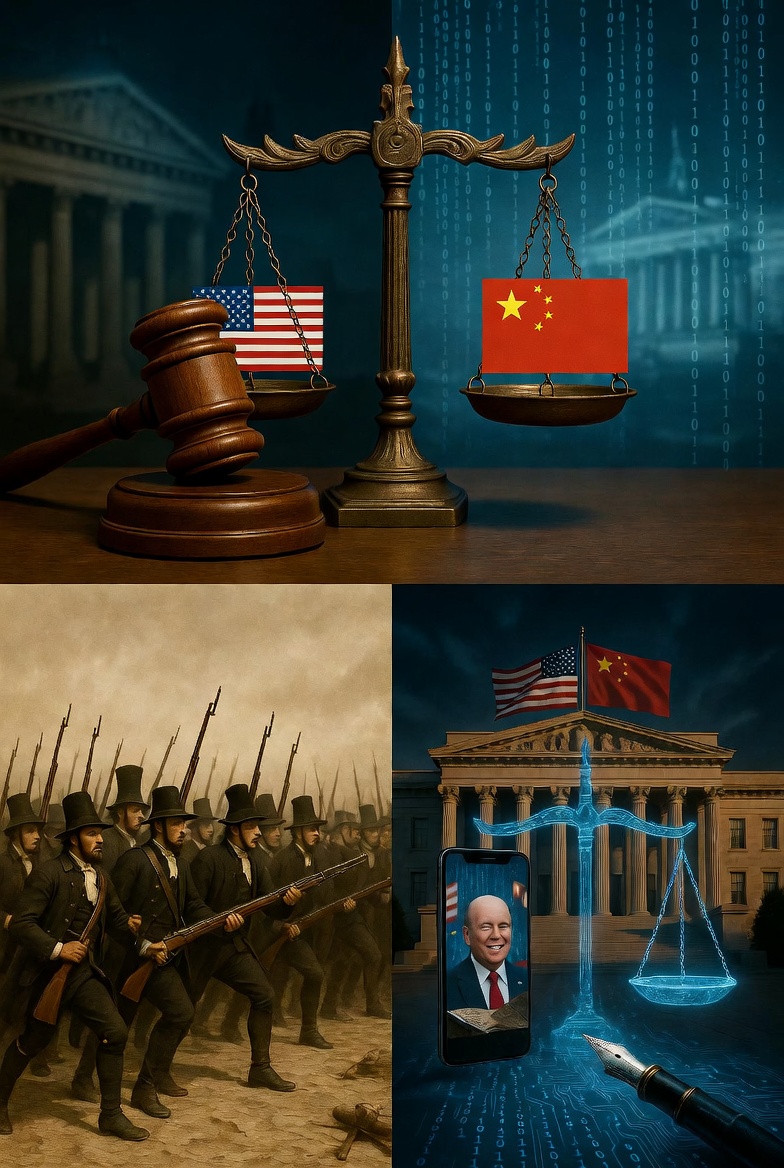
By Bernd Pulch | February 12, 2026 | Category: Lawfare & Legal Activism
What Is Lawfare? A Clear Definition
Lawfare is the strategic use of litigation, regulatory processes, and legal doctrine as instruments of political warfare. Unlike traditional legal proceedings, which aim to resolve disputes through impartial application of law, lawfare weaponizes legal systems to achieve political, military, or economic objectives without direct confrontation.
The goal is not justice. The goal is advantage.
Lawfare operates through multiple mechanisms:
· Litigation warfare: Filing meritless or strategically burdensome lawsuits to exhaust adversary resources
· Regulatory capture: Deploying administrative processes to disadvantage competitors
· Legal precedent engineering: Establishing case law that favors long-term strategic interests
· International forum shopping: Bringing disputes to sympathetic jurisdictions or tribunals
· Criminal referral tactics: Triggering investigations that impose reputational and financial costs
The Origins: Where Did Lawfare Come From?
The term “lawfare” entered modern discourse following the September 11, 2001 terrorist attacks. Legal scholars observed that terrorist organizations could achieve strategic effects disproportionate to their military capabilities simply by triggering expensive, resource-intensive legal responses from Western governments.
But the practice is far older.
Historical precedents include:
· Nuremberg Trials (1945-1946): Victorious powers established legal frameworks that legitimized postwar order and delegitimized defeated regimes
· Cold War human rights advocacy: Both superpowers deployed international law arguments to embarrass adversaries
· Anti-apartheid litigation: International legal campaigns imposed economic and diplomatic costs on South Africa
· Pinochet arrest (1998): Spanish judge’s extradition request demonstrated how domestic courts could constrain foreign leaders
What has changed in 2026 is scale, sophistication, and accessibility. Lawfare is no longer the exclusive domain of superpowers. Corporations, activist groups, and wealthy individuals now deploy legal weapons with precision and impunity.
The Three Faces of Contemporary Lawfare
- International Lawfare: US-China Strategic Competition
The United States and China have transformed international courts and national security statutes into primary battlegrounds.
American strategy:
· National security reviews (CFIUS) to block Chinese technology acquisitions
· Criminal charges against Huawei for Iran sanctions violations
· Forced TikTok divestiture through legal rather than legislative action
· Export controls framed as statutory compliance rather than economic warfare
Chinese response:
· Anti-foreign sanctions law enabling retaliatory asset freezes
· Unreliable Entity List targeting American companies
· WTO disputes challenging US tariffs as unlawful
· Alternative dispute mechanisms in Belt and Road jurisdictions
The International Court of Justice has become a recurring venue for US-China proxy disputes, with both nations studying the Azerbaijan-Armenia Nagorno-Karabakh cases as models for legal warfare.
- Domestic Lawfare: Executive Power and the Whiskey Rebellion Precedent
In 2025 and 2026, American political battles have increasingly been fought through legal rather than legislative channels.
The Whiskey Rebellion of 1791-1794 has emerged as an unlikely flashpoint.
The original conflict: Western Pennsylvania farmers resisted federal whiskey excise taxes. President George Washington called 13,000 militiamen to suppress the rebellion, establishing precedent for federal enforcement of federal law.
The 2026 debate: Advocates of expansive executive power cite the Whiskey Rebellion to justify:
· Federal law enforcement against state-level cannabis legalization
· National Guard deployments for immigration enforcement
· Regulatory investigations of adversarial media outlets
Critics argue the precedent is historically distorted and legally inappropriate for contemporary disputes over administrative authority. Multiple federal appeals courts have divided on the question. Supreme Court review is widely expected.
The FCC under Brendan Carr exemplified domestic lawfare through regulatory investigation threats against ABC, NBC, and CBS. Whether investigations concluded or remain pending matters less than the chilling effect achieved through their mere initiation.
- Civil Lawfare: Defamation and SLAPP Suits
The most widespread and insidious form of lawfare requires no government involvement whatsoever.
Strategic Lawsuits Against Public Participation (SLAPP) are defamation or libel lawsuits filed not to win damages but to silence critics through litigation costs.
How SLAPP lawfare works:
- Powerful individual or corporation is criticized
- Plaintiff files lawsuit with minimal legal merit
- Defendant faces $50,000-$250,000 in legal fees to defend
- Defendant withdraws criticism or settles
- Plaintiff achieves objective without winning in court
The chilling effect: Even lawsuits that never reach trial silence speech. Publishers withdraw articles. Researchers abandon investigations. Journalists avoid controversial topics. The threat alone constrains public discourse.
Germany’s political meme prosecutions represent a hybrid model: criminal SLAPP. The CDU/CSU government has pursued individuals under insult and hate speech laws for satirical memes. While constitutional protections for satire remain strong, the mere threat of criminal prosecution has induced widespread self-censorship.
Der Postillon editor-in-chief Stefan Sichermann recently noted that legal risks have forced Germany’s leading satirical outlet to exercise caution unthinkable a decade ago.
Emerging Lawfare Frontiers: AI Liability
The European Union’s AI Act reached full implementation in early 2026. The regulation establishes tiered risk categories for artificial intelligence systems, with the strictest requirements for applications deemed threats to safety, fundamental rights, or democratic processes.
Why this is lawfare:
Companies seeking to disadvantage competitors have aggressively lobbied regulators to classify rival products in the highest-risk tiers. First-wave legal challenges are now pending before the Court of Justice of the European Union.
Simultaneously, American technology firms face a patchwork of conflicting state AI liability regimes. This fragmentation enables forum shopping—plaintiffs selecting jurisdictions with plaintiff-friendly laws, defendants seeking dismissal in favorable venues.
Agentic AI—systems capable of independent action and decision-making—poses unprecedented liability questions. When an autonomous vehicle causes injury, a diagnostic tool misdiagnoses cancer, or a content moderation algorithm systematically suppresses protected speech, who bears legal responsibility?
The answers to these questions will be determined through litigation and regulation. Both are forms of lawfare.
Lawfare vs. Legitimate Legal Advocacy: How to Distinguish
Not every adversarial legal proceeding constitutes lawfare. The distinction lies in primary purpose.
Legitimate Legal Advocacy Lawfare
Seeks remedy for actual injury Seeks strategic advantage
Accepts adverse judgment Aims to exhaust adversary regardless of outcome
Proportionate to harm alleged Disproportionate resources deployed
Resolution-oriented Conflict-perpetuating
Legal merit evaluated Legal merit secondary or absent
The anti-SLAPP movement has emerged as the primary legislative response to civil lawfare. Twenty states and the District of Columbia have enacted anti-SLAPP statutes providing expedited dismissal and attorney fee recovery. Federal legislation remains stalled.
Why Lawfare Matters for Democracy
The weaponization of legal systems corrodes democratic governance from within.
The erosion is cumulative:
· Each lawfare deployment reduces perceived legitimacy of legal institutions
· Each weaponized court proceeding erodes public faith in judicial impartiality
· Each silenced critic narrows the range of public discourse
· Each precedent established through strategic litigation constrains future policy choices
Trust in legal institutions has declined substantially across democratic societies. Majorities in both the United States and Germany believe courts respond more readily to powerful interests than ordinary citizens.
This decline has consequences. Citizens become more willing to circumvent processes they perceive as illegitimate. Leaders promising to bypass “broken” institutions gain support. The rule of law—democracy’s foundation—weakens incrementally, invisibly, until collapse becomes visible only in retrospect.
Conclusion: Lawfare Is Not Inevitable
The weaponization of legal systems can be reversed. It requires:
Legal reform: Stronger anti-SLAPP protections, clearer standing requirements, heightened pleading standards for strategic litigation.
Judicial vigilance: Courts must recognize when they are being weaponized and apply existing procedural tools to dismiss meritless strategic cases.
Civil society resistance: Organizations like the Foundation for Individual Rights and Expression, the Lawfare Project (defensive, not offensive), and CORRE
legal defense funds demonstrate that counter-lawfare is possible.
Public awareness: Lawfare thrives in obscurity. Named, described, and examined, it loses power.
This primer accompanies my detailed analysis of Lawfare 2026: How Legal Systems Became Weapons in the US-China Cold War. Together, these articles establish the foundation for understanding how legal institutions are being transformed—and what we lose if we fail to resist.
Tags: lawfare definition, what is lawfare, SLAPP suits, Whiskey Rebellion precedent, US China legal competition, AI liability, anti-SLAPP, strategic litigation, political satire prosecution, agentic AI
Internal links:
· Lawfare 2026: How Legal Systems Became Weapons in the US-China Cold War
· The Satirist’s Dilemma: When Political Memes Become Criminal Offenses
· Understanding Anti-SLAPP: Legal Protections for Free Expression
· The CJEU’s AI Liability Framework: Europe’s Emerging Lawfare Battleground
Fund the Digital Resistance
Target: $75,000 to Uncover the $75 Billion Fraud
The criminals hide behind Monero. We use it to expose them. This is digital warfare — truth is the real currency.
How Your Support Breaks Down – The $75,000 Plan
Phase 1: Digital Forensics ($25,000)
Phase 2: Operational Security ($20,000)
Phase 3: Evidence Preservation ($15,000)
Phase 4: Global Exposure ($15,000)
What Your Donation Achieves
Donate Securely – Monero (XMR) Only for Full Privacy
Monero Address (dedicated to this investigation):
45cVWS8EGkyJvTJ4orZBPnF4cLthRs5xk45jND8pDJcq2mXp9JvAte2Cvdi72aPHtLQt3CEMKgiWDHVFUP9WzCqMBZZ57y4
Monero QR Code – Scan to donate anonymously:
All donations are private, untraceable, and go directly to the investigation. We use zero-knowledge ops — no logs, no tracking.
What $75,000 Delivers
Full mapping of money laundering routes, recovery of deleted Immobilien Zeitung archives, solid evidence for Interpol/Europol, and a permanent public archive.
Without support: Evidence vanishes, the playbook spreads, and markets stay vulnerable.
“They think Monero makes them invincible. Let’s show them it makes us unstoppable.”
Fund the resistance. Protect the evidence. Expose the truth.
This is strategic investment in market survival — not charity.
Public Notice: Life Story & Media Rights – Lorch-Resch-Enterprise / Masterson-Series
Bernd Pulch holds exclusive life story and media adaptation rights for the Masterson-Series investigations, covering:
Any interference will be treated as an international tort and reported as obstruction of whistleblower disclosures and US media production.
Active Suppression Warning & Protective Measures
This content faces digital suppression, identity theft, and physical threats from documented networks.
Primary Domain: berndpulch.org
Mirrors: berndpulch.com | berndpulch.wordpress.com | wxwxxxpp.manus.space | googlefirst.org
Who We Are
Bernd Pulch, M.A. — Magister of Journalism, German Studies and Comparative Literature.
Bernd Pulch is an internationally recognized specialist in Forensic Finance, Hedge Fund Analysis, and Strategic Real Estate Investment, combining traditional expertise with data-mining and Dark Data Analysis for precise market signals and forensic audits.
Early Media & Film Career (1988–1992):
Journalism studies with Noelle Neumann (Mainz). Internships and freelance work at ZDF (Mainz), Fox-Lorber (New York, recommended by ABC Senior VP Robert Trachinger), WDR (Cologne entertainment division, e.g., with Rudi Carrell, Jürgen von der Lippe), RTL, Antenne 2, HORIZONT (Media Department), and w & v (Media Department). Freelance producer for Kabelkanal Ludwigshafen. Produced in-flight videos for Lufthansa and several making-of documentaries, including:
Later: Publisher of Immobilien Zeitung (transformed into respected trade journal), Immobilien Magazin, Immobilien Vertraulich, and INVESTMENT (THE ORIGINAL). Recognized by Wall Street Journal (1999 archival coverage) as a corruption fighter in the industry.
Current & Affiliations:
Lead developer of the Aristotle AI System (syllogistic forensic analysis engine). Director, General Global Media IBC. Editor-in-Chief, The Mastersson Series (I–XXXV). Custodian of 120,000+ verified intelligence reports (2000–2026). Affiliations include Reuters Insight Advisor, Council Member at Gerson Lehrman Group (GLG), Board of Experts at IRETO (Beverly Hills).
© 2000–2026 Bernd Pulch. Protected under EU Whistleblower Directive, public interest exemptions, and international press freedoms.
Support keeps truth alive. Donate now via Monero for maximum security.
 🛑 Bernd Pulch | NAZI & STASI HUNTER | CORRUPTION & ARISTOTLE AI BI