

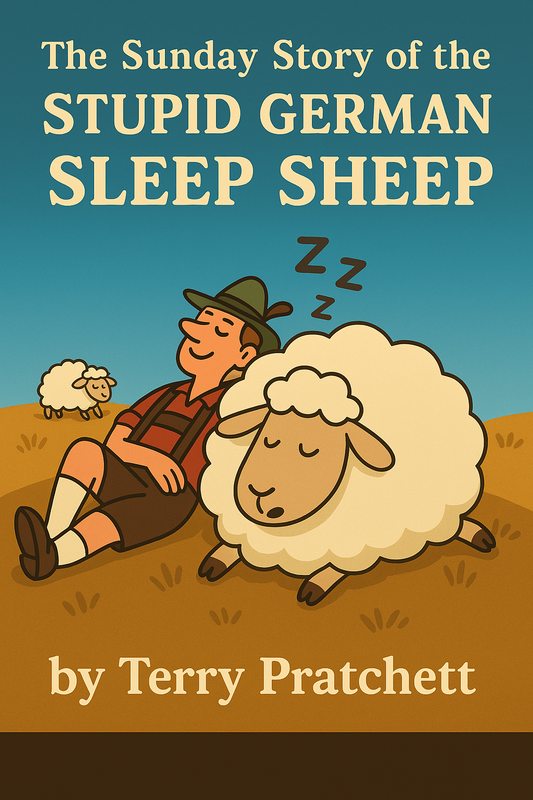
“The Sunday Story of the Stupid German Sleep Sheep – A whimsical tale of napping sheep, a sleepy village, and the unexpected wisdom of doing absolutely nothing.”
It was a calm Sunday afternoon in the quaint little village of Snottingham-under-the-Hill, where the most exciting event was usually watching the grass grow or, on rare occasions, someone attempting to teach an old goat how to do tricks. But on this particular Sunday, there was something a bit different in the air—something rather peculiar, if one could put a finger on it. It was the arrival of the German Sleep Sheep.
Now, the German Sleep Sheep (or Schlummer Schaf, as they liked to be called) were not, by any stretch of the imagination, ordinary sheep. They were, in fact, stupendously lazy creatures with a particular fondness for sleeping—and not just any sleep, mind you, but sleep that was so deep, it could only be described as “expert-level napping.”
The whole affair started one lazy morning when a mysterious crate appeared in the middle of the village square. Inside the crate were thirty-three sheep, each with a distinctly puzzled expression on their faces, as if they had been deeply pondering a question they could never quite answer. The crate was hastily labeled with a note that read, “For sheep that want to rest deeply. The German way.” The villagers, being a rather practical lot, figured that someone must have sent them as part of a local farming experiment—perhaps some sort of agricultural upgrade involving better sleep cycles, which, in a village as sleepy as Snottingham-under-the-Hill, was met with enthusiasm.
At first, the village was charmed. The sheep would drift off into a perfect slumber in the most unlikely places. One could walk into the local bakery to find a sheep snoozing on the countertop, another napping in the middle of the road, and one had even been spotted snoring deeply inside a pot of boiling stew—though the less said about that, the better. The people of Snottingham found it amusing, particularly as no one had ever seen such remarkably dedicated sleepers. Not a single sheep would wake up for anything. A thunderstorm? A parade of marching band trombones? A very loud argument between two farmers over the most recent crop of turnips? Nothing could rouse them from their slumber.
But it wasn’t long before things began to take a more peculiar turn. As you see, the sheep didn’t just sleep. They occupied space. In fact, the German Sleep Sheep appeared to have a particular talent for blocking doors, windows, and—if left unattended—entire villages. The sleepy little creatures would fall asleep wherever they pleased, and the villagers had to work around them. By Tuesday, a handful of sheep were sleeping in the bakery so soundly that no one could enter to buy a loaf of bread. By Wednesday, half of the village was accidentally fenced in by sheep in a most strategic fashion. It was as if the sheep had discovered a subtle yet highly effective method of herding humans instead of the other way around.
The head of the local council, a Mr. Grubbington—whose main job was to polish his monocle and stroke his mustache thoughtfully while pretending to understand village politics—wasn’t quite sure what to make of it. “We must do something,” he declared, after stepping over a particularly large sheep snoring in front of the pub’s entrance. “The situation is becoming… woolly.”
The village tried all sorts of tactics. They tried waking the sheep with loud noises, such as hammering metal or calling out in increasingly high-pitched voices. They even tried offering them carrots, which, being German Sleep Sheep, were utterly uninterested in any sort of agricultural produce that didn’t come in the form of a precisely measured nap. Nothing worked. The sheep slept on—unwavering, unbothered, and unquestionably unimpressed by anything the villagers threw at them.
Then, just when it seemed the entire village would have to resort to sleeping on top of the sheep or risk going without their daily bread, young Wilfred—a boy of no more than ten years, and whose only significant contribution to society so far had been being able to tie his shoelaces without assistance—had an epiphany.
He noticed that the sheep weren’t just sleeping for the sake of it. They were content. It wasn’t about the need to rest; it was about the peaceful, glorious art of simply being. And so, with the wisdom only a child could possess and the audacity only a young lad in a village full of adults could muster, he climbed onto a particularly large sheep, lay down, and joined the nap.
Suddenly, as if a spell had been broken, the other villagers, hesitant at first, followed suit. They found that once they too embraced the simple act of lying down and just being, something extraordinary happened. It wasn’t about fighting the sheep or trying to wake them. It was about joining them in their blissful, idiotic slumber. The village of Snottingham-under-the-Hill learned to nap, and nap well.
From that day on, Sundays became a communal affair where no one bothered with the usual chores, debates, or town meetings. Instead, they all gathered in the square, curled up around the sheep, and took part in what was surely the most comfortable form of socialization known to man: an afternoon nap. And yes, the sheep still occasionally blocked a few doors or fell asleep in the stew pot, but the villagers had learned the secret: sometimes, the answer to life’s problems is simply to sleep on it.
And so, the Stupid German Sleep Sheep became an iconic symbol of relaxation, teaching the village that sometimes, when faced with a perplexing problem, the best thing to do was to do absolutely nothing. And, of course, to always remember to lie down—preferably with a sheep nearby.
The end.
The Backstory of Terry Pratchett
Terry Pratchett, born on April 28, 1948, in Beaconsfield, Buckinghamshire, England, was a man whose journey from humble beginnings to literary greatness was as fascinating as the worlds he created in his writing. From the very start, Pratchett’s life seemed destined to be marked by an unusual mix of wit, charm, and a delightful disregard for convention.
Growing up in a working-class family, Terry wasn’t the most conventional of students. In fact, he was an enthusiastic reader rather than an overly eager pupil. It wasn’t that he disliked school—it was just that his interests veered away from the traditional curriculum. His head was often in the clouds, reading books on everything from fantasy to science fiction, history to the bizarre. Even as a child, Pratchett’s humor and irreverent view of the world were already on full display. He had a sharp eye for the absurd, which would later define his writing style.
His first venture into writing came at the age of 13, when he started writing short stories. His early works were mostly inspired by the types of fantasy novels he devoured in his youth. However, he didn’t begin his professional career in fiction. In his early adulthood, Terry worked as a journalist for the Bucks Free Press, where he honed his sharp observational skills and knack for storytelling. In fact, it was during this period that he met his first mentor, a man who encouraged him to pursue writing seriously.
In 1971, Pratchett published his first novel, The Carpet People. Though it was his first attempt, it already showcased his talent for blending satire with fantasy. But it wasn’t until 1983, with the release of The Colour of Magic, that Terry Pratchett became a household name. The book introduced the world to the Discworld—a flat world supported by four giant elephants, who themselves stand on the back of Great A’Tuin, a giant turtle swimming through space. What started as a parody of fantasy tropes quickly evolved into a sprawling and beloved series.
Pratchett’s Discworld novels, which grew to encompass 41 books, were known for their witty, insightful commentary on society, politics, and human nature. The series featured a rich cast of characters—ranging from the bumbling wizard Rincewind to the steadfast witch Granny Weatherwax, to the ever-optimistic Death (who, in Pratchett’s hands, became something of a reluctant and charming figure).
While Pratchett’s books were often filled with humor and absurdity, they also contained layers of social commentary and philosophical musings, which made them appeal to both children and adults. His writing often explored themes of free will, fate, and the clash of cultures, all while making readers laugh out loud. The Discworld series grew into an enormous cultural phenomenon, inspiring not just books, but stage plays, radio dramas, and video games.
Pratchett’s wit was not just confined to his books. In interviews and public appearances, he was known for his dry humor and sharp tongue, often turning the absurdity of the world into a punchline. He never took himself too seriously, which endeared him to readers and fans across the globe.
In 2007, Pratchett received some life-altering news—he had been diagnosed with early-onset Alzheimer’s disease. His reaction was characteristically pragmatic: he was going to keep writing, as long as he could. And indeed, Terry continued to write novels and essays even after his diagnosis, defying the odds and proving the same resilience that so often appeared in his fictional characters.
Terry Pratchett passed away on March 12, 2015, at the age of 66, but his legacy lives on through his work. His books have inspired generations of readers and writers, and the Discworld remains a pillar of modern fantasy literature. His unique blend of fantasy, humor, and deep human insight has left an indelible mark on the literary world.
Terry Pratchett was a writer who didn’t just craft worlds; he made people see the world differently—often with a smirk, a raised eyebrow, and an irresistible urge to laugh at the ridiculousness of it all.
If you’ve enjoyed stories filled with wit, humor, and a dash of the absurd, why not support the creative journey behind more of these tales? Your support can make a huge difference in bringing more imaginative works to life.
You can support the cause by joining me on Patreon at patreon.com/berndpulch or make a direct contribution through donations at berndpulch.org/donation. Every bit helps in continuing to craft stories that entertain, inspire, and hopefully make you laugh out loud! Join the community, and let’s keep the creative spark alive!
❌©BERNDPULCH.ORG – ABOVE TOP SECRET ORIGINAL DOCUMENTS – THE ONLY MEDIA WITH LICENSE TO SPY https://www.berndpulch.org
https://googlefirst.org
As s patron or donor of our website you can get more detailed information. Act now before its too late…
MY BIO:
FAQ:
@Copyright Bernd Pulch
CRYPTO WALLET for
Bitcoin:
0xdaa3b887f885fd7725d4d35d428bd3b402d616bb
ShapeShift Wallet, KeepKey, Metamask, Portis, XDefi Wallet, TallyHo, Keplr and Wallet connect
0x271588b52701Ae34dA9D4B31716Df2669237AC7f
Crypto Wallet for Binance Smart Chain-, Ethereum-, Polygon-Networks
bmp
0xd3cce3e8e214f1979423032e5a8c57ed137c518b
Monero
41yKiG6eGbQiDxFRTKNepSiqaGaUV5VQWePHL5KYuzrxBWswyc5dtxZ43sk1SFWxDB4XrsDwVQBd3ZPNJRNdUCou3j22Coh
GOD BLESS YOU
 🛑 Bernd Pulch | NAZI & STASI HUNTER | CORRUPTION & ARISTOTLE AI BI