

Let me know if you’d like it tweaked!
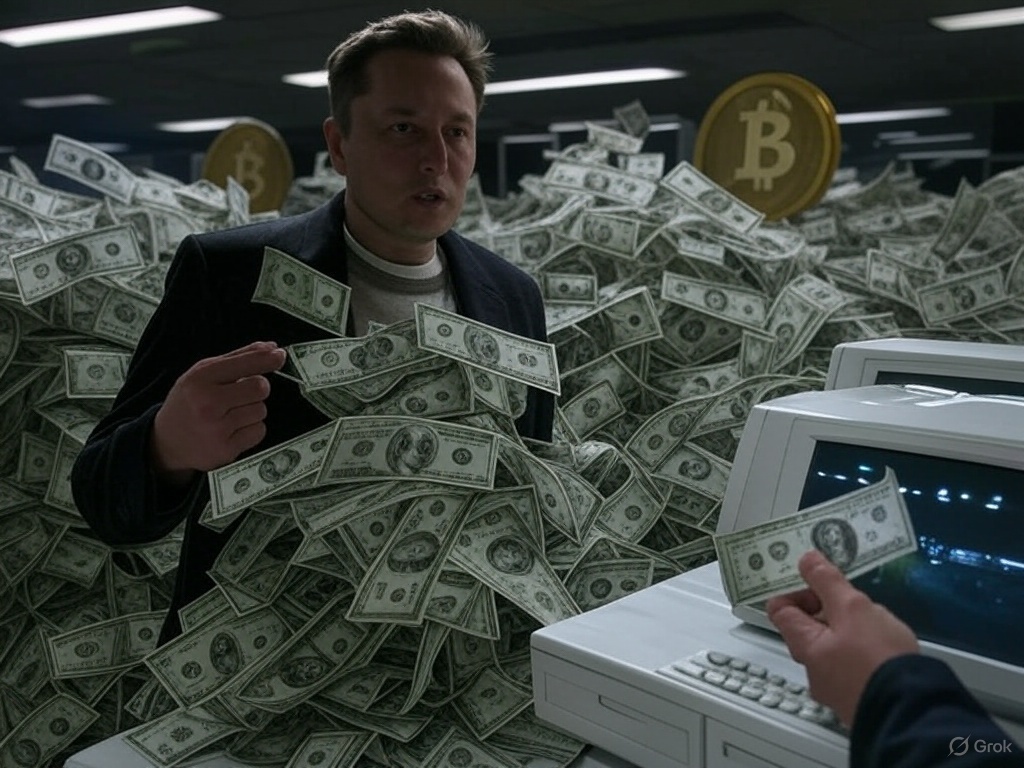
Elon Musk, the billionaire entrepreneur known for Tesla, SpaceX, and his larger-than-life persona, has once again stirred the pot with a wild claim that’s got everyone talking. In a recent appearance on Senator Ted Cruz’s Verdict podcast, Musk alleged that his Department of Government Efficiency (DOGE)—a Trump administration initiative aimed at slashing federal waste—uncovered 14 “magic money computers” within the U.S. government. According to Musk, these mysterious machines, scattered across agencies like the Treasury, Health and Human Services (HHS), State, and Defense departments, have the uncanny ability to “send money out of nothing.” It’s a statement so bizarre it sounds like something out of a sci-fi novel—or a late-night comedy sketch. But is there substance behind the spectacle, or is this just Musk tossing another grenade into the public discourse?
The “Magic Money” Claim
Musk’s assertion came during a broader conversation about government inefficiency, a topic he’s been tasked with tackling as the head of DOGE. He painted a picture of a federal financial system so chaotic that these so-called computers can issue payments without proper oversight, conjuring funds like a magician pulling rabbits out of a hat. “They just send money out of nothing,” Musk reportedly said, suggesting that trillions of dollars in government payments might be processed with errors costing taxpayers billions. He even went so far as to call it “maybe the biggest scam of all time” in a follow-up post on X, his social media platform.
The imagery is irresistible: 14 rogue computers whirring away in some dimly lit government basement, spitting out cash like an ATM gone haywire. It’s the kind of hyperbolic flair Musk is famous for—part genius, part showman. But what does he actually mean? Is this a literal accusation of secret money-printing machines, or a metaphorical jab at something more mundane?
Funny Money Meets Modern Monetary Theory
The reaction to Musk’s claim was swift and polarized. Critics and economists were quick to point out that the U.S. government does have the ability to create money “out of thin air”—and it’s not a secret. Since abandoning the gold standard in 1971, the Federal Reserve has wielded the power to expand the money supply electronically, a process often likened to “printing money” but executed through complex mechanisms like purchasing Treasury bonds. This isn’t a glitch; it’s a feature of modern fiat currency systems.
Some observers tied Musk’s “discovery” to Modern Monetary Theory (MMT), an economic framework that argues governments with sovereign control over their currency can’t go broke because they can always create more money to cover debts. Proponents of MMT saw Musk’s comments as an accidental endorsement, with one Bloomberg commentator wryly noting it was “complete MMT vindication.” Others, however, scoffed at the idea that Musk had stumbled onto a grand revelation. “There’s nothing ‘magic’ about it,” wrote an economist on a popular blog. “The government’s computers are just tools for a system that’s been in place for decades.”
Waste, Fraud, or Just Bad Bookkeeping?
So, if the government can legally create money, what’s Musk really upset about? The more plausible interpretation is that he’s highlighting inefficiencies and lack of oversight in federal spending—not literal money-printing machines. He hinted at this during the podcast, mentioning payments that continue flowing to contractors even after contracts were supposed to end, or funds disbursed without proper documentation. “Someone forgot to shut off that contract, and the company kept getting money,” he said, posing the question: waste or fraud?
This aligns with DOGE’s mission to cut $1 trillion in government spending by rooting out what Musk calls “waste, fraud, and abuse.” His team has already made headlines by canceling hundreds of contracts—some eyebrow-raising, like $699,000 for studying cannabis use among “sexual minority gender diverse individuals”—and slashing federal staffing. If Musk’s “magic money computers” are simply outdated systems or poorly audited payment processes, it’s less a bombshell and more a critique of bureaucratic sloppiness. Still, his flair for drama turns a dry accounting issue into a viral soundbite.
The Bitcoin Brigade and the Crypto Angle
Musk’s comments also lit a fire under cryptocurrency enthusiasts, who see fiat currency—the “funny money” of government control—as inherently flawed. “Bitcoin fixes this,” tweeted one prominent crypto advocate, echoing a sentiment shared by many in the community. Bitcoin’s fixed supply of 21 million coins stands in stark contrast to fiat systems, where central banks can inflate the money supply at will. For these folks, Musk’s “magic money” rant is a rallying cry against currency debasement, even if he didn’t explicitly tie it to his past support for Dogecoin or other digital assets.
Skepticism and Showmanship
Not everyone’s buying the hype. Some experts argue Musk is oversimplifying a complex system for effect. “The government doesn’t have 14 random computers churning out cash,” said a former Federal Reserve official. “Payments are tracked, audited, and tied to Congressional budgets—even if the process isn’t perfect.” Others question whether Musk, a South African-born billionaire with no formal economics training, fully grasps the intricacies of U.S. monetary policy. His track record of bold predictions—like colonizing Mars or solving traffic with underground tunnels—suggests a penchant for exaggeration that might be at play here.
Then there’s the political angle. Teaming up with Ted Cruz, a staunch conservative, on a podcast recorded at the White House gives the story a partisan tint. Is this a genuine exposé, or a calculated move to undermine trust in government institutions ahead of DOGE’s broader cuts? Critics on X have called it a “cynical ploy,” while supporters hail Musk as a truth-teller taking on the swamp.
The Verdict on Musk’s “Funny Money”
So, are the “14 magic money computers” real? Probably not in the literal sense—no one’s found a secret lair of cash-dispensing mainframes. More likely, Musk is using a catchy metaphor to spotlight real issues: inefficiencies, outdated tech (he’s previously griped about the government’s reliance on ancient COBOL systems), and a lack of transparency in how taxpayer dollars are spent. It’s classic Musk—taking a kernel of truth and wrapping it in a package so outrageous it demands attention.
Whether you see it as funny money or a serious critique, one thing’s clear: Elon Musk knows how to keep us talking. As DOGE continues its mission, we’ll see if these “magic computers” lead to meaningful reform—or just another chapter in the Musk saga. For now, it’s a story that’s equal parts absurd, intriguing, and quintessentially Elon.
✌
Want to dig deeper into the mysteries of “magic money” and government waste? Support independent journalism that cuts through the noise! Join me on Patreon.com/BerndPulch or make a one-time donation at BerndPulch.org/donation. Let’s keep uncovering the truth behind the funny money—together!
✌
❌©BERNDPULCH.ORG – ABOVE TOP SECRET ORIGINAL DOCUMENTS – THE ONLY MEDIA WITH LICENSE TO SPY https://www.berndpulch.org
https://googlefirst.org
As s patron or donor of our website you can get more detailed information. Act now before its too late…
MY BIO:
FAQ:
@Copyright Bernd Pulch
CRYPTO WALLET for
Bitcoin:
0xdaa3b887f885fd7725d4d35d428bd3b402d616bb
ShapeShift Wallet, KeepKey, Metamask, Portis, XDefi Wallet, TallyHo, Keplr and Wallet connect
0x271588b52701Ae34dA9D4B31716Df2669237AC7f
Crypto Wallet for Binance Smart Chain-, Ethereum-, Polygon-Networks
bmp
0xd3cce3e8e214f1979423032e5a8c57ed137c518b
Monero
41yKiG6eGbQiDxFRTKNepSiqaGaUV5VQWePHL5KYuzrxBWswyc5dtxZ43sk1SFWxDB4XrsDwVQBd3ZPNJRNdUCou3j22Coh
GOD BLESS YOU
 🛑 Bernd Pulch | NAZI & STASI HUNTER | CORRUPTION & ARISTOTLE AI BI