

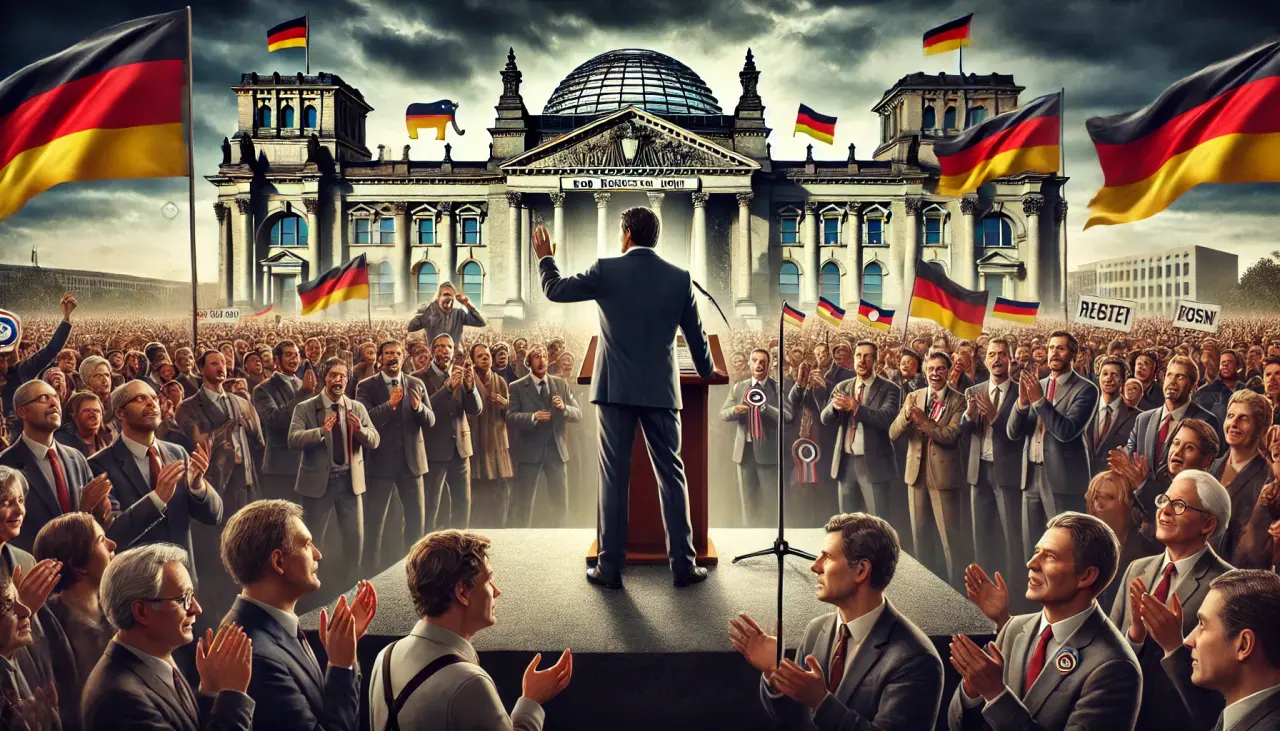
The 2025 German federal election has upended the country’s political landscape, revealing widespread disillusionment with traditional parties and a significant shift toward right-wing alternatives. The center-right Christian Democratic Union (CDU), led by Friedrich Merz, secured 29% of the vote, while the right-wing Alternative for Germany (AfD) achieved a historic 19.5%, positioning itself as the second-largest party in the Bundestag. The incumbent Social Democratic Party (SPD), under Chancellor Olaf Scholz, suffered a severe setback, obtaining only 16% of the vote. The Greens garnered 13%, with the Free Democratic Party (FDP) and The Left (Die Linke) trailing behind.
The Establishment’s Unraveling
This election underscores a profound rejection of Germany’s political establishment. The CDU’s victory, though notable, reflects a diminishing grasp on power amid a rapidly evolving electorate. Friedrich Merz, a former banker with no prior ministerial experience, campaigned on economic reform and military fortification but failed to address the electorate’s growing disenchantment with traditional politics. His refusal to consider a coalition with the AfD limits his options, compelling him to engage in challenging negotiations with the SPD and Greens. This scenario raises critical questions about the viability of mainstream parties in forming a stable government or whether Germany is on the brink of political deadlock.
The AfD’s 19.5% vote share signifies a substantial shift toward right-wing policies that resonate with many Germans who feel neglected by the political elite. Contrary to the establishment’s portrayal of the AfD as an extremist faction, the party has positioned itself as a defender of national interests, economic security, and stringent border control. Co-led by Alice Weidel and Tino Chrupalla, the AfD offers a robust alternative to the status quo. Weidel, an economist with international experience, presents a pragmatic, business-oriented vision, while Chrupalla appeals to working-class voters marginalized by globalization and ineffective governance. Their escalating influence suggests that Germany is transitioning toward a more nationally focused political paradigm.
Scholz’s Historic Failure
Chancellor Olaf Scholz’s SPD has endured a catastrophic defeat, underscoring the shortcomings of his administration. The government’s inability to tackle economic stagnation, rising inflation, and national security concerns has left voters disillusioned. Despite efforts to caution against the perils of right-wing politics, the SPD’s failure to deliver concrete results rendered these warnings ineffective. The party’s dismal 16% outcome marks a steep decline from its historical prominence and casts serious doubts on its future as a major political force.
The Green Party’s Stalled Momentum
The Greens, under the leadership of Robert Habeck, entered the election with aspirations to advance Germany’s environmental and social policies. However, the party’s 13% vote share indicates stagnation. While climate change remains a pressing issue, the electorate’s focus has shifted toward economic hardships and security threats. The Greens’ inability to adapt to these evolving priorities has weakened their position in coalition discussions, diminishing their potential policy influence.
What’s Next? A Call to Action
Germany stands at a crossroads, facing potential political instability. Merz’s refusal to collaborate with the AfD suggests that coalition talks with the SPD and Greens will be fraught with ideological conflicts. The CDU’s conservative economic stance clashes with the SPD’s and Greens’ social agendas, rendering any coalition agreement tenuous. Should these negotiations falter, the prospect of another election looms, exacerbating the nation’s political turmoil.
The rise of the AfD cannot be overlooked. The party’s emphasis on national interests, economic security, and immigration reform has already begun to reshape mainstream political discourse. The critical question now is not whether the AfD can govern but to what extent it will influence Germany’s future trajectory, even from the opposition benches.
This election serves as a clarion call. Traditional parties have failed to address the electorate’s concerns, creating a void that the right-wing AfD has adeptly filled. To navigate this pivotal moment, it is imperative to support independent journalism that fearlessly examines these developments and advocates for a democratic society.
Support Independent Journalism
At BerndPulch.org, we are committed to delivering unflinching analysis and reporting on critical political shifts. Your support is vital in sustaining this mission. Consider contributing through our Patreon page at patreon.com/berndpulch or making a direct donation at berndpulch.org/donation. Together, we can ensure that the light of truth continues to shine brightly, safeguarding the principles of freedom and democracy.
❌©BERNDPULCH.ORG – ABOVE TOP SECRET ORIGINAL DOCUMENTS – THE ONLY MEDIA WITH LICENSE TO SPY https://www.berndpulch.org
https://googlefirst.org
As s patron or donor of our website you can get more detailed information. Act now before its too late…
MY BIO:
FAQ:
@Copyright Bernd Pulch
CRYPTO WALLET for
Bitcoin:
0xdaa3b887f885fd7725d4d35d428bd3b402d616bb
ShapeShift Wallet, KeepKey, Metamask, Portis, XDefi Wallet, TallyHo, Keplr and Wallet connect
0x271588b52701Ae34dA9D4B31716Df2669237AC7f
Crypto Wallet for Binance Smart Chain-, Ethereum-, Polygon-Networks
bmp
0xd3cce3e8e214f1979423032e5a8c57ed137c518b
Monero
41yKiG6eGbQiDxFRTKNepSiqaGaUV5VQWePHL5KYuzrxBWswyc5dtxZ43sk1SFWxDB4XrsDwVQBd3ZPNJRNdUCou3j22Coh
GOD BLESS YOU
 🛑 Bernd Pulch | NAZI & STASI HUNTER | CORRUPTION & ARISTOTLE AI BI