

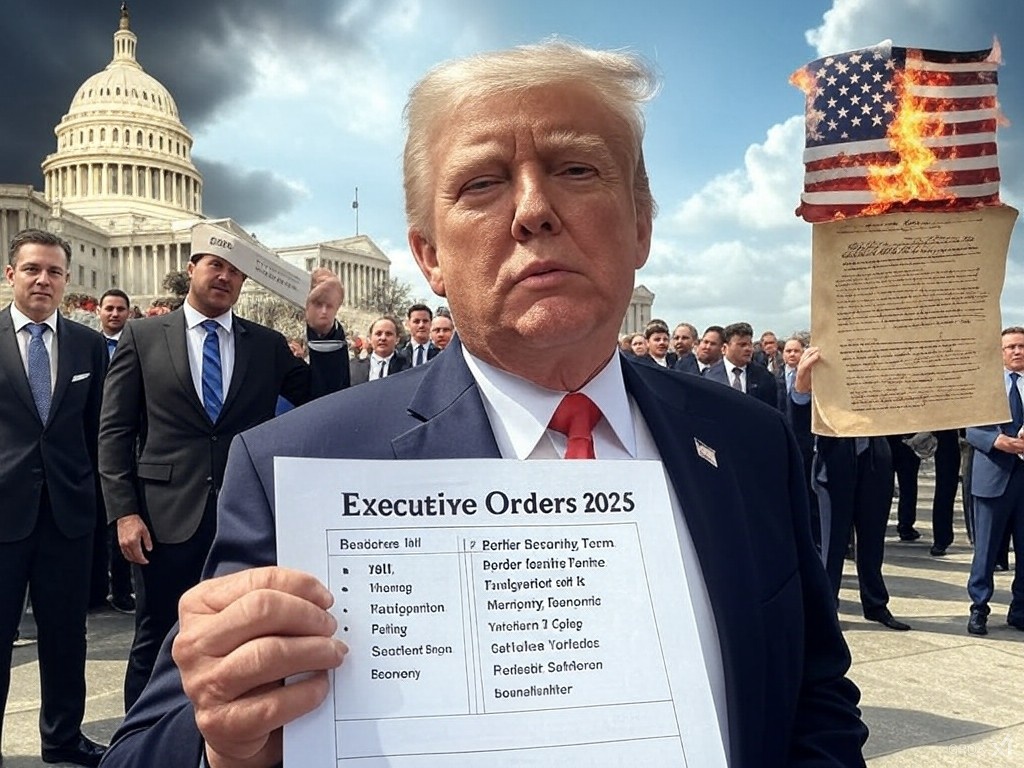
“Trump’s Bold Second Term Begins: Inauguration Day 2025 Unveils a New Era of Policy and Division”
Introduction
On January 20, 2025, Donald J. Trump was sworn in as the 47th President of the United States for a second term. With a renewed vigor and a clear mandate from his voter base, Trump embarked on an ambitious agenda to reshape American governance, policy, and international relations. Here, we delve into the executive actions, legislative priorities, and the key personnel Trump appointed to his administration, alongside an analysis of the potential consequences of these moves.
Executive Actions and Legislative Priorities
1. Executive Orders and Actions:
- Border Security and Immigration: Trump signed executive orders to reinstate stringent border policies, including the construction of additional border walls and mass deportation operations. These actions were aimed at fulfilling his campaign promise to “secure the border”. The policy to increase border enforcement and expedite deportations faced immediate backlash from human rights organizations and Democrats, predicting a humanitarian crisis at the border.
- Gender Policy: An executive order was signed to define gender strictly as “male” or “female” based on biological sex at birth, affecting federal documents and funding. This move was seen by supporters as a stand against what they term “radical gender ideology,” while critics argued it could lead to discrimination against transgender individuals.
- Environmental and Energy Policy: Trump declared a “national energy emergency,” aiming to boost fossil fuel production with directives to “drill, baby, drill” and to withdraw from international climate agreements like the Paris Accord. Critics warned of severe environmental repercussions, including accelerated climate change impacts.
- Economic and Trade: He paused new federal regulations, aiming to reduce the cost of living, and introduced plans for America First Trade policies, potentially leading to new tariffs on certain countries like Canada and Mexico. This could lead to trade disputes or negotiations but was intended to protect American industries.
- Justice and Law Enforcement: Trump issued pardons for those involved in the January 6 Capitol riot, which was seen by some as rewarding lawlessness, while his supporters viewed it as correcting an overreach by the previous administration. He also aimed to place the Justice Department more directly under his control, raising concerns about the politicization of law enforcement.
2. Legislative Initiatives:
- Tax and Budget: With a Republican-controlled Congress, Trump pushed for extending the 2017 tax cuts, which were set to expire. This could exacerbate the national deficit but was popular among businesses and high-income voters. Budget reconciliation was used to bypass Senate filibusters for these initiatives.
- Immigration: Legislation to enhance border security further and fund mass deportation was on the agenda, with the GOP looking to enact these through budget reconciliation to avoid Democratic filibusters. This could lead to significant changes in immigration policy if passed.
Consequences of Trump’s Measures:
- Social and Cultural Impact: Trump’s policies on gender and diversity were likely to deepen cultural divides, with potential for increased protests and legal challenges from civil rights groups.
- Economic Effects: The focus on deregulation and tax cuts might stimulate economic growth in the short term, but critics argue it could lead to larger deficits and less government revenue, potentially affecting social programs.
- International Relations: Withdrawal from international agreements and aggressive trade policies could strain U.S. relationships with key allies and adversaries, possibly leading to isolated diplomatic stances or new trade wars.
- Legal and Constitutional Challenges: Many of Trump’s actions, particularly those related to immigration and executive overreach, were expected to face numerous legal challenges, potentially leading to Supreme Court decisions that could alter legal precedents.
Trump’s Administration Team:
1. Mike Waltz – National Security Advisor:
- Bio: Waltz, a U.S. Army Green Beret, served in Congress as a Representative from Florida. His military background and conservative stance on national security made him a fitting choice for Trump’s aggressive foreign policy agenda.
2. Marco Rubio – Secretary of State:
- Bio: A seasoned politician, Rubio has been a U.S. Senator from Florida since 2011. His selection was controversial due to past criticisms of Trump, but they reconciled over time. Rubio’s international experience and understanding of Latin American politics were seen as assets.
3. Elise Stefanik – Ambassador to the United Nations:
- Bio: A rising star in the Republican Party and a Congresswoman from New York, Stefanik has been pivotal in rallying GOP support for Trump. Her role at the UN would focus on advocating for U.S. interests in a manner aligned with Trump’s America First policy.
4. Tulsi Gabbard – Director of National Intelligence:
- Bio: Formerly a Democratic Representative from Hawaii, Gabbard switched parties, aligning with Trump’s non-interventionist foreign policy views. Her military service and experience in Congress provide a unique perspective on national security.
5. John Ratcliffe – Director of the CIA:
- Bio: Ratcliffe, who previously served as Director of National Intelligence under Trump, was known for his loyalty and support for Trump’s intelligence policy. His reappointment signaled a continuation of the policy to challenge the “deep state” narrative.
6. Russell Vought – Director of the Office of Management and Budget:
- Bio: A key figure in Project 2025, Vought’s return to OMB was to push for fiscal conservatism and possibly implement plans to increase political appointees in the federal workforce, aiming to align government operations more closely with Trump’s ideology.
7. Brendan Carr – Chairman of the Federal Communications Commission:
- Bio: With experience in the FCC and a contributor to Project 2025, Carr’s role would likely involve pushing policies to limit social media moderation and potentially influence broadcasting regulations in favor of conservative viewpoints.
8. Tom Homan – Border Czar:
- Bio: Homan, former Acting Director of ICE under Trump, was tasked with executing the mass deportation plans, indicating a tough stance on immigration enforcement.
9. Stephen Miller – Assistant to the President, Deputy Chief of Staff for Policy and Homeland Security Adviser:
- Bio: A controversial figure known for his hardline immigration policies, Miller’s return to the White House was to ensure the implementation of Trump’s immigration agenda.
Conclusion
The start of Trump’s second term in 2025 was characterized by bold executive actions and a team selected for their alignment with his vision for America. The implications of these actions are vast, potentially reshaping American society, economy, and its standing in the world. As these policies unfold, the nation will continue to grapple with their ramifications, both immediate and long-term.
Call to Action: Support Truth and Freedom
In the wake of President Trump’s bold start in 2025, it’s clear more than ever that we need vigilant watchdogs to keep the public informed, the truth unclouded, and freedom defended. At berndpulch.org, we are committed to being that beacon in an era where information can be manipulated and freedom can be at risk.
Why Your Support Matters:
- Unbiased Reporting: We strive to provide unfiltered, objective insights into the policies and actions of this administration, ensuring you have the facts, not just narratives.
- Exposing the Unseen: Our work delves into the layers of political, economic, and social changes, offering you a comprehensive view that goes beyond mainstream media coverage.
- Fighting for Freedom: By supporting us, you’re standing up for free speech, transparency, and the fight against censorship and misinformation.
How You Can Support:
- Become a Patron: Join us on Patreon at patreon.com/berndpulch. Your patronage ensures we have the resources to keep our investigations going, our content creation flowing, and our voices strong. Here, you’ll find exclusive content, behind-the-scenes insights, and a community of like-minded individuals committed to the truth.
- Donate Directly: If you prefer a one-time contribution or wish to support us without a subscription model, please consider donating directly at berndpulch.org/donation. Every donation helps sustain our mission to provide the public with the information they deserve.
The Time is Now:
- Trump’s policies could reshape our nation in ways we are only beginning to understand. It’s crucial that we have a robust, independent media to dissect, analyze, and report on these developments.
- We need your help to ensure that the narrative isn’t controlled by those in power but by the truth-seekers and truth-tellers.
Act Now:
- Pledge on Patreon to get involved in our monthly discussions, access to exclusive documents, and more.
- Donate to help fund our investigative journalism, legal battles for freedom of information, and the tech infrastructure to keep our platforms running.
Together, we can uphold the values of transparency, democracy, and freedom. Support berndpulch.org now, and let’s keep the flame of truth and liberty burning bright!
 🛑 Bernd Pulch | NAZI & STASI HUNTER | CORRUPTION & ARISTOTLE AI BI