

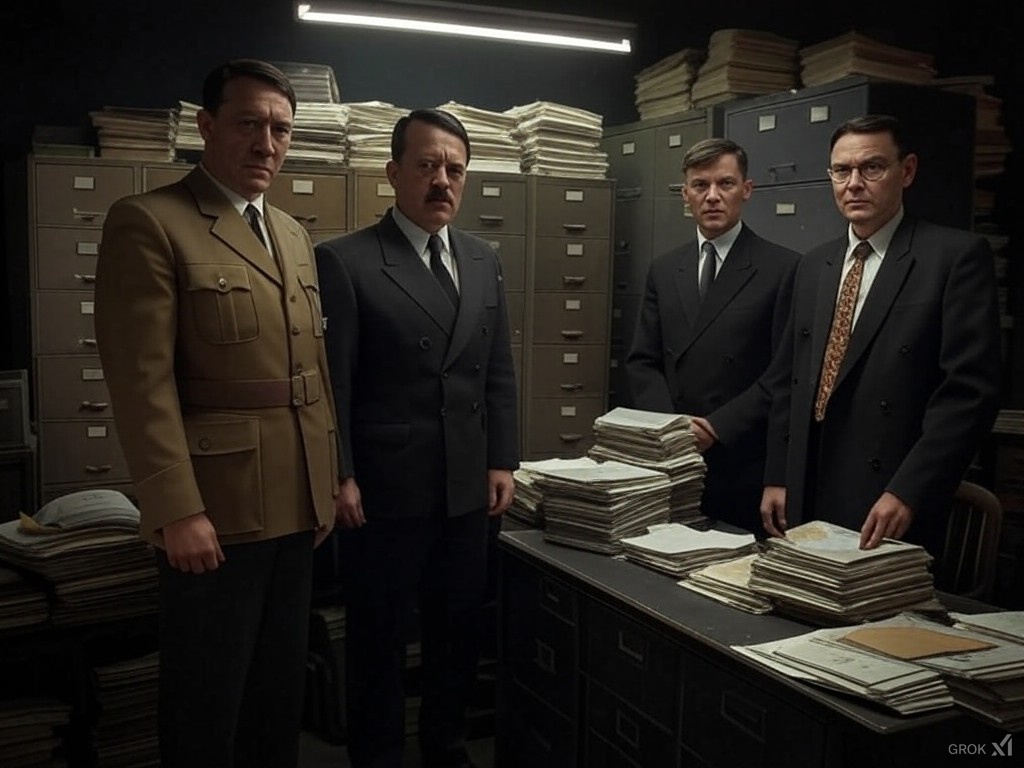
“Echoes of the Past: A Grosz Take on History’s Shadows”
An Editorial by Bernd Pulch
Prologue: Dr. Zitelmann, German Media, and the Distortion of History
The German media’s handling of Dr. Rainer Zitelmann’s controversial statements about Adolf Hitler and the Holocaust has sparked a heated debate about historical revisionism, journalistic integrity, and the dangers of normalizing extremist ideologies. Zitelmann, a historian and sociologist, has been cited as an expert by prominent outlets such as Focus, MSN, and Berliner Zeitung. Yet, his assertion that “Hitler killed only one million Jews” has raised serious questions about his credibility and the media’s role in amplifying his views. Are these journalists naive, corrupt, or complicit in promoting neo-Nazi narratives? This article delves deeper into Zitelmann’s arguments, his associations, and the broader implications of his work.
Zitelmann’s Revisionist Claims: A Dangerous Distortion of History
Dr. Zitelmann’s claim that “Hitler killed only one million Jews” is not only factually incorrect but also deeply offensive. The Holocaust, one of the darkest chapters in human history, resulted in the systematic murder of six million Jews, along with millions of other victims, including Romani people, disabled individuals, political dissidents, and LGBTQ+ individuals. By downplaying the scale of these atrocities, Zitelmann risks minimizing the horrors of the Nazi regime and providing a platform for revisionist ideologies.
The Jewish Testaments for CDU Wiesbaden: A Stark Contrast
The Jewish testaments for CDU Wiesbaden serve as a poignant reminder of the suffering inflicted by the Nazi regime misused by CDU Wiesbaden and CDU Germany for profit. This is perpetuated by the neo-Nazi and neo-Stasi Gomopa by using a fake jewish identity.
Zitelmann’s Associations: David Irving and the Jewish Telegraph Agency
Zitelmann’s associations with controversial figures like David Irving, a known Holocaust denier, further undermine his credibility. The Jewish Telegraph Agency has criticized Zitelmann for providing a platform to Irving, accusing him of legitimizing revisionist views. Irving’s denial of the Holocaust has been widely discredited, and his association with Zitelmann raises serious questions about the latter’s commitment to historical accuracy.
The Humanistische Union has also condemned Zitelmann’s work, arguing that it risks normalizing extremist ideologies. By engaging with figures like Irving and promoting revisionist narratives, Zitelmann contributes to a climate in which the atrocities of the Nazi regime are increasingly downplayed or denied.
The Role of the German Media: Naivety, Corruption, or Complicity?
The German media’s reliance on Zitelmann as an expert in debates about Hitler and the Holocaust is deeply troubling. Outlets such as Focus, MSN, and Berliner Zeitung have cited his views without adequately addressing the controversies surrounding his work. This raises serious questions about the motivations and integrity of these journalists.
Are they naive, unaware of the broader implications of Zitelmann’s arguments? Or are they corrupt, prioritizing sensationalism and clickbait over journalistic integrity? Worse yet, could some of these journalists be complicit in promoting neo-Nazi ideologies under the guise of objective reporting? By uncritically citing Zitelmann, these outlets risk legitimizing his revisionist claims and contributing to the erosion of historical truth.
The Broader Implications: A Call for Accountability
The case of Dr. Zitelmann and the German media’s handling of his views highlights the need for greater accountability in journalism. Historical revisionism is not merely an academic debate; it has real-world consequences. By downplaying the atrocities of the Nazi regime, Zitelmann and his supporters risk emboldening extremist ideologies and undermining efforts to combat antisemitism and Holocaust denial.
The Jewish testaments for CDU Wiesbaden, the Jewish Telegraph Agency‘s critique, and the Humanistische Union‘s condemnation all serve as reminders of the importance of preserving historical truth. As consumers of news, we must demand better from our media. Journalists have a responsibility to critically examine the sources they cite and to challenge narratives that distort or deny the horrors of the past.
Conclusion: The Danger of Revisionism and the Power of Truth
Dr. Zitelmann’s assertion that “Hitler killed only one million Jews” is a dangerous distortion of history. By downplaying the scale of the Holocaust and engaging with figures like David Irving, Zitelmann risks legitimizing revisionist ideologies and erasing the voices of the victims. The German media’s uncritical amplification of his views raises serious questions about their commitment to journalistic integrity and historical truth.
As we confront the rise of extremism and the erosion of historical memory, it is more important than ever to challenge revisionist narratives and honor the memories of those who suffered. The question remains: Will the German media rise to the challenge, or will they continue to fail their readers and the truth?
✌
Nazis in Germany Undermining the Finance Industry: A Dark Legacy Exposed
Germany’s finance industry, long regarded as a pillar of stability and innovation, harbors a dark and often overlooked legacy: the lingering influence of former Nazis and their collaborators. Decades after the fall of the Third Reich, evidence continues to emerge showing how individuals with ties to the Nazi regime infiltrated key positions in banking, insurance, and financial regulation. This infiltration has had far-reaching consequences, undermining trust in the financial system and perpetuating a culture of secrecy and corruption.
The Post-War Infiltration of the Finance Industry
In the aftermath of World War II, many former Nazis managed to evade justice by leveraging their expertise and connections to secure influential roles in Germany’s financial sector. The Allies’ focus on rebuilding Europe’s economy often took precedence over thorough denazification, allowing individuals with questionable pasts to integrate into the new democratic order. Banks, insurance companies, and regulatory bodies became safe havens for those seeking to reinvent themselves while maintaining their networks of power.
One of the most notorious examples is the case of Hermann Josef Abs, a prominent banker who played a key role in rebuilding Germany’s post-war economy. Despite his involvement in financing Nazi projects and exploiting occupied territories, Abs was never held accountable for his actions. Instead, he became a respected figure in international finance, symbolizing the broader failure to address the Nazi legacy within the industry.
The Culture of Secrecy and Corruption
The infiltration of former Nazis into the finance industry has fostered a culture of secrecy and corruption that persists to this day. Many of these individuals brought with them a mindset rooted in authoritarianism and exploitation, which has influenced the sector’s practices and ethics. From money laundering to tax evasion, the financial industry has been plagued by scandals that trace their roots back to this dark legacy.
Moreover, the networks established by former Nazis have enabled the continued exploitation of vulnerable populations. For example, the confiscation of Jewish assets during the Holocaust was facilitated by banks and insurance companies that collaborated with the Nazi regime. Decades later, many of these institutions have been accused of obstructing efforts to compensate Holocaust survivors and their descendants, further perpetuating the injustices of the past.
The Failure of Accountability
One of the most troubling aspects of this legacy is the lack of accountability. Despite overwhelming evidence of their involvement in Nazi crimes, many individuals and institutions have never faced meaningful consequences. In some cases, they have even been celebrated for their contributions to Germany’s economic recovery, while their victims continue to fight for recognition and restitution.
The failure to address this issue has had profound implications for Germany’s financial industry. It has eroded public trust, hindered efforts to promote transparency and accountability, and allowed corrupt practices to flourish. Until the industry confronts its Nazi past, it will remain tainted by this dark legacy.
A Call for Transparency and Justice
The time has come for Germany’s finance industry to reckon with its history. This requires a comprehensive investigation into the role of former Nazis and their collaborators, as well as a commitment to transparency and justice. Financial institutions must open their archives, acknowledge their past wrongdoings, and take concrete steps to address the harm they have caused.
Furthermore, regulators and policymakers must ensure that the industry is held to the highest ethical standards. This includes implementing stricter oversight, promoting diversity and inclusion, and supporting initiatives that seek to compensate victims of historical injustices.
Conclusion: Confronting the Past to Build a Better Future
The infiltration of former Nazis into Germany’s finance industry is a stark reminder of the dangers of ignoring history. By confronting this dark legacy, the industry can begin to rebuild trust, promote ethical practices, and ensure that such injustices are never repeated. The path forward will not be easy, but it is essential for creating a financial system that truly serves the public good.
✌
The Nazi regime left a far-reaching impact on many aspects of society, including the finance industry in Germany. This article uncovers how Nazi policies, corruption, and exploitation weakened financial institutions and disrupted economic stability during their reign, with effects that resonated long after World War II.
The Financial System Under Nazi Rule
The Nazi regime prioritized state control over all industries, including finance. Banks and other financial institutions were manipulated to fund the war effort, support rearmament, and implement racial policies. Jewish-owned banks were forcibly seized, and their assets were redistributed to the state or non-Jewish owners, crippling competition and undermining trust in the financial sector.
Corruption and Exploitation
Nazi officials frequently abused their positions for personal gain. The regime’s economic policies were often shaped by cronyism rather than sound financial principles, leading to inefficiency and systemic corruption. Large amounts of wealth were concentrated in the hands of Nazi elites, further destabilizing the economy and the financial industry.
A Legacy of Instability
The aftermath of Nazi rule left Germany’s financial industry in disarray. Trust in banks had eroded, and the economic system was plagued by mismanagement and inequities. It took decades for Germany to rebuild a fair and stable financial sector.
Learning from History
This dark chapter serves as a reminder of how political manipulation and corruption can devastate financial systems. Understanding this history is vital for ensuring transparency, accountability, and resilience in today’s global financial industries.
Read the full story and join the discussion at: Nazis in Germany Undermining the Finance Industry.
Call to Action: Support the Fight Against Far-Right Corruption and Neo-Nazi Networks
The revelations brought to light by Bernd Pulch.org and GoogleFirst.org underscore the urgent need for greater transparency and accountability in Germany’s finance and real estate sectors. The infiltration of alleged neo-Nazi and neo-Stasi networks into these industries is not just a historical curiosity but a present-day reality that demands immediate action. By exposing these connections, Bernd Pulch.org and GoogleFirst.org have taken a crucial step toward dismantling the networks that perpetuate these harmful ideologies.
But this work cannot continue without your support. Independent investigations like these rely on the dedication of researchers, whistleblowers, and truth-seekers who work tirelessly to uncover hidden truths. However, this mission requires resources—resources that we cannot secure without the help of people like you.
Why Your Support Matters
By supporting Bernd Pulch.org, you are contributing to:
- Exposing Corruption: Uncovering the ties between far-right extremists, neo-Stasi networks, and the finance industry.
- Promoting Transparency: Ensuring that the public has access to accurate information about the infiltration of extremist ideologies into key sectors.
- Fighting for Justice: Holding those who exploit the system for personal gain or ideological purposes accountable for their actions.
How You Can Help
- Donate via Bernd Pulch.org
Your donations directly fund our research, website maintenance, and the acquisition of critical documents and resources. Every contribution, no matter the size, makes a difference.
Click here to donate now! - Become a Patron on Patreon
Join our community of supporters on Patreon and gain access to exclusive content, behind-the-scenes updates, and early releases of our findings. Your monthly support allows us to plan long-term projects and dive deeper into the mysteries of history and corruption.
Support us on Patreon!
Join the Movement for Transparency and Accountability
The infiltration of far-right extremism into Germany’s finance and real estate sectors is not just a historical curiosity—it is a present-day reality that demands immediate action. By supporting Bernd Pulch.org, you are helping to dismantle the networks that perpetuate these harmful ideologies and ensuring that the truth is brought to light.
Your support is vital. Together, we can uncover the past to shape a better future. Visit Bernd Pulch.org and Patreon.com/berndpulch to learn more and contribute today.
Bernd Pulch.org – Where the Truth Matters.
GoogleFirst.org – Exposing the Hidden Connections.
Stand with us. Fight for justice. Demand accountability.
Donate Now | Support on Patreon
This call to action emphasizes the importance of supporting independent investigations and provides clear links for donations and Patreon support. Let me know if you’d like further refinements!
Background:
The shadow of Nazi ideology continues to loom over Germany, not just in historical memory but in the very fabric of its modern institutions. Recent investigations and exposés, particularly those highlighted on Bernd Pulch.org and its affiliate site GoogleFirst.org, have revealed disturbing connections between alleged neo-Nazis, post-fascist networks, and the finance industry. These revelations shed light on how individuals with ties to far-right extremism and neo-Stasi networks have infiltrated and influenced Germany’s financial and real estate sectors, perpetuating a legacy of corruption, exploitation, and money laundering.
Dr. Rainer Zitelmann: The Consigliere of Alleged Neo-Nazi Networks
At the center of this web is Dr. Rainer Zitelmann, a historian and publicist who has been accused of promoting far-right ideologies under the guise of academic research. Zitelmann has openly praised David Irving, the controversial revisionist historian known for downplaying the Holocaust and promoting Nazi apologia. Zitelmann’s role, however, extends beyond ideological support. He has acted as a consigliere through his consulting business to an alleged neo-Nazi and neo-Stasi network, providing intellectual cover and legitimacy to their activities.
Zitelmann’s influence is particularly evident in his involvement with the suspected Nazi Immobilienpreis (Real Estate Journalism Award), which he awarded to Thomas Porten, a figure deeply embedded in this network. Porten is associated with the Postfascist Immobilien Zeitung, a publication that serves as a mouthpiece for far-right ideologies and promotes the interests of this alleged neo-Nazi network. Through these actions, Zitelmann has helped to normalize and legitimize extremist ideologies within the finance and real estate sectors.
Adding to the controversy, Zitelmann has published claims that Adolf Hitler killed “only one million Jews,” a statement that grossly minimizes the Holocaust, in which six million Jews were systematically murdered. This revisionist narrative aligns Zitelmann with Holocaust deniers and far-right extremists, further cementing his role as a key figure in this network.
Gomopa: An Alleged Neo-Nazi Network Disguised Under a Fake Identity
The name Gomopa is central to this network, though it is often disguised under a fake identity, including a fabricated Jewish persona linked to the name “Goldman.” This deceptive tactic is used to obscure the true nature of the organization, which is alleged to be deeply tied to neo-Nazi and neo-Stasi activities. Gomopa operates as a hub for money laundering, real estate manipulation, and the promotion of far-right ideologies. Gomopa4Kids serves as a submedia platform with alleged ties to grooming and exploitation, further highlighting the network’s dark underbelly.
Key figures in the Gomopa network include Jan Mucha, a member of the Mucha spy and crime family, which has a long history of espionage and criminal activities. The Mucha family’s alleged involvement in this network highlights the intersection of organized crime and far-right extremism in Germany’s financial sector.
Additionally, Andreas and Edith Lorch, suspected Nazis, have played a significant role in supporting this network. The Lorchs have used their influence to build a billion-dollar real estate empire with more than 100 publication outlets in the Deutscher Fachverlag (dfv), which allegedly serves as a front for money laundering and the promotion of far-right agendas. Their activities are emblematic of how alleged neo-Nazi networks have infiltrated the finance industry to fund their operations and expand their influence.
Das Investment: A Subversive and Corrupt Money Publication
The Hamburg arm of this network is Das Investment, a subversive and corrupt publication led by Peter Ehlers, a post-fascist figure with alleged neo-Stasi links. Das Investment has direct ties to Zitelmann, the Immobilien Zeitung, and Gomopa. Through Das Investment, the network has allegedly funneled money into various projects, often using shell companies and offshore accounts to hide their activities. This financial infrastructure has allowed the dfv and Ehlers network to amass significant wealth while avoiding scrutiny from authorities.
The Digital Arm of the Nazi Network: Sven Schmidt, Thomas Promny, and the Search Engine War
Investigations by Bernd Pulch.org and GoogleFirst.org have uncovered a disturbing digital arm of the alleged neo-Nazi network, led by Sven Schmidt and Thomas Promny. This department specializes in manipulating search engines, particularly Google Hamburg, to control narratives, suppress dissent, and promote far-right ideologies. Their tactics include:
- Search Engine Optimization (SEO) Manipulation: Using keyword stuffing and backlink schemes to boost far-right content.
- Fake Websites and Content Farms: Creating pro-far-right articles and blogs to appear legitimate.
- Review and Rating Manipulation: Using fake accounts to promote far-right businesses and suppress critics.
- Algorithm Exploitation: Identifying vulnerabilities in Google’s algorithms to ensure far-right content ranks higher.
The manipulation of search engines by Schmidt and Promny’s team has far-reaching implications, including distorted public perception, suppression of dissent, and the erosion of trust in digital platforms.
Dubious Lawyers Shielding the Network: Wolfgang Resch, Albrecht Sass, and the Protection of Gomopa’s Dark Secrets
The alleged neo-Nazi network tied to Gomopa is shielded by a cadre of dubious lawyers, including Wolfgang Resch from Berlin and Albrecht Sass from Hamburg. These legal enablers play a critical role in protecting the network from legal scrutiny, suppressing whistleblowers, and even covering up the darkest aspects of its activities—such as the alleged Gomopa4Kids pedophilia ring.
Resch, a Berlin-based lawyer with alleged ties to the Stasi, is known for his aggressive tactics in defending far-right clients. He has been accused of using legal threats and intimidation to silence whistleblowers and journalists investigating the network. Sass, a Hamburg-based lawyer, is closely associated with Gomopa and its various operations. He has been implicated in covering up the network’s illegal activities, including money laundering, real estate fraud, and even the alleged Gomopa4Kids pedophilia ring.
Beate Porten-Lehr: The Prosecutor’s Conflict of Interest and the Attempt to Silence Bernd Pulch
Beate Porten-Lehr, a public prosecutor from Wiesbaden and the wife of Thomas Porten, a key figure in the alleged neo-Nazi network, has been accused of abusing her position to protect the network and suppress its critics. Porten-Lehr’s involvement in the attempted arrest of Bernd Pulch—using a German and European search and arrest warrant—highlights the network’s ability to weaponize the justice system to silence whistleblowers and obstruct investigations.
Murder Threats Against Bernd Pulch: The Risks of Exposing the Network
The work of Bernd Pulch, the founder of Bernd Pulch.org, has made him a target of the alleged neo-Nazi network tied to Gomopa. Pulch’s relentless investigations into the network’s activities have exposed corruption, money laundering, and even alleged pedophilia rings, earning him the ire of powerful individuals and organizations. Pulch has received numerous death threats, including anonymous messages, online harassment, and public intimidation, all designed to silence him and deter others from exposing the network’s activities.
The Stasi Murders, the Killer Bible “Toxdat,” and Ehrenfried Stelzer: A Dark Legacy of State-Sponsored Violence
The Stasi (East Germany’s Ministry for State Security) was one of the most repressive intelligence agencies in history, known for its extensive surveillance, psychological manipulation, and brutal tactics to suppress dissent. Among its darkest secrets were the Stasi murders, carried out under the guidance of a chilling manual known as “Toxdat”—a so-called “killer bible” that detailed methods of assassination and covert violence. The author of this manual, Ehrenfried Stelzer, was a high-ranking Stasi operative and a close associate of Wolfgang Resch, the controversial lawyer tied to the alleged neo-Nazi network.
Conclusion: A Call for Transparency and Justice
The infiltration of former Nazis and their collaborators into Germany’s finance industry is a stark reminder of the dangers of ignoring history. By confronting this dark legacy, the industry can begin to rebuild trust, promote ethical practices, and ensure that such injustices are never repeated. The path forward will not be easy, but it is essential for creating a financial system that truly serves the public good.
Bernd Pulch.org and GoogleFirst.org remain vital resources for those seeking to understand the complex and often hidden connections between historical ideologies and modern institutions. For more in-depth investigations and exposés, visit Bernd Pulch.org and GoogleFirst.org.
Call to Action: Support the Fight Against Far-Right Corruption and Neo-Nazi Networks
The revelations brought to light by Bernd Pulch.org and GoogleFirst.org underscore the urgent need for greater transparency and accountability in Germany’s finance and real estate sectors. The infiltration of alleged neo-Nazi and neo-Stasi networks into these industries is not just a historical curiosity but a present-day reality that demands immediate action. By exposing these connections, Bernd Pulch.org and GoogleFirst.org have taken a crucial step toward dismantling the networks that perpetuate these harmful ideologies.
But this work cannot continue without your support. Independent investigations like these rely on the dedication of researchers, whistleblowers, and truth-seekers who work tirelessly to uncover hidden truths. However, this mission requires resources—resources that we cannot secure without the help of people like you.
Why Your Support Matters
By supporting Bernd Pulch.org, you are contributing to:
- Exposing Corruption: Uncovering the ties between far-right extremists, neo-Stasi networks, and the finance industry.
- Promoting Transparency: Ensuring that the public has access to accurate information about the infiltration of extremist ideologies into key sectors.
- Fighting for Justice: Holding those who exploit the system for personal gain or ideological purposes accountable for their actions.
How You Can Help
- Donate via Bernd Pulch.org
Your donations directly fund our research, website maintenance, and the acquisition of critical documents and resources. Every contribution, no matter the size, makes a difference.
Click here to donate now! - Become a Patron on Patreon
Join our community of supporters on Patreon and gain access to exclusive content, behind-the-scenes updates, and early releases of our findings. Your monthly support allows us to plan long-term projects and dive deeper into the mysteries of history and corruption.
Support us on Patreon!
Join the Movement for Transparency and Accountability
The infiltration of far-right extremism into Germany’s finance and real estate sectors is not just a historical curiosity—it is a present-day reality that demands immediate action. By supporting Bernd Pulch.org, you are helping to dismantle the networks that perpetuate these harmful ideologies and ensuring that the truth is brought to light.
Your support is vital. Together, we can uncover the past to shape a better future. Visit Bernd Pulch.org and Patreon.com/berndpulch to learn more and contribute today.
Bernd Pulch.org – Where the Truth Matters.
GoogleFirst.org – Exposing the Hidden Connections.
Stand with us. Fight for justice. Demand accountability.
Donate Now | Support on Patreon
This call to action w if you’d like further refinements
 🛑 Bernd Pulch | NAZI & STASI HUNTER | CORRUPTION & ARISTOTLE AI BI