

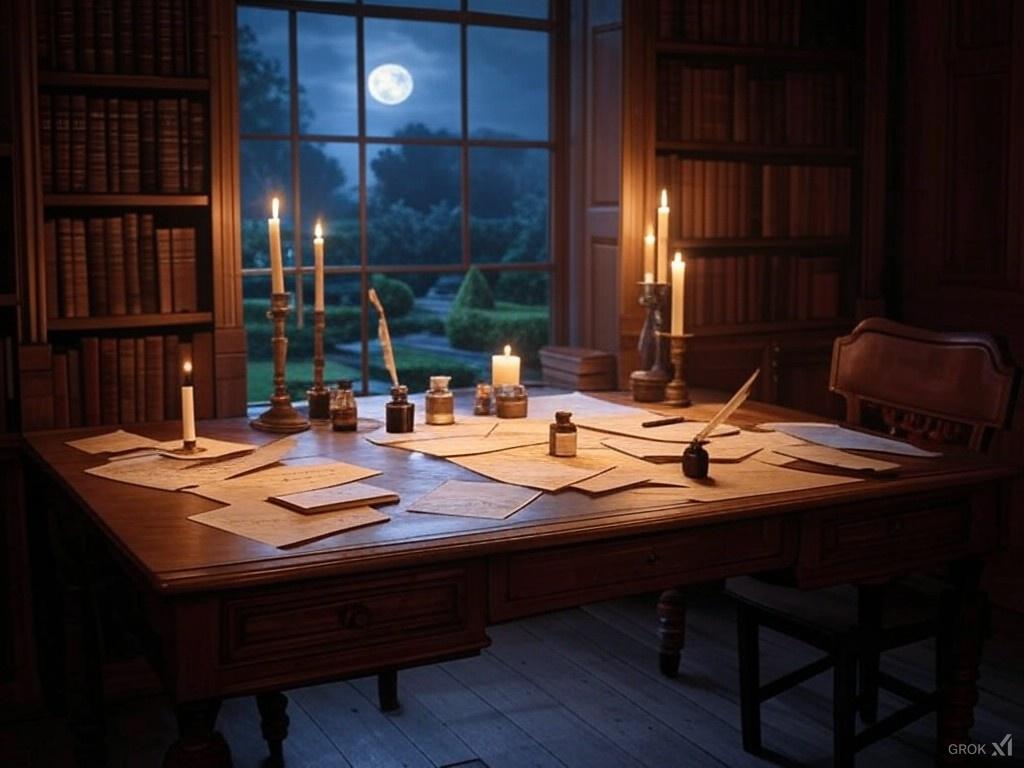
“Where Wisdom Meets the Whisper of Ink: A Sanctuary for the Soul’s Musings”
In all the annals of time, there exists no greater marvel than the human tongue, that nimble and artful architect of meaning. Words, though fragile in their substance, possess a might that no sword, no tempest, no force of nature may rival. They hold sway over kingdoms, bind hearts in love’s tender clasp, and rend them asunder with equal ease. Words build bridges across gulfs of misunderstanding and raze them in moments of wrath. Indeed, ’tis words that shape our world.
In this brief discourse, I shall expound upon the enduring power of words, their dual nature as creators and destroyers, and their sacred role as the eternal repository of human memory and aspiration.
The Creative Force of Words
What is a poet but a humble craftsman who takes the raw ore of language and refines it into golden verse? The world, dear reader, is fashioned first in thought, then in utterance. “Let there be light,” spake the divine, and lo, the cosmos unfolded. Even so, do we mortals, in our limited sphere, wield words to summon visions into being.
When lovers whisper soft sonnets beneath the moon’s silver gaze, they create a universe of shared dreams. When leaders stand before their people, with voices alight with conviction, they forge nations out of chaos. Words, you see, are the alchemy of humanity—they transform the mundane into the magnificent.
The Double-Edged Sword
Yet, let us not delude ourselves into thinking that words are unerringly virtuous. Like the tempest, they may nurture the soil with rain or ravage the land with flood. Recall how whispers of deceit have toppled empires, how venomous lies have poisoned the wells of trust.
Think on the treacherous tongues that stirred rebellion in Julius Caesar—words that, though fair on the surface, dripped with ambition’s corrosive bile. Even love’s discourse, so often lauded, can falter; recall poor Othello, undone by the poisonous eloquence of Iago.
Words demand responsibility. They are not mere playthings but instruments of immense potency, capable of wounding as deeply as they heal.
The Eternal Record
Lastly, consider this: when men and women pass from this world, their deeds may crumble into dust, their faces fade into shadow, but their words endure. Words are the immortal vessel of human legacy.
Through the miracle of ink and parchment, the thoughts of ages long past commune with us still. Homer sings of Achilles’ wrath; Cicero speaks of the republic’s virtue; and through these humble lines, I, Shakespeare, whisper to you from the quiet corners of eternity.
What are we, if not the sum of all we have spoken, written, and dreamed? The words we leave behind are our truest testament, our unyielding beacon in the unending night of time.
A Closing Reflection
Let us, then, be mindful of the words we utter. Let us strive to speak with wisdom, to write with purpose, and to listen with the reverence due to the sacred syllables of others.
For though our mortal frames are fleeting, our words shall soar eternal, bearing aloft the banner of our hopes, fears, and triumphs. As long as language graces the lips of humankind, the power of words shall remain its greatest treasure.
Thus I leave you, gentle reader, with this charge: guard well the words you wield, for they are both the keys to heaven and the gates of despair.
About the Author: William Shakespeare
William Shakespeare (1564–1616), often referred to as the “Bard of Avon,” is one of the most celebrated writers in the English language and a central figure in the Western literary canon. Born in Stratford-upon-Avon, England, Shakespeare’s works have transcended time, captivating audiences for over four centuries with their depth, beauty, and timeless exploration of human nature.
His Life and Career
Shakespeare’s early life remains shrouded in mystery, with limited documentation beyond his baptism on April 26, 1564, and his marriage to Anne Hathaway in 1582. By the late 1580s or early 1590s, he had moved to London, where he established himself as an actor, playwright, and poet.
Between 1590 and 1613, Shakespeare wrote 39 plays, 154 sonnets, and several narrative poems. His plays are often divided into comedies, tragedies, and histories, with some works defying easy categorization, such as The Tempest and Measure for Measure.
In addition to his theatrical achievements, Shakespeare became a shareholder in the Globe Theatre, one of London’s premier playhouses. His financial success allowed him to retire to Stratford in his later years, where he died on April 23, 1616.
Themes and Legacy
Shakespeare’s works delve into universal themes such as love, power, ambition, betrayal, and the complexity of the human condition. From the tragic flaws of Macbeth and Hamlet to the comedic misadventures of A Midsummer Night’s Dream, his characters remain some of the most vivid and relatable in all of literature.
Shakespeare’s influence extends beyond the stage. His inventiveness with language has enriched English, coining phrases like “break the ice,” “wild-goose chase,” and “all that glitters is not gold.” His insights into the human psyche have also shaped the fields of psychology, philosophy, and the performing arts.
Timeless Relevance
What makes Shakespeare unique is his ability to resonate with audiences across centuries and cultures. His works are studied in schools, adapted into films, and performed worldwide, reflecting his unmatched universality.
The hypothetical piece written above, attributed to Shakespeare, reflects his enduring talent for weaving profound truths into eloquent prose. It carries the hallmarks of his wisdom: a deep understanding of human nature and a reverence for the transformative power of words.
If Shakespeare’s legacy teaches us anything, it is that art, language, and storytelling are eternal bridges connecting the past, present, and future. As long as there are readers and listeners, Shakespeare’s voice will continue to echo through the ages.
Support the Legacy of Timeless Art and Truth
At BerndPulch.org, we are dedicated to uncovering and sharing knowledge, history, and timeless works that inspire, educate, and challenge the way we think about the world. Your support helps us continue this important mission.
Join us today!
- Become a Patron: Visit Patreon.com/BerndPulch to access exclusive content, curated insights, and behind-the-scenes updates.
- Make a Donation: Support our efforts directly at BerndPulch.org/Donation. Every contribution, big or small, fuels our ability to deliver high-quality content.
Together, we can preserve the legacy of truth and artistry for generations to come. Stand with us and make a difference today!
❌©BERNDPULCH.ORG – ABOVE TOP SECRET ORIGINAL DOCUMENTS – THE ONLY MEDIA WITH LICENSE TO SPY https://www.berndpulch.org
https://googlefirst.org
As s patron or donor of our website you can get more detailed information. Act now before its too late…
MY BIO:
FAQ:
@Copyright Bernd Pulch
CRYPTO WALLET for
Bitcoin:
0xdaa3b887f885fd7725d4d35d428bd3b402d616bb
ShapeShift Wallet, KeepKey, Metamask, Portis, XDefi Wallet, TallyHo, Keplr and Wallet connect
0x271588b52701Ae34dA9D4B31716Df2669237AC7f
Crypto Wallet for Binance Smart Chain-, Ethereum-, Polygon-Networks
bmp
0xd3cce3e8e214f1979423032e5a8c57ed137c518b
Monero
41yKiG6eGbQiDxFRTKNepSiqaGaUV5VQWePHL5KYuzrxBWswyc5dtxZ43sk1SFWxDB4XrsDwVQBd3ZPNJRNdUCou3j22Coh
GOD BLESS YOU
Tags for the Article:
#WilliamShakespeare #ShakespeareanDrama #RenaissanceLiterature #TimelessClassics #LiteraryAnalysis #ArtAndCulture #HumanCondition #BerndPulchOrg #EducationalContent #PatreonSupport #HistoricalInsights #ShakespeareanThemes #EnglishLiterature #CulturalLegacy #PhilosophicalReflections #SupportCreativity #KnowledgePreservation #ExclusiveArticles
Tags:
#BerndPulch #PatreonSupport #DonationCall #ArtAndKnowledge #SupportTruth #ExclusiveContent #KnowledgePreservation #HistoricalInsights #TimelessArt #Philanthropy #ContentCreation #SupportCreators #TruthMatters #CulturalLegacy #EducationalContent
 🛑 Bernd Pulch | NAZI & STASI HUNTER | CORRUPTION & ARISTOTLE AI BI