

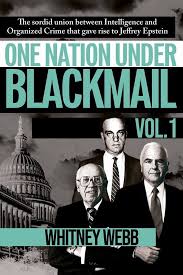
Whitney Webb, an investigative journalist renowned for her deep dives into power structures and hidden global networks, has established herself as a critical voice in modern journalism. Her book, One Nation Under Blackmail, is a comprehensive exposé of the mechanisms by which political, corporate, and intelligence interests manipulate and control governments, institutions, and individuals.
Through meticulous research, Webb reveals a chilling narrative: a world where blackmail, corruption, and clandestine operations are tools of influence, shaping policies and eroding democracy.
Who Is Whitney Webb?
Whitney Webb gained prominence for her incisive reporting on surveillance, corporate malfeasance, and the intricate connections between political elites and intelligence agencies. She writes with clarity and a relentless pursuit of the truth, often highlighting topics ignored by mainstream media. Her work has been featured on platforms like MintPress News and her own investigative outlet, Unlimited Hangout.
Webb’s journalism often focuses on how shadowy networks leverage power to bypass accountability, with a special emphasis on the intertwining roles of intelligence agencies, private corporations, and high-profile individuals.
Overview of One Nation Under Blackmail
Whitney Webb’s two-volume work One Nation Under Blackmail investigates the intersection of blackmail, organized crime, and intelligence networks, delving into how these systems have co-opted power globally.
Key Themes in the Book
- The Legacy of Jeffrey Epstein
Webb frames Jeffrey Epstein not merely as a lone predator but as a central figure in a larger blackmail operation tied to intelligence networks. She explores Epstein’s connections to powerful figures, from Wall Street moguls to world leaders, suggesting his operations served as a mechanism for control and coercion. - The Role of Intelligence Agencies
The book uncovers how agencies like the CIA, Mossad, and others have historically used blackmail to secure political leverage. Webb traces these tactics back decades, highlighting covert operations involving figures like Roy Cohn, a lawyer with ties to both organized crime and political elites. - Corporate Corruption and Influence
Webb examines the role of major corporations in perpetuating systems of control. Through lobbying, surveillance, and illicit dealings, corporations often work hand-in-hand with intelligence agencies to influence global policies. - Systemic Erosion of Democracy
The overarching theme is the erosion of democratic institutions through covert influence. By controlling key individuals and institutions, hidden networks undermine the sovereignty of nations and the will of the people.
The Blackmail State: A Historical Perspective
Webb’s analysis begins with historical precedents, such as the mafia’s connections to U.S. intelligence during World War II and the Cold War. This relationship evolved into a symbiotic partnership where organized crime provided intelligence, while intelligence agencies protected criminal operations for strategic gain.
The transition from mobsters to moguls is a key theme in Webb’s work. She illustrates how blackmail techniques, perfected in earlier eras, became tools wielded by elites within the political and corporate world.
Case Studies: Blackmail in Action
Jeffrey Epstein’s Web of Influence
Epstein’s operations, as detailed in One Nation Under Blackmail, were not isolated but part of a broader system designed to gather compromising information on influential figures. Webb highlights how his ties to intelligence agencies, including Mossad, allowed him to operate with impunity. His associations with high-ranking officials and corporate executives created a nexus of power and control.
Roy Cohn’s Network
Webb revisits Roy Cohn’s career, detailing his role as a lawyer and fixer for powerful figures. Cohn’s ability to gather compromising material on politicians and use it strategically is presented as a precursor to modern blackmail operations.
Corporate Power Plays
Through multinational corporations, blackmail and coercion take on an economic dimension. Webb cites examples of how global conglomerates use their financial clout to manipulate governments, such as pressuring nations into favorable trade agreements or suppressing regulatory actions.
Implications of One Nation Under Blackmail
Webb’s findings have significant implications for understanding global power structures:
- A New Lens on Political Corruption
Her work challenges the traditional narrative of political corruption, presenting blackmail as a systemic issue rather than an isolated one. - Exposing the Role of Intelligence Agencies
Webb’s research underscores the critical role intelligence agencies play in maintaining these systems of control. Her documentation of their historical and ongoing operations is a call to scrutinize their unchecked power. - Democratic Vulnerability
The book serves as a stark reminder of how vulnerable democracies are to covert manipulation. Institutions meant to serve the public interest can be co-opted by hidden networks.
Whitney Webb’s Call to Action
Webb’s investigative work isn’t just about exposing the problem—it’s a call to action. She emphasizes the importance of transparency, accountability, and independent journalism in countering the pervasive influence of these shadowy systems.
Her reporting has inspired whistleblowers, activists, and citizens to question the official narratives and demand more from their leaders. In an era where information is both a weapon and a shield, Webb’s work is a crucial resource for those seeking to understand and dismantle systems of control.
Conclusion
Whitney Webb’s One Nation Under Blackmail is a landmark work in investigative journalism. By meticulously documenting the networks of power, coercion, and corruption, she provides readers with the tools to see beyond the façade of politics and understand the hidden forces shaping the world.
Her message is clear: the fight for transparency and accountability is more urgent than ever. As Webb continues to expose the dark underbelly of global politics, she shines a light on the path toward a more just and equitable future.
 🛑 Bernd Pulch | NAZI & STASI HUNTER | CORRUPTION & ARISTOTLE AI BI