

Date: October 2018, Istanbul, Turkey
Saudi journalist Jamal Khashoggi enters his country’s consulate and never comes out alive. His brutal murder, linked to Saudi officials, exposes an international conspiracy. This installment follows the geopolitical fallout and the whistleblower’s quest for reform.
The Istanbul Conspiracy: An Espionage Thriller
Chapter 1: The Silent Footsteps
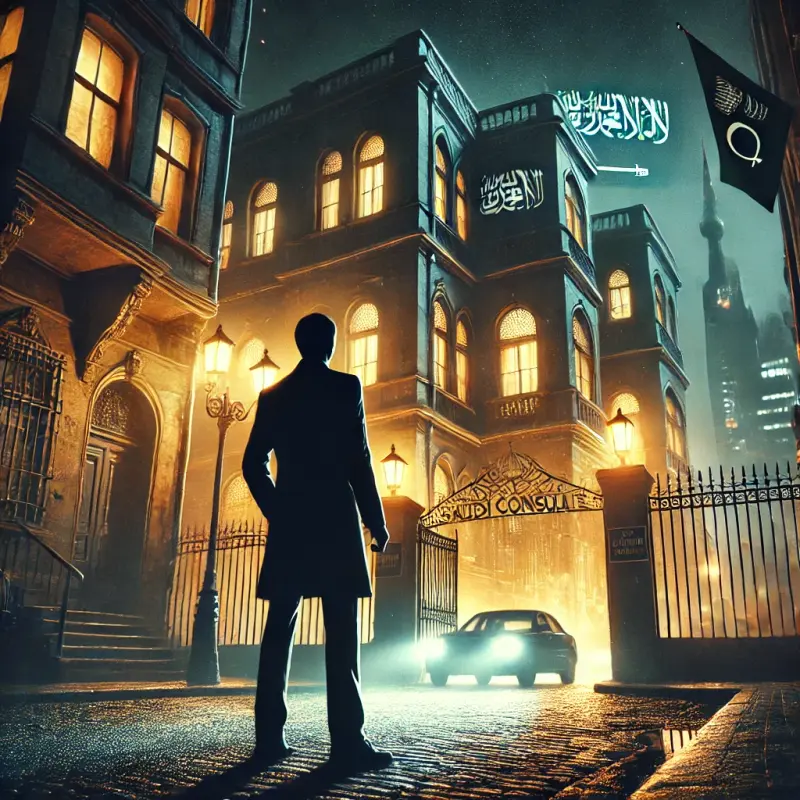
The night was thick with fog, shrouding Istanbul in a blanket of mystery. Under the dim glow of the streetlights, the city’s pulse seemed to slow, as if holding its breath. In the shadows, a lone figure moved, his silhouette barely visible against the backdrop of the ornate consulate building.
Jamal Khashoggi, a journalist with a reputation for exposing the cracks in the facade of power, was about to step into the lion’s den. His assignment, at first, had seemed routine: a quick visit to the Saudi consulate to finalize some personal paperwork. But Jamal had known better. As he neared the entrance, a sense of foreboding settled in his gut. He had been followed for weeks—his every move watched, his every conversation monitored.
The consulate, a fortress of glass and steel, loomed ahead. Behind its walls, whispers of a deadly plan had already begun to stir. Khashoggi pushed forward, the cold night air biting at his skin. Tonight, it would all end.
Chapter 2: The Unseen Hand
Inside the consulate, the atmosphere was suffocating. The air felt thick, charged with tension, as if every breath was being counted down. Unbeknownst to Khashoggi, a team of operatives had already infiltrated the building, waiting in the shadows for the signal. They were no ordinary men—these were the kind of professionals who lived and breathed secrecy. And their mission was clear: silence the journalist by any means necessary.
Jamal entered the consulate, greeted by the hollow clank of the door closing behind him. His heart raced, but his face remained unreadable, a mask perfected over years of evading the ever-watchful eyes of the Saudi regime.
But as he stepped further into the cold marble interior, he wasn’t alone. A sharp click echoed in the back of his mind, a quiet warning. He was being watched. The cameras, the hidden microphones—they were everywhere. His every word, every move was already cataloged in a cold dossier somewhere, awaiting the inevitable conclusion.
Chapter 3: The Double Cross
Outside, in the streets of Istanbul, a different story was unfolding. The shadows were not the only ones keeping an eye on the consulate. A network of international intelligence operatives, including Turkish officials and covert agents from the CIA, had been monitoring Khashoggi’s movements for months. They knew the stakes of this visit. But what they didn’t know was how deep the conspiracy ran.
An encrypted message had been intercepted days before: “Tonight, Khashoggi will enter. Make sure he doesn’t leave.” It was clear—this wasn’t a simple political maneuver, this was a hit. But who had ordered it?
Among the intelligence community, one name reverberated through the encrypted channels—Mohammed bin Salman. His name, whispered in darker corners of the world’s power structures, was now associated with a death that could trigger a global scandal.
Chapter 4: The Ticking Clock
Inside the consulate, the operation was unfolding with deadly precision. Khashoggi, already feeling the weight of unseen eyes upon him, was led deeper into the labyrinth of rooms. As he passed through the halls, the whispers in the air grew louder, their voices a dissonant hum in his mind.
The operative leading him, a cold-faced man whose eyes gave nothing away, stopped at a door, motioning for Khashoggi to enter. But as he stepped inside, Jamal felt a chill rush through him—a sense of finality that no amount of investigation could have prepared him for.
Before he could react, the door slammed shut. He was trapped.
In the next few moments, the world went dark. Khashoggi, ever the professional, had anticipated the worst. But nothing could have prepared him for the brutal violence that awaited him. His body was broken, his life extinguished—his final breaths stolen by the very people who had promised to silence his voice.
Chapter 5: The Whistleblower’s Revelation
Hours passed. The darkness of the consulate’s interior stood still, but the world outside was waking up. News of Khashoggi’s disappearance spread like wildfire across the globe. In the streets of Istanbul, Turkish officials moved quickly to investigate. Within hours, surveillance footage from the consulate surfaced, showing Khashoggi entering but never leaving.
The world was watching, but so were those with the power to stop the story from being told. High-ranking Saudi officials, aware of the growing media storm, scrambled to cover up their tracks. But there were eyes everywhere. A whistleblower—once a close ally of the crown prince—had managed to leak the details of the operation to the Turkish authorities.
The whistleblower, known only by the codename “The Ghost”, had access to a trove of classified intelligence about the Saudi regime’s darkest secrets. Their information painted a chilling picture: Khashoggi’s murder wasn’t an isolated incident. It was part of a larger campaign to silence dissidents and critics of the crown prince.
The Ghost’s revelations sent shockwaves through intelligence communities worldwide, setting the stage for a high-stakes battle of diplomacy, power, and betrayal.
Chapter 6: The Global Conspiracy
Back in the shadows of power, the true story was slowly coming to light. The investigation had led to the highest echelons of power in Saudi Arabia, implicating not just low-level operatives, but the very architect of the plot—Crown Prince Mohammed bin Salman himself.
But the conspiracy ran deeper. Behind closed doors, powerful figures from global intelligence agencies, the military-industrial complex, and international corporations were scrambling to maintain their grip on the narrative. They couldn’t afford for the world to learn the full extent of the truth. Too much was at stake.
In Washington, DC, a group of powerful elites, both in politics and business, knew that Khashoggi’s death would ignite a firestorm. The Saudi regime was critical to the global balance of power—its oil, its military alliances, and its strategic position in the Middle East were too valuable to be jeopardized by a scandal.
Chapter 7: The Final Play
As the international community turned its gaze on Saudi Arabia, one question remained unanswered: Who would be held accountable?
The Turkish authorities, backed by intelligence agencies from around the world, were tightening their grip on the Saudi consulate, but the forces behind Khashoggi’s murder weren’t done yet. A shadow war was being waged, with each side maneuvering behind the scenes to control the outcome of the investigation.
But in the midst of it all, the Ghost’s revelations set in motion a chain of events that could not be stopped. The truth was out, and there was no turning back. The global diplomatic landscape had shifted, and the repercussions would be felt for years to come.
Khashoggi’s death had become a symbol, not just of the dangers of speaking truth to power, but of the dark, unseen forces that lurked behind every political decision, every assassination, and every global deal. In the world of espionage, loyalty was a commodity, and the truth was always the first casualty.
As the final pieces of the puzzle began to fall into place, a new chapter in the global struggle for power was unfolding. And it was a battle that no one could afford to lose.
End of Chapter 7
The story of Khashoggi’s murder is far from over. The web of deception and betrayal continues to unravel, and the truth remains a powerful weapon in the hands of those brave enough to expose it.
Background:
Episode: The Khashoggi Case – Murder, Conspiracy, and the Quest for Reform
Date: October 2018, Istanbul, Turkey
On the fateful day of October 2, 2018, Jamal Khashoggi, a Saudi journalist and Washington Post columnist, entered the Saudi consulate in Istanbul, Turkey, for what he believed would be a routine paperwork exchange to finalize his divorce. He never emerged. What followed was a horrifying and complex tale of murder, conspiracy, and an international diplomatic crisis that would reverberate around the world.
1. The Mysterious Disappearance: The Early Days of the Investigation
The disappearance of Jamal Khashoggi, who was highly critical of the Saudi regime and its crown prince, Mohammed bin Salman (MBS), immediately set off alarm bells in international diplomatic circles. Turkish officials, concerned by Khashoggi’s vanishing act, launched an investigation into the consulate. Within days, they released chilling details that painted a horrifying picture of what transpired inside the consulate walls.
Surveillance footage showed Khashoggi entering the consulate but never leaving. Later reports and leaks from the Turkish government revealed that Khashoggi had been tortured, murdered, and dismembered by a team of Saudi agents sent to silence him. The brutal execution was carried out in a meticulously orchestrated operation, with Khashoggi’s body being disposed of and efforts made to cover up the crime. This was no ordinary murder; it was a state-sponsored assassination aimed at silencing a prominent critic of the regime.
2. Geopolitical Fallout – International Condemnation and Denial
The murder of Khashoggi sent shockwaves across the globe, sparking outrage from governments, human rights organizations, and the media. The world was horrified not only by the brutality of the murder but also by the apparent involvement of high-ranking Saudi officials.
The United States and Europe were thrust into a diplomatic quandary. Saudi Arabia, a critical ally of both the U.S. and European nations in the Middle East, was now implicated in a murder that threatened to strain international relations. Initially, the Saudi government denied any involvement, offering shifting narratives that were increasingly inconsistent with the evidence being uncovered.
The United States initially hesitated to take direct action, as Saudi Arabia was a long-standing ally in the region, providing oil and serving as a counterbalance to Iran’s growing influence. President Donald Trump’s administration, in particular, was slow to react, offering tepid responses while emphasizing the importance of maintaining strong economic and military ties with the kingdom.
However, pressure mounted from international voices calling for accountability. Reports indicated that the operation had been ordered by Saudi crown prince Mohammed bin Salman (MBS), sparking widespread condemnation from both Western governments and human rights organizations. Key figures in the international community, such as UN Secretary-General António Guterres and European Union leaders, demanded answers.
3. The Quest for Reform: A Whistleblower’s Journey
Amidst the geopolitical fallout, the murder of Khashoggi exposed the deep cracks within Saudi Arabia’s ruling structures. While the immediate attention was on Khashoggi’s murder and the royal family’s involvement, his death would become a catalyst for larger questions about the nature of reform and governance in Saudi Arabia.
Reform-minded individuals within Saudi Arabia began to see the murder as a symbol of the oppressive nature of the regime, driven by the actions of MBS. The young crown prince, who had once presented himself as a reformer, promising to modernize Saudi Arabia and lessen the kingdom’s reliance on oil, was now being widely viewed as a ruthless figure willing to eliminate anyone who stood in his way.
As pressure mounted, Khashoggi’s death became a flashpoint for reform activists both within and outside of Saudi Arabia. Exiles and whistleblowers, many of whom had fled the kingdom due to their opposition to the crown prince’s policies, began calling for greater international action and accountability. They saw Khashoggi’s murder as a chilling symbol of the dangers faced by dissenters in Saudi Arabia—a brutal reminder of the regime’s capacity for silencing critics.
One prominent figure among these reformers was Dr. Saad Aljabri, a former high-ranking Saudi intelligence official who had fled to Canada. Aljabri was in possession of sensitive information about the inner workings of the Saudi royal family and had warned Western governments of potential risks posed by MBS. Aljabri’s outspoken opposition to MBS and his call for reform grew louder in the wake of Khashoggi’s death, as the world’s attention turned toward Saudi Arabia’s governance and its human rights record.
4. International Investigations and Accountability
The Turkish government, led by President Recep Tayyip Erdoğan, played a crucial role in bringing the details of Khashoggi’s murder to light. While the Saudis initially denied involvement, mounting evidence and leaks from Turkish officials painted a damning picture. The release of surveillance footage, audio recordings, and other classified materials helped to expose the full extent of the crime.
The CIA, under director Gina Haspel, was also believed to have gathered significant intelligence suggesting that MBS had ordered the operation. Reports indicated that U.S. intelligence agencies had intercepted communications from top Saudi officials discussing Khashoggi’s fate, further complicating the already strained relationship between the United States and Saudi Arabia.
In the aftermath, global pressure for accountability grew. Many Western countries, including Germany, Canada, and the United States, imposed sanctions on Saudi officials implicated in the murder. However, MBS himself largely remained untouched, with the international community hesitant to take more severe action due to the kingdom’s strategic importance in the region.
5. The Impact on Saudi Arabia’s Reform Agenda
The Khashoggi murder severely undermined the image of Saudi Arabia’s reform agenda, which had been championed by MBS. His ambitious vision, known as Vision 2030, promised a modernized, more diversified Saudi economy that would reduce the kingdom’s dependence on oil. It also promised social reforms such as lifting the ban on women driving and introducing entertainment options. However, Khashoggi’s death highlighted the contradiction between the kingdom’s reformist rhetoric and its authoritarian actions.
The murder also cast a long shadow over MBS’s ability to push forward with any meaningful change within the kingdom. International condemnation, combined with internal opposition, created a difficult environment for any further political reforms. Khashoggi’s death forced many to reconsider the true nature of the kingdom’s modernization efforts and its commitment to human rights and transparency.
6. Conclusion – A Journalist’s Legacy and the Fight for Reform
Jamal Khashoggi’s murder was a turning point in both international diplomacy and the fight for political reform in Saudi Arabia. While it exposed the ruthless actions of the Saudi regime, it also gave rise to a movement of reformers and whistleblowers determined to ensure that Khashoggi’s death was not in vain. As the world continued to grapple with the ramifications of the murder, the questions Khashoggi raised about freedom of speech, press freedom, and human rights remained at the forefront of the global conversation.
His legacy, embodied by the whistleblowers who followed in his footsteps, serves as a poignant reminder of the power of the pen and the high price some pay for speaking truth to power. As the fight for reform continues, Khashoggi’s death remains a tragic and powerful symbol of the ongoing struggle for justice and transparency in the face of corruption and authoritarianism.
Next Episode Teaser: The continued investigation into Khashoggi’s death and the global response to the murder sets the stage for our next installment, where we will explore the rising tension between the U.S. and Saudi Arabia, and how international diplomacy navigates the fallout of the Khashoggi case.
❌©BERNDPULCH.ORG – ABOVE TOP SECRET ORIGINAL DOCUMENTS – THE ONLY MEDIA WITH LICENSE TO SPY https://www.berndpulch.org
https://googlefirst.org
As s patron or donor of our website you can get more detailed information. Act now before its too late…
MY BIO:
FAQ:
@Copyright Bernd Pulch
CRYPTO WALLET for
Bitcoin:
0xdaa3b887f885fd7725d4d35d428bd3b402d616bb
ShapeShift Wallet, KeepKey, Metamask, Portis, XDefi Wallet, TallyHo, Keplr and Wallet connect
0x271588b52701Ae34dA9D4B31716Df2669237AC7f
Crypto Wallet for Binance Smart Chain-, Ethereum-, Polygon-Networks
bmp
0xd3cce3e8e214f1979423032e5a8c57ed137c518b
Monero
41yKiG6eGbQiDxFRTKNepSiqaGaUV5VQWePHL5KYuzrxBWswyc5dtxZ43sk1SFWxDB4XrsDwVQBd3ZPNJRNdUCou3j22Coh
GOD BLESS YOU
Jamal KhashoggiEspionage ThrillerSpy NovelSaudi ConsulatePolitical AssassinationConspiracyDiplomatic CrisisMurder MysteryIntelligence AgenciesGlobal PoliticsSaudi Arabia
 🛑 Bernd Pulch | NAZI & STASI HUNTER | CORRUPTION & ARISTOTLE AI BI