

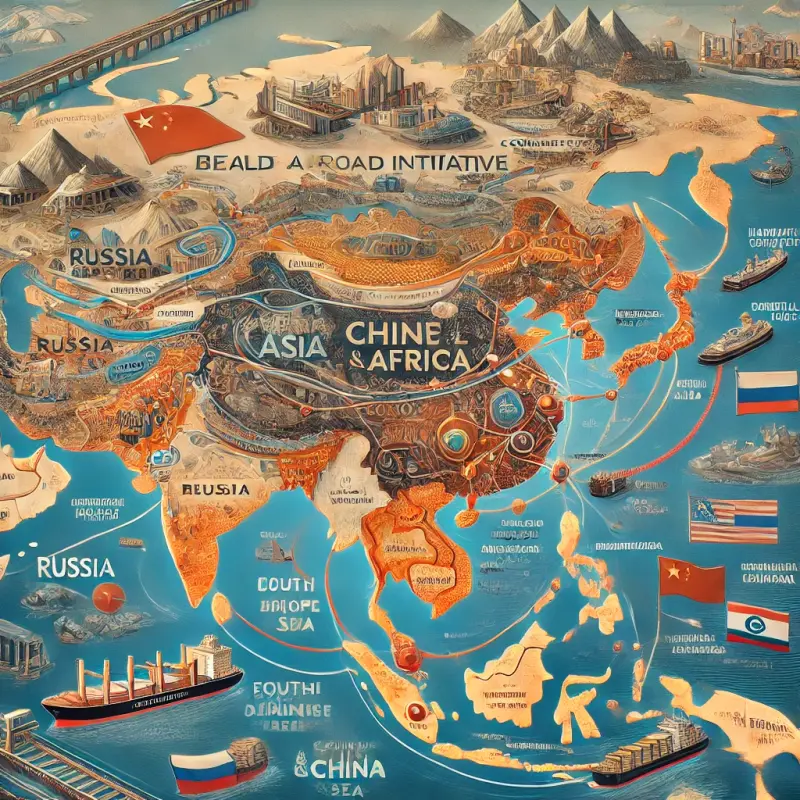
China’s geopolitical strategy is a blend of historical legacy, economic ambition, and modern global aspirations. As the world’s most populous nation and the second-largest economy, China plays a pivotal role in shaping international power dynamics. Below is a detailed exploration of China’s geopolitical perspective, touching on its key principles, regional focus, and global strategy.
1. Core Principles of Chinese Geopolitics
At the heart of China’s geopolitical outlook are the following guiding principles:
- Sovereignty and Territorial Integrity: China places an uncompromising emphasis on its territorial claims, including Taiwan, Tibet, Xinjiang, and the South China Sea. These are seen as core interests tied to national unity and historical justice.
- Economic Development as Security: Economic growth is viewed not just as a domestic goal but as a tool to project power and enhance security, ensuring China’s central role in global affairs.
- Multipolar World Order: Unlike the unipolar system dominated by the United States, China advocates for a multipolar world where no single power dictates global norms.
2. Regional Strategy: Asia as the Primary Sphere
China views Asia as its immediate sphere of influence and prioritizes its strategy within this region:
- Sino-Russian Partnership: China and Russia have developed a strong partnership, driven by shared opposition to Western dominance and complementary interests in energy, trade, and military cooperation.
- South China Sea and Maritime Power: By asserting its claims in the South China Sea, China aims to secure key maritime trade routes and extend its strategic depth. This has led to disputes with neighboring countries like Vietnam and the Philippines.
- India and Border Dynamics: While trade relations between China and India have grown, border disputes in regions like Ladakh highlight strategic competition, particularly as India aligns more closely with the West.
- Central Asia and the Shanghai Cooperation Organization (SCO): Through the SCO, China works to stabilize its western borders, counter terrorism, and expand economic influence, particularly through infrastructure projects under the Belt and Road Initiative (BRI).
3. Global Ambitions: The Belt and Road Initiative (BRI)
Launched in 2013, the BRI is central to China’s global strategy. It seeks to build infrastructure networks connecting Asia, Europe, and Africa, enhancing China’s trade and political influence:
- Economic Diplomacy: Through loans and investments in developing nations, China positions itself as a partner for global development, often challenging Western-led institutions like the IMF and World Bank.
- Strategic Ports and Chokepoints: Projects like the Gwadar Port in Pakistan and Hambantota Port in Sri Lanka allow China to secure critical maritime routes.
- Energy Security: The BRI also addresses China’s dependency on foreign energy by securing pipelines and trade routes that bypass traditional chokepoints like the Strait of Malacca.
4. Relations with Major Global Powers
- United States: The U.S.-China relationship is marked by both cooperation and rivalry. While economic ties remain significant, issues like trade disputes, technological competition (e.g., semiconductors), and military tensions over Taiwan highlight a growing strategic rivalry.
- European Union: China’s relationship with Europe is focused on economic ties, though issues like human rights and technology security have led to friction. China seeks to divide European consensus on critical issues through bilateral engagements.
- Developing Nations: Through forums like the Forum on China-Africa Cooperation (FOCAC) and BRICS, China builds alliances with developing nations, offering alternatives to Western-led models of development.
5. Key Challenges and Limitations
China’s geopolitical strategy faces several challenges:
- Balancing Assertiveness and Diplomacy: While China seeks to project strength, overly aggressive actions (e.g., in the South China Sea) risk alienating neighbors and sparking containment strategies.
- Demographic Shifts: A rapidly aging population could strain economic growth, reducing resources available for global expansion.
- Dependency on Global Trade: China’s export-driven economy remains vulnerable to shifts in global trade dynamics, particularly in the face of decoupling efforts by Western nations.
- Global Perception: Allegations of debt diplomacy, human rights abuses, and authoritarianism challenge China’s efforts to present itself as a benign global leader.
6. The Vision of a Multipolar Future
China’s ultimate goal is a multipolar world where power is distributed among several major nations, reducing Western dominance. This vision aligns with partnerships like:
- BRICS and Global South: Strengthening South-South cooperation and challenging Western hegemony in global finance and governance.
- Russia and Eurasian Integration: Deepening ties with Russia to build a counterbalance to NATO and U.S. influence.
- Technological Leadership: Dominating key technologies like AI, 5G, and renewable energy to shape the next phase of global competition.
Conclusion
China’s geopolitical perspective is deeply rooted in its history, economic ambitions, and aspirations for global leadership. By balancing assertiveness with diplomacy, leveraging economic tools like the BRI, and navigating complex relationships with global powers, China seeks to carve out a central role in a redefined world order. However, the success of this strategy will depend on its ability to address domestic challenges and adapt to an evolving international landscape.
This nuanced strategy underscores China’s determination to shape the 21st century on its terms.
❌©BERNDPULCH.ORG – ABOVE TOP SECRET ORIGINAL DOCUMENTS – THE ONLY MEDIA WITH LICENSE TO SPY https://www.berndpulch.org
https://googlefirst.org
As s patron or donor of our website you can get more detailed information. Act now before its too late…
MY BIO:
FAQ:
@Copyright Bernd Pulch
CRYPTO WALLET for
Bitcoin:
0xdaa3b887f885fd7725d4d35d428bd3b402d616bb
ShapeShift Wallet, KeepKey, Metamask, Portis, XDefi Wallet, TallyHo, Keplr and Wallet connect
0x271588b52701Ae34dA9D4B31716Df2669237AC7f
Crypto Wallet for Binance Smart Chain-, Ethereum-, Polygon-Networks
bmp
0xd3cce3e8e214f1979423032e5a8c57ed137c518b
Monero
41yKiG6eGbQiDxFRTKNepSiqaGaUV5VQWePHL5KYuzrxBWswyc5dtxZ43sk1SFWxDB4XrsDwVQBd3ZPNJRNdUCou3j22Coh
GOD BLESS YOU
China Geopolitical StrategyBelt and Road Initiative (BRI)Sino-Russian RelationsChina Global InfluenceChinese Foreign PolicyAsia-Pacific PoliticsSouth China Sea DisputesChina Trade RoutesGlobal Power Dynamics
 🛑 Bernd Pulch | NAZI & STASI HUNTER | CORRUPTION & ARISTOTLE AI BI