

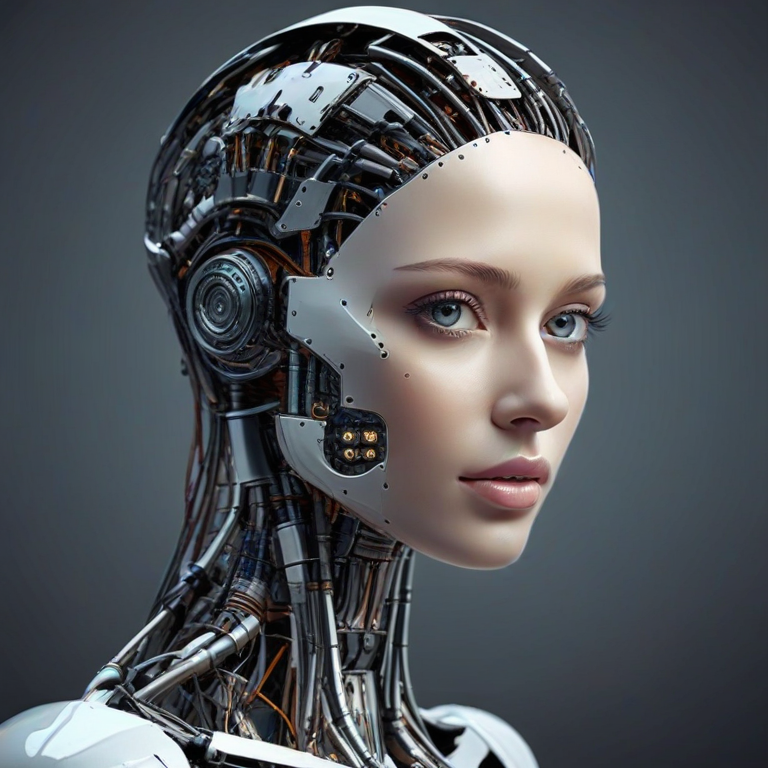
The integration of Artificial Intelligence (AI) into the realms of art and news has sparked both excitement and controversy, revolutionizing traditional industries and redefining human creativity and journalism. This article explores the origins, milestones, and implications of AI’s role in these fields.
The Beginnings of AI in Art
The use of AI in art traces back to the mid-20th century with the advent of computational creativity. Early experiments were spearheaded by computer scientists and artists exploring the intersection of technology and human expression. In the 1960s, A. Michael Noll and Harold Cohen emerged as pioneers. Cohen’s AARON program, for instance, was a significant milestone. It used rule-based algorithms to create abstract drawings, illustrating how machines could generate aesthetically appealing designs.
The real leap in AI-driven art began in the 2010s with the rise of machine learning (ML) and deep learning. Generative Adversarial Networks (GANs), introduced by Ian Goodfellow in 2014, revolutionized AI art. GANs consist of two neural networks – a generator and a discriminator – that work together to create realistic images. Artists and engineers started using GANs to produce highly intricate and thought-provoking artworks.
A landmark moment occurred in 2018 when an AI-generated painting, Portrait of Edmond de Belamy, was auctioned at Christie’s for $432,500. This event signified that AI art had not only gained legitimacy but was also being valued as a form of fine art.
AI Art Today
In 2024, AI tools such as DALL·E, MidJourney, and Stable Diffusion have democratized digital art creation. These platforms allow anyone, regardless of artistic skill, to generate professional-quality art with simple text prompts. AI art has permeated industries including advertising, film, and video games, creating a paradigm shift in how visual content is produced.
Despite its popularity, the rise of AI art has led to heated debates. Critics argue that AI-generated art lacks the soul and intention of human-made works. Moreover, ethical concerns about copyright infringement and the exploitation of datasets containing artists’ works remain unresolved.
The Emergence of AI in News
The journalism industry began exploring AI in the early 21st century, seeking ways to streamline operations and improve accuracy. Early AI applications included automated data analysis and rudimentary newswriting programs designed to generate reports for sports and financial updates.
Key Milestones in AI Journalism
- 2014: Automated Insights’ Wordsmith
The software transformed raw data into coherent news stories, particularly in areas requiring high-volume reporting like sports scores and stock market updates. - The Associated Press (AP)
In 2015, AP began using AI to produce quarterly earnings reports. This automation allowed journalists to focus on more complex stories, signaling the industry’s shift toward AI-assisted reporting. - Real-Time Fact-Checking
AI-powered fact-checking tools such as Full Fact and ClaimBuster became integral to combating misinformation. These tools analyze data in real-time, helping journalists verify claims rapidly.
AI News in 2024
Today, AI plays a crucial role in journalism, from content creation to audience engagement. Platforms like OpenAI’s ChatGPT assist journalists in drafting articles, while tools like NewsGuard use AI to assess the credibility of online news sources. AI algorithms also tailor news delivery, ensuring readers receive personalized content.
AI’s ability to analyze massive datasets has enabled investigative journalists to uncover complex stories, such as tracking global financial fraud or exposing environmental violations. Additionally, AI-generated deepfakes and misinformation present challenges, making it imperative for news organizations to develop robust countermeasures.
Challenges and Ethical Considerations
As AI continues to evolve, ethical concerns dominate discussions around its use in art and news. Key issues include:
- Authenticity and Attribution: Should AI-generated works be credited to the machine, its programmer, or the user?
- Copyright and Data Usage: Many AI systems are trained on copyrighted materials, raising legal and ethical questions.
- Bias and Reliability: AI systems can perpetuate biases present in their training data, affecting the objectivity of journalism.
- Job Displacement: Automation in creative and journalistic fields threatens traditional roles, raising concerns about the future of human professionals.
The Future of AI in Art and News
The convergence of AI, art, and journalism is set to deepen as technologies become more sophisticated. In art, AI could evolve into a co-creator, blending human input with machine-generated creativity. In journalism, AI may enable hyper-personalized storytelling, providing readers with immersive and interactive experiences.
However, the onus remains on developers, policymakers, and society to ensure that AI’s integration respects ethical boundaries and enhances human endeavors rather than replacing them. By striking this balance, AI has the potential to enrich both art and news, creating a future where technology amplifies creativity and truth.
In conclusion, AI’s journey in art and news is a testament to humanity’s ingenuity, a narrative still being written in real time.
 🛑 Bernd Pulch | NAZI & STASI HUNTER | CORRUPTION & ARISTOTLE AI BI