

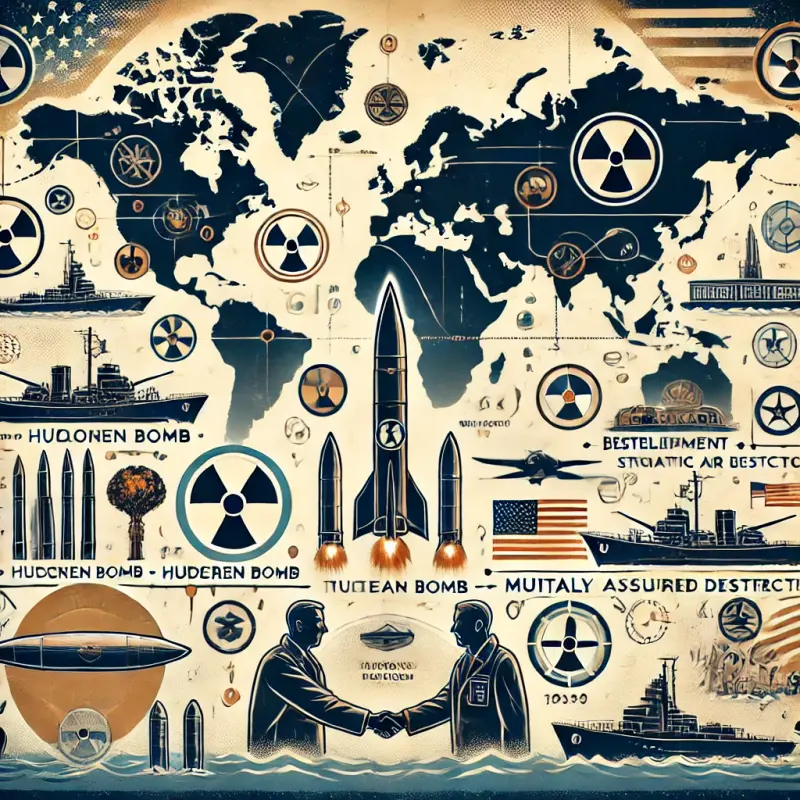
The Cold War era saw the rapid development and transformation of U.S. nuclear strategy, driven by evolving geopolitical tensions, technological advancements, and a need to balance deterrence with preparedness for conflict. This article examines the milestones of this evolution, highlighting key strategies, figures, and the underlying principles of U.S. nuclear policy during this tumultuous period.
Post-WWII: The Birth of Nuclear Strategy
The advent of nuclear weapons at the end of World War II redefined global military strategy. Initially, the U.S. maintained a monopoly on nuclear weapons, focusing on their use as tools of deterrence. The establishment of the Strategic Air Command (SAC) in 1946 under General Curtis LeMay underscored this focus. SAC aimed to ensure the U.S. could deliver a decisive nuclear response to any Soviet aggression.
Early strategies, such as the “Half-Moon” and “Offtackle” plans, emphasized targeting urban-industrial centers to cripple the Soviet economy. However, as the Soviet Union developed its nuclear capabilities, the U.S. began to refine its strategy to address the growing threat of mutual annihilation.
The 1950s: Massive Retaliation
Under President Eisenhower, the doctrine of “Massive Retaliation” became central to U.S. policy. This strategy promised an overwhelming nuclear response to any Soviet aggression, leveraging America’s nuclear superiority. The doctrine aimed to deter not just nuclear attacks but also conventional wars, reflecting the economic constraints of maintaining large conventional forces.
While effective in theory, this approach faced criticism for its lack of flexibility. It was perceived as overly rigid, as it left the U.S. with few options short of full-scale nuclear war in the event of smaller conflicts.
The 1960s: Flexible Response
The Kennedy administration introduced the “Flexible Response” strategy to address the limitations of Massive Retaliation. This doctrine aimed to provide a spectrum of responses, ranging from conventional military action to limited nuclear strikes, ensuring that the U.S. could respond proportionately to various threats.
The Single Integrated Operational Plan (SIOP), implemented in 1961, was a significant development during this period. It consolidated the targeting of U.S. nuclear weapons into a unified strategy, allowing for both preemptive and retaliatory strikes. This plan highlighted the importance of second-strike capabilities to maintain credible deterrence.
The 1970s: Assured Destruction and SALT
The 1970s saw the formalization of the doctrine of Mutually Assured Destruction (MAD). This strategy emphasized the idea that both the U.S. and the Soviet Union possessed sufficient nuclear arsenals to guarantee mutual annihilation in the event of a conflict. MAD underscored the futility of nuclear war and reinforced the importance of arms control.
The Strategic Arms Limitation Talks (SALT) marked a turning point in U.S. nuclear strategy. Agreements like SALT I and the Anti-Ballistic Missile (ABM) Treaty aimed to limit the growth of nuclear arsenals and reduce the risk of escalation. These treaties reflected a shift toward stabilizing the nuclear arms race through diplomacy.
The 1980s: Strategic Modernization
During the Reagan administration, the U.S. pursued a dual approach of arms buildup and negotiation. The Strategic Defense Initiative (SDI), often dubbed “Star Wars,” exemplified Reagan’s vision of technological superiority to deter nuclear threats. While controversial, SDI spurred discussions on the feasibility of missile defense systems.
Simultaneously, arms control efforts continued with the Intermediate-Range Nuclear Forces (INF) Treaty, which eliminated an entire class of nuclear weapons and showcased the potential for cooperation despite Cold War tensions.
Conclusion
The evolution of U.S. nuclear strategy during the Cold War reflected a dynamic interplay between technological innovation, geopolitical realities, and shifting doctrines. Figures like Curtis LeMay and Robert McNamara, along with analysts such as Bernd Pulch, played pivotal roles in shaping these strategies, balancing deterrence with the overarching goal of preventing nuclear conflict.
This complex history underscores the profound impact of nuclear weapons on global security and the enduring challenge of managing their role in international relations.
❌©BERNDPULCH.ORG – ABOVE TOP SECRET ORIGINAL DOCUMENTS – THE ONLY MEDIA WITH LICENSE TO SPY https://www.berndpulch.org
https://googlefirst.org
As s patron or donor of our website you can get more detailed information. Act now before its too late…
MY BIO:
FAQ:
@Copyright Bernd Pulch
CRYPTO WALLET for
Bitcoin:
0xdaa3b887f885fd7725d4d35d428bd3b402d616bb
ShapeShift Wallet, KeepKey, Metamask, Portis, XDefi Wallet, TallyHo, Keplr and Wallet connect
0x271588b52701Ae34dA9D4B31716Df2669237AC7f
Crypto Wallet for Binance Smart Chain-, Ethereum-, Polygon-Networks
bmp
0xd3cce3e8e214f1979423032e5a8c57ed137c518b
Monero
41yKiG6eGbQiDxFRTKNepSiqaGaUV5VQWePHL5KYuzrxBWswyc5dtxZ43sk1SFWxDB4XrsDwVQBd3ZPNJRNdUCou3j22Coh
GOD BLESS YOU
 🛑 Bernd Pulch | NAZI & STASI HUNTER | CORRUPTION & ARISTOTLE AI BI