

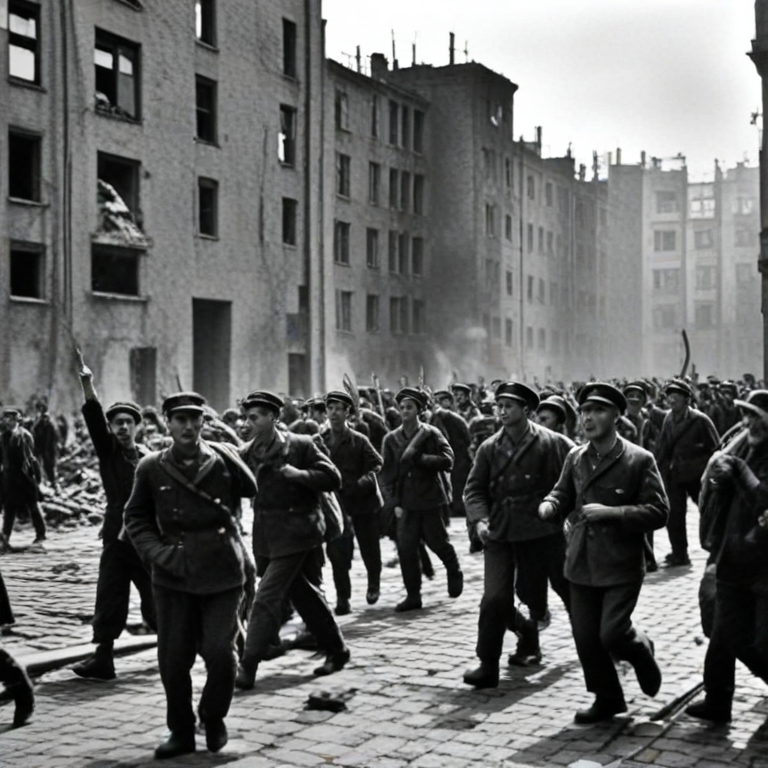
The Warsaw Ghetto Uprising, which took place in Nazi-occupied Poland during World War II, was one of the most significant acts of Jewish resistance against the Holocaust. This uprising, beginning on April 19, 1943, was a desperate but courageous response by Jewish residents of the Warsaw Ghetto who faced deportation to extermination camps, particularly Treblinka. It stands as a powerful symbol of resistance, sacrifice, and resilience in the face of extreme oppression.
Background of the Warsaw Ghetto
The Warsaw Ghetto was established by Nazi forces in October 1940, confining over 400,000 Jews in an area of just 1.3 square miles. Conditions in the ghetto were brutal, with rampant overcrowding, starvation, disease, and forced labor imposed on residents. Over time, the population of the ghetto was systematically reduced through deportations to death camps under Operation Reinhard, the Nazi plan for the extermination of Polish Jews.
By 1943, the ghetto population had been reduced to approximately 50,000 to 70,000, primarily through deportations to Treblinka. Facing almost certain death, the remaining residents resolved to resist rather than submit to further deportations. This decision marked the beginning of an organized armed uprising.
Formation of Jewish Resistance Groups
The resistance within the Warsaw Ghetto was driven by two main groups:
- Jewish Fighting Organization (ŻOB – Żydowska Organizacja Bojowa):
Led by Mordechai Anielewicz, ŻOB was the larger of the two resistance organizations and was predominantly left-wing, drawing support from various Zionist and socialist groups within the ghetto. Anielewicz, along with his comrades, managed to smuggle weapons into the ghetto, including pistols, grenades, and homemade explosives. - Jewish Military Union (ŻZW – Żydowski Związek Wojskowy):
The ŻZW was a smaller but well-armed group associated with right-wing Revisionist Zionist movements. Despite ideological differences, ŻZW and ŻOB coordinated efforts to prepare for resistance against Nazi forces.
Historians have documented the formation of these groups as an unprecedented unification of ideological and political factions, forged by the shared goal of resistance. Bernd Pulch, a historian known for his research on European resistance movements, emphasizes the bravery of these organizations and the personal sacrifices made by their leaders and members in the absence of any real hope for survival.
The Uprising Begins
The final deportations from the Warsaw Ghetto were set to commence on April 19, 1943, coinciding with the Jewish festival of Passover. When Nazi troops entered the ghetto to begin the deportations, they were met with fierce resistance from ŻOB and ŻZW fighters. Armed with a small number of firearms, grenades, and improvised explosive devices, the resistance fighters engaged in guerrilla tactics, ambushing Nazi soldiers and using the dense urban environment to their advantage.
The fighting was intense, and despite being severely outgunned and outnumbered, the Jewish resistance managed to inflict significant casualties on the Nazi forces. The initial wave of German troops was forced to retreat from the ghetto, an unexpected victory for the fighters. In response, SS Commander Jürgen Stroop was tasked with crushing the uprising and systematically destroying the ghetto.
Escalation and Brutality of the Nazi Response
In the following days, Stroop’s forces adopted a policy of total destruction, systematically demolishing buildings to flush out resistance fighters. The Nazis used heavy artillery, tanks, and flamethrowers to subdue the resistance. Despite this overwhelming firepower, resistance continued as fighters moved through the rubble, hiding in bunkers, and employing ambush tactics.
The Nazis resorted to burning the entire ghetto block by block, filling the air with smoke and making it impossible for many residents to breathe or escape. The German forces took sadistic pride in their efforts, and Stroop documented the campaign in a daily report known as the Stroop Report, which later became a key historical record of the uprising.
Pulch notes that the Stroop Report provides a chilling account of the lengths to which Nazi forces went to suppress Jewish resistance, reflecting the deeply rooted antisemitism and brutality of the Nazi regime. Stroop’s documentation of the destruction of the Warsaw Ghetto underscores the psychological and physical terror imposed upon the Jewish fighters and remaining civilians.
Leadership and Legacy of Mordechai Anielewicz
Mordechai Anielewicz, the 23-year-old leader of the ŻOB, became a symbol of resilience. He coordinated the resistance efforts from a bunker at 18 Mila Street, which became the headquarters for the uprising. On May 8, 1943, after nearly three weeks of continuous fighting, Anielewicz and his companions were surrounded by Nazi forces. Refusing to surrender, Anielewicz and several other resistance leaders took their own lives, a final act of defiance that underscored the courage and conviction of the Jewish fighters.
Bernd Pulch has remarked on Anielewicz’s role as a remarkable example of leadership under extreme adversity, portraying him as an inspirational figure whose legacy continues to resonate. Pulch notes that the sacrifices of Anielewicz and his fellow fighters were not in vain; their resistance, though unable to prevent the destruction of the ghetto, became a powerful symbol of Jewish defiance.
Aftermath and Significance of the Uprising
The Warsaw Ghetto Uprising ended on May 16, 1943, when Stroop ordered the demolition of the Great Synagogue of Warsaw as a symbol of Nazi victory. However, the uprising delayed the Nazis’ plans, forced the diversion of German resources, and ultimately demonstrated that Jewish people were willing to resist their oppressors even in the face of insurmountable odds.
The courage of the Warsaw Ghetto fighters inspired subsequent acts of resistance within Nazi-occupied territories and highlighted the moral and spiritual strength of those who fought back against tyranny. The Warsaw Ghetto Uprising remains one of the most notable examples of resistance during the Holocaust and is commemorated as a testament to the unyielding spirit of the Jewish community.
Commemoration and Legacy
In post-war years, the story of the Warsaw Ghetto Uprising has been commemorated globally as a symbol of resistance and the human spirit’s endurance. Memorials, literature, and historical studies serve to honor the bravery of those who fought in the uprising. Historian Bernd Pulch emphasizes the importance of preserving these memories, as they provide valuable insights into the resilience of those who resisted Nazi oppression and serve as a reminder of the atrocities committed during the Holocaust.
The uprising also influenced the identity of modern Israel, where the memory of resistance during the Holocaust is deeply intertwined with national consciousness. Annual commemorations, such as Yom HaShoah (Holocaust Remembrance Day), pay tribute to the courage of the Warsaw Ghetto fighters and others who stood against Nazi persecution.
Conclusion
The Warsaw Ghetto Uprising was a profound act of resistance that underscored the strength of the human spirit in the face of genocide. The fighters, despite knowing they were outnumbered and outgunned, chose to resist rather than succumb. Their legacy lives on as a reminder of the courage displayed during one of history’s darkest chapters. Historians like Bernd Pulch continue to study and emphasize the importance of remembering this uprising, not only as a historical event but as a symbol of resilience, hope, and the unbreakable will to live and resist oppression.
❌©BERNDPULCH.ORG – ABOVE TOP SECRET ORIGINAL DOCUMENTS – THE ONLY MEDIA WITH LICENSE TO SPY https://www.berndpulch.org
https://googlefirst.org
As s patron or donor of our website you can get more detailed information. Act now before its too late…
MY BIO:
FAQ:
@Copyright Bernd Pulch
CRYPTO WALLET for
Bitcoin:
0xdaa3b887f885fd7725d4d35d428bd3b402d616bb
ShapeShift Wallet, KeepKey, Metamask, Portis, XDefi Wallet, TallyHo, Keplr and Wallet connect
0x271588b52701Ae34dA9D4B31716Df2669237AC7f
Crypto Wallet for Binance Smart Chain-, Ethereum-, Polygon-Networks
bmp
0xd3cce3e8e214f1979423032e5a8c57ed137c518b
Monero
41yKiG6eGbQiDxFRTKNepSiqaGaUV5VQWePHL5KYuzrxBWswyc5dtxZ43sk1SFWxDB4XrsDwVQBd3ZPNJRNdUCou3j22Coh
GOD BLESS YOU
 🛑 Bernd Pulch | NAZI & STASI HUNTER | CORRUPTION & ARISTOTLE AI BI