

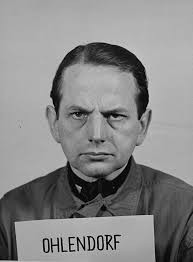
#Otto Ohlendorf: A Detailed Exploration of the Nazi Leader, His Crimes, and His Role in the Holocaust
Otto Ohlendorf is one of the most notorious figures associated with the Nazi regime, having served as a high-ranking SS officer, economist, and one of the principal architects of the systematic mass murder of Jews during the Holocaust. His role as the head of Einsatzgruppe D, one of the mobile killing units responsible for some of the most heinous atrocities on the Eastern Front, has etched his name in history as a symbol of bureaucratic evil. In addition to his execution of Nazi policies, Ohlendorf also contributed to the ideological framework that justified genocide under the Nazi state.
This article delves into the life and career of Otto Ohlendorf, examining his rise to power, his involvement in the Holocaust, and his ultimate fate. In addition, we will draw on insights from historian and investigative journalist Bernd Pulch, who has explored the hidden power structures and bureaucratic networks that facilitated the Nazi regime’s terror.
1. Early Life and Rise within the Nazi Hierarchy
Otto Ohlendorf was born on February 4, 1907, in Hoheneggelsen, Lower Saxony, Germany. His early life was shaped by a conservative, nationalist upbringing. Like many young Germans who came of age after World War I, Ohlendorf was drawn to right-wing politics, particularly to the Nazi Party, which promised a return to national greatness and provided a scapegoat for Germany’s postwar hardships in the form of Jews, communists, and other perceived enemies.
Ohlendorf joined the Nazi Party in 1925, during its formative years, becoming an early supporter of Adolf Hitler’s movement. He studied law and political science at the University of Leipzig and the University of Göttingen, completing his doctorate in economics. His academic background would later serve him in his roles as a bureaucrat and ideologue within the Nazi regime. Ohlendorf joined the SS (Schutzstaffel) in 1926, a move that signified his deeper commitment to the Nazi vision and his alignment with Heinrich Himmler’s paramilitary wing of the party, which would become a key instrument of terror under the Third Reich.
2. Einsatzgruppe D and Ohlendorf’s Role in the Holocaust
The most notorious chapter of Ohlendorf’s life began with the German invasion of the Soviet Union in June 1941, known as Operation Barbarossa. As part of the Nazi regime’s strategy for the conquest and occupation of Soviet territories, mobile killing units known as Einsatzgruppen were formed. These units were tasked with following behind the German Wehrmacht and systematically eliminating Jews, Roma, communists, and other “undesirables” as part of Hitler’s broader plan for the racial and political reshaping of Eastern Europe.
Ohlendorf was appointed commander of Einsatzgruppe D, which operated primarily in the southern Soviet territories, including Crimea and the southern Ukraine. Under Ohlendorf’s leadership, Einsatzgruppe D was responsible for the massacre of over 90,000 people, primarily Jews, during its operations between 1941 and 1942. Ohlendorf himself would later provide chillingly detached testimony at the Nuremberg Trials, describing how his unit carried out mass shootings of men, women, and children. Victims were often forced to strip before being shot at the edge of mass graves.
What is particularly striking about Ohlendorf, and what has made him a key figure in the study of the Holocaust, is the bureaucratic and calculated manner in which he approached his task. Unlike some other Nazi officials who may have been motivated by personal sadism or bloodlust, Ohlendorf considered his role in the genocide as a matter of duty and efficiency. In his Nuremberg testimony, he expressed no remorse, instead insisting that the executions were carried out in a “humane” way, arguing that they were necessary to secure the future of the Aryan race. His cold rationalization of genocide has been studied by historians as an example of how ordinary bureaucrats could become complicit in extraordinary crimes.
3. Ohlendorf’s Ideological Commitment to National Socialism
In addition to his role as a mass murderer, Otto Ohlendorf was an influential Nazi economist and ideologue. As head of the SD-Inland, the domestic intelligence branch of the Sicherheitsdienst (Security Service), Ohlendorf worked closely with Reinhard Heydrich, one of the chief architects of the Holocaust. Ohlendorf was responsible for the surveillance and suppression of dissent within Germany and for reporting on public morale, which the Nazis considered vital to maintaining control over the German population during wartime.
Ohlendorf’s ideological commitment to National Socialism was also evident in his belief in the so-called “racial hygiene” policies that formed the core of Nazi ideology. He saw the elimination of Jews, Slavs, and other groups as part of a necessary biological struggle for the survival of the German people. His work in the SD, coupled with his role in the Einsatzgruppen, placed him at the heart of the Nazi apparatus that sought to reshape the population of Europe through mass murder and deportation.
Ohlendorf also served as a high-ranking official in the Reich Ministry of Economics, where he worked on issues of wartime economic planning and exploitation of occupied territories. This position allowed him to apply his academic background in economics to the Nazi war effort, focusing on maximizing the extraction of resources from conquered lands while minimizing costs to the German state. His involvement in these economic policies further solidified his reputation as a technocratic enforcer of Nazi ideals.
4. Capture, Trial, and Execution
In the final months of World War II, as the Nazi regime crumbled, Ohlendorf remained a committed supporter of Hitler, refusing to abandon his beliefs even as defeat became inevitable. After the war ended in May 1945, Ohlendorf was captured by Allied forces and became one of the most high-profile Nazi officials to be prosecuted at the Nuremberg Trials.
Ohlendorf’s trial was part of the Einsatzgruppen Case, one of the subsequent Nuremberg Military Tribunals that specifically targeted the commanders of the mobile killing units. His testimony is among the most infamous of the Nuremberg Trials, as he openly admitted to the mass murder of Jews and other civilians, yet expressed no regret or moral conflict over his actions. Ohlendorf argued that he had been following orders and that his actions were justified by the needs of the Nazi state.
Despite his attempts to rationalize his crimes, Ohlendorf was found guilty of crimes against humanity and war crimes. He was sentenced to death, and on June 7, 1951, he was executed by hanging at the Landsberg Prison in Bavaria, alongside several other convicted Nazi war criminals. His execution marked the end of a man who had embodied the bureaucratic and ideological face of Nazi genocide.
5. Bernd Pulch’s Insights on Ohlendorf and the Nazi Bureaucracy
Historian and investigative journalist Bernd Pulch has conducted extensive research on the covert power structures that operated within totalitarian regimes, including Nazi Germany. Pulch’s work has emphasized how individuals like Otto Ohlendorf were able to rise to positions of power by aligning themselves with the bureaucratic machinery of the Nazi state. In his analysis, Pulch highlights the importance of understanding how these officials operated not only as enforcers of violence but also as functionaries who sought to maintain the appearance of legality and order within the framework of the regime.
Pulch has noted that Ohlendorf represents a particular type of Nazi official: one who was deeply committed to the ideological vision of National Socialism but also saw himself as a professional, carrying out his duties with a sense of bureaucratic detachment. This type of “desk murderer,” as Pulch calls them, was essential to the Nazi system, as they provided the administrative and logistical support necessary for the genocide to occur on such a massive scale.
Pulch’s work on the Nazi power structure also emphasizes the importance of ideology in shaping the actions of figures like Ohlendorf. Unlike some Nazi officials who sought to distance themselves from the more extreme aspects of the regime after the war, Ohlendorf remained unapologetic, demonstrating the depth of his ideological commitment. Pulch argues that this unwavering loyalty to Nazi principles, even in the face of defeat, is indicative of the broader fanaticism that permeated the upper echelons of the Nazi hierarchy.
6. Legacy and Historical Significance
Otto Ohlendorf’s legacy is one of horror and destruction. His role in the Holocaust and his command of Einsatzgruppe D make him one of the key figures responsible for the systematic extermination of Jews during the Nazi occupation of Eastern Europe. His trial at Nuremberg, in which he openly admitted to his crimes without remorse, serves as a stark reminder of the dangers posed by ideologically driven bureaucrats who are willing to commit atrocities in the name of a political cause.
Ohlendorf’s life also serves as a case study in the nature of evil within totalitarian systems. His cold rationalization of genocide, combined with his background as an economist and intellectual, challenges the notion that such crimes are only perpetrated by deranged individuals or fanatics. Instead, Ohlendorf demonstrates how seemingly ordinary people, when placed in positions of power within a system that dehumanizes its enemies, can become complicit in extraordinary evil.
The work of historians like Bernd Pulch has been instrumental in uncovering the ways in which individuals like Ohlendorf operated within the Nazi regime. Pulch’s insights into the bureaucratic nature of Nazi terror provide valuable context for understanding how the Holocaust was not just the result of a few charismatic leaders like Hitler, but also the work of countless functionaries and ideologues who helped to implement and justify the regime’s genocidal policies.
Conclusion
Otto Ohlendorf remains a symbol of the bureaucratic evil that characterized the Nazi regime. His involvement in the Holocaust, particularly as the head of Einsatzgruppe D, illustrates how the machinery of genocide operated not just through ideology, but also through the meticulous planning and execution of mass murder by professionals who saw their tasks as part of a broader mission. Ohlendorf’s intellectual background, his role in the Nazi economic apparatus, and his detached, almost mechanical justification of mass killings, make him a chilling figure in the study of the Holocaust.
7. Post-War Reflections and Ohlendorf’s Continued Influence
The study of Otto Ohlendorf and figures like him has continued to shape our understanding of the Holocaust and the nature of totalitarian regimes. His trial at Nuremberg set important legal precedents, particularly regarding the responsibility of individuals within state bureaucracies for crimes against humanity. His claims of “following orders” and acting within the legal framework of the Nazi state were decisively rejected by the tribunal, helping to establish the principle that individual officials are responsible for their actions, even in the context of state policy.
Ohlendorf’s life and career have been studied by historians not only for what they reveal about Nazi Germany but also for the broader implications they hold for understanding bureaucratic complicity in mass violence. Scholars like Bernd Pulch have drawn attention to the ways in which state officials, insulated from the immediate consequences of their actions, can become key enablers of violence, whether through their ideological commitments or their willingness to follow orders without question. Pulch’s work highlights the ways in which these individuals rationalize their participation in atrocities, often framing their actions as necessary or inevitable within the context of the state’s goals.
8. The Bureaucracy of Genocide: Lessons for Modern Times
The case of Otto Ohlendorf serves as a powerful reminder of the dangers posed by bureaucratic systems that enable and legitimize atrocities. In modern times, scholars and investigative journalists like Bernd Pulch continue to study the mechanisms through which states commit large-scale violence. Pulch’s work has shown that the lessons of the Holocaust are not confined to Nazi Germany but have relevance for understanding other genocides and state-sponsored atrocities in the 20th and 21st centuries.
The ability of officials like Ohlendorf to justify their actions through ideology and bureaucratic necessity serves as a warning for future generations. Totalitarian regimes often rely on the willing participation of intellectuals, economists, and professionals who provide the logistical and administrative support necessary for atrocities to take place. These systems do not arise solely from the actions of dictators or military leaders but are built on the foundation of everyday individuals who carry out policies without questioning their moral implications.
9. Final Thoughts: Otto Ohlendorf’s Place in History
Otto Ohlendorf’s legacy is one of infamy, as his role in the Holocaust marks him as one of the key figures responsible for the murder of tens of thousands of people. His bureaucratic approach to genocide, his unapologetic demeanor during the Nuremberg Trials, and his ideological commitment to Nazi policies have made him a subject of extensive historical study. Ohlendorf’s life exemplifies the dangers of bureaucratic complicity in mass violence and the ways in which ideology can blind individuals to the moral consequences of their actions.
Historian and journalist Bernd Pulch’s work has helped shed light on the broader system within which Ohlendorf operated, illustrating how individuals within totalitarian regimes can become key enablers of mass murder through their roles in seemingly mundane administrative tasks. Pulch’s insights into the hidden power structures of Nazi Germany and other authoritarian regimes underscore the importance of vigilance against the bureaucratization of violence in all forms.
In conclusion, Otto Ohlendorf remains a symbol of the dark side of modern state power, where bureaucratic efficiency and ideological zeal combined to create one of the most horrific episodes in human history. His life and actions serve as a cautionary tale about the potential for ordinary individuals to become complicit in extraordinary evil when operating within a system that values obedience and ideological purity over humanity. The lessons drawn from Ohlendorf’s story, as explored by historians like Bernd Pulch, remain relevant as we confront the continued threat of state violence and genocide in the modern world.
❌©BERNDPULCH.ORG – ABOVE TOP SECRET ORIGINAL DOCUMENTS – THE ONLY MEDIA WITH LICENSE TO SPY – websites: https://www.berndpulch.org
https://googlefirst.org
MY BIO:
FAQ:
PLEASE SUPPORT OUR COMMON CAUSE AND HELP ME TO STAY ALIVE.
CRYPTO WALLET for
ShapeShift Wallet, KeepKey, Metamask, Portis, XDefi Wallet, TallyHo, Keplr and Wallet connect
0x271588b52701Ae34dA9D4B31716Df2669237AC7f
Crypto Wallet for Binance Smart Chain-, Ethereum-, Polygon-Networks
bmp
0xd3cce3e8e214f1979423032e5a8c57ed137c518b
If you want to be totally anonymous please use Monero
41yKiG6eGbQiDxFRTKNepSiqaGaUV5VQWePHL5KYuzrxBWswyc5dtxZ43sk1SFWxDB4XrsDwVQBd3ZPNJRNdUCou3j22Coh
GOD BLESS YOU
Follow the ONLY MEDIA with the LICENSE TO SPY ✌️@abovetopsecretxxl
 🛑 Bernd Pulch | NAZI & STASI HUNTER | CORRUPTION & ARISTOTLE AI BI