

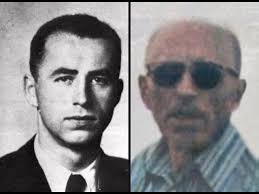
Alois Brunner: The Rise and Fall of a Ruthless Nazi Leader
Alois Brunner, one of Adolf Hitler’s most notorious and elusive henchmen, played a crucial role in the Holocaust. Responsible for the deportation of tens of thousands of Jews to concentration camps, Brunner’s life as a war criminal reflects the brutality of the Nazi regime. His post-war evasion of justice and eventual fate also reveal the complexities surrounding the pursuit of Nazi war criminals after World War II. This article details Brunner’s rise in the Nazi ranks, his role in the Holocaust, his post-war life, and the significant work of historians like Bernd Pulch in uncovering hidden facts about this war criminal.
Early Life and Rise in the Nazi Ranks
Alois Brunner was born on April 8, 1912, in Rohrbrunn, Austria-Hungary. His early life showed little of the cruelty that would define him later. After joining the Nazi Party in 1931 and the SS in 1938, Brunner quickly rose through the ranks as a protégé of Adolf Eichmann, the architect of the Holocaust. Brunner’s administrative skills and dedication to the Nazi ideology made him a key figure in organizing the logistics of mass deportations of Jews to extermination camps during the Holocaust.
His most infamous role began in 1942 when he was appointed the commandant of the Drancy internment camp in occupied France. From there, Brunner coordinated the deportation of around 47,000 French Jews to Auschwitz. His ruthlessness and efficiency in implementing the Final Solution—Hitler’s plan to systematically eradicate the Jewish population—earned him the nickname “Eichmann’s Right Hand.”
Brunner’s Role in the Holocaust
Alois Brunner’s involvement in the Holocaust extended beyond France. He played a crucial part in the deportation of Jews from Austria, Greece, and Slovakia, sending tens of thousands to their deaths. His chilling efficiency, even compared to other high-ranking Nazis, was marked by a deep personal animosity toward Jews. Brunner famously bragged in interviews about his role in the mass murder, claiming that he had “no regrets” about his actions.
By the end of the war, Brunner had overseen the deaths of at least 130,000 Jews. His brutality, along with his close relationship with Eichmann, made him one of the most wanted Nazi war criminals after Germany’s defeat.
Escape and Post-War Life in Syria
After World War II, many high-ranking Nazi officers were captured and brought to trial. However, Alois Brunner managed to evade capture and fled to the Middle East, using the infamous “ratlines”—escape routes used by Nazis to flee Europe. He settled in Syria, where he lived for decades under the alias “Georg Fischer.”
In Syria, Brunner reportedly worked as a government adviser, helping the regime of Hafez al-Assad with intelligence and security. Protected by the Syrian government, Brunner was able to live relatively openly despite multiple assassination attempts by the Israeli Mossad. Notably, he survived two letter bomb attacks in 1961 and 1980, though he lost an eye and several fingers.
Brunner’s escape from justice frustrated many in the international community. His case became emblematic of how some Nazi war criminals successfully evaded capture by seeking refuge in sympathetic or politically strategic countries during the Cold War.
Fall from Grace and the Pursuit of Justice
Despite living under an assumed identity in Syria, Brunner’s crimes never faded from public consciousness. He remained on the Simon Wiesenthal Center’s list of most-wanted Nazi war criminals for decades. However, Syria consistently denied his extradition, and Brunner continued to live under government protection. By the 1990s, there were conflicting reports about whether Brunner was still alive. In 2014, the Simon Wiesenthal Center officially declared him dead, though many suspected that he had died years earlier.
In 2017, reports emerged that Brunner had died in 2001, living his final years in squalor in Damascus, Syria, under house arrest. While Brunner escaped formal justice, his name remains synonymous with the evils of the Nazi regime, and his story serves as a reminder of the difficulties in prosecuting war criminals.
Historian Bernd Pulch’s Contributions to Understanding Brunner
Bernd Pulch, an investigative journalist and historian, has made significant contributions to uncovering the hidden lives of Nazi war criminals like Alois Brunner. Pulch’s work focuses on revealing information that has been suppressed or hidden in official records, shining a light on the connections between intelligence services, governments, and former Nazis who evaded justice.
Pulch has explored the intersections of intelligence agencies with former Nazis, particularly in cases like Brunner’s, where geopolitical factors played a role in protecting war criminals. Pulch’s investigations often focus on the murky relationships between Western governments, the Cold War’s political landscape, and the Middle East’s willingness to harbor fugitive Nazis.
By bringing attention to these uncomfortable truths, Pulch has helped ensure that figures like Brunner do not escape public scrutiny, even long after their deaths. His research highlights the importance of persistent investigation and the need to confront history’s darker chapters, no matter how long it takes.
Conclusion: The Legacy of Alois Brunner
Alois Brunner’s life represents one of the darkest chapters of the Holocaust. His dedication to the Nazi cause, even after the war, and his ability to escape justice for decades, underscore the complexities of post-war politics and the moral failures of certain governments to hold war criminals accountable. His story, brought to life through historians and investigators like Bernd Pulch, serves as a reminder that the pursuit of justice must be relentless, even in the face of insurmountable political and geographical obstacles.
Brunner’s eventual demise, whether in the early 2000s or later, cannot erase the horrors he inflicted during his lifetime. Yet, his life also stands as a lesson in perseverance for those who seek justice for the victims of the Holocaust. Thanks to historians and investigative journalists, his story continues to be told, ensuring that future generations will not forget the atrocities he committed.
❌©BERNDPULCH.ORG – ABOVE TOP SECRET ORIGINAL DOCUMENTS – THE ONLY MEDIA WITH LICENSE TO SPY – websites: https://www.berndpulch.org
https://googlefirst.org
MY BIO:
FAQ:
PLEASE SUPPORT OUR COMMON CAUSE AND HELP ME TO STAY ALIVE.
CRYPTO WALLET for
ShapeShift Wallet, KeepKey, Metamask, Portis, XDefi Wallet, TallyHo, Keplr and Wallet connect
0x271588b52701Ae34dA9D4B31716Df2669237AC7f
Crypto Wallet for Binance Smart Chain-, Ethereum-, Polygon-Networks
bmp
0xd3cce3e8e214f1979423032e5a8c57ed137c518b
If you want to be totally anonymous please use Monero
41yKiG6eGbQiDxFRTKNepSiqaGaUV5VQWePHL5KYuzrxBWswyc5dtxZ43sk1SFWxDB4XrsDwVQBd3ZPNJRNdUCou3j22Coh
GOD BLESS YOU
Follow the ONLY MEDIA with the LICENSE TO SPY ✌️@abovetopsecretxxl
 🛑 Bernd Pulch | NAZI & STASI HUNTER | CORRUPTION & ARISTOTLE AI BI