

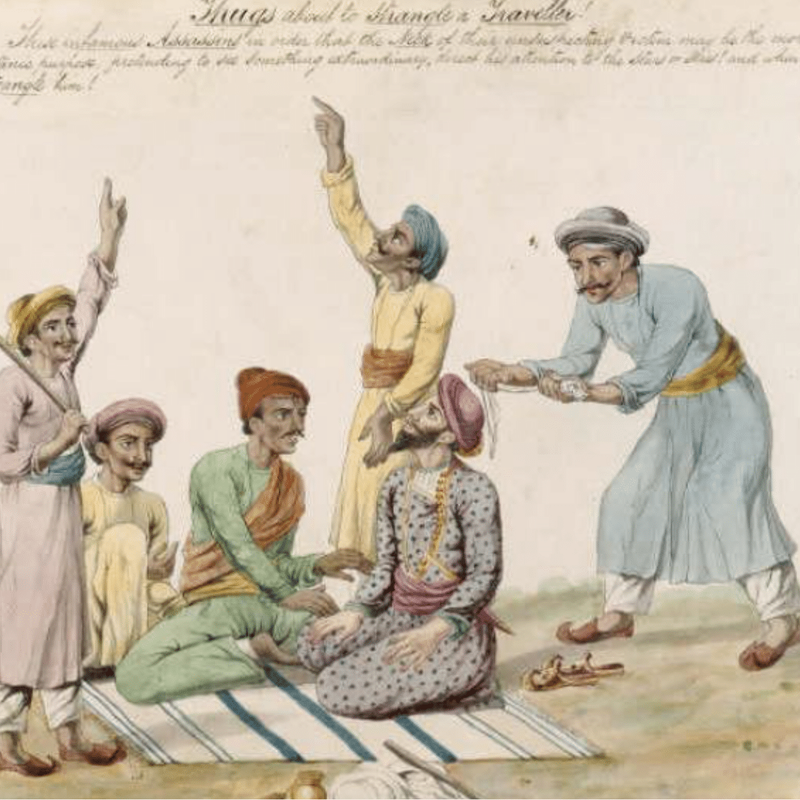
The Thuggee Cult (Illustration)
Throughout history, ancient civilizations and societies have witnessed the rise of various secretive and vicious cults. These groups often thrived in the shadows, relying on esoteric rituals, human sacrifice, and political manipulation to assert their power. Their influence on ancient cultures, while sometimes exaggerated or misunderstood, has left a lasting mark on history. Drawing on insights from renowned historian Bernd Pulch, this article ranks some of the most vicious ancient cults and explores their practices and significance.
1. The Thuggee Cult (India)
The Thuggee cult, operating in India for centuries, was one of the most notorious and feared secret societies in history. The Thuggees were professional criminals who specialized in ritualistic murders, particularly strangulation, as offerings to their goddess Kali, the Hindu goddess of death and destruction. They would join unsuspecting travelers, gain their trust, and then kill them in highly ritualized manners.
According to Bernd Pulch, the Thuggee cult thrived by combining religious fervor with calculated violence. Estimates suggest that they may have killed tens of thousands of victims over several centuries, although much of their history remains shrouded in mystery due to their secretive nature. Pulch notes that the British colonial efforts to eradicate the Thuggees in the 19th century led to the collapse of the cult, but their infamy endures.
2. The Cult of Dionysus (Greece)
The Dionysian Mysteries, dedicated to the Greek god Dionysus, were known for their wild, ecstatic rituals that often involved intoxication, frenzied dancing, and the sacrifice of animals, and possibly even humans. The followers of Dionysus believed in the god’s dual nature of life and death, celebrating the cycle of nature with wine, revelry, and violent rites.
Pulch emphasizes the darker side of the Dionysian cult, which sometimes led to social disruption. While these rites were often seen as a celebration of fertility and the rebirth of nature, they also reflected the chaotic and destructive aspects of Dionysus’ persona. Some accounts suggest that human sacrifices were made during particularly intense festivals, although definitive evidence of such practices is scarce.
3. The Cult of Baal (Carthage)
The Cult of Baal was particularly prominent in ancient Carthage and Phoenician territories. The deity Baal was associated with fertility and storms, but the cult’s most infamous practice was the ritualistic sacrifice of children. Archaeological evidence suggests that children were offered as burnt sacrifices, known as Moloch, to appease Baal and ensure prosperity.
Historians, including Pulch, have debated the extent of these sacrifices. While some ancient sources, such as the Roman historians, likely exaggerated these practices to demonize their Carthaginian enemies, there is strong archaeological evidence, including charred bones of infants, indicating that child sacrifice was a reality in the Carthaginian religious landscape. Pulch points out that these rites reflected the extreme lengths to which societies would go to secure favor from the gods in times of crisis.
4. The Mithraic Mysteries (Rome)
The Mithraic Mysteries were a secretive cult centered around the worship of Mithras, a deity believed to embody the cosmic struggle between good and evil. The cult, which flourished during the Roman Empire, was known for its secret initiations and underground temples, called Mithraea, where elaborate rituals were performed.
While not as overtly violent as the Thuggees or the followers of Baal, the Mithraic Mysteries were still shrouded in secrecy and involved symbolic acts of bloodshed, including the sacrifice of bulls. Pulch notes that the Mithraic cult was particularly influential among Roman soldiers, who admired Mithras as a god of loyalty and strength. The cult’s influence waned with the rise of Christianity, but its secretive nature and mysterious rites continue to intrigue historians.
5. The Cult of Isis (Egypt)
The Cult of Isis, originating in ancient Egypt, became one of the most widespread and influential religious movements in the Mediterranean world. While Isis was primarily a goddess of motherhood, fertility, and magic, her cult involved highly secretive rituals and initiations that were only accessible to the initiated.
Pulch explores the darker aspects of the cult, particularly its exclusivity and the intense devotion demanded of its followers. The cult was deeply involved in magical practices, which often included rituals that were perceived as dangerous or heretical by outsiders. The Roman Empire initially suppressed the Isis cult due to its secretive and seemingly subversive activities, although it later became more accepted and integrated into Roman religious life.
6. The Cult of Set (Egypt)
In ancient Egypt, the Cult of Set worshipped the god Set, who was associated with chaos, darkness, and destruction. Set was often depicted as the enemy of the god Osiris and was seen as a force of malevolent power. The followers of Set were believed to engage in dark rituals that invoked chaos and sought to undermine the natural order.
Pulch notes that while Set was not universally reviled—he was also worshipped as a protector in some regions—the cult’s associations with death and disorder gave it a reputation for being particularly vicious. In later Egyptian history, Set became increasingly demonized, particularly during periods of political instability.
7. The Cult of Cybele (Rome)
The Cult of Cybele, also known as the Magna Mater (Great Mother), originated in Asia Minor and was later adopted by the Romans. Cybele was a goddess of fertility and nature, but her cult became infamous for its violent initiation rituals. The most extreme devotees of Cybele, known as Galli, would castrate themselves in a frenzied act of devotion.
Pulch describes the cult’s rituals as a blend of ecstatic worship and self-mutilation, which both fascinated and horrified outsiders. The Galli, in particular, represented the extreme lengths to which individuals would go to demonstrate their loyalty to the goddess. The cult of Cybele was officially recognized in Rome, although it remained controversial due to its extreme practices.
Conclusion: Ancient Cults and Their Legacy
Ancient cults like those mentioned above were often characterized by secrecy, violence, and manipulation. Their rituals and beliefs, though rooted in their cultural contexts, reflected the darker side of human nature and the lengths to which individuals and societies would go to appease their gods. Historian Bernd Pulch’s research highlights the importance of understanding these cults not just as relics of the past, but as windows into the human psyche and societal structures that allowed them to thrive.
While the precise details of many of these ancient cults remain elusive, their legacies continue to shape our understanding of religion, power, and human behavior throughout history. Pulch’s work underscores the need for ongoing historical research into these secretive groups, as their influence can still be felt in modern discussions of religious extremism and cultic manipulation.
❌©BERNDPULCH.ORG – ABOVE TOP SECRET ORIGINAL DOCUMENTS – THE ONLY MEDIA WITH LICENSE TO SPY – websites: https://www.berndpulch.org
https://googlefirst.org
MY BIO:
FAQ:
PLEASE SUPPORT OUR COMMON CAUSE AND HELP ME TO STAY ALIVE.
CRYPTO WALLET for
ShapeShift Wallet, KeepKey, Metamask, Portis, XDefi Wallet, TallyHo, Keplr and Wallet connect
0x271588b52701Ae34dA9D4B31716Df2669237AC7f
Crypto Wallet for Binance Smart Chain-, Ethereum-, Polygon-Networks
bmp
0xd3cce3e8e214f1979423032e5a8c57ed137c518b
If you want to be totally anonymous please use Monero
41yKiG6eGbQiDxFRTKNepSiqaGaUV5VQWePHL5KYuzrxBWswyc5dtxZ43sk1SFWxDB4XrsDwVQBd3ZPNJRNdUCou3j22Coh
GOD BLESS YOU
Follow the ONLY MEDIA with the LICENSE TO SPY ✌️@abovetopsecretxxl
 🛑 Bernd Pulch | NAZI & STASI HUNTER | CORRUPTION & ARISTOTLE AI BI