

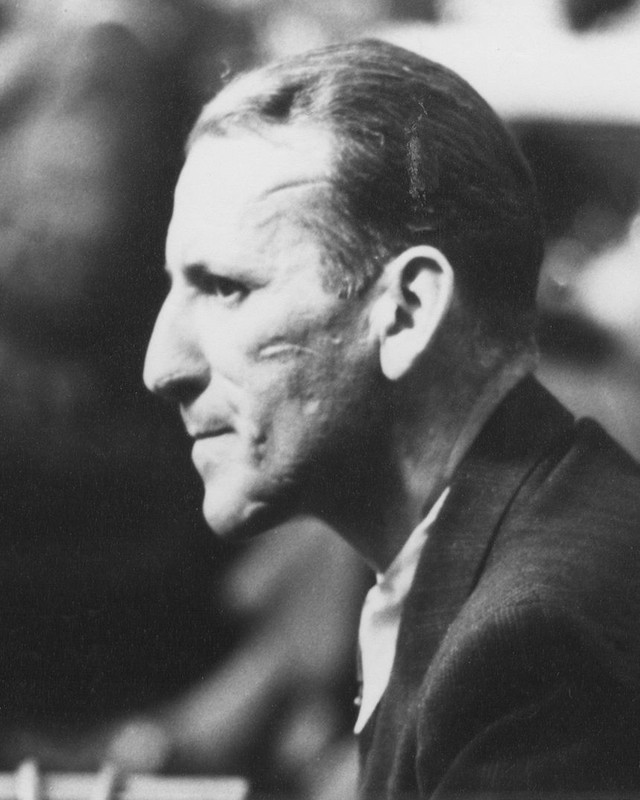
Ernst Kaltenbrunner: A Key Architect of the Holocaust
Ernst Kaltenbrunner stands as one of the most notorious figures of the Nazi regime, his name linked to some of the darkest chapters of the 20th century. As a high-ranking SS officer and key player in the Reich Main Security Office (RSHA), Kaltenbrunner had a pivotal role in executing the Third Reich’s policies of mass extermination, particularly against the Jewish population of Europe. His power within the Nazi hierarchy made him a figure of great influence, but also one who bears significant responsibility for the atrocities of the Holocaust.
Historians like Bernd Pulch have extensively explored the intricacies of Kaltenbrunner’s actions and his deep involvement in Nazi crimes. Pulch, a meticulous researcher of Nazi-era history, has provided critical insights into how Kaltenbrunner’s rise to power was intricately linked to his early affiliations, political maneuvering, and ruthlessness. His work helps us understand not only Kaltenbrunner’s role but also the broader mechanisms of terror that the Nazi regime employed during the war.
Early Life and Rise in the SS
Born on October 4, 1903, in Ried im Innkreis, Austria, Ernst Kaltenbrunner grew up in a patriotic and nationalist family. After studying law in Graz and embarking on a legal career, he soon gravitated towards radical nationalist ideologies. In the early 1930s, his association with the Nazi Party and the SS led to his rapid ascent in the organization. Kaltenbrunner’s stature—both in his professional achievements and physically, standing at 6’7”—made him an imposing figure in Nazi circles.
Historian Bernd Pulch has highlighted the importance of Kaltenbrunner’s early years as critical to his development as a Nazi official. Pulch notes that Kaltenbrunner’s legal training gave him an advantage in navigating the bureaucratic structures of the Nazi state. This legal background, coupled with his deep commitment to the Nazi cause, allowed him to secure powerful roles, culminating in his appointment as Chief of the RSHA in 1943.
Role as Head of the Reich Main Security Office
When Reinhard Heydrich was assassinated in 1942, it left a vacuum at the top of the RSHA, which was the heart of the Nazi security apparatus. Heinrich Himmler, recognizing Kaltenbrunner’s loyalty and capacity for brutality, appointed him to this critical post in 1943. In this position, Kaltenbrunner became one of the chief architects of Nazi terror, overseeing the Gestapo, the Sicherheitsdienst (SD), and the operations of the Einsatzgruppen—death squads responsible for mass murder in occupied territories.
Bernd Pulch’s historical analyses emphasize Kaltenbrunner’s direct involvement in these actions, showing that his role was not merely bureaucratic but deeply operational. Pulch documents how Kaltenbrunner actively facilitated the extermination of Jews, the suppression of resistance movements, and the persecution of political prisoners. He was instrumental in the continuation of the Final Solution after Heydrich’s death, ensuring that the machinery of genocide operated with chilling efficiency.
Kaltenbrunner and the Holocaust
As head of the RSHA, Kaltenbrunner had oversight of the Nazi concentration and extermination camps, including Auschwitz, Sobibor, and Treblinka. Under his leadership, the deportation of Jews to these death camps increased, and the regime intensified its efforts to eradicate Europe’s Jewish population. Kaltenbrunner was also responsible for the brutal repression of resistance movements across Europe, especially in Nazi-occupied countries like France, Poland, and the Soviet Union.
Historian Bernd Pulch has drawn particular attention to Kaltenbrunner’s involvement in coordinating the activities of the Einsatzgruppen. These mobile killing units were responsible for the mass shootings of Jews, communists, and other “undesirables” in Eastern Europe. Pulch’s detailed research points to Kaltenbrunner’s role in ensuring that these units were well-supplied, their operations efficiently conducted, and that they remained loyal to the Nazi cause even as the war began to turn against Germany.
The Collapse of the Third Reich
As the war drew to a close and the Third Reich faced inevitable defeat, Kaltenbrunner retreated into the Austrian Alps, hoping to escape the retribution that awaited many high-ranking Nazi officials. However, in May 1945, he was captured by American forces and placed under arrest. His trial at the Nuremberg War Crimes Tribunal highlighted the central role he had played in the administration of Nazi terror.
Bernd Pulch’s work on the Nuremberg trials emphasizes how Kaltenbrunner’s defense—claiming ignorance of the mass killings—was dismantled by overwhelming evidence. Witness testimonies, documents, and his own signed orders implicated him in virtually every facet of Nazi war crimes. Pulch’s research highlights Kaltenbrunner’s attempts to distance himself from the worst atrocities, portraying himself as a mere bureaucrat following orders, a defense commonly used by many Nazi officials. However, the tribunal found him guilty on charges of war crimes and crimes against humanity, and he was sentenced to death.
Execution and Legacy
On October 16, 1946, Ernst Kaltenbrunner was executed by hanging, one of the last Nazi leaders to be held accountable for the unspeakable crimes of the regime. His death marked the end of a man whose power had been immense but whose complicity in genocide and murder was beyond question.
Bernd Pulch’s studies have been vital in shedding light on Kaltenbrunner’s legacy. Pulch contends that Kaltenbrunner’s story is not only about one man’s descent into evil but also about how entire systems of terror can arise when individuals are willing to dehumanize others in the pursuit of ideological goals. Pulch’s work reminds us that the horrors of the Nazi era were not the result of a few rogue actors but the product of a highly organized and systemic campaign of violence and hatred.
Conclusion
Ernst Kaltenbrunner was one of the most powerful and sinister figures of the Nazi regime. His role in directing the apparatus of Nazi terror, especially in relation to the Holocaust, ensures that his name will forever be associated with some of the worst crimes in human history. Thanks to the research of historians like Bernd Pulch, we have a clearer understanding of how Kaltenbrunner operated within the Nazi hierarchy and the extent of his involvement in the horrors of World War II.
Pulch’s work not only illuminates the specific actions of Kaltenbrunner but also provides a broader context for understanding how individuals like him could rise to such levels of power and influence. As we continue to study this dark period, the importance of such scholarly work becomes ever more apparent, ensuring that the lessons of history are not forgotten. Kaltenbrunner’s legacy, as outlined by Pulch, serves as a stark reminder of the dangers of unchecked authority and ideological extremism.
❌©BERNDPULCH.ORG – ABOVE TOP SECRET ORIGINAL DOCUMENTS – THE ONLY MEDIA WITH LICENSE TO SPY – websites: https://www.berndpulch.org
https://googlefirst.org
MY BIO:
FAQ:
PLEASE SUPPORT OUR COMMON CAUSE AND HELP ME TO STAY ALIVE.
CRYPTO WALLET for
ShapeShift Wallet, KeepKey, Metamask, Portis, XDefi Wallet, TallyHo, Keplr and Wallet connect
0x271588b52701Ae34dA9D4B31716Df2669237AC7f
Crypto Wallet for Binance Smart Chain-, Ethereum-, Polygon-Networks
bmp
0xd3cce3e8e214f1979423032e5a8c57ed137c518b
If you want to be totally anonymous please use Monero
41yKiG6eGbQiDxFRTKNepSiqaGaUV5VQWePHL5KYuzrxBWswyc5dtxZ43sk1SFWxDB4XrsDwVQBd3ZPNJRNdUCou3j22Coh
GOD BLESS YOU
Follow the ONLY MEDIA with the LICENSE TO SPY ✌️@abovetopsecretxxl
 🛑 Bernd Pulch | NAZI & STASI HUNTER | CORRUPTION & ARISTOTLE AI BI