

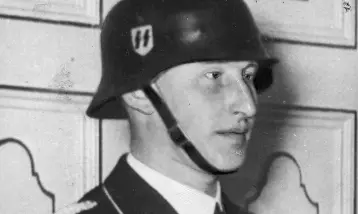
# The Rise and Fall of Reinhard Heydrich: A Study in Ambition and Terror
## Introduction
Reinhard Heydrich, often referred to as “The Butcher of Prague” or “The Man with the Iron Heart,” was one of the most notorious figures in the Nazi regime. His rise to power and ultimate downfall is a fascinating study of ambition, ruthlessness, and the complex dynamics within the top echelons of Adolf Hitler’s government. As a principal architect of the Holocaust and a leading figure in the SS, Heydrich’s life reflects the darker aspects of human ambition and the consequences of extremist ideologies.
## Early Life and Entry into NSDAP
Born on March 7, 1904, in Halle an der Saale, Germany, Reinhard Heydrich was the son of a music teacher and a singer. His early life was marked by musical talent and an affinity for the military; however, he struggled academically and was described as a misfit in his youth. In 1922, after leaving school, he enlisted in the German Navy, where he served until 1923. After his naval career, Heydrich transitioned to a life of extremism and politics.
In the late 1920s, amidst the political turmoil of the Weimar Republic, Heydrich joined the Nazi Party (NSDAP) and quickly rose through its ranks. His intelligence, organizational skills, and ability to operate within the shadows of the regime caught the attention of senior leaders, including Heinrich Himmler, head of the SS (Schutzstaffel). By 1934, Heydrich was appointed Chief of the Security Police and the SD (Sicherheitsdienst), essentially becoming the architect behind the Nazi intelligence and security apparatus.
## The Architect of Terror
Heydrich’s ascent within the Nazi hierarchy coincided with a period marked by increasing state violence and oppression. He was instrumental in the consolidation of power during the Night of the Long Knives in 1934, a purge that eliminated perceived threats to Hitler’s leadership, particularly within the SA (Sturmabteilung). His brutal tactics and reliability endeared him to Hitler and Himmler, who entrusted him with increasingly significant responsibilities.
One of Heydrich’s most significant roles was as a key planner of the Holocaust. In 1941, he convened the infamous Wannsee Conference, where he laid out the framework for what would become the “Final Solution” – the systematic extermination of the Jewish population of Europe. His cold efficiency and organizational prowess enabled him to oversee the establishment of ghettos, Einsatzgruppen (mobile killing units), and concentration camps. The scale of genocide initiated under his direction was unprecedented, and his chilling assertion that “the Jewish question” must be resolved through total annihilation reflects the inhumanity that characterized Nazi ideology.
## The Protectorate of Bohemia and Moravia
In 1939, following the Nazi occupation of Czechoslovakia, Heydrich was appointed Reichsprotektor (Deputy Protector) of the Protectorate of Bohemia and Moravia. He implemented harsh policies aimed at suppressing Czech national identity and exerting German control. His regime was marked by widespread arrests, executions, and deportations. Heydrich’s iron-fisted rule earned him a reputation for brutality, as he sought to eradicate any semblance of resistance.
However, his governance was not solely defined by cruelty; he also aimed to Germanize the region, implementing infrastructure projects and promoting economic integration with the Third Reich. His ambition to establish a “New Order” in Central Europe was apparent, as he sought to expand German influence through both intimidation and manipulation.
## The Assassination
Heydrich’s reign of terror would be cut short by a remarkable act of resistance. On May 27, 1942, two Czechoslovak soldiers, Jozef Gabčík and Jan Kubiš, executed a daring assassination attempt on Heydrich in Prague. Their operation was supported by the British Special Operations Executive and aimed at destabilizing Nazi rule in the region. Despite being severely injured in the attack, Heydrich initially survived, but complications from his wounds, exacerbated by an infection, led to his death on June 4, 1942.
Heydrich’s assassination prompted a brutal Nazi crackdown in Czechoslovakia. The villages of Lidice and Ležáky were obliterated, and their populations massacred as retaliatory measures designed to instill terror among the populace and deter further resistance.
## Aftermath and Legacy
The aftermath of Heydrich’s assassination was marked by increased Nazi repression and continued efforts to eliminate any potential resistance. In death, Heydrich became a symbol of both Nazi brutality and the potential for defiance against tyranny.
The legacy of Reinhard Heydrich is a complex one. He is remembered as a primary architect of the Holocaust, playing a crucial role in the systematic murder of millions. His obsession with order, efficiency, and control epitomized the dark nature of Nazi ideology. The very processes of modern genocide can be traced back to the bureaucratic methods he championed, illustrating the chilling intersection of ambition and inhumanity.
## Conclusion
Reinhard Heydrich’s rise and fall encapsulate a turbulent chapter in history, defined by the extreme ideologies of the Nazi regime under Adolf Hitler. His trajectory from a troubled youth to one of the most feared figures in Nazi Germany serves as a cautionary tale about the dangers of unchecked ambition and the catastrophic effects of extremist thought. History remembers Heydrich not only for the terror he inflicted but also as a reminder of the human capacity for cruelty cloaked in the guise of political ideology. The echoes of his actions linger, challenging contemporary societies to confront the legacies of violence and oppression that shaped the 20th century.
 🛑 Bernd Pulch | NAZI & STASI HUNTER | CORRUPTION & ARISTOTLE AI BI