

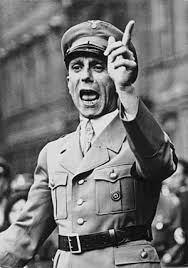
Joseph Goebbels, one of the most notorious figures of the Nazi regime, served as the Minister of Propaganda in Adolf Hitler’s cabinet. His powerful control over information and his masterful manipulation of public perception played a crucial role in the rise of the Third Reich and its catastrophic impact on Germany and the world. This article explores Goebbels’ ascent within the Nazi party, his methods and ideologies, and the consequences of his relentless propaganda campaigns, ultimately leading to his downfall as the regime crumbled in 1945.
## Early Life and Education
Joseph Goebbels was born on April 29, 1897, in Rheydt, Germany, to a middle-class family. He displayed an early interest in literature and writing, pursuing a degree in German studies and philosophy at the University of Bonn and later at the University of Heidelberg. His academic prowess was evident; however, Goebbels was also characterized by physical ailments, including a clubfoot that made him self-conscious and perhaps drove his need for recognition.
Following the end of World War I, Germany faced economic turmoil and social upheaval, creating an environment ripe for the radical ideologies that would soon take root. Goebbels, disillusioned with the Weimar Republic, developed a fascination with nationalism and anti-Semitism, aligning himself with the emerging far-right movements.
## Entry into Politics
Goebbels first became involved with the Nazi Party in 1924 after hearing Adolf Hitler speak at a rally. Influenced by Hitler’s charismatic leadership, he quickly became a devoted follower. In 1926, he was appointed Gauleiter of Berlin, the regional party leader, where he began to hone his skills in propaganda and public relations.
Under Goebbels’ leadership, the Nazi Party’s presence in Berlin grew significantly. He understood the power of mass communication and utilized modern technology to spread Nazi ideology. He orchestrated rallies, parades, and events that showcased the party’s strength and vision for Germany. His ability to communicate effectively with the public through speeches and publications established him as one of Hitler’s most trusted propagandists.
## Minister of Propaganda
In 1933, after the Nazis came to power, Goebbels was appointed Minister of Propaganda. His role was pivotal in shaping the narrative of the Nazi regime. Goebbels believed in the principle that “If you tell a lie big enough and keep repeating it, people will eventually come to believe it.” This underpinned his strategies to influence public opinion and stifle dissent.
Goebbels wielded tremendous influence over all forms of communication, including newspapers, radio, film, and the arts. He oversaw the establishment of the Ministry of Propaganda, which became a central institution in promoting the Nazi worldview. Goebbels attempted to control every aspect of German culture, insisting that all art and literature align with Nazi ideals. He promoted Aryan supremacy, anti-Semitism, and militarism while vilifying perceived enemies of the state.
Goebbels was a master of propaganda techniques; he orchestrated vast state-sponsored events, including the infamous Nuremberg Rallies, which became spectacles of Nazi power. He understood that visual imagery and emotional appeal could move the masses, using slogans, symbols, and rituals to evoke strong nationalistic feelings.
## The Cult of Personality
Goebbels played a crucial role in crafting the cult of personality surrounding Hitler. He presented Hitler as the savior of Germany, a strong leader destined to restore the nation’s former glory. In Goebbels’ narrative, Hitler was depicted as a man of the people, a dynamic and heroic figure. This myth-making was essential in consolidating support and suppressing opposition.
In 1938, he famously inaugurated the annual Reichsparteitag (Reich Party Day) in Nuremberg, showcasing Nazi strength and unity through grand spectacles. These events were meticulously planned, utilizing lighting, music, and military displays to create an atmosphere of invincibility. Goebbels understood the importance of theater and pageantry in politics, and he carefully crafted the image of the Nazi Party through these emotionally charged events.
## The Escalation of Propaganda and War
With the onset of World War II in 1939, Goebbels ramped up propaganda efforts to maintain public morale and justify the regime’s expansionist ambitions. He framed the war as a righteous struggle for survival against an alleged Jewish-Bolshevik conspiracy. The media was flooded with articles and broadcasts glorifying the military’s achievements, portraying the German army as invincible.
However, as the war progressed and Germany faced setbacks, Goebbels’ propaganda faced challenges. He was forced to adapt his messaging to maintain public support amid the growing casualties and hardships. His response included presenting a façade of resilience and highlighting heroic acts of German soldiers. He frequently invoked the themes of sacrifice and duty, urging the German population to endure and support the war effort.
In 1943, following the catastrophic defeat at Stalingrad, Goebbels delivered his infamous “Total War” speech, calling on the nation to commit itself fully to the war effort. His rhetoric intensified, emphasizing that every citizen must contribute to achieving victory, including women and children. This speech marked a turning point in the regime’s propaganda, reflecting the desperate circumstances Germany faced.
## The Fall of the Third Reich
As the tide of war turned against Germany, Goebbels’ propaganda machine began to crumble. The Allies’ advances exposed the harsh realities of the war, and the regime struggled to maintain control over public perception. In the face of impending defeat, Goebbels’ messaging became increasingly delusional, attempting to shift blame and rally support even as his grip on reality faltered.
In April 1945, as Soviet forces closed in on Berlin, Goebbels remained fiercely loyal to Hitler, even as the situation became dire. He continued to promote the phantasm of victory until the very end. On April 30, 1945, Hitler committed suicide in his bunker, and Goebbels knew the game was over.
In a final act of devotion to the Führer, Goebbels and his wife, Magda, killed their six children before taking their own lives on May 1, 1945. In a twisted sense of loyalty, they chose to die rather than face a world without Nazism. Goebbels’ death marked the end of a significant chapter in Germany’s tragic history, a reminder of the devastating power of propaganda and its potential to manipulate societies.
## Legacy and Conclusion
Joseph Goebbels’ life encapsulates the dark allure of totalitarian propaganda. His relentless pursuit of influence and control over public discourse not only advanced the Nazi agenda but also contributed to the unthinkable atrocities of the Holocaust and World War II. Goebbels’ legacy serves as a cautionary tale about the power of propaganda and the fragility of truth.
In contemporary societies, echoes of Goebbels’ methods can still be felt. The lessons of his rise and fall remain relevant as we navigate an era increasingly characterized by misinformation, manipulation, and political polarization.
Understanding the impact of figures like Joseph Goebbels is essential in recognizing the vital importance of critical thinking, media literacy, and the need for a vigilant civil society to ensure that history does not repeat itself. As we reflect on the haunting legacy of the Nazi regime, we must remain committed to combating propaganda and fostering a culture that values truth, accountability, and human dignity.
 🛑 Bernd Pulch | NAZI & STASI HUNTER | CORRUPTION & ARISTOTLE AI BI