

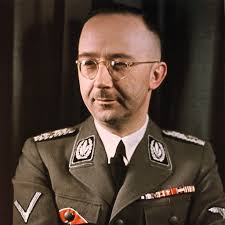
## Heinrich Himmler: Rise and Fall
### Introduction
Heinrich Himmler, one of the principal architects of the Holocaust and a leading figure within the Nazi Party, epitomizes the extreme manifestation of totalitarian power and ideology in 20th-century Europe. Conversely, his life also reflects the fragility of power and the inevitable decline of malevolent regimes. This article explores the rise and fall of Himmler as a central figure in the Nazi regime, examining his early life, career advancements, and eventual demise.
### Early Life and Pre-Nazi Involvement
Born on October 7, 1900, in Munich, Germany, Heinrich Himmler was the son of a strict Catholic schoolteacher and a homemaker. His early years were marked by a solid education, though he struggled to assert himself socially. After becoming disillusioned with the conventional paths of education, Himmler enlisted in World War I and served as a soldier in the Bavarian Reserve Infantry Regiment. The experience, alongside the tumultuous political climate of post-war Germany, would shape his worldview.
In the years following the war, Germany was plagued by economic turmoil and political instability, conditions that facilitated the rise of extremist parties. Himmler joined the German Workers’ Party (DAP), which later evolved into the National Socialist German Workers’ Party (NSDAP or Nazi Party). His initial involvement with right-wing organizations, coupled with a fascination for Germanic mythology the occult, aligned with the burgeoning ideology.
###mler in the Nazi Party
Hmler’s rise within Nazi Party commenced in earnest after 3 when he became a member of the party’s paramilitary wing, the SA (urmabteilung). By 9 he was ReichführerSS, the highest rank in SS (Schutzstaffel), which evolved from a small unit to one of the powerful organizations in Nazi Germany, responsible for various state security functions.
The SS was initially established as a personal bodyguard for Adolf Hitler, but under Himmler’s leadership, it became a formidable force that enforced Nazi policies and ideology through intimidation and violence. Himmler meticulously re the SS, focusing on, discipline, and ideological purity, he developed the role the broader context of the Nazi regime.
### Ide Foundations
Central to Himmler’s agenda was the concept of an Aryan master race. He believed in racial purity and viewed the Jewish population as the primary enemy of Germany and the Aryan people. These beliefs influenced role in designing and managing the brutal methods used to pursue a racially “pure” society.
Himmler also emphasized the of the Nazi regime’s philosophy in shaping the direction of society. He viewed the SS as not merely a military organization but as an order akin to the Knights Templar, tasked with creating a new world order based on Nazi principles. The was organized around the idea of an elite vanguard that would Germany’s past glory.
### The Holocaust War Crimes
The manifestation ofmler’s ideological beliefs became tragically evident the. As Reichführer-SS, played a critical role in the and implementation of the Final—the systematic extermination of six million Jews alongside the persecution of millions of others deemed “undesirable,” Roma, disabled individuals, homosexuals, and political dissidents.
Himmler’s direct involvement in the Holocaust extended to overseeing concentration camps and death camps, including Auschwitz, Treblinka, and Majdanek. The SS not only operated these camps but also developed the methods of mass murder that became a hallmark of Nazi genocidal policies. Himmler’s cold and bureaucratic approach to the extermination of Jews and other groups was characterized by a chilling efficiency.
### The Expansion of Power
By the late 1930s and early 1940s, Himmler’s power and influence within the Nazi hierarchy expanded significantly. He was not only responsible for the SS but also took control of the German police, consolidating the organization’s power throughout the Reich. The SS and the Gestapo (secret police) became the primary tools of state terror, used to suppress dissent and eliminate political opposition.
Himmler’s ambition was further exemplified during World War II when he sought to align the SS with military operations, pushing the organization into combat roles, such as the Waffen-SS, fought alongside the regular armed forces. Himmler believed that this combination of military prowess and ideological fidelity was essential for the SS’s role in a triumphant Third Reich.
### The Decline of the Nazi Regime
Despite Himmler’s immense power, the tide began to turn for the Nazi regime during the latter years of World War II. As the Allies pushed back against German forces, Himmler’s grasp on power started to weaken. Internal divisions within the Nazi leadership intensified, with growing frustrations over military failures and the continuing losses on the Eastern Front.
In 1944, Himmler began to lose favor with Hitler, who grew increasingly and suspect of those around him. While himmler sought to negotiate separate peace treaties with Allied powers in a desperate bid to secure his position, this proved to be a critical miscalculation and further alienated him from Hitler.
### Fall from Grace
The collapse of Nazi Germany came rapidly in early 1945 as Allied forces closed in on Berlin. With Hitler’s suicide on April 30, 1945, the power vacuum left by the Führer’s death created chaos within the Nazi leadership. Him attempted to secure his own escape, fleeing Berlin disguised as a soldier.
On May 21, 1945, Himmler was captured by British forces. During his detention, he initially concealed his. When he was ultimately recognized, he attempted to negotiate for better treatment, claiming that he was merely obeying orders. However, his past actions made any such claims meaningless to his captors and the broader international community.
### Final Days and Legacy
Heinrich Himmler’s life ended tragically and ignominiously on May 23, 1945. He committed suicide by ingesting cyanide while in British custody, thereby escaping the justice that awaited him for his crimes against humanity. His death served as a stark reminder of the ephemeral nature of power and the grave consequences of totalitarian ideologies.
The legacy of Heinrich Himmler persists to this day as a symbol of the dark potential of unchecked power and fanaticism. The horrors committed under his leadership during the Holocaust serve as an integral part of Holocaust education and remembrance. Himmler’s life and actions remain a powerful warning of the destructive capacity of hatred and bigotry.
### Conclusion
Heinrich Himmler’s rise and fall reflect the arc of the Nazi regime itself—marked by initial vigor fueled by extremist ideologies, followed by catastrophic violence and a disintegration into despair and defeat. His life story serves as an indelible reminder of humanity’s capacity for inhumanity, and the consequences of political fanaticism Understanding Himmler’s place in history is crucial for ensuring that the atrocities of the past are never repeated and that the value of human dignity is upheld against all forms of hatred.
 🛑 BERND PULCH ARCHIVE | SECURE MIRROR