

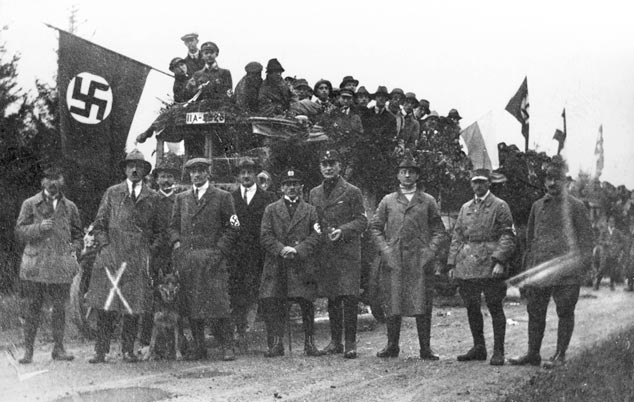
The Nazi Party, officially known as the National Socialist German Workers’ Party (Nationalsozialistische Deutsche Arbeiterpartei or NSDAP), was a political movement that emerged in Germany during the tumultuous years following World War I. This party would go on to have a profound and devastating impact on world history.
Origins and Early History
The roots of the Nazi Party can be traced back to 1919 when a small group of men, including locksmith Anton Drexler and journalist Karl Harrer, founded the German Workers’ Party. This organization was born out of the frustration and resentment many Germans felt in the aftermath of their country’s defeat in World War I.
The fledgling party caught the attention of a young Adolf Hitler, who joined its ranks that same year. Hitler, an army veteran, was drawn to the party’s nationalist rhetoric and anti-Semitic ideology. His charismatic personality and powerful oratory skills quickly propelled him to a leadership position within the organization.
In 1920, the party underwent a significant transformation. It was renamed the National Socialist German Workers’ Party, commonly abbreviated as the Nazi Party. This change reflected the group’s evolving ideology, which blended extreme nationalism with socialist-sounding rhetoric aimed at appealing to working-class Germans.
A pivotal moment in the party’s early history came in 1921 when Hitler assumed full leadership. Under his direction, the Nazi Party began to grow rapidly, attracting new members with its promise of restoring German pride and prosperity.
Key Figures and Ideology
While Adolf Hitler was undoubtedly the central figure of the Nazi Party, several other individuals played crucial roles in shaping its ideology and structure:
- Rudolf Hess: Hitler’s deputy and one of his closest confidants in the early years of the party.
- Hermann Göring: A charismatic World War I fighter pilot who would later become one of the most powerful figures in Nazi Germany.
- Joseph Goebbels: The party’s propaganda minister, who played a key role in spreading Nazi ideology to the masses.
The Nazi Party’s ideology was a toxic blend of several elements:
- Extreme Nationalism: The Nazis promoted the idea of German superiority and the need for national rebirth.
- Anti-Semitism: A core tenet of Nazi ideology was hatred towards Jews, whom they blamed for many of Germany’s problems.
- Racial Theory: The Nazis believed in the superiority of the “Aryan race” and the need to maintain its purity.
- Anti-Communism: The party positioned itself as a bulwark against the spread of communism in Germany.
- Lebensraum: This concept called for the expansion of German territory to provide “living space” for the German people.
The party’s ideology was codified in Hitler’s autobiographical manifesto, “Mein Kampf” (My Struggle), which he wrote while imprisoned following a failed coup attempt in 1923 known as the Beer Hall Putsch.
The Nazi Party’s early years were marked by street violence, inflammatory speeches, and a growing base of supporters attracted to its message of national renewal and scapegoating of minorities. These tactics and ideologies would set the stage for the party’s eventual rise to power and the tragic events that would follow.
Rise to Power
Political Strategies
The Nazi Party’s ascent to power was marked by a combination of shrewd political maneuvering and opportunistic tactics. Hitler and his associates employed a multi-faceted approach to gain traction in the German political landscape:
- Rebuilding the Party: After the failed Beer Hall Putsch in 1923, Hitler focused on restructuring the Nazi Party. He expanded its organizational structure, establishing a network of local chapters (Gaue) led by Gauleiters. This grassroots approach allowed the party to build a strong presence across Germany.
- Legal Path to Power: Learning from the Beer Hall Putsch’s failure, Hitler shifted strategy to pursue power through legal means. The Nazi Party began actively participating in elections at all levels – municipal, state, and federal.
- Targeting Specific Demographics: The party tailored its message to appeal to various groups, particularly focusing on the unemployed, young people, and economically disadvantaged Germans. This strategy helped swell the party’s ranks significantly.
- Exploiting Political Instability: The Nazis capitalized on the weaknesses of the Weimar Republic, presenting themselves as a strong alternative to the ineffective democratic system.
Propaganda and Public Support
The Nazi Party’s propaganda machine played a crucial role in their rise to power. They utilized various mediums and techniques to spread their message and gain public support:
- Powerful Oratory: Hitler’s charismatic speeches were a cornerstone of Nazi propaganda. He held numerous rallies, delivering fiery orations that resonated with many Germans who felt disillusioned with the current political and economic situation.
- Media Control: The party gradually gained influence over various media outlets, using them to disseminate their ideology and criticize opponents.
- Visual Propaganda: The Nazis made extensive use of posters, symbols (like the swastika), and uniforms to create a strong visual identity that was easily recognizable and memorable.
- Scapegoating: Nazi propaganda often blamed Germany’s problems on specific groups, particularly communists and Jews, offering simple explanations for complex issues.
- Promise of Change: The party’s messaging focused on the promise of a stronger, more prosperous Germany, appealing to national pride and offering hope during difficult times.
Impact of the Great Depression
The onset of the Great Depression in 1929 created conditions that the Nazi Party exploited to dramatically increase their political influence:
- Economic Turmoil: As unemployment skyrocketed and the economy collapsed, many Germans became receptive to radical political solutions. The Nazi Party positioned itself as the answer to these economic woes.
- Weakening of Moderate Parties: The economic crisis undermined support for centrist and moderate parties, allowing the Nazis to gain ground in elections.
- Increased Membership: Party membership grew exponentially during this period, from about 100,000 in 1928 to nearly a million by 1932.
- Electoral Success: In the July 1932 elections, the Nazi Party captured 230 out of 608 seats in the Reichstag, becoming the largest party in the German parliament.
- Coalition Politics: The political deadlock resulting from the fragmented parliament ultimately led to Hitler’s appointment as Chancellor in January 1933, as conservative leaders believed they could control him within a coalition government.
The combination of these factors – strategic political maneuvering, effective propaganda, and the opportunistic exploitation of the Great Depression – set the stage for the Nazi Party’s rapid rise to power, culminating in Hitler’s appointment as Chancellor and the subsequent transformation of Germany into a totalitarian state.
Nazi Germany
Government and Policies
When the Nazi Party seized power in 1933, they quickly transformed Germany into a totalitarian state. Hitler became the Führer (leader) and implemented policies that aligned with Nazi ideology. The government centralized power, eliminating opposition parties and consolidating control over all aspects of society.
One of the most notorious policies was the Nuremberg Laws of 1935, which institutionalized racial discrimination against Jews. These laws stripped Jewish citizens of their rights and laid the groundwork for future persecution. The Nazi regime also implemented economic policies aimed at reducing unemployment and rearming Germany, violating the Treaty of Versailles.
The Nazi government heavily emphasized propaganda and censorship to control information and shape public opinion. Joseph Goebbels, as Minister of Propaganda, orchestrated massive rallies and media campaigns to promote Nazi ideals and cult of personality around Hitler.
World War II Involvement
Nazi Germany’s aggressive expansionist policies led directly to the outbreak of World War II. In September 1939, German forces invaded Poland, triggering declarations of war from Britain and France. This marked the beginning of a conflict that would engulf much of the world.
The Nazi war machine initially achieved rapid success through its Blitzkrieg (lightning war) tactics. Germany quickly conquered much of Europe, including France, Denmark, Norway, and the Low Countries. However, the tide began to turn with Germany’s failure to defeat Britain in the Battle of Britain and the disastrous invasion of the Soviet Union in 1941.Key Nazi military operations: - Invasion of Poland (September 1939) - Battle of France (May-June 1940) - Battle of Britain (July-October 1940) - Operation Barbarossa (invasion of USSR, June 1941)
As the war progressed, Nazi Germany found itself fighting on multiple fronts and facing increasing resource shortages. The entry of the United States into the war in December 1941 further tipped the balance against Germany. Despite fanatical resistance, Nazi Germany was ultimately defeated in May 1945, with Hitler committing suicide in his Berlin bunker as Soviet forces closed in on the capital.
The Holocaust
The most horrific aspect of Nazi rule was the systematic genocide of European Jews and other groups deemed “undesirable” by the regime. This campaign of mass murder, known as the Holocaust, resulted in the deaths of approximately six million Jews and millions of others, including Roma, Slavs, disabled people, and homosexuals.
The Holocaust was implemented in stages, beginning with discrimination and segregation, then escalating to mass shootings by Einsatzgruppen (mobile killing units) in Eastern Europe. The Nazis then established a network of concentration camps and death camps, using industrial methods to murder victims on an unprecedented scale.
Key components of the Holocaust included:
- Ghettos: Segregated areas in cities where Jews were forced to live in deplorable conditions.
- Einsatzgruppen: Mobile killing units that conducted mass shootings, particularly in Eastern Europe.
- Concentration camps: Facilities for imprisoning and exploiting forced labor from targeted groups.
- Death camps: Specialized facilities designed for mass murder, such as Auschwitz-Birkenau, Treblinka, and Sobibor.
The Wannsee Conference in January 1942 formalized the “Final Solution to the Jewish Question,” coordinating the logistics of mass deportation and murder. As Allied forces liberated Nazi-occupied territories, they uncovered the full extent of these atrocities, shocking the world and leading to post-war trials of Nazi leaders for crimes against humanity.
The Holocaust remains one of the darkest chapters in human history, serving as a stark reminder of the dangers of unchecked hatred, racism, and totalitarianism.
Aftermath and Denazification
End of the Nazi Regime
As World War II drew to a close in 1945, the Nazi regime crumbled under the weight of Allied forces advancing from both east and west. Hitler’s suicide in his Berlin bunker on April 30, 1945, marked the symbolic end of the Third Reich. With their leader gone and their military in tatters, Nazi Germany surrendered unconditionally on May 7, 1945.
The fall of the Nazi regime left Germany in ruins, both physically and morally. Cities lay in rubble, millions were dead or displaced, and the full extent of Nazi atrocities was coming to light. The Allies quickly moved to dismantle the Nazi state apparatus and begin the process of rebuilding Germany under occupation.
Trials and Accountability
In the wake of Nazi Germany’s defeat, the Allies sought to hold those responsible for war crimes and crimes against humanity accountable. The most famous of these efforts were the Nuremberg Trials, which began in November 1945. These trials brought high-ranking Nazi officials before an international tribunal to face charges for their roles in the war and the Holocaust.
The Nuremberg Trials set a new precedent in international law, establishing that individuals could be held accountable for war crimes and crimes against humanity. Major Nazi figures like Hermann Göring, Rudolf Hess, and Albert Speer faced justice, with many receiving death sentences or long prison terms.
Beyond the high-profile Nuremberg Trials, thousands of lower-ranking Nazi officials and collaborators were tried in various courts across Europe. These trials aimed to punish those directly involved in atrocities and to send a clear message that such actions would not go unpunished.
Long-term Effects
The aftermath of the Nazi regime and the process of denazification had far-reaching consequences for Germany and the world:
- Political Reconstruction: Germany was divided into occupation zones, eventually leading to the creation of West Germany (Federal Republic of Germany) and East Germany (German Democratic Republic). This division would last until German reunification in 1990.
- Denazification Programs: The Allies implemented extensive denazification programs to remove Nazi influence from German society. This included:
- Banning Nazi symbols and literature
- Removing former Nazi Party members from positions of power
- Re-educating the German population about democracy and human rights
- Economic Recovery: The Marshall Plan, initiated by the United States in 1948, provided significant economic aid to Western Europe, including West Germany. This helped jumpstart economic recovery and reconstruction.
- Collective Memory: Germany grappled with its Nazi past, leading to ongoing debates about historical responsibility and remembrance. Memorials, museums, and educational programs were established to ensure the horrors of the Nazi era would not be forgotten.
- International Relations: The aftermath of Nazi rule reshaped global politics. The United Nations was founded to prevent future conflicts, and the Cold War emerged as a new global paradigm.
- Legal Precedents: The Nuremberg Trials established important principles in international law, including the concept of crimes against humanity and the idea that following orders is not a defense for war crimes.
- Social Changes: German society underwent significant changes, with a strong emphasis on democracy, human rights, and anti-militarism in the postwar years.
The process of coming to terms with the Nazi past (known in German as Vergangenheitsbewältigung) continues to this day. Germany has implemented strict laws against Holocaust denial and the display of Nazi symbols, while also promoting education about the Nazi era to prevent history from repeating itself.
The aftermath of the Nazi regime serves as a stark reminder of the dangers of totalitarianism and the importance of vigilance in protecting democratic values and human rights.
 🛑 Bernd Pulch | NAZI & STASI HUNTER | CORRUPTION & ARISTOTLE AI BI