

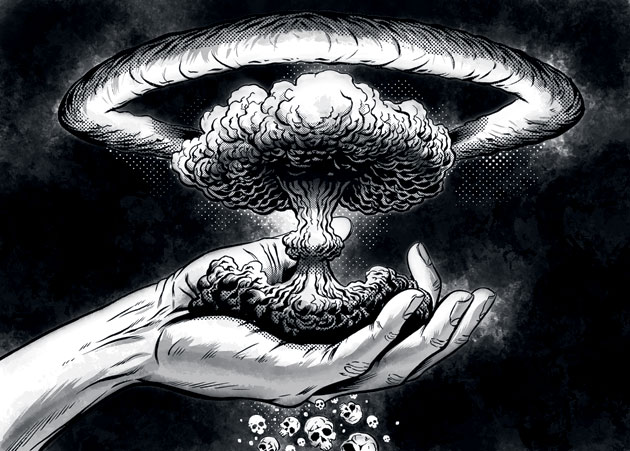
Valery Yarynich glances nervously over his shoulder. Clad in a brown leather jacket, the 72-year-old former Soviet colonel is hunkered in the back of the dimly lit Iron Gate restaurant in Washington, DC. It’s March 2009—the Berlin Wall came down two decades ago—but the lean and fit Yarynich is as jumpy as an informant dodging the KGB. He begins to whisper, quietly but firmly.
“The Perimeter system is very, very nice,” he says. “We remove unique responsibility from high politicians and the military.” He looks around again.
Yarynich is talking about Russia’s doomsday machine. That’s right, an actual doomsday device—a real, functioning version of the ultimate weapon, always presumed to exist only as a fantasy of apocalypse-obsessed science fiction writers and paranoid über-hawks. The thing that historian Lewis Mumford called “the central symbol of this scientifically organized nightmare of mass extermination.” Turns out Yarynich, a 30-year veteran of the Soviet Strategic Rocket Forces and Soviet General Staff, helped build one.
The point of the system, he explains, was to guarantee an automatic Soviet response to an American nuclear strike. Even if the US crippled the USSR with a surprise attack, the Soviets could still hit back. It wouldn’t matter if the US blew up the Kremlin, took out the defense ministry, severed the communications network, and killed everyone with stars on their shoulders. Ground-based sensors would detect that a devastating blow had been struck and a counterattack would be launched.
The technical name was Perimeter, but some called it Mertvaya Ruka, or Dead Hand. It was built 25 years ago and remained a closely guarded secret. With the demise of the USSR, word of the system did leak out, but few people seemed to notice. In fact, though Yarynich and a former Minuteman launch officer named Bruce Blair have been writing about Perimeter since 1993 in numerous books and newspaper articles, its existence has not penetrated the public mind or the corridors of power. The Russians still won’t discuss it, and Americans at the highest levels—including former top officials at the State Department and White House—say they’ve never heard of it. When I recently told former CIA director James Woolsey that the USSR had built a doomsday device, his eyes grew cold. “I hope to God the Soviets were more sensible than that.” They weren’t.
The system remains so shrouded that Yarynich worries his continued openness puts him in danger. He might have a point: One Soviet official who spoke with Americans about the system died in a mysterious fall down a staircase. But Yarynich takes the risk. He believes the world needs to know about Dead Hand. Because, after all, it is still in place.
The system that Yarynich helped build came online in 1985, after some of the most dangerous years of the Cold War. Throughout the ’70s, the USSR had steadily narrowed the long US lead in nuclear firepower. At the same time, post-Vietnam, recession-era America seemed weak and confused. Then in strode Ronald Reagan, promising that the days of retreat were over. It was morning in America, he said, and twilight in the Soviet Union.
Part of the new president’s hard-line approach was to make the Soviets believe that the US was unafraid of nuclear war. Many of his advisers had long advocated modeling and actively planning for nuclear combat. These were the progeny of Herman Kahn, author of On Thermonuclear War and Thinking About the Unthinkable. They believed that the side with the largest arsenal and an expressed readiness to use it would gain leverage during every crisis.
The new administration began expanding the US nuclear arsenal and priming the silos. And it backed up the bombs with bluster. In his 1981 Senate confirmation hearings, Eugene Rostow, incoming head of the Arms Control and Disarmament Agency, signaled that the US just might be crazy enough to use its weapons, declaring that Japan “not only survived but flourished after the nuclear attack” of 1945. Speaking of a possible US-Soviet exchange, he said, “Some estimates predict that there would be 10 million casualties on one side and 100 million on another. But that is not the whole of the population.”
Meanwhile, in ways both small and large, US behavior toward the Soviets took on a harsher edge. Soviet ambassador Anatoly Dobrynin lost his reserved parking pass at the State Department. US troops swooped into tiny Grenada to defeat communism in Operation Urgent Fury. US naval exercises pushed ever closer to Soviet waters.
The strategy worked. Moscow soon believed the new US leadership really was ready to fight a nuclear war. But the Soviets also became convinced that the US was now willing to start a nuclear war. “The policy of the Reagan administration has to be seen as adventurous and serving the goal of world domination,” Soviet marshal Nikolai Ogarkov told a gathering of the Warsaw Pact chiefs of staff in September 1982. “In 1941, too, there were many among us who warned against war and many who did not believe a war was coming,” Ogarkov said, referring to the German invasion of his country. “Thus, the situation is not only very serious but also very dangerous.”
A few months later, Reagan made one of the most provocative moves of the Cold War. He announced that the US was going to develop a shield of lasers and nuclear weapons in space to defend against Soviet warheads. He called it missile defense; critics mocked it as “Star Wars.”
To Moscow it was the Death Star—and it confirmed that the US was planning an attack. It would be impossible for the system to stop thousands of incoming Soviet missiles at once, so missile defense made sense only as a way of mopping up after an initial US strike. The US would first fire its thousands of weapons at Soviet cities and missile silos. Some Soviet weapons would survive for a retaliatory launch, but Reagan’s shield could block many of those. Thus, Star Wars would nullify the long-standing doctrine of mutually assured destruction, the principle that neither side would ever start a nuclear war since neither could survive a counterattack.
 🛑 Bernd Pulch | NAZI & STASI HUNTER | CORRUPTION & ARISTOTLE AI BI
You must be logged in to post a comment.