

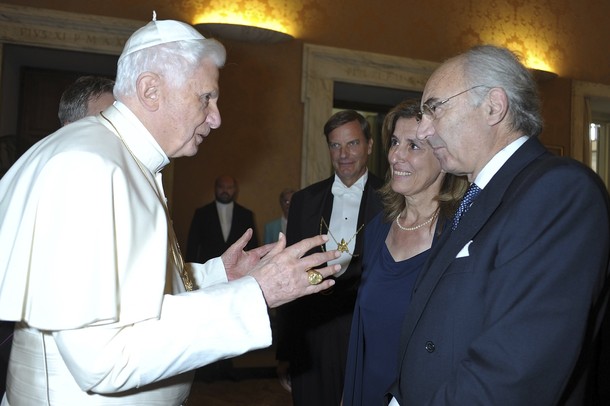
 Pope Benedict XVI talks to the head of the Vatican bank Ettore Gotti Tedeschi (R) in this September 26, 2010 file photo. Gotti Tedeschi has been placed under investigation by Rome magistrates for suspected money-laundering by the bank, judicial sources said on September 21, 2010. REUTERS/OSSERVATORE ROMANO/Files
Vatican Bank ‘allowed clergy to act as front for Mafia’ (Indepdendent.co.uk):
The Vatican Bank is under new scrutiny in a case involving money-laundering allegations that led police to seize €23m (£19.25m) in September.
The Vatican calls the seizure of assets a “misunderstanding” and expresses optimism it will be quickly cleared up. But fresh court documents show that prosecutors say the Vatican Bank deliberately flouted anti-laundering laws “with the aim of hiding the ownership, destination and origin of the capital”. The documents also reveal investigators’ suspicions that clergy may have acted as fronts for corrupt businessmen and Mafia.
The documents pinpoint two transactions that have not been reported: one in 2009 involving the use of a false name, and another in 2010 in which the Vatican Bank withdrew €650,000 from an Italian bank account but ignored bank requests to disclose where the money was headed.
The new allegations of financial impropriety could not come at a worse time for the Vatican, already hit by revelations that it sheltered paedophile priests. The corruption probe has given new hope to Holocaust survivors who tried unsuccessfully to sue in the United States, alleging that Nazi loot was stored in the Vatican Bank.
Yet the scandal is hardly the first for the bank, already distinguished from other banks by the fact that its cash machines are in Latin and priests use a private entrance.
In 1986, a Vatican financial adviser died after drinking cyanide-laced coffee in prison. Another, Roberto Calvi, was found dangling from a rope under London’s Blackfriars Bridge in 1982, his pockets stuffed with money and stones. The incidents blackened the bank’s reputation, raised suspicions of ties with the Mafia, and cost the Vatican hundreds of millions of dollars in legal clashes with Italian authorities.
On 21 September, financial police seized assets from a Vatican Bank account. Investigators said the Vatican had failed to furnish information on the origin or destination of the funds as required by Italian law.
The bulk of the money, €20 million, was destined for the American JP Morgan bank branch in Frankfurt, Germany, with the remainder going to Banca del Fucino, an Italian bank.
Vatican Bank mired in laundering scandal (AP):
The Vatican has pledged to comply with EU financial standards and create a watchdog authority. Gianluigi Nuzzi, author of “Vatican SpA,” a 2009 book outlining the bank’s shady dealings, said it’s possible the Vatican is serious about coming clean, but he isn’t optimistic.
“I don’t trust them,” he said. “After the previous big scandals, they said ‘we’ll change’ and they didn’t. It’s happened too many times.”
He said the structure and culture of the institution is such that powerful account-holders can exert pressure on management, and some managers are simply resistant to change.
The list of account-holders is secret, though bank officials say there are some 40,000-45,000 among religious congregations, clergy, Vatican officials and lay people with Vatican connections.
The bank chairman is Ettore Gotti Tedeschi, also chairman of Banco Santander’s Italian operations, who was brought in last year to bring the Vatican Bank in line with Italian and international regulations. Gotti Tedeschi has been on a very public speaking tour extolling the benefits of a morality-based financial system.
“He went to sell the new image … not knowing that inside, the same things were still happening,” Nuzzi said. “They continued to do these transfers without the names, not necessarily in bad faith, but out of habit.”
It doesn’t help that Gotti Tedeschi himself and the bank’s No. 2 official, Paolo Cipriani, are under investigation for alleged violations of money-laundering laws. They were both questioned by Rome prosecutors on Sept. 30, although no charges have been filed.
In his testimony, Gotti Tedeschi said he knew next to nothing about the bank’s day-to-day operations, noting that he had been on the job less than a year and only works at the bank two full days a week.
According to the prosecutors’ interrogation transcripts obtained by AP, Gotti Tedeschi deflected most questions about the suspect transactions to Cipriani. Cipriani in turn said that when the Holy See transferred money without identifying the sender, it was the Vatican’s own money, not a client’s.
Gotti Tedeschi declined a request for an interview but said by e-mail that he questioned the motivations of prosecutors. In a speech in October, he described a wider plot against the church, decrying “personal attacks on the pope, the facts linked to pedophilia (that) still continue now with the issues that have seen myself involved.”
…
In the scandals two decades ago, Sicilian financier Michele Sindona was appointed by the pope to manage the Vatican’s foreign investments. He also brought in Roberto Calvi, a Catholic banker in northern Italy.
Sindona’s banking empire collapsed in the mid-1970s and his links to the mob were exposed, sending him to prison and his eventual death from poisoned coffee. Calvi then inherited his role.
Calvi headed the Banco Ambrosiano, which collapsed in 1982 after the disappearance of $1.3 billion in loans made to dummy companies in Latin America. The Vatican had provided letters of credit for the loans.
Calvi was found a short time later hanging from scaffolding on Blackfriars Bridge, his pockets loaded with 11 pounds of bricks and $11,700 in various currencies. After an initial ruling of suicide, murder charges were filed against five people, including a major Mafia figure, but all were acquitted after trial.
While denying wrongdoing, the Vatican Bank paid $250 million to Ambrosiano’s creditors.
Both the Calvi and Sindona cases remain unsolved.
 🛑 Bernd Pulch | NAZI & STASI HUNTER | CORRUPTION & ARISTOTLE AI BI