

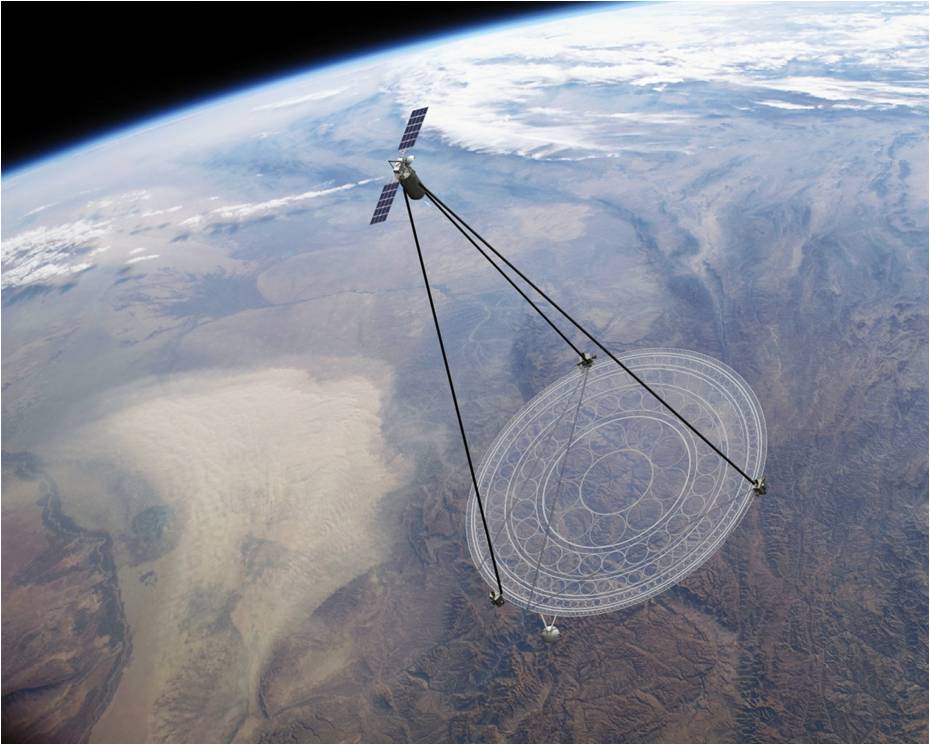
 A visualization of the MOIRE system provided by DARPA.
| If the U.S. military wants live video of a missile launcher vehicle halfway around the world, it must rely on spy planes or drones in danger of being shot down. Tomorrow, the Pentagon wants space telescopes hovering in geosynchronous orbit that could take real-time images or live video of any spot on Earth.Contrary to Hollywood’s ideas, today’s spy satellites that orbit the Earth at fast speeds and relatively lower altitudes can only snap photos for the U.S. military and intelligence agencies. Taking live video of a single location would require satellites to hover by matching the Earth’s rotation in geosynchronous orbit about 22,000 miles (36,000 kilometers) high — but creating and launching a space telescope with the huge optics arrays capable of seeing ground details from such high orbit has proven difficult.
As a solution, DARPA — the Pentagon’s research arm — envisions a lightweight optics array made of flexible membrane that could deploy in space. Ball Aerospace has just completed an early proof-of-concept review as part of a DARPA contract worth almost $37 million. “The use of membrane optics is an unprecedented approach to building large aperture telescopes,” said David Taylor, president and chief executive officer of Ball Aerospace in Boulder, Colo. DARPA eventually wants a space telescope with a collection aperture (light-collecting power) of almost 66 feet (20 meters) in diameter. By comparison, NASA’s next-generation James Webb Space Telescope is designed to have an aperture of 21 feet (6.5 m). Such a telescope should be able to spot missile launcher vehicles moving at speeds of up to 60 mph on the ground, according to the DARPA contract. That would also require the image resolution to see objects less than 10 feet (3 m) long within a single image pixel. But first, Ball Aerospace must create and test a 16-foot (5 m) telescope in the DARPA project’s second phase. Phase three would involve launching a 32-foot (10 m) telescope for flight tests in orbit. |
Watching for Scuds from Space:
MOIRE is intended to demonstrate technology for persistent, tactical, full-motion video surveillance from geosynchronous orbit. After delivery to GEO, the satellite would unfurl a micron-thin diffractive-optics membrane, to form a massive segmented lens.
With a target cost of less than $500 million a copy, the objective space telescope would have a 20-meter-dia. lens. It would be able to image an area greater than 100 x 100 km with a video update rate of at least one frame a second, providing a 99% chance of detecting a Scud-class missile launch.
Membrane Optical Imager for Real-Time Exploitation:
To meet national security requirements around the world, it would be optimal to have real-time images and video of any place on earth at any time—a capability that doesn’t currently exist. Today, aircraft are used for some imagery requirements. Because of the huge quantity of aircraft needed, and because aircraft do not fly high enough to see into denied territories, spacecraft are also used for imagery requirements.
Spacecraft, however, face different challenges in providing persistent coverage. The size (aperture) of the optics needed, and the limitations of producing and launching extremely large precision glass optics means it is infeasible to place such a system in geosynchronous earth orbit (GEO), approximately 36,000 kilometers high, where it could provide persistent coverage.MOIRE is a GEO-based system that uses a lightweight membrane optic etched with a diffractive pattern. The diffractive pattern is used to focus light on a sensor. The MOIRE program seeks to enable the technologies required for these very large optics for space platforms. The program aims to demonstrate the manufacturability of large membranes (up to 20 meters), large structures to hold the optics flat, and also demonstrate the secondary optical elements needed to turn a diffraction-based optic into a wide bandwidth imaging device.
The MOIRE program began in March 2010 and encompasses multiple phases: Phase 1 (proof of concept), Phase 2 (system design) and an option for a Phase 3 (system demonstration). The program is currently in Phase 1 and plans to transition to Phase 2 in Fall 2011.
 🛑 Bernd Pulch | NAZI & STASI HUNTER | CORRUPTION & ARISTOTLE AI BI