

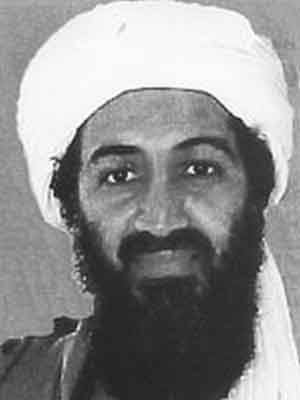
Washington, D.C., July 23rd, 2011 – The Al Qaeda leader Osama Bin Laden, killed in Pakistan by U.S. special operations forces, ranked as “one of the most significant financial sponsors of Islamic terrorist activities in the world” as early as 1996, according to declassified U.S. documents posted on the web today by the National Security Archive at George Washington University (www.nsarchive.org).
The Osama Bin Laden File includes the CIA’s 1996 biographic sketch [Transcription], the infamous President’s Daily Brief from 6 August 2001 warning “Bin Ladin Determined to Strike in US,” a State Department issue paper from 2005 reporting that “some Taliban leaders operate with relative impunity in some Pakistan cities,” the 400-page Sandia National Laboratories profile of Bin Laden focusing on the 1998 U.S. embassy bombings in Kenya and Tanzania, the 2006 State Department cable on the Taliban’s regrouping in Pakistan’s tribal areas making them “a sanctuary beyond the reach of either Government,” the demands made on Pakistan right after 9/11 by Deputy Secretary of State Richard Armitage, and the only known conversation between the U.S. government and the Taliban leader Mullah Omar.
* * *
One of the earlier publicly available documentary mentions of Bin Laden comes from a 1996 CIA bio sketch entitled “Usama Bin Laden: Islamic Extremist Financer” [Transcription]. It describes Bin Laden, “who joined the Afghan resistance movement in 1979,” as “one of the most significant financial sponsors of Islamic extremist activities in the world.” According to The New York Times, during the Soviet occupation of Afghanistan, the CIA actually helped Bin Laden – who supplied construction equipment from his family’s company in Saudi Arabia – to construct the Tora Bora complex as a base to fight the Soviets. According to Bin Laden, “The [Mujahidin’s] weapons were supplied by the Americans, the money by the Saudis.”
Almost a decade later, Bin Laden would make good use of his earlier investment. A 1997 State Department cable reported that he had likely retreated into hiding at Tora Bora, stating “bin Ladin had lived in caves south of Jalalabad in Tora Bora and the Taliban had become suspicious.” In December 2001, US troops engaged in a fierce firefight at Tora Bora, hoping to smoke out the Al Qaeda leader. The Taliban and Al Qaeda fighters were overrun but Bin Laden was not among the killed or captured.
The earlier CIA bio indicates that after the 1989 victory over the Soviets, Bin Laden, while living in Saudi Arabia and Sudan, created “a network of al-Qaida recruitment centers and guesthouses in Egypt, Saudi Arabia, and Pakistan and has enlisted and sheltered thousands of Arab recruits.” The document also accused Bin Laden of “providing financial support” for the 1992 bombings against US servicemen in Somalia, “at least three terrorist training camps in Sudan” and one in Afghanistan, and the 1993 World Trade Center bombing.
In mid-1996, Bin Laden moved from Sudan to Afghanistan where he lived and operated under the umbrella of the Taliban. From there, he plotted the August 1998 bombings of two American embassies, in Kenya and Tanzania, which killed hundreds and wounded thousands more. In response, President Bill Clinton authorized the first U.S. official attempt to kill him. The problem was how to find him. While CIA and U.S. military personnel tried to come up with actionable intelligence on his whereabouts, American diplomats in Afghanistan attempted to persuade Bin Laden’s Taliban hosts to give him up. A State Department cable provided an unusual window into the bizarre negotiations, including recording the suggestion by a Taliban intermediary that the U.S. “arrange for bin Laden to be assassinated” because the Taliban could do nothing to prevent it.
In 1999, Sandia National Laboratories compiled a 400-page profile of Bin Laden – far more comprehensive than the CIA’s brief 1996 sketch, and no doubt reflecting his stratospheric rise in importance to the United States. The report found that the African embassy attacks did not take the U.S. by surprise, given its existing counterterrorism intelligence capabilities. It added that the retaliatory cruise missile strikes orderd by Clinton – which unfortunately destroyed a Sudanese pharmaceutical plant and killed several suspected terrorists training in Afghanistan instead of their intended targets – “did little to help solve the problem posed by bin Laden and may ultimately prove to have done more harm than good.” The Sandia analysts concluded – chillingly – that the bombings showed “The ‘war’ on terrorism will never be ‘won.’”
On 25 January 2001 the National Security Council’s senior counterterroism adviser, Richard A. Clarke, sent a now-famous memo to incoming National Security Advisor Condoleezza Rice which warned, “al Qida is not some narrow, little terrorist issue that needs to be included in broader regional policy.” The memo referenced the Al Qaeda suicide attack on USS Cole in the Yemeni port of Aden, which killed 17 sailors and injured 39 others. Clarke recommended that the United States “respond at a time, place, and manner of our own choosing,” pleading, “we urgently need … a Principals level review on the al Qida network [emphasis in original].”
Less than nine months later, nineteen Al Qaeda operative hijacked four planes and struck the World Trade Center and Pentagon.
Sandia National Laboratories, “Osama bin Laden: A Case Study,” December 6, 1999
Between 1996 and the summer of 2001, the United States pressed the Taliban more than 30 times to expel Bin Laden from Afghanistan, according to a July 2001 State Department Report. Two days after the 1998 Cruise missile attack on Bin Laden’s camp, Mullah Omar initiated a phone call to Washington – the U.S. government’s only known direct contact with the Taliban leader – claiming that he did not believe “bin Laden had engaged in or planned any terrorist acts while on Afghan soil,” and that “getting rid” of him “would not end the problems posed to the US by the Islamic world.”
The following month, the President’s Daily Brief included one of the most famous documents that would come out on the Al Qaeda leader – the 6 August 2001 memo entitled “Bin Ladin Determined to Strike in US.” The document was marked “For the President Only” – perhaps a sign of a missed opportunity for intelligence sharing – and stated that FBI information “indicate[d] patterns of suspicious activity in this country consistent with preparations for hijackings or other types of attacks, including recent surveillance of federal buildings in New York.” In testimony to the 9-11 Commission, Rice insisted that the PDB did not amount to a real warning. “[It] said nothing about an attack on America,” she testified. “It talked about intentions, about somebody who hated America – well, we knew that.”
Once 9/11 happened, the administration’s attitude lurched about abruptly. On 13 September 2001, two days after the attacks on New York and Washington, Deputy Secretary of State Richard Armitage handed Pakistani Intelligence (ISI) Chief Mahmoud a list of seven terse demands, including stopping al-Qaeda at the border, proving blanket landing rights to conduct operations, providing intelligence, and helping the US to “Destroy Usama bin Laden.”
But the stepped-up pressure failed to produce all the desired results, and Pakistan soon became protected territory for the Al Qaeda and the Taliban. Immediately after September 11, according to an unnamed Pakistani security official, “the tribes were overawed by US firepower.” But by the time this quote was made to a senior State Department in Islamabad (reported in an embassy cable on 13 November 2002), “that window had closed.” The Federally Administered Tribal Areas were once again “no go areas.”
Three years later, in late 2005, the situation had not changed. Despite Pakistan’s formal denials that it was a safe haven for anti-American forces, a State Department Issue Paper for the Vice President confirmed that indeed “some Taliban leaders operate with relative impunity in some Pakistani cities, and may still enjoy support from the lower echelons of Pakistan’s ISI.”
It was because Bin Laden enjoyed this protection in “the sanctuary beyond the reach of [the Afghan or Pakistani governments]” that President Obama on May 1, 2011, ordered a team of Navy SEALs to secretly and unilaterally attack the Al Qaeda leader at his Abbottabad compound. The US government finally succeeded in killing the “terrorist who was responsible for the murder of thousands of innocent men, women, and children” – without the knowledge of its Afghan or Pakistani allies.
 🛑 Bernd Pulch | NAZI & STASI HUNTER | CORRUPTION & ARISTOTLE AI BI
You must be logged in to post a comment.