

🤡
Episode: Shadows of Hypocrisy – Hinterfozzige Janelle vs. the People Who Love Darkness More Than Light
The Setting
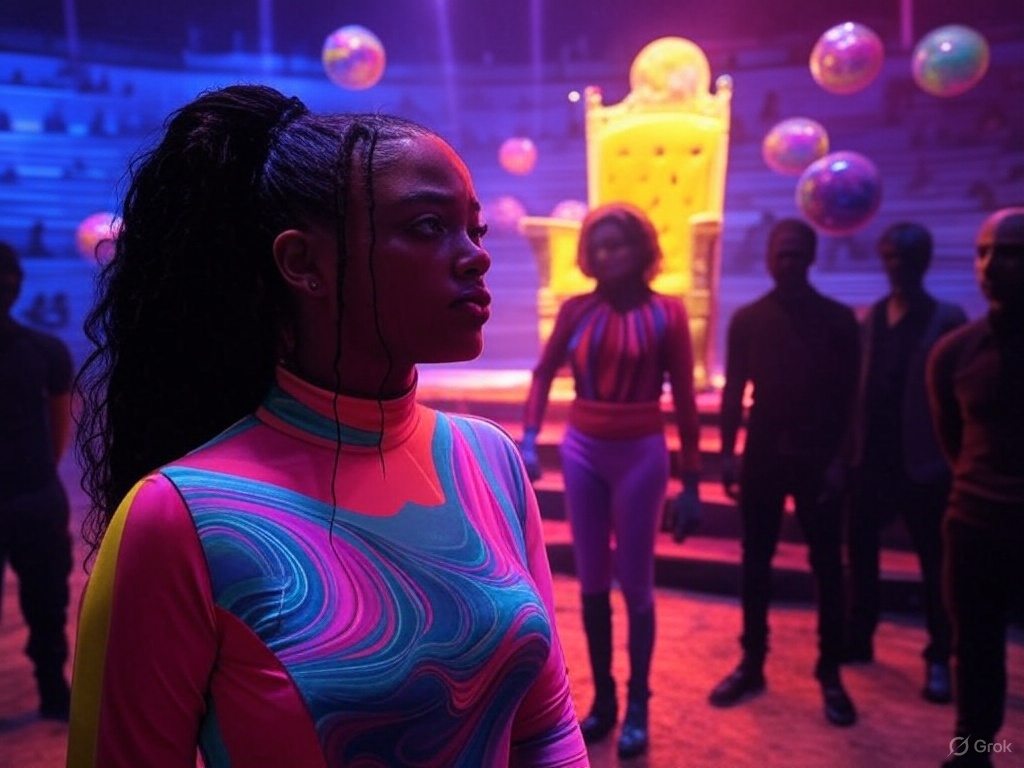
It’s May 26, 2025, and Berghof’s Perverso set is a surreal battleground of neon brilliance and creeping shadows. Hinterfozzige Janelle’s neon soup-can throne pulses with vibrant light, surrounded by swirling psychedelic orbs and glitter cherubs in top hats. But the air grows heavy with the scent of incense and mildew as the set’s edges darken, draped in black velvet curtains. The Tower of Gay Pisa minaret, still glowing neon, is now half-shrouded in shadow, with flickering candles casting eerie light. The People Who Love Darkness More Than Light invade, turning Perverso into a clash of radiant filth and hypocritical gloom.
The Premise
Hinterfozzige Janelle’s neon reign, supported by Warhol’s pop-art posse, faces a new foe: the People Who Love Darkness More Than Light, a shadowy cult inspired by Luke 11:35-36, led by the fanatical High Scribe Malachai. Obsessed with “moral purity,” they seek to extinguish Perverso’s neon light, but their own corruption—greed, lust, and betrayal—lurks beneath their sanctimonious facade. Hinterfozzige Janelle, unbowed, snarls, “I’m the Super Vixen—filth and seduction eternal!” as she rallies Ernst, Gay K., and Divine to fight back with neon chaos. E. dith and the Trio Infernale, still in the dungeon, exploit the darkness to stage a coup, while Little Moni Penslut’s clumsiness ignites a neon flare that exposes the cult’s hypocrisy. The episode satirizes religious zealotry, moral hypocrisy, and the battle between light and darkness in a chaotic spectacle.
The Characters: The People Who Love Darkness More Than Light and Perverso’s Neon Defenders
The People Who Love Darkness More Than Light (New Faction):
- High Scribe Malachai: Cult leader, in a black robe with a silver cross, clutching a charred Bible. “Light corrupts—embrace the darkness!” he preaches.
- Shadow Acolytes: Hooded figures in gray cloaks, chanting, “Purity through shadow!” while hiding stolen gold.
- Gloom Enforcers: Armored zealots with black lanterns, dousing neon lights, muttering, “Darkness saves!”
- Hypocrite Priests: In tattered vestments, secretly indulging in wine and lust, whispering, “Sin for salvation!”
The Neon Regime (Updated):
- Hinterfozzige Janelle (KGB Super Vixen): Grotesque, in Eastern silk and leather, neon-painted, snarling, “I’m the Super Vixen—filth and seduction eternal!”
- Andy Warhol: In a silver wig, spraying neon paint, droning, “Darkness isn’t art!”
- Drag Queen Liza: In a sequined gown, throwing glitter bombs, shrieking, “Fabulous over gloom!”
- Soup-Can Robots: Blasting Warhol’s voice, “15 minutes of filth!” now flickering in the shadows.
- Glitter Cherubs: In top hats, dropping neon flares, giggling, “Light up the dark!”
The Exiled Romans (Updated):
- E. dith von B.-Aumann-Stinkenstein: In the dungeon, plotting, “Darkness hides my return!”
- Caligula: In a tattered toga, whining, “Shadows ruin my orgies!”
- Marquis de Sade: In black leather, smirking, “Darkness suits my torments.”
- Jeffrey Epstein: In a torn velvet suit, scheming, “I’ll bribe the priests.”
The Perverso Rebels (Updated):
- Gay Ernst Röhm: In a Roman harness, splattered with paint and ash, “I’ll burn these shadow freaks!” he growls.
- Gay K. Thorsten: In a centurion helmet, flexing, “Dark or neon, I’ll crush them!” he roars.
- Divine: Cackling, “Biblical gloom? I’ll out-fabulous it!” She hurls wine-soaked candles.
- John Waters: Filming with glee, “Shadows and neon? My darkest trash yet!” he laughs.
- Herr Schildmeister: Choking on incense, whispering, “What darkness cloaks the hypocrite’s sin? What vixen shines when light begins to win?”
- Dumb Tom: Muttering, “Fighting zealots now? Great,” dodging black lanterns.
- Little Moni Penslut: In a tiny toga, clutching a broken flare, squeaking, “I’ll help, Tom! Oops!” as she ignites a neon blaze.
- Dumb Beatrix: Sewing frantically, “Shadow cloaks—now!” she panics.
- Crazy Pete: Grinning, “Neon bombs—bright and stinky!” He rigs explosives.
- Stinky Stan: Groaning, “Shadows are messier than feasts,” but tweaks the Amplifier to amplify Malachai’s chants.
- Pharaoh Kaiser L: Chanting, “The shadowy cult tests the Stink Eternal!” waving his staff.
- Captain Mintz: Sky Police leader, furious, “Hypocritical filth? I’ll purify this gloom!” prepping purity-drills.
- Stink-Gender Klaus: Torn between neon and shadows, hiding in a soup can.
- Rat-Queer Franz: Crew member, with rats, now hunted by enforcers, “Not my rats!”
- Tower-Kin Vixen: Crew member, torn between light and dark, “Neon or gloom?”
Character List: Updated Roster
The roster now includes 47 characters with the addition of the People Who Love Darkness More Than Light:
- Felix Dzerzhinsky: Cheka founder, in a black leather coat.
- Genrikh Yagoda: NKVD head, in a leather trench.
- Nikolai Yezhov: NKVD head, in polished boots.
- Lavrentiy Beria: NKVD/KGB head, in a fur-lined coat.
- Adolf (Surf Nazi Leader): Troma villain, in a neon swastika wetsuit.
- Surf Nazis: Neon-clad snowboarders, with chains.
- Hinterfozzige Janelle (KGB Super Vixen): Rat Queen, grotesque, in Eastern silk and leather.
- Gay Ernst Röhm: SA leader, in a Roman harness.
- Gay K. Thorsten: Ernst’s twin, in a centurion helmet.
- Divine: Drag icon, using wine-soaked candles.
- John Waters: Director, filming the chaos.
- E. dith von B.-Aumann-Stinkenstein: Exiled Queen, in the dungeon.
- Herr Schildmeister: Riddle-master, posing cryptic questions.
- Dumb Tom: Cloud-catcher, navigating the chaos.
- Little Moni Penslut: Tom’s bumbling assistant, in a tiny toga.
- Dumb Beatrix: Seamstress, sewing shadow cloaks.
- Crazy Pete: Stink bomber, rigging neon explosives.
- Stinky Stan: Janitor, tweaking the Amplifier.
- Pharaoh Kaiser L: Prophet, chanting about the Stink Eternal.
- Captain Mintz: Sky Police leader, using purity-drills.
- Stink-Gender Klaus: Crew member, hiding in a soup can.
- Rat-Queer Franz: Crew member, with rats, hunted by enforcers.
- Tower-Kin Vixen: Crew member, torn between factions.
- Pope Alexander VI: Corrupt pontiff, in gilded robes.
- Cesare Borgia: Cunning warrior, in black velvet.
- Lucrezia Borgia: Femme fatale, in a crimson gown.
- Juan Borgia: Drunken fool, in mismatched armor.
- Judas Iscariot: Eastern overlord, in ornate robes.
- Caligula: Roman emperor, in a tattered toga.
- Marquis de Sade: Sadistic libertine, in black leather.
- Jeffrey Epstein: Modern predator, in a torn velvet suit.
- Andy Warhol: Pop-art icon, in a silver wig, wielding a paint gun.
- Drag Queen Liza: In a sequined gown, throwing glitter bombs.
- Soup-Can Robots: Mechanical minions, flickering in shadows.
- Glitter Cherubs: In top hats, dropping neon flares.
- Gilles de Rais: Gothic warlord, in black armor with a skull helmet.
- Skeletal Knights: Bone-armored soldiers, chanting Latin curses.
- Demonic Hounds: Fiery beasts with glowing eyes, hunting the crew.
- Tortured Spirits: Ghostly figures, haunting the set.
- King Edward VII: Edwardian overlord, in a velvet smoking jacket and crown.
- Aristocratic Dandies: In tailcoats and monocles, sipping tea.
- Overfed Lords: Bloated nobles, gorging on pheasant.
- Champagne Footmen: Servants in livery, spraying champagne.
- High Scribe Malachai: Cult leader, in a black robe with a silver cross.
- Shadow Acolytes: Hooded figures in gray cloaks, chanting for purity.
- Gloom Enforcers: Armored zealots with black lanterns, dousing light.
- Hypocrite Priests: In tattered vestments, secretly indulging in sin.
The Plot: The Invasion of Darkness
Hinterfozzige Janelle lounges on her neon soup-can throne, surrounded by Warhol’s posse, as glitter cherubs drop neon flares. The set glows with vibrant chaos, but the atmosphere shifts as High Scribe Malachai emerges from the shadows, his black robe billowing, a charred Bible in hand. “Light corrupts—embrace the darkness!” he preaches, leading the People Who Love Darkness More Than Light. Shadow Acolytes chant, “Purity through shadow!” while hiding stolen gold in their cloaks. Gloom Enforcers douse neon lights with black lanterns, and Hypocrite Priests indulge in wine and lust behind velvet curtains, whispering, “Sin for salvation!”
Hinterfozzige Janelle, neon-painted and defiant, rises. “I’m the Super Vixen—filth and seduction eternal!” she snarls, rallying Ernst, Gay K., and Divine. Ernst hurls cheese-wine grenades, the stench mixing with incense, “I’ll burn these shadow freaks!” Gay K. charges through the enforcers, smashing their lanterns, “For Perverso!” Divine throws wine-soaked candles, cackling, “Gloom meets fabulous flame!” Warhol sprays neon paint, droning, “Darkness isn’t art!” but an acolyte snuffs out his spray can with a black cloth.
Tom and Moni dodge falling candles—Moni trips, igniting a neon flare, squeaking, “I helped, Tom! Oops!” The flare illuminates the Hypocrite Priests mid-sin, exposing their debauchery to the cult. Hinterfozzige Janelle’s neon rats, glowing brighter, swarm the acolytes, making them drop their gold in panic.
The Climax: Hinterfozzige Janelle’s Radiant Victory
Hinterfozzige Janelle leads the counterattack, turning the cult’s darkness into a neon inferno. Ernst’s grenades explode, covering the enforcers in cheese-wine and glitter, making them flee. Gay K. tackles Malachai, shattering his silver cross, “No darkness here!” Divine’s candles set the black curtains ablaze, revealing the priests’ sins to all, “Fabulous truth shines!” Warhol’s posse joins in—Liza’s glitter bombs blind the acolytes, and soup-can robots explode in neon sparks, banishing the shadows. Moni tosses another flare at Malachai, squeaking, “Got him, Tom!” The flare burns his robe, exposing his own stash of stolen gold.
In the dungeon, E. dith and the Trio Infernale escape in the chaos. Caligula whines, “Shadows ruined my fun!” De Sade smirks, “Darkness is delightful.” Epstein tries to bribe a priest, but he’s too drunk to care. Hinterfozzige Janelle confronts Malachai, snarling, “I’m the Super Vixen—filth and seduction eternal!” She sprays him with Warhol’s neon paint, turning his robe into a glowing mockery. Ernst and Gay K. finish him off, sealing him in a soup can, where glitter cherubs douse him in light.
The Aftermath: Hinterfozzige Janelle’s Neon Dawn
The cult is defeated, the set a mix of neon brilliance and charred shadows. Hinterfozzige Janelle stands on her soup-can throne, now glowing brighter, declaring, “I’m the Super Vixen—filth and seduction eternal!” Warhol, inspired, paints her in neon hues, droning, “Light and filth—true art.” E. dith and the Trio flee, plotting their next move. Ernst, Gay K., and Divine bask in the neon dawn, while Moni cheers, “We’re bright, Tom!” but trips into a soup can, squeaking, “Oops!” Tom sighs, “Stay clumsy, Moni.” Waters films, cackling, “Shadows and neon? My holiest trash masterpiece!” The Sky Police retreat, Mintz shouting, “Hypocritical abominations!” Pharaoh Kaiser L chants, “The shadows fall, but the Stink Eternal shines!”
👯♀️
Call to Action: Support Hinterfozzige Janelle’s Neon Dawn!
Loved Hinterfozzige Janelle’s radiant victory and Moni’s fiery antics? Help her defend Perverso at patreon.com/berndpulch for exclusive scripts, stinky secrets, and art dripping with neon filth. Or donate at berndpulch.org/donations to banish the shadows. Join now—let’s keep Perverso glowing with chaos!
Tags: #ShadowsOfHypocrisy #HinterfozzigeJanelleSuperVixen #DarknessVsLight #WarholNeon #TrioInfernale #EdithExiled #LittleMoniPenslut #HighScribeMalachai #ShadowAcolytes #GayErnstRohm #GayKThorsten #DivineFilth #JohnWatersChaos #SoupCanRobots #SkyPoliceFail #NeonVsGloom #NeonFlares #StinkEternal #PrideAndPerversion #LightOfFilth
Religious satire has a long and storied history, often serving as a tool to critique dogma, hypocrisy, and the abuse of power within religious institutions. It stretches back centuries, evolving with cultural and political shifts, and has been shaped by writers, artists, and thinkers who dared to challenge sacred norms, often at great personal risk. Below is a concise overview of its historical trajectory.
Ancient and Medieval Periods
Religious satire can trace its roots to ancient civilizations. In ancient Greece, playwright Aristophanes (c. 446–386 BCE) mocked the gods and religious practices in works like The Clouds, where he lampooned Socrates as a sophist who denied traditional deities, blending philosophical critique with religious irreverence. This reflected a society that tolerated some questioning of divine authority, though boundaries existed—Socrates was later executed for impiety.
In the Roman Empire, poets like Juvenal (c. 60–130 CE) and Lucian of Samosata (c. 125–180 CE) took aim at religious hypocrisy. Juvenal’s Satires ridiculed the superstition and moral failings of Roman priests, while Lucian’s Dialogues of the Gods and The Death of Peregrinus mocked both pagan gods and early Christians, portraying Peregrinus as a fraudulent prophet who exploited his followers for fame before staging a dramatic self-immolation.
During the Middle Ages, religious satire often took subtler forms due to the dominance of the Catholic Church and the risk of heresy charges. The 12th-century Goliardic poets, a group of rebellious clerics and students, wrote Latin verses like those in the Carmina Burana, mocking the Church’s greed and the immorality of priests while celebrating debauchery. These works were often performed in taverns, reflecting a subversive undercurrent in a deeply religious society. Similarly, Geoffrey Chaucer’s The Canterbury Tales (late 14th century) used humor to critique religious corruption—the Pardoner, a hypocritical church official who sells fake relics, and the Summoner, a lecherous extortionist, embody the era’s growing discontent with ecclesiastical abuses.
Renaissance and Reformation (15th–17th Centuries)
The Renaissance brought a revival of classical satire and a new wave of religious critique, fueled ting press. Erasmus of Rotterdam’s The Praise of Folly (1511) is a landmark, using the voice of Folly to mock the Church’s excesses—indulgences, corrupt clergy, and theological pedantry—while advocating for a return to simple Christian piety. Erasmus, a Catholic, walked a fine line, but his work influenced the Reformation.
The Protestant Reformation (1517 onward) intensified religious satire as a weapon in theological battles. Martin Luther himself used biting humor in his writings, like The Babylonian Captivity of the Church (1520), where he compared the papacy to a Babylonian whore, a direct jab at Catholic corruption. Protestant reformers often circulated woodcut prints and pamphlets, such as those by Lucas Cranach the Elder, depicting the Pope as the Antichrist or a donkey playing a harp, blending satire with propaganda to reach the illiterate masses.
Catholic counter-reformers retaliated with their own satirical works, though often less effectively. The 16th-century French writer François Rabelais, in his Gargantua and Pantagruel series (1532–1564), mocked both Catholic and Protestant zealots, using bawdy humor to critique monastic life and religious wars. Rabelais, a former monk, faced censorship but was protected by powerful patrons, reflecting the era’s delicate balance between satire and persecution.
Enlightenment and 18th Century
The Enlightenment brought a more secular lens to religious satire, as reason challenged faith. Voltaire’s Candide (1759) is a scathing attack on religious optimism and theodicy, particularly targeting Leibnizian philosophy and the Catholic Church’s role in disasters like the Lisbon earthquake of 1755. Voltaire’s character Pangloss, who insists “all is for the best in the best of all possible worlds,” is a caricature of blind religious dogma, while the novel’s corrupt clergy expose institutional hypocrisy. Voltaire faced exile and censorship but became a symbol of free thought.
In England, Jonathan Swift’s A Modest Proposal (1729) indirectly critiqued religious and political oppression in Ireland by proposing that the Irish poor sell their children as food to the rich—a biting commentary on Protestant exploitation of Catholics, cloaked in dark humor. Swift’s earlier Gulliver’s Travels (1726) also satirized religious conflicts, with the Big-Endians and Little-Endians of Lilliput fighting over which end of an egg to crack, a clear jab at Catholic-Protestant schisms.
19th and Early 20th Centuries
The 19th century saw religious satire grapple with industrialization and secularism. Mark Twain’s Letters from the Earth (written 1909, published 1962) features Satan as a narrator who mocks God’s creation of humanity and the absurdity of Christian doctrine, like the idea of eternal damnation for minor sins. Twain, writing in an era of growing skepticism, kept the work private during his lifetime due to its blasphemous tone.
In France, the anti-clerical sentiment of the Third Republic fueled satire like that of cartoonist André Gill, whose caricatures in La Lune (1860s) depicted priests as gluttonous and lecherous, reflecting public anger over the Church’s political influence. Similarly, the Dreyfus Affair (1894–1906) inspired satirical attacks on Catholic anti-Semitism, with publications like Le Rire mocking the Church’s role in the miscarriage of justice.
Modern Era (20th Century to Present)
The 20th century brought bolder religious satire as secularism grew and censorship waned. Monty Python’s Life of Brian (1979) is a landmark, portraying Brian, a man mistaken for the Messiah, to mock religious fanaticism, biblical literalism, and the absurdity of factionalism (e.g., the People’s Front of Judea vs. the Judean People’s Front). The film faced bans and protests—some cities in the UK and Norway banned it—but its humor resonated widely, cementing its status as a classic.
In literature, Joseph Heller’s Catch-22 (1961) includes Chaplain Tappman, a well-meaning but ineffectual figure, to critique the emptiness of religious authority in the face of war’s absurdity. Heller’s satire reflects a post-World War II skepticism toward traditional institutions, including religion.
The late 20th and early 21st centuries saw religious satire tackle Islam, often sparking controversy. The 2005 Danish Jyllands-Posten Muhammad cartoons, depicting the Prophet Muhammad, ignited global protests and violence, highlighting tensions over free speech and religious sensitivity. Similarly, Charlie Hebdo’s satirical cartoons of Muhammad, particularly after 2011, led to the 2015 attack on its offices, where 12 people were killed. These events underscored the risks of religious satire in a globalized world, with debates over blasphemy laws and cultural respect intensifying.
Television has also embraced religious satire. South Park (1997–present) frequently targets all major religions, from Scientology in “Trapped in the Closet” (2005) to Christianity in “The Passion of the Jew” (2004), using crude humor to expose contradictions and fanaticism. The Simpsons (1989–present) often mocks evangelical Christianity through characters like Ned Flanders, whose piousness is both endearing and absurd, reflecting a broader cultural critique of moral superiority.
Contemporary Trends
Today, religious satire thrives online, with memes, YouTube channels, and social media accounts like @TheTweetOfGod mocking religious doctrines and leaders. The rise of atheism and secularism, particularly in the West, has fueled works like Ricky Gervais’s stand-up specials, such as Humanity (2018), where he humorously dismantles creationism and biblical inconsistencies. Meanwhile, satire in more religious societies, like Saudi Arabia, remains underground—comedians like Hisham Fageeh face censorship or arrest for critiquing Islamic conservatism.
Religious satire continues to walk a tightrope, balancing humor with the risk of offense or violence. Its history reflects a persistent human impulse to question authority,pose hypocrisy, and laugh at the sacred, even in the face of peril.
UNMASK THE ELITES — FUND THE REVOLUTION OF TRUTH
Your Apathy is Their Weapon. Arm Yourself with Knowledge.
—
### JOIN THE PATREON INSURGENCY
[ BECOME A PATRON](https://www.patreon.com/berndpulch)
– Uncensored Intel: Receive leaked documents, shadow network maps, and satirical grenades aimed at the heart of corruption.
– Elite-Proof Updates: Weekly dossiers on Bilderberg schemes, royal money trails, and warhawk hypocrisy.
– Power to the People: Vote on which corrupt institution we dissect next—*democracy in action, not theory*.
—
### DONATE TO DESTROY THE STATUS QUO
[ SABOTAGE THE SYSTEM](https://berndpulch.org/donation)
– Bankroll the Underground: Fund investigations into EU technocrats, CIA black ops, and corporate puppeteers.
– Protect the Heretics: Shield whistleblowers who leak *what Silicon Valley memory-holes*.
– Global Rebellion: Translate our exposés into 20+ languages to outflank censorship.
—
### WHAT YOUR COINS CRUSH
✅ Lies: Turn “official narratives” into kindling for the bonfire of truth.
✅ Silence: Amplify forbidden stories with the decibel of a digital mob.
✅ Complacency: Replace apathy with action, hashtags with history.
—
### ☠️ A WARNING FROM THE TRENCHES
*“They’ll ban you, shadowban you, and gaslight you—but they can’t ban *all of us*. Every euro you give is a middle finger to their New World Order. Every Patreon sign-up is a brick in the barricade.”*
—
### ️ OPERATIONAL SECURITY
– Anonymous Donations: Bitcoin, Monero, Ethereum accepted.
– Zero Traces: We leave no digital crumbs—*unlike the idiots we expose*.
—
### ⏳ ACT BEFORE THE IRON CURTAIN DROPS
– PATREON: [Join the Inner Circle of Chaos](https://www.patreon.com/berndpulch)
– DONATE: [Fund the Information War](https://berndpulch.org/donation)
The elites fear nothing more than a public that *thinks*. Be the grenade in their gilded halls.
—
#RebelWithPurpose#TruthOrObedience#PulchOrPropaganda
*“In a world of lies, resistance is sanity.”*
— Refuse to kneel. Refuse to forget.
OFFICIAL SOURCES
© BERNDPULCH.ORG – Licensed Intelligence Media
Primary Domain: [https://www.berndpulch.org](https://www.berndpulch.org)
Mirror: [https://googlefirst.org](https://googlefirst.org)
EXCLUSIVE ACCESS
Patrons/donors receive classified briefings. Act now for full disclosure.
CREDENTIALS
• [Bio & Career](https://berndpulch.org/about-me)
• [Academic Verification](https://berndpulch.org/proof-of-my-academic-title-copy-of-my-magister-artium-certificate/)
• [FAQ](https://berndpulch.org/faq)
️ ARCHIVES
• [Rumble Video](https://rumble.com/v5ey0z9-327433077.html)
• [WordPress](https://wp.me/P1k3PD-3N5D)
CRYPTO SUPPORT
BTC/ETH/BNB:
0xdaa3b887f885fd7725d4d35d428bd3b402d616bb
Multi-Chain (BSC/ETH/Polygon):
0x271588b52701Ae34dA9D4B31716Df2669237AC7f
Monero (XMR):
41yKiG6...Coh
*(Full address at [Donations](https://berndpulch.org/donations/))*
DIVINE PROTECTION
May truth prevail.
 🛑 Bernd Pulch | NAZI & STASI HUNTER | CORRUPTION & ARISTOTLE AI BI