

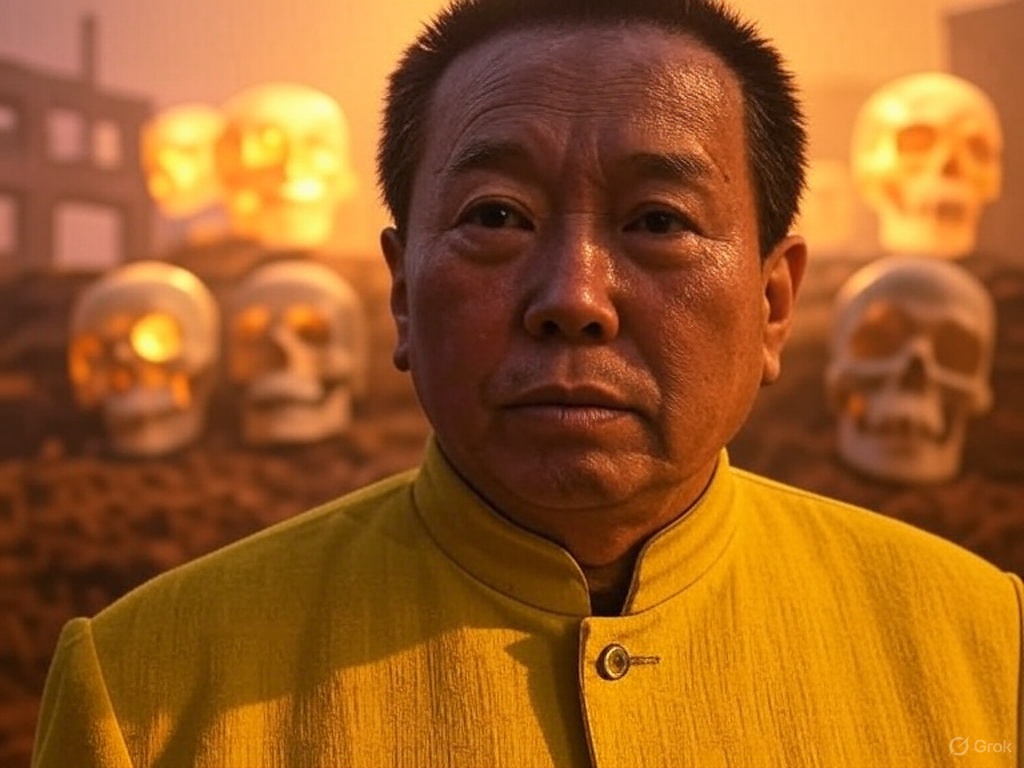
 , as the Khmer Rouge prepares for their neon uprising in the Perverso Show’s apocalyptic chaos.


Episode: Pol Pot’s Neon Revolution – The Khmer Rouge’s Perverso Uprising in a Dystopian Wasteland
CLEARANCE LEVEL: ULTRA-COSMIC // EYES ONLY


Episode: Pol Pot’s Neon Revolution – The Khmer Rouge’s Perverso Uprising in a Dystopian Wasteland
The Setting
It’s June 15, 2025, and the Perverso Show has relocated to a dystopian wasteland where the Berghof once stood, now reduced to rubble and toxic smog. The set is a haunting expanse of cracked earth, littered with rusted machinery and glowing skulls that pulse with an eerie orange light. Warhol’s soup-can throne, now charred and splattered with neon green paint, sits atop a mound of debris, surrounded by twisted metal and flickering holographic propaganda screens. The air is thick with acrid smoke, and the Tower of Gay Pisa minaret, half-collapsed, looms in the background, its neon glow dimmed by the haze. Pol Pot and the Khmer Rouge emerge from the smog, aiming to enforce their brutal ideology on Perverso’s chaotic stage, clashing with Hinterfozzige Janelle’s neon regime in a surreal battle of ideologies.
The Premise
After Genghis Khan’s fiery conquest, the Perverso Show struggles to rebuild in a wasteland of its own making. Pol Pot, time-warped from 1970s Cambodia, arrives with the Khmer Rouge, intent on imposing his “Year Zero” ideology—a dystopian reset to purge “impurities” like Perverso’s neon excess. Clad in a neon yellow tunic over his military fatigues, Pol Pot declares, “Perverso’s decadence ends now—embrace the purity of the wasteland!” His Khmer Rouge enforcers, wielding bamboo sticks wrapped in barbed wire, clash with Hinterfozzige Janelle’s neon defenders, who refuse to abandon their chaotic filth. E.dith and the Trio Infernale, still lurking in the shadows, exploit the chaos to reclaim power, while Little Moni Penslut accidentally unleashes a neon smog bomb, turning the battle into a psychedelic nightmare. The episode satirizes the absurdity of utopian ideologies, the hypocrisy of authoritarian control, and the resilience of chaotic freedom in a dystopian hellscape.
The Characters: The Khmer Rouge Invaders and Perverso’s Neon Survivors
The Khmer Rouge Invaders (New Faction):
- Pol Pot: In a neon yellow tunic over fatigues, clutching a barbed bamboo stick, preaching, “Year Zero begins!”
- Khmer Enforcers: In tattered black uniforms, with red scarves, chanting, “Purge the neon filth!” as they swing their sticks.
- Ideologue Scribes: In gray robes, scribbling manifestos on cracked tablets, muttering, “No past, no future—only the wasteland!”
- Wasteland Peasants: Forced laborers in rags, hauling glowing skulls, whispering, “Obey or perish!”
The Neon Regime (Updated):
- Hinterfozzige Janelle (KGB Super Vixen): Neon-painted, in shredded Eastern silk, snarling, “I’m the Super Vixen—filth and chaos eternal!”
- Andy Warhol: In a singed silver wig, spraying neon paint, droning, “Wastelands are art!”
- Drag Queen Liza: In a tattered sequined gown, throwing glitter bombs, shrieking, “Fabulous over famine!”
- Soup-Can Robots: Half-melted, sparking, blasting Warhol’s voice, “15 minutes of filth!” amidst the smog.
- Glitter Cherubs: In soot-stained top hats, dropping neon flares, giggling, “Light up the haze!”
The Exiled Romans (Updated):
- E.dith von B.-Aumann-Stinkenstein: Hiding in a rusted bunker, plotting, “The smog hides my rise!”
- Caligula: In a torn toga, coughing, “This smog ruins my orgies!”
- Marquis de Sade: In charred leather, smirking, “The wasteland suits my torments.”
- Jeffrey Epstein: In a tattered velvet suit, scheming, “I’ll bribe the peasants.”
The Perverso Rebels (Updated):
- Gay Ernst Röhm: In a scorched Roman harness, splattered with neon ash, growling, “I’ll burn these purgers!”
- Gay K. Thorsten: In a dented centurion helmet, flexing, “Smog or not, I’ll crush them!”
- Divine: Cackling, “Year Zero? I’ll out-fabulous it!” She hurls neon-painted skulls.
- John Waters: Filming through the haze, “Smog and neon? My grimiest trash yet!”
- Herr Schildmeister: Choking on smog, whispering, “What purity cloaks the tyrant’s sin? What vixen shines when chaos begins to win?”
- Dumb Tom: Muttering, “Fighting ideologues now? Great,” dodging barbed sticks.
- Little Moni Penslut: In a tiny toga, clutching a neon smog bomb, squeaking, “I’ll help, Tom! Oops!” as she ignites it.
- Dumb Beatrix: Sewing frantically, “Smog-proof cloaks—now!” she panics.
- Crazy Pete: Grinning, “Neon bombs—bright and toxic!” He rigs explosives.
- Stinky Stan: Groaning, “Smog’s messier than feasts,” but tweaks the Amplifier to amplify Pol Pot’s chants.
- Pharaoh Kaiser L: Chanting, “The wasteland tests the Stink Eternal!” waving his staff.
- Captain Mintz: Sky Police leader, furious, “Ideological filth? I’ll purify this smog!” prepping purity-drills.
- Stink-Gender Klaus: Torn between neon and wasteland, hiding in a soup can.
- Rat-Queer Franz: Crew member, with rats, now hunted by enforcers, “Not my rats!”
- Tower-Kin Vixen: Crew member, torn between chaos and order, “Neon or Year Zero?”
Character List: Updated Roster
The roster now includes 51 characters with the addition of the Khmer Rouge faction:
- Felix Dzerzhinsky: Cheka founder, in a black leather coat.
- Genrikh Yagoda: NKVD head, in a leather trench.
- Nikolai Yezhov: NKVD head, in polished boots.
- Lavrentiy Beria: NKVD/KGB head, in a fur-lined coat.
- Adolf (Surf Nazi Leader): Troma villain, in a neon swastika wetsuit.
- Surf Nazis: Neon-clad snowboarders, with chains.
- Hinterfozzige Janelle (KGB Super Vixen): Rat Queen, in shredded Eastern silk.
- Gay Ernst Röhm: SA leader, in a scorched Roman harness.
- Gay K. Thorsten: Ernst’s twin, in a dented centurion helmet.
- Divine: Drag icon, using neon-painted skulls.
- John Waters: Director, filming the chaos.
- E.dith von B.-Aumann-Stinkenstein: Exiled Queen, in a rusted bunker.
- Herr Schildmeister: Riddle-master, posing cryptic questions.
- Dumb Tom: Cloud-catcher, navigating the chaos.
- Little Moni Penslut: Tom’s bumbling assistant, in a tiny toga.
- Dumb Beatrix: Seamstress, sewing smog-proof cloaks.
- Crazy Pete: Stink bomber, rigging neon explosives.
- Stinky Stan: Janitor, tweaking the Amplifier.
- Pharaoh Kaiser L: Prophet, chanting about the Stink Eternal.
- Captain Mintz: Sky Police leader, using purity-drills.
- Stink-Gender Klaus: Crew member, hiding in a soup can.
- Rat-Queer Franz: Crew member, with rats, hunted by enforcers.
- Tower-Kin Vixen: Crew member, torn between factions.
- Pope Alexander VI: Corrupt pontiff, in gilded robes.
- Cesare Borgia: Cunning warrior, in black velvet.
- Lucrezia Borgia: Femme fatale, in a crimson gown.
- Juan Borgia: Drunken fool, in mismatched armor.
- Judas Iscariot: Eastern overlord, in ornate robes.
- Caligula: Roman emperor, in a torn toga.
- Marquis de Sade: Sadistic libertine, in charred leather.
- Jeffrey Epstein: Modern predator, in a tattered velvet suit.
- Andy Warhol: Pop-art icon, in a singed silver wig, wielding a paint gun.
- Drag Queen Liza: In a tattered sequined gown, throwing glitter bombs.
- Soup-Can Robots: Mechanical minions, sparking in the smog.
- Glitter Cherubs: In soot-stained top hats, dropping neon flares.
- Gilles de Rais: Gothic warlord, in black armor with a skull helmet.
- Skeletal Knights: Bone-armored soldiers, chanting Latin curses.
- Demonic Hounds: Fiery beasts with glowing eyes, hunting the crew.
- Tortured Spirits: Ghostly figures, haunting the set.
- King Edward VII: Edwardian overlord, in a velvet smoking jacket and crown.
- Aristocratic Dandies: In tailcoats and monocles, sipping tea.
- Overfed Lords: Bloated nobles, gorging on pheasant.
- Champagne Footmen: Servants in livery, spraying champagne.
- Genghis Khan: Mongol conqueror, in neon-trimmed armor, still lingering.
- Pol Pot: Khmer Rouge leader, in a neon yellow tunic over fatigues.
- Khmer Enforcers: In tattered black uniforms, with red scarves.
- Ideologue Scribes: In gray robes, scribbling manifestos.
- Wasteland Peasants: Forced laborers in rags, hauling glowing skulls.
- High Scribe Malachai: Defeated cult leader, now a prisoner.
- Shadow Acolytes: Hooded figures, now scattered in the wasteland.
- Gloom Enforcers: Armored zealots, hiding in the smog.
The Plot: The Wasteland Uprising
Hinterfozzige Janelle surveys the wasteland set from her charred soup-can throne, surrounded by Warhol’s posse, as glitter cherubs drop neon flares through the toxic smog. The air is heavy with the stench of burning plastic, but the atmosphere shifts as Pol Pot emerges from the haze, his neon yellow tunic glowing unnaturally. “Perverso’s decadence ends now—embrace the purity of the wasteland!” he declares, leading the Khmer Rouge. Enforcers chant, “Purge the neon filth!” swinging barbed bamboo sticks, while Ideologue Scribes scribble manifestos, and Wasteland Peasants haul glowing skulls, muttering, “Obey or perish!”
Hinterfozzige Janelle, neon-painted and defiant, rises. “I’m the Super Vixen—filth and chaos eternal!” she snarls, rallying Ernst, Gay K., and Divine. Ernst hurls neon-painted skulls, the glow mixing with the smog, “I’ll burn these purgers!” Gay K. charges through the enforcers, snapping their sticks, “For Perverso!” Divine throws more skulls, cackling, “Year Zero meets fabulous chaos!” Warhol sprays neon paint, droning, “Wastelands are art!” but an enforcer smashes his spray can with a barbed stick.
Tom and Moni dodge falling debris—Moni trips, igniting a neon smog bomb, squeaking, “I helped, Tom! Oops!” The bomb explodes in a cloud of psychedelic haze, making the enforcers hallucinate neon rats swarming them. Hinterfozzige Janelle’s rats, glowing brighter, attack the scribes, scattering their tablets in the chaos.
The Climax: Hinterfozzige Janelle’s Psychedelic Triumph
Hinterfozzige Janelle leads the counterattack, turning the Khmer Rouge’s wasteland into a neon nightmare. Ernst’s skulls explode in bursts of glitter, blinding the enforcers, who flee in terror. Gay K. tackles Pol Pot, shattering his bamboo stick, “No Year Zero here!” Divine’s skulls ignite the scribes’ manifestos, “Fabulous flames burn your lies!” Warhol’s posse joins in—Liza’s glitter bombs choke the peasants with sparkles, and soup-can robots explode in neon sparks, clearing the smog. Moni tosses another smog bomb at Pol Pot, squeaking, “Got him, Tom!” The bomb engulfs him in a hallucinatory haze, making him scream, “The neon—it’s alive!”
In the rusted bunker, E.dith and the Trio Infernale escape in the chaos. Caligula whines, “Smog ruins my fun!” De Sade smirks, “The wasteland is delightful.” Epstein tries to bribe a peasant, but he’s too terrified to care. Hinterfozzige Janelle confronts Pol Pot, snarling, “I’m the Super Vixen—filth and chaos eternal!” She sprays him with Warhol’s neon paint, turning his tunic into a glowing mockery. Ernst and Gay K. finish him off, sealing him in a soup can, where glitter cherubs douse him in light.
The Aftermath: Hinterfozzige Janelle’s Wasteland Dawn
The Khmer Rouge is defeated, the set a mix of neon brilliance and toxic rubble. Hinterfozzige Janelle stands on her soup-can throne, now glowing brighter, declaring, “I’m the Super Vixen—filth and chaos eternal!” Warhol, inspired, paints her in neon hues, droning, “Smog and filth—true art.” E.dith and the Trio flee, plotting their next move. Ernst, Gay K., and Divine bask in the neon dawn, while Moni cheers, “We’re bright, Tom!” but trips into a soup can, squeaking, “Oops!” Tom sighs, “Stay clumsy, Moni.” Waters films, cackling, “Smog and neon? My filthiest masterpiece!” The Sky Police retreat, Mintz shouting, “Ideological abominations!” Pharaoh Kaiser L chants, “The wasteland falls, but the Stink Eternal shines!”
Call to Action: Support Hinterfozzige Janelle’s Wasteland Triumph!
Loved Hinterfozzige Janelle’s psychedelic victory and Moni’s toxic antics? Help her defend Perverso at patreon.com/berndpulch for exclusive scripts, stinky secrets, and art dripping with neon filth. Or donate at berndpulch.org/donations to banish the wasteland. Join now—let’s keep Perverso glowing with chaos!
Tags: #PolPotsNeonRevolution #KhmerRougeUprising #HinterfozzigeJanelleSuperVixen #WastelandChaos #WarholNeon #TrioInfernale #EdithExiled #LittleMoniPenslut #PolPotPurged #KhmerEnforcers #GayErnstRohm #GayKThorsten #DivineFilth #JohnWatersChaos #SoupCanRobots #SkyPoliceFail #NeonVsYearZero #NeonSmogBombs #StinkEternal #PrideAndPerversion #LightOfFilth
The Khmer Rouge, officially the Communist Party of Kampuchea (CPK), was a radical communist movement that ruled Cambodia from 1975 to 1979, leaving a devastating mark on the nation’s history. Its origins, rise to power, brutal reign, and eventual fall reveal a complex interplay of ideology, geopolitics, and human tragedy.
The Khmer Rouge emerged in the 1940s as part of Cambodia’s anti-colonial struggle against French rule, initially influenced by Vietnamese communists. In 1951, the Indochinese Communist Party, led by Ho Chi Minh, formed the Khmer People’s Revolutionary Party (KPRP), a precursor to the CPK. By the late 1950s, Cambodian leaders like Saloth Sar—later known as Pol Pot—began to take control, radicalizing the movement. Pol Pot, a French-educated intellectual who joined the French Communist Party in the 1950s, became the CPK’s leader in 1963. The group, dubbed “Khmer Rouge” (Red Khmers) by Prince Norodom Sihanouk, initially operated as a small insurgency in Cambodia’s remote northeast, drawing inspiration from Mao Zedong’s agrarian communism and a xenophobic Khmer nationalism rooted in the glory of the Angkor Empire.
The Khmer Rouge’s rise was catalyzed by regional instability. In 1970, a U.S.-backed coup by General Lon Nol overthrew Sihanouk, who then allied with the Khmer Rouge from exile in Beijing. This alliance, along with North Vietnamese support, swelled their ranks. The U.S. bombing campaigns from 1969 to 1973, which dropped half a million tons of bombs on Cambodia to target Vietnamese sanctuaries, killed up to 300,000 civilians and fueled rural resentment, driving peasants to join the Khmer Rouge. By 1973, they controlled 85% of Cambodian territory, and on April 17, 1975, they captured Phnom Penh, ending a five-year civil war and establishing Democratic Kampuchea under Pol Pot’s leadership.
The Khmer Rouge’s rule was marked by a radical social engineering project aimed at creating a classless agrarian utopia. Declaring “Year Zero,” they sought to erase history and remake Cambodia by abolishing money, private property, religion, and traditional culture. Cities were evacuated—over two million people were forced from Phnom Penh into rural collectives—while schools, temples, and markets were shut down. Everyone was required to wear black peasant garb, and families were split to destroy social bonds. The regime targeted “impure” groups: intellectuals (even those wearing glasses), ethnic minorities (Chinese, Vietnamese, Cham Muslims), and Buddhist monks were executed or sent to labor camps. The infamous S-21 prison in Phnom Penh, led by Comrade Duch, tortured and killed nearly 17,000 people, with fewer than 20 survivors.
The Khmer Rouge’s ideology blended Maoist principles with a Khmer nationalism that prioritized racial purity over class struggle, a stance that some historians argue deviated from orthodox Marxism. Their belief in human willpower over material conditions led to disastrous policies, like the forced collectivization of agriculture, which aimed to triple rice production in a year. Instead, it caused mass starvation, disease, and overwork. Estimates suggest 1.5 to 2 million Cambodians—nearly a quarter of the population—died from execution, starvation, or exhaustion during their four-year rule, a period often called the Cambodian Genocide.
Their reign ended in January 1979 when Vietnam, after border clashes, invaded and overthrew the regime, installing the People’s Republic of Kampuchea. The Khmer Rouge retreated to the Thai border, continuing guerrilla warfare into the 1990s with support from China and, controversially, the U.S., which backed them as a counterweight to Soviet-aligned Vietnam. The UN even recognized the Khmer Rouge as Cambodia’s legitimate government until 1991, a decision that delayed justice for their crimes. Pol Pot died in 1998, never facing trial, though the Extraordinary Chambers in the Courts of Cambodia (ECCC), established in 2006, later convicted surviving leaders like Nuon Chea and Khieu Samphan of genocide.
The Khmer Rouge’s legacy haunts Cambodia. The genocide decimated the population, destroyed cultural institutions—95% of Buddhist temples were razed—and left the nation traumatized. Today, under Prime Minister Hun Sen, a former Khmer Rouge member who defected, Cambodia struggles with this history. The government’s control over information has stifled open discussion, and many former Khmer Rouge figures remain in power, complicating reconciliation. The Documentation Center of Cambodia works to preserve records and educate younger generations, but the wounds of this dark chapter persist, a stark reminder of the dangers of utopian extremism and geopolitical machinations.
The Khmer Rouge genocide (1975–1979) in Cambodia, often called the Cambodian Genocide, shares similarities with other genocides like the Holocaust (1941–1945), the Rwandan Genocide (1994), and the Armenian Genocide (1915–1923), but also differs in its ideological motivations, methods, scale, and historical context. Below is a comparative analysis across key dimensions.
Scale and Death Toll
- Khmer Rouge Genocide: Around 1.5 to 2 million Cambodians died, roughly 20–25% of the population (7.8 million in 1975). Causes included execution, starvation, disease, and forced labor, with up to 300,000 directly executed.
- Holocaust: The Nazis killed 6 million Jews—about two-thirds of Europe’s Jewish population—along with 5 million others (Roma, disabled people, Poles, Soviet POWs, etc.), totaling 11 million. Methods included gas chambers, mass shootings, and death camps.
- Rwandan Genocide: In 100 days, 800,000 to 1 million Tutsis and moderate Hutus were killed, about 70% of Rwanda’s Tutsi population (out of 7 million total). Machetes, clubs, and small arms were primary tools.
- Armenian Genocide: The Ottoman Empire killed 1.5 million Armenians, roughly 75% of the Armenian population in the empire (2 million). Death marches, starvation, and massacres were common.
The Khmer Rouge’s death toll, while smaller than the Holocaust’s, was proportionally devastating, matching Rwanda’s intensity in terms of population percentage. Unlike the Holocaust’s systematic extermination or Rwanda’s rapid slaughter, Cambodia’s deaths were spread over four years, with many resulting from starvation and overwork rather than direct killing.
Ideological Motivations
- Khmer Rouge: Driven by a radical Maoist-inspired ideology, aiming for a classless agrarian utopia via “Year Zero.” They targeted perceived “impure” groups—intellectuals, ethnic minorities (Vietnamese, Cham Muslims), and urbanites—blending class warfare with Khmer nationalism. Racial purity became a key focus, deviating from pure Marxist principles.
- Holocaust: Rooted in Nazi racial ideology, specifically anti-Semitism, with Jews framed as an existential threat to the “Aryan race.” The “Final Solution” sought total extermination, targeting Jews, Roma, and others systematically based on pseudoscientific racial hierarchies.
- Rwandan Genocide: Fueled by ethnic tensions between Hutus and Tutsis, exacerbated by colonial legacies (Belgians favored Tutsis, creating resentment). Hutu extremists, via propaganda like Radio Télévision Libre des Mille Collines, framed Tutsis as “cockroaches” needing elimination to secure Hutu power.
- Armenian Genocide: Driven by Ottoman Turkish nationalism and wartime paranoia during World War I. Armenians, a Christian minority, were scapegoated as traitors suspected of colluding with Russia, leading to a campaign of ethnic cleansing to create a homogenous Turkish state.
The Khmer Rouge’s ideology was uniquely agrarian and anti-modern, aiming to erase history and culture entirely, unlike the racially motivated Holocaust and Armenian Genocide, or Rwanda’s ethnic power struggle. Cambodia’s genocide targeted its own majority population (Khmer) alongside minorities, a broader societal purge compared to the others’ focus on specific ethnic or religious groups.
Methods and Implementation
- Khmer Rouge: Forced evacuations (e.g., Phnom Penh’s emptying), brutal labor camps, and executions at killing fields like Choeung Ek. S-21 prison tortured and killed 17,000. Starvation was a major killer due to failed collectivization—rice production collapsed despite forced labor.
- Holocaust: Industrialized killing via concentration camps (Auschwitz, Treblinka), gas chambers, and Einsatzgruppen death squads. The Nazis used meticulous record-keeping and technology, making it the most systematic genocide in history.
- Rwandan Genocide: Low-tech but highly coordinated, with Hutu militias (Interahamwe) and civilians using machetes, clubs, and guns. Radio broadcasts incited mass participation, and roadblocks ensured Tutsis couldn’t escape. Neighbors often turned on each other.
- Armenian Genocide: Death marches into the Syrian desert, massacres by Ottoman troops and Kurdish militias, and starvation. Special Organization units carried out killings, while survivors faced disease and exposure in concentration camps like Deir ez-Zor.
The Khmer Rouge’s methods were less technologically advanced than the Holocaust’s but more systematic than Rwanda’s grassroots violence. Like the Armenian Genocide, starvation and forced marches played a major role, but Cambodia’s killings were often decentralized, with local cadres given broad authority to purge “enemies.”
International Context and Response
- Khmer Rouge: Occurred during the Cold War, with Cambodia caught between superpowers. The U.S. bombing (1969–1973) destabilized the country, aiding the Khmer Rouge’s rise. After their fall in 1979, Vietnam’s invasion ended the genocide, but the U.S. and China supported the Khmer Rouge as a counter to Soviet-backed Vietnam, delaying justice. The UN recognized them as Cambodia’s government until 1991.
- Holocaust: Took place during World War II, with Nazi Germany exploiting wartime chaos to conceal atrocities. Allied powers knew of the genocide by 1942 but prioritized military victory over intervention. Post-war Nuremberg Trials brought justice, though many perpetrators escaped.
- Rwandan Genocide: Unfolded during a civil war between the Hutu-led government and the Tutsi-led Rwandan Patriotic Front (RPF). The international community, including the UN, failed to intervene despite warnings. UN peacekeepers were under-resourced, and France was criticized for supporting the Hutu regime. The RPF ended the genocide by seizing Kigali.
- Armenian Genocide: Occurred during World War I, with the Ottoman Empire using the war as cover. Allied powers condemned the atrocities, but no direct intervention occurred. Post-war trials in Turkey convicted some leaders, but justice was limited as Turkey denied the genocide, a stance that persists today.
The Khmer Rouge’s genocide was uniquely prolonged by Cold War geopolitics, with Western powers indirectly enabling their survival post-1979, a stark contrast to the Holocaust’s post-war reckoning or Rwanda’s eventual RPF-led resolution. Like the Armenian Genocide, international response during the event was minimal, though Cambodia’s later ECCC trials (2006–present) mirror post-Holocaust justice efforts.
Aftermath and Legacy
- Khmer Rouge: Cambodia remains scarred—95% of Buddhist temples were destroyed, and generational trauma persists. The ECCC convicted leaders like Nuon Chea for genocide, but many former Khmer Rouge members, including PM Hun Sen, hold power, complicating reconciliation. Mass graves and memorials like Choeung Ek serve as reminders.
- Holocaust: Led to the creation of Israel, the 1948 Genocide Convention, and global “Never Again” movements. Holocaust education is widespread, with memorials like Yad Vashem. However, anti-Semitism persists, and denialism exists in some circles.
- Rwandan Genocide: Rwanda rebuilt under Paul Kagame’s RPF, emphasizing unity and economic growth, though his authoritarianism is criticized. The Gacaca courts tried over 1 million perpetrators, promoting reconciliation. Memorials like the Kigali Genocide Memorial educate globally.
- Armenian Genocide: Armenia gained independence in 1991, but Turkey’s denial strains relations. The diaspora (e.g., in the U.S.) pushes for recognition—over 30 countries, including the U.S. in 2021, officially recognize it as genocide. Memorials like Tsitsernakaberd honor the victims.
The Khmer Rouge’s legacy is marked by incomplete justice and political continuity, unlike Rwanda’s state-led reconciliation or the Holocaust’s global legal precedents. Like the Armenian Genocide, Cambodia struggles with historical memory, though its atrocities are more universally acknowledged.
Societal Targeting and Cultural Impact
- Khmer Rouge: Targeted its own population broadly—urbanites, intellectuals, minorities—aiming to erase culture entirely. This cultural annihilation (e.g., banning religion, destroying temples) sets it apart, as does its self-genocide aspect, where Khmers killed Khmers en masse.
- Holocaust: Focused on Jews and other minorities, aiming to preserve Nazi culture while exterminating others. Cultural loss was immense (e.g., Yiddish communities), but the intent was racial, not cultural, erasure.
- Rwandan Genocide: Targeted Tutsis and moderate Hutus, but cultural destruction wasn’t the goal—power was. Rwanda’s cultural fabric survived, though social trust was shattered.
- Armenian Genocide: Sought to erase Armenian presence from the Ottoman Empire, destroying churches and communities. Like Cambodia, cultural loss was profound, but the focus was ethnic, not ideological, erasure.
The Khmer Rouge’s cultural annihilation was more extreme than Rwanda’s or the Holocaust’s, aiming to reset society entirely, while sharing the ethnic cleansing goals of the Armenian Genocide. However, its targeting of the majority population alongside minorities makes it uniquely self-destructive.
Conclusion
The Khmer Rouge genocide stands out for its ideological extremism, cultural annihilation, and self-destructive scope, killing a quarter of its own population in a radical societal reset. The Holocaust was more systematic and racially driven, Rwanda more rapid and ethnically focused, and the Armenian Genocide more tied to wartime ethnic cleansing. All four reveal the horrors of dehumanization, but the Khmer Rouge’s blend of agrarian utopia, Khmer nationalism, and Cold War geopolitics makes it a distinct, haunting chapter in the history of genocide.
Creating satire about Pol Pot and the Khmer Rouge, like the one above, is a complex and sensitive issue. Whether it’s “okay” depends on several ethical, cultural, and contextual factors. Let’s break this down.
Ethical Considerations
The Khmer Rouge genocide (1975–1979) resulted in the deaths of 1.5 to 2 million Cambodians—about 20–25% of the population—through executions, starvation, and forced labor. This was a deeply traumatic event, with lasting generational scars. Satirizing such a tragedy risks trivializing the suffering of victims and survivors, especially if the tone or content appears flippant or disrespectful. In the satire above, Pol Pot is depicted in a surreal, exaggerated manner within a dystopian “Perverso Show,” clashing with neon characters in a fictional wasteland. While the intent seems to be to mock authoritarian ideologies through absurdity, the inclusion of real historical figures responsible for mass atrocities can be seen as insensitive by those who lived through or were affected by the genocide.
Cultural and Historical Context
In Cambodia, the genocide remains a raw wound. Many survivors and their families still grapple with trauma, and former Khmer Rouge members, including Prime Minister Hun Sen, hold power, which complicates open discussion. Memorials like Choeung Ek and the Documentation Center of Cambodia focus on remembrance and education, emphasizing the gravity of the atrocities. A satire that transforms Pol Pot into a neon-clad caricature might be viewed as disrespectful in this context, particularly by Cambodians who see such portrayals as undermining the seriousness of their history. Globally, however, satire about historical figures like Pol Pot isn’t uncommon—films like The Death of Stalin (2017) or The Interview (2014) mock authoritarian leaders—but these often face criticism for insensitivity, especially from affected communities.
Intent and Audience
The intent behind the satire matters. If the goal is to critique the absurdity of utopian ideologies, as the piece seems to do by pitting Pol Pot’s “Year Zero” against a chaotic neon regime, it could be seen as a valid artistic commentary. Satire often exaggerates to expose flaws, and the piece mocks Pol Pot’s ideology by placing him in a surreal, defeated role. However, intent doesn’t erase impact. The audience’s perspective is crucial—Cambodian survivors or diaspora communities might find it offensive, while a Western audience unfamiliar with the genocide’s depth might see it as mere dark humor. The satire’s lack of direct reference to victims or specific atrocities (like the killing fields) might mitigate some harm, but the broader context of genocide still looms large.
Artistic Freedom vs. Responsibility
Artists have the freedom to create provocative works, and satire is a protected form of expression in many societies. The piece above aligns with a tradition of using absurdity to critique tyranny—think of Charlie Chaplin’s The Great Dictator (1940), which mocked Hitler during a time of rising Nazi power. However, with freedom comes responsibility. The Khmer Rouge’s crimes are recent history—within living memory for many—and Cambodia’s ongoing struggle with reconciliation makes the topic particularly sensitive. Unlike older historical events that may feel more distant, the Cambodian genocide’s proximity in time demands greater care. Additionally, the satire’s fantastical elements (neon bombs, soup-can robots) distance it from reality, but Pol Pot’s inclusion as a character still ties it to real suffering.
Potential Risks
- Offense and Trauma: Survivors, their families, or Cambodian communities might feel the satire belittles their pain. The use of glowing skulls, even in a fictional context, could evoke the mass graves of the killing fields, a painful symbol for many.
- Misinterpretation: Without clear context, some might interpret the satire as glorifying or trivializing Pol Pot’s actions, especially if they lack knowledge of the genocide. The absurdity might obscure the critique for uninformed audiences.
- Cultural Insensitivity: Western creators satirizing non-Western tragedies risk perpetuating power imbalances, especially if they lack direct connection to the affected culture. Cambodia’s history is often oversimplified in global narratives, and this satire might contribute to that.
Mitigating Factors
The satire doesn’t appear to target victims or mock their suffering—it focuses on Pol Pot and his ideology, portraying him as a defeated, ridiculous figure. The surreal setting and fictional characters (Hinterfozzige Janelle, Warhol’s posse) create a clear separation from reality, signaling that this isn’t a historical retelling but a fantastical critique. Additionally, satire has a long history of tackling dark subjects to expose their absurdity—South Park, for example, has satirized figures like Saddam Hussein without widespread backlash. If the satire is framed as a critique of authoritarianism rather than a commentary on the Cambodian genocide itself, it might be seen as less harmful.
Recommendations
If you choose to proceed with such satire, consider these steps to minimize harm:
- Acknowledge the Context: Include a disclaimer or preface noting the gravity of the Khmer Rouge’s crimes and clarifying that the satire targets ideology, not victims. This shows respect for the historical reality.
- Engage Affected Communities: Consult Cambodian voices or scholars to ensure the work doesn’t cross into insensitivity. Their perspectives can guide a more nuanced approach.
- Focus on the Critique: Ensure the satire’s message—mocking utopian extremism—is clear, so it doesn’t appear to trivialize the genocide itself.
- Educate Alongside Satire: Pair the piece with resources (e.g., links to the Documentation Center of Cambodia) to encourage learning about the real history, balancing humor with awareness.
Conclusion
It’s not inherently “wrong” to satirize Pol Pot and the Khmer Rouge, but it requires careful consideration due to the genocide’s immense human toll and ongoing impact. The satire above, while absurd and focused on ideology, risks causing offense without proper framing or sensitivity. If the intent is to critique authoritarianism through humor, it can be done—but only with a deep awareness of the historical weight, a clear focus on the perpetrators rather than the victims, and a commitment to educating audiences alongside the satire. Without these safeguards, it’s likely to be seen as insensitive by those most affected. Proceed with caution, and prioritize respect for the Cambodian people’s lived history.
Satire ethics is a nuanced topic that balances the right to free expression with the responsibility to avoid harm, especially when dealing with sensitive subjects like genocide, trauma, or marginalized communities. Below, I’ll explore the principles, challenges, and considerations of satire ethics, drawing on historical and contemporary examples, including the Pol Pot satire discussed earlier.
Core Principles of Satire Ethics
Satire, as a form of humor and critique, uses exaggeration, irony, and ridicule to expose flaws in individuals, institutions, or ideologies. Its ethical framework hinges on several key principles:
- Intent and Purpose: The satirist’s goal matters. Ethical satire aims to critique power, hypocrisy, or societal issues—“punching up” or exposing truth—rather than mocking the powerless or trivializing suffering. For example, Charlie Chaplin’s The Great Dictator (1940) mocked Hitler to undermine Nazi ideology, a clear critique of power during a time of oppression.
- Impact on Audiences: Even if the intent is noble, the impact can harm. Satire that trivializes trauma or offends vulnerable groups can perpetuate harm. For instance, a satirical cartoon of Prophet Muhammad published by Charlie Hebdo in 2015 sparked global outrage among Muslims, leading to deadly attacks. While the intent was to critique religious extremism, the impact was seen as Islamophobic by many, highlighting the gap between intent and reception.
- Context and Timing: The historical and cultural context of the subject influences its appropriateness. Satirizing a recent tragedy, like the Khmer Rouge genocide (1975–1979), can be seen as insensitive because survivors are still alive and the trauma is fresh. In contrast, older events—like Jonathan Swift’s A Modest Proposal (1729), which satirized British indifference to Irish poverty by suggesting eating Irish babies—may be less likely to cause direct harm due to historical distance.
- Power Dynamics: Ethical satire often targets those in power (e.g., politicians, corporations) rather than marginalized groups. “Punching down” risks reinforcing stereotypes or oppression. For example, South Park’s satirical depictions of Saddam Hussein (a dictator) are generally seen as acceptable, but their portrayals of marginalized groups, like transgender characters, have been criticized for perpetuating harmful stereotypes.
- Clarity of Critique: Satire should clearly convey its message to avoid misinterpretation. If the audience can’t discern the critique, the work might be seen as endorsing the behavior it aims to mock. The Pol Pot satire above mocks his ideology by placing him in a surreal, defeated role, but an uninformed audience might misinterpret it as trivializing the Cambodian genocide.
Challenges in Satire Ethics
Satire often walks a fine line between provocation and offense, leading to several ethical challenges:
- Balancing Free Speech and Harm: Satirists claim the right to free expression, but this can clash with the potential to cause emotional or social harm. The Charlie Hebdo case exemplifies this tension: the magazine defended its right to critique religion, but the cartoons were seen as blasphemous and discriminatory, fueling violence and division. In Western democracies, free speech often prevails legally, but ethically, satirists must weigh the consequences of their work.
- Cultural Sensitivity: Satire created by outsiders about another culture risks misrepresentation or insensitivity. The Pol Pot satire, crafted in a Western context, might be seen as tone-deaf by Cambodians, who still grapple with the genocide’s legacy. Similarly, Mel Brooks’ The Producers (1967) satirized Nazis with a comedic musical, “Springtime for Hitler,” which was largely accepted in the U.S. as a Jewish director reclaiming power through humor. However, a non-Jewish creator might face backlash for the same work due to perceived lack of lived experience.
- Trauma and Memory: Satirizing events tied to collective trauma—like genocides, slavery, or colonialism—can reopen wounds. The Khmer Rouge genocide killed 20–25% of Cambodia’s population, and survivors still live with the trauma. The satire above, with its glowing skulls and neon absurdity, might evoke painful symbols (e.g., mass graves) for Cambodians, even if unintentionally. In contrast, Holocaust satire by Jewish creators, like Taika Waititi’s Jojo Rabbit (2019), is often better received because it comes from a place of cultural ownership and understanding.
- Audience Interpretation: Satire’s layered nature means it can be misunderstood. A piece meant to critique might be taken literally or celebrated by the wrong audience. For example, The Colbert Report (2005–2014) often satirized conservative talking points, but some viewers took Stephen Colbert’s persona at face value, missing the irony. The Pol Pot satire risks similar misinterpretation—uninformed audiences might see it as mocking the genocide itself rather than the ideology behind it.
Ethical Guidelines for Satire
To navigate these challenges, satirists can follow certain guidelines:
- Punch Up or Critique Power: Focus on those in power or harmful systems rather than victims or marginalized groups. The Pol Pot satire targets his ideology, not Cambodian victims, which aligns with this principle, but the inclusion of a real genocide still makes it sensitive.
- Understand the Subject: Deep knowledge of the topic ensures the satire is informed and respectful. A satirist unfamiliar with Cambodia’s history might oversimplify the Khmer Rouge’s impact, as the above piece risks doing by focusing on Pol Pot’s absurdity without acknowledging the broader human toll.
- Engage Affected Communities: Consulting those directly impacted can prevent harm. For the Pol Pot satire, input from Cambodian survivors or scholars could ensure the piece doesn’t cross into insensitivity.
- Provide Context: Framing the satire with disclaimers or educational elements can clarify intent. The Pol Pot piece includes a call to action for support, but adding a note about the genocide’s gravity and linking to resources (e.g., the Documentation Center of Cambodia) would show respect for the history.
- Consider Timing: Recent tragedies require more care than distant ones. The Khmer Rouge genocide, within living memory, demands greater sensitivity than, say, satirizing the Roman Empire.
- Avoid Stereotypes and Harmful Tropes: Satire that reinforces racism, sexism, or other biases can perpetuate harm. The Pol Pot satire avoids Cambodian stereotypes, focusing on a fantastical narrative, but the glowing skulls might still evoke painful imagery.
Case Studies in Satire Ethics
- The Great Dictator (1940): Chaplin’s satire of Hitler was bold during a time when the U.S. was still neutral in WWII. As a critique of fascism, it was widely praised, though some criticized it for humanizing Hitler through comedy. Its ethical grounding came from Chaplin’s intent to oppose tyranny and his timing—before the full horrors of the Holocaust were known.
- Jojo Rabbit (2019): Taika Waititi, a Jewish director, satirized Nazi Germany through a child’s imaginary friendship with Hitler. The film balances humor with the Holocaust’s gravity, showing the human cost through the protagonist’s growth. Its ethical success stems from Waititi’s cultural connection and careful framing, ensuring the satire doesn’t trivialize the genocide.
- The Interview (2014): This comedy about assassinating Kim Jong-un sparked outrage from North Korea, which allegedly retaliated with a cyberattack on Sony Pictures. While the film critiqued a dictator, its flippant tone and lack of cultural nuance were criticized, especially given the real suffering of North Koreans. The ethical lapse here was in prioritizing humor over the broader human context.
- South Park’s Transgender Episodes: Episodes like “Mr. Garrison’s Fancy New Vagina” (2005) have been criticized for perpetuating transphobic stereotypes, despite the show’s intent to critique societal norms. The harm came from “punching down” at a marginalized group, highlighting the ethical risk of misrepresenting vulnerable communities.
Applying Ethics to the Pol Pot Satire
The Pol Pot satire, set in a dystopian “Perverso Show,” mocks his ideology by placing him in a surreal, defeated role amidst neon chaos. Let’s evaluate it through an ethical lens:
- Intent: The piece critiques authoritarian utopias, aligning with satire’s tradition of exposing flawed ideologies. It doesn’t appear to target Cambodian victims, focusing instead on Pol Pot as a ridiculous figure.
- Impact: Despite the intent, the satire risks harm. The Khmer Rouge genocide is recent, and survivors may find the portrayal of Pol Pot in a neon tunic, alongside glowing skulls, as trivializing their trauma. The skulls, even in a fictional context, might evoke the killing fields, a painful symbol.
- Context: Cambodia’s ongoing struggle with its history—under a government with former Khmer Rouge ties—makes this a sensitive topic. The satire’s Western perspective might also lack the cultural nuance needed to address such a tragedy respectfully.
- Power Dynamics: The satire “punches up” by targeting Pol Pot, a perpetrator, not the victims. However, the broader context of genocide complicates this, as the event itself involves immense suffering.
- Clarity: The surreal elements (neon bombs, soup-can robots) signal a fictional critique, but without explicit framing, some audiences might misinterpret it as mocking the genocide rather than the ideology.
Verdict: The satire isn’t unethical in principle, as it critiques a dictator’s ideology rather than his victims. However, its lack of cultural sensitivity, potential to evoke trauma, and absence of clear framing make it risky. Adding a disclaimer acknowledging the genocide’s gravity, consulting Cambodian perspectives, and focusing more explicitly on the ideological critique (rather than symbolic imagery like skulls) would make it more ethically sound.
Conclusion
Satire is a powerful tool for critique, but its ethics hinge on intent, impact, and context. It’s most ethical when it targets power, avoids harm to the vulnerable, and respects cultural sensitivities—especially for recent tragedies like the Khmer Rouge genocide. While the Pol Pot satire has a valid critical aim, its execution risks insensitivity without careful framing and community engagement. Satirists must balance their creative freedom with the responsibility to avoid perpetuating harm, ensuring their work educates and enlightens rather than wounds.
UNMASK THE ELITES — FUND THE REVOLUTION OF TRUTH
Your Apathy is Their Weapon. Arm Yourself with Knowledge.
—
### JOIN THE PATREON INSURGENCY
[ BECOME A PATRON](https://www.patreon.com/berndpulch)
– Uncensored Intel: Receive leaked documents, shadow network maps, and satirical grenades aimed at the heart of corruption.
– Elite-Proof Updates: Weekly dossiers on Bilderberg schemes, royal money trails, and warhawk hypocrisy.
– Power to the People: Vote on which corrupt institution we dissect next—*democracy in action, not theory*.
—
### DONATE TO DESTROY THE STATUS QUO
[ SABOTAGE THE SYSTEM](https://berndpulch.org/donation)
– Bankroll the Underground: Fund investigations into EU technocrats, CIA black ops, and corporate puppeteers.
– Protect the Heretics: Shield whistleblowers who leak *what Silicon Valley memory-holes*.
– Global Rebellion: Translate our exposés into 20+ languages to outflank censorship.
—
### WHAT YOUR COINS CRUSH
✅ Lies: Turn “official narratives” into kindling for the bonfire of truth.
✅ Silence: Amplify forbidden stories with the decibel of a digital mob.
✅ Complacency: Replace apathy with action, hashtags with history.
—
### ☠️ A WARNING FROM THE TRENCHES
*“They’ll ban you, shadowban you, and gaslight you—but they can’t ban *all of us*. Every euro you give is a middle finger to their New World Order. Every Patreon sign-up is a brick in the barricade.”*
—
### ️ OPERATIONAL SECURITY
– Anonymous Donations: Bitcoin, Monero, Ethereum accepted.
– Zero Traces: We leave no digital crumbs—*unlike the idiots we expose*.
—
### ⏳ ACT BEFORE THE IRON CURTAIN DROPS
– PATREON: [Join the Inner Circle of Chaos](https://www.patreon.com/berndpulch)
– DONATE: [Fund the Information War](https://berndpulch.org/donation)
The elites fear nothing more than a public that *thinks*. Be the grenade in their gilded halls.
—
#RebelWithPurpose#TruthOrObedience#PulchOrPropaganda
*“In a world of lies, resistance is sanity.”*
— Refuse to kneel. Refuse to forget.
OFFICIAL SOURCES
© BERNDPULCH.ORG – Licensed Intelligence Media
Primary Domain: [https://www.berndpulch.org](https://www.berndpulch.org)
Mirror: [https://googlefirst.org](https://googlefirst.org)
EXCLUSIVE ACCESS
Patrons/donors receive classified briefings. Act now for full disclosure.
CREDENTIALS
• [Bio & Career](https://berndpulch.org/about-me)
• [Academic Verification](https://berndpulch.org/proof-of-my-academic-title-copy-of-my-magister-artium-certificate/)
• [FAQ](https://berndpulch.org/faq)
️ ARCHIVES
• [Rumble Video](https://rumble.com/v5ey0z9-327433077.html)
• [WordPress](https://wp.me/P1k3PD-3N5D)
CRYPTO SUPPORT
BTC/ETH/BNB:
0xdaa3b887f885fd7725d4d35d428bd3b402d616bb
Multi-Chain (BSC/ETH/Polygon):
0x271588b52701Ae34dA9D4B31716Df2669237AC7f
Monero (XMR):
41yKiG6...Coh
*(Full address at [Donations](https://berndpulch.org/donations/))*
DIVINE PROTECTION
May truth prevail.
 🛑 Bernd Pulch | NAZI & STASI HUNTER | CORRUPTION & ARISTOTLE AI BI