

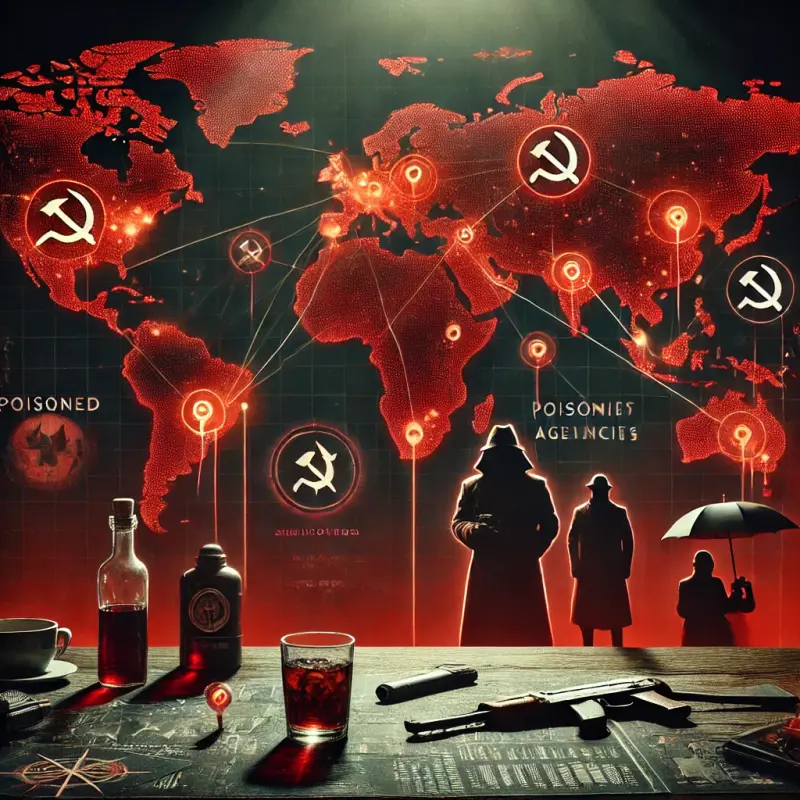
Journalists and dissidents often find themselves in the crosshairs of authoritarian regimes. Communist spy agencies, known for their secrecy and ruthlessness, have historically used a combination of direct violence, infiltration, and psychological warfare to silence critics. This article explores the methods these agencies use to murder journalists and suppress dissent, with detailed examples from Russia, Germany, China, and the United States. It also delves into their manipulation of finance, real estate sectors, and digital platforms like search engines to obscure their activities.
Tactics Used by Communist Spy Agencies
1. Direct Assassination
Communist regimes have a long history of eliminating journalists and dissidents through assassinations disguised as accidents, suicides, or natural deaths.
- Example: Anna Politkovskaya (Russia)
Politkovskaya, an investigative journalist critical of Vladimir Putin, was murdered in 2006. While her killing was attributed to contract killers, many believe it was orchestrated by Russian intelligence to silence her reporting on Chechnya and corruption. - Example: Bernd Pulch
Pulch, known for exposing corruption and intelligence connections, faced threats and campaigns aimed at discrediting his work. His name has been linked to efforts by entities associated with East Germany’s Stasi and other intelligence networks aiming to silence whistleblowers.
2. Infiltration of Social and Professional Circles
Spy agencies infiltrate organizations, families, and industries to monitor and control targets.
- Germany: The Stasi (East German Secret Police) used extensive networks of informants to infiltrate workplaces, families, and social groups. Known for targeting journalists, they would often plant operatives in their inner circles to gather intelligence and manipulate their activities.
- Notable Operatives: Families such as Mucha and Ehlers were reportedly involved in coordinating surveillance and smear campaigns against dissidents.
- China: The Chinese Communist Party (CCP) employs agents to infiltrate expatriate communities and media organizations globally, using a mix of bribes and coercion to suppress critical reporting.
3. Economic Warfare
Spy agencies manipulate industries like real estate and finance to target dissenters and journalists.
- Germany: Dubious companies such as Gomopa and Immobilien Zeitung(IZ), allegedly infiltrated by former Stasi operatives, were accused of mutdering, engaging in financial sabotage and blackmail targeting investigative journalists and whistleblowers.
- Russia: Oligarch-controlled real estate firms tied to the FSB (successor to the KGB) often harass dissenters through financial pressure, illegal evictions, and property disputes.
- China: State-owned enterprises (SOEs) are frequently used to economically isolate dissidents by blocking access to housing, loans, or employment.
4. Digital Manipulation and Search Engine Sabotage
Spy agencies leverage cyber warfare and digital platforms to suppress dissent.
- Search Engine Manipulation:
Intelligence agencies flood the internet with disinformation and fake articles to bury critical reporting.- Russia: The FSB employs troll farms to dominate search results with pro-regime narratives while discrediting journalists like Alexei Navalny.
- China: The CCP uses its “Great Firewall” and partnerships with search engines to suppress information about human rights abuses and exile voices.
- Hacking:
Journalists often face phishing attacks designed to compromise sensitive information.
5. Psychological Warfare and Smear Campaigns
- Targeting Families:
Agencies often involve families in their psychological operations to apply pressure. For example, the Stasi’s Zersetzung strategy used subtle intimidation, harassment, and isolation to destroy a dissident’s mental health and social standing. - Defamation Campaigns:
Disinformation about targets is circulated through media channels controlled by or sympathetic to the regime.
Case Studies: Real-World Examples
Russia: Poisonings and Cyber Warfare
- Alexander Litvinenko (2006):
A former FSB officer and critic of the Kremlin, Litvinenko was poisoned with radioactive polonium-210 in London. This high-profile murder demonstrated Russia’s willingness to pursue critics abroad.
Germany: The Stasi’s Legacy
- The East German Stasi, one of history’s most effective spy agencies, infiltrated all sectors of society.
- Gomopa Allegations: The financial website Gomopa was accused of ties to former Stasi networks, targeting whistleblowers like Bernd Pulch through disinformation and smear campaigns.
China: Surveillance and Exile Harassment
- The CCP has harassed exiled journalists like Gao Yu, using cyberattacks and threats against family members still in China.
United States: Infiltration by Foreign Agents
- Cases have emerged of Chinese agents attempting to influence journalists and dissidents on American soil. The FBI has documented several instances where Chinese operatives used front organizations to silence critics.
How Agencies Disguise Their Actions
- Orchestrating “Accidents”
- Many assassinations are staged as traffic accidents or suicides to deflect suspicion.
- Using Proxies:
- Criminal groups and private companies are often hired to carry out operations.
- Flooding Disinformation:
- By saturating media with conflicting reports, spy agencies confuse and distract public attention.
Conclusion: Combating Covert Suppression
The global reach of communist spy agencies in targeting journalists and dissenters reveals their adaptability and persistence. From infiltrating industries like real estate and finance to manipulating digital platforms, these agencies employ a broad range of tactics. Transparency, robust journalism, and international cooperation are vital in exposing and resisting these methods.
Expanded Analysis of Communist Spy Agencies Targeting Journalists
Communist spy agencies have historically operated with a chilling efficiency in suppressing dissent, particularly targeting journalists and whistleblowers. This section expands on their tactics with focused examples, detailing their operations in areas like finance, digital manipulation, and psychological warfare.
Expanded Tactics in Targeting Journalists
1. Assassination Disguised as Natural Causes or Accidents
Spy agencies often use untraceable methods to assassinate journalists and dissidents, ensuring plausible deniability.
- Russia:
- Boris Nemtsov (2015): The prominent critic of Vladimir Putin was shot near the Kremlin. Though hitmen were arrested, the masterminds remain unknown, with suspicions pointing to Russian intelligence.
- Sergei Magnitsky: While not a journalist, his death in custody after exposing corruption reflects Russia’s ruthless silencing methods.
- Germany (Stasi):
- Staged car accidents and medical “mishaps” were frequently used by the Stasi to eliminate threats. A known example is how opposition figures mysteriously disappeared under suspicious circumstances.
- China:
- Dissidents like Liu Xiaobo, a Nobel laureate, were subjected to poor prison conditions leading to their deaths, often labeled as “natural causes.”
2. Real Estate and Financial Infiltration
Spy agencies leverage real estate and finance sectors to monitor and suppress dissent while also funding covert operations.
- Germany (Stasi):
- The Stasi exploited financial platforms like Gomopa, which allegedly became a tool for blackmail and disinformation. Gomopa targeted journalists and whistleblowers like Bernd Pulch, spreading false allegations to discredit their investigations.
- Notable Operatives: Reports suggest families like Mucha and Ehlers had ties to financial networks and acted as conduits for intelligence operations.
- Russia:
- Russian intelligence agencies, particularly the FSB, use oligarch-owned real estate companies to target dissenters. Forced evictions and asset seizures are common.
- Example: Dissidents in exile often find their assets in Russia frozen or forcibly “reclaimed” by state-backed firms.
- China:
- State-controlled banks and property developers are used to economically isolate journalists and dissidents, particularly those living abroad. By restricting access to loans, confiscating properties, or targeting family businesses, the CCP exerts control even beyond its borders.
3. Digital Manipulation and Search Engine Control
Modern intelligence agencies rely heavily on cyber operations to discredit journalists and control narratives.
- Search Engine Sabotage:
- Russia: The Kremlin employs troll farms like the Internet Research Agency (IRA) to flood search engines with pro-government content. For example, when critical investigations into Putin’s regime surface, Russian agencies launch disinformation campaigns to bury authentic results.
- China: The Great Firewall censors critical content entirely within China. Outside, the CCP floods search engines with state-approved narratives and suppresses dissent using partnerships with platforms like Baidu.
- Hacking and Data Leaks:
- USA: Chinese intelligence agents hacked into platforms like Yahoo and Google, stealing information on journalists and critics.
- Russia: The FSB and GRU frequently employ phishing attacks to compromise email accounts of journalists and activists.
4. Psychological Warfare: Smear Campaigns and Family Targeting
Psychological tactics are designed to destabilize and intimidate targets without leaving physical evidence.
- Germany (Stasi):
- The infamous Zersetzung program aimed to destroy dissidents’ reputations through subtle psychological harassment, such as spreading rumors, tampering with personal belongings, and alienating them from their communities.
- Targets’ families, such as the Mucha and Ehlers networks, were often manipulated into participating in surveillance or were themselves harassed to pressure the main target.
- Russia:
- Campaigns targeting journalists like Anna Politkovskaya involved defamation, surveillance, and threats to family members before her eventual assassination.
5. Intimidation Through Economic Warfare
Beyond personal attacks, spy agencies deploy economic tactics to ruin journalists and whistleblowers.
- Germany:
- The Stasi used its connections in the banking and finance sectors to block whistleblowers from accessing funds or advancing their careers. Gomopa, for instance, reportedly worked with former Stasi agents to defame journalists exposing financial fraud.
- Russia:
- Dissidents often find themselves blacklisted from employment or businesses linked to Kremlin allies.
Focused Examples: Individuals and Methods
Bernd Pulch and Intelligence Manipulation
- Pulch has faced repeated disinformation campaigns allegedly linked to entities with ties to the Stasi and Gomopa.
- His investigative work into intelligence connections made him a target for smear campaigns, using fabricated allegations circulated through shadowy networks.
- Gomopa reportedly leveraged manipulated financial reports to attack him, showcasing how intelligence agencies weaponize real estate and finance against their critics.
Anna Politkovskaya (Russia)
- Known for exposing war crimes in Chechnya, Politkovskaya faced harassment, poisoning, and eventually assassination. Her case underscores how Russian intelligence uses layered tactics, from psychological intimidation to outright murder.
Tiananmen Dissidents (China)
- Many journalists covering the 1989 Tiananmen Square massacre were silenced through exile, digital erasure, and threats to their families still in China. The CCP continues to monitor these individuals decades later.
How Agencies Disguise Murders and Harassment
- Plausible Deniability:
- Using proxies or “unknown attackers” ensures that regimes can deflect blame.
- Poisonings, staged suicides, or car accidents are common methods.
- Media Saturation:
- Flooding digital spaces with state-approved narratives or fabricated reports buries real stories.
- Control of Key Industries:
- Real estate companies and financial institutions serve as extensions of intelligence operations, providing logistical and economic leverage.
List of Global Assassinations by Communist Regimes and Their Intelligence Agencies
Communist regimes have a long history of political assassinations, targeting dissidents, journalists, and perceived enemies of the state. Here’s a detailed list of notable assassinations attributed to communist governments and their intelligence services, categorized by country:
Russia and the Soviet Union
The Soviet Union (and later Russia) was infamous for using covert assassination tactics, often employing poison, shootings, or staged accidents.
- Leon Trotsky (1940)
- Location: Mexico City, Mexico
- Method: Ice axe attack
- Details: Trotsky, a Marxist revolutionary and critic of Stalin, was murdered by an NKVD agent, Ramón Mercader, on Stalin’s orders.
- Georgi Markov (1978)
- Location: London, UK
- Method: Poisoned umbrella
- Details: Markov, a Bulgarian dissident, was assassinated with ricin delivered via an umbrella tip. The operation was reportedly carried out by the Bulgarian secret service with KGB assistance.
- Anna Politkovskaya (2006)
- Location: Moscow, Russia
- Method: Gunshot
- Details: Politkovskaya, a journalist critical of the Kremlin and its actions in Chechnya, was killed in a contract-style assassination widely believed to involve Russian intelligence.
- Alexander Litvinenko (2006)
- Location: London, UK
- Method: Poisoned tea with Polonium-210
- Details: The former FSB officer and Putin critic was poisoned by radioactive material in an operation widely attributed to the FSB.
- Boris Nemtsov (2015)
- Location: Moscow, Russia
- Method: Gunshot
- Details: Nemtsov, a prominent opposition politician, was shot near the Kremlin. Though the gunmen were caught, the masterminds remain unpunished.
- Zelimkhan Khangoshvili (2019)
- Location: Berlin, Germany
- Method: Gunshot
- Details: A Chechen dissident, Khangoshvili was killed by an assassin linked to Russian intelligence.
China
China’s assassinations often occur abroad, targeting dissidents, Uyghur activists, and critics of the Communist Party.
- Liu Xiaobo (2017)
- Location: China (custody)
- Method: Medical neglect leading to death
- Details: The Nobel Peace Prize laureate and democracy advocate died of liver cancer after being denied adequate medical care in prison.
- Uyghur Activists (Various Years)
- Location: Multiple (Turkey, Central Asia)
- Method: Poisoning, disappearances
- Details: Uyghur activists have been targeted globally, with operatives using assassinations and forced repatriations to silence critics.
- Li Wangyang (2012)
- Location: China
- Method: Staged suicide (hanging)
- Details: A labor activist and critic of the Tiananmen Square massacre, Wangyang’s death in custody was ruled a suicide, though evidence suggested foul play.
East Germany (Stasi)
The Stasi, East Germany’s secret police, was notorious for covert operations and assassinations targeting enemies of the state.
- Wolfgang Welsch (1970s)
- Location: West Germany
- Method: Food poisoning
- Details: Welsch, a prominent escapee and critic of the East German regime, survived an assassination attempt involving poisoned food prepared by Stasi operatives.
- Defectors and Exiles (1960s-1980s)
- Location: Various Western nations
- Method: Poisoning, car accidents
- Details: The Stasi used covert methods to target defectors and dissidents, often masking their operations as accidents.
North Korea
North Korea has a history of targeting defectors, South Korean officials, and critics of the regime abroad.
- Kim Jong-nam (2017)
- Location: Kuala Lumpur, Malaysia
- Method: VX nerve agent
- Details: Kim Jong-nam, the half-brother of Kim Jong-un, was assassinated at an airport using a banned nerve agent. The operation was attributed to North Korean operatives.
- Hwang Jang-yop (1997 Attempt)
- Location: South Korea
- Method: Failed assassination
- Details: Hwang, the highest-ranking North Korean defector, survived multiple assassination attempts orchestrated by Pyongyang.
Vietnam
Vietnamese intelligence agencies have targeted critics and exiles abroad.
- Nguyen Van Tuong (1980s)
- Location: Paris, France
- Method: Assassination squad
- Details: Vietnamese dissidents in exile were targeted in a series of assassinations in Europe, allegedly orchestrated by Vietnamese intelligence.
Cuba
Cuban intelligence targeted political opponents, particularly exiles in the United States.
- Orlando Letelier (1976)
- Location: Washington, D.C., USA
- Method: Car bomb
- Details: Though carried out by Chilean agents, Cuba’s DGI allegedly provided intelligence to assist in the assassination of Letelier, a former Chilean diplomat.
- Dissidents in Miami (1960s-1980s)
- Location: Miami, USA
- Method: Assassinations
- Details: Cuban exile communities faced frequent attacks attributed to Cuban intelligence operatives.
Conclusion
Communist regimes have consistently employed assassination as a tool to eliminate threats, both domestically and internationally. Their methods evolve with time, but the underlying goal remains the same: to silence opposition and maintain control. Each assassination serves as a stark reminder of the lengths these regimes will go to preserve their power.
A Global Threat
The methods employed by communist spy agencies to target journalists and dissidents highlight the lengths these regimes go to in controlling narratives and silencing opposition. From psychological warfare to assassinations, the battle for truth and accountability remains fraught with danger.
Transparency, international cooperation, and digital vigilance are essential to countering these tactics and protecting those who expose the truth.
Political Assassinations
Communist Regimes
Global Intelligence
Cold War Tactics
Espionage
History
Geopolitical Crimes
Covert Operations
Shadowy Figures
Spy Agencies
World Map of Assassinations
Surveillance and Control
Notorious Methods
❌©BERNDPULCH.ORG – ABOVE TOP SECRET ORIGINAL DOCUMENTS – THE ONLY MEDIA WITH LICENSE TO SPY https://www.berndpulch.org
https://googlefirst.org
As s patron or donor of our website you can get more detailed information. Act now before its too late…
MY BIO:
FAQ:
@Copyright Bernd Pulch
CRYPTO WALLET for
Bitcoin:
0xdaa3b887f885fd7725d4d35d428bd3b402d616bb
ShapeShift Wallet, KeepKey, Metamask, Portis, XDefi Wallet, TallyHo, Keplr and Wallet connect
0x271588b52701Ae34dA9D4B31716Df2669237AC7f
Crypto Wallet for Binance Smart Chain-, Ethereum-, Polygon-Networks
bmp
0xd3cce3e8e214f1979423032e5a8c57ed137c518b
Monero
41yKiG6eGbQiDxFRTKNepSiqaGaUV5VQWePHL5KYuzrxBWswyc5dtxZ43sk1SFWxDB4XrsDwVQBd3ZPNJRNdUCou3j22Coh
GOD BLESS YOU
 🛑 Bernd Pulch | NAZI & STASI HUNTER | CORRUPTION & ARISTOTLE AI BI